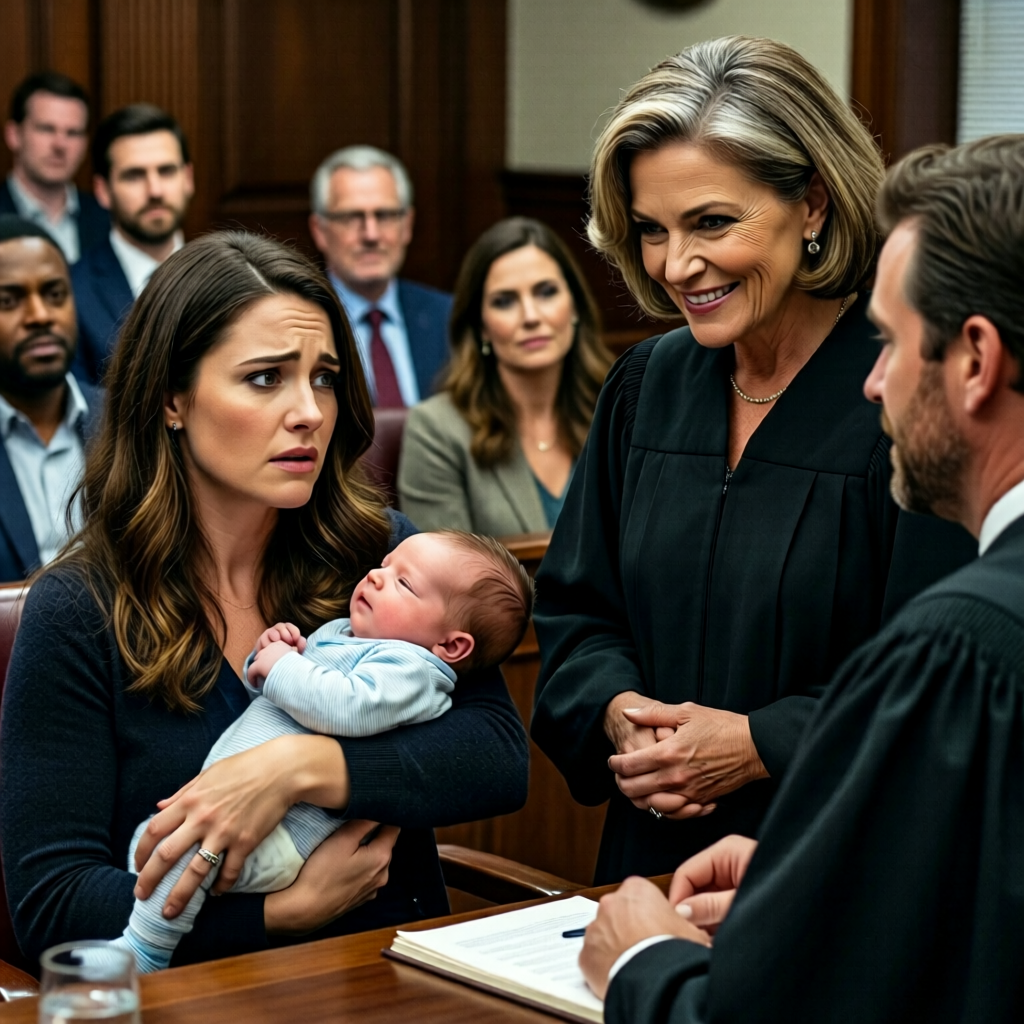
My newborn son, Daniel, was barely two weeks old.
My mother-in-law, Patricia, stood in my living room, clutching a silver rattle like it was a weapon.
Then she looked at me with eyes colder than ice and said, “If you can’t cope, Emily, we’ll take him.”
My world fractured.
Thomas, my husband, had been gone only a month.
A tragic accident, so sudden.
Now Patricia wanted my baby.
My heart hammered against my ribs.
I stared at her, speechless.
She saw my exhaustion.
She saw the dark circles under my eyes.
She saw a woman barely holding on.
And she used it against me.
“You’re overwhelmed, Emily,” she continued, her voice sharp.
“Anyone can see that.”
She gestured around the nursery, which was Thomas’s old office, now filled with tiny clothes.
“This isn’t a suitable environment.”
Mark, my father-in-law, stood quietly behind her.
His face was etched with a different kind of pain.
He didn’t meet my gaze.
He just shifted his weight, a silent bystander.
Daniel stirred in his bassinet.
A tiny whimper.
My instincts flared.
I felt a surge of protectiveness, hot and fierce.
“He is my son,” I finally managed, my voice shaking.
“And I *will* cope.”
Patricia simply arched an eyebrow.
“We shall see,” she murmured.
Then she turned and walked out, Mark following hesitantly behind her.
The door clicked shut.
Silence filled the room, heavy and suffocating.
I sank onto the glider, holding Daniel close.
Tears blurred my vision.
The past few weeks had been a blur of grief and exhaustion.
Thomas was gone.
My rock, my love.
And I was struggling.
Yes, I admit it.
The postpartum depression was a dark cloud over everything.
Some days, just getting out of bed felt impossible.
But Daniel was my light.
My reason to breathe.
My reason to fight.
I looked at his tiny, perfect face.
He was Thomas all over again.
A piece of my husband was still here.
I had promised Thomas I would be a good mother.
I would honor his memory.
I would make him proud.
But Patricia’s words echoed in my head.
*If you can’t cope, Emily, we’ll take him.*
That night, alone with Daniel, the weight of everything crashed down.
The nursery felt cozy, but also cavernous without Thomas.
I was a new mother, a widow, and now facing a battle for my child.
It was too much.
Yet, as Daniel slept peacefully, I made a vow.
I would not fail him.
I would find the strength somewhere.
This was only the beginning.
What I didn’t know was how far Patricia would go.
The next week, Patricia and Mark arrived unannounced again.
They brought documents.
Not gifts for Daniel, but legal papers.
Patricia placed them on my kitchen counter.
“We’ve consulted a lawyer, Emily,” she stated, her voice devoid of emotion.
“It’s for Daniel’s best interest.”
My blood ran cold.
I thought their previous threat was just bluster.
I was wrong.
These were real.
Mark finally spoke, his voice soft, “Emily, we just want to ensure Daniel has a stable upbringing.”
“A stable upbringing?” I scoffed.
“You think taking him from his mother is stable?”
Patricia cut in, “Thomas would have wanted him raised properly, with family values.”
She made it sound like I was an alien.
She made it sound like I was unfit.
The documents were a petition for temporary guardianship.
They were claiming I was incapable due to emotional distress.
They used Thomas’s death against me.
They used my grief as a weapon.
I felt a wave of nausea.
How could family do this?
I felt betrayed, deeply and utterly.
I realized then that this wasn’t just about concern.
This was about control.
And it was about erasing me from Daniel’s life.
My friends rallied around me.
Sarah, my oldest friend, was furious.
“They can’t just do this, Emily!” she exclaimed, her hand squeezing mine.
“You’re Daniel’s mother.”
Jessica, another dear friend, offered to help with childcare.
“You need to focus on yourself, and Daniel,” she urged.
I had been bottling everything up.
My grief, my fear, my exhaustion.
Their support was a lifeline.
But my pride still stung.
I didn’t want to admit how much I was struggling.
How much I needed help.
One evening, Sarah drove me to a local community center.
“Just listen,” she said gently.
“You don’t have to talk.”
It was a support group for single parents, for grieving parents.
I sat in the back, listening to stories that mirrored my own pain.
A mother shared her battle with postpartum depression after losing her partner.
Her words struck me hard.
I wasn’t alone.
The realization was a heavy, emotional blow, but also a relief.
I had been so isolated in my sorrow.
I heard myself say, “My name is Emily. And my husband just died. And his parents are trying to take my baby.”
The words tumbled out, raw and vulnerable.
A wave of understanding washed over the room.
That night, I started to feel a flicker of hope.
I knew I couldn’t do this alone.
I was determined to fight.
For Daniel.
For myself.
For Thomas.
The first court hearing arrived too quickly.
The courtroom was cold and impersonal.
Patricia sat stiffly beside her lawyer, her face unreadable.
Mark was beside her, looking smaller than usual.
Their lawyer, a slick man in an expensive suit, painted a picture of me as unstable.
He listed my late nights, my struggles with grief.
He even twisted my postpartum struggles into a sign of severe mental incapacity.
It was a brutal attack.
Patricia’s lawyer presented medical records, selectively chosen, that highlighted my vulnerability.
He didn’t mention my deep love for Daniel.
He didn’t mention my dedication.
He just focused on the darkness.
I felt like an open wound.
I heard him say, “Mrs. Carter, due to her recent loss and apparent mental state, is not currently fit to provide the necessary care and stability for baby Daniel.”
My blood ran cold.
Patricia nodded subtly, almost imperceptibly, as he spoke.
It was clear they weren’t just seeking guardianship.
They wanted full custody.
I overheard Patricia whispering to Mark, “This is the only way to protect his legacy.”
My heart pounded.
They truly believed I was a threat.
I felt isolated, targeted, and deeply, utterly heartbroken.
Was I truly incompetent?
No.
This only hardened my resolve.
I would prove them wrong.
I consulted a family lawyer, Ms. Davies, a kind but no-nonsense woman.
She laid out the grim reality.
“This won’t be easy, Emily,” she said.
“They have resources. They have Thomas’s family name.”
The technical talk about legal precedents and parental rights was overwhelming.
I felt a paralyzing fear.
What if I lost Daniel?
“You need to show the court you have a strong support system,” Ms. Davies advised.
“Letters of support from friends, colleagues, neighbors. Anyone who can vouch for your character and your ability to parent.”
“Show them you’re actively engaging with your grief, not letting it consume you.”
It was a tall order.
But it also sparked a new determination in me.
I wasn’t going to let them win.
I wouldn’t let them erase me.
I started reaching out.
It felt strange, asking people to vouch for me.
Like I was on trial for my very existence.
But my friends stepped up immediately.
Sarah wrote a heartfelt letter about my strength.
Jessica detailed my nurturing nature.
My former co-workers at the school penned glowing recommendations.
I found unexpected allies.
My neighbor, Mrs. Henderson, a quiet woman I barely knew, left a letter in my mailbox.
She wrote about seeing me walk Daniel in the park every day, even when I looked exhausted.
“She always has a smile for him,” Mrs. Henderson wrote.
“And a loving hand.”
It was a small gesture, but it brought tears to my eyes.
It made me realize that even amidst the gossip, there was real support.
There were people who saw past Patricia’s narrative.
I wasn’t as alone as I thought.
This small act of kindness fueled my hope.
It widened the crack in my isolated state.
The day of the second court hearing arrived.
I felt a mix of anxiety and a new, quiet confidence.
Ms. Davies had prepared me well.
Patricia’s lawyer tried to dismantle my newfound support.
He questioned the motives of my friends.
He implied they were biased, trying to cover for my supposed inadequacies.
He tried to paint my community support as a carefully orchestrated facade.
But then, Ms. Davies called my witnesses.
Sarah spoke eloquently.
My principal testified about my dedication and resilience.
Mrs. Henderson, shy but firm, described my unwavering care for Daniel.
The letters of support were presented.
A stack of them, from dozens of people.
The judge looked at them carefully.
I could see a flicker of something in her eyes.
Respect, perhaps.
Or just surprise.
I spoke myself, my voice steadier than before.
I talked about Daniel, about Thomas.
About how my love for my son was helping me heal.
It was a small win.
But the battle was far from over.
The animosity with Patricia only deepened.
Outside the courtroom, Patricia cornered me.
Her face was twisted with fury.
“You think your little fan club will save you?” she hissed.
“I know things, Emily. Things about your past.”
“Things Thomas would be ashamed of.”
My stomach clenched.
What was she talking about?
“You’ve been digging, haven’t you?” I accused, my voice low.
“Gathering dirt.”
“I have my sources,” she said, a chilling smirk on her lips.
“And they confirm my belief. You are not fit.”
Her words were a venomous strike.
I felt anger, hot and blazing.
How dare she?
How dare she try to rewrite my life?
Later that day, I was at the local café, trying to unwind.
I overheard a conversation at the next table.
“Did you hear about Emily Carter?” a woman whispered.
“Such a shame. Thomas barely cold in his grave, and she’s already causing a scene.”
“And the Carters trying to take the baby? Must be a good reason, eh?” another chimed in.
The rumors were spreading.
Patricia’s narrative was taking hold in the community.
It was a punch to the gut.
I felt defeated, momentarily.
Could I truly win against this tide of gossip and accusation?
That evening, my close friends gathered in my living room.
I broke down.
The exhaustion, the fear, the isolation.
It all spilled out.
“What if they’re right?” I sobbed.
“What if I’m not enough?”
Sarah hugged me tight.
Jessica held my hand.
Then, they started sharing their own struggles.
Jessica confessed to her own battle with postpartum anxiety after her second child.
Sarah spoke of feeling overwhelmed and inadequate in her first year as a mother.
I realized I wasn’t just hearing their stories.
I was hearing echoes of my own heart.
This was Discovery #6.
Hearing these raw, honest accounts made me feel less alone.
It was a healing moment.
It formed a bond of trust and love among us.
My friends were my emotional pillars.
They renewed my determination.
I would not let Patricia’s twisted version of me define my motherhood.
I would fight.
My journey to acceptance began in Thomas’s old study.
It was now Daniel’s nursery, but remnants of him were everywhere.
His old books, his favorite armchair.
I picked up a worn leather-bound journal.
It was Thomas’s.
I hadn’t been able to bring myself to read it since his death.
But now, I felt drawn to it.
His neat handwriting filled the pages.
He wrote about his dreams.
His hopes for our family.
He spoke of wanting to raise Daniel with kindness, with an open heart.
He even had notes on how he wanted to teach Daniel to ride a bike, to appreciate nature.
Discovery #8.
He had aspirations for Daniel, so similar to my own.
Tears streamed down my face, but they were different now.
Not just grief, but a profound sense of connection.
A catharsis.
Thomas was guiding me, even from beyond.
I could build a new legacy for Daniel, one rooted in Thomas’s love.
This clarity, this emotional breakthrough, fueled my resolve.
I was ready for the next phase of the court case.
We held a strategic meeting in my living room.
Ms. Davies, Sarah, Jessica, and I.
“We need to show the judge that Emily offers a stable, loving environment,” Ms. Davies stated.
“Not just emotionally, but physically and practically.”
Tensions rose as we debated the best approach.
Should we go on the offensive?
Should we focus solely on my strengths?
The importance of creating an undeniably stable home for Daniel became clear.
It wasn’t just about winning in court.
It was about truly being ready for any challenge ahead.
“We need a strong foundation,” Jessica emphasized.
We were a united front.
This empowerment, this shared sense of purpose, pulled strength from each of us.
It solidified our goals.
It shared our responsibilities.
I felt ready for the next battle.
A few days later, I was running errands.
Outside the café where I used to work part-time, I ran into an old patron.
She barely looked me in the eye.
“Heard about the Carters,” she mumbled.
“Such a shame. Children need two parents, don’t they?”
Her tone was dripping with judgment.
The community gossip was still swirling, poisoning perceptions.
Twist #3 had resurfaced with a vengeance.
I felt a momentary defeat.
Doubt crept in.
Could I ever truly dispel these rumors?
Could I ever win over public opinion when it felt so stacked against me?
But then I thought of Daniel.
I thought of Thomas.
And I pushed the doubt aside.
I decided to confront the rumors head-on.
I organized a community meeting at the center.
“I know there’s been talk,” I began, my voice clear and strong.
“Talk about me, about Daniel, about Thomas’s family.”
Some neighbors looked away.
Others stared with a mixture of curiosity and skepticism.
“I’m not going to pretend I haven’t struggled,” I admitted.
I spoke openly about my postpartum depression.
I talked about the overwhelming grief of losing Thomas.
I shared my fears, my insecurities about motherhood.
It was a raw, powerful emotional moment.
“But through it all,” I continued, “my love for Daniel has never wavered.”
“He is my strength. My reason.”
I saw tears in some eyes.
Sympathy, understanding.
Others, who had been hesitant, now nodded in support.
The community rallied around me.
Public perception began to shift.
They saw my vulnerability.
They saw my truth.
The upcoming court battle now felt more hopeful.
Ms. Davies and I spent hours in her office, preparing for the final, pivotal hearing.
The pressure mounted.
The fears of losing Daniel weighed heavily on my heart.
“They’ll try to find any fault, Emily,” Ms. Davies warned.
“Any perceived weakness.”
As I cleaned out an old storage drawer at Patricia’s house one day, searching for some of Thomas’s keepsakes for the court.
I found an old diary, faded and brittle.
It belonged to Patricia.
Discovery #2.
I felt a pang of guilt, but my curiosity won.
I opened it.
The entries revealed a young Patricia, struggling with her own grief after losing her mother young.
She wrote about her fears of not being enough, of losing control.
There were entries about her strained relationship with Thomas’s father, her own mother-in-law.
And a deep, profound guilt about her last words to her own son before his passing.
Twist #4.
It was a revelation.
It humanized Patricia.
It showed me a side of her I had never seen.
A vulnerable, hurting woman.
It hinted at a deep-seated pain that drove her need for control.
This discovery was a double-edged sword.
It brought a renewal of hope, a potential path to understanding.
But also anxiety.
Could I use this?
Should I?
The day of the final hearing arrived.
The air outside the courthouse crackled with emotional energy.
Patricia and Mark arrived, their faces grim.
Her lawyer looked confident.
But I felt a quiet strength.
My friends were there, a silent army of support.
My community members who had written letters were in the gallery.
Ms. Davies presented my case with precision.
She brought forward the testimony of my friends, my neighbors.
They spoke of my resilience, my commitment.
Then it was my turn.
I held Daniel’s tiny hand in mine as I spoke to the judge.
I shared how Daniel’s life had shaped mine.
How we had grown together in the face of unspeakable loss.
“He is my hope,” I pleaded, my voice clear despite the tremor in my soul.
“My reason. And I am his mother. I will always protect him.”
I spoke of Thomas’s diary, of his dreams for Daniel.
And then, I spoke of Patricia’s diary.
I explained how it had shown me her pain, her fears.
Her own journey of loss.
I looked at Patricia, and for the first time, I saw a flicker of something in her eyes.
Not anger, not disdain, but raw, naked grief.
Her lawyer looked furious.
Patricia looked shattered.
It was a curveball testimony. Twist #9.
A raw, vulnerable moment that stripped away all pretense.
The judge listened intently.
The courtroom was on an emotional rollercoaster.
The tension was at its peak as we awaited the judge’s ruling.
The judge cleared her throat.
“This court acknowledges the deep love and concern for Daniel Carter from both parties,” she began.
My heart pounded.
Patricia sat rigidly.
Mark looked at me, a silent plea in his eyes.
“However,” the judge continued, “the primary responsibility and right to raise a child lies with the biological parent, provided they are fit and capable.”
A wave of relief washed over me.
Then, the specifics.
“Custody of Daniel Carter is awarded to Emily Carter,” she stated firmly.
A gasp from somewhere behind me.
Patricia’s face crumpled slightly.
“However,” the judge added, “this court also recognizes the vital role grandparents play in a child’s life.”
“Therefore, the Carters are granted generous visitation rights.”
“And both parties are ordered to attend co-parenting counseling.”
It was a complex blend of relief and bitterness.
A small victory for me.
A compromise for Patricia.
But it was over.
Daniel was mine.
Outside the courthouse, the immediate emotional fallout was palpable.
Patricia stormed out, her face a mask of fury and humiliation.
“You used my private pain against me!” she spat, stopping abruptly.
“You exposed me!”
“I exposed your humanity, Patricia!” I retorted, my voice firm.
“Something you forgot I had.”
Mark stepped between us, his face drawn.
“Enough,” he pleaded.
But even amidst the anger, something had shifted.
I saw the raw grief in her eyes.
She saw the steel in mine.
And we both looked at Daniel, sleeping peacefully in his stroller.
Our shared love for him hung in the air, a silent truth that transcended our bitter differences.
It set the stage for healing, or further conflict.
I hoped for healing.
Life after the court case was a mix of quiet routines and new adjustments.
Daniel was growing quickly.
My home felt like a sanctuary again.
My friends were incredible.
They helped me navigate the new rhythm of single motherhood.
We created a safe space for Daniel to grow, filled with love and laughter.
I started a new chapter.
One evening, my phone rang.
It was Patricia.
My heart jumped.
Old emotions stirred.
I hesitated, then answered.
“Emily,” her voice was tentative, almost soft.
“I… I wanted to apologize for some of the things I said.”
A wave of mixed feelings washed over me.
Uncertainty.
But also a flicker of hope.
“I was wrong to doubt you,” she continued, her voice thick.
“And I was wrong to try and take Daniel.”
It was an unexpected reconciliation chance.
“It wasn’t fair of me,” she admitted.
“I was just so lost after Thomas. And I projected my own pain onto you.”
This was a major turning point.
It opened the door for discussion, for building a different kind of relationship.
I didn’t know if I could fully forgive, but I could try to understand.
Our journey towards understanding continued at a community support event.
It was a gathering to strengthen local ties, and Patricia and Mark were there.
The tension was still palpable.
It was the first time we truly interacted beyond the courtroom drama.
Patricia approached me hesitantly.
“Emily,” she began, her voice low.
“I read Thomas’s diary, after you mentioned it in court.”
“I found it.”
She paused, taking a shaky breath.
“He spoke so highly of you. Of your love. And his dreams for Daniel.”
Then she revealed something else.
“And I found my own diary, the one you… well, you know.”
“It brought back a lot.”
Discovery #9.
We shared a heartfelt conversation.
We spoke of our shared grief for Thomas, our fears for Daniel.
We exposed our vulnerabilities to each other.
The long-standing tensions eased, just slightly.
It was a glimpse of unity.
Seeds of potential reconciliation were planted.
We needed to find common ground.
We attended another open forum discussion at the community center.
The topic: nurturing environments for children.
Our differences in parenting styles still emerged.
Old wounds threatened to resurface.
But this time, we approached them differently.
“Thomas would have wanted us to work together,” I said, looking at Patricia.
“To honor his memory by raising Daniel with love from both sides of his family.”
Patricia nodded, her eyes soft.
“He would have,” she agreed.
“He always wanted family unity.”
Tender moments reinforced the need for understanding.
A sense of relief settled over us as our relationship slowly began to heal.
Hope for continued collaboration emerged.
I decided to take a leap.
I invited Patricia and Mark to dinner at my home.
It was Daniel’s first proper family dinner with his paternal grandparents.
My supportive friends, Sarah and Jessica, were also there for moral support.
At first, it was awkward.
The ghost of past tensions lingered in the air.
But then, we started sharing stories about Thomas.
Funny anecdotes.
Childhood memories.
Discovery #10.
Patricia spoke of Thomas as a mischievous boy.
Mark reminisced about his academic achievements.
I shared stories of our first dates, our quiet moments together.
Through shared reminiscing, healing began to take place.
We recognized each other’s profound love for Daniel, and for Thomas.
The family dynamics shifted.
The hard work was starting to pay off.
Daniel’s first birthday arrived.
We celebrated at the local park.
It was a beautiful day, filled with sunshine and laughter.
Patricia and Mark were there.
My friends.
Community members who had supported me.
Patricia and I shared responsibilities, setting up decorations, serving cake.
We presented a united front.
We bonded over the challenges of parenting, the joys of Daniel’s milestones.
We both realized that our love for Daniel far exceeded our misunderstandings.
Joyful healing permeated the celebration.
Our bonds strengthened.
Unity finally put Patricia and me on the same page.
We shared a vision for Daniel’s future.
We joined forces to establish a memorial for Thomas.
It was a community event, celebrating his life and legacy.
Initially, there were debates on how best to honor him.
Contrasting opinions stirred, reminding us of old frictions.
But this time, we listened to each other.
We found common ground in our shared love for family and connection.
We decided to start projects together in Thomas’s name.
A scholarship fund.
A community garden.
It brought joy from sorrow.
Cathartic moments led to a commitment to co-parenting, to working together.
We explored how Thomas’s values could live on through Daniel.
We initiated a parenting program.
It focused on mental health awareness, reflecting our own difficult journey.
At first, there were disagreements.
Past tensions highlighted themselves in the brainstorming sessions.
But as we labored together, a newfound respect grew.
We learned from each other’s strengths.
Patricia, with her organizational skills.
Me, with my empathetic connection to others.
There was excitement for the future.
Through forgiveness and understanding, our shared responsibility solidified our growth.
We held candid discussions at my home, planning Daniel’s future.
Co-parenting challenges.
Strategies moving forward.
Past grievances popped up momentarily, but they were quickly subdued.
We shared our fears.
We shared our hopes for Daniel.
It cemented our willingness to cooperate.
These conversations transformed our relationship dynamics.
They built trust.
They built hope.
I felt empowered, solidified by a growing familial bond.
The animation and anticipation for long-term collaboration was clear.
We held a public meeting at the community center.
An open discussion on mental health in parents.
We shared our personal stories.
There was some initial pushback from a few community members.
They challenged the stigma around postpartum health.
But then I stood up.
I told my story.
My vulnerability built powerful connections.
Others shared their stories too.
It was an empowering, emotional event.
A powerful unification occurred within the group.
Projects were set in motion, aiding mental health in the community.
It led to a feeling of collective fulfillment.
The future truly felt fresh.
Various locales around town celebrated the mental health awareness initiatives.
I reflected on the journey we had all taken.
The joys.
The struggles.
Personal challenges in allowing forgiveness into our lives.
Volunteers shared their emotional resolutions.
Each character acknowledged past mistakes.
Learning had led to growth.
Healing events fostered opportunities for new relationships.
Our future was based on growth and understanding.
A stronger community connection had emerged.
It was a sustainable campaign for families.
At my home, in the cozy environment filled with warmth, we gathered.
Emily, Patricia, Mark, and Daniel.
Reminders of loss touched deeper connections.
Encouraging grace and acceptance.
Patricia expressed gratitude.
“Thank you, Emily,” she said, her voice thick with emotion.
“For everything. For showing me the way back.”
Solidarity emerged.
It was a powerful moment about acceptance.
It brought closure to past hurt, while looking to the future.
Seasoned wisdom blossomed, indicating a robust support system for Daniel.
Hope transitioned into peace.
A community picnic marked our final celebration.
It was held at the outdoor park, sun shining brightly.
Friends, community members, Patricia, Mark, Daniel.
No conflict remained.
The community spirit reigned supreme.
Everyone celebrated together.
New friendships had formed.
Ongoing support for each other as families to drive change.
There was joy, connection, and deep contentment.
Families united, symbolizing the future.
A healed community, with a duty to continue supporting one another.
Instilling values of forgiveness and love.
Daniel laughed, surrounded by love.
His future was bright.
Could you ever truly forgive someone who tried to take your child?
Leave a Reply