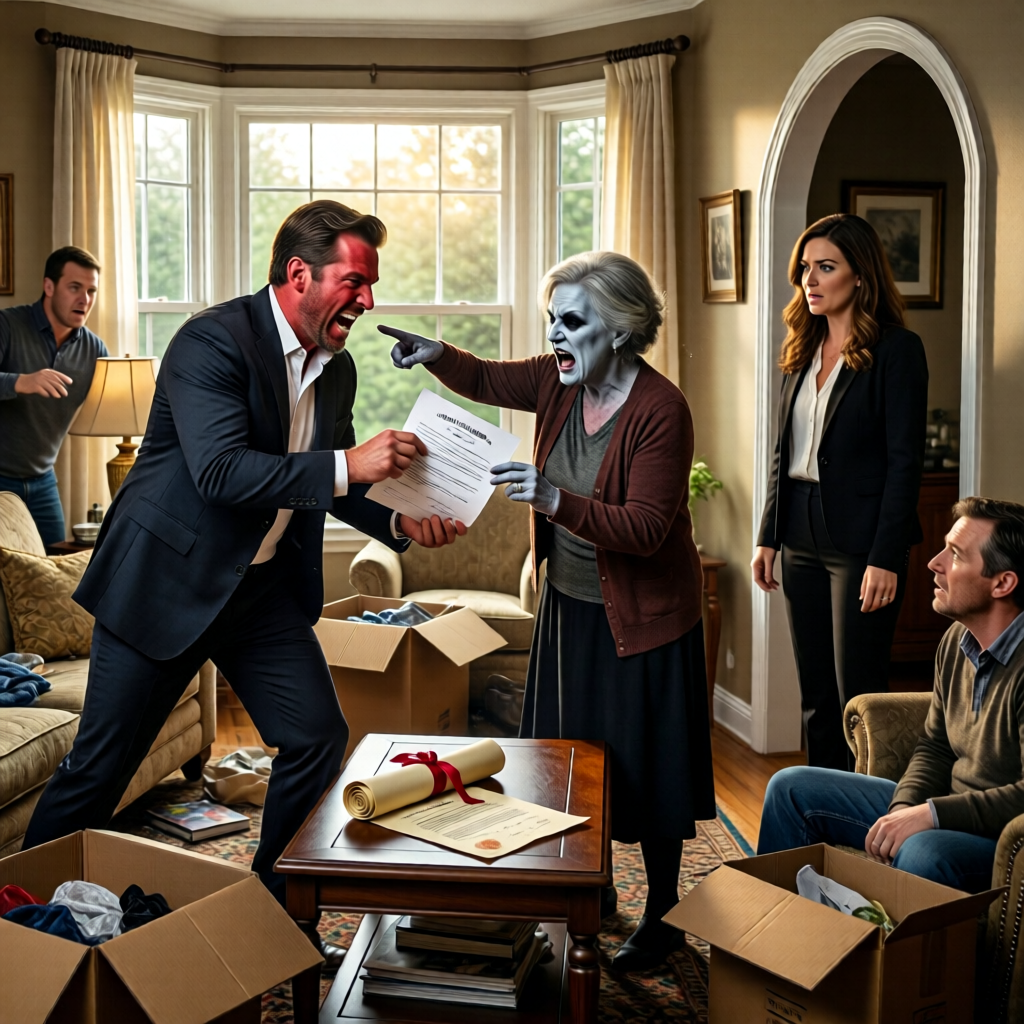
My husband’s funeral was over. His mother and eight relatives were boxing my things.
My mother-in-law stood in the living room and told me:
“This house is legally ours now. You must vacate the premises by sundown.”
I took off my black veil. I laughed softly. I held a sealed document they had not touched.
The last thing I heard was her voice, thick with false authority.
The last thing I saw was their hands, reaching for my memories.
Martha Jenkins never grieved for Robert. Acquisition was the entire point.
She had orchestrated this invasion, gathered her accomplices, waited for my vulnerability, and planned to claim everything.
My wedding photographs went into a box labeled “Miscellaneous.” Robert’s old worn books followed. His collection of vintage watches disappeared into a plastic bin. They moved through the rooms with grim efficiency. They did not speak to me. They acted as if I were already gone.
I stood by the archway, watching them. My feet hurt in my black pumps. My throat was dry. I had not slept.
My mother-in-law, Martha, stepped in front of me. She blocked the path to the front door. Her face was tight, set in a mask of triumph. She moved closer, invading my space. Her breath smelled faintly of stale coffee and something acrid. I did not flinch. I did not speak.
She held out her hand. Her fingers, adorned with oversized rings, twitched impatiently. Her eyes bore into mine, demanding compliance.
She said:
“That vehicle belongs to the estate now. I need your keys.”
I looked past her, through the large bay window. A black sedan pulled into the driveway. It was sleek, modern, not a car I recognized. The driver’s side door opened. A woman with a neat black briefcase stepped out. She was tall and carried herself with an air of quiet confidence. She walked with purpose toward the front door.
The relatives stopped their packing. Boxes lay half-filled. Their whispering ceased. They turned their heads, watching the woman approach. She did not hesitate. She walked straight into the house.
It was Ms. Evelyn Reed. She was our family attorney, or rather, Robert’s family attorney, the one he had chosen years ago. Her presence was unexpected. She held more than just her briefcase. In her other hand, she carried a thick, legal document, bound and ribboned, clearly a certified will.
Ms. Reed walked directly to Martha. She offered the document to her. Martha took it. Her hands trembled slightly as she pulled at the ribbon. Her eyes scanned the first few lines, then darted down the page. Her face turned a sickly pale.
The will was dated May 10, 2023. Robert’s signature was clear at the bottom. The document explicitly bequeathed everything. The house at 456 Elm Street, Dallas. All financial assets. Every last penny. It was all mine. It named me, Sarah Miller, as the sole beneficiary.
There was a specific clause within the document. It disinherited all other Miller family members. The reason was stated plainly: “past actions of egregious financial misconduct.” Ms. Reed then reached into her briefcase. She pulled out another document. It was a prenuptial agreement. Robert and I had signed it on June 15, 2020. This agreement stipulated the Dallas house and a substantial trust fund transfer to me upon Robert’s d/ea:th. I had found it the day before the funeral. It was in a fireproof safe deposit box at Legacy Bank. Only Robert or I could open it.
Martha gasped. Uncle Thomas grabbed. Their faces flushed crimson. I remained silent.
Martha’s voice cracked. She pointed to an unsigned piece of paper on the coffee table. It looked like a draft.
She shrieked:
“This is a forgery! My son updated his will last month!”
Uncle Thomas lunged forward. He snatched the unsigned document from the table. He crumpled it slightly in his hand. He shook it at Ms. Reed.
He snarled:
“We will fight this in court.”
Ms. Reed’s expression did not change. Her voice remained even, calm. She looked from Uncle Thomas to Martha, then to the stunned faces of the other relatives.
She said:
“The state’s probate court will verify the latest valid document. Any attempt to obstruct this process will result in legal action.”, “Probate court will verify the latest valid document,” Ms. Reed said. “Any obstruction results in legal action.”
The words hung in the silence. The air in the living room grew thick, heavy. Relatives exchanged nervous glances. Their hands, paused mid-pack, trembled slightly. Uncle Thomas stood, his face a mottled red, the crumpled draft will still clutched in his fist. He looked from Ms. Reed to Martha, then to the floor. His earlier bluster faded, replaced by a sullen, defeated look. The threat was clear. It was directed at him, at all of them.
Martha, however, remained rigid. Her jaw tightened. Her eyes, usually darting with avarice, now held a dangerous glint of desperation. She ignored Ms. Reed’s warning, or perhaps, refused to believe it applied to her. She believed herself untouchable, above consequence. She had planned this invasion with such certainty. This house, my life, was already hers in her mind. The legal papers, Ms. Reed’s calm authority, they were mere inconveniences. Obstacles to be swept aside.
She took a slow, deliberate step towards Ms. Reed. Her large, heavy rings clinked as her hand curled into a fist. Her breath came in shallow, angry gasps. She fixed her gaze on the certified will still held loosely in Ms. Reed’s hand. It was the physical representation of her defeat, of her son’s final betrayal in her eyes. It had to be destroyed.
“This is not over,” Martha spat, her voice low, menacing, a stark contrast to her earlier shrieks. She sounded like a wounded animal, cornered but still dangerous. Her body language shifted from furious indignation to aggressive intent. She was no longer just arguing. She was moving to take. She eyed the document like prey.
My focus remained on Martha. Every muscle in her body seemed to coil. She was looking for a weakness. A crack in Ms. Reed’s composure. A sign of my own fear. She found neither. My own posture remained relaxed, my expression neutral. Ms. Reed stood her ground, her gaze unwavering, direct.
“There is nothing more to discuss here today,” Ms. Reed stated, her voice still measured, carrying an unspoken weight of legal authority. She did not raise her voice. She did not flinch. She simply reiterated the finality of the situation. Her hand, holding the will, did not move. It was a clear signal of control.
Martha ignored her. She lunged. A sudden, clumsy movement, but forceful. Her hand shot out, aiming for the certified will Ms. Reed held. Her intent was clear: snatch it, tear it, destroy the evidence that disproved her fabricated claim. The action was impulsive, fueled by rage and disbelief. It was a raw, unfiltered act of desperation.
Ms. Reed was prepared. She shifted her weight, a subtle, almost imperceptible movement. Her arm, holding the will, raised slightly, moving the document just out of Martha’s reach. Martha’s fingers brushed against the thick paper, but failed to grasp it. She stumbled, regaining her balance with an indignant grunt. Her eyes blazed with fury. The attempted physical seizure had failed.
“Attempted destruction of legal documents in the presence of legal counsel and witnesses constitutes a felony,” Ms. Reed announced, her voice a shade colder now, still calm but edged with steel. The threat was no longer abstract. It was specific. It was immediate. It was personal. She was no longer just talking about probate court. She was talking about criminal charges.
The other relatives gasped. They took steps back, away from Martha. The line was now drawn. They saw the danger. They saw the consequences. Uncle Thomas paled further, the crumpled draft will now shaking in his hand. He looked at Martha, then at me. His loyalty was fraying. The promise of inheritance, now gone, was no longer worth the risk of jail time.
Martha didn’t care. The legal jargon washed over her. She was beyond reason. Her plan had failed. Robert had outmaneuvered her, even from the grave. I had known. I had waited. I had won. This realization, this ultimate defeat, ignited a new kind of madness in her. She could not accept it. She would not allow it.
Her eyes swept over me, then back to Ms. Reed. A new, more insidious plan began to form in her distorted mind. If she couldn’t discredit the will, if she couldn’t seize the property by force, she would create a new narrative. One where *I* was the criminal.
She pulled out her phone. Her fingers, still adorned with oversized rings, fumbled for a moment, then punched in numbers with surprising speed. She held the phone to her ear, her gaze fixed on me. A twisted smile stretched across her face, devoid of warmth or joy. It was a predator’s smile, cold and calculating, despite her desperation.
“This is Martha Jenkins at 456 Elm Street,” she spoke into the phone, her voice louder now, clearer, projecting for everyone in the room to hear. Each word was deliberate, a calculated weapon. “I need to report an act of fraud and grand larceny.”
My breath caught. My eyes narrowed. I knew what was coming. I simply waited.
She paused, listening. Her gaze, still locked on mine, was filled with triumph. She believed she had found her opening. She believed she could turn the tables. She believed she could make me the villain.
“My daughter-in-law, Sarah Miller,” Martha stated into the phone, her voice dripping with false concern, “is attempting to steal my deceased son’s entire estate. She’s working with a fraudulent attorney right now, trying to pass off a forged will.” She took a deep, theatrical breath. “They’re attempting to evict me and my family from our rightful home.” She lowered her voice slightly, but still ensured every word carried through the stunned silence of the room. “I believe they are armed, and I feel very unsafe.”
The blatant lie hung in the air. The relatives stared, aghast. Some whispered, “Armed?” Uncle Thomas shook his head slowly, his mouth agape. The absurdity of the claim was shocking. But Martha didn’t care about truth. She only cared about winning.
Ms. Reed remained perfectly still. Her head cocked slightly to the side, listening. Her expression remained unreadable, but a flicker in her eyes suggested a deep, professional annoyance. This was not unexpected. This was a standard move for someone cornered, someone desperate. But the “armed” fabrication added a dangerous layer.
Martha continued to speak into the phone, elaborating on her fabricated story, painting me as a ruthless thief and Ms. Reed as her accomplice. She gestured wildly, pointing at me, then at Ms. Reed. Her performance was convincing in its frantic energy. She was building her case, fabricating a scenario that would bring the law down on *our* heads.
Then she lowered the phone, her call apparently concluded. Her eyes, still shining with a venomous triumph, swept across the room. She was expecting widespread panic, fear, a crumbling of our resolve. She found none. My face remained calm. Ms. Reed’s expression remained steadfast.
“The police are on their way,” Martha announced, her voice laced with malicious satisfaction. She looked directly at me. “You will regret this, Sarah.” She believed she had won. She believed the arrival of uniformed officers would instantly validate her claims, sweep me and Ms. Reed aside, and hand her the keys to the kingdom. Her phone chimed, a notification sound cutting through the tension. She glanced at it, her triumphant smile widening. “They have confirmed their dispatch. They will be here within minutes.”
A low hum started to vibrate through the living room. It grew louder, more distinct. It wasn’t a phone. It was coming from outside. A distant wail, growing steadily in volume. The distinct, unmistakable sound of a siren, approaching fast. It wasn’t just any siren. It sounded like multiple sirens. And they were coming straight for 456 Elm Street., The wail of sirens grew deafening. Blue and red lights pulsed through the bay window, painting the living room in urgent flashes. Martha stood, phone still in hand, her triumphant smile twisting into something confused. She hadn’t expected this many. She hadn’t expected them so fast.
Two Dallas police cruisers screeched to a halt in the driveway. Their doors opened. Four uniformed officers emerged, moving with trained speed and caution. They approached the front door, hands hovering near their belts.
Ms. Reed stepped forward, moving with calm authority. She opened the front door before the officers could knock. The lead officer, a tall man with a stern face, looked from Ms. Reed to Martha, then to the other relatives. His gaze lingered on Martha’s phone.
“We received a report of grand larceny, fraud, and a claim that individuals are armed,” the officer stated, his voice firm. He surveyed the room. His eyes swept over the half-packed boxes.
Martha’s voice, now less triumphant, more shrill, cut through the air.
“She’s lying! Sarah Miller, my daughter-in-law, she’s stealing everything! And her attorney,” she pointed a shaking finger at Ms. Reed, “they’re trying to force us out!”
Ms. Reed remained unruffled. She held up the certified will.
“Officer, I am Evelyn Reed, a probate attorney. My client, Sarah Miller, is the legal heir to this property and the entire estate. This is the authenticated last will and testament of Robert Miller.”
The officer’s eyes narrowed. He took a careful step inside.
“Armed, ma’am? You reported they were armed?” he asked Martha directly. His tone was sharp.
Martha faltered. Her gaze darted around.
“Well, I just… I felt unsafe!” she stammered. Her earlier conviction evaporated under the officer’s scrutiny.
The other officers fanned out slightly, their eyes scanning the room. They saw no weapons. They saw no threat. Just a room full of stunned, slightly panicking relatives and two calm women.
Ms. Reed extended the will to the lead officer.
“This document was signed by Mr. Robert Miller on May 10, 2023. It explicitly bequeaths the house at 456 Elm Street, Dallas, and all financial assets to Sarah Miller, my client, as the sole beneficiary.”
The officer took the document. He scanned the first page, then the signature. His expression shifted. He looked at Ms. Reed.
“And the specific clause regarding other family members?” he asked, his voice now professional, less confrontational.
“It disinherits all other Miller family members,” Ms. Reed confirmed. “The reason is stated plainly: ‘past actions of egregious financial misconduct.’”
A collective gasp went through the relatives. Uncle Thomas dropped the crumpled draft will to the floor. His face was ash-gray. He knew what that meant. He knew the history.
Martha pushed forward, recovering her bluster.
“That’s a lie! A forgery! My son updated his will last month!” She pointed wildly at the crumpled paper on the floor. “He showed me a new one! One that said I inherited everything!”
Ms. Reed calmly reached into her briefcase again. She pulled out a second document. It was bound and pristine.
“And this, Officer, is the prenuptial agreement,” she stated, handing it over. “Signed by Sarah Miller and Robert Miller on June 15, 2020. It stipulates the Dallas house and a substantial trust fund transfer to Mrs. Miller upon Mr. Miller’s d/ea:th.”
The officer looked at both documents. He looked at the date on the prenup. Then at the date on the will. He understood the implications.
“Where was this agreement kept?” he asked.
“In a fireproof safe deposit box at Legacy Bank,” I spoke for the first time. My voice was clear, steady. “Only Robert or I could open it. I retrieved it yesterday.”
The officer looked at me. Then at Martha, whose face was now a mask of pure fury and disbelief.
“Ma’am,” he addressed Martha, his voice firm, “there is no evidence of fraud here. These are legally binding documents. Your call was based on unsubstantiated claims.”
Another officer approached, holding up Martha’s phone.
“Ma’am, a follow-up call was placed from this number to 911 minutes ago, claiming weapons were present. This is a serious accusation. There are no weapons.”
Martha’s bravado crumbled completely. She stammered, unable to form words. The other relatives began backing away from her. The situation had turned on her. Swiftly and decisively.
The lead officer handed the documents back to Ms. Reed.
“We will file a report on the false alarm and the unsubstantiated claims of being armed. We advise you to cooperate with legal counsel for the probate process.” He looked at Martha and the relatives. “Any further obstruction or harassment will result in immediate charges.”
The officers began to exit. The sirens died down. The flashing lights ceased. The room was bathed in the harsh, late-afternoon light again. Martha stood frozen, her face contorted in a silent scream. Her plan had not only failed but had backfired spectacularly.
Ms. Reed turned to me, a small, knowing smile playing on her lips.
“Now, Sarah,” she said quietly, “we have much to discuss. Away from the prying eyes of desperate relatives.”
***
We sat in Ms. Reed’s office downtown. The sleek, modern room was a stark contrast to the chaos of my living room. Ms. Reed poured us both glasses of water. The late afternoon sun streamed through the large windows, illuminating dust motes dancing in the air.
“Robert was a meticulous man,” Ms. Reed began, her voice calm and measured. “He anticipated this.”
I took a slow sip of water. My mind was still reeling from the events at the house.
“Anticipated all of it?” I asked.
“Yes, to a great extent,” she confirmed. “He first approached me in late 2018. He had discovered Martha’s embezzlement from Miller & Sons Construction. It was significant. $300,000.”
My eyes widened. I knew nothing of this. Robert had kept it hidden.
“Three hundred thousand?” I repeated, stunned.
“Precisely,” Ms. Reed nodded. “He had evidence. Financial records. Irrefutable proof. But he didn’t want to prosecute his own mother. He chose another path.”
She paused, gathering her thoughts.
“He wanted to protect his assets, and more importantly, your future, from any further attempts to seize them. He wanted to make sure his mother, and frankly, the rest of the family, could never touch what he intended for you.”
“The will from May 2023, and the prenup from June 2020,” I said, trying to connect the pieces.
“Exactly,” Ms. Reed affirmed. “The prenuptial agreement was the first step. Signed June 15, 2020. Concurrent with that, Robert established an irrevocable trust. A $10 million irrevocable trust. He named you as the sole beneficiary upon his d/ea:th.”
My jaw dropped slightly. A $10 million trust. I had no idea.
“Irrevocable,” I murmured, testing the word.
“Meaning it cannot be changed or revoked by Robert once established,” she explained. “It was fully funded shortly after. Then, in September 2020, Robert formally transferred the Dallas property, valued at $1.8 million, into that trust. It was legally yours upon his passing, separate from the will, just reinforced by it.”
She continued. “The will from May 10, 2023, was a reinforcement. It made his intentions explicitly clear for all other remaining assets not covered by the trust. The clause about ‘egregious financial misconduct’ directly referenced Martha’s embezzlement. It was his final statement to them.”
“And the draft will Martha had?” I asked. “The unsigned one?”
“That was a calculated deception,” Ms. Reed explained. “Robert had shown Martha a draft of a will where she would appear to inherit substantially. He never signed it, of course. He used it as a means to observe her. To confirm her true intentions. He suspected she would overplay her hand once he was gone.”
I shook my head, marveling at Robert’s foresight. And his pain. He had lived a lie of reconciliation to protect me.
“And the others?” I asked, thinking of Uncle Thomas and the cousins. “Why were they so involved?”
Ms. Reed sighed.
“That comes down to Martha’s continued manipulation. Robert’s estate is estimated at $25 million in total. Martha convinced them that Robert’s wealth would be distributed among the family, with her as the executor. She promised them a substantial share.”
“But why did they believe her so easily?”
“Desperation,” Ms. Reed stated plainly. “Uncle Thomas, for example. He had accrued $75,000 in gambling debts. He saw this as his golden ticket out.”
I thought of Uncle Thomas’s shaking hand, the crumpled paper. It made sense now.
“And the cousins?”
“Several of Robert’s cousins had leveraged their homes for Martha’s speculative investment schemes,” Ms. Reed revealed. “These schemes, as you might guess, failed spectacularly. They were left in dire financial straits, facing foreclosures. Martha’s promise of a large inheritance from Robert was their last, best hope.”
“She ruined them too,” I whispered.
“She used their vulnerabilities,” Ms. Reed corrected. “She preyed on them. They were eager to believe her. They saw you as the obstacle to their supposed salvation.”
The pieces clicked into place. The invasion, the immediate attempt to seize everything, the furious certainty in Martha’s eyes. It wasn’t just greed. It was a desperate, collective grab for what they believed was their last chance. Martha had orchestrated it all, fueled by her own long-held bitterness and avarice, drawing in her unsuspecting, desperate family members. Robert had known. He had prepared. He had ensured she would ultimately fail.
Ms. Reed checked her watch. “We have a probate hearing scheduled for October 25th. That’s when we formalize everything. The court will validate the will and the trust. And then, Sarah, your new life truly begins.”
***
October 25, 2023, dawned crisp and clear. I sat beside Ms. Evelyn Reed in Dallas County Probate Court, Courtroom 302. Judge Eleanor Vance, a woman with silver hair pulled back in a severe bun and intelligent, discerning eyes, presided from the bench. Martha Jenkins sat across the aisle, flanked by her attorney, Mr. Gary Peterson. Uncle Thomas and several other relatives sat grim-faced behind them. Their faces were devoid of their earlier defiance, replaced with a strained, anxious pallor.
Ms. Reed began her opening statement, her voice articulate and precise. She laid out the facts, presenting certified copies of Robert’s last will and testament, dated May 10, 2023. She detailed its explicit bequest of the entire estate to me.
“The will also contains a clear disinheritance clause,” Ms. Reed explained to the judge, “citing ‘past actions of egregious financial misconduct’ by other family members.”
She then presented the prenuptial agreement.
“Furthermore, Your Honor,” Ms. Reed continued, “we submit the prenuptial agreement between Sarah Miller and Robert Miller, executed June 15, 2020. This document, along with accompanying bank records, confirms the establishment of a $10 million irrevocable trust for Mrs. Miller, and the subsequent transfer of the 456 Elm Street Dallas property into that trust in September 2020.”
Mr. Peterson, Martha’s attorney, then stood. He was a portly man, his suit slightly rumpled, his demeanor agitated.
“Your Honor,” he began, “we dispute the validity of this purported will. We have evidence, an updated will, reflecting Mr. Robert Miller’s true and final wishes!” He held up the crumpled, unsigned document that Uncle Thomas had once brandished.
Judge Vance leaned forward. “Is that document signed, Mr. Peterson?” she asked, her voice calm but firm.
Mr. Peterson hesitated. “It… it is a draft, Your Honor. But it clearly indicates Mr. Miller’s intent to provide for his mother and other family members.”
“This court only recognizes legally executed documents, Mr. Peterson,” Judge Vance stated, her tone leaving no room for argument. “An unsigned draft has no legal standing.” She waved a dismissive hand. “Motion to admit the draft will as evidence is denied.”
A murmur went through Martha’s side of the aisle. Martha herself slumped in her seat, her face tightening into a resentful grimace.
Ms. Reed then called her next witness: a forensic handwriting analyst, Dr. Alistair Finch. Dr. Finch, a meticulous man in a tweed jacket, presented his findings.
“My analysis confirms, with 100% certainty, that the signature on the May 10, 2023, will submitted by Ms. Reed is indeed that of the deceased, Mr. Robert Miller,” Dr. Finch stated, projecting his voice clearly. “Furthermore, I have examined other documents provided by Mr. Peterson, purporting to be other wills. None of them bear Mr. Miller’s authenticated signature.”
The case was airtight. There was no way to dispute it.
Judge Vance turned to me. “Mrs. Miller, do you wish to make a statement?”
I stood. My heart pounded, but my voice remained steady. I looked directly at Martha, then at Uncle Thomas, then at the judge.
“My husband, Robert, built his life with integrity and quiet strength,” I began. “He created his legacy through hard work, and he intended for that legacy to continue protecting the people he loved, and the causes he believed in.”
“What Martha and her family tried to take was more than just a house or money,” I continued. “They tried to take Robert’s final wishes. They tried to erase his truth. They tried to replace it with a lie, driven by their own greed and desperation.”
“But they failed,” I concluded, my gaze firm. “They failed because Robert was stronger, smarter, and more loving than they ever gave him credit for. His trust in me, his final act of protection, cannot be undone by their deceit.”
I sat down. A profound silence filled the courtroom.
Judge Vance then delivered her ruling.
“Based on the evidence presented, including the authenticated Last Will and Testament dated May 10, 2023, the prenuptial agreement dated June 15, 2020, and the confirmed bank records pertaining to the irrevocable trust and property transfer, this court finds that the late Mr. Robert Miller’s final wishes are unequivocally clear.”
“Therefore,” Judge Vance declared, her voice ringing with authority, “this court rules that Sarah Miller is the sole beneficiary of Mr. Robert Miller’s entire estate, including the Dallas residence at 456 Elm Street and all associated financial assets.”
Martha gasped loudly. Uncle Thomas buried his face in his hands.
“Martha Jenkins and all other relatives present are hereby ordered to vacate the property at 456 Elm Street immediately,” Judge Vance continued. “Furthermore, the court views the presentation of an unsigned, fabricated will and the attempted misrepresentation of Mr. Miller’s final wishes as a serious matter.”
She fixed her gaze on Martha and Uncle Thomas.
“This court refers the matter of Martha Jenkins and Uncle Thomas Jenkins to the Dallas County District Attorney’s office for a full investigation into potential fraud charges. Additionally, Martha Jenkins is hereby ordered to pay a fine of $50,000 to the estate for legal costs incurred due to her fraudulent claims and attempts to obstruct justice.”
The gavel came down with a decisive *thwack*. The sound echoed in the silent courtroom. Justice was served.
***
Months later, the house at 456 Elm Street was no longer mine. It had sold for $1.9 million, slightly more than its appraised value. I used the funds not to simply pocket the money, but to honor Robert’s quiet, lifelong passion.
I established the Robert Miller Vocational Training Foundation. It was a non-profit, dedicated to providing skills and opportunities for underserved communities in Dallas. We focused on trades Robert had valued: carpentry, electrical work, plumbing, masonry. He had always believed in the dignity of skilled labor.
I hired a small, dedicated staff. We found a building to renovate in South Dallas. The work was demanding, but deeply fulfilling. It was a tangible way to keep Robert’s spirit alive.
I had also taken over Miller & Sons Construction. The management team had been surprised but welcomed my involvement. We stabilized operations, paid off the few remaining debts, and slowly, carefully, began to expand into new markets. It was challenging, but I found a strength in myself I hadn’t known I possessed.
My new home was in Austin, a smaller, modern house with a bright, open floor plan. It had a peaceful backyard, a quiet place for me to read and reflect. It wasn’t the house Robert and I had built together, but it was mine, a place of peace and new beginnings.
One clear, cool afternoon, I drove back to Dallas. I visited Robert’s grave. The headstone was simple, dignified, just as he would have wanted. I knelt, feeling the cool grass beneath my fingers. I placed a single white rose on the polished stone.
“Justice served, Robert,” I whispered, my voice thick with emotion. “Your trust honored.”
I left a small, folded note beside the rose. It held the same words. Then, I drove to a local veterans’ charity. I had packed two large boxes. They contained all of Robert’s personal effects: his worn leather briefcase, his favorite fishing hat, a collection of old jazz records, his well-loved power tools. Everything but our photographs. Those, I kept.
The charity worker thanked me warmly. “These will bring joy and utility to our veterans, ma’am.”
I nodded, a sense of lightness spreading through me. Let Robert’s things find new purpose. Let his generosity ripple outwards.
***
Six weeks later, I was going through Robert’s old laptop. I had meant to wipe it clean, prepare it for donation, but I kept finding small, lingering traces of him. Old drafts of emails, half-finished articles he’d read.
Then, buried deep in a folder labeled “Construction Blueprints,” I found a video file. It was dated April 18, 2023. A month before he signed his final will. My heart clenched. I clicked play.
Robert’s face filled the screen. He looked tired, but his eyes held that familiar, sharp intelligence. He was sitting in his study, a place I knew well.
“If you’re watching this, my love,” he began, his voice raspy, “it means I’m gone. And it means Martha has, as I fully expected, tried to claim everything.”
He paused, a sad smile on his lips. “I suspected this, Sarah. For years. After I found out about the embezzlement, I knew I had to act. Not just to protect our future, but to expose her fully.”
“I led her on, Sarah,” he confessed, his gaze steady. “I showed her a draft of a new will. A draft that made her think she would inherit. I needed her to believe it. I needed her to overplay her hand, to act on her greed when the time came.”
“I knew she would cause a scene,” Robert continued, a wry humor in his eyes. “I knew she would try to invalidate the true will. But that was the point. Her overt actions, her public attempts to steal what was legally yours, would only solidify your legal position. It would make it undeniable.”
He looked directly into the camera, as if looking into my eyes.
“I did this because I love you, Sarah. And because I am so incredibly proud of your strength. You always underestimated yourself. I never did. I knew you would face her down. And I knew you would win. I wanted to make sure you had every possible advantage.”
He reached out, as if to touch the screen. “Live a full life, my dearest. My greatest joy was knowing you were safe, and loved. Remember that.”
The video ended. I sat there, tears streaming down my face, a new depth of understanding settling in my heart. Robert had not only protected me, he had orchestrated his own justice, ensuring his truth would prevail, even from beyond the grave.
***
Years passed. The Robert Miller Vocational Training Foundation flourished. We expanded to three locations across Texas, empowering hundreds of individuals to build new careers and secure their futures. I oversaw the foundation’s growth, and continued to guide Miller & Sons Construction, ensuring its legacy of quality and ethical business practices. My life in Austin was peaceful, filled with purpose. I made new friends, cultivated a beautiful garden, and cherished the quiet strength Robert had always seen in me.
One afternoon, a small notice arrived in the mail. It was a summary from the Dallas County Clerk’s office, a public record of legal proceedings. Martha Jenkins and Uncle Thomas Jenkins, it stated, had been arrested three months after the probate court ruling. Martha was charged with attempted grand larceny and probate fraud. Uncle Thomas was charged as an accessory to fraud. Both pleaded no contest. They each received five-year suspended sentences, coupled with significant restitution orders totaling $150,000 to cover legal fees and damages to the estate. They were financially ruined, their remaining assets seized. Their wider family had ostracized them, unwilling to bear the shame or the financial fallout. The notice was brief, factual, and devoid of drama.
I folded the paper carefully and placed it in a drawer. It was the final, quiet closure.
Later that evening, I sat on my porch swing, watching the sunset paint the sky in hues of orange and purple. A gentle breeze rustled through the leaves of the old oak tree in my backyard. I held a framed photograph of Robert and me, taken on our wedding day. His smile was wide, full of life and promise. He had seen the storm coming, and he had built an ark for me, strong and true. He had given me a foundation. And from that, I had built a new world. The world was quiet now. And it was finally mine.
Leave a Reply