Chapter 1:
Part 1
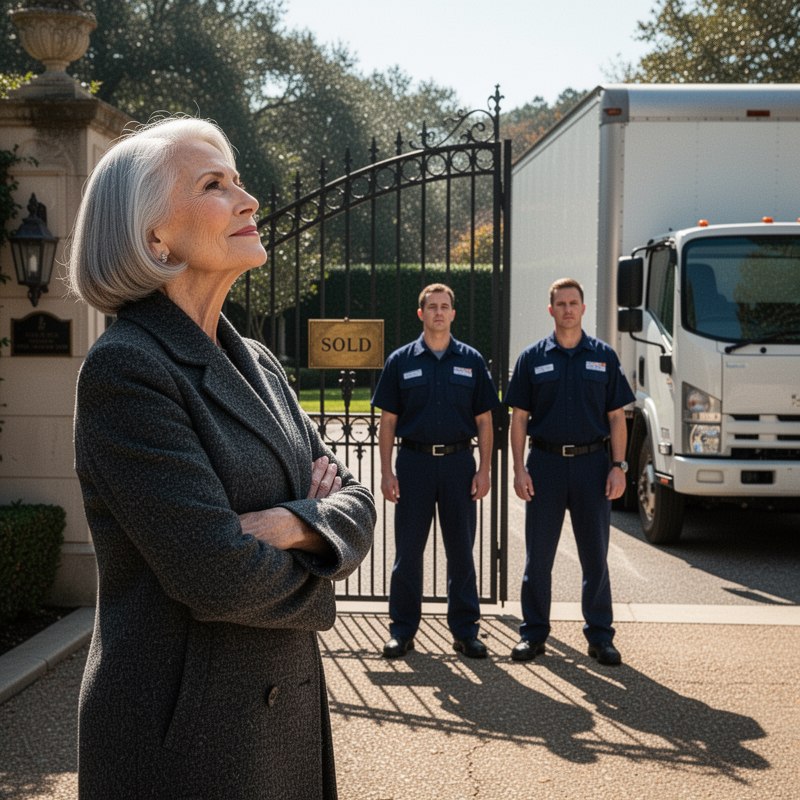
Minutes after my divorce was finalized, my former mother-in-law arrived with a moving truck, loudly proclaiming, ‘Open the gate, this house is ours now!’—unaware the mansion stood empty, its wrought-iron gates firmly locked.
The final decree had just landed in Sarah Miller’s email, a digital whisper of freedom. She sat on the plush, rented sofa in her small temporary apartment, a quiet peace settling over her shoulders for the first time in years. The hum of the city outside was a comforting backdrop, a stark contrast to the suffocating silence of the Vance mansion she had just legally escaped.
Her phone buzzed on the coffee table. It was Brenda Perez, her best friend, a frantic energy vibrating through the caller ID. Sarah picked up, a small smile playing on her lips.
“Brenda, hey! Just got the…”
“Sarah! You are not going to believe this,” Brenda’s voice cut her off, sharp with urgency. “You need to get down to the old place. Right now.”
Sarah’s smile faltered. A cold dread, familiar from years of dealing with the Vance family, began to creep into her chest. She pushed herself upright, the peaceful moment already shattered.
“What is it? What happened?” she asked, her voice tight.
“It’s Eleanor,” Brenda said, her words tumbling out in a rush. “She’s at the mansion. With a moving truck. A huge one, Sarah! And a whole crew of movers.”
A gasp caught in Sarah’s throat. Eleanor Vance, her ex-mother-in-law, was a woman whose entitlement knew no bounds. But this felt like a new low.
“She’s what?” Sarah managed, disbelieving.
“She’s literally shouting at the gate!” Brenda exclaimed. “She’s telling them to open it, saying ‘this house is ours now!’ I think she actually brought *her* furniture to move in.”
A surge of adrenaline, cold and sharp, shot through Sarah. She grabbed her keys, her momentary peace evaporating like morning dew. This wasn’t just Eleanor being Eleanor; this was a deliberate, public display of ownership, a brazen attempt to claim what was never hers.
“I’m on my way,” Sarah said, her voice steely.
She practically flew out of the apartment, the short drive to the sprawling Vance estate a blur. Every turn of the wheel tightened the knot in her stomach, bringing her closer to the familiar, imposing wrought-iron gates. The gates that, for years, had felt like both a barrier and a cage.
As she rounded the final bend, the scene unfolded like a crude play in broad daylight. A massive moving truck, emblazoned with “Elite Movers,” was parked awkwardly in front of the grand entrance, its ramp already lowered. Several bewildered men in blue uniforms stood by, shifting uncomfortably.
And there, at the foot of the locked gates, was Eleanor Vance.
Her vibrant silk scarf fluttered in the breeze, a defiant splash of color against the dark metal. Her hands were on her hips, her posture rigid with indignation, her voice piercing the afternoon quiet.
“I said open it!” Eleanor shrieked at the unyielding gates, her perfectly manicured finger jabbing the air. “What is wrong with you people? Don’t you know who I am?”
A young mover, looking utterly lost, approached her cautiously. “Ma’am, the gates are locked. We don’t have a key.”
Eleanor turned on him, her eyes flashing with impatience. “Then get a locksmith! What are you waiting for, an engraved invitation? This house is ours now! My son’s, and therefore, mine!”
Sarah parked her car a discreet distance away, watching the unfolding spectacle. Her breath hitched. The sheer audacity of it left her speechless, a dry laugh catching in her throat. She recognized the triumphant gleam in Eleanor’s eyes, the predatory excitement of someone certain of victory.
Eleanor pulled out her phone, gesticulating wildly, undoubtedly threatening to call a high-powered attorney, or perhaps the mayor, to resolve the “injustice” of a locked gate. She paced back and forth, muttering to herself, occasionally snapping at the increasingly uncomfortable moving crew.
After what felt like an eternity, but was probably only ten minutes, a small white van pulled up, a locksmith in tow. Eleanor barked orders at the bewildered man, pointing at the gates with an imperious gesture. The locksmith, clearly uncomfortable with the drama, set to work, his tools clinking softly.
The gates groaned open, slowly, with a reluctant creak. Eleanor’s face lit up, a smirk of absolute triumph spreading across her features. She turned to the moving crew, her voice ringing with renewed authority.
“Finally!” she declared. “Alright, boys! Let’s get this done. David’s been waiting for this. The master suite is upstairs, the one with the balcony.”
She swept past the locksmith and through the now-open gates, her head held high. The moving crew, still looking somewhat apprehensive, followed her, their hand trucks rattling on the paved driveway. Sarah felt her heart thump against her ribs. She took a deep breath, steeling herself, and quietly followed them up the long, curving driveway.
Eleanor marched straight to the immense mahogany front door, pausing for a dramatic flourish. She looked back at the movers, a dazzling, almost vicious smile on her face.
“Don’t just stand there, gentlemen!” she commanded, her voice echoing off the silent facade of the house. “Open it up! Let’s get David’s new life started!”
One of the movers, a burly man with a hesitant expression, stepped forward. He reached for the ornate brass handle, twisting it with a decisive click. The heavy door swung inward.
The entrance hall stretched before them, a cavernous space designed to impress. Sunlight streamed through the tall windows, painting luminous rectangles on the polished marble floor. But the light, rather than illuminating opulent furnishings, revealed only a vast, echoing emptiness.
The grand staircase, once adorned with a priceless Persian runner, was now bare wood, its steps gleaming faintly. The alcoves that had held antique statues were empty, their pedestals standing stark and vacant. Not a single painting graced the walls where countless masterpieces had once hung. The elaborate crystal chandelier, a permanent fixture, sparkled overhead, but its light fell upon nothing.
The air inside was still and cool, carrying only the faint scent of old dust and disuse. There were no drapes on the windows, no furniture to soften the hard edges, no rugs to muffle the sounds. Every single personal item, every piece of art, every stick of furniture, every decorative object Sarah had ever owned or helped choose, was gone. The mansion was a hollow shell, stripped bare to its magnificent bones.
Eleanor took one step across the threshold. Her triumphant smile, so fixed and confident just moments before, began to waver. Her eyes, wide with expectation, darted frantically from side to side, then narrowed in confused disbelief. Her perfectly made-up face drained of color, slowly, terribly.
The movers stood behind her, their earlier apprehension now replaced by outright bewilderment. One of them let out a small, involuntary gasp.
Eleanor spun around, her gaze sweeping over the empty hall again, her mouth opening and closing like a fish out of water. Her voice, which had been so loud and assertive, now came out as a strangled, incoherent sound. The mansion stood stark and silent around her, a monument to an absence she couldn’t comprehend. Her face twisted, the bewildered fury slowly replacing her initial shock.
What happened after that is in the first comment, because that’s when the truth started leaking out.
Part 2
Her gaze fell on me, standing just inside the open front door, my presence almost swallowed by the echoing emptiness.
“You!” she shrieked, her voice reverberating through the vast hall. “You ruined it! Where is everything? What have you done, you vandal?”
Her finger jabbed accusingly, trembling with raw indignation. David, who had followed her in, his usual swagger replaced by a slack-jawed disbelief, flinched at her outburst. His eyes scanned the barren room, his face reflecting a dawning horror.
“This is theft!” Eleanor raged, pulling out her phone. “I’m calling the police. You’ll be arrested, Sarah. Every single piece in this house belongs to the Vance family!”
Before her thumb could connect with the screen, a calm, measured voice cut through the chaos.
“I wouldn’t do that, Mrs. Vance.”
Art Jenkins stepped out from behind the empty space where the custom-built kitchen island had once been. He held a slim leather briefcase in one hand, his expression serene.
Eleanor’s head snapped towards him, her mouth agape. David’s eyes widened further.
“Mr. Jenkins?” Eleanor sputtered, momentarily disarmed. “What are *you* doing here?”
“I’m here to ensure my client’s property rights are respected,” Art replied, his voice even. “And to clarify any misconceptions you might have.”
He opened his briefcase, extracting a single, official-looking document.
“This mansion, Mrs. Vance, was legally transferred solely into Sarah’s name three months ago.”
He held up a certified copy of the deed, its official stamps clearly visible.
“As part of a pre-divorce asset division, long before the divorce was finalized,” Art continued. “Sarah had every legal right to empty or dispose of her property as she saw fit.”
Eleanor stared at the document, then at Art, then at me. Her cheeks, which had been flushed crimson with anger, now paled to an ashen grey. The shouts died in her throat. She closed her mouth, swallowing hard, her eyes fixing on me with a silent, venomous glare.
Chapter 2: The Forged Legacy
Days later, the tension in the courtroom was thick enough to taste. Eleanor’s family lawyer, Marcus Thorne, a man whose expensive suit seemed tailored for smugness, strode confidently forward. He held a document aloft, a thin sheaf of papers bound by a red ribbon, his gaze sweeping the room before settling on me.
“Your Honor,” he announced, his voice reverberating, “we present a newly discovered, legitimate will from the deceased patriarch, Thomas Vance.”
Eleanor, seated beside him, straightened her spine. A triumphant smirk played on her lips as she watched the judge’s eyes scan the document. This, she believed, was her ultimate ace.
“This will,” Marcus continued, “dated five years prior, explicitly leaves the mansion currently in contention directly to David Vance.”
Eleanor brandished the document as if it were a scepter, her eyes locking onto mine, a silent declaration that her earlier humiliation was now avenged. Her face practically glowed with vindication. “This nullifies any previous transfers, Your Honor,” she declared, her voice ringing out. “It reveals the true intent of the family patriarch.”
Art Jenkins, my lawyer, remained unphased. He watched the exchange with a cool, collected demeanor, a faint, almost imperceptible tilt to his head. When Marcus Thorne finally finished his theatrical presentation, Art rose slowly.
“May I approach, Your Honor?” he requested, his voice calm amidst Eleanor’s simmering satisfaction. Permission granted, Art took the document from the clerk, holding it up, not to the gallery, but directly to the judge. He ran a finger along the edges.
“Interesting,” Art murmured, not looking at anyone in particular. “I observe several inconsistencies in the formatting here, Your Honor. The legal standards for wills of that specific era typically followed a different template.” He pointed to a specific paragraph. “And the wording… it deviates significantly from Mr. Vance Sr.’s known legal preferences, as evidenced in his other estate documents.”
Eleanor’s confident posture stiffened. She watched Art, a flicker of doubt crossing her features.
Art then turned the document slightly, allowing the light to catch it just so. “Furthermore, and perhaps most critically, a preliminary assessment by my team indicates the ink appears remarkably fresh for a document purportedly drafted five years ago.” His gaze hardened, meeting Eleanor’s directly. “Much too fresh, in fact.”
A hush fell over the courtroom. The judge leaned forward, scrutinizing the “will” more closely. Art stepped back, allowing the judge space.
“My client,” Art continued, “suspected foul play regarding this ‘discovery.’ We initiated a preliminary forensic analysis.” He paused, letting the implication sink in. “That analysis confirms, beyond a shadow of a doubt, that this document is a crude forgery, created within the last six months. It was clearly designed to supersede Sarah’s legal claim to the property.”
The air in the room seemed to crackle. Eleanor gasped, her face draining of color, the triumphant smirk utterly wiped away. David, beside her, sank lower in his chair, eyes wide with alarm.
“Forgery?” Eleanor sputtered, her voice rising in a shrill protest. “This is outrageous! A fabrication!”
“The evidence suggests otherwise, Mrs. Vance,” the judge stated, his voice stern, his gaze fixed on Eleanor. He tapped a pen decisively. “Given the gravity of this revelation, the court orders a full, comprehensive investigation into the authenticity of this document and its origins.”
Eleanor’s grand legal play had not only been exposed but had backfired spectacularly. She stared at the judge, then at me, her eyes burning with a silent, venomous rage, a woman scorned and now cornered. The courtroom buzzed with hushed whispers as the gravity of the judge’s words settled upon everyone.
“This is not over, Sarah,” she mouthed across the courtroom, a promise of further retribution in her eyes. But her words were hollow, her power visibly shaken.
Chapter 3: The Offshore Mirage
The courtroom drama of the forged will sent ripples, but Eleanor remained defiant, convinced she could still outmaneuver the legal system. Art, however, was already anticipating her next move. Following the preliminary forensic confirmation, he immediately expanded his investigation, turning his meticulous focus to the Vance family’s broader financial landscape. My lawyer suspected this was merely a symptom of a deeper, more systemic pattern of fraudulent activity.
His team worked tirelessly, delving into layers of obscured transactions and corporate filings. Then, one Tuesday morning, Art called me into his office. He pushed a folder across the polished mahogany desk.
“We found something,” he stated, his voice measured. “Something significant.”
Inside the folder were documents detailing a meticulously hidden offshore bank account. It was in David’s name, domiciled in the Cayman Islands, and contained a staggering sum: €850,000, which converted to approximately $920,000 USD. My breath hitched.
“David claimed he lost everything in failed business ventures,” I said, my voice barely a whisper. The memory of his casual dismissals, his insistence on being “cash-strapped,” twisted in my gut.
Art nodded. “Precisely. This sum directly contradicts David’s sworn statements during your divorce proceedings. It represents a deliberate attempt to conceal substantial wealth.” He watched my face closely. “Are you surprised by the amount?”
I shook my head, my mind racing through all the times David had feigned poverty. “Only by the sheer audacity of it,” I admitted, a cold anger coiling in my stomach. The extent of their deception was far grander than I had ever imagined.
Art’s next actions were swift and decisive. He immediately filed for a freeze on the newly discovered assets. Then, without delay, he scheduled a meeting with Detective Elena Rodriguez, a respected and thorough officer known for her no-nonsense approach to financial crimes.
“This isn’t just about a divorce settlement anymore, Detective,” Art explained, laying out the evidence on the conference table in Rodriguez’s office. He pointed to the offshore account details, then to David’s sworn affidavits. “This is clear intent to defraud and conceal assets, exacerbated by the attempted use of a forged document.”
Detective Rodriguez studied the documents, her expression grim. She tapped a finger against the Cayman Islands bank statement. “A substantial sum, Mr. Jenkins. And a clear pattern emerging.”
Meanwhile, word of the offshore account and the impending freeze reached the Vance household. David, for once, was genuinely panicked. I pictured him pacing, his pampered existence suddenly threatened.
“Mom, they know about the account!” I imagined him stammering, his voice tight with fear.
But Eleanor, oblivious to the full scope of Art’s strategy and the legal trap tightening around her, remained dismissive. “Relax, David,” I could almost hear her, her tone laced with patronizing assurance. “I have people. This is a minor setback. They can’t touch us in the Caymans.”
She assured him that her “connections” would handle it, utterly unaware that Art had already initiated proceedings that would bring those hidden funds crashing back into the American legal system. Her hubris was a blinding force, leading her deeper into the web she herself had spun.
“She has no idea what’s coming,” Art said to me later that day, a grim satisfaction in his voice. “This is just the beginning.”
Chapter 4: Richard’s Quiet Treachery
The legal noose around Eleanor tightened dramatically with the freeze on David’s offshore funds and the ongoing investigation into the forged will. The pressure began to crack the Vance family facade. David grew increasingly agitated, his mother’s reassurances doing little to quell his genuine fear.
Amidst this turmoil, a quiet, unexpected ally emerged. My phone buzzed one evening. It was Brenda. “Sarah,” she whispered, her voice low and urgent. “Richard Vance just called me. He wants to talk to you and Art. He says it’s urgent, and it has to be secret.”
A flicker of surprise ran through me. Richard, Eleanor’s perpetually passive husband, rarely spoke above a murmur, let alone acted against his wife. He had always seemed to float through life, weary and resigned. Brenda arranged a clandestine meeting for the following evening, in a discreet private room at a local diner.
When Art and I arrived, Richard was already there, hunched over a cup of lukewarm coffee, his face pale and drawn. He looked utterly drained, the lines around his eyes deeper than usual. He flinched when the door creaked shut behind us.
“Thank you for coming,” Richard said, his voice barely audible. He glanced nervously at the door, then back at us. “I… I can’t stand by any longer. Not with what Eleanor is doing. She’s risking everything, including David’s future.”
He confessed that Eleanor frequently pressured David into signing various financial documents, often without him understanding their contents. “He just trusts her,” Richard sighed, running a hand through his thinning hair. “She tells him it’s for his own good, for the family.” His admission painted a grim picture of David’s lifelong subjugation.
Then, his voice dropped even lower. “I also… I’ve always suspected something was off with Thomas’s will.” He paused, his gaze meeting mine directly for the first time. “My father, Thomas. He was very specific about things. And he knew Eleanor’s tendencies.”
Richard reached into his jacket pocket, his hand trembling slightly, and pulled out a yellowed envelope, sealed with an antique wax impression. It looked fragile, as if it had been hidden away for years. “This,” he said, pushing it across the table, “this is from my father. To his personal lawyer, years ago.”
Art carefully took the envelope, examining the seal before breaking it open. Inside was a single, aged letter, the ink faded but still legible. As Art read, his eyebrows rose steadily.
The letter explicitly detailed Thomas Vance’s deep concerns about Eleanor’s greed and David’s immaturity. It stated, in no uncertain terms, his intention to establish a *supervised trust* for David, ensuring he couldn’t squander his inheritance. Crucially, it stated his clear intention *not* to leave the mansion to David outright, instead outlining specific conditions for accessing any funds. It was a stark testament to the grandfather’s foresight and distrust of Eleanor’s manipulative nature.
“He confided in me once,” I murmured, recalling a conversation years ago. “He told me he had concerns about how his estate would be managed.”
Richard nodded, his shoulders slumping. “He trusted you, Sarah. He saw something in you that he knew David needed.” He added, a quiet note of regret in his voice, “This letter… it proves everything. Eleanor tampered with the original will years ago, I just know it. And she’s been covering it up ever since.”
His confession and the grandfather’s letter were a bombshell. They provided crucial, irrefutable insight into Eleanor’s long history of manipulation and her powerful motive for orchestrating the recent forgery. The true legacy of Thomas Vance, now revealed, completely undercut Eleanor’s desperate narrative.
Unaware of her husband’s quiet treachery, Eleanor, at that very moment, was likely still plotting her next move, convinced that David’s loyalty, and Richard’s timidity, would shield her from any real consequences.
Chapter 5: The P.I.’s Boomerang
Eleanor, fueled by her escalating desperation and a profound underestimation of Art’s legal prowess, decided on a full frontal assault. She believed the only way out was to discredit me. She hired a private investigator, a seasoned professional named Mr. Grant, with a clear directive: dig up every piece of dirt on Sarah Miller, regardless of how small.
Mr. Grant, a man of quiet efficiency and unwavering dedication to his craft, began his diligent work. He followed every lead, interviewed old acquaintances, and sifted through public records. He was thorough, meticulous, and entirely oblivious to the true machinations at play. Instead of finding scandalous information about me, his investigation took an unexpected turn, leading him down a path that would ultimately seal Eleanor’s fate.
One afternoon, Mr. Grant presented his findings to Eleanor in her lavish living room. He set up a portable screen, his expression one of professional pride. “Mrs. Vance, I believe I’ve found something highly pertinent to your case,” he stated, his voice even. “It’s surveillance footage from the First National Bank branch on Elm Street.”
Eleanor watched, a confident smirk playing on her lips. She expected footage of me, perhaps in some compromising position, or evidence of financial misdeeds. As the video began to play, showing the interior of the bank, her smirk solidified, ready for vindication.
But as the camera zoomed in on the notary public’s desk, Eleanor’s face crumpled. Her eyes widened, her jaw dropping. The footage clearly showed *Eleanor herself*, not David, interacting suspiciously with a young, visibly inexperienced temporary notary. The date on the video matched the exact date on the forged will.
On screen, Eleanor leaned conspiratorially across the desk, her head close to the notary’s. Her hand could be seen subtly guiding the notary’s hand, then, with a practiced flourish, appearing to sign what was unmistakably David’s signature on the document. The temporary notary, looking flustered and overwhelmed, simply nodded along, seemingly taking instruction.
Mr. Grant, observing Eleanor’s horrified reaction with bemusement, continued his report. “Further investigation confirmed the notary was a temporary hire, inexperienced and clearly new to the protocols. An easy target for… guidance, one might say.” He looked at Eleanor expectantly, waiting for his praise. “This footage is quite damning for Ms. Miller’s claims about the will’s legitimacy, wouldn’t you agree?”
Eleanor sat frozen, the blood drained from her face, her carefully constructed world crumbling around her. Her own weapon had boomeranged, delivering a fatal blow to her defense. She had paid a professional to incriminate me, and instead, he had delivered irrefutable evidence of her own direct involvement in the forgery.
Art Jenkins acted swiftly. The moment he heard about the footage, he immediately subpoenaed it, adding it to the growing mountain of evidence. The footage, combined with Richard’s letter and the forensic analysis, left no room for doubt. Eleanor Vance was caught red-handed. We were preparing to present it to Detective Rodriguez and the court, a final, crushing blow that Eleanor could not possibly evade.
Chapter 6: The Grandfather’s Gambit
The atmosphere in the courthouse was electric. The climactic hearing had drawn a significant crowd, buzzing with anticipation. Eleanor, though pale and visibly shaken, still clung to a thread of her usual arrogance, flanked by Marcus Thorne, whose face was now etched with palpable concern. Art Jenkins, however, commanded the room with quiet authority.
He began by presenting the surveillance footage from the bank. The video, stark and irrefutable, played silently on a large screen for all to see. Eleanor’s desperate attempt to guide the notary’s hand, her own signature masquerading as David’s, shattered any lingering doubt about her criminal intent. Gasps rippled through the gallery. Eleanor shrank in her seat, her face ashen, her carefully constructed lies imploding before her very eyes.
“Your Honor,” Art announced, his voice resonating through the hushed courtroom, “this footage confirms Mrs. Vance’s direct involvement in the forgery of Thomas Vance Sr.’s will. But there is more. Much more.” He paused, letting the weight of his words settle. “We will now address the full disposition of the mansion.”
He delivered the first layer of his final, devastating blow. “Firstly, we refer to Ms. Miller’s pre-nuptial agreement, signed years ago, prior to her marriage to David Vance.” He projected a specific clause onto the screen. “It contains a critical, often overlooked stipulation: any significant asset *voluntarily transferred* to her name during the marriage would remain her exclusive property upon divorce, granting her full, unchallengeable discretion over its disposition.”
Art’s gaze swept over Eleanor, whose eyes widened in dawning horror. “The mansion, the property in question, was indeed voluntarily transferred solely into Sarah Miller’s name, months before the divorce finalization. Therefore, it was legally and unequivocally hers to control.”
Then came the second revelation. “The ’empty’ mansion, as Mrs. Vance discovered so dramatically, wasn’t merely cleared out.” Art clicked a remote, and a new document appeared on screen: a meticulously detailed bill of sale. “Six weeks prior to the divorce finalization, Sarah Miller legally *sold* the property for a sum of $3.5 million USD.”
A collective gasp echoed through the room. Eleanor looked as though she’d been struck. “The proceeds,” Art continued, “were immediately deposited into a very specific account: an educational trust fund, established years ago by David’s grandfather, Thomas Vance Sr.” He displayed the original, legitimate will, confirmed by Richard’s letter, designating me as the sole, unchallengeable trustee. “This trust, crucially, stipulated that David could only access these funds upon completing a certified rehabilitation program for addiction, a condition he has always vehemently refused.”
The gallery erupted in whispers. This was David’s grandfather’s true legacy, a carefully crafted plan to safeguard David’s future from his own weaknesses and Eleanor’s avarice.
Finally, Art unveiled the last, most intricate layer of the gambit. “And now, to the identity of the purchaser of the mansion.” He clicked again, revealing a corporate registration document. “The buyer was ‘Phoenix Holdings LLC,’ a shell corporation.” He paused, a slight smile playing on his lips. “This shell corporation is secretly owned by Patricia Vance – a distant, estranged cousin of Thomas Vance Sr.”
Eleanor’s face went utterly slack, her mouth agape. She looked like a ghost.
“Thomas Vance Sr. had discreetly enlisted Patricia years ago,” Art explained, “having witnessed Eleanor’s past manipulations. Patricia agreed to purchase the property specifically to secure it from Eleanor’s grasp and ensure Thomas Vance Sr.’s true wishes for David’s future – via Sarah Miller’s trusteeship – were realized.” The sale, he concluded, was structured to be irreversible and legally impenetrable.
Eleanor stared, utterly defeated, the grand edifice of her deceit crumbling to dust around her. Her eyes darted from the screen to me, then to David, who sat paralyzed, comprehending the depth of his grandfather’s foresight and his mother’s ruin.
The judge, his face grim, brought down his gavel with a resounding thud. “Given the overwhelming evidence of felony fraud, forgery, and conspiracy,” he declared, his voice cutting through the stunned silence, “this court formally announces criminal proceedings against Eleanor Vance. Furthermore, all her remaining personal assets are hereby frozen pending further investigation.”
The air left Eleanor’s lungs in a visible whoosh. Her reign of manipulation was over.
Chapter 7: Aftermath and New Beginnings
The court’s definitive ruling sent shockwaves not only through the Vance family but throughout the tightly knit circles of local high society. Headlines blared, detailing the intricate web of deceit and the spectacular downfall of Eleanor Vance. She was formally charged with felony forgery, conspiracy to defraud, and obstruction of justice. The legal analysts predicted a lengthy prison sentence, likely between three to five years, alongside substantial legal fees estimated at $300,000 USD and severe fines potentially ranging from $100,000 to $250,000 USD. Her social standing, once her most prized possession, was utterly annihilated.
David, watching the public spectacle of his mother’s disgrace, was utterly broken. The comfortable, irresponsible lifestyle he had always known vanished in an instant. The revelation of his grandfather’s true intentions, his genuine concern for David’s future, and the explicit rehabilitation clause, struck him deeply. For the first time, he seemed to grasp the full extent of his mother’s manipulative grip and his own profound dependency.
Art approached David, who sat hunched in the empty courtroom after Eleanor was led away. His usual arrogance was replaced by a vacant despair. “David,” Art said, his voice softer than I’d ever heard it, “there’s a path forward for you.”
David slowly lifted his head, his eyes red-rimmed. “What path?” he mumbled, his voice hoarse.
“Cooperate fully with the prosecution against your mother,” Art explained, “and agree to enter the two-year rehabilitation program stipulated by your grandfather’s trust. I will advocate for leniency regarding your complicity in hiding the offshore funds.” He laid out the terms, clear and unyielding. “It’s a difficult path, but it’s the one your grandfather intended, and it’s your only chance at a future free from this.”
For a long moment, David said nothing. He stared into space, perhaps envisioning a life without Eleanor’s control, a life he had never truly experienced. Then, with a shuddering breath, he nodded. “I’ll do it,” he whispered, a faint tremor in his voice. “I’ll go to rehab.” It was, perhaps, the first truly independent decision he had ever made.
I watched him leave for the facility a few days later, a bittersweet feeling washing over me. He was still a broken man, but there was a sliver of hope. I now held the trust for David, the proceeds from the mansion sale safe and secure, dedicated to his future if he chose to embrace it.
My own future, for the first time in years, stretched wide and open. I sold my current residence, severing the last physical tie to my old life. The financial freedom afforded by my assets allowed me to embark on a new chapter. I began planning the launch of a non-profit organization dedicated to helping victims of financial abuse, using my own experience to guide others through similar struggles. My life was finally my own, free from the toxic Vances, built on resilience and the quiet triumph of justice.
Leave a Reply