Chapter 1:
Part 1
My father invited the whole family to Thanksgiving dinner, but my mother insisted I stay in the kitchen serving everyone. Two grueling hours later, as I carried another platter to the table, a man in a crisp black suit calmly walked into our living room, briefcase in hand.
The air in our Alpharetta, Georgia, home was thick with the scent of roasted turkey, spiced cranberries, and my mother’s particular brand of forced festivity. Twenty-six-year-old Sarah Miller, that was me, felt the heat from the oven long after I’d pulled out the last dish, a warmth that did little to thaw the chill clinging to my spirit. This wasn’t a family gathering for me; it was a performance, and I was perpetually cast as the unpaid help.
Fifteen relatives were seated at the extended dining room table, a tapestry of loud laughter and clinking silverware. My mother, Eleanor Miller, presided at the head, her silver hair perfectly coiffed, her smile radiant and utterly insincere. Her eyes, however, found mine across the room with a laser-like focus that brooked no argument.
“Sarah, darling,” she’d called brightly earlier that afternoon, “it would be so helpful if you could just… handle the serving this year. You know how clumsy Michael is.”
Michael, my older brother, sat at the table now, his tie loosened, a smug grin plastered on his face as he joked with Aunt Carol Thompson. He hadn’t lifted a finger all day, his contribution limited to fetching another bottle of Cabernet from the cellar. His clumsy hands, apparently, were only an issue when it involved platters and gravy boats.
For over two grueling hours, I had been a blur of motion. My hands trembled slightly from the weight of the massive turkey platter as I first brought it out, the steam hot against my face. Then came the sweet potato casserole, the green bean almondine, the creamy mashed potatoes, each trip from the kitchen to the dining room a fresh reminder of my designated role.
Every time I set a dish down, I’d catch my mother’s gaze. A slight nod, a flicker in her eyes, a silent instruction for another refill, another piece of pie, another forgotten napkin. I was a phantom limb, an extension of her will, silently fulfilling every unspoken command.
My father, Robert Miller, was conspicuously absent, a topic that Eleanor had brushed aside with practiced ease. “Oh, you know Robert,” she’d announced to Aunt Carol, waving a dismissive hand. “Always off on some last-minute business trip. Never one to miss a deal.”
I remembered him telling me just a week ago, his voice hushed over the phone, that he had a crucial meeting in New York. “Thanksgiving will be dull without you, Dad,” I’d murmured.
“Perhaps,” he’d said cryptically. “But sometimes, a little distance offers a new perspective.”
I didn’t understand what he meant then, and now, juggling gravy boat refills, I barely remembered the conversation. My perspective was fixed: the gleaming, well-fed faces at the table, and my own weary reflection in the polished silver.
Uncle David Miller, my father’s brother, offered me a small, sympathetic smile as I passed by with an empty water pitcher. He was a kind man, quiet and observant, but he never intervened. No one ever did.
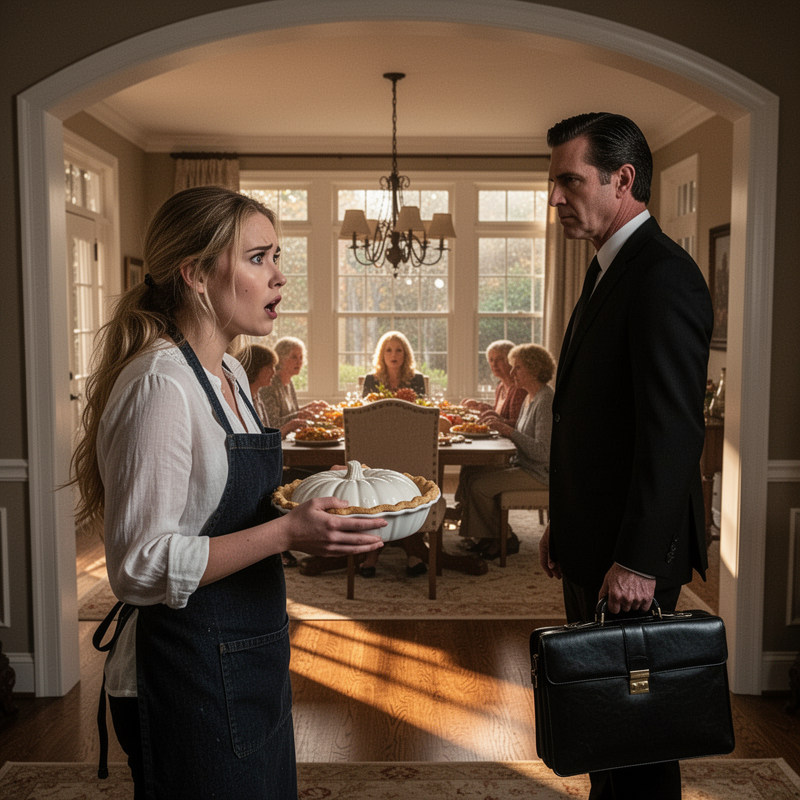
As the sun began to dip below the horizon, casting long shadows through the dining room windows, I prepared the final course. The pumpkin pie, perfectly golden and aromatic, rested on a pristine white ceramic dish. It was a dessert I had personally baked, a small act of defiance against the day’s forced labor.
I took a deep breath, the scent of cinnamon and nutmeg a small comfort. This was it. The last major delivery. Perhaps then, I could finally sit, even if it was just on a stool in the corner of the kitchen.
Carefully, I carried the pie through the kitchen archway, my eyes fixed on the path ahead. The familiar clatter of forks and the buzz of conversation filled the living room. My mother was mid-anecdote, her voice carrying clearly.
Then, a sudden lull in the conversation. The air shifted. It wasn’t the silence of polite listening, but an abrupt, heavy stillness.
I looked up.
Standing in the grand archway that led from the foyer into our living room, just opposite the dining room, was a man I had never seen before. He was tall, impeccably dressed in a crisp black suit, his dark hair slicked back. In one hand, he held a sleek leather briefcase, its polished surface catching the last rays of sunlight. His face was stoic, his gaze sweeping across the room with a quiet authority that silenced even Aunt Carol’s usually indefatigable chatter.
He took a slow, deliberate step forward, his eyes landing on my mother first, then sweeping over the assembled family. Every head was turned toward him, forks suspended mid-air.
“Good afternoon, everyone,” he said, his voice calm, deep, and utterly devoid of emotion. “My name is Maxwell Thorne.”
He paused, letting his name hang in the sudden, profound silence. My grip on the pie dish tightened.
“I am an attorney,” he continued, his gaze now settling firmly on my mother. “And I am here on behalf of the late Robert Miller, to discuss some urgent family business.”
The pie dish slipped.
What happened after that is in the first comment, because that’s when the truth started leaking out.
Part 2
The ceramic pie dish hit the hardwood floor with a sharp crack that echoed in the sudden, deep silence. Pumpkin pie, still warm and fragrant, splattered across the polished wood, shards of white glittering among the orange goo. I stared at the mess, my hands still suspended in the air.
A collective gasp went through the room. Eleanor was on her feet, a hand flying to her mouth, her eyes wide with what seemed like genuine horror. Michael pushed back his chair, a look of contrived disbelief on his face.
“Robert?” Eleanor choked out, her voice trembling, but her eyes, when they darted to mine, held a strange, unsettling flicker. “Dead? What are you saying?”
Michael echoed her, “Dad? No, that can’t be right! He was just on a business trip!”
Their voices, however, lacked the raw edge of true shock. It was a performance, carefully rehearsed, but my own gut was churning.
Maxwell Thorne, the attorney, remained perfectly still. His gaze flickered from the shattered pie to me, then back to Eleanor and Michael. Not a muscle in his face twitched.
“Robert Miller passed away three weeks ago,” he stated, his voice as calm and steady as before. “A sudden heart attack. He explicitly instructed me to convene this gathering, on this day, at this time.”
My breath hitched. Three weeks. Three weeks, and no one had told me. My father was gone, and I had been serving pie, oblivious.
Thorne reached into his briefcase. “I am here now, as per Mr. Miller’s wishes, to read his last will and testament.”
He pulled out a thick envelope, the paper crisp and white. He didn’t wait for anyone to respond, simply motioned towards the head of the dining table. Eleanor’s eyes, fixed on the envelope, were no longer feigning surprise. They were sharp, assessing, and calculating.
I looked from the attorney’s stoic, unreadable face to my mother’s suddenly hardened expression. The clatter of forks, the laughter, the warmth of the day had vanished. This wasn’t Thanksgiving dinner anymore. This was a battlefield, and the main course was about to be served.
Chapter 2: The Shocking Revelation
Attorney Maxwell Thorne cleared his throat, his gaze sweeping over the gathered family. He held the thick document steady in his hands, its pages rustling softly in the otherwise silent living room.
“Per the last will and testament of Robert Thomas Miller,” he began, his voice devoid of inflection, “I hereby declare the following bequests.”
My breath hitched in my chest as he continued. A sum of $1.5 million USD was allocated to me, Sarah Miller. The words hung in the air, a physical weight.
Then came the next shock. “Furthermore, the primary residence located at 1450 Whispering Pines Drive, Alpharetta, Georgia, inclusive of all its furnishings, valued at $950,000 USD, is also bequeathed to Sarah Miller.”
Aunt Carol gasped, a small, choked sound. Eleanor’s face, usually so composed, tightened into a mask of disbelief, her eyes flicking towards me with a sudden, sharp intensity. Michael, slumped in an armchair, straightened slightly, a frown etching itself between his brows.
Thorne continued, undeterred. “Additionally, Ms. Sarah Miller is granted full control and discretion over the Robert Miller Legacy Charitable Trust, a multi-million-dollar fund designated for community development initiatives, per Mr. Miller’s explicit instructions.”
My head swam. Control of a multi-million-dollar trust? It felt utterly surreal. My hands trembled where they rested on my lap.
Then, the focus shifted. “Regarding Eleanor Miller and Michael Miller,” Thorne stated, pausing for dramatic effect, “they are each granted an annual stipend of $25,000 USD.”
A low growl rumbled from Eleanor’s throat. Michael’s jaw dropped. The relatives around the table exchanged swift, scandalized glances, their whispers beginning to rise in volume.
“This sum,” Thorne added, his voice cutting through the murmuring, “is conditional upon certain terms, as will be detailed.”
The room buzzed with the suppressed clamor of shocked family members. Aunt Carol turned to her neighbor, her hand clamped over her mouth. Thorne brought his small gavel down on the coffee table with a sharp crack.
“Order, please,” he commanded, his voice firm. “I assure you, every clause is precise and legally binding.”
Eleanor’s eyes, wide and furious, fixed on mine. Michael stared at his mother, then back at me, a flicker of something dark in his gaze. I felt a chill despite the warmth of the room. This was not just an inheritance; it was an upheaval.
Chapter 3: A House Divided
Attorney Thorne waited for the last whispers to die down, his gaze unwavering. My chest felt tight, the air thick with unspoken animosity.
“Now, concerning the residency of Eleanor and Michael Miller within the Alpharetta home,” Thorne resumed, “Mr. Miller’s will specifies a critical condition.”
He looked directly at me. “Ms. Miller, you are required to reside in the Alpharetta home and actively manage the estate for a minimum period of six consecutive months to fully claim your inheritance, including the trust.”
My eyes widened. Six months. With them.
“Eleanor and Michael Miller are permitted to reside in the home during this six-month period,” Thorne continued, “but only under specific stipulations.”
Eleanor shifted, her fingernails digging into the armrest of her chair. Michael looked utterly bewildered.
“They must acknowledge Sarah Miller as the sole head of the household during this time,” Thorne read, his voice clear. “Any action perceived as disruptive behavior, disrespect towards Sarah Miller, or failure to comply with her reasonable authority will result in an immediate cessation of their annual stipends.”
Eleanor’s face contorted, a vein throbbing visibly in her temple. Her hands clenched into fists.
“In such an event,” Thorne added, his tone sharpening, “their stipends will be immediately redirected to the Robert Miller Legacy Charity Fund.”
A collective intake of breath swept through the room. Michael’s mouth hung slightly open, a blank, horrified expression on his face. Eleanor sat rigid, her breath coming in shallow gasps.
“I will personally oversee the initial transition period,” Thorne concluded, closing the will document with a decisive snap. “My office will be in regular contact.”
He stood, gathering his briefcase. The family remained frozen, silently watching him. I felt completely overwhelmed, trapped in a house that was now legally mine, yet filled with a palpable, hostile tension.
Eleanor slowly turned her head, her gaze meeting mine, and a silent, venomous promise passed between us. The Thanksgiving celebration was truly over.
Chapter 4: Whispers of the Past
Days later, the tension in the Miller home remained a heavy, suffocating blanket. Eleanor swept through the house, giving me the cold shoulder. She made veiled comments about my “sudden ambition” and how quickly I had forgotten my “place.”
Michael, meanwhile, openly sulked, spending most of his time holed up in his room. The comfortable rhythm of my new, bizarre authority was constantly interrupted by their passive-aggressive resistance.
One morning, while sorting through mail addressed to “The Miller Estate,” I found a final notice. It was a property tax bill for $8,500 USD, marked severely overdue. Eleanor had clearly “forgotten” to mention it.
I carried the bill downstairs. Michael was in the kitchen, casually leaving a stack of dirty dishes by the sink, ignoring Mrs. Hayes who was trying to clean.
“Michael,” I said, my voice firmer than I expected, “this is an $8,500 property tax bill. It’s overdue.”
He barely glanced at it. “Mom probably just forgot. Relax, it’ll get handled.”
“No,” I insisted, “it needs to be handled now. And these dishes need to be washed by you.”
He scoffed, turning back to his phone. “What are you going to do? Cut my measly $25,000?”
“I will, if you can’t respect simple rules,” I stated, placing the bill on the counter with a definitive tap. “This house is my responsibility now.”
Michael threw his phone down. “You think you’re so smart, don’t you? With your big inheritance.” His face was flushed with anger.
“It’s about responsibility,” I countered, crossing my arms.
He let out a bitter laugh. “Responsibility? Our father disinherited me years ago because of responsibility. You think you’re so special?”
My breath hitched. “What are you talking about?”
He glared at me, then looked away, rubbing his forehead. “Gambling debts. Over $200,000. Dad found out and rewrote his will right then and there.”
My stomach dropped. “But… but you were included in the previous will, weren’t you?”
“Mom fixed it,” he mumbled, his voice low. “She paid it all off, pulled some strings, even forged some documents to make it look like Dad was still going to include me.”
My mind raced, connecting the dots. Eleanor’s desperate need for control, her manipulation. It went deeper, far deeper, than I had ever imagined.
Chapter 5: Robert’s Secret Legacy
Michael’s confession about his gambling debts and Eleanor’s elaborate cover-up echoed in my mind for days. It solidified my suspicions, painting a far more sinister picture of my mother’s actions. Every passive-aggressive slight, every manipulative remark, took on new meaning.
One afternoon, as I was attempting to make sense of the chaotic stacks of papers in Robert’s home office, Mrs. Evelyn Hayes entered quietly. She moved with a purpose, clearing dust from the old mahogany desk.
She approached me hesitantly, her eyes darting towards the closed door. “Sarah,” she whispered, her voice barely audible, “your father… he entrusted me with something.”
She reached into the deep pocket of her apron and pulled out a small, leather-bound journal and a thick, sealed envelope. Both felt cool and heavy in my hand.
“He gave these to me years ago,” Mrs. Hayes explained, her gaze earnest. “He said to give them to you, and only you, ‘when the time was right.’ He said you’d know.”
My heart pounded. I nodded, clutching the items tightly. “Thank you, Evelyn.”
I retreated to my room, locking the door. The journal had Robert’s familiar handwriting on the first page. It was a meticulous account of his observations. Dates, small incidents, snippets of conversations.
He documented Eleanor’s increasing greed, her subtle ways of diverting family funds, and Michael’s escalating financial irresponsibility, always followed by Eleanor’s desperate attempts to conceal it. Each entry was a tiny, damning piece of evidence.
He even detailed his observations of me—my quiet resilience, my unnoticed efforts, my longing for fairness. The journal revealed his long-term plan, the intricate clauses of his will not just legal directives, but carefully laid traps.
A particularly chilling entry described how he had subtly orchestrated the Thanksgiving dinner, intending it as a final “test” of everyone’s true character. He wanted to witness Eleanor’s and Michael’s behavior towards me firsthand, to confirm his suspicions before his will was read.
My father, from beyond the grave, had woven a complex tapestry of justice. I stared at the sealed envelope, knowing it likely held even more of his calculated brilliance.
Chapter 6: The Counterattack
Armed with my father’s journal, a newfound resolve solidified within me. The pages detailed not just betrayal, but Robert’s deep faith in my capabilities. I could not, would not, let him down.
My first act was to address the neglected property. The sprinkler system, which Eleanor had declared “too expensive to fix,” was constantly leaking, turning a section of the lawn into a muddy mess. I called a contractor, scheduled the repair, and paid for it from the estate’s funds.
Later that week, I found Michael in the living room, betting on a horse race on his tablet. His stipend was already low, but he seemed unable to stop.
“Michael,” I stated, standing over him, “your gambling is impacting your financial stability. If this continues, your $25,000 stipend will be significantly reduced, as per the will’s conditions for financial irresponsibility.”
He flinched, his head snapping up. “You can’t do that!”
“I can, and I will,” I affirmed, feeling my backbone stiffen. “Father planned for this.”
This must have been the final straw for Eleanor. The very next day, I received a thick envelope in the mail. Inside were legal papers. Eleanor had hired a prominent Atlanta estate lawyer, Mr. Arthur Sterling, to challenge the will.
I called Attorney Thorne immediately, my voice trembling with a mix of anger and fear. He listened calmly, his voice steady. “I anticipated this, Sarah. We will proceed as planned.”
A week later, I was served with formal court summons. Eleanor, through her aggressive new lawyer, presented a seemingly legitimate document. It was a signed affidavit from a distant relative I barely knew, a second cousin from out of state.
The affidavit alleged that Robert Miller had been in a state of diminished mental capacity during the last months of his life. It claimed he was confused, easily swayed, and that I, Sarah, had been manipulating him for financial gain.
The public accusation felt like a punch to the gut. The social facade of the Miller family was crumbling, and Eleanor was willing to burn it all down to get what she wanted.
Chapter 7: The Final Verdict
The courtroom was packed, a silent, expectant audience watching as Eleanor’s attorney, Mr. Sterling, made his final, dramatic presentation. He presented the forged affidavit, painting a picture of my father as frail and susceptible.
Then, he called his “witness” to the stand—a meticulously dressed man who claimed to be a lifelong friend of Robert’s. The man, a paid actor I quickly realized, spun a convincing tale of Robert’s alleged mental decline, his wandering thoughts, and my supposed undue influence.
Just as the judge seemed to lean forward, a thoughtful expression on his face, Attorney Thorne calmly rose from his seat. He stood tall and unhurried.
“Your Honor,” Thorne began, his voice clear and resonant, “we anticipated such an unfortunate challenge. Mr. Robert Miller, a man of profound foresight, prepared for precisely this scenario.”
He walked to a monitor set up in the courtroom. “I submit into evidence a notarized video recording of Robert Miller, made three weeks prior to his passing.”
The screen flickered to life. Robert, my father, appeared, looking composed and articulate. He spoke eloquently, discussing the intricate details of his will, his sound mental state, and the specific, carefully considered reasons behind every decision he made regarding his estate. He looked into the camera, a familiar twinkle in his eye, and explained how each clause was designed to ensure long-term stability and fairness for all involved.
The video then abruptly shifted. The image changed to a hidden camera perspective. It was our living room, on Thanksgiving Day. The angle was subtle, almost unnoticeable. My jaw dropped.
The footage showed Eleanor’s demeaning treatment of me as I served dinner, her disparaging glances, her whispered complaints to Aunt Carol. Then, it cut to a later segment, capturing a hushed conversation between Eleanor and Michael.
“We’ll challenge it,” Eleanor whispered, her face tight with fury. “Claim she manipulated him. He was clearly losing it at the end.” Michael nodded, his face grim. “He was always so strange, writing in that journal.”
A collective gasp swept through the courtroom. Eleanor’s face went ashen, her mouth opening and closing soundlessly. Michael stared at the screen, utterly speechless.
Thorne allowed the silence to stretch, then delivered the final, devastating blow. “Your Honor, Mr. Miller also foresaw that his finances might be tampered with. A year prior to his death, he initiated a forensic audit of all joint family accounts, designed to become accessible only after his passing.”
He presented a thick binder. “This audit reveals that Eleanor Miller systematically embezzled $350,000 USD from a joint family account over the last five years. These funds, Your Honor, were primarily used to cover Michael Miller’s extensive gambling debts, as well as to maintain Mrs. Miller’s lavish personal lifestyle.”
The digital evidence, meticulously gathered and presented by Thorne, was irrefutable. Eleanor slumped in her chair, her face utterly defeated. Michael buried his face in his hands.
The judge, his expression grave, looked from the screen to Eleanor and Michael, then back to the audit. “Given the overwhelming and undeniable evidence,” he stated, his voice ringing through the silent court, “I believe I have sufficient information to deliver my verdict.”
Leave a Reply