Chapter 1:
Part 1
My mother called at 2 AM, her voice a hushed urgency, saying I was only allowed at my brother’s fiancée’s family dinner if I kept absolutely silent. She warned me that the fiancée’s father was a highly decorated Colonel, a man of immense influence.
The phone vibrated off my nightstand like a frantic wasp. My eyes cracked open, heavy with sleep, to the glowing red numbers of my digital clock: 2:13 AM. It was my mother, Evelyn. A call at this hour could only mean trouble, or worse.
I fumbled for the cold device, pressing it to my ear.
“Sarah? Are you awake?” Her voice was a strained whisper, tight with a fear I instantly recognized.
“Mom, what is it? Is everything okay?” I pushed myself up, my heart already hammering against my ribs.
“It’s about Michael’s engagement dinner tonight,” she breathed, the words tumbling out as if someone might overhear. “You have to promise me, Sarah. You have to promise you’ll just… stay quiet.”
I blinked, trying to clear the fog from my brain. “Quiet? What are you talking about?”
“Just listen,” she insisted, her voice rising slightly before she caught herself, pulling it back to a frantic hiss. “Colonel Sterling. Liz’s father. He’s… he’s very important. Highly decorated. A man with immense influence. You cannot, under any circumstances, say anything controversial. Anything at all.”
My mother was prone to anxiety, especially concerning social events. She often worried about me, a financial analyst who preferred spreadsheets to small talk, saying something “inappropriate” at a high-society gathering. Usually, her warnings were about my sometimes blunt honesty or my tendency to question things others let slide. But this felt different. The terror in her voice was palpable, raw.
“Mom, what are you afraid I’ll say?” I asked, a knot forming in my stomach. Was there something she’d heard about me? Some perceived slight in my past she thought might surface?
“It’s not about what *you* might say, exactly,” she hedged, her words still rushed. “It’s about maintaining harmony. For Michael. This marriage is so important for him. For his future.”
She was clearly holding something back, the true reason for her panic shrouded in vague pleas for “harmony.” I imagined her pacing her kitchen in the dark, wringing her hands, terrified of some unknown social disaster. The conversation ended with her extracting a reluctant promise of silence from me, a heavy weight settling on my shoulders long after I hung up.
The Sterling estate in Greenwich, Connecticut, was everything my mother’s hushed reverence had implied. A grand iron gate, flanked by perfectly sculpted hedges, swung open silently as my Uber approached. The long, winding driveway led to a mansion of imposing stone and glass, sprawling across acres of manicured lawn that stretched towards a distant glint of water. It was less a home and more a fortress, meticulously designed and maintained, exuding an air of untouchable wealth and power.
Inside, the opulence was sterile, almost museum-like. Every surface gleamed, every piece of art seemed carefully curated, strategically placed for maximum impact. The air was thick with the scent of expensive lilies and old money. Guests mingled in hushed tones, their polite laughter never quite reaching the cavernous ceilings. I felt like a misplaced piece of furniture, dressed in a borrowed silk dress, observing rather than participating.
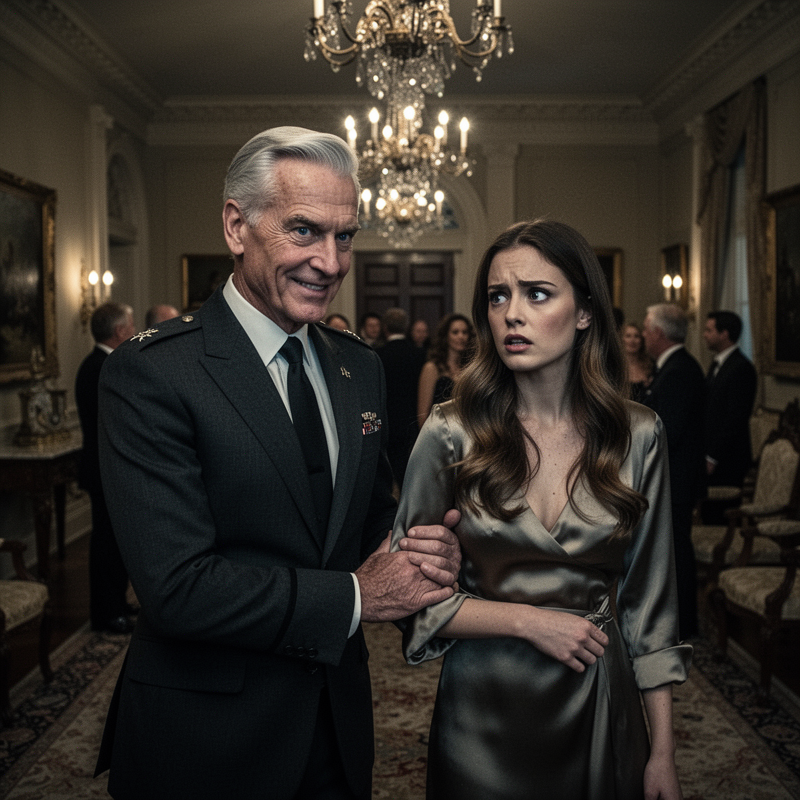
Then I saw him. Colonel Robert Sterling. He was taller than I’d imagined, his posture military-erect, even in a custom-tailored suit. His silver hair was impeccably groomed, and his blue eyes, though crinkling at the corners when he smiled, held a piercing intensity that seemed to take in every detail, every person, in the room. He moved with an effortless authority, commanding attention without saying a word, a living embodiment of my mother’s whispered warnings. He was charismatic, certainly, but something in his gaze felt calculating, like a predator assessing its territory.
Liz, his daughter and Michael’s fiancée, was a perfect reflection of her environment – elegant, poised, with a smile that was charming but felt just a little too polished. She navigated the room with practiced ease, her hand frequently resting on Michael’s arm, a silent claim of possession. Michael, bless his kind heart, looked utterly enamored, his usual nervous energy replaced by a serene, almost oblivious happiness.
As the evening progressed, the small talk felt increasingly suffocating. Eventually, Colonel Sterling tapped a crystal glass with a silver spoon, bringing the room to a polite silence for a pre-dinner toast. Liz beamed beside him, clutching Michael’s hand.
“To family,” the Colonel boomed, his voice resonant and commanding, “and to the wonderful union of my daughter, Elizabeth, and Michael.”
A wave of murmured congratulations swept across the room. Michael, a history teacher and a self-proclaimed history buff, flushed with pride. He cleared his throat, eager to add his own sentiment.
“And to Colonel Sterling,” Michael began, his gaze full of admiration for his future father-in-law. “A true American hero. You know, I was just telling Liz about the incredible stories of your bravery, especially your commendation at… uh… Fort Blakley.” He pronounced the name with a slight, almost imperceptible mispronunciation, elongating the ‘a’ sound. “Unbelievable courage in the face of impossible odds.”
A hush fell, more profound than before. The room seemed to collectively hold its breath.
Colonel Sterling, who had been holding his glass high, froze. The smile on his face faltered, dissolving into something rigid. A muscle in his jaw clenched, then released, almost imperceptibly. For a fraction of a second, his piercing blue eyes hardened, losing all warmth, replaced by a cold, distant look. It was gone as quickly as it appeared, masked by another practiced smile, but I had seen it.
Across the room, my mother Evelyn’s head snapped towards me. Her eyes were wide, panicked, a silent scream of “Don’t you dare!” in her desperate gaze. The warning she’d given me at 2 AM suddenly clicked into place. This wasn’t about my tendency to be socially awkward or controversial. It was about *their* secrets. About a hidden incident, a buried past, that Michael, in his innocent enthusiasm, had just accidentally stumbled upon. He had hit a nerve, a raw, exposed wound that the formidable Colonel Sterling clearly preferred to keep hidden.
The Colonel recovered with a hearty chuckle, raising his glass again. “Ah, yes, Fort Blackley,” he corrected, his voice smoother than ever, though a slight tremor in his hand betrayed the effort. “Old war stories for another time, perhaps. But tonight, it is about Michael and Liz!”
Glasses clinked, polite chatter resumed, but the air felt charged, heavy with unspoken tension. I watched the Colonel from across the room, feeling a chill creep down my spine despite the warmth of the room. He looked at Michael with an almost unsettling intensity, then his gaze drifted, landing directly on me. A thin, almost predatory smile stretched across his lips.
He began to walk towards me, his eyes never leaving mine. Every step was deliberate, unhurried, yet filled with an undeniable purpose. My breath caught in my throat. He stopped directly in front of me, his shadow falling over me like a shroud.
“Sarah,” he said, his voice a low, smooth rumble, devoid of its earlier booming cheer. His smile widened, but his eyes remained cold, like chips of blue ice. “We need to ensure family harmony, don’t we?”
His hand, surprisingly firm, grasped my elbow. Without waiting for a response, he gently but undeniably steered me away from the mingling guests, towards a quiet, secluded alcove at the far end of the vast room. He was ushering me away for a private word.
What happened after that is in the first comment, because that’s when the truth started leaking out.
Part 2
The alcove was dimly lit, adorned with a large, unsettling portrait of an ancestral Sterling. Colonel Sterling released my elbow, but his presence still loomed.
“Michael is a sensitive young man,” he said, his voice soft, almost paternal. “He thrives on stability, on peace. This marriage, his future with Liz, means the world to him.”
He paused, letting his words hang in the air, his eyes unblinking. “Some old stories, Sarah, are best left undisturbed. For the sake of harmony. For the sake of our family’s peace.” It was a warning, cold and precise, delivered with a smile that never quite reached his eyes.
My throat felt tight, a knot of unease coiling in my stomach. The implied threat was clear: Michael’s happiness, his future, depended on silence. My silence.
Later that evening, the elaborate dinner concluded. The polite chatter and clinking silverware continued to grate on my nerves. I excused myself, needing a moment away from the oppressive atmosphere, and headed towards the powder room.
As I pushed open the heavy, carved door, a shadow fell behind me. I turned to find Liz, her perfect smile in place, closing the door softly.
She moved gracefully to stand beside me at the ornate mirror, adjusting a stray strand of her meticulously styled hair. Her reflection was flawless.
“You know,” she began, her voice a hushed, conspiratorial whisper, “Michael is quite chatty when he’s comfortable. He also loves digging into old archives, doesn’t he?”
Her eyes met mine in the reflection. They were no longer the warm, charming eyes of a fiancée; they were cold, calculating, utterly devoid of softness.
“We wouldn’t want him getting the wrong ideas about anything, would we, Sarah?” Her smile remained, but her gaze was a direct, chilling warning.
A jolt ran through me. This wasn’t just about her father’s past. Liz was not only aware of the secret Michael had inadvertently touched upon, but she was actively involved in its meticulous concealment. Her threat was personal, a stark message aimed directly at me if I dared to probe further.
Chapter 2: The Redacted Past
The chilling edge in Liz’s voice, the cold calculation in her eyes, left a metallic taste in my mouth. I had expected a socialite, not an operator. Her words, so casually delivered, confirmed my initial suspicion: the silence wasn’t for my social ineptitude, but to cover a secret the Sterlings desperately wanted buried.
My mind replayed Michael’s casual mention of “Fort Blakley,” the slight mispronunciation echoing in my thoughts. Back in my apartment, I pulled out my laptop, the screen’s glow the only light in the silent room. My old university library access provided a familiar portal to academic databases and military archives.
I began with “Fort Blackley,” the correct spelling, cross-referencing it with Colonel Robert Sterling’s name. His public military history was a monument to valor, a decorated career, but I spotted a peculiar gap, a redacted section around the time of the Fort Blackley incident. It was a blank space where vital information should have been, a deliberate obscuring of facts.
The search continued, expanding to local newspapers around the Fort Blackley area, targeting two decades ago. I sifted through scanned microfiches and digitized archives, scrolling past mundane headlines and local announcements. Then, I found it. An obscure clipping, buried deep within a small-town gazette, caught my eye.
The headline was understated: “Unexplained Incident Claims Two Civilians Near Fort Blackley.” The article, brief and lacking detail, described how two local residents had died during a military training exercise. It mentioned the official ruling of an “unfortunate accident,” but a follow-up line noted how further detailed records had been “swiftly scrubbed from public access.”
A knot tightened in my stomach. This wasn’t just a powerful man’s temper; this was a cover-up. The contrast between Colonel Sterling’s pristine public image and this deliberately obscured tragedy was jarring. His heroism, it seemed, had a deeply unsettling shadow.
I clicked through more search results, trying to find anything else, a clearer picture of the incident, names of the victims, but the digital trail went cold. It was as if the event had been erased from history.
The air in my apartment felt suddenly heavy, the silence oppressive. Liz’s warning was now amplified by the weight of what I’d found. This wasn’t just about protecting Michael from a manipulative fiancée; it was about exposing a truth that someone had gone to extreme lengths to bury. I saved the clipping and closed my laptop, the screen reflecting my own grim expression.
Chapter 3: The Fabricated Affair
The phone vibrated on my kitchen counter, startling me as I made coffee. Michael’s name flashed across the screen. I answered, expecting a routine check-in, but his voice was immediately strained, tight with an anger I rarely heard from him.
“Sarah, what have you done?” he demanded, no preamble.
My brow furrowed. “What are you talking about, Michael?”
“Don’t play innocent with me! I just got an email. It’s… it’s disgusting!” His voice cracked, a tremor running through his words.
He then launched into a breathless explanation, describing an anonymous email he’d received. It contained doctored photos of me talking with a male colleague from my previous job. The accompanying story was a lurid fabrication, claiming I was having an affair and was now jealous of his happiness, actively trying to sabotage his engagement.
“It says you’re unstable,” Michael continued, his voice raw. “That you’re making up stories because you can’t stand to see me happy with Liz.”
A cold dread spread through me. This was Liz’s doing, a calculated strike. She was discrediting me, turning my own brother against me, making my genuine concerns sound like the ramblings of a scorned woman.
“Michael, that’s not true,” I insisted, my voice tight. “Those photos are fake. That’s Mark, we were discussing a project from two years ago.”
“The email says you’re obsessed with me, that you tried to break us up before,” he shot back, ignoring my explanation. “It has details, Sarah. About things you said after my last breakup. It feels… real.”
He paused, a heavy silence hanging between us. When he spoke again, his tone was laced with hurt, a profound disappointment. “Liz is devastated. She thinks you genuinely hate her. How could you do this?”
“I didn’t do anything, Michael. This is a setup. Someone is trying to make me look bad so you won’t believe me about the Sterlings,” I pleaded, but my words seemed to fall on deaf ears.
“You need to drop this, Sarah,” he warned, his voice hardening. “Leave it alone. If you keep pushing, if you keep trying to destroy what I have with Liz… I won’t come to your wedding. I mean it.”
The line went dead, leaving me in stunned silence, the bitter taste of betrayal in my mouth. Liz had succeeded. She had driven a wedge between us, exploiting Michael’s vulnerability, poisoning his trust. The email, so carefully crafted, had not only attacked my credibility but had severed the one connection I desperately needed. My brother, my reason for all of this, now saw me as the antagonist.
Chapter 4: Michael’s Forgotten Memory
The sting of Michael’s words lingered, but I pushed it down, focusing on the immediate problem. I needed to dismantle Liz’s smear campaign, starting with the doctored photos. I called Mark, my former colleague.
“Hey, Sarah, long time,” Mark said, his voice cheerful.
“Mark, I have a weird question,” I began, explaining the email and the fabricated story. “Do you remember photos of us talking, maybe two years ago, in the old breakroom?”
He chuckled. “Yeah, definitely. We were in a heated debate about the Q3 earnings report. Your brother’s fiancée probably thinks we were plotting corporate espionage.”
“Did anyone else ever join us in those discussions?” I asked, a faint hope stirring.
“Sometimes, sure. But that specific conversation, the one where you’re waving your hands around like a conductor? Just us. Why, is this about Michael?” Mark asked, concern now in his voice.
I explained the situation briefly, and he was immediately empathetic. “Look, if you need me to, I can swear on a stack of Bibles that we were just talking about work. You tell your brother to call me, I’ll clear it up.”
His easy confirmation was a small victory, a crack in Liz’s carefully constructed lie. Now, for the harder part: rebuilding trust with Michael. I knew confronting him about the email directly would only push him further away. I had to approach him differently, gently, pulling on the loose thread he’d already given me.
I drove to his apartment, finding him slumped on his couch, a textbook open but unread. He didn’t look up when I came in, the air thick with tension. I sat opposite him, not pressing, just being present. After a long silence, I spoke, keeping my voice low and calm.
“I spoke to Mark,” I said. “He remembers our conversation. It was about work. He’s willing to tell you himself.”
Michael stiffened, then sighed, running a hand through his hair. He didn’t meet my gaze. “It doesn’t matter, Sarah. The email… it raised doubts I didn’t know I had. About you, about everything.”
“I know it did,” I conceded. “But you’re a history teacher, Michael. You know how to spot a fabrication. I’m not asking you to believe me completely right now. I just need you to remember something else you told me.”
He finally looked at me, his eyes tired. “What?”
“That commendation,” I prompted gently. “The one for Colonel Sterling. The one you found during your genealogy project, that you said seemed incongruous with other records. You mentioned Fort Blackley.”
He blinked, a flicker of memory crossing his features. “Oh. Right. Yeah, it was weird. A ‘commendation for distinguished service,’ I think it said. But the date… and the unit… it just didn’t quite line up with the narratives I was finding about his other deployments.”
“And what happened when you tried to cross-reference it?” I pressed.
Michael hesitated, then leaned forward, speaking almost in a whisper. “I found a vague mention of an ‘incident’ near Fort Blackley around that time. Nothing specific, just a placeholder. When I asked Liz about it, she… she just said it was ‘private family history,’ and I shouldn’t ‘pry.’ She made it sound like it was some old, embarrassing medical detail or something. So I just dropped it.”
He looked at me, a dawning realization in his eyes. “She told me it wasn’t important.”
A chill ran down my spine. Liz hadn’t just been passively aware; she had actively intervened, subtle as it was, to prevent Michael from digging deeper. Her quick dismissal, framed as protecting family privacy, had effectively steered him away from the truth. Michael had found a crucial detail, and Liz had already been there, deftly sweeping it under the rug.
Chapter 5: A Glimmer of Guilt
With Michael’s admission, the pieces began to click into place, forming a disturbing mosaic of deceit. Liz’s early intervention to dissuade Michael, combined with the redacted records I’d found, solidified my belief that the “Fort Blackley Incident” was at the heart of the Sterling family’s secret. I needed more than obscure newspaper clippings and vague memories; I needed a human connection to the past.
I revisited the Fort Blackley incident details I’d unearthed, focusing on any names associated, however briefly, with the hush-hush investigation. Amidst a list of military personnel involved in the brief, official inquiry, one name stood out: Dr. Aris Thorne, then a junior medical officer. It was a long shot, but a lead was a lead.
A quick online search brought up a Dr. Aris Thorne practicing internal medicine in a quiet town in New Hampshire. The distance was considerable, but the urgency I felt propelled me forward. I concocted a plausible cover story: a medical history student researching military medicine, specifically post-trauma care in the late 90s, the rough timeframe of the Fort Blackley incident.
A few days later, I sat in Dr. Thorne’s waiting room, the antiseptic scent of the clinic doing little to calm my racing pulse. He was a man in his late fifties, his hair flecked with gray, a quiet dignity in his demeanor. When my turn came, he greeted me politely, his eyes kind but weary.
“Ms. Miller, you mentioned you’re a student?” he asked, gesturing to the chair opposite his desk.
“Yes, Dr. Thorne,” I replied, pulling out a notebook. “I’m working on a paper about the evolution of medical reporting in military contexts. I’m focusing on lesser-known incidents from around the late 90s.”
I led the conversation through general topics for a few minutes, easing into the specifics. Then, I casually dropped the names, watching for a reaction. “I’ve come across a few interesting case studies,” I continued, “including one that briefly mentions an ‘unexplained incident’ near Fort Blackley, and a Captain Robert Sterling, who would later become Colonel Sterling.”
Dr. Thorne’s posture, which had been relaxed, stiffened imperceptibly. His hand, resting on a notepad, clenched around his pen, his knuckles whitening. A muscle in his jaw twitched. He cleared his throat, a dry, rasping sound.
“Fort Blackley?” he repeated, his voice suddenly thinner. “Colonel Sterling? I’m afraid I don’t recall any specifics from that far back. Many cases, you understand. A junior officer then, hardly involved in anything major.”
His gaze flickered away, avoiding my eyes, settling on a framed diploma on the wall behind me. He began to fiddle with the papers on his desk, arranging them with unnecessary precision.
“It was a rather brief mention, buried in old reports,” I pressed gently. “Something about a training exercise gone wrong, involving civilian casualties?”
His head snapped up, his eyes wide, a flicker of something unreadable – fear? panic? – crossing them. He quickly composed himself, pushing out a tight smile. “No, no, I truly don’t recall the details, Ms. Miller. The passage of time dulls the memory, you see. I’m afraid I can’t be of much help for your paper.”
He stood abruptly, indicating our conversation was over. “Now, if you’ll excuse me, I have another patient waiting.”
His hurried dismissal, the visible tremor in his hands, the panicked shift in his eyes – it all spoke volumes. Dr. Thorne knew something. Something significant, something he was desperate to keep buried, just like the Sterlings. The silence wasn’t just fear of reprisal, but a heavy burden of guilt.
Chapter 6: The Bitter Ex
Back home, pondering Dr. Thorne’s obvious discomfort, my phone buzzed with a notification from a military history forum I’d joined. It was an anonymous message, cryptic and intriguing: “Ask about Gregory Price. Liz Sterling’s ex. He knows things.”
An ex-boyfriend. The idea sparked immediately. An intimate connection, potentially a jilted one, could provide a different, more personal window into the Sterling family’s secrets. I searched for Gregory Price and found him to be a disgruntled investor, a former college classmate of Liz’s. His public online footprint hinted at recent financial troubles and a bitter tone in his social media posts.
It took some digging, but I eventually found a way to contact him discreetly. We agreed to meet at a quiet coffee shop, away from prying eyes. Gregory, a man with sharp features and even sharper cynicism, arrived promptly. He eyed me with a guarded curiosity.
“So, you’re Michael’s sister,” he stated, stirring his coffee. “Liz Sterling’s future sister-in-law.”
“That’s right,” I affirmed. “And I’m investigating some things about the Sterlings. I heard you might have some… insights.”
He leaned back, a humorless laugh escaping him. “Insights? Oh, I have insights. Liz Sterling. What a piece of work.” He took a sip of his coffee, a vengeful glint in his eyes. “She ruined me, you know. Framed me. Said I cheated on her after I lost a chunk of my investment.”
“She said you cheated?” I prompted.
“Yeah. Pathetic, right? She needed a scapegoat. Needed to cover her tracks. She had a serious gambling problem, online betting. Blew through a lot of cash, more than she admitted to her daddy.” He scoffed. “And when I couldn’t bail her out anymore, I became the ‘cheating bastard’.”
My jaw tightened. This was the manipulation Michael had described, a pattern of deceit Liz skillfully wove. “And her father?”
Gregory’s expression darkened further. “Oh, the Colonel. He’s a real charmer, isn’t he? Built his whole life on an image. Liz used to boast about him. Said he was brilliant at making problems disappear.”
He paused, a thoughtful, calculating look on his face. “I remember one night, she was really drunk. After a big win, I think. She was going on about how lucky she was to have a father like him. Said he once covered up an ‘old training accident at Blackley’ that ‘could have ruined everything’ if he hadn’t stepped in.”
My heart hammered against my ribs. “She said that?”
“Word for word, practically,” Gregory confirmed, a flicker of satisfaction in his eyes. “She gloated about how he could ‘pull strings’ and make ‘inconvenient truths vanish’. Said he was a genius at it. Protected his reputation, protected the family name.”
He took another long sip of coffee, watching my reaction. “She was proud of it, actually. Said it showed how powerful he was. How untouchable.”
The conversation was a revelation, shattering the last vestiges of Liz’s carefully constructed façade. Gregory’s bitter testimony painted a picture of a cunning, self-serving woman, and his drunken anecdote about the “training accident at Blackley” was a direct, independent confirmation of the cover-up Michael had stumbled upon and I had glimpsed in redacted records. The pieces were no longer just connecting; they were slotting into place with terrifying precision.
Chapter 7: Unraveling the Legend
Gregory Price’s testimony provided the crucial human link I needed. His description of Liz’s character and her drunken confession about her father’s cover-up gave me the ammunition to approach someone who could truly help: David Chen, the investigative journalist. I found his contact details through an online search and sent him a concise, detailed email, outlining my findings and the pattern of deceit.
Chen responded surprisingly quickly, his interest piqued by the layers of manipulation and the involvement of a highly decorated military officer. We arranged a meeting, and I laid out everything: Michael’s initial discovery, Liz’s veiled threats and smear campaign, Dr. Thorne’s fearful reaction, and Gregory’s explosive insights. Chen listened intently, his pen flying across his notepad.
“A highly decorated Colonel, civilian deaths, a coerced doctor, and a manipulative daughter actively covering it up,” Chen mused, tapping his pen against his lips. “This has all the makings of a major story.”
He promised to leverage his extensive contacts within military archives and intelligence communities. Over the next few days, we exchanged frequent updates. Chen was tenacious, following every thread I’d given him, pushing past initial bureaucratic stonewalling.
Then, his call came, his voice buzzing with controlled excitement. “Sarah, you were right. We’ve got something big.”
He explained that his contacts had unearthed heavily redacted internal documents related to Colonel Sterling’s service history. These documents, previously considered inaccessible, told a very different story from the public narrative. Colonel Sterling’s “heroic” injury, always attributed to a “covert operation,” was now explicitly hinted to be a severe training accident. Not enemy action, but a catastrophic mistake.
“Even more damning,” Chen continued, “we found cryptic allusions to ‘unauthorized activity’ and a ‘special directive’ to ‘manage public perception’ surrounding the incident. These weren’t isolated phrases; they were recurring themes in the classified reports.”
He explained that the “special directive” strongly implied Colonel Sterling’s direct and commanding role in orchestrating the cover-up. The documents suggested he hadn’t just been a victim of an accident, but potentially the cause, and then the architect of its concealment. The language used was carefully vague, but the context was unmistakably clear.
“The commendation Michael found?” Chen asked. “It wasn’t for bravery in the line of duty, Sarah. It was for his ‘efficiency and decisive action’ in handling the aftermath. Meaning, orchestrating the cover-up.”
A cold wave washed over me. The entire legend, the carefully curated image of a valiant war hero, was a meticulously crafted lie. The commendation, Michael’s innocent discovery, was the smoking gun for a different kind of “service” – the systematic burying of truth, the silencing of witnesses, and the rewriting of history to protect a career. Colonel Sterling had built his legacy not on valor, but on deception and the tragic loss of innocent lives.
Chapter 8: Thorne’s Burden
The weight of David Chen’s findings settled heavily in my chest. The meticulously crafted legend of Colonel Sterling was not merely flawed; it was a total fabrication. With the official documents confirming the cover-up, we knew we had to confront Dr. Thorne again, this time with irrefutable evidence.
We drove back to New Hampshire, the silence in the car heavy with anticipation. Dr. Thorne was startled to see both of us, his initial polite demeanor quickly replaced by a visible unease. He recognized me, and Chen’s direct, authoritative presence visibly rattled him.
“Dr. Thorne,” Chen began, his voice calm but firm, “we have evidence that indicates your involvement, however coerced, in falsifying medical reports related to the Fort Blackley incident. This isn’t a student paper anymore. This is about a military cover-up and civilian deaths.”
I saw the color drain from Thorne’s face. His gaze darted between Chen and me, then landed on the stack of heavily redacted documents Chen had placed on his desk. He picked up one, his fingers trembling as he traced a line of text, his eyes wide with a mixture of fear and despair.
“I… I can’t,” he whispered, his voice barely audible. “He’ll destroy me. He still has so much influence.”
“Colonel Sterling’s influence is waning, Dr. Thorne,” I interjected, my voice gentle. “The truth is coming out, one way or another. You have a chance to tell your side of the story, to unburden yourself. To choose justice.”
He slumped back in his chair, his shoulders shaking. His composure finally shattered, and he began to speak, his words tumbling out in a rush, years of suppressed guilt and fear pouring forth.
He confessed everything. Captain Sterling, then a reckless and arrogant officer, had been heavily intoxicated during a late-night “training exercise” near Fort Blackley. He had driven a military vehicle recklessly off-base, striking and killing two local civilians walking near the perimeter.
“He was drunk, Sarah,” Thorne choked out, tears welling in his eyes. “So drunk he could barely stand. They were just… there. Two innocent people.”
Thorne, a terrified junior medic barely out of medical school, had been coerced under severe duress and threats to his budding career. Sterling, leveraging his immediate authority and connections, had forced him to sign false reports, blaming “enemy insurgents” for the deaths and attributing Sterling’s own injuries to “heroic action during a covert operation.”
“He said if I ever breathed a word, my life, my family… everything would be ruined,” Thorne whispered, his voice raw. “He had people. He had power.”
The commendation Michael had found, Thorne confirmed, was indeed for Sterling’s “efficiency” in orchestrating the cover-up and silencing those involved, twisting the narrative into one of heroism. It was a macabre reward for deceit.
He wiped his eyes with a shaking hand. “I’ve lived with this for decades. The faces of those poor people… they haunt me.”
After a long, emotional silence, Thorne looked at us, his eyes still red but with a newfound resolve. “I’ll testify,” he said, his voice firmer now. “I’ll tell everything. Whatever the cost. I can’t live with this lie anymore.”
The confession was a breakthrough, providing the critical human testimony needed to expose Sterling’s crimes. Yet, as he spoke, the deep-seated fear in Thorne’s eyes was still palpable. He was choosing conscience, but the shadow of Colonel Sterling’s power still loomed large.
Chapter 9: The Colonel’s Downfall
The stage was set. Michael, having finally absorbed the full extent of Liz’s deceit from Gregory and seeing the compiled evidence from David Chen and me, had made his choice. He arranged a meeting at the Sterling estate, a tense family gathering where the truth would finally come to light. Liz and Colonel Sterling sat stiffly, their expressions a mix of arrogance and thinly veiled irritation. Michael’s face was grim.
Chen and I began to present our irrefutable evidence. Dr. Thorne’s detailed, sworn confession was laid out first, followed by Gregory Price’s testimony about Liz’s manipulations and the Colonel’s drunken boasts. Then came the declassified military documents, highlighting the glaring discrepancies in Sterling’s official record, the carefully worded allusions to a cover-up.
Colonel Sterling remained impassive, his gaze fixed and unyielding. “This is preposterous,” he scoffed, his voice booming with practiced authority. “Dr. Thorne is a disgruntled subordinate with a vendetta. And Sarah,” he sneered, turning his eyes on me, “is simply a jealous, unstable family member, trying to sabotage Michael’s happiness.” Liz, beside him, mirrored his indignation, her hand flying to her chest. She gasped, her eyes wide, “I can’t believe this! Sarah, how could you invent such cruel lies?” She tried to present herself as an innocent victim caught in a malicious family drama.
“We have more, Colonel,” Chen stated calmly, undeterred by their theatrical denials.
I then produced my phone. “Gregory also provided this,” I said, hitting play on a recorded conversation. Liz’s voice, clear and chilling, filled the room. She was heard coaching a friend on how to further discredit me, detailing specific false rumors to spread about my character and mental state. The feigned shock vanished from Liz’s face, replaced by a mask of horrified realization.
Chen followed, producing a series of previously sealed photographic evidence from the incident site near Fort Blackley. The images clearly showed the civilian victims’ vehicle damage, utterly inconsistent with “enemy action.” He then held up a long-suppressed local police report from the time, detailing the discovery of the civilian bodies and, crucially, describing the intoxicated Captain Sterling at the scene.
The room fell silent. Colonel Sterling’s perfectly composed facade began to crack. His face mottled, a vein throbbing in his temple. He began to tremble, his controlled anger giving way to something raw and primal.
“This is outrageous!” he roared, leaping to his feet, his voice shaking with uncontrollable fury. “You think you can just march in here and dismantle everything I’ve built? My career? My legacy?” He slammed his fist on the table, porcelain clattering. “You think I enjoyed covering up the deaths of those two peasants? It was a necessary evil to protect my career and this family!”
The words hung in the air, thick and poisonous. His unwitting confession, screamed in a fit of rage, was heard by everyone: Michael, Evelyn, and David Chen. Liz flinched, her eyes widening in terror at her father’s self-incrimination. Michael stood rigid, his face etched with disgust and horror. The meticulously crafted legend had shattered, irrevocably.
“Michael,” I whispered, relief washing over me, knowing he’d finally seen the truth.
He turned to Liz, his eyes cold and hard. “It’s over, Liz. This engagement, us… it’s all over.”
Chapter 10: Justice Unveiled
The revelation of Colonel Robert Sterling’s confession sent shockwaves far beyond the Sterling estate. David Chen’s explosive investigative piece, published nationwide a few days later, detailed the decades-long cover-up in chilling detail. It meticulously laid out the sequence of events, from the reckless accident caused by an intoxicated Captain Sterling to the systematic coercion of Dr. Aris Thorne and the falsification of reports.
Dr. Thorne’s courageous testimony, now publicly delivered, provided the human heart of the story, finally clearing his conscience after years of silent suffering. Combined with the irrefutable documents unearthed by Chen and the damning corroboration from Gregory Price and Michael, the case against Colonel Sterling was airtight.
The military launched an immediate, formal investigation. The process was swift and decisive. Colonel Robert Sterling was stripped of all his military honors, his distinguished rank, and, perhaps most painfully, his substantial military pension. The estimated loss of his pension, a figure he had meticulously calculated, amounted to over $1,500,000 USD over his expected retirement, a final, crushing blow to his carefully cultivated wealth and status. He now faced federal charges for obstruction of justice and involuntary manslaughter, and was served with multiple wrongful death lawsuits from the victims’ surviving families, potentially amounting to multi-million dollar payouts that would completely dismantle his financial empire. His legacy, once revered, was utterly destroyed, replaced by public scorn and ignominy.
Liz Sterling, her engagement to Michael dissolved, faced immediate social ostracization. Her wealthy circle, once impressed by her family connections, recoiled from the scandal. Her social standing was irrevocably ruined, her manipulative nature exposed for all to see. The life of privilege she had so desperately clung to crumbled around her.
Michael, though heartbroken and profoundly disillusioned by the deceit of both Liz and Colonel Sterling, found a measure of peace. He approached me, his eyes tired but clear. “You saved me, Sarah,” he said, his voice thick with emotion. “You saved me from a lifetime of lies.” Our bond, once strained, was now stronger than ever, forged in the crucible of truth.
Dr. Thorne, despite facing a potential reprimand for his past silence, found profound peace. He received an outpouring of support from his community and medical peers for finally coming forward, his integrity restored at last.
I felt a deep sense of justice, a quiet satisfaction that resonated through my core. The truth, however inconvenient or dangerous, had emerged. And in standing up against overwhelming power, I had not only protected my brother but had brought a powerful man to account, proving that courage, even in the face of profound adversity, was essential for upholding justice and integrity.
Leave a Reply