Chapter 1:
Part 1
I returned home after completing my military service, eager to see my wife’s smile. Instead, I found a coffin in the living room. “She passed away during childbirth…”
The dry Oregon air, so different from the dust and heat of Kandahar, filled my lungs as I stepped off the plane at Portland International. Every bone in my body ached with a fatigue that 15 months of deployment as an Army medic had etched deep, but my spirit was alight. I was coming home to Sarah, my vibrant, loving wife, and the promise of our first child, due any week now.
My uniform felt heavy on my shoulders, yet I walked lighter than I had in years, the weight of war lifting with each step towards the baggage claim. I imagined Sarah’s beaming face, her arms wrapping around me, the soft curve of her belly pressing against me. I called her cell, but it went straight to voicemail, just like it had for the past two days. *Probably just busy with last-minute baby prep,* I thought, a small, hopeful smile playing on my lips.
A taxi dropped me off at our quiet suburban house in Southeast Portland. The familiar cherry tree in the front yard, the slightly crooked mailbox—everything was just as I’d left it. But then I saw the cars. Too many cars. Not festive, welcome-home cars, but solemn, dark sedans lining the street. A knot tightened in my stomach.
A black ribbon was tied to the door handle.
My hand trembled as I pushed open the front door, the key feeling strangely alien in my palm. The usual warmth of home was replaced by a chill, a heavy silence broken only by muffled sobs from deeper inside. My heart hammered against my ribs, a frantic drumbeat against an encroiting dread.
And then I saw it.
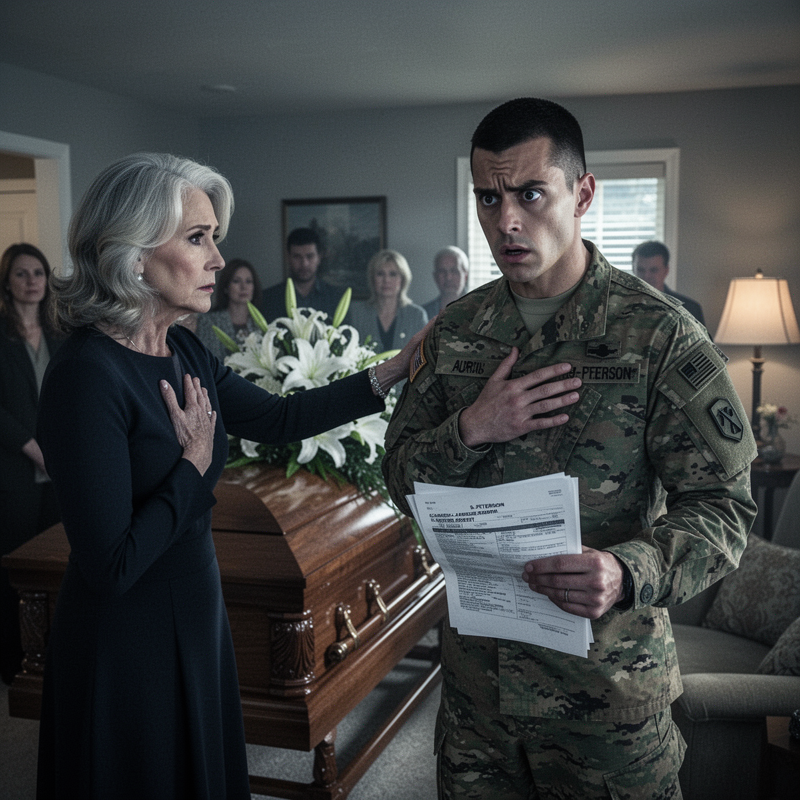
In the center of our living room, where our worn coffee table usually sat, was a polished oak coffin. It was draped in a blanket of pristine white lilies, their petals gleaming under the soft lamplight. Relatives I barely recognized, their faces etched with grief, dotted the room, some wiping their eyes, others staring blankly ahead.
Marjorie Peterson, Sarah’s mother, was the first to see me. Her eyes, red and swollen, widened slightly before she let out a choked cry. She rushed towards me, her arms closing around me in a crushing embrace that felt more like a vise.
Her voice was raw, raspy with sorrow.
“Oh, Ethan, my dear boy. You’re home.”
She pulled back, her gaze unwavering, even through her tears.
“Our Sarah… she’s gone.”
The world tilted. The air left my lungs in a silent whoosh. My mind reeled, grasping for purchase in the sudden, unimaginable void. *Gone?* No, it couldn’t be. Sarah was waiting for me. Sarah was pregnant.
“What are you talking about?” I managed to whisper, the words catching in my throat.
Marjorie shook her head slowly, a fresh wave of tears rolling down her cheeks.
“She passed away, Ethan. Three days ago. Sudden complications during childbirth.”
My ears buzzed. *Childbirth.* A new, horrifying thought pierced through the fog of disbelief.
“The baby?”
Her expression softened, a fragile light entering her eyes.
“A beautiful baby girl. Eleanor. Our sweet granddaughter.”
Someone gently tugged my sleeve. It was Richard, Sarah’s father, his face gaunt and pale. He led me to a bassinet tucked away in a quiet corner. Inside, swaddled in a soft blue blanket, was the tiniest human I had ever seen. Eleanor. My daughter. My heart, still shattered, felt a flicker of something new, something profound and protective, for this innocent creature.
I spent the next few days in a daze, moving through the motions of the funeral, accepting condolences, holding Eleanor whenever I could. The house was filled with the scent of lilies and sorrow. Every conversation about Sarah’s passing was vague, always circling back to “sudden complications.” It felt like a gap in the story, a missing piece that my medic’s brain instinctively sought.
One evening, after everyone had left and Eleanor was asleep in her bassinet beside my bed, I found myself drawn to Sarah’s desk. It was still covered with baby books, ultrasound photos, and scribbled notes about names. My fingers brushed over a stack of envelopes, official-looking documents from St. Jude’s Hospital. I picked them up, hoping for some closure, some concrete detail to help me process the impossible.
The top document was a discharge summary. My eyes scanned the lines, searching for answers. *Sarah Vance, DOB…* No, that wasn’t right. The name at the top of the form read “S. Peterson.” My brow furrowed. It was Sarah’s maiden name, one she hadn’t used since we married almost three years ago. A strange detail, but perhaps a mistake, I reasoned.
Then I saw the “Cause of Death” section. It listed a vague “cardiac arrest” as the primary reason, followed by a general note about “unforeseen intrapartum events.” Cardiac arrest? Sarah had been in excellent health, a marathon runner before her pregnancy, with no history of heart issues. This was completely inconsistent with the vibrant, robust woman I knew. My military training, which had drilled into me the importance of precise, accurate record-keeping, screamed that something was wrong.
I walked into the kitchen, where Marjorie was quietly making a cup of tea. She looked up, startled by my presence.
I held up the papers, my voice tight, devoid of emotion.
“Marjorie, why do these hospital papers say ‘S. Peterson’? And ‘cardiac arrest’? Sarah was perfectly healthy.”
She stiffened, her gaze flickering from the documents to my face, then back again. Her hand went to her chest.
“Ethan, dear, put those away. It’s just… grief. You’re grieving. And that name, it’s just a clerical error, a mix-up, no doubt. She was admitted so quickly. And the heart… it just gave out, they said. Sometimes these things happen, darling. A mother’s heart is fragile, especially after…” Her voice trailed off, thick with feigned tears.
But her explanation felt too rehearsed, too convenient. My gut, honed by years of assessing critical situations under pressure, told me otherwise. Clerical error? A perfectly healthy young woman’s heart just “gave out” during childbirth, with no prior indication? The vague diagnosis, the altered name… a cold, chilling dread began to settle deep within my bones. Something wasn’t right about my wife’s last moments, and I knew it.
What happened after that is in the first comment, because that’s when the truth started leaking out.
Part 2
The thought gnawed at me, a cold ember in the pit of my stomach. I carried Eleanor back to her bassinet, her tiny weight a strange comfort in my arms. I sat in the rocking chair, pulling her close, the soft murmur of her breath the only sound in the quiet house. My gaze drifted over her peaceful face, down her little body wrapped in its blanket.
Then I saw it. On her left shoulder, just peeking out from beneath the fabric, was a small, star-shaped birthmark. It was faint but distinct. A mirror image of the one I had on my own shoulder, a mark that ran through generations of Vance men and women. My great-grandmother had it, my father had a smaller version, and I carried it too.
A wave of certainty washed over me. She was mine. Unequivocally. Any lingering, unvoiced doubt, a cruel whisper born of the chaos and Marjorie’s evasions, vanished instantly. This was my daughter, Sarah’s daughter, our daughter. The connection, now visibly undeniable, solidified my resolve.
But the question of Sarah’s death still hung heavy. Marjorie’s vague explanations of a “difficult birth” echoed in my mind, increasingly hollow against the memory of Sarah’s vibrant health and athletic build. She wasn’t fragile; she was strong.
Later that morning, I found Richard Peterson in the garage, tinkering with an old radio. His shoulders were slumped, his movements slow.
“Richard,” I began, my voice quiet but firm. “I need to understand what happened. In the hospital. Sarah was so healthy.”
He flinched, dropping a small screwdriver. It clattered to the concrete floor. He kept his back to me, fumbling to pick it up.
“It was… just bad luck, Ethan,” he mumbled, his voice strained. “So fast. A lot of complications.”
I pressed him, my gaze unwavering on his retreating back.
“What kind of complications? Marjorie said cardiac arrest, but Sarah never had heart issues.”
He finally turned, his eyes darting around the garage, anywhere but at me. A sheen of sweat broke out on his forehead despite the cool air.
“I… I don’t know the specifics. Marjorie handled everything. She was there.”
His words, intended to deflect, only solidified my unease. Marjorie handled everything. That phrase, so casually delivered, landed like a stone in my gut. It wasn’t just grief coloring their stories. There was something more, a deliberate evasion, a hidden current beneath the surface of their sorrow. The complications weren’t just “unavoidable.” I felt certain they were hiding something else entirely.
Chapter 2: The Beneficiary’s Shadow
My hands trembled as I opened the unassuming manila envelope. I had been sifting through Sarah’s personal documents for hours, a desperate attempt to grasp at any tangible pieces of her life from the past year. My gaze fell upon a life insurance policy, issued just weeks before my deployment, for a staggering $1,500,000. It was a sum far beyond anything we had discussed for our existing joint policies.
My brow furrowed, a cold knot tightening in my stomach as I read the fine print. A specific rider stipulated that if Sarah died and I was missing, incapacitated, or passed away within six months of my return, Marjorie Peterson was named as the sole beneficiary. The dates aligned perfectly with my deployment. The realization hit me like a physical blow. This wasn’t just a coincidence; it was a carefully constructed safety net, but for whom?
I carried the document directly to Marjorie, finding her in the kitchen, meticulously arranging lilies in a vase. She looked up, her expression a practiced blend of sorrow and concern. I laid the policy on the counter between us.
“What is this, Marjorie?” I asked, my voice flat.
She glanced at the paper, then back at me, a flicker of something unreadable in her eyes. “Oh, that? Sarah took it out for family security, dear. A good wife plans for the future.” She reached for a lily stem.
“Family security? It’s for one and a half million dollars, and you’re the sole beneficiary if I’m out of the picture. We had joint policies already.” My jaw tightened.
She sighed, pressing a hand to her temple. “Ethan, you’re distraught. Sarah wanted to ensure Eleanor was provided for, no matter what happened to either of you. She trusted me to manage things.”
“But why you? And why these specific conditions about my return?” I pressed, the air growing thick between us.
Marjorie’s gaze hardened. “Because I am Eleanor’s grandmother. And perhaps Sarah knew you might not return from Afghanistan in the same state, mentally or physically. It was a loving gesture, a contingency.”
A chilling dread snaked through my veins. The explanation felt too rehearsed, too convenient. Her grief-stricken facade, which had seemed so convincing, now felt like a carefully constructed mask.
“A contingency that pays you a fortune,” I stated, my voice barely above a whisper.
She gathered the lilies, turning her back to me. “You’re letting your grief distort everything, Ethan. This conversation is not productive.”
But for me, it clarified everything. This wasn’t a tragic loss, not just a sad turn of events. This was about a calculated scheme. I left the house shortly after, the insurance policy clutched in my hand. I needed a lawyer, and I needed to start digging deeper into Marjorie’s finances and every corner of her family dynamic. The truth was buried, and I had to unearth it.
Chapter 3: Sarah’s Silent Voice
The discovery of the life insurance policy ignited a desperate urgency within me. I knew the truth about Sarah’s final months had to be hidden somewhere within our home. I began a methodical search of her belongings, far more meticulous than before, starting with the boxes of keepsakes she’d packed before my deployment. Every item felt heavy with unspoken memories.
Hours later, tucked deep within a sealed box marked “Letters & Memories,” beneath old photographs and dried flowers, my fingers brushed against something hard and leather-bound. I pulled out a small, unassuming journal. Its cover was a rich, dark brown, and it felt worn, as if often handled. Sarah’s familiar, elegant handwriting filled the pages.
I sat on the floor, the journal open in my lap, reading entry after entry. The initial pages spoke of her excitement for Eleanor, her plans for the nursery, and her longing for my return. But as the entries progressed, the tone shifted. A chilling narrative began to unfold.
*August 12th:* “Marjorie insists I invest in her ‘sure-fire’ biotech company. Says it’s for Eleanor’s future. I don’t feel right about it. It’s so much money, and she’s so pushy. I told her I’d think about it, but she just won’t let up.”
*September 5th:* “Marjorie wants to come to all my appointments now. Says she needs to be ‘involved’ in every step. I feel like I have no privacy. She talks over me when I try to ask the doctor questions.”
*October 21st:* “She’s pressing me hard on signing some legal documents about ‘medical directives.’ Says it’s a standard thing for pregnant women, to ensure my wishes are met if something goes wrong. It feels… too much. Too much control.”
A cold dread seeped into my bones with each new paragraph. Sarah wasn’t just anxious; she was distressed, fearful of her own mother. Marjorie wasn’t merely offering support; she was exerting intense pressure, demanding control over Sarah’s finances and medical decisions.
*November 10th:* “I feel so alone. Ethan, I miss you so much. Marjorie intercepts all the mail. She says you need to focus, that I shouldn’t bother you with my ‘moods.’ She won’t let me call you. I just want to hear your voice.”
A fresh wave of grief, sharper and more painful than before, washed over me. Sarah’s desperation, her isolation, her attempts to reach out—all thwarted by the very woman who claimed to be protecting her. The journal proved that Marjorie’s narrative of a happy, compliant mother-to-be was a lie.
The final entry, scrawled faintly on the last page, sent a shiver down my spine. It was dated just days before I arrived home.
*December 14th:* “I’m so afraid of what she might do…”
I closed the journal, its weight suddenly immense in my hands. Sarah’s fear wasn’t just anxiety about childbirth; it was a desperate plea for help I couldn’t answer from overseas. Marjorie had not only benefited from Sarah’s death but had actively cultivated an environment of fear and isolation leading up to it. This was no longer just about suspicion; this was about justice.
Chapter 4: The Doctor’s Revelation
Armed with Sarah’s journal and the unsettling details of the insurance policy, I knew I couldn’t navigate this alone. My next step was the police. I contacted Detective Marcus “Mac” Riley, a veteran officer known for his quiet persistence, at the Portland Police Bureau. His office was cluttered, the air thick with the scent of old coffee.
He listened patiently as I laid out my findings: the altered hospital admission name, the strange insurance policy, the deeply disturbing entries from Sarah’s journal. Initially, his gaze held a familiar skepticism, the look of an overworked detective encountering a grieving man’s “conspiracy theories.”
“Mr. Vance, I understand this is incredibly difficult,” Detective Riley said, leaning back in his chair. “But a sudden death during childbirth, while tragic, isn’t uncommon. And a mother-in-law having financial motives, while concerning, doesn’t equate to a crime.”
“Sarah wasn’t just anxious, Detective,” I insisted, pushing the open journal toward him. “She was terrified. And that insurance policy, the timing, the conditions—it’s too specific. Someone wanted her dead and planned for it.”
He picked up the journal, his eyes scanning a few entries. His skepticism visibly wavered, replaced by a flicker of professional curiosity. “This does paint a troubling picture of Mrs. Peterson’s influence.”
A week later, after a formal request for Sarah’s complete medical records, Detective Riley scheduled a meeting with Dr. Lena Sharma, Sarah’s obstetrician at St. Jude’s Hospital. I waited nervously in the hallway while they conferred. When they emerged, Dr. Sharma looked grim, her face etched with a mix of professional concern and regret.
“Mr. Vance,” she began, her voice soft, “Detective Riley has obtained a court order allowing me to discuss Sarah’s case more openly.” She paused, adjusting her glasses. “When Sarah was admitted, she wasn’t just presenting with labor pains. She was in a state of acute emotional distress, highly agitated, and exhibited clear signs of an advanced nutritional deficiency.”
My heart hammered against my ribs. “Nutritional deficiency?”
“Yes, specifically severe iron deficiency anemia,” Dr. Sharma confirmed. “It was advanced enough to significantly weaken her body, which would have made any medical procedure, especially childbirth, far more complicated and risky.” She offered a sad, knowing look. “It wasn’t something that developed overnight; it suggested prolonged neglect or, potentially, intentional malnourishment.”
The air crackled with unspoken implications. This wasn’t a perfectly healthy Sarah experiencing “natural complications.” This was a Sarah who had been compromised, physically and emotionally, before she even entered the delivery room.
Detective Riley turned to me, his expression now one of deep concern. “This information contradicts Mrs. Peterson’s account of a perfectly healthy Sarah, Mr. Vance. It raises serious questions about the ‘unavoidable complications’ narrative.” He rubbed his chin. “We still need more direct evidence linking Marjorie Peterson to Sarah’s condition, but this is a significant development.”
A chilling silence filled the hospital corridor. My suspicions had solidified into tangible, medical facts. Someone had intentionally weakened Sarah, paving the way for her tragic end.
Chapter 5: Aunt Susan’s Confession
Despite Dr. Sharma’s revelation, a piece of the puzzle still felt missing, a connection to Marjorie’s deeper machinations. I remembered Sarah mentioning her Aunt Susan, her mother’s sister, with whom Marjorie had a strained relationship. Aunt Susan might have seen something. I reached out, arranging to meet her at a quiet diner in Gresham, away from Marjorie’s prying eyes.
Aunt Susan Miller arrived, her face lined with a perpetual worry, clutching a worn handbag. After polite pleasantries, I gently brought up Sarah. I pulled out Sarah’s journal and read a few of the more damning entries aloud, particularly the ones detailing Marjorie’s controlling behavior and Sarah’s increasing anxiety.
As I spoke, Susan’s knuckles whitened around her coffee cup. Her eyes, usually darting nervously, fixed on me with a sudden, profound sadness. A tremor ran through her shoulders.
“Oh, Sarah,” she whispered, her voice barely audible. “I knew Marjorie was… difficult. But I didn’t know it was this bad.”
I leaned forward. “Did you ever see Marjorie interfere with Sarah’s communication with me? Or her doctors?”
Susan hesitated, her gaze flickering around the diner as if Marjorie might materialize. Then, a deep sigh escaped her lips. “Yes, Ethan. During your deployment, Marjorie was obsessed with ‘protecting Sarah’s peace.’ She insisted Sarah needed absolute quiet. I saw her intercepting mail, more than once.”
My blood ran cold. “Intercepting mail? My letters?”
“Yes,” Susan confirmed, her voice gaining strength as guilt seemed to compel her. “Sarah tried to call you a few times, too. Marjorie would just… dismiss it. Say you were too busy, or that Sarah was being ‘overly emotional’ and shouldn’t bother you with her ‘moods’.” She wrung her hands. “She isolated Sarah completely.”
“Did she ever come with Sarah to medical appointments?” I pressed, remembering Sarah’s journal entry.
Susan nodded vigorously. “Always. And she didn’t just sit quietly. She would often ‘clarify’ Sarah’s wishes to the doctors, sometimes even before Sarah spoke. It was like Marjorie was dictating what Sarah wanted, not letting Sarah speak for herself.” Her eyes filled with tears. “Sarah looked so small, so tired, those last few months.”
The missing piece clicked into place. Marjorie had actively prevented me from knowing Sarah’s true distress, from intervening. She had meticulously cut Sarah off from her primary support, making her vulnerable, both emotionally and physically, just as Dr. Sharma had described.
I thanked Aunt Susan, her confession a painful but vital turning point. I immediately called Detective Riley. His tone, usually measured, was now sharp with purpose.
“That’s it, Mr. Vance,” he stated. “That’s enough. We have grounds to bring Marjorie Peterson in for formal questioning.”
Chapter 6: The Unveiled Truth
The following morning, the Petersons were brought in for separate interrogations at the police station. The air in the precinct felt heavy with anticipation. Marjorie, impeccably dressed and radiating an icy calm, maintained her innocence, her voice unwavering as she painted me as a grieving veteran succumbing to paranoia and PTSD. She deflected every question, blaming my “fragile mental state” for these “unfounded accusations.”
Meanwhile, in an adjacent interrogation room, Richard Peterson, Sarah’s father, visibly crumbled under the relentless pressure of Detective Riley’s questions and the mounting, irrefutable evidence. The medical records, Dr. Sharma’s testimony, Sarah’s journal, and Aunt Susan’s confession were laid out before him. The quiet, kind-hearted man I knew seemed to shrink in his chair.
Finally, Richard broke. In a halting, tear-filled confession, he revealed the full, horrifying truth, his words a painful echo of Sarah’s last, desperate entry.
“Marjorie… she exploited Sarah,” Richard stammered, his eyes red and swollen. “Sarah was suffering, after Eleanor’s birth, a deep depression in late pregnancy. Marjorie saw it.” He paused, wiping his face. “She coerced Sarah into signing a ‘Comprehensive Medical Directive’.”
My fists clenched. A medical directive.
“It gave Marjorie ultimate authority over Sarah’s medical decisions if Sarah were ‘incapacitated’ during childbirth,” Richard choked out, tears streaming down his face. “She said it was to ‘protect Sarah’s wishes,’ but it was for control.”
The first layer of the monstrous scheme was laid bare. Richard continued, his voice barely a whisper. “During the delivery, Sarah’s condition worsened rapidly. The doctors, they advised a specific, common, life-saving intervention. They begged Marjorie to let them proceed.” He buried his face in his hands. “But Marjorie… she stood there, waving that directive. She explicitly overruled them. She refused the intervention, citing the document.”
A primal scream built in my throat, threatening to escape. Marjorie had actively chosen to let Sarah die.
“And the hospital records?” Detective Riley pressed, his voice tight. “The name change? The altered history?”
Richard looked up, his eyes meeting mine through the two-way glass. “Marjorie did that too. She tampered with Sarah’s hospital admission. A slightly altered name, ‘S. Peterson,’ and a modified medical history to conceal Sarah’s previous stress-related doctor visits. To avoid specific ethical doctors Sarah trusted.” He gulped, his body shaking. “It was to ensure her plan could be executed without immediate scrutiny. To facilitate the narrative of ‘sudden, unavoidable complications’ while ensuring the $1,500,000 life insurance payout.”
At the same time, Lawyer Thomas Sterling, brought in for questioning, was confronted with the overwhelming evidence. Under intense pressure, his professional reputation on the line, he confirmed he had drafted both the “Comprehensive Medical Directive” and the life insurance policy at Marjorie’s behest. He insisted, however, he was completely unaware of Marjorie’s heinous intent.
As agents moved to arrest Marjorie, she made a desperate dash for a waiting private jet at Portland International Airport, having already accessed a substantial portion of the insurance funds. But her escape was futile. Federal agents, alerted by Detective Riley, intercepted her just before she could board. Marjorie Peterson was arrested, her carefully constructed world of control and greed crumbling around her.
I held Eleanor close, her tiny hand gripping my finger. The truth was out, justice for Sarah was finally within reach. But the profound silence of Sarah’s absence, and the deep, emotional scars of this betrayal, would forever remain. We had survived, Eleanor and I, but at an unimaginable cost.
Leave a Reply