Chapter 1:
Part 1
My father thought I came home as the quiet girl he could still erase. No badge. No white coat. No title. Perfect. So, when he told a stranger, “She quit medicine years ago,” I stayed silent.
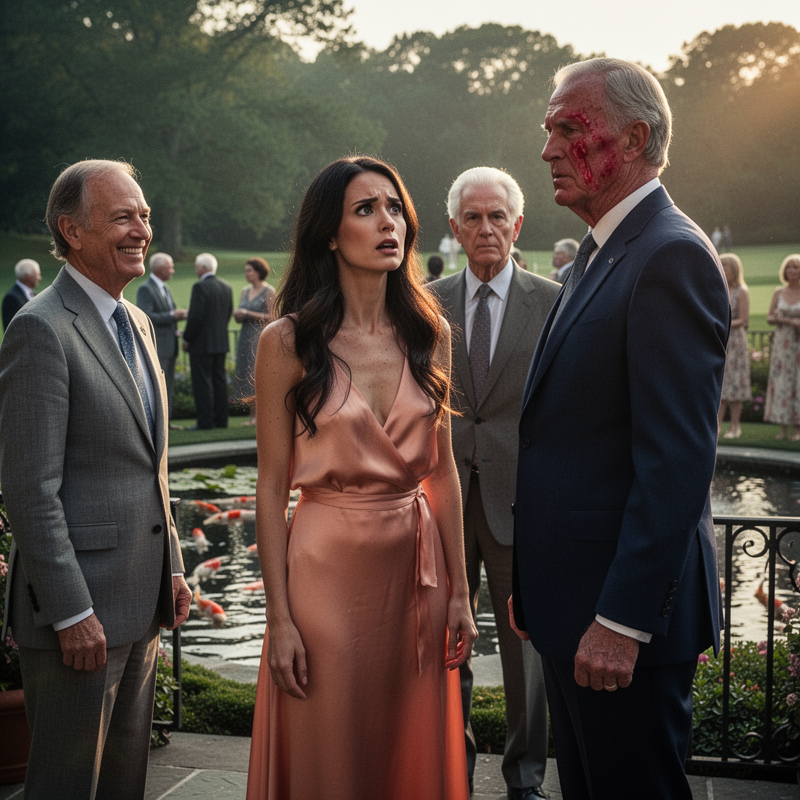
The humid Connecticut air clung to the silk of my dress as I navigated the crowded terrace of the country club. My mother, Eleanor, had insisted on this visit, a rare trip back to the opulence of the Finch estate, purportedly for her annual charity gala. She’d made one request very clear before I packed: “Leave the hospital behind, Evelyn. Just be my daughter this weekend. Your father…” She trailed off, a familiar worry etched around her eyes. So, my surgical scrubs remained folded in a drawer over a thousand miles away, my Johns Hopkins ID badge safely tucked into my wallet back in Baltimore. No white coat. No title. Just Evelyn.
I clutched a glass of sparkling water, observing the familiar tableau of wealth and performative civility. My father, Richard Finch, held court by the koi pond, his booming laugh carrying over the polite hum of conversation. His posture exuded the kind of self-assured authority that only decades of accumulated influence could cultivate. He was the undisputed patriarch, and in his orbit, everyone else felt the pull of his gravitational force.
A faint anxiety tightened in my chest. This feeling, a peculiar blend of dread and resignation, was a constant companion whenever I returned home. It was the same feeling that had driven me to pursue a life far removed from this manicured world.
Richard spotted me across the lawn, a glint of possessive triumph in his eyes. He raised a hand, a silent command for me to approach. My mother’s soft warning echoed in my mind, a subtle plea to avoid any friction. I straightened my shoulders and made my way towards him, a carefully neutral expression on my face.
He stood beside a man I vaguely recognized as Judge Beaumont, a stern-faced, silver-haired figure known for his unyielding judgments. Richard’s arm swept out, encompassing me in his gesture.
“Judge Beaumont, allow me to introduce my daughter, Evelyn,” Richard announced, his voice brimming with paternal pride.
Judge Beaumont offered a curt nod, his gaze assessing me with the detached curiosity of a seasoned legal mind.
“Evelyn here gave up on medicine years ago, bless her heart,” Richard continued, his hand briefly resting on my back. “She much prefers a quiet life now. Just returned from a little retreat, didn’t you, darling?”
The words hit me with the force of a physical blow, stripping away years of relentless effort, countless sleepless nights, and the profound satisfaction of saving lives. My breath hitched. He had rewritten my entire professional narrative, casually dismissing my calling, my identity, as if it were a fleeting hobby discarded on a whim. The lie hung in the air, a thick, suffocating blanket. My father’s grip on my back tightened almost imperceptibly, a silent warning.
My throat constricted. Every instinct screamed at me to correct him, to proclaim my true calling, to defend the years I’d dedicated to the operating room. But I stayed silent. My heart sank, a heavy stone plunging into an abyss. My mother’s words reverberated: *“Don’t antagonize him.”* The familiar script of paternal control and filial submission was already being enacted.
Just as the judge began to form a polite, noncommittal response, a new voice cut through the ambient chatter. It was deep, resonant, and unmistakably familiar.
“Dr. Finch! There you are!”
My head snapped towards the sound. My eyes widened. Standing just a few yards away, a broad smile illuminating his kind face, was Dr. Arthur Caldwell. The Dean of Surgery at Johns Hopkins. My mentor. He strode towards us with purpose, completely oblivious to the carefully constructed narrative Richard had just delivered.
Richard, caught mid-sentence, stumbled backwards a half-step. A flicker of alarm, quickly masked, crossed his features.
Dr. Caldwell extended a hand to me, his grip firm and warm.
“We’ve been trying to get a hold of you, Evelyn,” he said, his voice carrying easily over the muted symphony of the party. “You didn’t respond to my last email. Everything alright?”
He looked genuinely concerned, his gaze full of professional respect and genuine admiration. My mind raced, trying to process the impossible collision of my two worlds.
Richard stiffened beside me, his eyes darting frantically between Dr. Caldwell and the now-very-attentive Judge Beaumont. The air crackled with an unspoken tension.
“Dr. Finch, we’re still hoping to formalize that Head of Cardiothoracic Research offer,” Dr. Caldwell stated, his smile unwavering. He turned slightly, including Judge Beaumont in his address, as if sharing a point of common knowledge. “She’s one of the finest surgeons we’ve ever trained. Her work on the new arterial graft procedure is revolutionary. Absolutely revolutionary.”
The words hung in the silence that followed, vibrant and undeniable. A truth bomb detonated in the meticulously controlled environment of Richard’s making. The praise was lavish, specific, and impossible to ignore. It painted a stark, vivid contrast to Richard’s casual dismissal moments before.
Richard’s face, usually so composed, began to turn a deep, angry shade of beet red. His jaw clenched, a muscle twitching violently beneath his skin. He looked as if he might spontaneously combust.
Judge Beaumont’s polite, neutral expression dissolved into one of keen, almost bewildered interest. His left eyebrow lifted slowly, arcing into a perfect question mark above his piercing eyes. His gaze flickered from Dr. Caldwell, to me, and finally settled on Richard, whose mask of genial authority had utterly crumbled.
The weight of the judge’s gaze on Richard was palpable. Every eye on the terrace, it seemed, had suddenly become fixed on our small group. I felt a dizzying mix of validation and profound shock. The ground beneath Richard’s feet had just given way, not with a quiet tremor, but with a thunderous roar. The public contradiction, so swift and absolute, left me utterly stunned.
What happened after that is in the first comment, because that’s when the truth started leaking out.
Part 2
Richard forced a strained laugh, his face still crimson. “Arthur, good to see you,” he stammered, pulling Dr. Caldwell into a quick, awkward handshake. “Just a misunderstanding, old boy. Evelyn enjoys a sabbatical, you know. Been working too hard.” He then quickly pivoted, gesturing towards the bar. “Judge Beaumont, can I get you another martini? My treat.”
Dr. Caldwell’s brow furrowed, but he was too polite to press the issue further in front of a crowd. He gave me a knowing look, a silent message that he understood more than he let on, before being pulled away by another well-wisher.
The judge, however, remained. His gaze lingered on me, then on Richard, before he too offered a curt nod and moved on, his silence speaking volumes. Richard, visibly shaken, muttered something about needing fresh air and practically fled the terrace.
Later that evening, after the last guest had departed and the house settled into an uneasy quiet, I found him in his study, nursing a glass of scotch. The smell of old leather and his expensive cigars hung heavy in the air.
“Why, Father?” I asked, my voice calm, but with an edge of steel I hadn’t known I possessed.
He spun around, startled. His eyes, usually so calculating, were clouded with irritation. “Why what, Evelyn? What are you talking about?”
“You lied. To Judge Beaumont. To everyone.” My hand tightened into a fist at my side.
He scoffed, taking a long sip of his drink. “It was a joke, Evelyn. A figure of speech. You always take things so seriously.” He waved a dismissive hand. “Honestly, you’ve never fully committed to this family, have you? Always off chasing your own ambitions.”
His words, a familiar refrain, no longer stung with their usual force. They only fueled a cold, quiet anger within me. I turned and left the study, the heavy oak door thudding softly behind me.
Back in my childhood bedroom, the ornate wallpaper and antique furniture felt alien now, a relic of a life I’d long outgrown. I sat on the edge of the four-poster bed, my mind racing. My mother, earlier that week, had slipped me a box of old documents, mostly sentimental letters and faded photographs, saying, “Just some things I thought you might want, dear. For old times’ sake.”
I rummaged through the box, pulling out a sheaf of papers. Old school reports, drawings, a few cards from my grandfather. Then, tucked beneath a stack of my high school diplomas, a document caught my eye. It was an official-looking contract, thick and formal.
A non-compete clause. Dated five years ago.
It was for a prestigious research grant opportunity, one I distinctly remembered considering and then declining. The terms were harsh: I couldn’t work for any competing institution for a decade if I accepted it.
My signature was scrawled at the bottom. But as I stared at it, a prickle of unease started in my gut. It was almost perfect. The curve of the ‘E’, the flourish on the ‘h’ – all there. Yet, something was off. The slant of the ‘F’ was just slightly too vertical. The loop on the ‘y’ was a hair too open.
A cold dread seeped into my bones. It was my signature, but it wasn’t. It was an incredibly skilled forgery. A sickening realization washed over me. How many other opportunities, how many other paths, had been secretly blocked without my knowledge?
Chapter 2: The Missing Will
The faint, almost imperceptible difference in the forged signature from the non-compete clause gnawed at me. It reignited a quiet fury, solidifying my suspicion: this wasn’t an isolated incident. My father, Richard, had a history of subtle interferences, but this felt deeper, more insidious. I remembered snippets of conversations from my childhood, my deceased grandfather, Dr. Alistair Finch, speaking with such pride about my early aptitude for medicine.
He had often mentioned specific instructions for my future, instructions I knew were enshrined in his will. Years ago, my mother, Eleanor, had quietly slipped me a faded copy of that very document, tucked away with old school certificates. I retrieved it now, the brittle pages rustling. My grandfather’s careful penmanship detailed a substantial medical research trust, specifically naming me as an executive trustee with significant autonomy. It was designed to support my career, a legacy from one surgeon to another.
A week later, the family gathered in Richard’s study for a formal reading of Grandfather Alistair’s estate. Richard, looking impeccably self-satisfied, motioned for his lawyer, Mr. Thompson, to begin. Thompson cleared his throat, reading from a document I didn’t recognize. As he spoke, a cold dread began to settle over me.
“And to Evelyn Finch, an annual stipend of fifty thousand dollars from the trust, contingent upon her continued residency in the family home,” Mr. Thompson stated blandly, his gaze skimming over me.
My breath hitched. The entire clause designating me as an executive trustee, the one granting me significant autonomy over the multi-million dollar medical research fund, was completely absent. My portion of the trust, intended to fuel my life’s work, had been reduced to a pittance, a mere allowance tied to my father’s roof. Richard sat across from me, a placid smile on his face, observing my reaction with unsettling calm. The document Mr. Thompson held was not my grandfather’s true will; Richard had tampered with the official papers.
Chapter 3: The Ghost of Debt
Later that day, I found Sarah Miller, the sharp junior partner from the law firm, reviewing files in the library. I approached her, keeping my voice low.
“Sarah,” I began, “I have a personal copy of my grandfather’s will. There are… discrepancies with the one Mr. Thompson read.”
She raised an eyebrow, a flicker of professional curiosity in her eyes. “Significant ones?”
“Critically so,” I affirmed. “Could you discreetly verify the legitimacy of the version Richard presented?”
She nodded, scribbling a note. “I’ll look into it, but it might take time to navigate without tipping anyone off.”
A few days later, Richard, ever the benevolent patriarch, staged another performance. He called David, my older brother, into his office. I heard the muffled tones through the closed door, then David’s relieved sigh. When David emerged, he explained that Richard had offered him a “loan” of $100,000 for his struggling real estate venture.
“He just wants me to support his proposals for the trust,” David mumbled, rubbing the back of his neck. “Said it’s important for family unity.”
A pang of concern shot through me. David’s desperation was palpable, a vulnerability Richard was clearly exploiting. I observed David throughout the week, noticing his anxious demeanor. Then, late one evening, I heard him arguing on the phone from his room.
“I told you I’d have it by the deadline!” David hissed, his voice strained. “Half a million dollars isn’t easy to come by!”
My heart thudded. Half a million? That was far more than Richard’s supposed “loan.” The next morning, I discreetly accessed a secure credit monitoring service, using my knowledge of data management from the hospital. I searched David’s name. A pattern of large, irregular repayments to an entity named “Phoenix Ventures LLC” materialized on the screen. The total exceeded $500,000. David was deep in debt, far deeper than I, or anyone else, knew. And the name Phoenix Ventures LLC rang no bells in our family’s extensive business network. The chilling thought settled in: Richard wasn’t just lending David money; he was somehow intertwined with David’s secret, crippling burden.
Chapter 4: The Phoenix Network
The name “Phoenix Ventures LLC” haunted me. It sounded deliberately vague, a corporate ghost. I knew I couldn’t investigate this alone without raising suspicion, so I called Dr. Anya Sharma, my brilliant colleague and friend from Johns Hopkins, known for her unparalleled tech skills. We spoke under the guise of discussing my research.
“Anya, I need your digital wizardry,” I told her, my voice low and urgent. “Can you do a deep dive on a company for me? ‘Phoenix Ventures LLC’.”
Anya’s fingers flew across her keyboard as we spoke. “Give me a few minutes,” she said, her voice full of focus. A short while later, she delivered her findings.
“Okay, this is interesting, Ev. Phoenix Ventures LLC is incorporated in Delaware, classic shell company territory. Its listed address is just a post office box.”
My gut tightened. “Any directors, shareholders?”
Anya typed furiously. “Hold on… the sole listed director is a Mr. Thomas Bellweather. Does that name mean anything to you?”
A jolt went through me. Thomas Bellweather. He wasn’t a family member, but a long-time associate of Richard Finch. Bellweather had managed several of Richard’s less savory business dealings over the years, always operating in the shadows. The pieces clicked into place with a sickening thud. This wasn’t some independent loan shark.
“He’s my father’s man,” I breathed, the realization chilling me to the bone. “This isn’t David’s debt; it’s *Richard’s* debt, orchestrated through a fake company.”
Anya let out a low whistle. “He’s running a private loan operation, essentially, to control David? That’s… next level.”
My resolve, which had simmered since the country club incident, solidified into an unshakeable determination. Richard wasn’t merely manipulating me; he was actively preying on his own son, weaving an intricate web of control and financial servitude. The depth of his insidious power plays within our family was far greater than I had ever imagined. This wasn’t just about my inheritance anymore; it was about exposing the rot at the core of our family.
Chapter 5: The Housekeeper’s Letter
The weight of Richard’s deception pressed heavily on me, making every interaction in the house feel like walking through a minefield. I needed another ally, someone whose loyalty transcended Richard’s influence. My thoughts turned to Mrs. Henderson, our family’s long-time housekeeper. She had been with us since before I was born, practically a shadow, but always observant, and fiercely devoted to Grandfather Alistair.
I found her in the kitchen, quietly polishing silver. Her hands paused as I entered. “Mrs. Henderson,” I began, my voice softer than usual. “Do you remember my grandfather well?”
Her eyes, usually placid, held a flicker of something guarded. She nodded slowly. “Dr. Alistair was a good man. Very particular about his papers.”
I explained, carefully, my concerns about the will and Richard’s recent behavior, sensing her distress. Mrs. Henderson’s gaze softened, her shoulders relaxing slightly.
“Your grandfather, he worried about Mr. Richard,” she murmured, her voice barely a whisper. “Said Richard had… grand ambitions, but not always the right way about them.” She wrung her hands. “He told me once, he put in safeguards. For you, Evelyn. He admired your mind so.”
A surge of hope, fragile but insistent, bloomed in my chest. “Safeguards? Do you remember anything specific?”
She tilted her head, thinking. “He kept a special safe deposit box at the old bank downtown. Always said it held something important, especially for your ‘true path’ in medicine.” Her eyes widened. “And there was a note… a small one. He told me to keep it safe, in case of trouble.”
Mrs. Henderson bustled away, disappearing into the linen closet. A moment later, she returned, her hand clutching a faded, embroidered sewing kit. From its depths, she pulled out a delicate, yellowed piece of paper. It was Grandfather Alistair’s elegant script, scrawled hastily.
The note read: “Evelyn’s true path is safeguarded. Find the specific document in box 33B at the old bank. Trust no one but your own intellect.”
I stared at the note, my fingers tracing the faded ink. It was vague, yes, but undeniably a lead, a direct message from my grandfather, bridging the decades. It confirmed everything: his distrust of Richard, his foresight, and his unwavering belief in my future. My grandfather hadn’t just predicted Richard’s manipulations; he had prepared for them.
Chapter 6: Deciphering the Signature
With renewed purpose, I focused back on the forged non-compete signature from months ago. I arranged for a discreet forensic analysis, ensuring the expert understood the sensitivity of the family dynamics involved. A few days later, the report arrived, concise and damning.
“The signature is a highly skilled forgery,” the expert’s report concluded. “The perpetrator possessed intimate knowledge of Ms. Finch’s handwriting nuances, indicating either close observation or access to numerous authentic samples.”
This confirmed what I already knew: Richard or someone directly associated with him was responsible. This wasn’t just a casual imitation; it was a deliberate, targeted act. Simultaneously, Sarah Miller, with access to her firm’s legal databases, had been quietly investigating the financial implications of that very non-compete clause. Her findings were even more shocking.
“Evelyn,” Sarah said over a secure call, her voice tight with professional indignation, “I’ve found something incredible. This non-compete wasn’t just designed to block you from that research grant.”
My knuckles whitened as I gripped the phone. “What was it for?”
“There’s a hidden clause, almost imperceptible unless you know what you’re looking for,” she explained. “It diverted the full $1.2 million research grant—the one intended for your original project—to something called the ‘Finch Family Endowment Fund’.”
The name sounded legitimate enough, a classic philanthropic maneuver. But Sarah wasn’t finished.
“I dug deeper into that ‘endowment fund’,” she continued, “and it’s a phantom. It’s actually a struggling biotech startup, founded by Richard years ago without any family knowledge. It was facing a critical audit deficit, on the verge of collapse.”
My breath hitched. The pieces clicked into place with horrifying clarity. The forgery wasn’t simply to sabotage my career or deny me an opportunity. It was a direct, criminal act of financial fraud, designed to funnel my grant money—my grant, secured by my research—into Richard’s secret, failing venture. It was a lifeline for him, purchased at the expense of my professional future. Richard hadn’t just buried my past; he’d tried to steal my future.
Chapter 7: Reluctant Alliance
The revelation that Richard had used my grant to bail out his failing company gave me the leverage I needed. It was time to confront David, not as an accuser, but as someone offering a way out. I found him in the dimly lit study, nursing a drink, looking utterly defeated.
“David,” I began softly, placing the forensic report and Sarah’s findings on the table. “We need to talk about Phoenix Ventures LLC.”
He flinched, his shoulders tightening. “Leave it alone, Evelyn. It’s my problem.”
“It’s Richard’s problem,” I countered, pushing the documents towards him. “Phoenix Ventures LLC is his shell company. He set you up, David. He’s been draining you, keeping you in debt, just to control you.”
David stared at the papers, his face pale, but he still resisted. “You don’t understand. He’s my father. He’ll ruin me if I cross him.” His voice was laced with genuine fear.
I leaned forward, my gaze unwavering. “He’s already ruined you, David. He’s done worse to me.” I then laid out the evidence of the forged non-compete clause and, most importantly, the diversion of my $1.2 million research grant. “That money was for my breakthrough research, David. It was stolen to save *his* failing biotech startup. He didn’t just ensnare you; he robbed me.”
A different kind of shock registered on David’s face. The idea of being indebted to Richard was one thing; the realization that his father had stolen from his own daughter, his own family, to fund a secret, failing venture, hit him hard. His initial fear began to morph into something else—a simmering resentment, a sense of profound betrayal. He wasn’t just a pawn; he was a victim.
His hand trembled as he reached for his glass. “He made me keep a ledger,” David admitted, his voice barely a whisper. “Of all his… private transactions. Hidden accounts, shell companies. He forced me to manage it.”
He looked up, his eyes meeting mine. “I’ll give it to you,” he said, his voice firming with reluctant resolve. “Everything. Maybe if I help you, I can save myself from this mess too.” He pushed a small, leather-bound book across the table. It was Richard’s personal ledger, a trove of his financial deceits. My brother, finally seeing the true extent of his father’s depravity, had shifted his allegiance.
Chapter 8: The Final Blow
The family meeting Richard called was a meticulously staged affair. He had assembled the entire family in the grand drawing-room, along with Mr. Thompson, the family lawyer, presumably to finalize the changes to Grandfather Alistair’s will. Richard, radiating an air of unshakeable authority, stood before us, a triumphant glint in his eye. He sensed the walls closing in, the evidence I had been gathering. This was his last, desperate play.
“Family,” Richard boomed, his voice resonating through the room, “I have made a discovery of vital importance.” He paused dramatically, then pulled a yellowed document from a leather portfolio. “A newly found codicil to Grandfather Alistair’s will, dated just months before his passing.”
He held it up for all to see. “This codicil,” he announced, his gaze sweeping over me with contempt, “disinherits Evelyn for ‘insubordination and professional misconduct.’ It seems Alistair, in his wisdom, foresaw a rebellious and unreliable heir.”
A collective gasp went through the room, but I remained still, my gaze locked on Richard. This was it. Sarah Miller, standing discreetly by my side, stepped forward.
“Mr. Finch,” Sarah interjected, her voice calm but firm, “with all due respect, we have some information regarding ‘discoveries’ of your own.” She presented a thick binder to Mr. Thompson, clearly marked. “Forensic analysis confirms multiple forgeries, including the non-compete clause used to divert Dr. Evelyn Finch’s $1.2 million research grant to a shell company you control.”
Richard’s face began to flush, but before he could respond, I rose. “Grandfather Alistair, as it happens, foresaw more than just ‘rebellion’.” I held up the faded note from Mrs. Henderson, then produced a small, antique key. “He foresaw your manipulations, Richard.”
I explained how Mrs. Henderson had led me to the note and the true safeguard. “Just hours ago, using this key,” I continued, my voice steady, “I retrieved the contents of safe deposit box 33B at the old bank.” I then presented two documents. The first was a letter from Alistair, addressed to me, detailing his profound distrust of Richard’s financial ambitions and explicitly discrediting any document presented by Richard without specific verification. He had, with chilling accuracy, anticipated Richard’s exact tactics.
The second document was the *true* secret codicil. Mr. Thompson, his face ashen, took it. He read aloud, his voice trembling: “Should Richard Alistair Finch ever be proven to have tampered with Evelyn Finch’s professional or financial future, Evelyn shall gain immediate executive control over the entire $30 million medical research trust, and a 51% stake in the family’s primary real estate holdings.” He swallowed hard. “It also outlines an annual salary of $800,000 for Evelyn if she continues medical research.”
Richard stared, his mouth agape. “That’s a forgery! Another one of her lies!” he spluttered, gesturing wildly at me.
“On the contrary,” Sarah said, picking up the “insubordination” codicil Richard had just presented. “This document, Mr. Finch, is the forgery. A crude one, according to our forensics expert, commissioned for ten thousand dollars from a disgraced former notary public just last week.”
Just then, the front door chimes, and Officer Ramirez, a local police detective, entered, followed by two uniformed officers. “Mr. Richard Finch?” Ramirez stated, his gaze hard. “We have received a complaint alleging multiple counts of forgery and fraud. We’re opening an investigation.”
Richard, utterly defeated, sank into his chair, his carefully constructed empire crumbling around him. My grandfather’s true legacy, and my own, were finally reclaimed.
Leave a Reply