Chapter 1:
Part 1
At the reading of my grandfather’s will, my sister, Sarah, inherited $6.9 million, while I, Michael, was left with a single dollar. My parents scoffed: ‘All that time you cared for Grandpa Richard for nothing; he must have known you’re a fraud.’ Sarah then mocked, ‘No one is providing for Mom and Dad. You two are pathetic.’ They threw all my belongings into the trash and kicked me out of the house, convinced I was a loser.
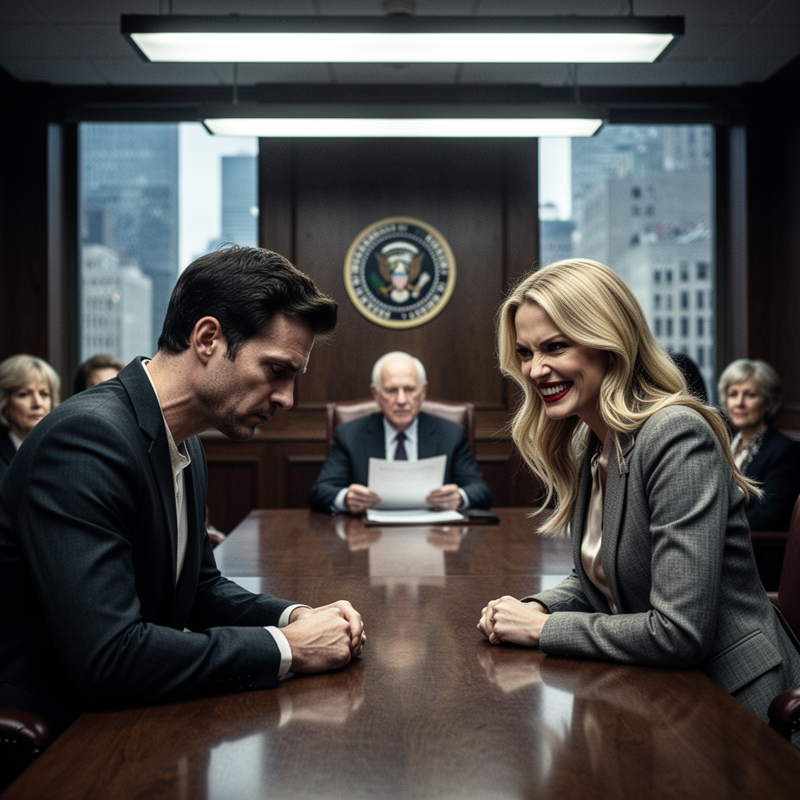
The stale air in Arthur Finch’s Manhattan law office felt heavy, suffocating. Every breath I took seemed to catch in my throat, each beat of my heart echoing the anxious silence that had fallen over the room. Across the polished mahogany table, my sister, Sarah, sat poised, a predatory glint in her eyes, while my parents, Eleanor and David, shifted restlessly in their plush chairs.
They had been eager for this day, I knew. Eager for the reading of Grandpa Richard’s last will and testament. They expected a substantial inheritance, something befitting the Miller name, especially after all the years I had dedicated to caring for Grandpa.
But their expectations, and mine, were about to be shattered in the cruelest way imaginable.
Arthur Finch, Grandpa’s stoic lawyer for decades, cleared his throat. He adjusted his spectacles, the fluorescent lights glinting off the frames, before beginning to read in a clear, measured tone that only amplified the tension.
His voice resonated with the weight of officialdom, recounting the initial formalities, the legal boilerplate that seemed to drone on endlessly. My gaze drifted around the room, settling on Sarah, who was already smirking faintly, as if she knew some secret joke that was about to be played.
Then, Mr. Finch reached the crux of the document. “To my beloved granddaughter, Sarah Miller, I bequeath the sum of six million, nine hundred thousand dollars.”
A sharp intake of breath escaped Eleanor. Sarah, however, merely straightened her designer jacket, a triumphant, almost gloating smile spreading across her face. My own stomach tightened into a knot.
Then came the next line, the one that would forever change the trajectory of my life, the words that hit me with the force of a physical blow. “And to my grandson, Michael Miller,” Mr. Finch continued, his voice devoid of emotion, “I leave the sum of one dollar.”
The room erupted. Or rather, my parents erupted. Eleanor gasped, then let out a sharp, derisive laugh that grated on my ears. David’s jaw dropped, then snapped shut, his face turning a blotchy red.
“One dollar?” Eleanor shrieked, her voice high and piercing. “Are you serious, Arthur? A single dollar?”
Sarah’s smirk widened, morphing into a full-blown, malicious grin. She glanced at me, then back at our parents, her eyes dancing with a wicked satisfaction.
“All that time you cared for Grandpa Richard for nothing,” my mother spat at me, her gaze a mixture of contempt and disgust. Her words sliced through me.
My father, usually quiet and conflict-verse, chimed in, his voice thick with accusation. “He must have known you’re a fraud, Michael. All your supposed devotion, all for show.”
My hands clenched under the table. I felt a flush creeping up my neck, but I bit back any retort. What was there to say? The words were printed right there, in black and white.
Sarah leaned forward, her voice dripping with venom, savoring every syllable. “No one is providing for Mom and Dad anymore, Michael. Not with that princely sum.”
She gestured dismissively at the paper in Mr. Finch’s hand.
“You two are pathetic.” She included my parents in her condemnation, a cruel twist of the knife, clearly implying that they, too, had been disrespected by Grandpa, and that I was to blame for their financial disappointment.
A heavy silence descended, broken only by my own ragged breathing. I could feel their eyes burning into me, a collective judgment, a dismissal of everything I had done for Grandpa Richard over the last five years. The care, the companionship, the endless nights spent by his side — it was all meaningless to them now. It was a sham.
The meeting concluded abruptly. There was no warmth, no sympathy, no offer of comfort. Arthur Finch gave me a pitying glance, a look I couldn’t quite decipher, but said nothing further. My family simply rose, Sarah practically skipping out of the office, while Eleanor and David trailed behind her, muttering darkly, never once looking back at me. I was left alone in the stark reality of my new inheritance. One dollar.
The drive back to Grandpa Richard’s historic home in Southampton felt endless, each mile a further descent into a nightmare. By the time I arrived, the gate stood open, an ominous invitation. A large moving truck, one I didn’t recognize, was already parked in the driveway, its rear doors gaping open like a hungry maw.
My heart hammered in my chest. What was going on?
As I stepped onto the manicured lawn, the scene unfolding before me punched the air from my lungs. Sarah, hands on her hips, was directing two burly men. They were carrying armloads of my personal belongings—my books, my framed photographs, the old sweater Grandpa had given me—and tossing them, with shocking carelessness, into three oversized, black outdoor trash bins.
“No!” I shouted, the word torn from my throat.
Sarah spun around, her face alight with triumph. “Get out of here, Michael! You heard the will. This isn’t your home anymore.”
Eleanor emerged from the front door, her face a mask of cold fury. “We don’t want your deceitful presence here. You’re a liability.”
David stood behind her, his eyes wide and fearful, avoiding my gaze entirely. He just nodded weakly in agreement with my mother.
I rushed towards the bins, trying to salvage a photo album, but one of the men blocked my path. His arm was like a tree trunk, unyielding.
“Don’t touch that!” Sarah shrieked, pointing at me. “Those are *our* trash bins. He’s trespassing!”
“These are my memories!” I pleaded, my voice hoarse. “My life!”
“Your life is over here,” Eleanor sneered, stepping closer. “Grandpa was clear. You get nothing. Now leave before we call the police for trespassing.”
My father finally spoke, his voice low and trembling. “Just go, Michael. Please. Don’t make this harder.”
They watched as my entire existence—my personal history, my keepsakes, the small, intimate markers of my five years living here and caring for Grandpa—were summarily cast aside, landing with dull thuds amongst household refuse. A worn copy of Grandpa’s favorite novel, the one we’d read together every night, hit the bottom of a bin with a pathetic thud. A framed picture of me and Grandpa fishing, a wide, genuine smile on his face, followed close behind.
They were systematically erasing me. Not just from the will, but from their lives, from this house, from any memory of my devotion. The two men marched out with the last boxes, emptied my room entirely. Then they flanked me, one on each side, guiding me firmly towards the street.
“If you ever return,” Sarah warned, her voice chillingly calm, “we will have you arrested.”
I stood on the sidewalk, the evening sun casting long shadows, but offering no warmth. The familiar scent of freshly cut grass, usually so comforting, now felt alien, tainted. My gaze remained fixed on the three overflowing trash bins in the driveway. Inside, amidst crumpled paper and discarded junk, lay the shattered remnants of my past, my life’s memories, utterly abandoned, reduced to garbage by the very people who should have been my family.
What happened after that is in the first comment, because that’s when the truth started leaking out.
Part 2
I just stood there, watching. The weight of betrayal pressed down on me, heavy and suffocating. Each passing moment felt like a slow, agonizing slide into utter despair.
As I turned, numbly beginning to walk away, the front door of the house burst open. Arthur Finch, the lawyer, emerged, rushing down the steps.
He called my name, a note of urgency in his usually calm voice, and hurried to catch up to me on the sidewalk. His face was unusually grave, his brow furrowed with concern.
He stopped before me, his hand extended. In it was a small, aged, sealed envelope, clearly addressed to me in Grandpa Richard’s distinctive, elegant handwriting.
“This was strictly for you, Michael,” he said, his voice hushed. “My final instruction.”
My fingers trembled as I took the envelope, the paper cool against my skin. What could this be? A small, belated apology? A final, sentimental token?
I tore open the seal, my heart pounding a frantic rhythm against my ribs. Inside, nestled together, were two items.
One was a tarnished brass key, its antique shape suggesting it had seen many years. Attached to it, a small tag read: ‘Safe Deposit Box, Liberty Trust Bank, Huntington.’
The other was a folded piece of paper, a note in Grandpa Richard’s familiar script. “Not everything is as it seems, my boy,” it read. “Seek the true path.”
I clutched the key and the cryptic note in my hand, a tiny, fragile flicker of hope igniting in the vast emptiness of my despair. What secret could possibly be hidden in that bank, a secret my family knew nothing about?
Chapter 2: The First Clue
The ‘Liberty Trust Bank’ in Huntington was less imposing than I expected, a quiet building of polished marble and hushed tones. Danny Chen, my best friend, stood beside me, his presence a solid comfort. I clutched the tarnished brass key Arthur Finch had given me, the metal warm against my palm.
“Ready for this?” Danny asked, his voice low.
I swallowed, a dry catch in my throat. “As I’ll ever be.”
We presented the key and Grandpa Richard’s letter to the bank official, a woman with kind eyes who led us to a private viewing room. The safe deposit box, when retrieved, was smaller than I’d imagined, plain and unassuming. My hands trembled slightly as I inserted the key.
Inside, there was no stack of bills, no deed to a sprawling estate. My breath hitched. Instead, nestled on a bed of velvet, lay a single, antique silver pocket watch. Its surface gleamed faintly in the dim light.
I lifted it, turning it over in my fingers. The back was intricately etched with a peculiar, swirling cipher, symbols I didn’t recognize. My brow furrowed.
Beneath the watch, I found a small, leather-bound journal. It felt heavy with age and secrets. I opened it to the page marked with a faded ribbon.
The date at the top was from a year ago, Grandpa’s familiar, elegant script filling the page. “The past holds the true inheritance,” I read aloud, my voice barely a whisper. “Along an old forgotten path. The symbols point to the foundation.”
Danny leaned closer, his eyes scanning the words. “A riddle, then,” he murmured. “Not a direct payout.”
My chest tightened with a mix of confusion and a strange disappointment. I had hoped for something clearer, something to immediately counter the sting of the $1 inheritance. This was another puzzle.
“Grandpa always loved his games,” I said, a dry chuckle escaping me. The irony tasted bitter. This was hardly the time for games.
“This is classic Grandpa,” Danny pointed out. “He never did anything simple.”
I traced the cipher on the watch face with my thumb, feeling the raised lines. “But what foundation? What path?”
“It implies something specific,” Danny mused, reaching for his phone. “We need to break this code first.”
The journal entry offered no immediate answers, only more questions. It felt like Grandpa Richard was still orchestrating things from beyond, testing me, pushing me to think beyond the obvious. My initial hope had been for tangible proof, a straightforward reversal. Instead, I faced a cryptic challenge.
“He wants me to work for it,” I said, my voice hardening with resolve. “He always did.”
Danny nodded. “And we’re going to figure it out, Michael. Together.”
I looked at the watch, then back at the journal, the weight of the mystery settling over me. My grandfather hadn’t left me money, he’d left me a quest. The path ahead was unknown, but the feeling of utter abandonment had receded, replaced by a growing determination. This was just the beginning.
Chapter 3: Hidden in Plain Sight
The next few days were a blur of intense focus, fueled by coffee and a shared sense of urgency. Danny, with his remarkable aptitude for complex systems and digital forensics, immersed himself in the cipher. His desk became a landscape of old maps, historical documents, and open web pages.
I watched him, my own attempts at understanding the symbols proving fruitless. “Any luck?” I asked, for what felt like the hundredth time.
Danny sat back, rubbing his temples. “It’s an old surveyor’s code, Michael. Not military, not naval. Very niche, almost archaic.” He pointed to a series of symbols on a printout. “These aren’t letters, they’re directional markers, angles, distances.”
He explained how he’d cross-referenced the cipher with historical surveying practices, eventually finding a match in a rare 19th-century civil engineering textbook. The code was a grid system. “It’s pointing to coordinates,” he said, tapping a point on an antique map of New York City. “And when I overlay those with modern satellite imagery…”
His finger landed on a specific, unremarkable spot in a neglected part of Queens. “It’s an address, Michael. An old industrial warehouse building.”
My stomach dropped. A warehouse? Not a grand estate, not a hidden bank account. Just a dilapidated building. “Are you sure?”
“The precision is uncanny,” Danny affirmed. “Every symbol lines up. This has to be it.”
I immediately contacted Arthur Finch. The lawyer’s voice remained professional, but I detected a slight pause when I mentioned the Queens address.
“Mr. Finch,” I began, “I’ve deciphered a clue from Grandpa Richard. It points to a warehouse at…”
He cut me off, a soft intake of breath on his end of the line. “Michael, I am bound by client confidentiality.”
“But Grandpa left me a key,” I pressed. “And a note about a true path. This address feels like part of it.”
A longer silence stretched between us. Then, Arthur Finch sighed. “I can confirm that six months prior to his passing, your grandfather discreetly transferred the ownership deed for an industrial property at that precise address into your name. It was executed as a private gift, entirely separate from his primary estate and will.”
The words hit me like a physical blow. Six months ago. Before the will, before everything. My grandfather had given me something, privately, that my family had no knowledge of. The initial sting of abandonment faded further, replaced by a surge of shock and a growing sense of vindication.
“He didn’t want anyone to know,” I murmured, the pieces clicking into place.
“That was explicitly his instruction,” Finch confirmed. “He ensured all paperwork was filed to prevent immediate public discovery. Your family was never informed.”
The revelation was staggering. My grandfather had played a deeper game than I could have imagined. He hadn’t just disinherited me for show; he had *already* provided for me, in secret, long before. The warehouse, seemingly worthless, was a puzzle piece.
My heart pounded with a mix of anticipation and dread. What exactly was waiting for me there? What kind of inheritance lay hidden in plain sight, overlooked by everyone? I thanked Arthur, hung up, and grabbed my keys. The dilapidated warehouse suddenly felt like the most important place on Earth.
Chapter 4: Grandpa’s Legacy
The warehouse stood stoically on a crumbling street in an industrial section of Queens, its brick façade stained with years of neglect. Rust crawled up the metal siding, and a broken window stared out like a vacant eye. It looked abandoned, exactly as a place meant to hide a significant secret should.
I pushed open the heavy, creaking door, a cloud of dust rising around me. Inside, the air was thick with the scent of old oil and disuse. Giant, hulking shapes covered in tarps dominated the vast space. Forgotten machinery lined one wall, remnants of some bygone industry.
My gaze swept across the cavernous interior. “The symbols point to the foundation,” Grandpa’s journal entry echoed in my mind. I walked deeper, scanning the walls, the floor. Then, partially obscured by a stack of wooden crates, I saw it: a cleverly concealed, reinforced vault door. It blended seamlessly with the concrete, designed to be missed by a casual glance.
Another journal entry, tucked between pages marked with faded ink, yielded a sequence of numbers. I approached the vault, my fingers tracing the cold steel of the keypad. Taking a deep breath, I input the code. A soft click echoed through the silent warehouse, and the massive door swung inward with a low groan.
Inside, the vault was bathed in soft, recessed lighting, revealing a breathtaking spectacle. My eyes widened, taking in a collection that stole my breath. Ten pristine, classic American muscle cars from the 1960s and 70s gleamed under the lights. Shelby Mustangs, Corvettes, Chargers—each one appeared meticulously restored, museum-quality. I knew enough about cars to estimate their worth. These were not just vehicles; they were art, each valued easily over $500,000.
Beyond the cars, several glass display cases showcased an array of extremely rare historical artifacts. Revolutionary War-era pistols, signed Declaration of Independence fragments, vintage baseball memorabilia. Grandpa’s true passion, his secret obsession, lay here, locked away from the world. The sheer scale of it was overwhelming.
My hands shook as I moved through the collection, absorbing the sight. This was what he had been building, what he had been protecting. This was his *true* inheritance for me.
Then, tucked beneath a workbench in a corner of the vault, I found a stack of bound ledgers. These were not old, dusty books, but modern, meticulously kept financial records. I opened the top one, my gaze falling on column after column of detailed entries. My grandfather’s neat handwriting filled the pages.
The ledgers documented repeated, unauthorized withdrawals. Over the past three years, over $500,000 had been siphoned from Grandpa’s smaller, less-watched investment accounts. My eyes darted to the notations, feeling a cold dread creep up my spine. Forged signatures. Suspicious transfers. And names. Sarah. Eleanor.
The entries were explicit, detailing cash withdrawals, wire transfers to accounts I didn’t recognize, all clearly attributed to my sister and mother. My vision blurred. A sickening realization washed over me. This wasn’t just a hidden treasure; it was undeniable proof of their deep, calculated betrayal. My family hadn’t just disinherited me; they had been systematically stealing from Grandpa for years.
The true value of what I found here wasn’t just in the cars or the artifacts, but in the irrefutable evidence of their greed. The vault hummed around me, filled with both an incredible legacy and a festering wound of deceit. I leaned against a cool metal wall, overwhelmed, the ledgers heavy in my trembling hands.
Chapter 5: The Counter-Attack
The exhilaration of discovery mingled with a profound sense of betrayal, leaving me reeling. I spent hours in the vault, poring over Grandpa’s meticulous ledgers, each entry a fresh stab. The extent of Sarah and Eleanor’s deception, and David’s passive complicity, was far greater than I could have imagined. Over $500,000. They had bled Grandpa dry, while he watched, planned, and documented.
Just as I began to formulate a plan, a sharp buzz vibrated in my pocket. It was Danny. His voice on the other end was strained.
“Michael, you won’t believe this,” he said, his words tumbling out. “My friend at the local news desk just called. Your sister just filed an emergency injunction against you.”
My blood ran cold. “What? How do they even know?”
“A former handyman,” Danny explained, “a guy Sarah and Eleanor fired a few months back. Apparently, he was still holding a grudge, saw you at the warehouse, and tipped them off, probably hoping for some reward.”
I slammed my fist against a nearby stack of crates. My family moved with predatory speed. Sarah was furious, and her rage was always destructive.
“She’s accusing you of breaking and entering, theft, and forging the property deed,” Danny continued, his voice tight. “She’s launched a full-blown lawsuit, Michael. It’s all over the local news feeds already.”
My mind raced, images of the warehouse, the cars, the ledgers flashing before my eyes. This was exactly what Grandpa had feared, what he had guarded against. But the malice of Sarah’s attack was truly sickening.
“It gets worse,” Danny added, a grim note in his voice. “She’s claiming you were an abusive and neglectful caretaker to Grandpa Richard. She’s even fabricating a ‘deathbed confession’ from Grandpa, painting you as financially unstable and untrustworthy. Saying he disinherited you because you couldn’t be trusted with his money.”
The fabricated narrative twisted the knife. To turn my care, my genuine affection for Grandpa, into a weapon against me was a new low, even for Sarah. It was a complete inversion of the truth.
Later that afternoon, a process server arrived at the warehouse, slapping me with a thick stack of legal papers. The official summons felt heavy and cold in my hands. I stood there, surrounded by Grandpa’s magnificent legacy, but now facing a massive legal battle, public defamation, and the very real prospect of losing everything I had just found. My family wasn’t just branding me a loser; they were branding me a criminal.
The media storm began almost immediately. Local news outlets ran with Sarah’s dramatic claims. The initial humiliation of the $1 inheritance paled in comparison to this calculated, public assassination of my character. But something had shifted inside me. The initial shock gave way to a hardened resolve. My grandfather had set me on this path for a reason, and I wouldn’t back down.
Chapter 6: Unexpected Allies
The onslaught of legal papers and public accusations left me reeling, but Danny’s unwavering support grounded me. Arthur Finch, however, called with a different kind of urgency.
“Michael, we need to move quickly,” Finch stated, his voice firm. “Sarah’s injunction will freeze the warehouse assets. We need to discredit her claims, especially the one about your grandfather’s mental state.”
“But how?” I asked, my frustration building. “It’s their word against mine, and they’ve already poisoned the well.”
“Not entirely,” Finch replied. “I’ve reached out to Dr. Evelyn Hayes, your grandfather’s geriatric specialist. She was a meticulous record-keeper, and ethically bound to his welfare. She agreed to speak with you.”
I met Dr. Hayes the next day. Her office was quiet, filled with the scent of antiseptic and old books. She looked at me with a sympathetic expression.
“Michael, your grandfather was a remarkable man,” she began, her voice gentle. “His mental acuity remained sharp, right up until his final days. I have detailed notes from every consultation.”
She handed me a thick binder. Inside were pages of carefully dated entries, observations, and cognitive test results, all confirming Grandpa Richard’s excellent mental health. This directly refuted Sarah’s claims of his declining health and her fabricated “deathbed confession.”
“Sarah, however,” Dr. Hayes continued, her expression darkening slightly, “was a persistent presence during some visits. She often inquired, quite inappropriately, about your grandfather’s finances. She seemed very keen to know if he was ‘of sound mind’ for managing his assets, even when his health was clearly stable.”
I nodded, a chill tracing my spine. Grandpa had known. He had put people in place, not just to help him, but to observe.
Later that week, a nervous call came from an unrecognized number. “Michael? It’s Maria Rodriguez. Your grandfather’s housekeeper.”
We met at a small, unassuming coffee shop. Maria looked anxious, twisting her hands in her lap. “I had to call you, Michael. I heard what they’re saying. It’s not right.”
She took a deep breath. “Mr. Richard… he often asked me to discreetly move ‘important documents.’ He’d have me put them into a hidden safe.” Her eyes darted around the coffee shop, as if Sarah might suddenly appear. “Behind a specific, ornate bookcase in his study.”
My jaw tightened. “A hidden safe?”
Maria nodded. “Yes. He trusted me. And he always made sure to do it when your mother and Sarah weren’t around. He mentioned once that Sarah was always ‘snooping,’ ‘looking for things’ in his study.” She wrung her hands. “He didn’t trust her, Michael. Not with his secrets.”
A jolt of electricity shot through me. This was it. The final, crucial piece of Grandpa’s puzzle. He had known, and he had meticulously prepared. Dr. Hayes had confirmed his mental state, Maria had revealed the final hiding place. The path was becoming clear.
“Maria,” I said, leaning forward, a new hope blossoming within me. “Thank you. You have no idea how much this means.”
The hidden safe. Grandpa had laid a trail, not of breadcrumbs, but of trusted witnesses and carefully guarded secrets, all leading to one final destination.
Chapter 7: The Ultimate Revelation
Armed with Dr. Hayes’ detailed records and Maria Rodriguez’s crucial confession, I felt a surge of focused determination. There was no more uncertainty, only purpose. Arthur Finch quickly secured a court order, allowing us access to Grandpa Richard’s study to investigate Maria’s claims.
The air in the familiar room felt charged as we entered. The ornate bookcase Maria had described stood against the far wall, its dark wood imposing. I ran my hands along its carved surface, searching for a seam, a latch, anything out of place.
“He was incredibly thorough,” Arthur Finch murmured, watching me closely. “Your grandfather left nothing to chance.”
Behind a heavy, carved floral motif, my fingers found a faint indentation, almost imperceptible. I pressed, and with a soft click, a section of the bookcase swung inward, revealing a cleverly concealed safe. It was built into the wall, a heavy steel door blending into the shadows.
Another journal entry, this one more recent, provided the combination. My heart hammered against my ribs as I dialed the numbers. The tumblers fell into place with distinct clicks, and the heavy door eased open.
Inside, bathed in the beam of Arthur Finch’s flashlight, lay three staggering items.
First, nestled at the top, was a thick envelope marked “Michael.” I pulled it out, my hands trembling, and found Grandpa Richard’s *true and final* will. It was dated five years prior to his death, a full four years before the $1 will had been drafted. This document explicitly established a $15 million trust fund for me, contingent on me uncovering this hidden will after the initial public reading. The $1 will wasn’t a disinheritance; it was merely the first step of a complex, carefully orchestrated test.
Next, I found a comprehensive, timestamped ledger. This was more than just the $500,000 I’d found proof of in the warehouse. This ledger, meticulously organized, contained copies of bank statements and expertly forged signatures. It proved Sarah and Eleanor had systematically siphoned over $700,000 from various accounts over several years. David’s role was also documented: detailed notes described how he quietly facilitated these thefts, often by distracting Grandpa during sensitive financial periods, creating opportunities for his wife and daughter. The sheer scope of their financial elder abuse was laid bare.
Finally, beneath the ledger, was a handwritten, signed “Confession and Explanation” note from Grandpa Richard himself. His familiar handwriting filled the page, but the words carried a weight I’d never heard from him. He detailed his profound disappointment in Sarah’s insatiable greed and Eleanor and David’s complicity. He spoke of his meticulous plan: the public $1 inheritance, the elaborate trail of clues, and the warehouse, all designed to expose their true character and ensure my future was secure from their interference.
“I needed to see who would truly stand by you, Michael,” the note read, “and who would betray my trust for mere money. You, my boy, were always my true heir, not just of wealth, but of character.”
He had known. He had seen everything. My grandfather hadn’t been naive; he had been a master strategist, building a trap, testing me, and ultimately, securing my legacy. The room fell silent, save for my ragged breathing. The truth, in its full, devastating glory, had finally been revealed.
Chapter 8: Justice Served
The courtroom was packed, buzzing with hushed whispers and the click of camera shutters. Sarah, Eleanor, and David sat at the defense table, their faces a mask of strained composure. They still believed in their fabricated narrative, confident that their wealth and public accusations would prevail.
Michael’s legal team, led by a now fully engaged Arthur Finch, wasted no time. We presented Grandpa Richard’s true will, the one establishing my $15 million trust fund, dated five years prior. The judge, a stern woman with a reputation for meticulousness, examined the document carefully. The authenticity was undeniable.
Then came the comprehensive embezzlement ledger. Arthur Finch, with chilling precision, walked the court through every forged signature, every suspicious transfer, every withdrawal, totaling over $700,000 systematically siphoned from Grandpa’s accounts by Sarah and Eleanor. Bank statements, expert handwriting analysis, and even a recording of David subtly distracting Grandpa during one key transaction were presented.
The air grew thick with tension. Sarah’s eyes darted frantically between the judge and her parents. Eleanor’s face went chalk-white. David, as always, looked like a deer caught in headlights.
Finally, I stepped forward, holding Grandpa’s handwritten “Confession and Explanation” note. I read his words aloud, my voice clear and steady. The raw emotion, the profound disappointment in his own children, and his unwavering faith in my character filled the courtroom.
“He called it a test,” I finished, my gaze meeting Sarah’s. “A test to expose greed.”
The evidence was overwhelming, leaving no room for doubt. Sarah’s fabricated stories crumbled into dust. The judge’s gavel struck the bench with a resounding crack.
“This court finds the claims against Michael Miller entirely unfounded,” she declared, her voice cold and unyielding. “Ms. Miller’s lawsuit is hereby dismissed.”
A gasp rippled through the courtroom. But the judge wasn’t finished. “Furthermore, based on the irrefutable evidence presented, I am initiating a full fraud and elder abuse investigation into Sarah Miller, Eleanor Miller, and David Miller.”
Sarah’s initial $6.9 million inheritance was legally redirected, not to me, but to “The Miller Foundation for Youth Development.” Grandpa had established this charity in his true will, a contingency for her proven greed, ensuring her illicit gain would fund local youth programs instead. It was poetic justice.
Eleanor and David were ordered to repay their full share of the $700,000 embezzled, with interest. They faced potential criminal charges, public humiliation, and the very real threat of losing their Long Island home. Their social standing, once their most prized possession, was utterly ruined.
I stood there, watching my family’s world collapse. There was no joy, only a quiet, profound sense of vindication. Grandpa Richard’s intricate plan had succeeded. He had not only secured my future with a $15 million trust fund, but he had also brought justice for his long-standing manipulation, exposing the true character of those who had wronged us both. His legacy wasn’t just in the money or the cars; it was in the integrity he had fought to uphold, a lesson I would carry forever.
Leave a Reply