Chapter 1:
Part 1
After my beloved wife, Sarah, died suddenly, my own family—who had always feigned affection—completely abandoned me in my deepest grief, leaving me isolated. So, I closed all my bank accounts, sold our house in Portland, Oregon, and vanished without a single farewell, determined to start anew.
The scent of cedar and old books usually brought me comfort within the walls of our Portland home, but not anymore. Now, it was just another reminder of Sarah, a silent testament to a life we had built together, a life that had been abruptly torn away just weeks ago. The ovarian cancer, swift and brutal, had left me hollow.
My older brother, Robert Miller, called every other day. His voice, usually booming with self-importance, adopted a falsely softened tone.
“How are you holding up, Ethan?” he would ask, the words feeling like a practiced performance.
His wife, Carol Miller, would chime in on speakerphone, her concern as thin as the designer silk scarves she favored.
“We’re just so worried about you, darling,” she’d purr, a forced warmth in her tone.
It was always a façade, a paper-thin veneer of familial concern. They called, but they never *came*. Not once since the funeral had either of them truly sat with me, truly offered a shoulder, or simply shared a quiet moment of genuine grief. Their condolences were carefully curated soundbites, tailored for public consumption, for the family group chat.
This evening, the usual Friday gathering was at Robert and Carol’s sprawling estate, a place I had no desire to visit. The thought of their forced cheer, their subtle probing questions about my future, was unbearable. I craved the solitude of our home, even if it echoed with absence.
“I don’t think I can make it,” I had told Robert on the phone earlier, my voice raspy with fabricated congestion. “Feeling a bit under the weather.”
A pause stretched, then Robert’s voice returned, laced with a barely perceptible impatience.
“Oh, really? That’s a shame, Ethan. Carol made that lovely salmon dish you like.”
I imagined him rolling his eyes, already calculating the inconvenience.
“I’m sure it’s delicious,” I mumbled, pulling the phone away from my ear slightly. “Just need to rest.”
Carol’s voice then cut in, sharper than before. “Well, don’t overdo it, dear. We’ll tell everyone you’re still recovering.”
Recovering from what, I wondered? From the loss of my soulmate, or from their insincere affections?
The phone clicked off, leaving me in the oppressive quiet. I didn’t feel under the weather, but the exhaustion of pretending, of performing the role of the grieving widower for their benefit, was immense. The silence stretched, broken only by the hum of the refrigerator. The house felt like a tomb, yet it was my only sanctuary. I made a simple meal, barely tasting the food, and retreated to the living room. The grand piano Sarah used to play stood untouched, gathering dust. I stared at it, the memories a dull ache behind my eyes.
The streetlights cast long shadows through the front window. I must have drifted off, because I was jolted awake by the unmistakable sound of car doors slamming outside. My heart seized. Had they come here? My brother and Carol? A quick glance at the clock told me it was nearing 11 PM. Too late for a casual visit. Panic, cold and sharp, coiled in my stomach. I peered through a gap in the blinds, my breath catching in my throat.
It was Robert Miller’s sleek black sedan. Carol emerged from the passenger side, her arm linked through his. They weren’t coming to console me. Their faces, illuminated by the porch light, were not etched with concern, but with a strange, almost giddy excitement. They were laughing. Not a polite, muted chuckle, but a full, unrestrained laugh that carried across the quiet street. They were walking towards my front door, keys jangling in Robert’s hand.
*Keys?* My mind screamed. Robert had a spare key, for emergencies, he’d said years ago. An emergency like this, perhaps, where they suspected I was faking it, or perhaps, for another, darker reason?
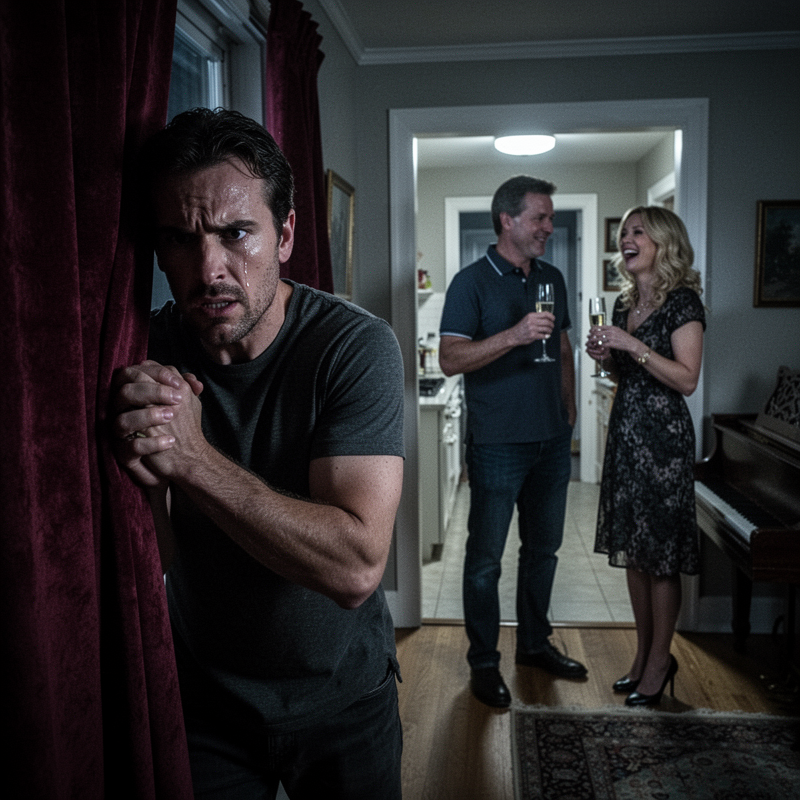
I froze, retreating into the shadows of the living room, heart hammering against my ribs. The lock clicked, then the door creaked open. They stepped inside, their voices still carrying the same unusual buoyancy. My eyes darted around, searching for a place to hide, but it was too late. The light from the hallway spilled into the living room, and I pressed myself against the wall beside the heavy, velvet curtains, hoping the dimness would conceal me.
“He’s probably passed out cold,” Robert said, his voice now lower, but still cheerful.
Carol giggled, a sharp, metallic sound.
“Or he’s just pretending to be asleep, the drama queen,” she added, her tone mocking.
They didn’t come into the living room. Instead, their voices grew slightly muffled as they moved deeper into the house, towards the kitchen, where they usually congregated during their rare, brief visits. I heard the clink of glasses, the distinct pop of a champagne cork. My eyes widened. Champagne? At my house? After Sarah’s death?
“To us,” Robert’s voice drifted, clearer now, from the kitchen archway. “And to new beginnings.”
Carol’s answering cheer was enthusiastic. “To the future, darling! Finally!”
My mind reeled. What future? What new beginnings? The sound of their footsteps drew closer, and I instinctively held my breath, pressing myself even further into the wall. They were coming back towards the living room, their voices growing louder, unburdened by any pretense of sorrow.
“I still can’t believe it’s this easy,” Carol whispered, her voice practically vibrating with excitement. “Poor, dear Sarah. Gone too soon, of course, but honestly, it’s a blessing in disguise, isn’t it? For *us*.”
A sickening cold spread through my chest. My hands clenched into fists, nails digging into my palms.
Robert scoffed, a dry, dismissive sound.
“Easy? Carol, we’ve been waiting for this opportunity for years. Ever since Ethan married her, with her paltry family money. But now… now all of his significant investments, his life insurance… it’s all within reach.”
The words struck me like physical blows. My breath hitched. This wasn’t grief they were feeling. This was triumph. This was greed.
“And he’s so broken, so utterly lost,” Carol continued, her voice dripping with false sympathy. “He won’t even see us coming. We just need to play the ‘supportive family’ card for a few more weeks, make sure he’s sufficiently ‘comforted’ and ‘guided’ through his darkest hour. Then, we can nudge him towards ‘sensible’ financial decisions. You know, consolidating his assets, perhaps getting you to manage his portfolio.”
Robert chuckled, a low, satisfied rumble.
“Exactly. The life insurance policy alone is substantial. Over a million dollars. And his personal investments… well, they’ve always been rather impressive. We can ‘help’ him secure his future. And ours.”
He paused, then added, “It was a stroke of luck, really. Her passing. Tragic, of course.” The word “tragic” was a throwaway, an afterthought, devoid of all meaning.
My vision blurred, not from tears, but from a surge of pure, blinding rage. They were celebrating Sarah’s death. My beautiful, kind, loving Sarah. They saw her demise not as a tragedy, but as a financial opportunity, a doorway to my assets. Every superficial call, every feigned condolence, every empty offer of support—it had all been a calculated act. A disgusting, manipulative performance.
A single tear finally escaped, trailing a burning path down my cheek, not for Sarah this time, but for the profound, ugly betrayal I was witnessing. The grief that had consumed me for weeks, that had rendered me a hollow shell, began to crystallize into something entirely new. Something sharp. Something cold.
They wanted my money. They thought I was a broken man, easily led, easily exploited. They thought they had won.
A new clarity settled over me, chilling and absolute. They would not get a single cent. They would not get to parade their false sympathy or their calculated greed over my wife’s grave. They wanted me gone, out of their way, a broken man they could control.
But I wouldn’t be broken. And I wouldn’t be controlled. I would be gone.
They walked out of the house a few minutes later, their voices still light and cheerful, oblivious to the fact that I had heard every horrifying, despicable word. I listened to their car pull away, the sound fading into the night, taking with it the last remnants of my naive trust.
My heart still pounded, but the pain of grief had been overshadowed by a different, searing emotion. The man they thought they could manipulate, the man they believed was too lost to see their true nature, was gone. And in his place, a quiet, unshakeable resolve had taken root.
They wanted me to vanish. Fine. I would give them precisely what they wanted. But I would not be the victim they envisioned. I would not be an easy mark. My disappearance would not be a surrender, but a declaration of war.
What happened after that is in the first comment, because that’s when the truth started leaking out.
Part 2
The cold resolve that had settled in my chest hardened with the morning light. I felt no sorrow now, only a quiet, burning determination.
The phone rang, jarring the silence. It was Robert, his voice a little too eager, a little too concerned for my “well-being.”
“Ethan, I just wanted to check in. You sounded pretty rough last night,” he said. “Everything alright? And, uh, are your finances in order?”
I kept my answers brief, deliberately vague.
“Just a lingering cough,” I muttered. “Everything’s fine, Robert. I’ve got things handled.”
He hesitated, then offered a hollow, “Good, good. Just let us know if you need anything at all.”
I hung up, his transparent greed a bitter taste in my mouth. My eyes fell on Sarah’s old mahogany desk in the corner, a piece she adored. I hadn’t touched her personal items yet, the grief too raw. Now, however, there was a different kind of urgency.
I began sifting through her things, the familiar scent of her stationery and dried lavender filling the air. Each item was a memory, but I pushed the sentimentality aside, focusing on the task. Behind a stack of old journals, tucked away in a hidden compartment I never knew existed, my fingers brushed against a thick, sealed envelope.
It was addressed to “My Dearest Ethan,” in Sarah’s elegant handwriting. My heart gave a strange lurch. Inside, a single sheet of paper, folded neatly, bore the header “Codicil to Last Will and Testament.” It was dated six months before her death.
I began to read, my eyes scanning the legal language. Sarah had foresight. She had known.
The document stipulated that a significant portion of her personal estate—precisely three hundred thousand dollars—was to be donated to the Oregon Cancer Research Foundation, the very charity that had funded some of the most promising studies into ovarian cancer.
My gaze dropped further down the page. A separate clause established a small, fifty-thousand-dollar sentimental trust for me, specifically “to ensure Ethan’s personal comfort and independent future, free from external influence.” The codicil explicitly stated that these funds were to bypass any other family member’s claim or interference.
A profound shock ran through me, followed by a surge of something akin to awe. Sarah, even in her illness, had been protecting me, protecting her legacy. She had outmaneuvered Robert and Carol before they even knew there was a game. Their greedy scheme to seize *her* money, the money they believed was now “within reach,” was already fruitless.
CHAPTER 2: The Missing Heir
Days after Linda Rodriguez finalized the sale, my Portland home stood empty, stripped of life and memory. My bank accounts, once a significant part of my identity, now held nothing. I had vanished, just as planned, leaving the silence to speak volumes.
Robert and Carol, driven by their insatiable greed, would soon discover my absence. I pictured their arrival, the shock, the quick shift from feigned concern to calculated panic. This was the first ripple of my carefully orchestrated plan.
A short time later, the first news reached me through David, my loyal friend and tech wizard. Robert and Carol had indeed descended upon the vacant house. Their initial confusion quickly morphed into something more sinister.
They went straight to the police, filing a “missing person” report.
“Ethan Miller,” Robert’s voice, tight with feigned distress, had resonated through the police station, according to David’s discreet sources. “He’s been utterly distraught since Sarah’s passing. We’re worried about his mental state.”
Detective Marcus Thorne, a man known for his thoroughness, listened patiently. He noted their “concern” for my well-being, but his gaze, I imagined, would have been piercing.
Carol chimed in, her voice dripping with artificial worry. “He’s been so unstable, Detective. A flight risk, really.”
My family didn’t care about my mental stability. They cared about the assets they believed were still within their grasp. This was Twist 3 unfolding perfectly.
Robert then moved to his true agenda, his voice dropping slightly. “Given his fragile condition, we believe it’s imperative to freeze his remaining assets.”
“Just until he’s found, of course,” Carol quickly added, a veneer of propriety. “For his own protection.”
They wanted to gain legal access. They wanted control. They still believed I had an inheritance ripe for the taking, not realizing I had already ensured Sarah’s wishes were respected and my own financial landscape was utterly barren for them.
Detective Thorne, however, was not easily swayed. “Mr. Miller, Mrs. Miller, freezing assets is a significant legal step. We’ll need concrete evidence of endangerment, not just supposition.”
“But he sold his house!” Robert exclaimed, his mask slipping slightly. “And emptied his accounts! Who does that unless they’re unstable?”
I smiled grimly in my secluded cabin, miles away in Montana. Their desperation was palpable, even from a distance. They couldn’t grasp that my actions were a calculated escape, not a breakdown.
David sent me a coded message later that day. “Thorne’s not buying their ‘distraught widower’ act. But they’re pushing hard for that asset freeze.”
“Good,” I replied, typing quickly on the encrypted device. “Let them push. It will reveal their true intentions.”
My family, in their blindness, had completely misunderstood my disappearance. They saw vulnerability where I had meticulously built an impregnable shield. They saw an opportunity for plunder where I had sown the seeds of their downfall. The game had begun, and they were already moving their pieces exactly as I anticipated.
Leave a Reply