Chapter 1:
Part 1
My father’s final secret completely rewrote everything I believed about my family, revealing hidden decisions, long-buried financial deals, and carefully guarded truths kept from me for years. It forced me to re-evaluate every memory and relationship, as the past became far more complex and irreversible than I ever imagined.
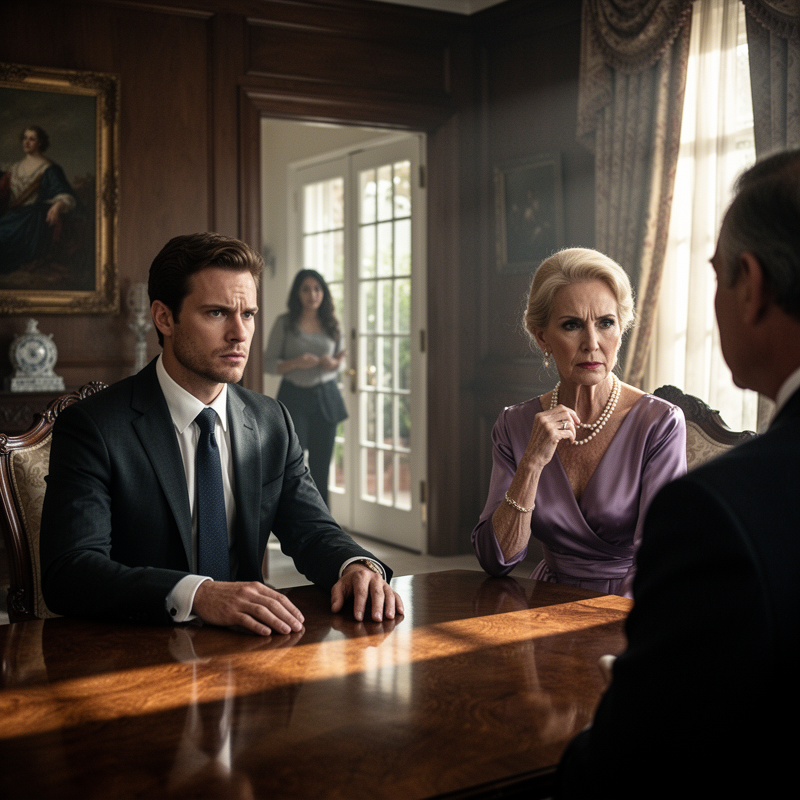
The polished mahogany table reflected the grim faces gathered around it. Sunlight, filtered through the ornate curtains of the Thorne family’s elegant Los Angeles home, seemed to lose its warmth, casting long, somber shadows across the somber room. It had been three weeks since Richard Thorne, my father, passed away peacefully in his sleep, and now, the inevitable formality of the will reading had arrived.
Mr. Henderson, our family lawyer for decades, cleared his throat, his gaze sweeping over the small assembly. He wore a dark, impeccably tailored suit, his silver hair neatly combed back. His eyes rested on me, Ethan Thorne, then on Eleanor, my stepmother, who sat opposite me, her expression carefully composed, a single strand of pearls gleaming at her throat.
Maria Garcia, our loyal housekeeper of 35 years, stood quietly by the French doors, her hands clasped, her eyes red-rimmed but stoic. She was practically family, more familiar with my father’s daily rhythms than anyone.
Mr. Henderson began to read, his voice steady, reciting the standard legal boilerplate. The initial clauses detailed the division of personal effects, the family heirlooms, the cars. Then came the significant assets: the house, the investment portfolios, the summer cottage in Malibu. A formidable estate, valued at just over $5 million, was to be primarily divided between Eleanor and myself.
The words washed over me, a familiar comfort and a profound sadness intertwining. My father had always been meticulous, pragmatic, a man of unwavering integrity. This was precisely what I expected—a clear, equitable distribution, reflecting his thoughtful nature.
Then, Mr. Henderson paused, adjusting his reading glasses.
“And finally,” he stated, his tone shifting slightly, “there is one specific, recurring bequest.”
Eleanor shifted in her seat, a faint, almost imperceptible frown creasing her brow.
“A monthly stipend of one thousand United States Dollars,” Mr. Henderson continued, “is to be issued to ‘The Silent Guardian Charitable Trust, Account #7G4-NM987.’ This payment is to commence immediately upon the estate’s finalization and continue indefinitely.”
I leaned forward, a prickle of unease running down my spine. The Silent Guardian Charitable Trust? I had never heard my father mention it. He was a generous man, certainly, but he always supported established, reputable organizations like Doctors Without Borders or the local children’s hospital. This name, “Silent Guardian,” sounded… clandestine.
And the account number. My mind, trained in the precise logic of software engineering, latched onto it immediately. 7G4-NM987. It was an odd string. The “NM” stood out, clearly indicating New Mexico, but the alphanumeric sequence didn’t conform to any standard bank account or routing number I was familiar with. It lacked the necessary digits, the specific format. It looked more like a product code, or a serial number, or even a coordinate.
Eleanor cleared her throat softly.
“Richard could be… quite eccentric sometimes,” she offered, her voice light, dismissive. “I imagine it was some small, forgotten pledge. Perhaps to an animal sanctuary he visited once.”
Mr. Henderson offered a noncommittal nod, closing the file. “The will is quite explicit, Mrs. Thorne.”
The meeting concluded, the air thick with polite condolences and strained pleasantries. Eleanor approached me, her hand resting briefly on my arm.
“Don’t trouble yourself over that unusual clause, Ethan,” she murmured, her smile not quite reaching her eyes. “I’ll handle it. Richard had so many quirky habits. I’m sure it’s nothing important.”
Her words, intended to soothe, only deepened my unease. My father didn’t have “quirky habits” when it came to his finances. He was exact, precise, almost to a fault. That account number, that unknown trust, it gnawed at me.
Later that evening, after everyone had departed, I found myself drawn to my father’s study. It was a sanctuary of organized chaos: towering bookshelves crammed with first editions, a vintage radio collection gleaming in a glass cabinet, and a sprawling, antique desk where he spent countless hours. The scent of old paper and pipe tobacco, even three weeks on, still lingered.
My father, Richard, had been a voracious reader of history, a hobbyist geographer, and a man who believed in the tangible. His collection of atlases and maps was particularly impressive, meticulously annotated with his elegant script. I ran my fingers over the spine of a worn National Geographic atlas, a gift from my tenth birthday.
Something tucked between the brittle pages of the New Mexico section caught my eye. It was a yellowed newspaper clipping, distinct from the pristine condition of the atlas pages. I carefully extracted it. The date at the top, barely legible, indicated it was exactly 25 years old. The headline spoke of a “Small, Controversial Land Deal Near Santa Fe.” The article was short, vague, mentioning a dispute between local landowners and a nascent development project, but offering few concrete details.
My gaze drifted to the space beneath where the clipping had been lodged. There, tucked against the binding of the atlas, was a small, cream-colored note. It was typewritten, but I recognized the distinct spacing and faint impression of his old manual typewriter, the one he kept for “important thoughts.”
My fingers trembled slightly as I unfolded it. The text was brief, stark.
“7G4-NM987 – A.R.F. – Look East.”
My breath hitched. The very same string of characters from the will. It wasn’t an account number. It was a code. A message.
“A.R.F.” What did that mean? And “Look East”? East of what? East of New Mexico? East of Santa Fe, the location in the article?
A cold wave washed over me. My father, the man of absolute transparency, had left behind a secret. A secret so carefully buried, so subtly revealed, that it bypassed everyone but me. The “charity” Eleanor had dismissed so readily was a deliberate breadcrumb, a trail left just for me to follow. My father hadn’t been eccentric; he had been trying to tell me something, something he couldn’t say aloud.
I stood there, the crisp paper in my hand, the vague clipping spread on the desk. The numbers, the initials, the direction—they swirled in my mind, forming an impenetrable puzzle. This wasn’t some minor, forgotten pledge. This was a deliberate, coded communication, a desperate plea from beyond the grave. And I had absolutely no idea what “A.R.F.” or “Look East” could possibly entail, or why my father had gone to such lengths to hide it.
What happened after that is in the first comment, because that’s when the truth started leaking out.
Part 2
The next morning, the cryptic note still burned in my mind. I was already sitting at the study desk, a laptop open, cross-referencing public records for anything related to “Silent Guardian Charitable Trust” or “A.R.F.” in New Mexico.
Eleanor found me there, a cup of coffee steaming in her hand. Her dress was a soft lavender, her expression gentle, concerned.
“Ethan, dear,” she said, her voice a low purr. “You look exhausted. Still thinking about that peculiar clause?”
I offered a noncommittal hum.
“It really was just one of Richard’s little eccentricities, I promise,” she continued, moving closer. “Perhaps a forgotten donation from years ago. Please, let me take care of it. I’ll arrange for the estate to send the funds directly, quietly resolve it. No need for you to trouble yourself further.”
Her offer felt like a subtle attempt to redirect me, to close this avenue of inquiry. But I was already too far down the rabbit hole.
My father had often joked about a “secret stash” for his poker winnings. He’d point to the antique writing desk, tapping the ornate wooden side panel. “That’s where I’d hide the real treasures, son.” I’d always laughed, knowing he rarely played poker, and certainly wasn’t a gambler.
Now, the joke felt less like humor and more like a clue. I ran my hands along the desk’s intricate carvings, pressing, feeling. My fingers found a subtle seam, a barely perceptible join.
A small section of the wood slid inward, revealing a hidden compartment. Inside, nestled on a bed of faded velvet, was a tiny, tarnished silver key. Beside it, a single folded sheet of paper.
My heart hammered against my ribs. This was it. I unfolded the note. It was my father’s familiar, elegant script, written with an old fountain pen.
“For my son,” it read, “should you ever question… a glimpse into burdens I carried. See the old bank on Main Street.”
The “old bank on Main Street” could only mean the First National Bank, a sturdy, granite building where my father had kept his business accounts for decades. I practically flew across town. The bank manager, a polite woman named Ms. Davies, recognized me immediately.
She retrieved a small, unassuming box. The silver key slid into the lock with a soft click. I lifted the lid, expecting to find… what? Deeds? Stock certificates? A confession?
Instead, I found a leather-bound journal. Its pages were filled with meticulous handwritten entries. “NetBridge Solutions – Failed Investment,” one header read. Another detailed “Poker Losses – Vegas Trip,” then “Market Downturn – Q3.”
The journal chronicled years of what appeared to be minor gambling debts and a significant, but failed, investment in a dot-com startup called “NetBridge Solutions.” Entry after entry detailed modest losses, small payouts, and then the final, crushing write-off of nearly $350,000 for the startup.
I stared at the neatly organized columns, the precise figures. It was all there, laid out clearly. The missing money. The hidden assets. It suddenly made sense. My father had secret debts. He had hidden this journal to explain any future discrepancies, perhaps to protect Eleanor from worrying.
But something about it felt wrong. My father, the meticulous, conservative Richard Thorne, losing $350,000 in a failed startup and gambling? It didn’t fit. The numbers were too neat, the story too perfectly contained. Was this the burden he carried, or was this journal another piece of an elaborate, unexplained puzzle?
Chapter 2: The Real Deed and The Ghost Trust
The “NetBridge Solutions” journal sat open on my desk for two days, its pages a careful imitation of financial history. As a software engineer, I was trained to spot patterns and anomalies, and this document screamed fabrication. The listed stock prices for specific dates didn’t align with any historical market data I could pull, and certain transaction records utilized an outdated account structure that hadn’t been in use for years.
“It’s a fake,” I muttered aloud, the realization chilling me. My father, a man I believed to be utterly transparent, had orchestrated this intricate charade.
A soft knock came at the study door. Maria Garcia, our long-time housekeeper, entered with a dust cloth, her gaze falling on the fireplace.
“Your father, he spent many hours there,” she said quietly, her eyes drifting to an antique portrait hanging above the mantel. “Always reading, sometimes tapping his fingers on the brickwork.”
I looked from the fake journal to the fireplace, a memory sparking. My father had often settled there, a book in hand, seemingly lost in thought. I approached the fireplace, running my hand along the cool stone, remembering Maria’s subtle hint. Behind the dusty old portrait, my fingers found a subtle seam. A brick shifted.
It was a small, hidden compartment. Inside, nestled in velvet, was a compact microfiche reader and a single roll of microfiche. Not another journal, I thought, but something far more delicate. I loaded the film, the tiny screen flickering to life.
Blurred images scrolled past: old newspaper clippings, faded photographs, then a sharp, undeniable clarity. It was a property deed. Not for a small plot, but for 500 acres of undeveloped land in Nevada, near Las Vegas, purchased almost three decades ago. My breath hitched.
Alongside the deed were financial records for something called the “Thorne Family Legacy Trust (TFLT).” This name, this trust, was completely absent from my father’s official estate documents, from everything Mr. Henderson had read. The implications hit me with the force of a physical blow. This land, now undoubtedly developed into a sprawling resort, would be worth tens of millions of dollars.
My father had owned this colossal asset. He had hidden it, tied it to a secret trust, and left a breadcrumb trail for me to find. Eleanor’s quiet dismissal of the “charity” clause, her readiness to “resolve” it, suddenly took on a sinister edge. It wasn’t about a thousand dollars; it was about diverting me from a fortune.
Chapter 3: The Ghost of Trust X
I wasted no time. The next morning, I confronted Mr. Henderson in his downtown office, spreading the microfiche copies of the Nevada deed and the TFLT documents across his pristine mahogany desk. He leaned over them, his spectacles slipping down his nose.
“This is… extraordinary, Ethan,” he murmured, his voice tight. He adjusted his tie, visibly shaken. “I have no knowledge of any ‘Thorne Family Legacy Trust.’ Richard never mentioned it, not once.”
“That’s what worries me,” I replied, gesturing to the documents. “It’s a multi-million-dollar asset. How could it be missing from his estate?”
Henderson promised to investigate immediately. Meanwhile, I delved deeper into the TFLT’s establishment documents, tracing names and dates. A peculiar detail emerged: while Richard’s signature was on the founding papers, the original benefactor was listed as “Ms. E. Davies.” The name tugged at a distant corner of my memory.
I cross-referenced old family photos, scanning for familiar faces, and then checked my parents’ marriage license. My eyes widened. “E. Davies” was Eleanor’s maiden name. She had never spoken of it, always simply Eleanor Thorne. The trust, the land, Eleanor’s initial involvement—all predated her marriage to my father by years.
This discovery spun my world. Eleanor and the TFLT were connected long before she became my stepmother. I returned to our home, finding Eleanor arranging flowers in the living room, her usual picture of composed elegance.
“Eleanor,” I began, trying to keep my voice even. “I’ve been looking into some old family records. Do you remember a ‘Ms. E. Davies’?”
She froze, a stem of white lilies clutched in her hand. Her back stiffened before she slowly turned. A small, forced smile touched her lips.
“Oh, E. Davies,” she said lightly, almost too quickly. “A very distant relation, darling. She passed years ago. Why do you ask?”
“Her name is on some old trust documents related to my father’s assets. The Thorne Family Legacy Trust.”
Her smile faltered slightly. “Richard sometimes asked for help with paperwork before we were serious. I merely lent a hand as a favor. He was always so busy with his investments.” She plucked a wilting leaf from a rose, her eyes avoiding mine. “It really was nothing significant, just some old land deal paperwork.”
The evasiveness was palpable. A “favor”? Years before they married, and tied to a secret trust worth millions? The thought that Eleanor’s connection to my father’s deepest secret wasn’t a byproduct of their marriage, but something that predated it, was unsettling. My father’s love story, once a cherished memory, began to curdle into something more calculated, more cold.
Chapter 4: Eleanor’s Past Shadows
The weight of Eleanor’s pre-marriage involvement pressed on me. I needed answers beyond her dismissive words. There was only one person who might know: my estranged Uncle Wallace. Richard’s older brother, a retired history professor, lived in Santa Monica, a cynical guardian of family lore. It wouldn’t be an easy conversation.
I drove out, the Pacific breeze doing little to cool my nerves. Wallace’s small, cluttered bungalow smelled of old books and Earl Grey tea. He greeted me with a grunt, his eyes sharp behind thick glasses.
“So, the prodigal nephew returns,” he drawled, gesturing to a worn armchair. “What brings you to my dusty corner of the world? Not another one of Richard’s ‘brilliant’ ideas, I hope.”
I cut straight to it, explaining the TFLT and Eleanor’s maiden name on the founding documents. His expression, usually acerbic, hardened.
“E. Davies,” he repeated slowly, a distant look in his eyes. He leaned back, a deep sigh escaping him. “The Davies family. Once quite prominent in textiles, if I recall. They lost everything, Ethan. Everything.”
He recounted a story I’d never heard. My grandfather, Richard’s father, had orchestrated a complex business deal decades ago, resulting in the Davies family’s financial ruin. It was a scandal that had nearly torn the Thorne family apart.
“Eleanor Davies was practically a child when her family lost everything,” Wallace continued, his voice low. “Her father, a proud man, never recovered. I never saw Eleanor again until Richard brought her home, years later, as his new fiancée. It seemed… quite a coincidence, even then.”
The air crackled with unspoken history. Eleanor’s “innocent favor” now appeared rooted in a deeper, far more personal vendetta. This wasn’t merely a coincidence; it was a calculated move, transforming the hidden trust into a potential instrument of generational revenge. My grandfather had ruined her family, and now, decades later, his son’s wife was tied to a secret fortune.
“Did my father know about this history?” I asked, my voice barely a whisper.
Wallace shrugged, a flicker of pain in his eyes. “Richard knew everything, Ethan. He always did. Whether he chose to see it, that’s another matter.”
I left Wallace’s, the Santa Monica sunset painting the sky in fiery hues, but my mind was in shadow. Eleanor’s long-game strategy, her carefully concealed past, cast my entire family history in a new, unsettling light. The intricate web of deception stretched back decades, ensnaring my father, and potentially, all of us.
Chapter 5: Arthur’s Web of Lies
Back in Los Angeles, I burrowed deeper into the TFLT’s financial records, focusing on its outflows. It wasn’t long before a disturbing pattern emerged: consistent, substantial payments, averaging $150,000 monthly, had been flowing out of the trust for over two decades. The recipient was a shell company called “Desert Bloom Holdings LLC,” registered in Delaware.
I knew that name. A quick search of public records confirmed my suspicion. The registered agent for Desert Bloom Holdings was none other than Arthur Finch, Richard’s former business partner and a man who had always presented himself as a benevolent family friend. My stomach clenched.
I dove into Arthur’s public profile. He had amassed a significant portfolio of luxury properties—mansions in Malibu, a penthouse in New York, a villa in Tuscany—assets that far exceeded anything his declared income as a financial consultant should have allowed. Desert Bloom Holdings had also been intricately involved in the early zoning and development applications for the Nevada land, the very land the TFLT owned.
This was no coincidence. I arranged a meeting with Arthur, selecting a neutral coffee shop. He greeted me with a wide, professional smile, but his eyes held a wary glint.
“Ethan, good to see you,” he began, taking a sip of his cappuccino. “I heard you’ve been digging into Richard’s affairs. A bit morbid, isn’t it?”
I laid out my findings, watching his face closely. “Desert Bloom Holdings, Arthur. And the substantial payments from the TFLT. What exactly was your ‘legal counsel’ for?”
Arthur’s smile didn’t quite reach his eyes. “My dear boy, I merely provided professional services to Richard and the trust. Standard fees for complex land deals. Nothing illicit.” He pushed his cup aside, his posture stiffening. “Richard was a shrewd investor, you know. He trusted my judgment implicitly.”
“He trusted you with millions from a secret trust?” I pressed. “A trust Eleanor’s maiden name is tied to, a trust nobody knew existed?”
He leaned forward, his voice dropping. “Let me be clear, Ethan. Richard was my partner, a close friend. If you continue to interfere with the estate’s legitimate business partners, I will be forced to take legal action.” His gaze was steely, a clear warning.
The conversation ended abruptly. Later that afternoon, an email landed in my inbox. It was a formal cease-and-desist letter from Arthur’s lawyer, accusing me of “defamation and probate interference,” and threatening a lawsuit if I didn’t stop my “harassment.” The message was stark: Arthur Finch, like Eleanor, was actively trying to shut me down.
Chapter 6: The Unraveling Thread
Arthur’s legal threat only strengthened my resolve. Undeterred, I consolidated my meticulously organized folder of findings. It contained the fake journal, copies of the real Nevada deed, the TFLT documents with Eleanor’s maiden name, and irrefutable proof of Arthur’s shell company, Desert Bloom Holdings, siphoning funds. I needed more than just family theories now. I needed official power.
I drove straight to Detective Rodriguez’s office at the LAPD. She listened patiently, her expression unreadable, as I laid out the intricate web of deception. She picked up the fake journal, flipping through the pages.
“Most people wouldn’t notice these inconsistencies,” she observed, tapping a record. “Your background was a definite advantage.”
I explained the connection to Eleanor, the Davies family history, and Arthur’s escalating threats. Rodriguez, initially skeptical of what often boiled down to “family drama,” began to nod slowly, her interest piqued by the sheer volume of financial irregularities and my diligent presentation.
“This isn’t just family drama anymore, Mr. Thorne,” she finally said, closing the folder. “This is a legitimate financial fraud investigation. I’ll open a preliminary case.”
Just as Rodriguez’s team began their work, Eleanor and Arthur intensified their retaliation. Within days, Eleanor’s legal team filed a motion to have me removed as executor of my father’s estate. Their filing cited “emotional instability and harassment,” painting me as an erratic son driven by grief, attempting to discredit my findings and seize full control of the estate.
Almost simultaneously, Arthur initiated a rapid, predatory legal maneuver. He filed an “unresolved lien” claim against the Nevada land through Desert Bloom Holdings, demanding an immediate forced sale. His intention was clear: liquidate the primary asset, the multi-million-dollar land, before Rodriguez’s investigation could expose the TFLT and freeze the assets. The clock was ticking. The estate was on the verge of being irrevocably plundered, and I felt a chilling race against time.
Chapter 7: Sarah’s Lost Legacy
While Detective Rodriguez’s team scrambled to secure an injunction, I remembered another piece of the puzzle. Eleanor’s revenge against my grandfather for ruining her family. The Davies family textile business. I reached out to my cousin, Sarah Jenkins, my grandmother’s only direct heir.
We met at a quiet cafe, the urgency in my voice undeniable. I laid out the full scope of my findings: the TFLT, Eleanor’s hidden past, Arthur’s involvement, and the Nevada land. Sarah listened, her brow furrowed, her young child asleep in a stroller beside us.
“My grandmother always felt cheated,” Sarah finally said, her voice strained. “She used to talk about how her share of the family textile business just… vanished. Right before your grandfather, Richard’s father, started some big ‘venture.’ She always suspected he took her capital.”
My blood ran cold. “Richard vaguely mentioned something about a ‘western land’ venture,” I murmured, recalling Uncle Wallace’s words. “Do you have anything concrete?”
Sarah reached into her bag, pulling out a worn, leather-bound journal. “This was hers. She meticulously documented everything.” She flipped through yellowed pages. “Here, look. Forced buyouts. Missing funds. The dates align with your grandfather launching his ‘new venture.’”
My eyes scanned the entries. The dates in Sarah’s grandmother’s journal aligned perfectly with the TFLT’s establishment and the Nevada land purchase, almost thirty years ago. The capital from Sarah’s grandmother’s stolen inheritance, the very funds that had fueled the Davies family’s ruin, had been used as seed money for the Thorne Family Legacy Trust.
“My God,” I whispered, the full horror dawning on me. Eleanor’s “revenge” wasn’t just built on her family’s historical injustice; it was layered upon a previous, related injustice to my own family. Sarah’s grandmother, and by extension, Sarah, had been victims twice over. The TFLT wasn’t just a vehicle for Eleanor and Arthur’s greed; it was a testament to decades of intertwined betrayals.
Sarah’s eyes welled with tears, raw grief and anger etched on her face. “My grandmother died believing she’d been robbed. And she was right.” Her voice broke. This pursuit of truth was no longer just about my father’s secrets; it was about generational justice for our entire family.
Chapter 8: The Forensic Ghost
The injunction against the Nevada land sale was granted, literally minutes before Arthur’s predatory legal maneuver could finalize the transaction. Detective Rodriguez’s swift action had saved the multi-million-dollar asset from being liquidated. With the immediate threat contained, Rodriguez’s team moved quickly, subpoenaing all the original TFLT founding documents and land transfer agreements.
Dr. Lena Petrova, a renowned forensic document examiner, was brought in. Her reputation for meticulous, unassailable analysis was well-deserved. Weeks passed in agonizing silence. Then, a call came.
“Mr. Thorne, Detective Rodriguez,” Dr. Petrova’s voice was calm, professional, yet held an underlying note of gravity. “My analysis is complete.”
We met her in her sterile laboratory, surrounded by specialized equipment. She pointed to magnified projections of Richard Thorne’s signature on the TFLT establishment documents and several key land acquisition contracts, dating back nearly thirty years.
“These are highly sophisticated forgeries,” she stated, her pointer hovering over a minute irregularity. “A near-perfect imitation, but an imitation nonetheless. The stroke pressure, the minute hesitation points… Richard Thorne did not sign these documents.”
The revelation landed like a thunderclap. My father, the man I thought had been a willing, albeit secretive, participant, was a victim. He hadn’t established the TFLT; he’d been framed, coerced. This changed everything. It transformed my father’s entire hidden life from one of secret guilt to one of desperate, heartbreaking protection.
“He was forced,” I whispered, the words catching in my throat. “He was trying to tell me.”
Rodriguez’s expression was grim. “This elevates the case significantly, Ethan. From fraud to potential coercion and extortion.”
The image of my father, a kind and loving man, trapped in a decades-long scheme, broke my heart. My mind flashed to a dusty, locked toolbox in his workshop, a place he always guarded carefully, a place I had never dared to breach. A sudden, potent surge of intuition hit me. That toolbox. It had to hold the key to who coerced him, to the missing piece of his untold story.
Chapter 9: The Truth, Unmasked
My heart hammered against my ribs as I drove home, the image of Dr. Petrova’s analysis burned into my mind. I burst into my father’s workshop, the familiar scent of sawdust and oil doing little to calm my racing pulse. The old, steel toolbox, battered and scarred, sat precisely where he’d always kept it. With trembling hands, I broke the rusted lock.
Inside, beneath a layer of forgotten tools, lay a small, sealed, coded audio cassette. It was labeled in my father’s neat hand: “For Ethan – If I cannot tell you myself.” My fingers fumbled with the old cassette player I found on his workbench. I pressed play, the whirring of the tape filling the silent room.
Richard’s voice, distressed and thin, filled the air, recorded nearly thirty years ago. He recounted the agonizing details: being cornered by Eleanor and Arthur shortly after marrying Eleanor. They revealed their families’ shared ruin by my grandfather, detailing his ruthless business tactics. Then came the threat—not just to his reputation, but to my safety and my mother’s well-being. They coerced him into maintaining the illusion of the TFLT, a long-term scheme to “reclaim” their family fortunes.
“I had no choice, son,” his voice cracked with anguish. “I feigned complicity to protect you, to protect your mother. I tried to leave you clues, Ethan. The charity clause, the microfiche… I prayed you’d find them, that you’d know the truth.” His voice broke, dissolving into a quiet sob.
Armed with this devastating confession, the forged signatures, the intricate financial trail, and Sarah’s grandmother’s journal, we arranged a final, court-mandated mediation with Eleanor and Arthur. It was held in a somber conference room, Detective Rodriguez by my side, Sarah a pillar of quiet strength.
Eleanor, her usual composure fractured, sat opposite us, Arthur fidgeting beside her. Rodriguez placed the evidence on the table, piece by damning piece. The forged signatures. The TFLT documents. The Desert Bloom Holdings ledgers. Finally, I played the audio cassette.
Richard’s anguished voice, recounting their threats, their coercion, echoed in the room. Eleanor’s face crumpled. She began to weep, deep, gut-wrenching sobs.
“He ruined us!” she cried out, her voice raw. “Your grandfather destroyed my family! I took back what was mine! I made him pay!” She confessed to orchestrating the entire scheme with Arthur, driven by decades of bitterness and a desperate need for financial security, framing my father as a willing participant. Arthur, seeing no way out, mumbled his own confession. Federal agents, who had been waiting outside, entered the room. Eleanor and Arthur were handcuffed, their faces ashen, led away to face the cold glare of justice.
Chapter 10: Reckoning and Rebirth
In the stark aftermath, Eleanor Thorne and Arthur Finch faced the full weight of the law. They were formally indicted on multiple counts of felony financial fraud, money laundering, and conspiracy. Eleanor, stripped of her composure, lost all claims to Richard’s estate, which was finally re-evaluated and properly distributed, with me as the sole rightful heir. Arthur’s sprawling financial consulting business was seized, its assets frozen. Both faced significant federal prison sentences, their carefully constructed reputations shattered beyond repair.
With Sarah’s unwavering help, I meticulously reconstructed the true financial history of the TFLT and the Nevada land. We worked closely with her legal team, pursuing a class-action lawsuit against the remaining shell entities involved in the scheme. This led to the recovery of substantial funds, which were then allocated to Sarah and other descendants of families wronged by my grandfather decades ago. It was a long-overdue measure of justice.
I liquidated the Nevada land, a property steeped in so much pain and deception. A significant portion of the funds was used to establish a genuine “Richard Thorne Legacy Foundation,” dedicated to educational grants, fulfilling what I knew to be my father’s true wish for a positive legacy. The remaining funds were channeled into rebuilding my family’s trust and supporting my own career and future.
The long-standing rift with Uncle Wallace began to heal. We shared quiet conversations, pouring over old photographs, and slowly, gently, understanding the impossible position my father had been forced into. We saw him not as a complicit figure, but as a silent protector.
A profound peace settled over me, a peace I hadn’t realized I was missing. My father’s honor was restored, his sacrifice understood. The truth, no matter how painful its uncovering, had finally brought justice and, for the first time in a very long time, genuine healing to our fractured family.
Leave a Reply