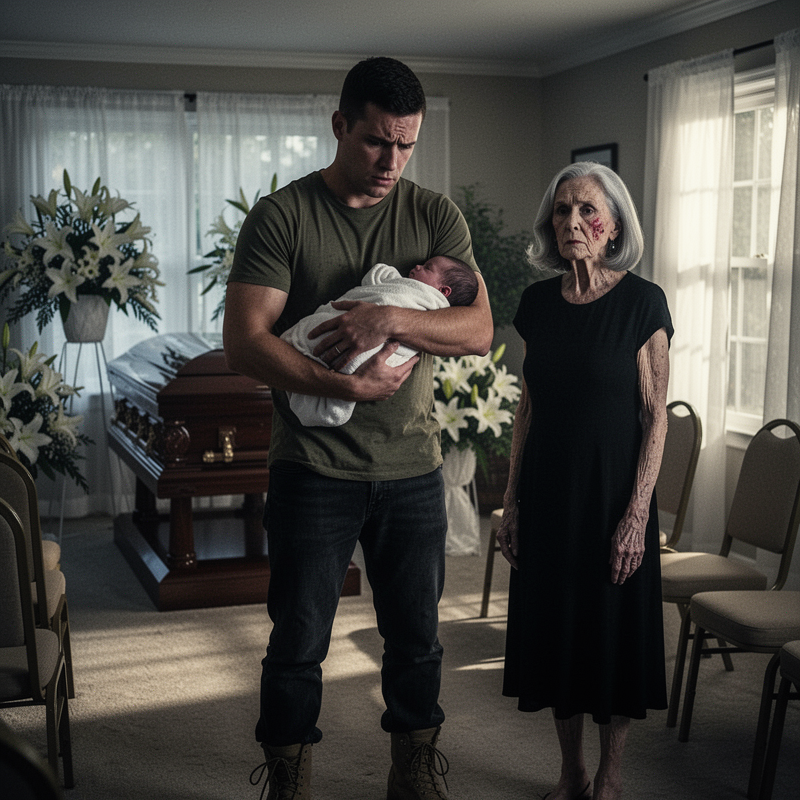
CHAPTER 1: The Coffin in the Living Room
Part 1
As I returned home from my military deployment, all I wanted was to see my beloved wife’s smiling face and hold her close, but the sight that greeted me in our living room was a polished mahogany coffin, starkly out of place, as my mother-in-law tearfully whispered, “She died during childbirth…”
The dry Arizona air, a familiar scent of dust and distant citrus groves, brushed against my face as I stepped off the Greyhound. Two grueling years overseas had sharpened every sense, but softened none of the aching anticipation to be back on American soil, back in Scottsdale, back home. My duffel bag, heavy with the weight of memories and the relief of duty done, felt light compared to the burden of longing I carried.
I spotted our street, the neat rows of adobe houses shimmering under the afternoon sun, the bougainvillea spilling vibrant color over every wall. A quiet suburban paradise. The bus hissed to a stop, and I descended, my boots hitting the familiar pavement, a sound I hadn’t heard in what felt like a lifetime.
My heart hammered against my ribs, a wild drum solo of pure, unadulterated excitement. Sarah. Our baby. I imagined her, standing on the porch, her smile lighting up the whole block, our newborn cradled in her arms. The pictures she’d sent, pixelated and a bit blurry, had sustained me through desolate nights and harrowing days. I pictured her swollen belly, the proud glow on her face. Our child. A new life.
A small tremor ran through me, not of fear, but of overwhelming joy. I walked down the street, my stride purposefully slow, wanting to savor every single step towards the most important reunion of my life. The air seemed to hum with the promise of future happiness, of finally holding them both.
Then I saw them.
Eleanor Albright, Sarah’s mother, and Robert Albright, her father, stood on my porch. My porch. The porch of the house Sarah and I had bought together, painted together, dreamed in together. They weren’t waving. They weren’t smiling. Their faces were drawn, etched with a somber seriousness that instantly sucked the air from my lungs.
My initial thought was annoyance. Why were they here, instead of Sarah? Had something gone wrong with their car, preventing them from bringing her to meet me? A thousand mundane explanations flashed through my mind, anything to avoid the creeping dread that began to coil in my stomach.
I quickened my pace, the weight of my duffel forgotten. Their eyes, usually warm and welcoming, held a distant, almost pitying quality. Robert, typically jovial, stood rigidly, his hands clasped behind his back, his gaze fixed on the perfectly manicured desert landscaping. Eleanor’s shoulders were slumped, her usually vibrant outfit a muted gray against her pallor.
“Mac,” Eleanor said, her voice a fragile whisper, barely audible over the thudding of my own pulse. Her eyes were red-rimmed, swollen.
Robert simply nodded, a tight, almost imperceptible movement of his chin. He didn’t meet my gaze. The silence stretched, thick and suffocating, between us. The smile I’d been ready to unleash, the embrace I’d rehearsed in my mind a thousand times, froze on my face.
“Where’s Sarah?” I asked, my voice coming out rougher than I intended, a desperate attempt to break through the wall of their grief. “Is she inside? Is the baby okay? Did something happen?”
Eleanor took a hesitant step forward, her hand reaching out, then dropping. Her lip trembled. She looked past me, into the empty street. Robert remained still, a statue of sorrow.
“Come inside, John,” Robert finally managed, his voice hoarse, barely more than a croak. “There’s… there’s something we need to tell you.”
The ominous tone sent a shard of ice through my heart. I pushed past them, the front door swinging inward without a sound. The house was unnaturally quiet. No music. No TV. No baby cooing. The familiar scent of Sarah’s lavender potpourri was absent, replaced by the faint, cloying aroma of lilies.
My gaze swept the living room, searching for a logical explanation, for Sarah to jump out with a playful cry of “Surprise!” But there was no surprise. Only a stark, horrifying reality that slammed into me with the force of a physical blow.
In the very center of our carefully decorated living room, where Sarah’s favorite armchair usually sat, stood a polished mahogany coffin. Its lid was closed, dark and imposing, draped elegantly with a spray of white lilies, their petals pristine and stark against the wood. It was impossible. It couldn’t be. This was someone else’s house, some terrible mistake.
My knees threatened to buckle. A cold sweat broke out on my forehead. My mind raced, grappling with the surreal, nightmarish image. Who? Why? What was this?
Eleanor stepped in behind me, her hand finally resting gently on my arm. Her touch was cold.
“Oh, John,” she choked out, her voice breaking, “my poor boy. Sarah… Sarah passed during childbirth. Just two weeks ago.”
The words hit me like a sniper’s bullet. Sarah. My Sarah. Gone. Childbirth. My vision blurred, the room spinning around me. The coffin. The lilies. The impossible, crushing finality of it all. My breath hitched. My heart felt like a shriveled thing in my chest. No. Not Sarah.
A gut-wrenching sob tore itself from my throat, raw and uncontrolled. The world tilted on its axis, dissolving into a maelstrom of agony and disbelief. I swayed, my hand reaching out blindly for something, anything, to ground me. Robert stepped forward, catching my arm, his grip surprisingly strong, but I barely registered it.
“Our baby?” I managed, the words ripping past the lump in my throat, barely a whisper. My head snapped up, searching Eleanor’s tear-stained face, then Robert’s. “Where’s our baby? Is our baby okay? Is it a boy or a girl?”
Eleanor’s gaze dropped instantly to the floor, her lips pressing into a thin, tight line. Robert’s eyes darted away, fixed on a distant point above my shoulder, anywhere but on me. The heavy, grief-laden silence returned, thick and impenetrable, punctuated only by my ragged breaths.
Eleanor cleared her throat, a small, unnatural sound. She wrung her hands. “John, dear,” she said, her voice now strangely detached, almost practiced, “it was a… a tragic loss. Of both. We’re so sorry.”
“Both?” I repeated, my voice rising, confusion battling with the tidal wave of grief. “What do you mean, both? Where is the baby? Where is our child’s coffin? You mean… you buried them together? Sarah would have wanted to see her baby, to hold our child.”
Robert finally met my eyes, but his were empty, almost vacant. He didn’t offer an answer, just a slow, sorrowful shake of his head. He looked away again. Neither of them met my desperate questions with any specific details, only vague, sorrowful pronouncements of “tragic loss” and averted glances. They simply stood there, stiff and uncomfortable, offering no explanation, no comfort about my child, no mention of where my newborn lay, no separate burial, nothing. The silence screamed louder than any words.
What happened after that is in the first comment, because that’s when the truth started leaking out.
Part 2
My gaze darted between Eleanor and Robert, pleading for clarity, for a simple answer. My throat ached, raw from the unshed tears. The silence stretched, tight and suffocating, thick with unspoken grief and something else I couldn’t quite name.
Then a voice cut through the stillness, cool and smooth. “Mac, there’s no need to distress Mom and Dad further.”
Paul Albright, Sarah’s younger brother, stepped out from the hallway, where I hadn’t noticed him before. He wore a dark suit, impeccably tailored, his expression carefully composed, almost too calm.
He approached me, a faint, almost pitying smile on his lips. “It was all very sudden, a terrible shock. Sarah developed severe pre-eclampsia. The doctors at St. Jude’s did everything they could.”
He paused, a practiced beat. “Sadly, the baby was stillborn due to the complications. It was a mercy, really, considering everything.”
Stillborn. The word hung in the air, a new layer of ice forming around my heart. Two losses. My mind struggled to comprehend it.
“Sarah, in her final hours, made a very clear request,” Paul continued, his eyes unwavering. “She asked that if anything happened to the baby, we should arrange for an immediate cremation. She wanted to spare you the pain of seeing a deceased infant, a memory too tragic for you to bear after all you’ve been through.”
He reached into the inner pocket of his jacket, pulling out a folded piece of paper. With a crisp flick of his wrist, he unfolded it, presenting it to me.
“Here,” he said, his tone authoritative. “The official death certificate for Baby McKenzie. Dated two days after Sarah’s passing. I personally oversaw all the arrangements, just as she wished.”
My eyes scanned the document. “Baby McKenzie.” Stillborn. Cremated. St. Jude’s Hospital. It looked official, emblazoned with a seal, but the words swam before my eyes.
Everything had been handled so quickly, so efficiently. My wife, gone. My child, never even a breath. And then, vanished into ash.
A hollow ache in my chest began to twist, morphing into a cold, gnawing doubt. How could so much profound loss be managed with such chilling speed?
Chapter 2: The Hidden Truth of the Twins
The funeral felt like a blur, a collection of unfamiliar faces offering condolences that felt hollow. My mind replayed Paul’s smooth words about a stillborn baby, and Mrs. Albright’s tearful nod of agreement. Nothing felt right about the efficiency, the speed, the lack of a proper goodbye for my child.
I retreated to Sarah’s study, a room my in-laws had carefully suggested was “too painful” to disturb. The scent of her perfume still lingered, a ghost in the air. I ran my hand over her desk, picking up a forgotten pen.
I began to sort through her things, seeking not answers but just a shred of her presence. Tucked away beneath a stack of vibrant landscape sketches in an old art portfolio, my fingers brushed against something leather-bound. It was a small, elegant journal, its cover worn smooth from her touch.
My heart ached as I opened it, recognizing her familiar, elegant handwriting. The pages chronicled her pregnancy journey, day by day, hope by hope. I traced her words, a raw ache settling in my chest.
Then, an entry from six months prior stopped me cold. Sarah described an ultrasound appointment with vivid detail. She wrote of hearing “two strong heartbeats” and the overwhelming joy of “preparing for twice the joy.” Subsequent entries discussed “twin prenatal vitamins” and even mused about nursery layouts for two.
My breath hitched. Twins. Two babies. Paul had said “a baby,” singular. A stillborn infant.
A cold dread seeped into my bones. Further down, in the same entry, Sarah had scribbled a chilling line about Paul. He was “insisting on handling all financial matters,” she wrote, and it made her “uneasy” about her trust fund’s accessibility. The revelation of twins, combined with Paul’s strange financial interest, ignited a fierce spark of defiance within me. My baby, or *babies*, were never mentioned by my in-laws. This was no longer just grief; it was a battle.
Chapter 3: A Doctor’s Coded Confession
The journal in my hand felt like a weapon. I drove straight to Paul’s office, the leather-bound pages burning against my palm. He sat behind his polished desk, a picture of calm confidence.
“Twins, Paul?” I asked, my voice flat. “Sarah was expecting twins.”
He barely flinched, his composure holding firm. “Mac, I know this is hard for you. Grief does strange things to the mind.” He steepled his fingers. “Perhaps wishful thinking on Sarah’s part, or a mistake by a tired tech. You know how those things can be.”
“It’s in her journal,” I insisted, but he waved a dismissive hand.
“A journal isn’t a medical record,” he said, his tone turning sharp. “Your PTSD, Mac, it’s making you paranoid. You need to focus on healing, not chasing ghosts.” His eyes glinted with agitation.
Unconvinced and fuming, I called Mark, my loyal army buddy. Together, we drove straight to St. Jude’s Hospital, making an unannounced visit to Dr. Evelyn Reed’s office. Sarah’s obstetrician looked up, her face draining of color when she saw me.
“Mr. McKenzie,” she began, her voice a reedy whisper. She looked at Mark, then back at me, her eyes darting nervously towards the closed door.
“Dr. Reed, I need to understand what happened with Sarah,” I said, trying to keep my voice even. “She was expecting twins, wasn’t she?”
The doctor’s face went utterly pale. Her hand unconsciously went to a small, decorative ceramic owl on her desk, stroking its smooth head. “Mr. McKenzie, the details of Sarah’s delivery… are complicated.” She cleared her throat. “I need to check her chart again.”
She excused herself, disappearing into another room, leaving us in a tense silence. A few moments later, she returned, clutching a new prescription pad. She sat, seemingly preoccupied, and started writing. Suddenly, a faded, slightly crumpled piece of paper slipped from her pad and fluttered to the floor.
“Oh, dear,” she murmured, bending quickly to retrieve it. It was a prescription note for “Prenatal Plus TWIN Formula,” with Sarah’s name clearly visible. She snatched it up, her fingers trembling. “Just old paperwork, Mr. McKenzie. Nothing to worry about.” She offered me a standard prenatal script.
But as she handed it over, her eyes met mine. There was a quick, desperate plea in them, and an almost imperceptible shake of her head. Dr. Reed was terrified. She knew more, and she was desperate for me to understand without her having to speak a single incriminating word.
Chapter 4: The Stolen Inheritance
Dr. Reed’s silent message cemented my resolve. Paul was hiding something, and it went beyond just a single baby. I went back to Sarah’s journal, specifically the entry hinting at Paul’s involvement in her finances. “Uneasy about her trust fund,” she’d written. It was a lead I couldn’t ignore.
I started digging. Financial records were a labyrinth, but with the help of a family lawyer I’d contacted, I began to piece together Sarah’s financial history. My gut clenched when I saw the figures. Sarah had inherited a substantial trust fund from a wealthy great-aunt, a sum amounting to $850,000 USD. The terms were clear: accessible upon marriage or reaching age 30, with full control to her direct heirs.
The discrepancies weren’t immediately obvious but became glaring with careful scrutiny. Quarterly statements showed small but consistent withdrawals of $5,000 to $10,000 USD over the past five years. They were meticulously categorized as “investment fees” or “administrative costs,” but the sheer volume was staggering. The total siphoned off came to over $150,000 USD.
My lawyer helped me find the authorization. Paul Albright had been granted limited power of attorney over Sarah’s finances. This was apparently “to help her manage” after her father had a minor health scare. Paul, it turned out, had secretly abused that power, systematically enriching himself.
The biggest shock hit me with the force of a physical blow. We found an archaic clause in the trust. If there were no living heirs, control of the entire $850,000 USD fund would revert to the closest living relative. That relative was Paul Albright.
My breath caught in my throat. This wasn’t just a tragic loss anymore. This was a meticulously planned crime. Sarah’s death and the disappearance of her child, my child, weren’t an accident. They were an elaborate scheme, designed to steal an inheritance.
Chapter 5: The Impostor Child
My relentless questioning of Dr. Reed, and my open investigation into Sarah’s finances, clearly unsettled Paul. He wasn’t one to wait for trouble to arrive; he manufactured his own distractions. Detective Lena Miller, whom I’d officially brought into the case after my lawyer’s advice, received a call from Paul. He played the role of the distraught uncle to perfection, claiming to have received a cryptic ransom note for a “missing child.”
A few days later, Paul’s performance culminated in a local news report. The anchors dramatically announced the “heroic recovery” of a kidnapped infant from a homeless encampment, supposedly thanks to an anonymous tip. The story was everywhere.
Paul then orchestrated a media circus, inviting reporters and cameras to his lavish home. He stood before them, tears streaming down his face, clutching a tiny bundle. He turned, his gaze fixed on me, and then presented the baby. It was a healthy, blonde, blue-eyed infant, no older than six months.
“Mac,” he choked out, his voice thick with emotion for the cameras. “It’s your child, miraculously found.” He pushed the baby gently towards me. “Now, please, let’s move on. Accept this blessing. She needs her father.”
The baby was the right age, and the general description matched what I vaguely remembered of Sarah’s last ultrasound scan. But as I looked into the child’s unfamiliar eyes, a profound emptiness echoed within me. There was no flicker of recognition, no paternal bond. I searched for a sign, a family resemblance, anything.
Then I saw it. Sarah had a tiny, distinctive birthmark on her right earlobe, a trait she said her mother also possessed. I remembered seeing a similar, fainter one on our baby’s earliest ultrasound image. This child had no such mark. My eyes scanned the baby’s tiny hands, her feet, comparing them to the faint, blurry images I had of Sarah’s prenatal scans. Subtle physical differences, undeniable to a father looking for his own. This wasn’t my child. It was an elaborate, cruel deception.
Chapter 6: Unraveling the Adoption Ring
I stared at Paul, then at the innocent baby in his arms, a cold rage tightening in my chest. “This isn’t my child, Paul,” I stated, my voice low but firm. “This is a cruel joke.”
Paul’s face contorted, morphing from feigned sorrow to a mask of thinly veiled anger. “You’re delusional, Mac! After all we’ve done for you, for Sarah’s memory…”
Detective Miller stepped forward, her expression hard. “Mr. Albright, we’re going to need to take the baby for standard identification protocols.” Her eyes promised no room for argument.
Her investigation moved swiftly. The staged kidnapping unravelled within days. The “kidnappers” turned out to be two desperate individuals Paul had hired, their stories crumbling under Miller’s interrogation. Their arrests were public, further exposing Paul’s manipulative tactics. This tangible evidence, coupled with my persistence, solidified Miller’s commitment to the case. She obtained a warrant to officially investigate Sarah’s death and, more critically, to access St. Jude’s Hospital records.
The hospital’s financial audit, cross-referenced with Sarah’s trust fund records, quickly yielded a critical discovery. There was a significant, unexplained transfer of $50,000 USD from Sarah’s trust fund account, authorized by Paul under his power of attorney. The recipient? A personal account belonging to Martha Jensen.
Martha Jensen. A nurse who had been on duty during Sarah’s delivery. Miller’s team looked into Jensen’s background and found a woman recently facing severe financial distress due to her own child’s mounting medical bills. This wasn’t a coincidence.
Detective Miller and I confronted Nurse Jensen. She sat across from us, wringing her hands, her face etched with fear and guilt. Miller laid out the evidence: the financial transfer, her presence during Sarah’s delivery, her personal financial woes.
Nurse Jensen broke down, tears streaming down her face. “He… he approached me,” she sobbed, her voice trembling. “Paul Albright. He offered a substantial sum. $50,000.” She buried her face in her hands. “He wanted me to facilitate the removal of a healthy baby… connect him with a discreet adoption agency.” Her final words chilled me to the bone: “A black market ring. Operating out of state.”
Chapter 7: Lily’s True Home
Martha Jensen’s tearful confession was the breakthrough we needed. The leads she provided on the black market adoption ring were immediate and actionable. Detective Miller mobilized her resources, tracing the illegal adoption through a network of shady intermediaries and falsified documents. The trail led us directly to a quiet, tree-lined suburb in upstate New York, not far from Albany.
We identified a young couple, David and Emily Chen. They were loving, unsuspecting parents who had adopted a baby girl six months prior, believing it was a legitimate, if unconventional, private adoption. They’d paid a substantial fee, eager to expand their family.
Armed with a court order, Mac and Miller approached the Chens’ unassuming brick home. My heart hammered against my ribs, a mixture of terror and desperate hope. Emily Chen opened the door, a beautiful, healthy baby girl nestled in her arms.
“Lily?” I whispered, the name a fragile plea.
When I saw her, a wave of profound recognition washed over me. She had Sarah’s distinctive almond-shaped eyes, the exact curve of her upper lip. Then, my gaze fell to her tiny right earlobe. There it was—a faint, butterfly-shaped birthmark, just as I remembered from Sarah’s early ultrasound images. This was her. My daughter. Lily.
The Chens, initially bewildered, then devastated, invited us in. They were loving, attentive parents, completely unaware of the horrifying truth behind their adoption. Emily’s eyes, full of tears, showed us the adoption paperwork. On the surface, it appeared legitimate, but Detective Miller quickly pointed out the forged signatures and the vague details of the intermediary, who had vanished after accepting a payment of $75,000 USD.
The pieces clicked into place. Baby Lily was alive and well, living with a loving but unsuspecting family. Her adoption was a meticulously planned, illegal black market transaction, orchestrated by Paul Albright. He had bribed Martha Jensen with $50,000 from Sarah’s stolen trust fund to falsify records and facilitate Lily’s removal and placement.
With overwhelming DNA evidence confirming Lily was my daughter, and undeniable proof of Paul’s intricate financial and criminal network, we finally had everything. Detective Miller placed the call. Paul Albright was arrested at his office, his face finally devoid of its characteristic composure. The game was over.
Chapter 8: Justice and New Beginnings
Paul Albright’s arrest sent shockwaves through the community and dominated every news cycle. The Albright family, once pillars of society, was irrevocably disgraced. Mrs. Albright’s social standing shattered, her carefully constructed world crumbling around her. Mr. Albright, finally finding a sliver of courage, publicly condemned Paul’s actions, his expression etched with a deep, weary remorse.
Dr. Reed, feeling immense relief and the heavy weight of her guilt finally lifting, came forward. She fully cooperated with the prosecution, providing crucial testimony that painted a damning picture of Paul’s coercion and her own complicity.
The legal battle for Lily’s custody was swift and clear-cut. DNA evidence proved, without a shadow of a doubt, that I was her biological father, and the illegal nature of her adoption was undeniable. David and Emily Chen were heartbroken but understood the truth. They agreed to supervised visits as Lily slowly, carefully, began the transition into my care.
Paul Albright was sentenced to 25 years in federal prison for kidnapping, fraud, and conspiracy. He was also ordered to pay $300,000 USD in restitution to the Chens for their legal expenses and emotional damages, a small attempt to right the immense wrong he had inflicted. The remainder of Sarah’s $850,000 USD trust fund, now freed from Paul’s grasp, was finally secured for Lily.
I stood in my living room, holding Lily close for the first time in our own home. My gaze lingered on the empty space where Sarah’s coffin had once stood. The pain of Sarah’s loss remained, a raw, aching wound. But the vibrant, gurgling presence of my daughter, Lily, a living testament to Sarah’s love and resilience, finally brought a glimmer of hope and purpose back into my life. The journey of healing, and of building our new family, had finally begun.
Leave a Reply