CHAPTER 1: The Sound of Broken Glass and Silenced Strings
Part 1
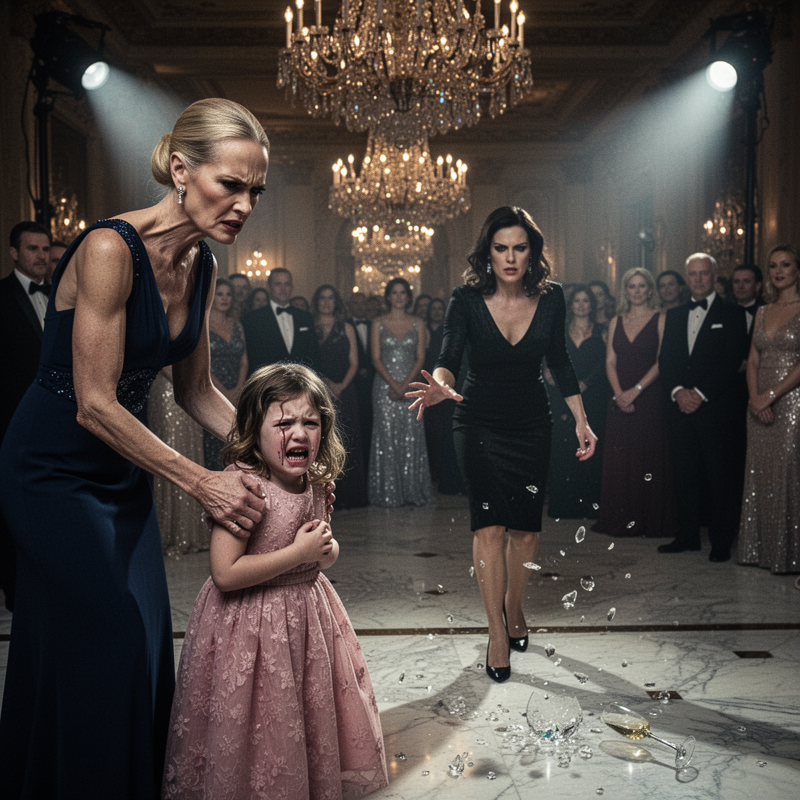
“Unhand my child right now, Victoria, or I swear this ballroom becomes your courtroom,” I shouted, my voice cutting cleanly through the sudden silence of the Boston Symphony Hall grand ballroom. My six-year-old daughter, Maya, was sobbing hysterically in her pale pink chiffon dress while Victoria Sterling—Boston’s most feared arts chairwoman—twisted her tiny wrist and accused her of ruining a $450,000 antique porcelain display. Over two hundred tuxedoed guests and donors watched in frozen silence, terrified to cross a woman who controlled an $85 million cultural foundation. But Victoria didn’t know that the vintage pink dress Maya was wearing had a hidden silk-embroidered family crest inside—or that my late husband’s secret legacy was about to destroy her high-society empire piece by piece.
The soaring strings of the classical orchestra had just filled the Boston Symphony Hall grand ballroom, a familiar, elegant prelude to the annual Founders Gala.
Then, the music stopped.
It wasn’t a planned intermission, nor a dramatic flourish.
It was an abrupt, jarring halt, as if a conductor’s baton had snapped mid-air.
Into that sudden, cavernous silence, Maya’s piercing cries echoed.
My six-year-old daughter was a small, shaking bundle of pale pink chiffon under the dazzling central chandelier.
Victoria Sterling, impeccable in a sapphire gown that shimmered under the lights, loomed over her.
Victoria’s manicured hand, adorned with a formidable diamond ring, twisted Maya’s tiny wrist.
The skin around Victoria’s grip turned an alarming, angry red.
“You clumsy, destructive child,” Victoria hissed, her voice low but carrying an icy menace that silenced any remaining murmurs.
“Look what you’ve done.”
Her other hand swept towards the broken fragments of an 18th-century porcelain vessel scattered across the polished marble floor.
“A $450,000 antique. Ruined.”
Maya whimpered, tears streaming down her face, her small frame trembling uncontrollably.
Her eyes, wide with terror, darted desperately around the room, searching for me.
My heart hammered against my ribs, a frantic drumbeat demanding action.
Two hundred wealthy guests, titans of Boston society, stood frozen.
They were tuxedoed men and gowned women, each accustomed to navigating complex social dances.
But not one dared to challenge Victoria Sterling.
Her influence, her control over the Sterling Cultural Foundation’s $85 million endowment, was a gilded cage of power.
To cross her meant social and financial ruin.
I saw Arthur Pendelton, a senior trustee, shift uncomfortably, his gaze fixed on his polished shoes.
Chloe Montgomery, Victoria’s PR VP, stood rigid by a velvet rope, her face pale, avoiding eye contact with anyone.
No one moved.
No one spoke.
A wave of impotent rage washed over me, cold and sharp.
“Unhand my child right now, Victoria, or I swear this ballroom becomes your courtroom,” I’d already shouted, cutting through the silence.
Now, I sprinted.
My black cocktail dress, usually so unassuming, felt like a battle uniform as I weaved through the petrified guests.
They parted like the Red Sea, their faces a mixture of shock and morbid fascination.
I reached Maya, my breath catching in my throat.
Victoria finally released her, almost shoving Maya forward.
My daughter collapsed into my arms, sobbing into my shoulder, clinging to me as if I were her only lifeline in a storm.
“It’s okay, baby. Mama’s here,” I murmured, pulling her close, stroking her tangled blonde hair.
I straightened up, Maya still nestled against me, and met Victoria’s gaze.
Her eyes, cold and hard, narrowed in contempt.
“Eleanor Vance,” she drawled, her voice dripping with disdain. “Always appearing where you’re least wanted.”
She glanced at Maya, then back at me.
“Your child has just cost my foundation half a million dollars. I expect a preliminary payment of $150,000 by morning.”
A gasp swept through the room, hushed and collective.
Someone dropped a champagne flute. It shattered violently against the marble, the sound echoing the fragments of porcelain.
“Pay by morning?” I repeated, my voice steady, though my hands trembled slightly as I held Maya.
“For this fabricated accident?”
Victoria scoffed, a brittle, dismissive sound.
“Fabricated? Look at the evidence, Eleanor. Your child, unsupervised, directly in front of a priceless artifact.”
She gestured towards the broken pieces.
“Carelessness, pure and simple. A reflection of poor parenting, perhaps.”
The insult hung in the air, a venomous dart.
My grip tightened around Maya, who flinched at Victoria’s words.
I felt a surge of cold fury, but I forced myself to remain calm.
My late husband, Harrison, had taught me the power of quiet precision.
It was a lesson I had honed in my workshop, meticulously restoring historical artifacts.
I looked at Victoria, then down at Maya.
The pale pink chiffon dress, an heirloom from my husband’s side of the family, was wrinkled and tear-stained.
But it was more than just a dress.
It was a key.
With a deliberate, unhurried motion, I gently turned Maya’s dress collar inside out.
The fine silk lining, a soft counterpoint to the chiffon, came into view.
And there it was.
Neatly stitched into the fabric, a small, elegant crest, barely visible unless you knew to look for it.
A soaring hawk, its wings spread wide, clutching a laurel wreath.
Beneath it, the interwoven initials: C.V. 1982.
The Vance family crest.
The original.
My husband’s family.
Victoria’s sneer faltered, a flicker of something unreadable crossing her face as her eyes fixed on the embroidered silk.
“What is… what is that?” she demanded, her voice losing its icy control, a tremor of uncertainty entering it.
I met her gaze, a calm, unwavering force against her sudden panic.
“This, Victoria,” I said, my voice clear and resonant in the suddenly silent ballroom, “is proof.”
I tightened my hold on Maya, who looked up at me with wide, tear-filled eyes, confused but sensing a shift in the air.
“Proof that Maya Vance,” I continued, my voice steady, “is the direct biological granddaughter of Charles Vance.”
I let the name hang, reverberating through the hushed hall.
“The founder of this very foundation,” I added, looking around at the stunned faces of the guests.
“The founder you publicly claimed,” I finished, my gaze locked on Victoria’s now utterly frozen face, “died without surviving heirs.”
Part 2
“The founder you publicly claimed,” I finished, my gaze locked on Victoria’s now utterly frozen face, “died without surviving heirs.”
Victoria’s face, usually a fortress of cold disdain, contorted. Her eyes darted, searching for an escape, a rebuttal. A ripple of murmurs finally broke through the crowd, spreading like wildfire. Before Victoria could recover her icy composure or issue another command, a stern-faced man in a tailored black suit stepped decisively between us. It was Marcus Reed, the Symphony Hall’s Director of Venue Security, his presence commanding and unyielding. He held up a hand, a silent signal that halted Victoria’s two hulking private guards who had started to advance.
“This is Symphony Hall property, Ms. Sterling,” Marcus stated, his voice calm but firm, directly addressing Victoria. “I have sole legal jurisdiction over all premises. Any further action must go through me.”
Victoria’s shock quickly morphed into explosive rage. “Jurisdiction? Don’t be absurd, Marcus! This woman is a trespasser, and her child has destroyed priceless art. Seize her phone! Escort her out under armed guard, now!” She pointed at me, her finger trembling. “And if you fail to comply, I’ll revoke every penny of the Hall’s $1.2 million annual maintenance grant before this night is over. You understand?”
Marcus didn’t flinch. His gaze remained steady on Victoria, then briefly swept over her guards. He made no move towards my phone. Instead, as Victoria continued to seethe, Marcus leaned in, his voice dropping to a low, gravelly whisper meant only for my ears. “Don’t worry about your phone, Eleanor. I already initiated an automatic high-definition security backup the moment her hand touched your daughter. Raw 4K multi-angle video, crystal-clear spatial audio of the entire incident.” He paused, a subtle, almost imperceptible shift in his posture. “It’s already encrypted and saved onto an external drive in my pocket. Victoria’s PR team won’t even know what hit them before they try to wipe the server room.”
CHAPTER 2: The Forty-Eight Hour Ultimatum
The morning sun through my Cambridge workshop window felt cold and sterile.
By 8:00 AM, the local morning news broadcasts were already broadcasting a crisp, polished photo of my face. Above it ran a glowing red ticker: *Vandals at the Symphony Hall Gala.*
Chloe Montgomery, Victoria Sterling’s Vice President of Public Relations, appeared on three separate channels within twenty minutes.
“A reckless trespasser allowed an unsupervised child to run wild,” Chloe said into a reporter’s microphone, her blue suit immaculate under the studio lights. “Her gross negligence caused the catastrophic destruction of an 18th-century porcelain masterpiece valued at $450,000.”
Across the room, six-year-old Maya sat at my long oak workbench. Her small shoes dangled above the floor. She clutched Barnaby, her faded plush teddy bear, pressing her chin into his worn plush head.
“Mommy,” Maya whispered, her lower lip trembling. “Are the men in suits going to take Barnaby away?”
“No one is taking anything, sweetheart,” I said, setting down my finest sable-hair restoration brush. “Draw me a bird, alright? A bright blue one.”
A sharp knock rattled the shop’s glass front door.
A Process Server in a gray windbreaker stepped inside without waiting. He laid a heavy thick envelope directly onto my cutting mat.
“Eleanor Vance?” he asked.
“Yes,” I said.
“You’ve been served.”
I broke the wax seal on the legal document inside. Victoria’s personal attorneys had filed an emergency civil action in Suffolk Superior Court, demanding an immediate $150,000 preliminary settlement.
The notice gave me exactly forty-eight hours to wire the funds to the Sterling Foundation’s account or face immediate asset seizure, freezing of bank accounts, and a full civil suit.
Attached to the legal claim was an itemized appraisal sheet detailing the broken porcelain artifact: *1765 Meissen Celestial Garniture Set, Serial #M-8834-UK.*
I pulled my magnifying lens over the appraisal sheet and logged into the International Art Loss Registry database on my workbench terminal.
My fingers flew across the keyboard. As a master conservator, I maintained active clearance with global auction archives.
“What is it, Eleanor?” a quiet voice asked from the doorway.
Marcus Reed walked in, his heavy dark coat damp with rain. He pulled off his leather gloves and looked down at the screen.
“Look at this entry,” I said, pointing at the flashing monitor. “Serial #M-8834-UK was sold at Sotheby’s London six months ago to a private collector in Munich. It’s sitting in a vault in Bavaria right now.”
Marcus leaned closer, his brow furrowing.
“Victoria claimed a $450,000 write-off on an artifact that wasn’t even in the building,” Marcus said, his voice hard. “She used an old catalog description to fake the valuation report.”
“She didn’t just exaggerate,” I said, printing out the certified registry receipt. “She filed fraudulent court papers.”
“The board meets at two o’clock at the Prudential Tower,” Marcus said, pulling a black leather wallet from his coat pocket and tapping an encrypted thumb drive against his palm. “I’ve got the raw 4K video ready.”
“Let’s go show fourteen board members what forty-eight hours really looks like,” I said.
CHAPTER 3: The Boardroom Confrontation
The executive boardroom on the forty-second floor of the Prudential Tower smelled of expensive leather, fresh espresso, and cold ambition.
Fourteen prominent board members sat around a thirty-foot polished mahogany table. At the far head sat Victoria Sterling, wrapped in a ivory cashmere jacket.
Chloe Montgomery stood beside her, advancing slides on a presentation deck titled *Crisis Mitigation and Offender Exclusion.*
“We are voting to permanently bar Eleanor Vance from every cultural institution in the Commonwealth,” Victoria announced, her voice dripping with royal authority. “Her presence is a menace to our endowment.”
The double doors swung open.
Marcus Reed walked in first, his broad shoulders filling the entryway. I walked right behind him, holding a dark leather folder.
“This is a private executive session!” Chloe snapped, taking a quick step forward. “Security, escort these people out!”
“I *am* venue security, Miss Montgomery,” Marcus said plainly. “And under Section 4 of the Symphony Hall operating contract, safety incidents fall under my primary investigative authority.”
Victoria stood up slowly, leaning her manicured hands on the table.
“Marcus,” Victoria sneered, her eyes narrowing. “You are an employee of the hall. You hand over your security logs to my office, or your contract is canceled before five o’clock.”
“The logs belong to the Boston Police Department and the Life Trustees, Mrs. Sterling,” Marcus replied calmly.
He walked straight to the wall-mounted media panel, pushed aside Chloe’s laptop cable, and plugged in his encrypted black drive.
“What is the meaning of this?” shouted Senior Trustee Arthur Pendelton, his silver hair catching the recessed lighting as he adjusted his wire-rimmed glasses.
“Watch the screen, Mr. Pendelton,” Marcus said.
The 85-inch display flickered to life. Raw, uncompressed 4K video flooded the room with crisp spatial audio.
The high-definition camera angle showed the grand ballroom from directly above the display pedestal.
On screen, six-year-old Maya was standing quietly near the velvet rope, admiring a floral arrangement. Victoria walked swiftly into frame from behind, her red soles slipping on the edge of Maya’s long pale pink chiffon dress train.
Victoria stumbled forward. In a flash of blind rage, she reached down, grabbed Maya’s small wrist, and yanked the child backward.
As Maya lost her balance, Victoria’s elbow struck the wooden display column, sending the porcelain vessel crashing to the marble floor.
*“Look what you made me do, you little brat!”* Victoria’s sharp voice echoed through the boardroom speakers in crystal-clear digital sound.
The room went dead silent.
Two female board members gasped, drawing their hands to their mouths.
Arthur Pendelton slowly rose from his leather armchair, staring straight at Victoria.
“You said the child pulled the pedestal down,” Arthur said, his voice trembling with quiet indignation.
“The video is obviously manipulated!” Victoria spat, her face flushing deep crimson. “A deepfake engineered by a disgruntled restorer!”
“That digital file carries a military-grade cryptographic timestamp from the hall’s secure server,” Marcus said, stepping back toward the door. “It stands up in any court in the state.”
“This board meeting is adjourned pending a full internal review,” Arthur declared, knocking his wooden pen against the table. “And all PR budget authorizations for Mrs. Sterling are frozen immediately.”
Victoria glared at me across the mahogany table, her knuckles white.
“You think a digital clip makes you safe, Eleanor?” Victoria whispered so low only I could hear. “You have no idea what I can make vanish before sunrise.”
CHAPTER 4: The Framed Toy Bear
By 6:30 PM, rain was hammering against the glass windows of my Cambridge apartment.
I was stirring a small pot of soup on the stove while Maya sat on the rug, arranging her colored pencils around Barnaby the bear.
“Mommy,” Maya said, holding up a drawing. “I drew the pink dress with the golden crest inside.”
Before I could answer, three heavy knocks sounded against the apartment door.
I opened it to find two uniformed Boston Police officers standing beside Detective Thomas Callahan, a thickset man with sharp eyes and a damp trench coat.
“Eleanor Vance?” Callahan asked, holding up a laminated badge.
“Yes, Detective. What is this about?”
“I have an emergency search warrant issued by the District Court,” Callahan said, stepping into the entryway. “Mrs. Victoria Sterling reported a theft from her private greenroom at Symphony Hall during last night’s event.”
“A theft?” I asked, stepping between the officers and my daughter. “I didn’t touch anything in her greenroom.”
“A custom platinum brooch set with a eight-carat yellow diamond,” Callahan said, pulling a pair of blue latex gloves from his pocket. “Valued at $120,000. Mrs. Sterling states you were seen entering her private suite shortly before the gala began.”
“That is a complete lie,” I said, my pulse spiking. “I never stepped near her private suite!”
The two uniformed officers began methodically searching the bookshelf and my workbench bags.
“Mommy!” Maya cried out as one officer picked up her pink canvas backpack.
“Stay still, sweetheart,” I said, holding my breath.
Detective Callahan walked over to the small sofa. He picked up Barnaby, Maya’s plush teddy bear.
“Detective, leave her toy alone,” I demanded. “She’s six years old!”
Callahan didn’t answer. His fingers felt along the stitched seam running down the bear’s back. He pulled out a small pocket knife and cleanly sliced through three blue threads.
He reached inside the soft white cotton stuffing.
When his hand came back out, his blue latex glove caught the light of the living room lamp.
Glittering between his fingers was a massive platinum brooch. Its center stone was an eight-carat canary yellow diamond, framed by delicate filigree metalwork shaped like intertwined leaves.
Maya let out a terrified screech, hiding her face in my apron.
“Item recovered,” Callahan said flatly, looking at me with cold disappointment. “You’re under arrest for felony grand larceny, Ms. Vance.”
“I didn’t put that there!” I shouted, my hands shaking. “Victoria had her staff plant that during the commotion!”
“You can explain it to the magistrate,” Callahan said, reaching for his handcuffs. “Bail for grand larceny at this valuation starts at $500,000.”
“Wait!” I yelled, staring at the brooch in Callahan’s hand.
The overhead lamp hit the back of the platinum mounting. My trained conservator’s vision caught a tiny pattern etched along the rim—a micro-pattern I had memorized over fifteen years of studying my late mother’s bench journals.
“Detective, turn that brooch over,” I said, my voice suddenly dropping into absolute calm. “Look at the reverse side of the setting right under the central prong.”
Callahan paused, his handcuffs dangling from his index finger.
“Why?” he asked.
“Because if that brooch belongs to the Sterling estate, the back will be smooth polished platinum,” I said. “But if it belongs to my family, there is a hand-carved leaf filigree hiding a hidden maker’s mark.”
Callahan frowned, raising the heavy platinum piece directly beneath the halogen desk lamp.
CHAPTER 5: Microscopic Proof
By 11:00 PM, the air inside the Boston Police Department Forensic Laboratory was sharp with the smell of isopropyl alcohol and hot electronics.
Marcus Reed had used his former detective credentials to secure an emergency court order for evidence preservation, forcing Detective Callahan to delay booking me into the county jail.
Victoria Sterling stood near the doorway of the lab, flanked by her lead corporate attorney, Arthur Vance-Sterling’s former firm partner. She wore a dark mink coat over her silk dress, her expression full of icy disdain.
“This is an absurd delay of basic criminal process,” Victoria’s attorney declared, tapping his expensive leather briefcase. “The stolen property was recovered inside the suspect’s child’s toy. My client demands an immediate press conference.”
“The court granted the defense an immediate forensic verification of origin,” Callahan replied from behind a steel workbench. “It takes ten minutes.”
Door hinges creaked, and an elderly man stepped inside holding a leather optical case.
Julian Thorne, international master appraiser and senior gemologist for the Museum of Fine Arts, set his briefcase on the counter without acknowledging anyone in the room.
“Master Thorne,” I said softly from where I sat beside Marcus.
“Eleanor,” Julian acknowledged with a stiff nod. “Your late mother was the finest precious metals restorer this city ever produced. Let us see what we have here.”
Julian snapped on white silk gloves, picked up the $120,000 diamond brooch with precision brass tweezers, and placed it under the lens of a heavy 50x magnification optical microscope.
He flipped a switch. A live digital feed from the microscope projected onto a large wall monitor above the workbench.
The platinum metal surface appeared on screen like massive silver terrain.
“Adjusting focus across the lower gallery,” Julian murmured, turning a micro-dial with his thumb.
The screen zoomed past the brilliant yellow diamond facet to reveal the solid platinum wall beneath the central setting prong.
Etched deep into the platinum metal, visible only under high-power optical magnification, was an intricate micro-stamp: a crest featuring three oak leaves, followed by a crisp laser-engraved serial code: **#V-1982-09**.
“Magnificent,” Julian breathed, tracing his finger across the wall display. “This is a custom microscopic maker’s mark executed with a solid-state laser cutter.”
“What does that string of numbers mean?” Detective Callahan asked, stepping forward.
“The letter V stands for Vance Archives,” I said, my voice ringing clear across the laboratory. “1982 is the year my mother designed the master setting for my grandfather, Charles Vance. 09 is the register number for the private family collection.”
“Nonsense!” Victoria snapped, her voice cracking for the first time. “That brooch has been in the Sterling family vault since 2010!”
Julian turned around slowly, taking off his silk gloves.
“Mrs. Sterling,” Julian said with dry precision. “Solid-state laser micro-engraving on platinum of this structural density was not available to commercial jewelers until the late 1990s. Furthermore, I personally appraised this exact piece for Charles Vance’s personal inventory in November 1982.”
Detective Callahan turned his back on me and walked slowly toward Victoria.
“Mrs. Sterling,” Callahan said, his voice dropping into a dangerous register. “Fourteen years ago, when Charles Vance passed away, you filed an sworn estate inventory declaring all personal jewelry items had been destroyed in the estate fire.”
“I… I made an administrative error,” Victoria stammered, stepping back toward her attorney.
“You didn’t make an error,” Callahan said, pulling out his notebook. “You reported a stolen item that was never legally yours, planted it in a six-year-old child’s toy, and filed a fraudulent police report.”
Callahan turned to his uniformed officers.
“Uncuff Ms. Vance,” Callahan ordered. “And hold Mrs. Sterling’s attorney right where he is.”
CHAPTER 6: The Paper Trail of Frauds
By 7:30 AM the following morning, rain was pouring down the windows of my Cambridge workshop.
The felony theft charges against me had been formally dismissed at dawn.
I sat at my long workbench, pouring dark coffee into two porcelain mugs. Sitting across from me was Senior Life Trustee Arthur Pendelton, holding an old leather ledger with yellowed edges.
“I haven’t slept all night, Eleanor,” Arthur said softly, his hands trembling as he held his mug. “When Detective Callahan called me from the police station at midnight, I went straight to the foundation’s basement archives.”
“What did you find, Arthur?” I asked.
Arthur opened the heavy leather ledger across my work surface.
“In 2010, after Charles Vance died in that tragic fire at the estate, Victoria presented a signed codicil to the board,” Arthur explained. “It claimed Charles had revoked his original trust agreement and transferred 100% executive control of the $85 million foundation to her.”
“My husband, Harrison, knew that codicil was fake,” I whispered, touching the worn mahogany grain of the workbench. “That’s why Victoria drove him out of Boston high society before he died. She told everyone he was unstable.”
“We believed her because she had the notarized signature pages,” Arthur said, tears glassing his eyes. “But last night, after seeing that micro-engraved brooch, I checked the notary record books from 1998. The original trust agreement was never revoked.”
“Where is the original deed?” I asked.
“It vanished the night of the fire,” Arthur said. “Charles kept all his primary trust documents inside his personal furniture collection.”
Arthur stopped talking. His eyes slowly drifted across my workshop floor.
His gaze landed on a massive, beautifully restored 1895 mahogany roll-top desk sitting under my workshop spotlights.
I stood up slowly, looking at the desk I had spent six painstaking months restoring for a private anonymous estate auction.
“This desk,” I breathed, my heart pounding against my ribs. “It came out of the Vance estate storage locker in Rhode Island three months ago.”
“Charles commissioned that roll-top desk from a master cabinetmaker in Philadelphia in 1895,” Arthur whispered, standing up beside me. “He always called it ‘The Founders Vault.’”
I ran my fingers across the desk’s tambour door, feeling the smooth brass keyhole.
“Master conservators know every hidden void in late 19th-century furniture,” I said, reaching for my precision brass calipers and an ultrasonic scanner from my tool rack.
I rolled the heavy mahogany desk away from the wall.
“If Charles hid the original 1998 deed inside this frame,” I said, setting the ultrasonic sensor against the lower interior panel, “Victoria spent fourteen years ruling an empire built on thin air.”
CHAPTER 7: The Unlocking of the Founders Vault
The ultrasonic scanner emitted a low, rhythmic beep as I moved the transducer over the interior rear panel of the 1895 mahogany desk.
*BEEP. BEEP. BEEP-BEEP-BEEP.*
“The acoustic density shifted,” I whispered, setting the probe down. “There’s a four-inch hollow cavity behind the lower left drawer runner.”
Arthur Pendelton leaned over my shoulder, holding a bright LED inspection torch.
Using a fine surgical scalpel, I carefully eased out two decorative rosewood inlay pegs hiding the structural brass locking pins. With a soft click, the interior back panel slid downward, revealing a cedar-lined compartment untouched by dust or fire.
Inside lay a heavy, ribbon-bound parchment document sealed with dark red wax.
I lifted the document out with white cotton gloves and spread it flat across my cutting mat.
At the top of the parchment, printed in bold calligraphic lettering, were the words: **THE CHARLES VANCE IRREVOCABLE CULTURAL TRUST AGREEMENT OF 1998**.
Arthur gasped. He brought his magnifying glass down to the bottom signature line.
“It’s Charles’s authentic signature,” Arthur said, his voice choking with emotion. “And right below it—the embossed seal of the Commonwealth of Massachusetts.”
“Read Section 3, Arthur,” I said, pointing to the dark ink clauses.
“‘All assets, real estate, historical collections, and capital endowments totaling $85,000,000 shall be held in irrevocable trust for the direct biological heirs of my son, Harrison Vance,’” Arthur read aloud. “‘In the event of total executive vacancy, control reverts immediately to the living legal guardian of said heir.’”
“Maya,” I whispered.
“This document completely invalidates Victoria’s 2010 codicil,” Arthur said, taking a deep breath. “Everything she did—every contract she signed, every dollar she spent—was illegal.”
“When is the annual Founders Gala?” I asked, looking up at the clock on the wall.
“Tonight at seven,” Arthur said. “At the Ritz-Carlton Boston. She’s scheduled to announce an $85 million foundation expansion program before three hundred major donors and the media.”
“She thinks she can freeze you out at the board level before the public knows,” I said, gathering the document and placing it inside a fireproof leather portfolio.
“What are you going to do, Eleanor?” Arthur asked.
“I’m going to attend the gala,” I said softly.
At 7:00 PM, the grand ballroom of the Ritz-Carlton Boston was brilliant with crystal chandeliers, white orchids, and three hundred tuxedoed guests.
Victoria Sterling stood behind a crystal podium on the main stage, wearing a dramatic emerald green silk gown. Her public relations VP, Chloe Montgomery, stood in the wings, nervously watching the room.
“Tonight, we celebrate fourteen years of my unbroken stewardship!” Victoria announced into the microphone, her voice booming through the sound system as cameras flashed. “And before we begin our expansion vote, I must announce that Life Trustee Arthur Pendelton has been relieved of his board vote due to gross administrative irregularities…”
The heavy double doors at the back of the grand ballroom swung open with a resounding thud.
The room fell quiet as I walked down the long center carpet, wearing a simple black dress, holding the leather portfolio in my left hand.
Beside me walked Marcus Reed and Detective Thomas Callahan.
“What is the meaning of this interruption?” Victoria yelled into the microphone, her face turning pale under the stage lights. “Security! Remove these intruders!”
“Nobody moves,” Detective Callahan called out, stepping into the center aisle and holding up his official police badge.
I stopped right at the foot of the stage, looking directly up into Victoria’s eyes.
“Your speech is over, Victoria,” I said.
CHAPTER 8: The Fall of the Empire
A murmur swept through the three hundred high-society guests as news camera operators pivoted their lenses toward the stage.
“You dare show your face here?” Victoria shrieked, clutching the edges of the crystal podium. “You’re a disgraced restorer who broke an irreplaceable museum artifact!”
“The porcelain you claimed was destroyed sat in a vault in Munich,” I said clearly, my voice carrying across the silent ballroom. “You filed a false $150,000 claim to cover up your own physical assault on my six-year-old daughter.”
“That’s a lie!” Chloe Montgomery yelled from the wings, her voice cracking with panic.
“We have the 4K multi-angle video with spatial audio, Miss Montgomery,” Marcus Reed called out, holding up a black storage drive for the cameras. “And Detective Callahan has the physical evidence report.”
“Furthermore,” I said, stepping onto the low wooden stage riser and opening my leather portfolio, “the $120,000 diamond brooch you planted in my daughter’s toy bear was stolen from the Vance estate fourteen years ago. Its platinum setting carries my family’s laser-engraved serial code #V-1982-09.”
Gasps erupted across the tables. Several board members stood up from their seats.
“That brooch was a gift!” Victoria stammered, stepping back from the podium.
“It was stolen property,” Detective Callahan said, stepping up onto the stage beside me. “And this document in Ms. Vance’s hand is the original 1998 notarized Charles Vance Trust Deed, recovered today from Charles Vance’s personal desk.”
Arthur Pendelton walked down the aisle, holding his own silver ledger high above his head.
“As Senior Life Trustee,” Arthur shouted to the board members in the room, “I declare that Victoria Sterling’s 2010 codicil is a fraudulent instrument! I call an immediate emergency voice vote of the board to terminate her executive authority!”
“Seconded!” yelled three board members simultaneously, raising their hands in the air.
“All in favor of immediate removal and asset freeze!” Arthur called out.
“AYE!” a chorus of fourteen board votes roared through the ballroom.
“You can’t do this to me!” Victoria screamed, her voice echoing off the high ceilings. “I am the Sterling Cultural Foundation! I built this city’s arts fund!”
“You didn’t build it,” I said, looking her in the eyes. “You stole it from my late husband, and you tried to crush my child to keep your secret.”
Detective Callahan pulled a pair of steel handcuffs from his belt. The metal clicked loudly in the silent room.
“Victoria Sterling,” Callahan said, turning her around and pulling her hands behind her back. “You are under arrest for felony child endangerment, filing a false police report, grand larceny, and corporate trust fraud.”
*CLICK.*
The steel cuffs locked tightly around her wrists.
Flashbulbs exploded across the ballroom like blinding lightning as news reporters rushed forward. Victoria tried to duck her face into her mink coat, but Detective Callahan firmly guided her down the center aisle, past the three hundred guests she had ruled for fourteen years.
Chloe Montgomery stood frozen by the stage curtain, trembling as two uniformed officers approached her to take her statement.
Arthur Pendelton turned to me, his eyes full of tears.
“It’s over, Eleanor,” Arthur said softly. “The truth won.”
CHAPTER 9: The Inheritance of Integrity
Three weeks later, the morning sun poured through the high windows of my Cambridge workshop, washing over rows of ancient wood polishes, precision brass tools, and soft cotton cloths.
The news on the workbench radio was quiet and calm.
Victoria Sterling had been formally indicted on five felony counts. Her personal bank accounts, along with $14.5 million in illegally disbursed discretionary funds, had been frozen by court order to undergo full restitution proceedings.
The shop door bell chimed, and Arthur Pendelton walked in alongside Marcus Reed. Both men carried heavy leather briefcases.
“Good morning, Eleanor,” Arthur said, placing his briefcase on the oak table.
Maya looked up from her coloring book, waving her small hand. Barnaby the plush bear sat safely beside her, his torn back seam carefully re-stitched with blue silk thread.
“Good morning, gentlemen,” I said, setting down my tea.
“The board met officially yesterday afternoon,” Arthur said, pulling out a thick set of legal documents. “We have completed the full legal restructuring of the $85 million Vance Trust. By unanimous vote of the board, we are offering you the permanent position of Chairwoman of the Foundation.”
Marcus smiled, nodding approvingly.
“You would control the entire regional arts endowment, Eleanor,” Marcus added. “No one could ever question your place in this city again.”
I looked at the white parchment papers spread out across my workbench. Then I looked at Maya, who was happily humming a song while drawing a sun over a small wooden house.
I picked up my pen, turned to the last page of the contract, and carefully drew a long blue line straight through the Chairwoman title block.
Arthur blinked in surprise. “Eleanor… what are you doing?”
“I don’t belong in high-society ballrooms or boardrooms, Arthur,” I said softly. “That world turned Victoria into a monster, and it almost destroyed my family.”
“Then what do you want to do with the $85 million?” Marcus asked.
“I want the entire endowment converted into an independent public arts foundation,” I said, handing the revised paper back to Arthur. “Managed jointly by you, Arthur, and Marcus as Chief of Oversight. The funds will go directly to public schools, free conservatorship grants, and community arts programs.”
“And Maya’s inheritance?” Arthur asked.
“Her share will sit in a quiet, protected educational trust until her twenty-fifth birthday,” I replied, pressing my hand against my daughter’s soft hair. “She doesn’t need eighty-five million dollars to know who she is. She just needs an honest home and a mother who works with her own hands.”
Arthur looked at the document, then back at me, a profound look of respect filling his eyes.
He signed his name at the bottom of the public trust agreement.
“You are more noble than any title high society could ever give you, Eleanor,” Arthur said softly.
After Arthur and Marcus left, the workshop was quiet once again.
I sat down at my long wooden bench, pulled a centuries-old carved walnut picture frame under my restoration light, and picked up my small sable-hair brush.
Maya dragged her chair over next to mine, resting her chin on the edge of the workbench.
“Mommy,” Maya whispered, watching the golden varnish flow smoothly over the old carved wood. “Are we safe now?”
“We were always safe, sweetheart,” I said, dipping the brush in pure amber oil. “Because we had the truth.”
They build castles out of polished glass and thin lies, forgetting that the simplest truth can shatter an empire in a single heartbeat.
Leave a Reply