CHAPTER 1: The Flame That Refused to Burn
Part 1
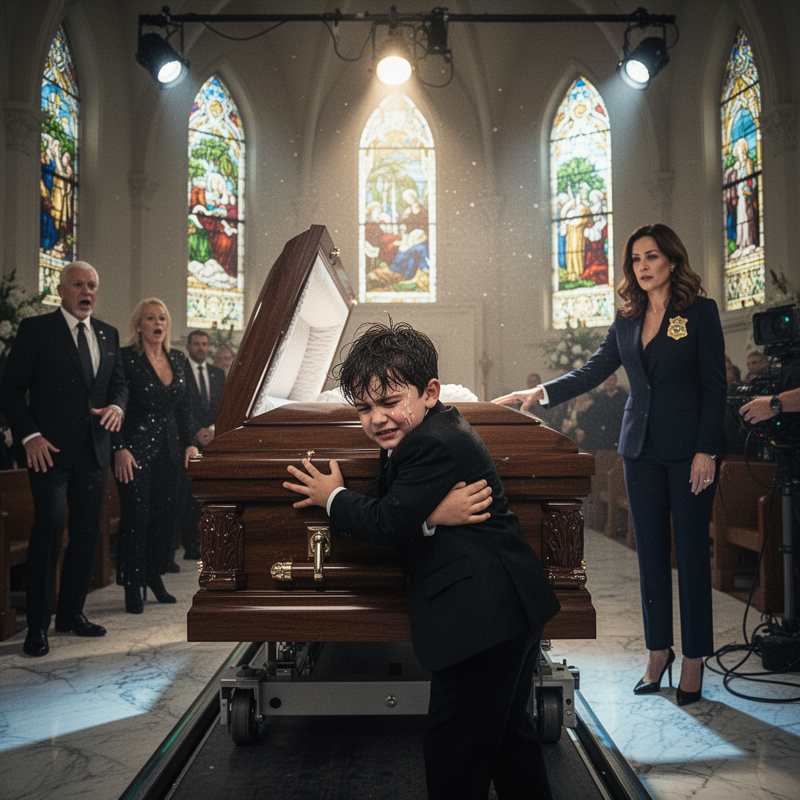
“Don’t push the button! She’s burning warm, Mommy, her fingers grabbed my hand!” seven-year-old Leo screamed, throwing his body across the stainless steel conveyor belt inside the West Palm Beach crematorium. The mechanized track creaked to a sudden halt just four inches from the glowing brick mouth of the incinerator as two technicians slammed the emergency kill switch. My brother-in-law, Julian, lunged forward to grab Leo by his collar, barking at the security guards to throw us out before the invited funeral guests noticed. But when I pulled my trembling son off the casket, his small palm came away damp with sweat from the polished oak lid—and from inside the sealed box, three distinct thumping sounds rattled the brass hinges.
The hum of the industrial incinerator filled the cold, marble staging hall of Evergreen Memorial Park, a low, guttural thrum that vibrated through the floor and up Clara Vance’s shoes. It was a sound designed to sterilize, to erase, to turn solid into ash. It felt brutally inappropriate for a woman as vibrant and full of life as Sonia Vance, even in death.
Fifty pairs of eyes, all belonging to Miami’s elite, watched from behind the viewing glass, their faces a mixture of solemnity and a curious impatience. They were here to pay respects, yes, but also to mark the passing of a real estate titan. Julian Vance, Sonia’s eldest son, stood at the control panel, his jaw clenched, his eyes fixed on the operator.
The operator, a man in a crisp navy uniform, paused with his finger hovering over the final activation button for the $14,000 mahogany cremation process.
“What are we waiting for?” Julian’s voice, sharp and strained, cut through the quiet reverence. “Everything has been cleared. The family is ready to proceed.”
Clara stood a few feet back, holding Leo’s small hand tightly in hers. Her son had been unusually agitated all morning, tugging at her sleeve, his face flushed. He’d complained about the “loud machines” and the “cold air” inside the funeral home, his sensory sensitivities heightened by the somber occasion. She tried to soothe him, stroking his hair, but a primal fear coiled in her stomach.
The polished oak casket containing Sonia’s body rested on the stainless steel conveyor belt, gleaming under the recessed spotlights. It was a magnificent, heavy box, a stark contrast to the sterile efficiency of the crematorium. The air smelled faintly of ozone and something metallic, a scent that made Leo squirm.
“Just a moment, Mr. Vance,” the operator replied, his voice calm, almost robotic. “Standard safety protocols require a final visual check before engaging the system. We’re almost there.”
Clara watched, her gaze drifting from the imposing maw of the incinerator to the sealed casket. The idea of Sonia, even an empty vessel, being consumed by those flames felt wrong. A wave of grief, fresh and sharp, washed over her for the mother-in-law who had become more of a mother than her own. And for Raymond, her late husband, Sonia’s favorite son, whose absence made this moment even more unbearable.
Julian tapped his foot impatiently. “The funeral director assured me everything was expedited. There’s a reception to attend.” His words were low, but the urgency in them was palpable. He didn’t look at the guests; he only looked at the operator and the conveyor belt.
Suddenly, a small, desperate sob escaped Leo’s throat. His hand, clammy in Clara’s, slipped free.
Before Clara could react, before anyone could anticipate it, Leo darted forward. He was a blur of blue suit and frantic motion, ducking under the velvet rope barrier that separated the grieving family from the ceremonial machinery.
“Leo, no!” Clara screamed, her voice cracking, but he was already there.
He threw his small, seven-year-old body across the stainless steel conveyor belt, his arms and legs wrapped around the polished oak casket. His face was pressed against the lid, his cheek against the cold wood.
“Don’t push the button! She’s burning warm, Mommy, her fingers grabbed my hand!” he shrieked, his voice piercing the air, raw with terror.
The world seemed to freeze. The operator’s finger, still hovering, recoiled. The hum of the incinerator, which had been a steady drone, seemed to grow louder, more menacing.
Behind the viewing glass, the wealthy guests gasped. A few shifted uncomfortably, some whispered, others averted their eyes as if witnessing a spectacular breach of decorum.
Julian Vance, his face contorted in a mask of fury and humiliation, lunged forward. “What is he doing? Get him off there!”
His words were cut short by the sharp crack of an emergency kill switch being slammed down. Mateo Ruiz, a young, apprentice crematorium technician with kind eyes and a nametag that read ‘Mateo,’ had reacted instinctively. He’d leaped from his station near the back wall, his hand striking the bright red button with a resounding thud.
The conveyor belt, which had begun its slow, deliberate forward creep, jerked to a sudden, violent halt. It stopped with a metallic groan, just four agonizing inches from the glowing brick mouth of the incinerator. The steel doors, designed to seal shut and hold the casket within the inferno, remained partially open, a dark, gaping maw.
Silence descended, heavy and suffocating, broken only by Leo’s whimpers and the faint, lingering mechanical groans of the belt.
“Security! Get them out of here!” Julian roared, his face purpling, lunging toward Leo as if to physically tear him away. He barked at two uniformed security guards, who were now moving, unsure, toward the scene. “Before the invited guests notice this circus!”
Clara, her heart pounding against her ribs, was faster. She pushed past Julian, her focus solely on her terrified son. Her hands shook as she reached for Leo, pulling him gently but firmly from the casket.
“Leo, darling, it’s okay, it’s okay,” she murmured, trying to reassure him, though her own voice trembled. She cradled him in her arms, pressing his head against her shoulder.
As she pulled him away, Leo’s small palm came away from the polished oak lid. It was damp, not just with his own sweat and tears, but with a strange moisture clinging to the wood.
And then, unmistakably, from inside the sealed box, three distinct thumping sounds rattled the brass hinges. A hollow, resonant series of knocks that echoed in the stunned silence of the crematorium hall.
Part 2
The creaking sound of the hinges died away, replaced by an even deeper, more terrifying silence. Everyone in the room was frozen, their eyes wide, staring at the closed casket. Julian’s face, moments ago contorted in rage, was now chalk-white.
Mateo Ruiz, the young technician who had slammed the emergency kill switch, was the first to move. His eyes, fixed on the casket, were filled with a dawning horror. Without a word, he grabbed a heavy steel crowbar from a maintenance rack mounted on the wall. He moved with a speed that belied his apprentice status, inserting the crowbar into the seam of the polished oak. With a grunt, he forced the first of the six brass latches open.
A gasp rippled through the viewing area as he systematically pried open each one. The final latch sprang free with a metallic snap, and Mateo, with surprising gentleness, lifted the heavy lid.
Inside, Sonia Vance lay not in peaceful repose, but pale, her skin slick with cold perspiration. Her chest, shockingly, rose and fell in a shallow, almost imperceptible rhythm. She was un-embalmed, her body shockingly soft and real.
“She’s alive!” I screamed, the words tearing from my throat, barely audible over the sudden clamor.
Paramedics, who had been on standby in the parking lot – a standard precaution for high-profile funerals – burst into the staging hall. Their faces were grim as they rushed to the casket. One of them immediately pressed two fingers against Sonia’s neck. “Faint, irregular carotid pulse,” he announced, his voice urgent. “Twenty-two beats per minute.”
They began to reach for their medical bags, for IV fluids, for oxygen, but Julian suddenly materialized between them and the casket. He held up a laminated document, his hand trembling slightly.
“Stop!” he commanded, his voice hoarse, but regaining some of its authority. “She has a Do Not Resuscitate order. Signed this morning at 9:00 AM.”
My blood ran cold. A DNR? It couldn’t be. Sonia had been so vibrant, so full of life, even with her age. This morning?
As the paramedics hesitated, their eyes darting between Julian and the barely breathing Sonia, I saw her. Detective Evelyn Mercer, a sharp, no-nonsense Miami-Dade homicide investigator, was standing among the “security consultants,” a favor Julian had pulled to impress the guests. She was off-duty, but her gaze was already hard and assessing.
I didn’t think. I lunged towards her, grabbing her arm. “Detective Mercer! This is murder! I demand an immediate homicide hold on that document!”
Her eyes met mine, then swept over the scene – Leo still trembling in my arms, the open casket, the sweating Sonia, and Julian, now visibly panicked. Without a word, she nodded to the paramedics. “Under emergency criminal suspicion,” she stated, her voice cutting through the tension. “Override the DNR. Get her to Jackson Memorial. I’ll need a full police escort.”
The paramedics moved with renewed purpose, lifting Sonia carefully from the casket onto a stretcher. As they wheeled her out, sirens wailing in the distance, Julian stumbled backward, pulling out his phone. From the parking lot, I watched him frantically dial his attorney, his face a mask of desperate fury.
CHAPTER 2: The Paralytic Shadow
The rhythmic double-click of the mechanical ventilator echoed through Jackson Memorial Hospital’s Intensive Care Unit.
Sonia Vance lay motionless on the steel bed, her skin grey and dry under the bright fluorescent lights. A monitors mounted to the wall ticked at twenty-two beats per minute.
Chief Toxicologist Dr. Elena Vance slid a thin plastic catheter into Sonia’s radial artery, drawing six cubic centimeters of dark blood into a glass vial.
“The initial screen flagged something abnormal,” Dr. Vance said, capping the tube. “It isn’t a heart attack or an ischemic stroke.”
She slid the tube into a desktop centrifuge. Five minutes later, the printout spat out of the terminal.
“Tetrodotoxin,” Dr. Vance read aloud, her forehead creasing. “A lethal marine neurotoxin. It blocks sodium channels, paralyzing all voluntary muscles while leaving the brain fully conscious.”
The ICU door swung open. Dr. Arthur Sterling stepped into the room, holding a thick beige medical file under his arm.
“That toxin explains everything,” Dr. Sterling said, standing near the head of the bed. He pulled three printed pages from his file and handed them to the Miami-Dade police officer stationed at the door.
“Clara runs an exotic saltwater aquarium business out of her Coral Gables residence,” Dr. Sterling continued, gesturing toward me. “Three weeks ago, she imported six blue-ringed octopus specimens and seven rough-skinned newts. Both harbor concentrated tetrodotoxin.”
The lead officer turned to face me. “Is that true, Mrs. Vance?”
“I sell ornamental coral and clownfish,” I said. “I have never ordered venomous species.”
“Her invoice records say otherwise,” Dr. Sterling said, flashing a dark blue printout stamped with my business header. “She has been administering micro-doses to Sonia’s evening tea to simulate progressive neurological decline.”
Julian stood at the far end of the hallway beyond the glass barrier, his hands resting deep inside his coat pockets. A faint smile touched the corner of his mouth.
“We need to impound your personal devices, ma’am,” the officer said, stepping forward and reaching for my handbag. “Step away from the patient.”
They took my phone, my laptop, and my purse, slipping them into clear plastic evidence bags.
As the officers escorted me toward the waiting area, my wrist buzzed against the fabric of my sleeve. An old emergency burner phone—one I kept in my jacket pocket for client aquarium emergencies—chattered silently.
I pulled it out under the cover of my coat. A text message from an unknown number appeared on the screen:
*Stairwell B, Parking Level 3. Twenty minutes. I have the staging room audio.*
CHAPTER 3: The $150,000 Cash Envelope
The concrete stairwell of Parking Level 3 smelled of damp exhaust and old paint.
Mateo Ruiz stood behind the heavy steel fire door, holding a small black digital recorder in his left hand. His blue work shirt was still stained with gray dust from the crematorium.
“They’re going to fire me by morning,” Mateo whispered, glancing up the stairwell shaft. “But I turned on my pocket memo during the intake.”
He pressed play on the device.
A static hiss filled the narrow space, followed by the muffled sound of a heavy zipper.
“She doesn’t need embalming,” Julian’s voice came through clearly on the speaker. “Push the schedule forward. Burn the body by three o’clock.”
“Standard procedure requires a twenty-four-hour hold without a state waiver,” an older man’s voice replied on the recording.
“There’s a hundred and fifty thousand dollars in cash inside this Manila envelope,” Julian said on the tape. “No paper trail. No delay. Seal the box and turn on the burner.”
Mateo stopped the recording and handed me a folded sheet of yellow carbon paper.
“This is the physical intake log from Evergreen Memorial,” Mateo said. “Look at the baseline vitals when the transport van brought her in at eleven o’clock.”
My eyes scanned down the hand-written lines: *Body temperature: 99.1 degrees Fahrenheit.*
“A corpse sitting in a morgue for six hours does not have a ninety-nine-degree core temperature,” Mateo said softly. “She was alive when they loaded her into our van. Dr. Sterling forged the time of death on the state health portal.”
“I need to get this to Detective Mercer right now,” I said, gripping the carbon paper.
I pushed open the door to the main hospital lobby. Two uniformed officers were waiting beside the security desk, holding a signed white document.
“Clara Vance?” the lead officer called out, blocking the exit. “Stop right there.”
CHAPTER 4: The Midnight CPS Raid
At 11:45 PM, heavy knocks rattled the front door of my Coral Gables apartment.
I opened it to find two Child Protective Services workers standing in the hallway, flanked by four armed Miami-Dade police officers.
“Clara Vance, we are executing an emergency child-endangerment protective order,” the lead social worker said, holding up a blue legal document signed by a night court judge.
“On what grounds?” I demanded, standing in the doorway.
“Dr. Arthur Sterling filed a sworn medical affidavit two hours ago,” she replied. “He testified that you are experiencing severe psychological delusion and posing an immediate physical threat to your son using neurotoxic substances.”
From the bedroom down the hall, Leo cried out.
He walked into the living room barefoot, clutching his dark blue spiral drawing notebook tightly against his chest.
“Mommy?” he sobbed, his voice shaking. “Where are they taking me?”
“Don’t touch him!” I screamed, stepping between the officers and my son.
Two officers grabbed my arms, twisting them behind my back and snapping steel handcuffs around my wrists.
“Mommy!” Leo yelled as a social worker took his arm and guided him out into the cold hallway. His blue notebook slipped from his fingers, bouncing across the floorboards and coming to rest beneath the hall table.
They brought me to the Miami-Dade central booking station. I sat on a cold wooden bench for two hours until the iron cell gate clicked open.
Detective Evelyn Mercer stood in the doorway, holding a yellow receipt sheet.
“I posted your bail out of my personal account,” Mercer said quietly, handing me my coat. “Julian’s legal team tried to freeze your bond approval, but I bypassed their filing.”
We walked out to her unmarked police cruiser in the parking lot.
As I climbed into the front passenger seat, my knee bumped against something hard lying on the floorboards behind my seat.
It was Leo’s blue notebook. It must have fallen from his hands when the officers searched my apartment earlier.
I flipped open the pages to a drawing dated three days ago.
The colored pencil sketch showed Sonia’s sunroom. A man with gray hair and glasses—labeled *Dr. Sterling* in Leo’s neat handwriting—was tilting a small clear eyedropper bottle over a purple teacup while Sonia looked out the window.
CHAPTER 5: The Coral Gables Bank Codicil
At 8:30 AM, Detective Mercer used her law enforcement authority to enter the underground vault at SunTrust Bank on Miracle Mile.
A bank officer slid box number 412 out from the steel wall, setting it down on a private table inside the viewing room.
I lifted the lid. Inside lay a stack of foreign bank statements from Nassau, along with a heavy cream envelope sealed with red wax.
“This is an unrecorded codicil to the Vance Family Trust,” I said, lifting the paper. “It was notarized in 2021.”
Mercer bent down to read the legal text printed across the second page.
*If Julian Vance incurs personal or commercial liability exceeding $5,000,000, or attempts to liquidate real estate assets without unanimous board consent, his executive authority over Vance Commercial Properties is instantly terminated.*
Stapled to the back of the codicil was a red collections notice from a private Caribbean investment firm based in George Town.
Julian owed twenty-eight million dollars to an offshore syndicate. The total balance was due in full in less than forty-eight hours.
“He didn’t just want her dead,” Mercer said, scanning the numbers. “He had to cremate her before Friday morning.”
“Why Friday?” I asked.
“Because the bank conducts its mandatory quarterly audit on Friday at nine in the morning,” Mercer replied. “If Sonia was alive to answer the auditors’ phone calls, Julian’s debt disclosure would trigger the codicil and strip him of every dime.”
“He needed a rapid death certificate to collect the forty-two-million-dollar trust payout,” I said. “And he needed her body turned to ash so no pathologist could prove she was poisoned.”
Mercer pulled out her radio. “We need a forensic warrant for Dr. Sterling’s clinic immediately.”
CHAPTER 6: The Cloud Pulse at 2:48 PM
We arrived at the private office of Dr. Aris Thorne, a former Miami-Dade Chief Medical Examiner who now operated an independent forensic laboratory in Wynwood.
Dr. Thorne plugged a USB hardware bridge into his computer, connecting it to Medtronic’s encrypted cloud database.
“Sonia had a Model 2240 smart pacemaker implanted four years ago,” Dr. Thorne explained, tapping at his keyboard. “It transmits live cardiac telemetry every fifteen minutes to an offsite server.”
A series of red lines spread across his double monitors.
“Look at this timestamp,” Dr. Thorne said, pointing his pen at a sudden spike in the waveform. “At 2:48 PM yesterday—while she was stored inside the crematorium holding freezer—her heart rate jumped from thirty beats per minute to one hundred and forty.”
“She was alive in the box?” I asked, my voice barely audible.
“Not only alive, but conscious,” Dr. Thorne said, adjusting his glasses. “The internal sensor recorded a sudden increase in body temperature and physical motion. The paralytic dose was wearing off.”
The graph showed nine continuous minutes of violent cardiac exertion before dropping back down to twenty-two beats per minute.
“She woke up inside that sealed staging box,” Dr. Thorne said softly. “She was trying to kick her way out while Julian was standing twenty feet away in the hallway, paying off the technicians.”
Detective Mercer pulled her gun and badge from her desk drawer, her jaw set tight.
“That’s physical proof of attempted murder,” Mercer declared. “I’m issuing an immediate felony arrest warrant for Dr. Arthur Sterling.”
CHAPTER 7: The Broken Signature Pad
Six police cruisers pulled up outside Dr. Sterling’s private clinic in South Miami, their blue lights flashing against the glass facade.
Officers breached the back door, catching Dr. Sterling beside an industrial cross-cut shredder with armfuls of patient files. They forced him to the carpet and placed him in heavy wrist restraints.
At 1:15 PM, Detective Mercer escorted Victoria Vance into Interrogation Room 3 at Miami-Dade Homicide headquarters.
Mercer spread the pacemaker telemetry graphs and the SunTrust bank statements across the cold stainless steel table.
“Your brother is going away for life, Victoria,” Mercer said, leaning across the table. “And right now, you are sitting on the edge of a capital murder charge as an accessory.”
Victoria sat in the chair, her hands shaking violently as she adjusted her gold bracelets.
“I didn’t know he was going to hurt her!” Victoria sobbed, hiding her face in her hands. “Julian said it was just a legal technicality!”
“Where did the DNR form come from?” Mercer demanded.
“Julian brought a portable electronic signature pad to Clara’s apartment three days ago,” Victoria confessed, her voice breaking. “He took a digital copy of Sonia’s signature from an old Christmas card and uploaded it to the state registry using Clara’s home IP address.”
“Where is Julian now?” I asked, stepping into the room.
“He’s at the Vance Commercial Properties headquarters in Brickell,” Victoria squeaked, wiping her face with a paper towel. “He’s executing an emergency wire transfer to move forty-two million dollars out of the corporate account before the audit hits.”
“Where is he going after that?” Mercer asked.
“He booked a private Gulfstream G550 out of Opa-locka Airport,” Victoria whispered. “It leaves for Nassau at three-thirty.”
CHAPTER 8: The Opa-locka Runway Intercept
At 3:10 PM, the corporate portal flagged a wire transfer of forty-two million dollars originating from the Brickell office, destined for a non-resident account in George Town.
Four federal marshal vehicles and Mercer’s unmarked cruiser tore down the Thanksgiving Expressway toward Opa-locka Executive Airport, their sirens blaring.
Through the windshield, I saw a sleek black SUV hit the airport perimeter fence at sixty miles per hour, crushing the chain-link barrier and charging straight onto the tarmac.
A white Gulfstream G550 sat two hundred yards away, its twin jet engines whining as it prepared to taxi toward the runway.
“Hold on!” Mercer yelled, turning the steering wheel sharply to the right.
Our cruiser cut across the active taxiway, heading straight for the black SUV.
Three federal marshal trucks converged from the opposite direction, creating a heavy steel wedge that slammed Julian’s vehicle directly against the corrugated airfield security wall.
Glass shattered across the asphalt.
Federal marshals jumped out with their weapons drawn, pulling the driver’s door open and yanking Julian out onto the tarmac.
“Get down on the ground! Do not move!” a marshal shouted, pressing Julian’s face against the hot pavement and pulling his arms behind his back.
Julian glared at me through the dust, his suit coat torn and covered in oil.
Before I could step forward, the phone in my hand vibrated with a loud, continuous emergency tone.
It was the ICU supervisor at Jackson Memorial Hospital.
“Clara, you need to come back right now,” the doctor said over the speaker. “Sonia’s blood pressure is crashing. She has less than ten minutes.”
CHAPTER 9: The Zurich Hash Code
I ran through the double doors of Jackson Memorial ICU at 4:10 PM, my heart pounding in my chest.
Sonia lay on the elevated bed, her eyelids fluttering open as the cardiac monitor sounded a low, continuous warning chime.
She reached out her pale hand, her fingers searching the empty air until I grabbed them tight.
“Leo…” Sonia whispered, her voice a raspy breath.
“He’s safe, Sonia. He’s safe,” I sobbed, kneeling beside the bed.
Sonia turned her eyes toward Detective Mercer, who held her official digital recorder close to the patient’s lips.
“Z… U… R… seven… seven… four… nine… two…” Sonia whispered, each syllable taking her last ounce of strength.
Her fingers relaxed in my grip, and her monitor flatlined at 4:16 PM.
Mercer immediately typed the eight-digit code into a secure portal hosted by a Swiss digital asset vault in Zurich.
A green confirmation icon flashed on the screen, opening a high-definition 4K video file recorded on Sonia’s hidden bedroom camera twenty-four hours before her collapse.
The camera showed Julian entering Sonia’s sunroom, pulling a dark eyedropper from his coat, and stirring liquid tetrodotoxin into her lavender tea while she feigned sleep on the daybed.
The video then cut to Sonia speaking directly to the lens ten minutes later.
“If you are watching this,” Sonia said on the recording, her voice clear and strong, “my son Julian has attempted to end my life for money. I have already executed an irrevocable trust transferring $1.1 billion of real estate assets to my grandson, Leo, with Clara acting as sole trustee.”
A Zurich cryptographic timestamp was hardcoded into the file, proving it was notarized automatically twenty-four hours before the incident occurred.
Julian’s murder plot was financially useless before he even carried it out.
CHAPTER 10: The Last Sunset at Star Island
Three weeks later, the Florida State Probate Court formally validated the Zurich digital trust documents.
The judge dismissed all legal claims brought by Julian’s remaining civil attorneys, granting me full legal guardianship of the Vance estate and returning Leo to my home.
Julian Vance and Dr. Arthur Sterling sat in high-security isolation units at the Turner Guilford Knight Correctional Center, facing capital murder charges without the possibility of bail.
Dr. Sterling received thirty-five years in state prison after agreeing to plead guilty to second-degree murder and medical forgery.
Julian was convicted of first-degree felony murder, grand larceny, and corporate fraud, receiving a sentence of life in prison without parole.
The sun was sinking below the horizon, casting orange and golden lights across the calm waters of Biscayne Bay behind Sonia’s estate on Star Island.
Mateo Ruiz stood beside me on the wooden dock, holding a set of blue architectural prints for the new facility.
“The permits cleared this afternoon,” Mateo said, smiling. “We break ground on the testing lab next month.”
Leo sat on the edge of the dock, his legs swinging over the water as he held his blue drawing notebook.
He turned the page to show me his newest picture.
It showed Sonia wearing a golden crown, holding his small hand tightly under a bright, radiant sun that filled the sky.
CHAPTER 11: The Legacy of the Unspoken Word
The official launching of the Sonia Vance Foundation for Forensic Protection took place in a high-floor boardroom in Downtown Miami.
I appointed Mateo Ruiz as the lead technical consultant, backing his team with a five-hundred-thousand-dollar annual operating budget to perform independent audits on private funeral homes and morgues across Florida.
During the final reading of the corporate trust distribution, our estate attorney unfolded a small piece of heavy cream paper found inside Sonia’s safe deposit box.
It was a handwritten note from Sonia, tucked behind her original real estate deeds:
*To my trustee: Set aside $5,000,000 to construct an educational center dedicated to children with sensory processing differences. It was my grandson Leo’s acute sensitivity to the world that saw through the darkness when everyone else was blind.*
I signed the final transfer papers, setting down the pen on the polished mahogany table.
Across the room, Leo sat quietly by the large glass window overlooking the bay.
Outside, a light afternoon rain began to fall against the glass pane, tapping out a soft, rhythmic pattern against the structure.
Leo closed his drawing book, laid his small palm flat against the cool pane, and listened to the peaceful rhythm of the storm.
They built an entire fortress out of lies and legal papers, but they forgot that a child’s love can feel a heartbeat through six inches of polished oak.
Leave a Reply