CHAPTER 1: Splintered Spruce on a Polished Stage
Part 1
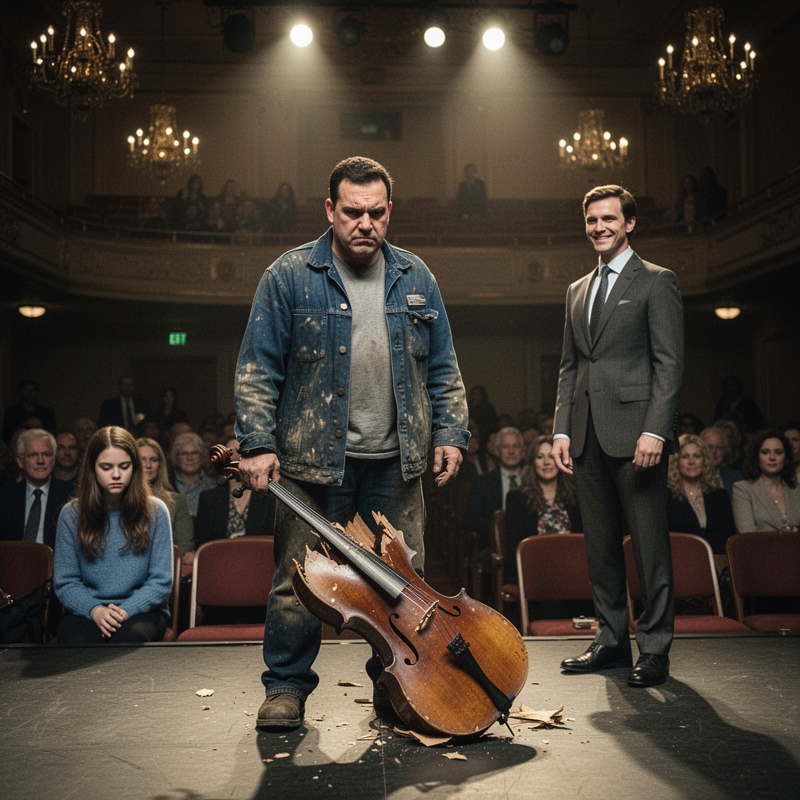
“If that tone-deaf girl touches my instrument again, I’m calling security and ending her scholarship tonight!” Mr. Sterling’s voice echoed off the oak panels of the 450-seat auditorium as he pointed a trembling finger at sixteen-year-old Maya. I watched from the fifth row as my daughter dropped her hands from her cello, her shoulders shaking while the crowd of wealthy patrons began to whisper. Maya locked eyes with me and tapped her left collarbone twice—our secret sign that meant she couldn’t hear anything because her $4,200 digital hearing aid was missing. Before the school principal could step up to the podium, I charged up the side steps, grabbed Sterling’s signature $15,000 Montagnana-style cello from its stand, and smashed it flat against the hardwood stage floor.
A sharp, violent crack ripped through the hushed elegance of the St. Jude Music Academy hall. It wasn’t the refined sound of a symphony, but the brutal splintering of aged spruce and maple.
The heavy, polished wood of the stage vibrated beneath my boots. The Montagnana-style cello, moments ago a symbol of Mr. Julian Sterling’s prestige, lay in fractured pieces.
Its soundboard, a delicate curve of spruce, had split into two jagged halves. The bridge was gone, the strings slack, some snapped like angry whips.
A collective gasp swept through the 450 formally dressed audience members. It was a sound caught between horror and disbelief, quickly followed by utter silence.
No one moved. The polite rustle of programs, the soft coughs, even the nervous whispers — all ceased.
Every eye in the opulent hall was fixed on me, Arthur Vance, a hydraulic mechanic from South Philly, standing on the polished stage of the most exclusive music academy in the city.
Mr. Sterling stood frozen, his face a mask of shocked fury. His perfectly coiffed silver hair seemed to bristle. He looked less concerned for Maya and more like someone had just vandalized a priceless museum exhibit.
From the edge of the stage, Dr. Harrison Croft, the Academy Headmaster, began to step forward. His usually composed demeanor had shattered.
His mouth opened, but no words came out. His gaze flickered between the ruined instrument and my daughter, Maya, who still stood rooted at the center of the stage, her shoulders trembling.
Her dark stage dress shimmered under the spotlights, a stark contrast to the rough lumber I’d just created.
Maya’s eyes, still wide with unshed tears, were on me. The tap on her collarbone had been a desperate plea, a confession of her vulnerability.
She had been performing for the annual winter showcase, an event critical for her scholarship and future. Then, Mr. Sterling had interrupted.
“Miss Vance, your intonation is appalling tonight!” he had boomed, his voice echoing off the oak panels, each word a hammer blow. “You are intentionally sabotaging this performance, aren’t you?”
He had gestured wildly at the $15,000 instrument, a loaned academy treasure. His face was a thundercloud.
“Hand over that cello, girl. You are a disgrace. Leave this academy at once!”
A few polite titters had rippled through the audience then, hushed quickly as some of the wealthy patrons exchanged knowing glances. They thought it was a simple disciplinary issue, a spoiled child being reprimanded.
They didn’t see the silent terror in Maya’s eyes. They didn’t understand the collarbone tap.
They didn’t know she was effectively deaf without her $4,200 digital hearing aid, a device as crucial as any instrument for her to navigate a hearing world.
And they certainly didn’t know it was missing.
My own rage had boiled over, a primal protective instinct overriding every rational thought. My daughter, my brave, resilient Maya, was being humiliated, robbed of her ability to even understand the attack.
I had moved on instinct, fueled by the unfairness of it all. I had to make them see.
Now, silence stretched, thick and suffocating. The air still vibrated with the ghost of the shattering wood.
I looked down at the ruined cello. Its gleaming varnish was scratched, the delicate f-holes gaping like broken eyes.
My steel-toed boot, still on the stage, nudged a splintered piece of the bass bar.
It dislodged a small, pink object. It tumbled from the wreckage.
Then, right beside it, an even smaller, darker component, secured with a thin strip of electrical tape, bounced off the stage and came to rest.
Maya’s missing $4,200 digital hearing aid lay there, nestled tightly against a custom electronic circuit board.
Part 2
A stunned silence, heavier than before, fell over the auditorium. Then, it fractured into a collective, disbelieving gasp. It wasn’t just the destruction of the cello anymore; it was the impossible sight of Maya’s $4,200 hearing aid and that strange, taped-up circuit board lying amidst the wreckage. A wave of murmurs, confused and then horrified, rippled through the rows of wealthy patrons.
Two burly campus security guards, their faces grim and set, were already moving with purpose from the back of the hall, surging toward the stage. Their presence seemed to snap Headmaster Croft out of his stunned stupor. His face, usually a picture of refined control, was now contorted in a mask of panic and outrage.
‘Someone call the Philadelphia Police immediately!’ Dr. Croft shrieked, his voice cracking as he pointed a trembling finger directly at me. ‘This man is a violent, unhinged felon! He has just destroyed a priceless piece of academy history! This is a criminal act!’
Mr. Sterling, who had been standing frozen just feet away, watching his shattered cello, visibly flinched when his eyes landed on the hearing aid and the electronic component. The color drained from his face, leaving it pasty white. For a fleeting second, I saw pure, unadulterated fear in his eyes. He took an involuntary step backward, away from the incriminating evidence, his composure crumbling.
But then, with chilling speed, Sterling’s panic twisted into a fresh wave of performative fury. He straightened, puffing out his chest, and pointed a dramatic, trembling finger at me. ‘He threw it!’ Sterling shrieked, his voice surprisingly strong despite the tremor in his hand. ‘He smashed my cello, and then, in the ensuing chaos, he *planted* that medical device on stage! He’s trying to frame me! Don’t let him get away with it! Call the police! Arrest this man for felony destruction and for fabricating evidence!’
CHAPTER 2: The Frequency Behind the F-Holes
Yellow police tape stretched across the proscenium arch of the St. Jude Music Academy auditorium by 7:45 PM.
Detective Marcus Reed stood under the warm stage lights, snapping photos of the splintered spruce wood lying scattered near the podium. He scribbled in a small notepad while two uniformed officers took statements from 14 lingering audience members in the front rows.
“I’m not moving until you bag every piece of this wood,” I told Reed, stepping past a brass music stand.
“You smashed a private instrument, Mr. Vance,” Detective Reed said, his voice flat. “Right now, you’re looking at felony criminal mischief.”
“Look inside the lower chamber,” I said.
Julian Sterling stood twenty feet away by the grand piano, nursing a glass of water provided by Headmaster Harrison Croft. Sterling’s hands were trembling, but his eyes were hard as flints.
“He’s delusional, Detective,” Sterling called out, his voice carrying easily across the wooden panels. “He launched himself onto the stage like a madman and destroyed a classic Montagnana-style cello. He’s looking for excuses for his daughter’s poor performance.”
Sal Russo pushed through the heavy oak double doors at the back of the hall. He was carrying a grey plastic diagnostic multimeter from our auto repair shop.
“I got the lead cables, Artie,” Sal muttered, stepping under the police tape.
Detective Reed raised a hand. “Hold it. This is an active scene.”
“Then look at what my boot kicked out of the soundbox,” I said, pointing down.
Near the cracked bass bar lay Maya’s pink digital hearing aid. Dark gray electrical tape was wrapped around its plastic casing, binding it tightly to a flat, circular circuit board no larger than a quarter.
Sal knelt down before anyone could stop him. He clipped two alligator leads from his multimeter onto the exposed micro-chip pins.
“What do you have, Sal?” I asked.
“Power’s still live,” Sal said, staring at the digital readout. “It’s a miniature piezo micro-buzzer. Driven by a lithium button cell.”
He flipped a switch on the frequency counter side of the meter. The digital screen flickered and settled on a steady reading: 8.4 kHz.
“Eight point four kilohertz,” Sal murmured, looking up at Detective Reed. “That’s high-frequency acoustic output. On a loop every twelve minutes.”
Maya stood near the stage steps, her hands folded tightly in front of her jacket. Without her digital aids, she couldn’t hear the hum, but she knew the number.
An 8.4 kHz frequency delivered directly into a high-gain digital hearing aid doesn’t just sound loud. It creates instant, excruciating vertigo and spatial disorientation.
Sterling took three fast steps toward the tape, his face flushed red.
“That’s absurd!” Sterling shouted. “He brought that trash onto my stage! He threw it into the wood fragments while everyone was panicked to frame me!”
Detective Reed looked slowly from Sterling’s white face down to the taped circuit board sitting on the stage floor.
“Nobody touches the debris,” Reed said quietly. “Bag the electronic component first.”
CHAPTER 3: The Eighteen-Second Smear
By 8:00 AM the following morning, my phone was ringing every ninety seconds.
Local news networks had obtained an eighteen-second video clip recorded from the balcony. The video did not show Sterling humiliating Maya or pointing at her collarbone.
It showed only the moment I leaped onto the stage, grabbed the instrument, and slammed it down against the floorboards.
The headline running across the bottom of the screen read: *Blue-Collar Parent Destroys $15,000 Academy Cello During Student Concert.*
Over 300,000 people had viewed the clip before I finished my first cup of coffee.
At 9:15 AM, an official courier delivered a certified envelope to our front porch.
It contained a formal letter signed by Dr. Harrison Croft. Maya was officially placed on a twelve-day emergency suspension from St. Jude Music Academy, effective immediately.
Her access to the practice halls was revoked, and her mid-term performance marks were set to zero.
Attached to the suspension notice was a second document: an itemized bill for $15,000 for the immediate replacement of the academy’s instrument.
I drove straight to the academy’s main gate on Chestnut Hill.
Two private security guards stood behind the iron gates. When I pulled my truck up to the guardhouse, the senior guard stepped out with a clipboard and held up a hand.
“Arthur Vance?” he asked.
“I need ten minutes with Dr. Croft,” I said through the open window.
“You’re formally served with a criminal trespass warning, Mr. Vance,” the guard said, handing a paper through the window. “Step off school property or we call the precinct.”
I drove back home with my jaw clenched so tight my teeth hurt.
When I stepped into the kitchen, Maya was sitting at the wooden table. Her cello bow lay flat beside her, and next to it was a small, black leather notebook she usually kept locked inside her instrument case.
She slid the notebook toward me.
I opened it. Inside were fourteen neatly lined entries written in blue ink, going back four months.
Each entry listed a date, a time, and a specific frequency description: *3:15 PM – sharp right ear pain, room spinning, pitch slipped flat.*
“Every date matches Mr. Sterling’s mandatory private rehearsals,” Maya wrote on a notepad beside her elbow.
She looked up at me, her brown eyes steady and unblinking.
“He didn’t just steal my hearing aid last night,” she wrote. “He’s been using that tone on me since September.”
CHAPTER 4: The Oscilloscope Truth
At 1:00 PM, Sal locked the front glass doors of Vance Hydraulic Repair and flipped the sign to Closed.
We cleared the heavy iron workbench in the back bay, sweeping away metal shavings and hydraulic fluid canisters. Sal set up our dual-trace digital oscilloscope—the one we used to diagnose high-pressure pump pulse vibrations.
Detective Reed had allowed us to keep photographic scans and signal captures of the piezo circuit before putting the physical board into the precinct evidence locker.
Sal plugged the signal data into our shop analyzer.
The screen lit up with sharp, jagged green sine waves.
“Look at that pulse shape,” Sal said, pointing a grease-stained finger at the screen. “That isn’t a standard alarm chip. That’s an industrial-grade acoustic driver.”
“How much does something like that cost?” I asked.
“Six hundred bucks minimum,” Sal said. “Sold by specialty audio supply houses. You can’t buy this at a local electronics store.”
Maya sat on a high stool beside the bench, watching the green line cycle up and down across the grid.
She opened her notebook and laid it right beside the digital frequency log.
The timestamps matched down to the minute. Every time the piezo driver cycled its 8.4 kHz burst, Maya’s private journal recorded a sudden drop in her intonation accuracy during solo rehearsals.
“It wasn’t poor technique,” I said, staring at the screen. “It was physical sabotage.”
Sal leaned back against the tool cabinet and pulled up the St. Jude Music Academy public digital archives on his tablet.
He searched through the past three years of student rolls, scrolling past orchestra rosters and recital programs.
“Look here, Artie,” Sal said quietly.
He highlighted three names on the screen.
All three were cellists who had held the principal chair at St. Jude over the last 36 months. All three had dropped out of the academy unexpectedly before their senior auditions.
The school newspaper articles buried in the archive cited the same reason for each student: *sudden performance anxiety and unexplained vestibular issues.*
“Three star students in three years,” Sal said. “All three had Sterling as their primary instructor.”
CHAPTER 5: Counter-Suit and Confiscation
At 2:15 PM, a process server in a grey suit walked into our shop bay without knocking.
He handed me a thick stack of legal papers stamped by the Philadelphia County Court of Common Pleas.
Julian Sterling was suing me personally for $45,000.
The filing cited severe defamation, intentional infliction of emotional distress, and deliberate damage to his professional artistic reputation.
Ten minutes later, my phone buzzed with an incoming call from Detective Reed.
“Vance,” Reed said, his voice flat over the speaker. “Headmaster Croft just filed an emergency motion with the district attorney.”
“What kind of motion?” I asked.
“They’re demanding the immediate release and surrender of all cello debris, circuit boards, and technical logs,” Reed said. “Croft claims the instrument fragments are registered academy property and that your shop is tampering with evidence.”
“If they get those fragments back into the academy vault, that circuit board will disappear within an hour,” I said.
“I know how the game is played,” Reed replied. “Which is why I moved the physical components to the state forensic lab in Harrisburg forty minutes ago. Croft’s lawyers can’t touch them there.”
I took a breath. “Thank you, Detective.”
“Don’t thank me yet,” Reed said. “Sterling’s attorney pulled another move this morning. Sterling filed an official $15,000 property loss claim with his private insurance carrier.”
“For a cello I smashed on stage?”
“Not just any carrier,” Reed said. “An offshore underwriting firm based in the Cayman Islands. They paid out a preliminary settlement check within four hours of the police report being filed.”
“He had an insurance policy ready for a broken instrument?” I asked.
“It gets better,” Reed said. “The policy was taken out seven months ago. And the declared value on the paper wasn’t fifteen thousand. It was listed as a museum-grade original valued at eighty thousand.”
CHAPTER 6: The Accompanist’s Confession
At 9:30 PM, the rain was coming down hard against the corrugated tin roof of the auto shop.
I was cleaning hydraulic fluid off a pump casing when the side access door rattled.
I grabbed a heavy steel wrench off the rack and walked to the door. “We’re closed.”
A small figure in a yellow slicker was standing in the downpour under the security light. She pulled back her hood.
It was seventeen-year-old Chloe Bennett, the lead piano accompanist from St. Jude who had been on stage during the recital.
She was shaking violently, her hands shoved deep into her coat pockets.
“Mr. Vance?” she whispered, looking over her shoulder toward the empty street. “Please don’t tell Mr. Sterling I’m here.”
I opened the door wider. “Get inside out of the cold.”
Maya stepped out from the back office, carrying a warm mug of tea. When Chloe saw Maya, her posture collapsed, and she sat down hard on an empty oil drum.
“I can’t sleep,” Chloe said, her voice breaking. “I haven’t slept since last night.”
She pulled a black, encrypted USB flash drive from her pocket and laid it on the metal workbench.
“What is that?” I asked.
“Mr. Sterling keeps an iPad on his music stand during every major showcase,” Chloe said, staring at her shoes. “He told everyone it was for viewing digital scores.”
She wiped her eyes with the sleeve of her sweater.
“It wasn’t for scores,” Chloe said. “He had a custom Bluetooth control application installed on it. It links directly to the micro-buzzers installed inside specific student cellos.”
“He triggered it from his seat?” Sal asked, stepping out of the office.
“He made me sit next to the stage mixing board,” Chloe sobbed. “At 6:15 PM, before the doors opened, I saw him go into Maya’s locker in the green room. He took her hearing aid off the prep tray and walked out.”
She looked straight at Maya, tears spilling down her cheeks.
“He threatened me, Maya,” Chloe said. “He said if I ever mentioned the app or the lockers, he would call Juilliard and cancel my recommendation letter. He said he would make sure I never played in this state again.”
She pushed the USB drive toward me.
“On that drive are twenty-seven raw multitrack audio files from the auditorium sound desk,” Chloe whispered. “You can hear the 8.4 kilohertz tone clearly on track four every time he hit the button.”
CHAPTER 7: The Counterfeit Montagnana
At 8:30 AM the next day, I drove down to the historic district in downtown Philadelphia.
In my trunk was a sealed wooden box containing four large pieces of the smashed spruce soundboard that Detective Reed had permitted me to take to an independent luthier for appraisal.
Master Luthier Elias Thorne had been restoring nineteenth-century stringed instruments for forty-two years.
He laid the pieces on a black velvet cloth under high-intensity ultraviolet halogen lamps.
Thorne pulled a lighted magnifying visor down over his eyes and picked up a piece of the broken upper bout with wooden tweezers.
He didn’t speak for nearly six minutes.
“Mr. Vance,” Thorne said finally, swinging the UV lamp closer to the wood. “Who told you this was a Montagnana-style instrument?”
“Mr. Sterling,” I said. “And the Headmaster of St. Jude. They billed me fifteen thousand dollars for its destruction.”
Thorne let out a dry, rattling laugh.
“This wood is not spruce from Northern Italy,” Thorne said, pointing a thin brass scribe at the inner edge of the break. “This is three-ply laminated poplar. Machine-pressed in a factory in Guangzhou, China, less than two years ago.”
“It’s a fake?” I asked.
“It’s an eight-hundred-dollar student model,” Thorne said flatly. “They coated the exterior in a dark amber polyurethane varnish to make it look aged under stage lights. Look at the corner blocks—they aren’t even fitted, they’re glued with synthetic resin.”
He picked up a small paper label from inside the lower soundhole using tweezers.
“This maker’s label inside is a cheap laser reprint,” Thorne added. “It was aged using coffee stains.”
I stood quiet in the quiet, dust-filled workshop, listening to the ticking of a grandfather clock in the corner.
“Sal,” I said, pulling out my phone and dialing. “Run a public property registry check on Vance Fine Violins—that private shop Sterling operates on the side.”
“On it,” Sal said over the line.
Three minutes later, Sal came back on the phone.
“Artie,” Sal said, his voice dropping an octave. “Six months ago, Sterling exported an authentic, museum-certified 1880 Montagnana replica cello to a private buyer in Munich, Germany.”
“How much did he sell it for?”
“Twenty-two thousand dollars cash,” Sal said. “He swapped the real academy instrument for an eight-hundred-dollar plywood knockoff, kept the fake on stage, and waited for an excuse to write it off.”
“He didn’t just sabotage my daughter,” I said. “He was running an antique replacement scam using academy funds.”
CHAPTER 8: The Boardroom Ambush
At 10:00 AM on Friday morning, the St. Jude Music Academy Administration Building was packed.
Dr. Harrison Croft had convened an emergency public meeting of the Board of Trustees in the central glass atrium.
Over 80 people filled the rows of mahogany chairs: wealthy donors, board members in dark suits, and four local television news crews carrying shoulder-mounted cameras.
Croft stood at the main podium, adjusting his gold-rimmed spectacles. Julian Sterling sat to his right, wearing a grey wool suit, his hands folded neatly over a leather folder.
“We are gathered today under tragic circumstances,” Croft announced into the microphone. “To address an unprecedented act of violence against our institution and to formally revoke the enrollment of Maya Vance.”
The camera lights flickered on, illuminating Croft’s silver hair.
“We must maintain institutional integrity,” Croft continued. “We cannot allow blue-collar hostility or undisciplined students to destroy the artistic legacy of St. Jude—”
The heavy double glass doors at the back of the atrium slammed open.
I walked down the central marble aisle.
Beside me walked Detective Marcus Reed in his dark police trench coat, flanked by two uniformed Philadelphia Police officers. Behind us, Sal Russo carried a heavy, portable industrial job-site speaker under his arm.
“What is the meaning of this intrusion?” Croft demanded, gripping the edges of the podium. “Security! Remove these people immediately!”
The two campus security guards stepped forward, but Detective Reed held up his badge.
“Back off,” Reed said sternly. “Official police business.”
Sal set the heavy blue speaker directly onto the polished committee table right in front of the board members. He plugged a lead from a tablet straight into the auxiliary port.
“Mr. Croft,” I said, my voice cutting cleanly through the crowded room. “Before you vote on my daughter’s expulsion, you should listen to track four from Thursday night’s master mix.”
Sal hit the play button on the tablet screen.
CHAPTER 9: The Climax — Shattering the Myth
The industrial speaker boomed across the glass atrium.
First came the crystal-clear acoustic sound of Maya playing her cello solo from the winter recital.
Then, six seconds in, a sharp, piercing 8.4 kHz electronic whine cut through the music.
Sterling’s voice echoed out of the speaker next, captured clearly by Chloe’s multitrack microphone feed on the stage floor:
*”Hit the driver now, Chloe. Increase the gain to maximum. Let’s see how long the deaf girl holds her pitch before she breaks.”*
Gasps erupted across the audience. Two female board members sitting in the front row stood up in shock.
Julian Sterling leaped from his chair, his face turning an unhealthy shade of purple.
“That audio is a forgery!” Sterling shrieked, pointing a finger at Sal. “He fabricated that clip in his auto repair shop! He’s a mechanic, not a sound engineer!”
I stepped up to the committee table and laid three physical documents down side by side.
“First document,” I said, tapping the paper. “A digital oscilloscope signal analysis certified by the Pennsylvania State Forensic Laboratory, proving an active high-frequency acoustic driver was embedded inside the instrument.”
Sterling took a step back, his foot catching on his chair leg.
“Second document,” I continued. “A sworn affidavit from Master Luthier Elias Thorne, confirming the instrument I smashed was not a fifteen-thousand-dollar Montagnana, but an eight-hundred-dollar plywood fake.”
The news cameras swung around, zoom lenses focusing tightly on the papers on the table.
“And third,” I said, dropping the final stack. “Bank records from the First Commercial Bank of Munich, showing a twenty-two-thousand-dollar wire transfer into Mr. Sterling’s offshore account for the sale of the real academy cello six months ago.”
Dr. Croft’s mouth opened, but no sound came out. He looked at Sterling, then at the news cameras, his hands shaking violently against the podium.
“Dr. Croft,” I said, stepping closer to the stage. “I suggest you check your internal procurement records from last June.”
“I… I have no knowledge of any sales!” Croft stammered, pulling at his stiff collar.
I pulled one final paper from my coat pocket.
“This is a signed authorization memo dated June 14th,” I said. “Signed by you, Headmaster Croft, approving the unvouched transfer of three academy stringed instruments to Sterling’s private gallery.”
Detective Reed stepped around the table and placed his hand on Julian Sterling’s shoulder.
“Julian Sterling,” Reed said, his voice echoing through the silent atrium. “You are under arrest for felony grand larceny, insurance fraud, and child endangerment.”
The metal cuffs clicked shut loudly in front of four live television news crews.
CHAPTER 10: The Fall of the Academy Elite
The atrium erupted into pure chaos.
Reporters shoved microphones over the wooden railing while cameras flashed continuously as Sterling was led out of the building by uniformed officers, his head ducked down toward his chest.
Before Detective Reed reached the outer glass doors, the Board of Trustees chairman stepped up to the microphone.
“Effective immediately,” the chairman announced, his voice tight with anger, “the Board of Trustees votes seven to zero to terminate Dr. Harrison Croft’s employment contract with St. Jude Music Academy, without severance or institutional indemnity.”
Croft stood frozen behind the podium as two security guards—the same ones who had barred me from the gate—stepped up and escorted him down the side hallway.
By 6:00 PM that evening, the local news network aired a full broadcast retraction.
The anchor who had previously called me a “violent mechanic” sat in front of a graphics screen displaying our oscilloscope readouts and the luthier’s report.
The headline now read: *Master Teacher Arrested in High-Tech Acoustic Abuse and Fraud Scheme.*
Two days later, on Sunday afternoon, a black sedan pulled up to my house.
Dr. Harrison Croft stepped out onto the driveway. He looked years older, his designer coat rumpled, carrying a brown leather briefcase.
I stood on the front porch with my arms crossed as he walked up the wooden steps.
“Mr. Vance,” Croft said, his voice trembling slightly. “I am here to deliver a formal, written apology on behalf of the administration.”
He opened his briefcase and pulled out a thick envelope.
“The board has expunged Maya’s suspension from all academic records,” Croft said, handing me the paper. “And they have authorized me to present this to your family.”
Inside the envelope was an official cashier’s check drawn from the academy’s endowment reserve fund.
The amount written on the line was $50,000.
“It is a full, four-year merit scholarship,” Croft said hastily. “With zero tuition fees, full access to master classes, and a private practice suite. We want Maya back at St. Jude, Mr. Vance. We want to make this right.”
CHAPTER 11: Resonance Mechanics
Maya stepped out onto the porch through the screen door.
She took the $50,000 check from my hand and looked at the bold black numbers printed on the front.
Without a word, she looked Croft straight in the eyes.
Maya folded the paper in half once. Then she folded it again and tore it cleanly down the middle.
She ripped the pieces into four clean squares and dropped them back into Croft’s open briefcase.
“I will never play inside a hall that values polished wood over human dignity,” Maya wrote on her notepad, holding it up for Croft to read.
Croft stared at the torn pieces of paper, swallowed hard, closed his briefcase, and walked back down the porch steps without saying another word.
Three weeks later, Sal and I took down the old oil drum storage racks in the west bay of Vance Hydraulic Repair.
Using our personal savings and the financial proceeds from a successful civil counter-claim against Sterling’s seized personal assets, we converted 1,200 square feet of shop space into a brand-new workshop.
We hung a painted metal sign over the double bay doors: *Resonance Mechanics.*
We didn’t repair commercial hydraulic pumps in the west bay anymore.
Instead, Sal and I designed custom, tamper-proof cello, violin, and viola soundboards built specifically with high-sensitivity tactile feedback plates for hard-of-hearing and deaf musicians.
Six weeks after the recital, the sun was setting through the high shop windows, casting long golden bars across the concrete floor.
Maya sat on a high wooden stool near the main workbench, holding a custom cello we had modified together over the past fourteen days.
Sal stood near the coffee maker, while Chloe Bennett sat at an upright piano near the tool racks.
Maya tapped her collarbone twice—showing her digital aids were turned on and clear.
She set the horsehair bow against the lower C-string and drew it smoothly across the wood.
A deep, resonant, perfect tone filled the entire workshop, vibrating through the concrete floorboards, the steel tool racks, and the heavy iron workbenches.
It was a clear, unshakeable note that no machine could fake, and no lie could ever mute.
They build high walls and expensive stages to hide their weakness, but a single clear note of truth can shatter even their finest wood.
Leave a Reply