CHAPTER 1: Locked in the Dark
Part 1
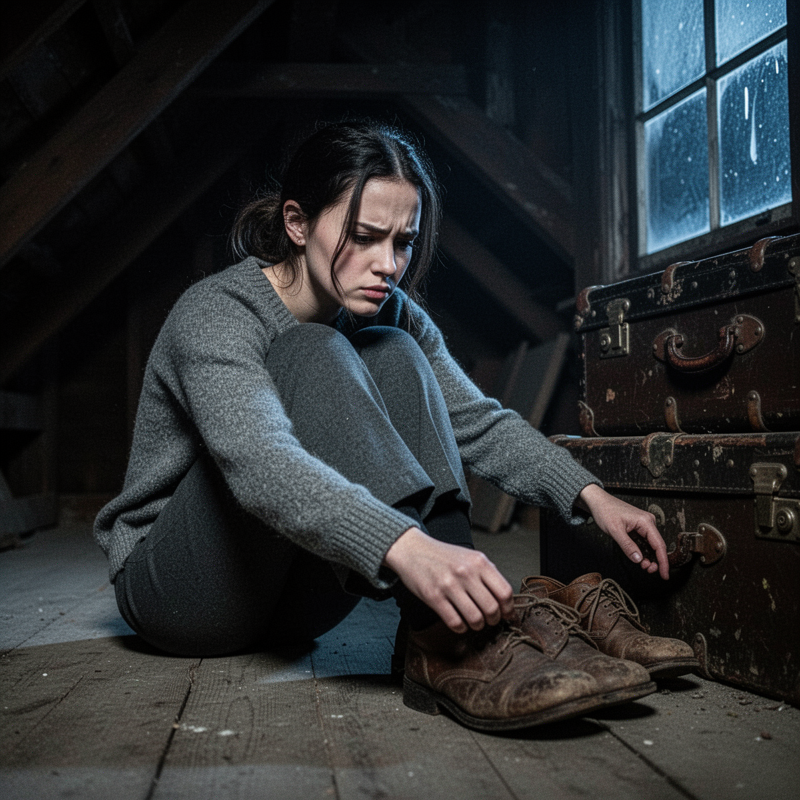
“An adopted child has no part in this celebration,” my adoptive mother, Eleanor, hissed, her eyes like chips of glacial ice. She shoved me roughly towards the narrow, creaking stairs leading to the dusty attic of our historic Boston brownstone, the heavy oak door slamming shut and locking with a chilling click just as the clink of crystal glasses signaled the toast for my adoptive sister, Olivia, and her Harvard scholarship. I could hear the triumphant cheers reverberating through the floorboards, but all I could focus on was the scuttling of unseen mice in the suffocating dark, shrinking into a corner, utterly forgotten. But not for long, because somewhere in this very house lay a pair of my biological mother’s old shoes, holding a handwritten letter revealing the shocking truth about who truly owned this house.
The grand parlor of the Hayes brownstone, usually a quiet sanctuary of antique furniture and hushed conversations, now vibrated with a forced merriment. The air hung thick with the scent of lilies and expensive perfume, punctuated by the clinking of champagne flutes. Chandeliers, polished to a blinding gleam, cast a brittle light on the faces of Boston’s elite, all gathered to celebrate Olivia.
My adoptive sister, Olivia Hayes, stood radiant by the fireplace, her red silk dress shimmering. A cascade of perfect blonde curls framed her triumphant smile as she accepted accolades for her Harvard scholarship. Everyone adored Olivia. She was everything a Hayes daughter should be: brilliant, beautiful, and destined for greatness.
I hovered near the periphery, a forgotten shadow by the heavy velvet drapes, nursing a glass of sparkling cider. The cloying sweetness of the drink matched the sickeningly sweet atmosphere, making my throat ache. I felt like an intruder, a misplaced piece in a meticulously arranged tableau.
My adoptive father, James Hayes, offered a rare, weak smile in my direction from across the crowded room. He was a tall man, stooped by some unseen burden, his eyes often carrying a distant sadness. But his gaze quickly darted away, drawn back into the orbit of the celebration, swallowed by the boisterous laughter.
I understood. He was never one for confrontation, especially not with Eleanor.
Suddenly, a shift in the room’s energy made the hairs on my arms prickle. Eleanor Hayes, a formidable woman even in repose, moved with predatory grace. Her silk gown, a deep emerald green, seemed to absorb the light rather than reflect it. She navigated through clusters of guests, her smile fixed, her eyes scanning, searching.
And then they found me.
Her expression, initially a mask of polite engagement, tightened. The corners of her mouth drew down, a barely perceptible flicker of contempt passing through her glacial blue eyes. She made a beeline, her heels clicking softly on the polished parquet floor.
The chatter around me seemed to fade into a dull roar. The scent of lilies, once pleasant, now felt suffocating.
Eleanor stopped barely a foot away, her presence chilling the already cool air. Her perfect smile vanished, replaced by a snarl that twisted her aristocratic features. It was a private display, meant only for me, shielded by the din of the party.
“Clara,” she hissed, her voice low and sharp, barely audible above the din. “You are still here.”
I straightened my shoulders, trying to project an air of composure I didn’t feel. My hands clenched around the cider glass.
“Yes, Eleanor,” I managed, my voice a whisper. “I was just—”
“An adopted child has no part in this celebration,” she declared, her words cutting through the air like shards of glass. This time, her voice carried a little further, enough for a few nearby guests to subtly turn their heads.
The blood drained from my face. My cheeks burned.
Before I could react, her hand clamped around my arm. Her grip was surprisingly strong, digging into my flesh. Her fingers felt like cold steel. She didn’t pull; she shoved, propelling me forward with surprising force.
I stumbled, nearly dropping the glass. It clattered against the wall, but miraculously didn’t break. No one seemed to notice, their attention already returning to Olivia’s spotlight.
She pushed me again, her momentum guiding me away from the parlor, past the formal dining room, and towards the lesser-used servant’s wing. The sounds of the celebration began to recede, replaced by the hollow echo of our footsteps.
My heart hammered against my ribs. I tried to pull away, but her grip was unyielding.
“Eleanor, what are you doing?” I pleaded, my voice barely a choke.
She didn’t answer. Her jaw was set, her eyes fixed on the destination. Her posture screamed unyielding resolve, a force of nature I knew I couldn’t fight.
We reached the narrow, creaking stairs. They were steep and dark, leading up to the dusty attic—a place I rarely ventured. The air grew cooler, tinged with the scent of aged wood and neglect.
She released my arm abruptly, and I stumbled on the first step. The pain blossomed in my arm where her fingers had dug in.
“Go,” she commanded, her voice flat, devoid of emotion. Her hand gestured dismissively toward the darkness above. “Stay there until everyone has left.”
My eyes stung, but I refused to let the tears fall. I glared at her, trying to summon a defiance I didn’t possess. She simply stared back, her expression utterly devoid of pity.
I took a shaky breath, then started to climb, each step a protest against the humiliation. The stairs groaned under my weight, the old wood complaining with every ascent. Above, only shadows and the faint, unsettling scratch of unseen life awaited.
I could hear the muffled sounds of the party below, a distant hum of laughter and music. It only made the silence around me feel heavier, colder.
I reached the landing, a small, cramped space leading to a heavy oak door. It was warped with age, its surface rough and splintered.
Eleanor followed me to the base of the stairs, her silhouette a dark, imposing figure against the distant light of the hallway. She watched me ascend, a silent sentinel of my shame.
As I hesitated, she stepped forward, reaching for the door. Her hand closed around the tarnished brass handle.
“You’ve been enough of an embarrassment for one night, Clara,” she said, her voice dripping with cold finality.
The heavy oak door swung shut with a resounding thud. The sound reverberated through the small space, trapping the dust-filled air around me.
Then, with a chilling click that echoed in the sudden, complete darkness, the lock engaged.
Almost simultaneously, from downstairs, a triumphant cheer erupted, followed by the joyous clink of crystal glasses. The sound vibrated through the floorboards beneath my feet, a mocking fanfare to my utter abandonment.
Part 2
The darkness was absolute, heavy and cold. It pressed in on me, suffocating any remaining breath of defiance. My eyes stung, but I blinked rapidly, refusing to cry. The sound of the celebration downstairs, once a distant hum, now felt like a cruel, mocking laugh specifically aimed at my exile. Below my feet, the rhythmic creak and scuttle of mice was my only company in the inky blackness.
I took a shaky breath, the air thick with dust and the scent of forgotten things. My bruised arm throbbed, a physical reminder of Eleanor’s contempt. I couldn’t just stand there in the dark. The rough wooden floor, I knew, would be cold and splintered. I needed something, anything, to cushion myself against the harsh reality of my situation.
Tentatively, I shuffled forward, my hands outstretched, blindly sweeping the air. My fingers brushed against cobwebs, then something solid and cold – an old iron grate, part of the attic’s sparse ventilation. I kept moving, one slow step after another, until my shin bumped hard against a forgotten object.
“Ouch!” I hissed, wincing in pain.
I knelt, reaching down to feel what I’d hit. It was a large, wooden trunk, rough and unvarnished, caked in layers of fine, gritty dust. I ran my hand over its surface, then found the rusted clasp. It groaned loudly as I pushed it open.
Inside, beneath a few layers of faded, moth-eaten linens, something else lay hidden. I reached in, my fingers closing around soft, supple leather. I pulled them out.
They were shoes.
Not the sleek, modern heels Eleanor wore, nor Olivia’s fashionable flats. These were old, worn leather women’s shoes, clearly antique, with delicate stitching and a low, practical heel. They looked like something out of a different era, perhaps a century ago. A strange sense of familiarity washed over me as I held them, an unidentifiable echo of something lost.
I idly picked up one shoe, turning it over in my hands. The leather was soft, molded by years of use. My fingers traced the sole, feeling the raised stitching along the inner seam. But as my thumb pressed into it, I noticed something unusual. There was a subtle, rigid bulge, a firm, unyielding object meticulously stitched deep within the sole, hidden from plain sight.
Chapter 2: The Letter’s Secret
The metallic clang of the lock still echoed in the vast, dusty silence of the attic, a brutal counterpoint to the distant, muffled celebration downstairs. I knelt by the forgotten trunk, the old leather shoe heavy in my hands. My fingers still traced the unusual rigidity in its sole, a firm line beneath the worn leather that didn’t feel like typical padding or an old insole.
A frantic energy stirred inside me. What could it be? My eyes darted around the dim space, searching for anything I could use. In a corner, half-hidden beneath a stack of decaying newspapers, I spotted a forgotten wooden drawer. Inside, among dried-up inkwells and a single, petrified apple, lay a rusty, blunt butter knife.
It wasn’t ideal, but it was all I had. I sat back on the floor, ignoring the dust that coated my jeans, and brought the shoe closer. The leather, though old, was tough. I carefully worked the dull edge of the knife into the seam where the sole met the upper, pushing with a focused intensity. The stitching crackled, resisting, then slowly gave way.
A faint tearing sound, like old paper crinkling, accompanied the leather’s protest. Then, with a soft, almost imperceptible slide, a tightly folded, yellowed piece of paper emerged from the narrow gap. It was dense, aged, and impossibly thin.
My heart hammered against my ribs, a drumbeat in the quiet attic. My hands trembled as I unfolded the fragile document, flattening it against my knee. The elegant, looping script immediately jumped out at me. I’d seen it before, on the back of a single faded photograph Eleanor had kept tucked away in a locked box—a photo of a beautiful, smiling woman with my eyes.
Sarah Jensen. My biological mother.
The first few lines confirmed it, clear as day, written in a hand that felt both familiar and utterly new: “To my dearest Clara, my brave little girl…” A wave of profound warmth, quickly followed by a stinging pang of grief, washed over me. This was from her. A stark, undeniable contrast to the bitter rejection that had just driven me into this suffocating darkness.
Chapter 3: The True Heir
I retreated to a narrow, dusty window seat, the last weak rays of autumn sunlight filtering through the grimy pane. The letter felt impossibly fragile in my hands as I settled in, needing every bit of light to read the rest. My breath hitched as I devoured each word, the silence of the attic broken only by the distant tick of a grandfather clock downstairs.
It wasn’t just a letter; it was a desperate testament, a hastily written but incredibly detailed document outlining Sarah’s deepest fears and wishes. She wrote of her profound concern for her safety, how “certain parties” wished to see her incapacitated and removed. Then came the bombshell, a detail that shattered everything I thought I knew.
The brownstone, 14 Elmwood Lane—our house, my *adoptive* family’s house—along with a significant portion of the Jensen family estate, belonged to her direct blood heir. Me. The letter explicitly stated this, referencing a complex ancient trust deed, “The Elmwood Legacy Trust.”
According to Sarah, this trust dictated that ownership would revert to me upon my 21st birthday, or even earlier if she were deemed incapacitated or missing. She’d left other clues, she wrote, “should you ever need them, hidden where only we would look.” My head spun. Eleanor wasn’t the owner, never had been. I was. This entire life, this constant feeling of being an outsider, was built on a lie. A betrayal so deep it felt like the floorboards beneath me might crack open.
Chapter 4: Eleanor’s Counter
The next morning, I couldn’t wait. The letter, carefully refolded, was clutched tight in my hand as I burst into Eleanor’s pristine sunroom, where she was sipping Earl Grey tea from a delicate china cup.
“Eleanor,” I started, my voice trembling, “I found this. It’s from Sarah.”
Her hand, poised mid-air with the teacup, paused. A slow, theatrical smile spread across her face, chilling me to the bone. “A madwoman’s ramblings, dear,” she scoffed, placing the cup down with a soft clink. Before I could react, her hand shot out, snatching the letter from my grip.
“What—” I started, but she was already tearing it, once, twice, a rapid, ruthless shredding that silenced my protest. Yellowed fragments fluttered to the polished floor like dying leaves. “You were legally adopted. Your *real* mother, Sarah, signed away all rights—parental, proprietary, everything—fifteen years ago.”
She rose, her silk robe rustling, and glided to an antique mahogany desk. From a hidden compartment, she produced a stack of crisp, official-looking documents. She fanned them out on the polished surface. “See? Here they are. Signed and sealed.”
There it was. My adoption papers. And on the last page, Sarah Jensen’s signature, stark and undeniable, waiving all claims to me and to the estate. My world tilted. The papers seemed iron-clad, perfectly legal. Eleanor’s eyes, cold and triumphant, held mine. The depth of her manipulation, the legal trap she had sprung years ago, hit me like a physical blow. I was reeling, utterly exposed.
Chapter 5: A Glimmer of Hope
Devastated, I stumbled through the day in a daze. That night, at 3 AM, unable to sleep, I found myself calling Liam Miller, my childhood friend, his number a lifeline.
“She tore it up, Liam,” I whispered into the phone, tears finally breaking free. “And then she showed me the adoption papers. Sarah signed everything away. I have nothing.”
Liam, usually laid-back, was sharp and focused. “Hold on, Clara. Don’t let her win that easily. We need to fight this. Who signs away an estate that belongs to their child, especially if there’s an old family trust?”
He urged me not to give up. By morning, fueled by his insistence, I had an initial consultation with a reputable family law attorney in Cambridge. The office was quiet, professional, a stark contrast to Eleanor’s opulent home.
The attorney, Ms. Davies, listened patiently, her brow furrowed as I recounted Eleanor’s dismissive laughter and the shredded letter. “Adoption papers are powerful, Ms. Hayes, yes. But the timing and circumstances of Sarah’s waiver, especially concerning an ancestral trust, could be challenged. We’ve seen cases like this before.”
She leaned forward, her gaze direct. “First step: genealogical and property records. We need everything predating your adoption 15 years ago. We’re looking for any discrepancies in the transfer of the brownstone’s title. Anything that hints at foul play, a forced signature, or a suppressed document.” A glimmer of hope, faint but real, sparked within me.
Chapter 6: Sarah’s Journal
Ms. Davies’ words had ignited a new resolve. I returned to the brownstone with a different set of eyes. Eleanor had always kept Sarah’s old nursery locked, a silent, dusty shrine to a past she claimed was over. But in the chaos of Eleanor’s heightened security around the main house after my legal inquiry, she’d “forgotten” to secure the nursery door.
It creaked open, revealing a room frozen in time, filled with antique baby items, covered in white sheets. A small rocking horse sat in the center, its painted eyes staring blankly. I felt an inexplicable pull towards it. Kneeling, I ran my hand along the polished wood of the floorboards nearby.
One section felt different. Not just loose, but slightly elevated, as if something was wedged beneath it. I tried to pry it with my fingernails, then with the blunt butter knife from the attic. It resisted, groaning, but finally, with a sharp crack, the board lifted.
Hidden beneath, nestled in the dust, was a small, leather-bound journal. Its pages were filled with Sarah’s familiar, elegant script, but many entries were a jumble of symbols and letters that made no sense. A code.
The journal dated back 17 years ago, to the exact time of my birth and Sarah’s subsequent disappearance. My fingers traced the cover, a wave of profound sadness washing over me. Sarah was planning something long-term. This wasn’t a simple disappearance. This was deliberate, calculated. And coded.
Chapter 7: Evelyn Reed’s Expertise
“A coded journal,” Liam mused, staring at the pages over my shoulder. We were hunched over the kitchen table, Sarah’s journal laid open between us. “That’s… intense. Who even knows how to crack something like that?”
“Maybe someone who knows old families,” I suggested, recalling Ms. Davies’ advice about historical records. “Someone who deals with documents from way back.”
Liam’s eyes lit up. “Ms. Evelyn Reed! The family archivist. She’s practically a walking encyclopedia of Boston’s old money. My aunt used to say she could tell you who owned what cobblestone in Beacon Hill before the American Revolution.”
Nervously, I made an appointment. Ms. Reed’s office on Beacon Hill was impeccably organized, smelling of old paper and quiet intelligence. Stacks of antique ledgers lined the walls, and a single, perfectly arranged teacup sat on her mahogany desk. I presented Sarah’s journal, my hands shaking slightly.
Ms. Reed, a woman with kind eyes and a sharp intellect, took the journal. She examined Sarah Jensen’s handwriting, then peered closely at the unusual cipher. “Ah, yes. The Jensen family cipher. A rather old, obscure method. I’ve encountered snippets in other documents. Intriguing.” She agreed to help, her professional curiosity piqued.
The very next day, as Ms. Reed began her meticulous work, Eleanor’s attorney, Mr. Arthur Thorne, sent a chilling cease and desist letter to my modest apartment. The official seal was embossed, the language cold and formal. It threatened defamation charges if I continued to “harass” the Hayes family with my “baseless claims.” It was a clear attempt to intimidate, but with Sarah’s journal in Ms. Reed’s capable hands, I refused to back down.
Chapter 8: The Suppressed Clause
Three tense weeks crawled by. Ms. Reed, true to her reputation, was a methodical force. One afternoon, her call came through, precise and urgent. “Ms. Hayes, I believe I’ve made significant progress with your mother’s journal.”
I raced to her office. She held up a specific page, its coded symbols now interspersed with legible English. “This cipher key, I recognized it from other Jensen family correspondence from the late 19th century. Sarah was brilliant to use it.”
She pointed to a decoded passage. “Here, your mother details her growing paranoia and fear of Eleanor. She describes how Eleanor manipulated her during a vulnerable post-partum period, even planting false medical records suggesting Sarah was unstable. A classic move to gain control.”
My stomach clenched. This was more than just greed; it was calculated malice.
Then Ms. Reed tapped another paragraph. “And this. Your mother wrote about a ‘fail-safe.’ A specific reversion clause in the *original* Jensen Family Trust. She believed Eleanor had suppressed it, deliberately keeping it out of the official records. This clause, Sarah writes, was designed to protect the estate if she, or her direct heir, were ever unlawfully dispossessed.”
Ms. Reed peered over her spectacles. “And she left a clue to its hidden location: ‘Behind the old world map, where the mice still whisper.’” My eyes widened. The attic. The mice. It all clicked into place.
Chapter 9: The Attic’s Last Secret
The decoded entry sent a jolt through me, electrifying every nerve ending. “Behind the old world map, where the mice still whisper.” It could only mean the attic. The place where my rejection began, where my discovery had started.
Eleanor’s latest threat from Mr. Thorne—a formal warning that my modest bank account might be frozen—felt like an insignificant hum against the roar of new purpose. I called Liam, my voice tight with urgency. “The attic. I know where Sarah hid something else.”
He didn’t hesitate. “I’ll be there in twenty.”
When he arrived, armed with a powerful flashlight and a small toolkit, we climbed the narrow, creaking stairs, the air thick with dust and a shared sense of impending revelation. We made our way to the crumbling wall where the mice had scurried on that fateful night, their rustling my only company in the dark.
A moth-eaten tapestry, depicting a faded hunting scene, hung there. “This must be it,” I murmured, my heart pounding. Liam, without a word, reached up and tore the fabric away. Beneath it, painted directly onto the plaster, was a faded, ancient world map. The colors were muted, the continents blurred by time.
“Where…?” Liam scanned the wall.
Following Sarah’s cryptic hint, I ran my hand over the plaster, tapping lightly. When my fingers brushed the section depicting the North Atlantic, a hollow echo reverberated back. “Here!”
Liam immediately brought his tools to bear. With a grunt, he wedged a crowbar into a loose brick at the edge of the painted ocean. The brick groaned, then shifted, exposing a small, dark recess within the wall. Our eyes met, wide with a mixture of terror and exhilaration. We were on the brink of everything.
Chapter 10: The Reversion
Inside the recess, shrouded in a thin layer of dust and spiderwebs, they found a metal cylinder. My hands trembled as Liam carefully pulled it free. It was cool, smooth, and surprisingly heavy. With barely a breath, I uncapped it and extracted an aged, rolled parchment.
This was it. The original Jensen Family Trust document, dated 1888, hand-signed by the family patriarch and witnessed. Its 22 pages, stiff and brittle with age, contained the full, legally binding details that Eleanor had systematically suppressed for decades. I scanned the archaic script, my eyes darting across the elaborate language until they landed on Section 4, bolded and underlined by time: “The Reversion Clause.”
I began to read aloud, my voice hoarse, the words cutting through the dusty silence of the attic. “Should the direct blood heir to the Jensen Estate be unlawfully dispossessed, declared incompetent under false pretenses, or suffer undue harm resulting in their removal from the property, then the entirety of the Jensen Estate, including all real property and financial holdings, shall immediately revert to the establishment of the ‘Jensen Family Charitable Trust,’ with an independent executor designated by the Boston Probate Court.”
Liam let out a low whistle. “The entire estate?”
My gaze dropped to the following lines, outlining the scope. “90% of the estate, estimated now at over $8 million in various investments, beyond the $3.5 million brownstone…” It was a total, devastating loss for Eleanor and Olivia. Not just the house, but everything. The full extent of Sarah’s foresight, her incredible protection, was now undeniable. Eleanor’s carefully constructed empire was about to crumble.
Chapter 11: The Charitable Trust
With the original trust document clutched tightly in my hand, my attorney, Ms. Davies, wasted no time. She filed an emergency injunction, presenting the irrefutable evidence to Judge Helen Chen in Boston Probate Court. The courtroom, usually a somber place, crackled with a palpable tension. Eleanor sat beside Mr. Thorne, her face a mask of furious disbelief, her usual composed demeanor shattered.
Mr. Thorne, usually so arrogant, stammered, his arguments crumbling under the weight of the undeniable, physically produced document. Judge Chen, sharp and impartial, reviewed the reversion clause. Her expression grew grim as she absorbed the meticulous details of the 1888 trust.
After a terse 48-hour deliberation, the judge’s ruling came down like a gavel strike. “The Jensen Estate, as per the 1888 trust, reverts to the ‘Jensen Family Charitable Trust.’” A ripple went through the courtroom. Eleanor gasped, a small, choked sound.
Then came the final, astonishing twist. Judge Chen continued, “Furthermore, Section 4.b.ii specifically names Clara Hayes, Sarah Jensen’s proven blood heir, as the principal trustee of this newly established fund.”
I stared, my mind struggling to comprehend. I was 21 now. I would oversee the massive $11.5 million estate, not as a direct owner, but as its powerful, legal steward. The responsibility, the weight of upholding its philanthropic mission, settled on my shoulders. It was a position of immense power, given not through inheritance of wealth, but through the justice of a hidden truth.
Chapter 12: Aftermath and Future
Eleanor Hayes’s world imploded. The magnificent brownstone, her prized symbol of status, was now formally placed under the charitable trust. She was given 30 days to vacate, a humiliating eviction from a house she believed was hers. Her carefully cultivated social standing among Boston’s elite, her most cherished possession, was utterly ruined. Whispers of fraud and manipulation now echoed through those exclusive circles. She was a pariah.
Olivia, too, felt the sting, her anticipated inheritance vanished, the prestige that came with it evaporating. Her comfortable future, once assured, was now uncertain.
James Hayes, my adoptive father, visibly sobered by the outcome, approached me after the final court hearing. His face was drawn, guilt etched around his eyes. He offered a quiet, heartfelt apology, admitting he had always suspected something was wrong with Sarah’s disappearance, but had been too afraid of Eleanor to act. It was a bittersweet moment, a fractured piece of truth offering a tentative, quiet reconciliation for his past failures, acknowledging his cowardice without excusing it.
Armed with resources and a newfound sense of purpose, I returned to Sarah’s journal. The remaining coded entries, now with Ms. Reed’s full key, revealed a final, hopeful lead. Sarah hadn’t just disappeared; she had meticulously planned an escape. The journal hinted at her fleeing to a specific artisan community in upstate New York, a place called “The Willow Creek Collective.”
The house, no longer a cage or a symbol of my rejection, became my responsibility, a beacon of reclaimed truth. Its grand rooms, once filled with Eleanor’s cold ambition, now awaited a new purpose. It was a new beginning, a profound shift in my identity and my life’s direction.
Sometimes, to find where you truly belong, you must risk shattering everything you once thought was home.
Leave a Reply