CHAPTER 1: The Cold Storage Betrayal
Part 1
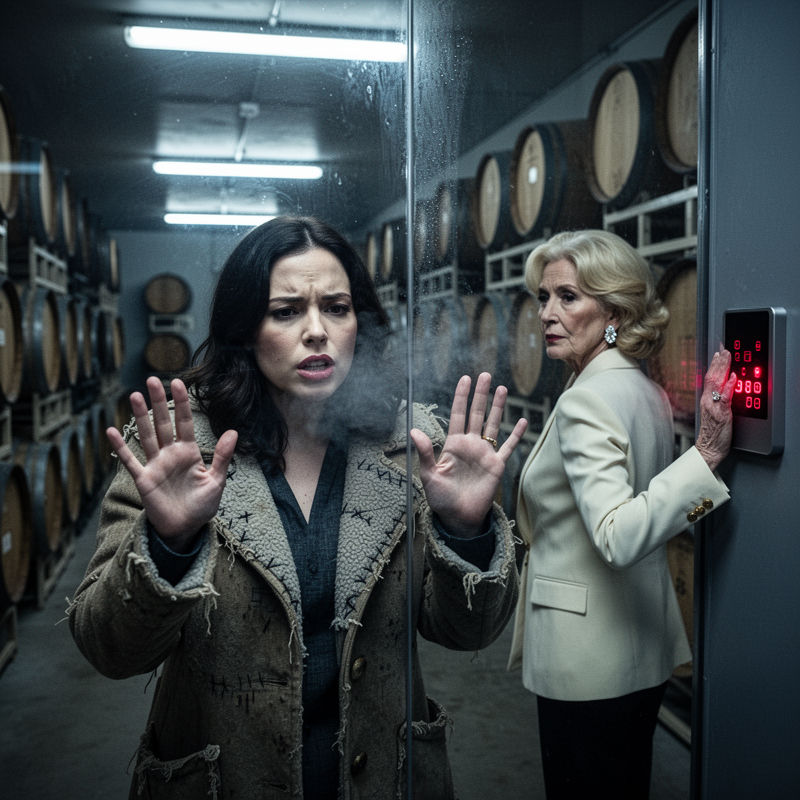
“Learn some gratitude first, and then I’ll open this door for you,” my mother-in-law, Virginia Beaumont, sneered, shoving me forcefully into the -2°C wine cold storage of their Napa Valley family estate. She then spun on her heel, striding back towards the bubbling laughter and clinking glasses of the $20 million vineyard sale celebration party on the lawn, leaving me trapped. My lips quickly turned a mottled blue, my breath misting in the frigid air, but the threadbare coat I’d stitched with an extra layer of insulation during my lean college days had a secret. For two agonizing hours, it was all that stood between me and hypothermia, silently promising that Virginia’s cruel triumph was far from secure.
The aroma of aged Cabernet Sauvignon and expensive canapés hung heavy in the crisp Napa Valley air. It was a perfect early autumn evening, cool enough for a shawl, but not for the icy grip that was about to take hold.
The Beaumont family estate buzzed with over a hundred guests, their laughter echoing across the manicured lawns. Crystal glasses chimed like a constant, joyful bell choir, celebrating the $20 million sale of their prized vineyard.
Amelia “Amy” Miller-Beaumont, trying her best to blend in, felt the familiar prickle of being an outsider. Her modest navy dress, one of her best, felt like a costume among the designer gowns and bespoke suits.
She attempted small talk with a woman discussing her new investment portfolio.
“It’s a wonderful evening, isn’t it?” Amy offered, smiling.
The woman nodded, barely glancing at her. “The market is quite volatile, darling. One must be ruthless.” She turned back to her husband, dismissing Amy entirely.
Amy sighed, feeling the familiar weight of unspoken judgment. She moved towards the edge of the crowd, drawn by the imposing stone facade of the winery itself. The chill from the building offered a slight respite from the overwhelming social warmth she couldn’t quite access.
She was admiring the ancient, moss-covered stones when a shadow fell over her.
“Enjoying the architecture, Amelia?” Virginia Beaumont’s voice, laced with its usual patronizing lilt, cut through the background hum.
Amy turned, pasting on a polite smile. “Yes, Virginia. It’s truly magnificent. So much history.”
Virginia’s sharp, aquiline nose wrinkled slightly. Her eyes, usually cold, held a glint of something malicious.
“History, darling, is for those who earned it,” Virginia said, her voice dropping, suddenly intimate and venomous. “Not for those who married into it.”
Amy felt a flush rise to her cheeks. She knew Virginia resented her background, her lack of inherited wealth, but the directness still stung.
She tried to defuse the tension. “I’m just so glad to be here, celebrating with everyone.”
Virginia stepped closer, invading Amy’s personal space. Her expensive perfume, sharp and floral, was suddenly cloying.
“Are you, Amelia?” she sneered, her lips twisting into a thin, ugly line that erased all trace of her usual aristocratic composure. “Are you truly grateful for all that has been ‘given’ to you?”
Before Amy could respond, Virginia’s hand shot out, gripping Amy’s shoulder. Her fingers dug in, surprisingly strong.
The movement was so sudden, so unexpected, that Amy barely registered the cold steel door of the wine storage unit behind her before Virginia gave a powerful shove.
Amy stumbled backward, disoriented, the sudden force propelling her into the pitch-black interior. The air hit her like a physical blow, instantly stealing her breath.
She gasped, arms flailing, instinctively reaching for something to steady herself. Her fingers brushed against rough wood, then slick, icy metal.
The heavy steel door slammed shut behind her, plunging her into utter darkness. The sound of the latch clicking, a heavy, metallic clang, resonated through the small space, sealing her in.
A wave of intense cold washed over her, penetrating her dress instantly. It was a bone-deep chill, far colder than anything she had ever experienced outside a controlled lab environment.
“Learn some gratitude first, and then I’ll open this door for you,” Virginia’s voice, clear and chillingly deliberate, cut through the thick door, just before her footsteps receded.
Amy blinked in the darkness, trying to make sense of what had just happened. Her lungs burned with the icy air.
She heard the faint, distant strains of music and laughter, a cruel counterpoint to the rapidly plummeting temperature around her.
Panic flared in her chest. She pounded on the door.
“Virginia! Let me out! This isn’t funny!” Her voice sounded weak, swallowed by the cold, dense air.
No response. Only the fading sounds of the party, pulling further away.
She pounded again, harder this time, her fists stinging against the unyielding metal. The cold was already seeping into her joints, making her fingers stiff.
Virginia’s retreating figure had disappeared into the festive crowd, leaving Amy trapped. The reality of the -2°C temperature, combined with the chilling isolation, began to sink in, heavy and absolute.
Part 2
The cold was no longer just discomfort; it was a physical enemy. My fingers, already stiff from pounding on the door, began to ache with a deep, throbbing numbness. My toes, encased in thin party shoes, were losing all sensation. Panic, a cold knot in my stomach, wrestled with a desperate need for oxygen. Each breath was a sharp, painful gasp of frigid air that burned my throat and lungs. My vision blurred slightly, my head starting to feel light.
Instinct took over. I pulled my old, familiar coat tighter around me, a silent prayer of thanks forming in my mind. This wasn’t just any coat. It was a relic from my college days, a hand-me-down from my grandmother that I had meticulously reinforced myself. I’d spent hours stitching in extra layers of recycled wool and synthetic insulation, preparing it for long hours in freezing lab cold storage during my internships. It had been my shield against the cold then, and now, it was literally my lifeline.
I huddled against a stack of heavy wooden crates, my body curled into the tightest ball I could manage, trying to conserve every flicker of body heat. The minutes stretched into an agonizing eternity. I focused on my breathing, willing the tremors that shook my body to stop, fighting off the insidious creeping numbness that threatened to pull me into unconsciousness. Forty-five minutes must have passed, or maybe an hour, I couldn’t tell. My thoughts were starting to drift, icy tendrils creeping into my mind.
Then, a faint, muffled sound broke through the oppressive silence. Voices. Hushed, indistinct, but definitely voices, coming from the other side of the thick steel door. I pressed my ear against the cold metal, straining to hear.
It was Virginia. And Penelope, her cousin. Their voices were low, almost whispers, but I could make out fragments.
“…cleverly handled that minor detail,” Virginia’s clipped tone.
“…insignificant easement,” Penelope giggled, a breathy, unpleasant sound.
“…trip up the buyers if they looked too closely,” Virginia finished, a note of satisfaction in her voice.
My heart hammered against my ribs, a new kind of cold dread washing over me. They were talking about the $20 million vineyard sale. My mind, sluggish just moments before, sharpened with sudden clarity. Virginia had locked me in here, but she was also revealing something. Something important. The voices began to fade, moving away from the door, back towards the distant party. I strained, desperate to hear more, understanding in that terrifying moment that my very survival now hinged not just on the warmth of my coat, but on uncovering the veiled secret they had just carelessly let slip.
CHAPTER 2: The Grandfather’s Hidden Legacy
Eleven days after the cold storage door slammed shut, my fingertips still tingled with a sharp, burning numbness every time I typed.
The doctor called it mild frostbite. Virginia called it a non-event.
Ethan was in San Francisco for a three-day commercial real estate conference, leaving the house empty and silent. I sat in the corner booth of the Napa County Public Records Office, three blocks from the town square.
The fluorescent light hummed above my head. Spread across the scuffed wooden table were six heavy manila folders containing the historical property deeds of the Beaumont estate.
“Are you looking for the recent boundary filing, Mrs. Beaumont?” the clerk asked, resting her elbows on the counter.
“No,” I said, turning a brittle, yellowed page. “I’m looking at the original land split from 1978.”
I traced my fingers down the microfilmed ledger. My eyes stopped on a heavy red seal stamped near the bottom of document 408-B.
It was a land trust created by Ethan’s late grandfather, Cyrus Beaumont, three years before his death.
I leaned closer, my breath catching in my throat.
The document was titled *The Cyrus Beaumont Heritage Irrevocable Trust*.
Section 4, Clause B was underlined in fading fountain-pen ink.
“In the event of any commercial sale or transfer of the primary vineyard holdings,” the text read, “a mandatory fifteen percent equity disbursement from total gross revenues shall be allocated directly to the lawful spouse of the primary heir, provided said spouse maintains continuous legal residence on the estate grounds.”
My pulse hammered against my ribs.
The $20 million vineyard sale contract that Virginia was pushing through did not mention this trust. Not once.
“Excuse me,” I called out to the clerk. “Has this trust ever been modified or dissolved?”
The clerk tapped on her keyboard for two long minutes, the clicking sound echoing in the quiet room.
“No,” she said, squinting at her monitor. “The trust is active. But there’s a note here. The primary executor, Virginia Beaumont, filed an administrative affidavit eight years ago listing the trust as dormant due to ‘lack of eligible living beneficiaries.’”
“She filed that before Ethan and I even met,” I murmured.
“That’s right,” the clerk said. “If the executor doesn’t disclose it to the escrow company during a sale, the funds go straight to the primary seller account. In this case, Mrs. Virginia Beaumont’s personal holding company.”
I stared at the document in my hands. Virginia hadn’t just tried to freeze me out of a party. She had been hiding a $3 million inheritance that belonged legally to me the moment the vineyard sold.
“Can I print a certified copy of this full file?” I asked.
“That will be twenty-four dollars,” the clerk replied.
I handed her my card, my cold fingers gripping the plastic tightly.
Virginia thought I was just an uneducated girl from a working-class town who got lucky by marrying her son. She believed I would take her insults and stay in my lane.
She had no idea I was holding the exact paper that could tear her $20 million deal to pieces.
CHAPTER 3: A Vintner’s Lingering Doubts
Three weeks after the party, a local online news site published a fifty-word blurb about “a minor domestic mishap at a prominent Napa winery.”
It didn’t use my name, but it described a young family member getting briefly trapped in a temperature-controlled storage room due to a “faulty latch.”
The next morning, my phone buzzed with an unknown number.
“Amelia?” a deep, gravelly voice asked when I answered.
“Yes? Who is this?”
“It’s Mateo. Mateo Garcia. I managed your late grandfather-in-law’s vines for twenty-two years.”
My grip tightened on the phone. “Hello, Mateo.”
“I saw the piece in the paper,” Mateo said, his voice dropping an octave. “A mechanical failure on door four in the lower cellar is impossible. I installed those magnetic safety releases myself in 2016. They open from the inside even if the power cuts.”
We agreed to meet an hour later at a quiet roadside cafe on the edge of Sonoma, far away from Virginia’s usual lunch spots.
Mateo was sitting at a corner table outdoors, wearing a flannel jacket and a worn canvas cap. He looked at my thick, grey coat as I sat down opposite him.
“You’re still wearing that old coat,” Mateo said, smiling faintly as he pointed at the cuffs. “I recognized the fabric the first day Ethan brought you to the field.”
“What do you mean?” I asked.
“That grey wool lining,” Mateo said, reaching across the table to touch the hem. “That’s dense, double-faced recycled wool. Local vineyard workers used to line their work jackets with that exact weave back in the nineties to survive forty-degree winter pruning shifts.”
“My grandmother bought the fabric at a mill surplus store,” I said softly. “I sewed the inner insulation myself when I worked in the college refrigeration labs.”
Mateo nodded slowly. “Cyrus would have liked that. He hated waste. And he hated phonies.”
He set his coffee cup down with a sharp clink.
“Why did you call me, Mateo?”
“Because Virginia is lying to everyone,” Mateo said plainly. “Three months before she announced the sale to the French conglomerate, I saw her down by the western fence line with a private land surveyor named Davies. They were out there at six in the morning, before the crew arrived.”
“What were they surveying?” I asked.
“They weren’t measuring the grape rows,” Mateo said. “Virginia had a red binder with her. I heard her tell Davies, ‘Make sure the boundary line sits twenty yards east of the tree line. The buyers don’t need to see what’s on the other side.’”
“Did you ever ask Cyrus about that land?”
Mateo leaned closer across the table. “Years ago, Cyrus told me he put a lock on the family assets that Virginia could never break. He said, ‘Mateo, if anything happens to me, watch out for Ethan’s wife. Virginia will try to eat her alive.’”
“He said that about me?” I asked, my voice barely above a whisper.
“He said it about whoever Ethan married,” Mateo corrected. “He knew Virginia’s appetite.”
CHAPTER 4: The Unaccounted Acreage
For five straight days, I buried myself in the county surveyor archives.
I printed the master parcel map for the $20 million sale and laid it directly over the 1985 survey map Cyrus had filed before his death.
The boundaries matched almost perfectly—except for one tiny strip along the western ridge.
A 0.8-acre wedge of rocky, sloping land had been carved out of the current sale agreement.
Forty-eight hours before the final contracts were signed with the foreign investment group, Virginia’s lawyer had filed an amendment removing that exact 0.8 acres, citing “unresolved utility easement issues.”
I drove out to the public access road bordering the western edge of the Beaumont property.
The wind blew cold across the hills as I pulled my coat tight around my neck and walked along the perimeter fence.
The 0.8-acre parcel was hidden behind a thick stand of wild oak trees. I squeezed through a break in the wooden fence and walked up the gravel path.
The ground beneath my boots felt noticeably warm.
A faint plume of steam rose from a rocky depression fifty yards ahead.
I reached the natural stone basin and knelt down. I dipped my gloved hand into the clear water pool.
It was steaming hot.
I pulled out my phone and searched the local geological survey records using the exact GPS coordinates.
The result popped up on my screen within seconds.
The 0.8-acre parcel contained a high-flow, mineral-rich geothermal spring—the only active geothermal water source in that specific sub-appellation of Napa Valley.
In modern winemaking, an active geothermal spring meant free, sustainable year-round heating for fermentation facilities, as well as the potential for an exclusive luxury wellness resort.
The spring alone was worth millions.
And Virginia had quietly severed it from the main vineyard sale, keeping it in a private shell company registered under her cousin Penelope’s name.
My phone rang in my hand, startling me.
It was Ethan.
“Amy, where are you?” Ethan asked. His voice sounded strained, heavy with an emotion I couldn’t quite place.
“I’m out taking a walk near the west ridge,” I said. “Ethan, what’s wrong?”
“My mother just called me,” Ethan said, his voice cracking. “She said you’ve been harassing local government offices and spreading rumors about her to retired staff.”
Before I could answer, a second call beeped on my screen. It was a local number I didn’t recognize.
“Ethan, hold on a second,” I said, switching lines. “Hello?”
“Amelia Miller-Beaumont?” a stern female voice asked.
“Yes, this is she.”
“This is Officer Vance from the Napa County Sheriff’s Department. We have received an urgent mental health welfare complaint filed on your behalf by your legal guardian and family representative, Virginia Beaumont. Stay where you are.”
CHAPTER 5: The Public Smear
By five o’clock that afternoon, my phone was blowing up with notifications.
Virginia had posted a long, formal statement on the private Facebook group of the Napa Valley Women’s Culture Club—a group with over four hundred influential local figures, vintners, and business owners.
“It is with a heavy heart,” the post read, “that our family addresses the ongoing mental health crisis involving my daughter-in-law, Amelia. Following a minor fall in our cellar weeks ago, Amelia has experienced escalating paranoid delusions regarding our family’s vineyard affairs.”
Attached to the post were three screenshots.
They were heavily edited text messages between Penelope and Virginia, discussing how I had supposedly been “muttering to myself” and “showing aggressive behavior” during family dinners.
Penelope had commented under the post: *So heartbreaking. We tried so hard to welcome her into our home, but she needs professional help immediately.*
I stood in our living room, staring at the screen, my hands shaking.
The front door clicked open. Ethan walked in, carrying his briefcase. He looked exhausted, dark circles bruised beneath his eyes.
“Ethan, look at this,” I said, shoving my phone toward him.
Ethan looked at the screen, then rubbed his face with both hands.
“I talked to my mother on the drive home,” Ethan said softly, refusing to look me in the eye.
“And?” I demanded.
“She says you’ve been digging through private tax filings,” Ethan said, setting his briefcase down on the entry table. “Amy, why are you doing this? Why can’t you just let the vineyard sale close peacefully? We don’t need this drama.”
“Drama?” I stepped closer to him, pointing at my phone. “She filed an involuntary seventy-two-hour psychiatric hold request with the county court! She’s trying to have me committed so I can’t speak to the buyers!”
“She’s worried about you!” Ethan yelled, his voice suddenly exploding into the quiet room. “She thinks you’re falling apart because of the stress!”
“She locked me in a freezer at minus two degrees, Ethan!” I shouted back, my voice trembling with raw fury. “She locked the door! She told me to learn some gratitude!”
Ethan stood frozen in the hallway.
“She wouldn’t do that,” Ethan whispered, though his eyes darted away. “She said the lock jammed.”
“The lock didn’t jam!” I pulled the front of my coat open, showing him the reinforced stitching along the inner panel. “If I hadn’t modified this coat five years ago, I would have had full hypothermia before anyone came down those stairs! Your mother tried to break me, Ethan. And now she’s trying to lock me in a hospital so she can steal three million dollars that belongs to us!”
“What three million dollars?” Ethan asked, blinking in confusion.
“The trust,” I said coldly. “Your grandfather’s trust. But you wouldn’t know about that, would you? Because you never bothered to check if your mother was telling you the truth.”
Ethan took a step back, his jaw tightening.
Before he could answer, a loud knock rattled the front door.
I opened it.
Two uniformed sheriff’s deputies stood on the porch. Behind them, parked in our driveway, was a white county health services sedan.
“Amelia Miller-Beaumont?” Deputy Ramirez asked, taking off his cap. “We have a court-ordered petition for a emergency psychological evaluation.”
CHAPTER 6: Cyrus’s Last Secret
“She doesn’t need an evaluation,” Ethan said, stepping firmly between me and the deputies.
Deputy Ramirez held up a signed paper. “Mr. Beaumont, your mother filed a sworn affidavit supported by a second witness statement from Penelope Beaumont. The order mandates a seventy-two-hour observation unless a legal motion to stay is presented.”
“Give me three hours,” Ethan said suddenly.
I looked at Ethan in shock. His face was pale, but his voice was steady.
“Mr. Beaumont—” Ramirez began.
“Three hours,” Ethan repeated, his hands clenching into fists at his sides. “I am her legal husband. If I sign a temporary supervision responsibility waiver right now, you have to grant a three-hour delay before transport. That’s county code.”
Deputy Ramirez looked at his partner, then evaluated Ethan’s posture.
“Three hours,” Ramirez agreed, handing Ethan a clipboard. “If you aren’t at the station by eight tonight, we come back with a warrant.”
The moment the police car pulled out of the driveway, Ethan turned around and walked straight into his late father’s private study at the back of the house.
I followed him inside.
The room smelled of old leather and tobacco. Ethan walked over to the heavy oak roll-top desk that had belonged to his grandfather Cyrus before his father inherited it.
“Ethan, what are you doing?” I asked.
“My mother told me my father destroyed all of my grandfather’s personal papers before he died,” Ethan said, his voice quiet. “She told me there was nothing left.”
He pulled out the bottom left drawer, reaching all the way into the dark cavity behind the wood frame.
He pressed a small, spring-loaded brass pin hidden inside the interior runner.
With a soft *click*, the side panel of the desk slid forward three inches.
Inside the hidden cavity lay a thick, leather-bound notebook tied with a black ribbon.
Ethan pulled the notebook out with trembling hands. He untied the ribbon and opened the first page.
The handwriting was neat, dark black ink.
*To whoever holds this ledger when Virginia finally makes her move,* the first line read.
Ethan sank into the leather chair, his eyes scanning the pages as his breath hitched in his throat.
“It’s a daily log,” Ethan whispered, his hands shaking violently now. “Cyrus kept a log of every conversation he had with Virginia from 2002 until the month he died.”
“What does it say?” I asked, coming around the desk to stand beside him.
“Page forty-two,” Ethan read aloud, his voice breaking. “‘Virginia tried again today to convince me to remove the spousal residence clause for Ethan’s future wife. She called the clause an insult to the family bloodline. I told her the bloodline means nothing if the family lacks honor.’”
Ethan turned another page, his fingers pressing into the paper so hard it crumpled slightly.
“‘I have concealed the physical key to the trust compartment inside the desk’s primary locking mechanism,’” Ethan read. “‘It requires the inscribed silver key I gave to Ethan’s fiancée on the day of their engagement. If Virginia attempts to liquidate the vineyard, the true spouse will hold the key to stopping her.’”
Ethan stopped reading. He looked up at me, his eyes wide and filled with a painful, blinding clarity.
“She told me my grandfather hated you, Amy,” Ethan choked out, a single tear spilling over his lower eyelid. “She told me he called you a gold-digger before he died.”
“I know,” I said softly.
Ethan stood up from the desk, grabbing the notebook and hugging it tightly against his chest.
“We aren’t going to the police station,” Ethan said, his voice dropping into a register I had never heard from him before. “We’re going to Arthur Sterling’s office.”
CHAPTER 7: Gathering the Pieces
At seven o’clock that evening, Arthur Sterling, the Beaumont family’s lead corporate attorney for thirty years, sat behind his massive mahogany desk in downtown Napa.
He looked over his gold-rimmed glasses at the mountain of documents Ethan and I had spread across his polished desk.
Beside the certified trust copies lay the survey maps of the 0.8-acre geothermal spring, Cyrus’s leather-bound journal, and a formal written statement signed by Mateo Garcia.
Deputy Ramirez stood near the office door, his arms crossed over his chest, listening intently.
“Arthur,” Ethan said, standing across from the lawyer. “Look me in the eye and tell me you didn’t know about Clause B.”
Arthur Sterling pulled off his glasses and rubbed the bridge of his nose. He looked old and tired.
“Ethan,” Arthur began carefully, “your mother assured my firm that the spousal trust had been legally severed during the 2012 corporate restructuring.”
“Did you see the court severance decree?” I asked, stepping forward.
Arthur hesitated. “Mrs. Beaumont presented an executed waiver.”
“Show it to me,” I said.
Arthur reached into a drawer, pulled out a thin blue folder, and slid a single sheet of paper across the desk.
I looked at the signature line at the bottom.
It bore my printed name, dated four years ago—a year before I had even met Ethan.
“This is a total forgery,” Ethan snapped, slamming his hand down on the desk. “She forged my wife’s signature before my wife even entered this family!”
Arthur’s face went completely grey.
Before anyone could speak, Arthur’s desk phone rang loudly. He pressed the speaker button.
“Mr. Sterling,” his secretary’s voice echoed into the room. “Virginia Beaumont is on line one. She says she needs to speak with you immediately regarding a cease-and-desist order against Amelia Miller.”
Arthur looked at Deputy Ramirez, then back at Ethan.
“Put her through,” Arthur said quietly.
“Arthur!” Virginia’s voice filled the room, sharp, triumphant, and dripping with venom. “Have you drawn up the slander demand? I want half a million dollars filed against her by nine tomorrow morning. She’s been contacting the buyers’ representatives!”
“Virginia,” Arthur said, his voice flat. “Where are you right now?”
“I’m at the estate house with Penelope,” Virginia said impatiently. “We are finalizing the wire transfer instructions for the escrow closing tomorrow afternoon. Why?”
“I strongly advise you to pause the escrow process,” Arthur said. “Ethan and Amelia are in my office. Along with Deputy Ramirez.”
A dead silence fell over the speaker.
“Ethan?” Virginia’s voice suddenly softened, turning into a high-pitched, motherly purr. “Ethan, darling, are you okay? Is that woman keeping you hostage? Don’t let her confuse you, sweetie—”
“Mother,” Ethan interrupted, his voice cold as ice. “Shut up.”
“What did you say to me?” Virginia hissed.
“We have grandfather’s journal,” Ethan said. “We have the original 1978 trust deed. And we have Mateo’s statement about the geothermal spring parcel you tried to hide in Penelope’s shell company.”
A sharp gasp came through the speaker, followed by the sound of a glass breaking in the background.
“Arthur,” Virginia snarled, dropping all pretenses of maternal warmth. “Destroy those files. You work for me!”
“I work for the Beaumont Estate Trust, Virginia,” Arthur said, closing his eyes. “And right now, you are no longer the primary trustee.”
CHAPTER 8: The Silver Key
The emergency legal mediation was held at ten o’clock the next morning in the main conference room of Sterling & Associates.
The room smelled of stale coffee and leather.
Virginia sat on the far side of the long glass table, dressed in an immaculate cream-colored silk suit. Penelope sat beside her, nervously flipping through a stack of papers.
Across from them sat Ethan and me, flanked by Arthur Sterling and Deputy Ramirez.
“This entire meeting is an illegal farce,” Virginia’s high-priced defense attorney, Richard Vance, declared, slamming his briefcase shut. “My client is the sole managing partner of the vineyard corporate entity. These documents presented by Mrs. Miller-Beaumont are unverified copies.”
“They aren’t unverified,” Arthur Sterling said calmly, sliding a thick ledger across the table. “I personally cross-checked the trust seal with the county recorder at eight this morning. The trust is fully valid.”
Virginia glared at Arthur with pure hatred. “You traitorous old fool,” she spat. “I paid your retainers for three decades!”
“With estate money that belonged partially to my wife,” Ethan said coldly.
“Your wife is a nobody!” Virginia shouted, her polished composure completely shattering as she stood up, knocking her leather chair back. “She is a gold-digging peasant who ruined my family! She doesn’t belong in Napa, she doesn’t belong in this business, and she certainly doesn’t belong in my father-in-law’s legacy!”
The conference room door pushed open.
Mateo Garcia walked in, carrying a small black canvas bag.
Virginia’s face paled when she saw him.
“What is he doing here?” Penelope squeaked, pulling back into her chair.
Mateo didn’t look at Virginia. He pulled a framed eight-by-ten photograph out of his bag and set it gently in the center of the glass table.
It was a photograph taken fifteen years ago on the front porch of the estate.
A younger, smiling Cyrus Beaumont stood beside a nervous, twenty-two-year-old version of me on the day Ethan had first brought me home to meet his grandfather before Cyrus passed away.
In the photo, Cyrus was handing me a tiny, velvet-lined wooden box containing an intricately carved silver key.
“I took that photo,” Mateo said softly to the room. “Cyrus told me that day, ‘Mateo, this key opens the small safe in my desk. But more than that, it proves who I chose to trust.’”
I reached into my pocket, pulled out the exact silver key, and laid it on top of the photograph.
Ethan pulled the hidden wooden panel from his grandfather’s desk—which he had brought with him in a leather case—and set it on the table.
He took the silver key from my hand, inserted it into the tiny brass keyhole concealed inside the panel mechanism, and turned it ninety degrees to the left.
A loud, distinct *clack* echoed through the silent conference room.
A secret bottom compartment swung open, revealing a thick stack of original, signed land deeds and a handwritten codicil bearing Cyrus Beaumont’s official notary seal.
Arthur Sterling reached over, picked up the codicil, and read the bold text written at the bottom:
*”If my daughter-in-law, Virginia Beaumont, ever attempts to conceal assets or liquidate the family vineyard without the express written consent of my heir’s lawful spouse, all managerial voting rights shall instantly transfer to said spouse, Amelia Miller-Beaumont, effective immediately.”*
Virginia’s jaw dropped. She staggered backward, her hands reaching blindly behind her for support as her knees gave out.
She collapsed into her chair, her face drained of every drop of color.
“It’s over, Virginia,” Ethan said quietly.
CHAPTER 9: The Reckoning
By two o’clock that afternoon, the fallout hit the local news like a tidal wave.
The French investment group issued an immediate press release formally canceling the $20 million vineyard acquisition, citing material breach of warranty and non-disclosure of core corporate assets.
Two squad cars pulled into the circular driveway of the Beaumont estate.
I stood on the front porch beside Ethan as Deputy Ramirez walked up the stone steps, carrying an arrest warrant.
Virginia was led out of the front double doors in handcuffs.
She wasn’t wearing her silk jacket anymore. Her hair was disheveled, her eyes wild and bloodshot as the deputies guided her toward the backseat of the patrol vehicle.
When she passed me, she stopped for a brief second.
“You ruined my life,” Virginia whispered, her lips trembling with vicious anger. “You took everything from my son.”
“No, Virginia,” Ethan said, stepping up right beside me and holding my hand firmly. “You took it from yourself. When you locked Amy in that freezer, you locked yourself out of this family forever.”
Penelope fled the property in her SUV twenty minutes later, leaving behind two suitcases full of designer clothes after learning she was being named as a co-conspirator in the fraudulent shell company scheme.
Over the next six weeks, the full scale of Virginia’s financial house of cards collapsed.
Mateo Garcia provided Detective Ramirez with a secret digital voice recording he had made three days before the mediation.
In the recording, Virginia could be heard clearly offering Mateo $150,000 in cash from her personal account to lie about the geothermal spring boundaries and claim Cyrus had severe dementia when he wrote the trust.
The bribe recording sealed her fate.
The local prosecutor filed three felony counts against Virginia Beaumont: attempted grand larceny, fraud, and attempted bribery of a witness, alongside misdemeanor charges for the false emergency psychiatric report.
The three exclusive Napa Valley social clubs Virginia had spent thirty years cultivating stripped her of her memberships within forty-eight hours of her arraignment.
Her name was quietly scrubbed from the boards of two local charitable foundations.
Ethan sat at our kitchen table every night for three weeks, signing pile after pile of legal releases, corporate restructurings, and court affidavits.
He barely spoke during those long evenings.
He had saved my life and stood by my side when it mattered most, but the pain of cutting his own mother out of his existence left a deep, visible mark on his face.
Every time the phone rang, I could see him flinch, half-hoping it was a mother he used to know, and half-terrified it was the woman she actually was.
CHAPTER 10: A New Vintage
Nine months later, the morning sun broke over the western ridge of Napa Valley, painting the frosted vine rows in soft gold and amber.
Virginia Beaumont was sentenced in federal court to two years at the Federal Correctional Institution in Dublin, California, alongside a $250,000 criminal fine.
To cover her legal fees—which exceeded $1.8 million—and pay back the failed sale contract penalties, her private secondary estate in Sonoma was forced into liquid bankruptcy.
The $5 million proceeds from that court sale were transferred directly into the newly restructured Ethan & Amelia Beaumont Heritage Trust.
Ethan and I stood near the steaming edge of the geothermal spring on the 0.8-acre parcel.
A modest wooden sign had been mounted near the stone basin entrance: *Cyrus’s Spring — Sustainable Vinification & Wellness Project.*
We hadn’t sold the vineyard to the French conglomerate.
Instead, using the spring’s natural heat energy, we had retrofitted the existing production facilities, reducing our winery’s carbon footprint by seventy percent and cutting operating costs enough to keep the estate fully independent.
“How are the new reserve tanks looking?” I asked Ethan, leaning my head against his shoulder.
“Temperature is holding at a steady sixty-eight degrees,” Ethan said, wrapping his arm around my waist. “No electric heaters needed.”
He kissed the top of my head softly.
“I got a letter from Dublin today,” Ethan added quietly after a moment.
“From her?”
“Yeah,” Ethan said, looking out over the misty valley. “She asked if I would come visit next month.”
“Are you going to go?”
Ethan was silent for a long time.
“Not yet,” he said finally. “Maybe someday. But not today.”
Later that afternoon, we drove down to the Napa Valley Cultural History Museum on Main Street for a small community opening ceremony.
Seventy people filled the main exhibit room, including local vintners, workers, and press.
In the center of the room, inside a climate-controlled glass display case, hung my old, threadbare grey coat.
Beside it was a brass plaque that read:
*The Resilient Coat — A testament to the resourcefulness and enduring spirit of Napa Valley’s working class. Worn by Amelia Miller-Beaumont, this hand-insulated garment stood between survival and tragedy, helping uncover the true legal legacy of the historic Beaumont Estate.*
Mateo Garcia stood near the glass case, holding a glass of sparkling water, chatting with a young local journalism student.
When he saw me walk in, he raised his glass in a silent toast across the room. I smiled and nodded back.
As the attendees clapped and the museum director took the microphone, I reached down and touched the silver key hanging on a delicate chain around my neck.
Sometimes, the warmth of resilience, stitched from the threadbare parts of our past, proves stronger than any ice, revealing truths the powerful tried to keep buried.
Leave a Reply