CHAPTER 1: A Glass of Tap Water at the Head Table
Part 1
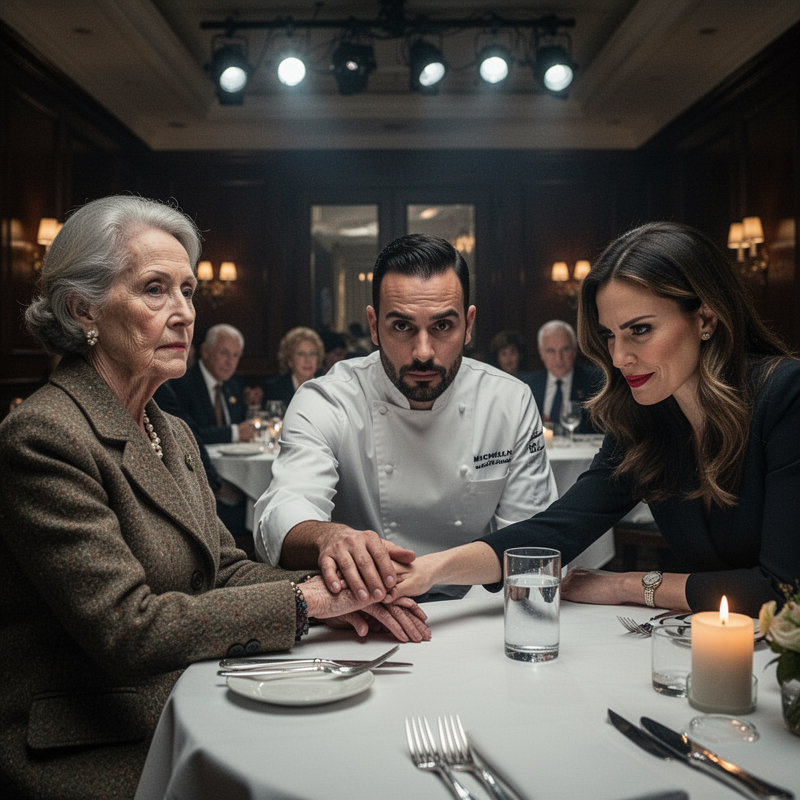
“Sit down and keep your mouth shut, Helen,” my daughter-in-law Marlene whispered with a smirk, placing a single glass of tap water in front of my empty plate while the eleven other guests at the table opened menus lined with gold leaf. I looked at my son, Michael, expecting him to defend me at this so-called ‘reconciliation dinner’ he had begged me to attend at Boston’s most exclusive restaurant. Instead, Michael leaned away, looking at the floor, and whispered, “Mom, please just know your place tonight—Marlene’s father is paying for everything, and I can’t afford you ruining my future.” Before I could even stand up to leave, Executive Chef Marcus Thorne walked straight out of the open kitchen, brushed past Marlene’s waving father, and bowed deeply in front of my chair. “Chef Vance,” Marcus announced loudly enough to freeze the entire dining room, “the kitchen staff is waiting—do you want us to serve this table, or shut the restaurant down right now?”
The words hung in the air, sharp and cold, cutting through the low hum of conversation that filled *L’Étoile D’Or*’s opulent dining room just moments before. Every head at the long mahogany table, set for twelve, swiveled in our direction. Crystal chandeliers glittered above, casting a warm, deceptive glow over the scene.
Marlene’s smirk widened, a venomous triumph in her eyes as she watched the color drain from my face. Her father, Arthur Sterling, sat at the head of the table, a self-satisfied smile playing on his lips, oblivious to the storm about to break. He was already regaling the table with a loud anecdote about his latest real estate deal, a testament to his own importance.
I still held onto the faint hope that Michael, my only son, would snap out of his trance. That he would stand up, finally, and tell Marlene to stop.
But he didn’t. He kept his gaze fixed on the polished floor, his shoulders hunched in a pathetic display of cowardice. The expensive suit he wore suddenly seemed to weigh him down, not elevate him.
My own chair felt like a block of ice beneath me. I had driven all the way from my quiet home in Vermont, believing Michael’s sincere pleas for reconciliation. He had promised Marlene had changed, that this dinner was a chance to mend fences.
Instead, it was a public execution.
Marlene’s hand had reached for the stack of menus moments earlier, thick leather-bound covers embossed with gold leaf. She had distributed them to each guest with a flourish, her diamond-studded fingers glinting under the lights.
One by one, the rich, elegant menus landed in front of every plate. Every plate, that is, except mine.
My plate remained starkly empty, a pristine white canvas of humiliation. Then came the single glass of tap water, placed with deliberate precision.
The unspoken message was clear: I wasn’t worthy of their gourmet food, their expensive wine, their gilded company. I was just Helen Vance, Michael’s unremarkable, retired mother, a relic from his less-than-glamorous past.
The waiter, a young man who looked barely out of culinary school, seemed uncomfortable. He glanced from Marlene’s imperious face to my blank one, then quickly retreated.
I could feel the heat rising in my cheeks. Not from shame, but from a quiet, simmering anger that threatened to boil over. How dare she? How dare they?
Michael’s whisper had been soft, almost inaudible, but it had resonated in my ears like a gong. *“Mom, please just know your place tonight—Marlene’s father is paying for everything, and I can’t afford you ruining my future.”*
His future. At what cost? His mother’s dignity? His own self-respect?
A wave of nausea washed over me. The vibrant chatter around the table, the clinking of silverware, the soft jazz playing in the background — it all faded into a dull roar. The delicious aroma of truffle and roasted meat, usually so comforting, now turned my stomach.
This was not reconciliation. This was a calculated power play. And I was the pawn.
My hand tightened around the simple silverware I still had. I felt a sudden, fierce urge to stand up, overturn the table, and walk out. But years of ingrained restraint, of quiet dignity, held me in place.
Just as my fingers began to push against the armrests of my chair, preparing to make my exit, a new presence cut through the opulent room.
A hush fell over the dining area, not a gradual one, but an immediate, palpable silence. Heads turned toward the open kitchen, a gleaming expanse of stainless steel and focused chefs.
A tall figure emerged, clad in a spotless white chef’s coat, his presence commanding attention without a single word. It was Executive Chef Marcus Thorne, a man whose reputation in Boston’s culinary scene was almost as legendary as the restaurant itself.
Arthur Sterling, who had just been mid-sentence, stopped abruptly. He waved a dismissive hand, attempting to reassert control.
“Marcus, what are you doing out here? The guests are waiting for the amuse-bouche.” His voice, though jovial, held an edge of impatience.
But Marcus didn’t even glance at Arthur. His eyes, sharp and intense, were fixed on me. He walked with a determined stride, weaving through the crowded tables as if on a predestined path.
He bypassed Arthur Sterling completely. He walked right past Marlene, whose smug expression was beginning to falter, replaced by a flicker of confusion.
Then, to the astonishment of every single person in the dining room, Chef Marcus Thorne stopped directly in front of my chair.
He bowed.
It wasn’t a casual nod or a polite dip of the head. It was a deep, respectful bow, the kind reserved for royalty or a revered master. His body was almost perpendicular to the floor, his head lowered in deference.
The silence in the room became absolute, a vacuum where sound had been.
Then, Marcus straightened, his gaze still locked onto mine, ignoring the gasps and whispers that rippled through the twelve high-society guests. His voice, clear and resonant, sliced through the stunned air.
“Chef Vance,” he announced, his words carrying to every corner of the dining room. “The kitchen staff is waiting—do you want us to serve this table, or shut the restaurant down right now?”
Part 2
The entire dining room, including the table of eleven stunned guests, seemed to hold its breath. Arthur Sterling, however, quickly recovered. A dismissive laugh boomed from him, hollow and forced.
“Marcus, that’s enough of your theatrics,” Arthur scoffed, waving a hand at the chef. “Go back to the kitchen, or I’ll have you fired on the spot. This is a private dinner, not a circus.”
Marcus didn’t move. He kept his steady gaze on me, then calmly reached into the inner pocket of his chef’s coat. He pulled out a sleek, leather-bound corporate operations binder, its spine clearly marked “Sterling Hospitality – L’Étoile D’Or.”
“Mr. Sterling,” Marcus said, his voice measured but firm, “with all due respect, I am merely following protocol. As Executive Chef, I am responsible for ensuring all operational agreements are upheld.” He opened the binder to a specific page, holding it up for everyone at the table to see.
My eyes widened as I recognized the letterhead: Vance Culinary Holdings. My own company.
“Sterling Hospitality,” Marcus continued, his voice cutting through the stunned silence, “is currently operating this establishment as a sub-tenant. You pay Vance Culinary Holdings a monthly lease of forty-two thousand dollars.”
A ripple of gasps went around the table. Marlene’s father, Arthur, visibly stiffened, his face beginning to flush a deep red. Michael finally looked up, a flicker of confusion and alarm replacing his earlier shame.
Marcus didn’t falter. He turned the binder to another page, pointing to a highlighted section. “Furthermore, the primary commercial lease for this property, held by Vance Culinary Holdings, requires a signed renewal by the sole property owner every five years.”
He paused, letting the words hang in the air. “That property owner, as you well know, is Chef Helen Vance herself.”
I felt a jolt of recognition. The paperwork Julian Mercer, my attorney, had sent me last month. I’d been too busy with my garden to look at it closely, but I remembered the urgent tone of his email regarding a “critical lease renewal.”
Marcus met my gaze again, then glanced at the table. “The deadline for that renewal, Mr. Sterling, expires in less than 48 hours.”
Marlene, who had been listening with an increasingly pale face, let out a small, strangled sound. Her eyes darted from Marcus to her father, then to me, a dawning horror in their depths. Arthur Sterling’s face was no longer red; it was an ashen gray. His hand, shaking slightly, reached for his phone and he began frantically dialing a number.
CHAPTER 2: The Owner of 240 Newbury Street
Marlene’s face twisted from smug satisfaction into pure rage. She slammed her hand onto the white tablecloth, rattling the empty glass of tap water in front of me.
“This is ridiculous!” Marlene snapped, her voice echoing off the vaulted ceilings. “You’re staging a pathetic scam with a rogue line cook! Arthur, call security right now!”
Arthur Sterling was already on his feet, his face red above his silk bow tie. He pulled out his phone and hit a speed dial button.
“Get up here immediately,” Arthur barked into the receiver. “We have a trespasser causing a scene at Table One.”
Michael leaned toward me, his voice trembling as he grabbed my forearm. His grip was tight, desperate, and entirely selfish.
“Mom, stop this,” Michael pleaded, looking around at the twelve silent guests. “You’re ruining everything. Do you have any idea how much money Arthur put into this place?”
“I know exactly how much this place is worth, Michael,” I said softly, removing his hand from my arm.
Two uniformed private security guards strode into the dining room, their heavy boots thudding against the polished hardwood floor. Marlene pointed a French-manicured finger directly at my face.
“Escort this woman out of the building,” Marlene ordered the lead guard. “She is disturbing our private investors and trespassing on commercial property.”
The lead guard stepped toward me, reaching for his belt. But before he could lay a finger on my chair, a tall man in a navy blazer stepped out from the main lobby doors.
It was Frank Reynolds, the head of building operations for Back Bay Real Estate Management. He carried a leather clipboard and looked around the tense room.
“What seems to be the problem here?” Frank asked, his voice calm and authoritative.
“Frank, thank goodness,” Arthur said, stepping forward with his hand outstretched. “This woman is refusing to leave my restaurant. Clear her out so we can resume our dinner.”
Frank ignored Arthur’s hand entirely. He looked straight at me, took off his reading glasses, and nodded respectfully.
“Good evening, Mrs. Vance,” Frank said loudly enough for the whole table to hear. “I didn’t know you were visiting the site tonight.”
Marlene let out a sharp, hysterical laugh.
“Frank, what are you doing?” Marlene demanded. “She’s Michael’s mother. She’s a retired nobody. I ordered security to remove her!”
Frank turned his head slowly toward Marlene, his expression turning ice-cold.
“Ma’am, I suggest you lower your tone,” Frank said. “Mrs. Helen Vance isn’t a trespasser. She is the sole owner of 240 Newbury Street.”
Silence fell over the dining room like a heavy anvil.
Arthur froze mid-stride, his arm dropping to his side. His lips moved, but no sound came out.
“What did you just say?” Arthur finally managed to whisper.
“Mrs. Vance owns the deed to this entire four-story commercial parcel,” Frank explained, pointing toward the floor. “Sterling Hospitality is merely a tenant on a sub-lease. And frankly, your structural alterations in the basement kitchen haven’t been cleared by her asset manager yet.”
“That’s impossible,” Marlene stammered, grabbing her father’s sleeve. “Arthur spent $1.5 million on the gold leafing and marble dining room alone!”
I wiped my lips with a cloth napkin, stood up slowly, and looked Arthur straight in the eye.
“A $1.5 million renovation on land you don’t own,” I said calmly. “And a lease you failed to renew.”
I turned to Frank, keeping my voice level and clear.
“Frank, please instruct security to lock down the kitchen inventory and document archives tonight,” I said. “No corporate property or intellectual assets leave 240 Newbury Street without my written consent.”
“Understood, Mrs. Vance,” Frank replied, stepping between the guards and our table.
Arthur stared at me, his eyes wide with horror as he realized his empire was built on foundation sand I controlled.
“This isn’t over, Helen,” Arthur hissed, his voice shaking with humiliation. “My legal team will destroy you by morning.”
“I look forward to it, Arthur,” I said, handing my untouched glass of tap water back to Marlene. “Enjoy your dinner.”
CHAPTER 3: The 72-Hour Audit
At precisely 8:00 AM the next morning, my phone rang on the kitchen counter of my townhouse. It was my senior legal counsel, Julian Mercer.
“Arthur Sterling just filed an emergency court injunction in Suffolk County,” Julian said, his voice clipped and precise. “He’s claiming corporate sabotage and requesting $500,000 in immediate damages.”
I poured myself a cup of black coffee and sat down at the table.
“On what grounds?” I asked.
“He claims your presence last night caused psychological distress to his investors and disrupted commercial operations,” Julian replied. “He thinks he can bully us into a forced lease renewal before the weekend.”
“What is our immediate counter-move, Julian?”
“We enforce Section 14B of the master commercial lease,” Julian said, the faint sound of turning paper rustling over the line. “Because Sterling Hospitality made unapproved structural changes to the kitchen load-bearing walls, we have the right to order an immediate 72-hour lease and safety compliance audit.”
“Do it,” I said without hesitation. “Trigger it right now.”
By 10:30 AM, two black sedans pulled up outside 240 Newbury Street. Julian Mercer stepped out of the lead car, followed by two city health inspectors and the chief building surveyor for the district.
Marlene was standing behind the host stand inside the main dining room, desperately trying to organize place cards for a high-profile corporate lunch. When she saw Julian walk in with the city officials, she marched to the front doors, her heels clicking angrily on the marble.
“You can’t be in here!” Marlene shouted, blocking the threshold with her arms crossed. “We have a $180,000 weekend slate of corporate banquets starting in two hours! Get out!”
Julian didn’t even pause. He handed her a laminated red administrative order stamped by the city magistrate.
“Section 14B compliance audit, Mrs. Sterling-Vance,” Julian said smoothly. “All gas lines, ventilation ducts, and commercial liquor distribution systems are subject to immediate physical inspection.”
“This is harassment!” Marlene yelled, her voice cracking. “Call Arthur! Call him right now!”
The chief city inspector stepped past her, pulling a bright yellow notice from his leather satchel.
“Until the ventilation modifications behind the main line stove are verified by a certified engineer, the commercial kitchen facilities and liquor license are temporarily suspended,” the inspector announced.
“Suspended?” Marlene gasped, her face draining of color. “We have 400 high-society guests arriving tonight! Do you know who my father is?”
“I know who owns the deed, ma’am,” the inspector replied plainly, slapping the bright yellow suspension tag directly onto the front glass doors of *L’Étoile D’Or*.
Arthur ran down the interior staircase, his tie undone and sweat glistening on his forehead.
“Mercer!” Arthur roared, pointing a trembling finger at my attorney. “You tell Helen Vance that if she destroys my weekend revenue, I will personally see to it that her son never works in this city again!”
Julian adjusted his wire-rimmed glasses and looked at Arthur with cold detachment.
“Mr. Sterling, your sub-lease expires tomorrow at midnight,” Julian said softly. “And right now, you are burning through money you don’t have.”
Arthur stood paralyzed in the doorway as the inspectors walked past him into the kitchen, shutting down the gas valves one by one.
CHAPTER 4: The Betrayal on Paper
By 2:00 PM, I was sitting in Julian Mercer’s glass-walled office overlooking Boston Harbor. Spread across the large mahogany conference table were thick stacks of financial disclosures and court filings.
“We have a problem, Helen,” Julian said, setting a grey folder down directly in front of me. “A serious personal breach.”
I looked at the cover of the folder. It bore the logo of Sterling Hospitality’s legal team.
“What is this?” I asked, opening the metal fastener.
Inside were clear, high-resolution photographs of my personal historical tax records, my private trust ledgers, and my confidential medical summary from three years ago.
“These were taken inside my private study at home,” I whispered, my fingers touching the printed pages. “These were inside my locked oak desk.”
“They were photographed three weeks ago,” Julian said, his voice dropping an octave. “Arthur Sterling used these private records to draft a petition for emergency adult guardianship over you.”
My heart pounded heavily against my ribs.
“They were trying to claim I was mentally incapacitated,” I said, the realization washing over me like ice water. “To seize control of Vance Culinary Holdings without a lease battle.”
“Yes,” Julian confirmed. “And there were only two people who had a key to your townhouse desk.”
I closed my eyes. The image of my son Michael came flooding into my mind—how he had offered to water my house plants while I was in Maine last month. How he had insisted on helping me organize my study paperwork.
“Michael,” I whispered, the word tasting like ash in my mouth.
“I pulled the metadata from the digital files attached to their court submission,” Julian said gently. “The photo files were created by an iPhone registered to Michael Vance.”
A tear slipped down my cheek, hot and stinging, but I wiped it away immediately. My own son had raided my private home to give his in-laws the weapons to declare me incompetent.
“He gave them my life’s work,” I said, my voice hardening. “He sold me out for a partnership at Arthur’s firm.”
“What do you want to do, Helen?” Julian asked, resting his hands on the table. “This constitutes felony unauthorized access and breach of trust.”
I stood up from the table, stepping over to the floor-to-ceiling window. Down on the street below, the Boston traffic moved in relentless, unfeeling lines.
“Michael took out a $450,000 commercial expansion loan for his residential architecture firm six months ago,” I said softly.
“I remember,” Julian replied. “You acted as the personal guarantor for the bank.”
“Call First Commercial Bank of Boston,” I said, turning back around to face my attorney with an unshakable resolve. “Notify them that due to potential legal proceedings involving the guarantor, I am withdrawing my personal liquidity guarantee immediately.”
Julian’s eyes widened slightly, then a slow, somber nod followed.
“That will trigger an immediate 24-hour full balance recall on his business loan,” Julian noted.
“Then let it recall,” I said. “If my son wants to play adult games with predators, he can pay adult debts on his own.”
CHAPTER 5: The Food Critic’s Unsparing Column
On Sunday morning, the rain poured over Back Bay, beating against my living room windows. I sat in my armchair with a hot cup of tea, opening the front page of the *Boston Globe* Sunday edition.
There, across the top of the Living and Dining section, was a headline that made my breath catch:
**”FAKERY AND FALLEN STARS ON NEWBURY STREET: THE SHAMEFUL DECEIT OF STERLING HOSPITALITY”**
Unbeknownst to Marlene or Arthur, Claire Higgins—the most feared and respected restaurant critic in the Northeast—had been seated at Table Four on Thursday night, just two yards away from our altercation.
I read her words line by line:
*”What was meant to be a grand unveiling of Sterling Hospitality’s culinary crown jewel turned instead into a masterclass in social cruelty and blatant fraud…”*
Claire Higgins did not spare a single detail. She described Marlene handing me a single glass of tap water while denying me a menu. She quoted Michael’s spineless refusal to defend his own mother.
But the real strike came in the second half of the article.
*”For months, Marlene Sterling-Vance has claimed credit for the restaurant’s flagship dish—a magnificent braised duck with spiced plum glaze—winning a $250,000 regional culinary grant on the back of this creation. However, long-time observers of Boston’s food scene know the truth. This exact recipe, down to the precise measurements of star anise and roasted shallots, was copyrighted in 1994 by legendary Master Chef Helen Vance…”*
Claire had included side-by-side photographic evidence comparing Marlene’s published press kit with my original copyrighted 1994 cookbook, *The Foundations of New England Cuisine*.
By noon, the article had gone viral across every major media platform in the city.
My phone rang continuously. Julian called first.
“Have you seen the paper?” Julian asked.
“I’m holding it right now,” I said.
“Arthur’s primary investment group, Beacon Hill Capital, just pulled their $1.2 million line of credit,” Julian reported. “They cited brand damage and intellectual property theft. The Sterling brand is radioactive.”
A few minutes later, my front doorbell began ringing frantically.
I walked to the hallway, pulled open the heavy wooden door, and found Michael standing on the porch in the pouring rain. His hair was plastered to his forehead, his suit jacket was soaked, and his eyes were bloodshot.
“Mom!” Michael cried, stepping forward. “Mom, please! You have to help me!”
I stood in the doorway, blocking the entrance.
“What do you want, Michael?” I asked flatly.
“The bank just froze all my business accounts!” Michael stammered, his voice trembling violently. “They called in the $450,000 loan! My architecture partner cleared out his desk an hour ago! And Marlene… Marlene locked me out of our apartment!”
“Actions have consequences, Michael,” I said, keeping my voice steady.
“I didn’t mean to hurt you, Mom!” Michael wept, putting his hands together in a desperate plea. “Marlene told me it was just a formality! She said if we got control of the trust, we could take care of you forever!”
“You photographed my private desk records for people who treated me like garbage,” I said, looking at him with deep sadness. “You stood by while your wife served me tap water and demanded I keep my mouth shut.”
“Mom, please!” Michael begged, taking a step closer.
“Do not come back here, Michael,” I said softly, and closed the door firmly in his face.
CHAPTER 6: The Fall of Sterling Hospitality
By Monday afternoon, a crowd of reporters, camera crews, and curious onlookers had gathered on the sidewalk outside 240 Newbury Street.
Arthur Sterling and Marlene had organized a last-ditch emergency press conference in the venue lobby. They stood behind a hastily erected podium, surrounded by lingering velvet ropes. Arthur looked exhausted, his cheeks sunken, while Marlene wore heavy sunglasses to hide her swollen eyes.
“We are here today to set the record straight,” Arthur announced into the cluster of microphones, trying desperately to project confidence. “Sterling Hospitality is voluntarily surrendering our tenancy at this location due to ongoing, unaddressed building structural defects that render the property unsafe for our high-standard clientele.”
“That is a lie!” a voice shouted from the back of the lobby.
The crowd turned. Julian Mercer walked through the entrance doors, accompanied by two armed Suffolk County Marshals carrying official legal summonses.
“Mr. Sterling,” Julian said, his voice echoing off the marble walls, “I am serving you with notice of immediate master lease termination due to non-payment of audit fees, fraud, and material breach of contract.”
Marlene stepped forward, whipping off her sunglasses.
“You can’t terminate our lease!” Marlene screamed. “We are surrendering it!”
“You cannot surrender what has already been revoked, Mrs. Vance,” Julian replied calmly. “Furthermore, the United States Bankruptcy Court has just placed Sterling Hospitality into involuntary Chapter 7 receivership on behalf of your creditors, who are seeking recovery of $3.2 million in unbacked personal loans.”
The reporters erupted into frantic questions, camera flashes lighting up the lobby like lightning.
Michael squeezed through the crowd of journalists, his tie crooked, desperately reaching for Marlene’s arm.
“Marlene, please,” Michael whispered loudly enough for the microphones to catch. “We need to talk to my mother together. If we explain—”
Marlene spun around and slapped Michael’s hand away with brutal force.
“Get away from me, you pathetic weakling!” Marlene spat, her voice dripping with pure venom. “You lied to me! You told me your mother was a penniless old woman who would sign whatever we put in front of her!”
“Marlene, I loved you!” Michael cried out, his voice cracking in front of all the cameras.
Marlene reached down, yanked her diamond wedding ring off her finger, and threw it hard against Michael’s chest. The ring bounced off his jacket and clattered onto the dirty floor.
“You are broke, Michael!” Marlene yelled, her face contorted in disgust. “You have no money, no firm, and no trust fund! I am filing for divorce today!”
Arthur grabbed Marlene by the shoulder and pulled her away toward the back exit as reporters swarmed them, shouting questions about bank fraud and stolen recipes.
Michael dropped to his knees on the cold floor, searching blindly through the crowd’s feet for the ring, completely ruined in front of the entire city.
CHAPTER 7: Rebuilding from the Fire
Two weeks later, the morning sun shone brightly through the clean glass windows of 240 Newbury Street.
The heavy velvet curtains were gone. The tacky gold leafing had been scraped away, replaced by clean brass accents, warm wood, and the mouth-watering scent of fresh herbs and roasting garlic.
A new gold-lettered sign hung above the main entrance: **THE VANCE CULINARY ACADEMY & BISTRO.**
I had donated the master lease and operational rights to a non-profit foundation dedicated to training young, underprivileged culinary talents. Chef Marcus Thorne stood at the pass, wearing a clean white chef’s coat, calling out tickets with fierce pride as young apprentices bustled around him.
“Order up! Braised duck, table six!” Marcus shouted, smiling as he plated a dish with perfection.
I walked through the swing doors into the bustling kitchen, checking the prep station.
Suddenly, a quiet knock sounded at the kitchen back delivery door.
I walked over and pushed the heavy metal door open.
Michael stood in the alleyway. He was wearing an old, faded jacket and frayed jeans. The arrogance that had once defined his posture was completely gone. He looked smaller, tired, and deeply humbled.
“Hello, Mom,” Michael said softly, looking at the brick pavement.
“Hello, Michael,” I replied.
“I read about the academy in the paper,” he said, taking a shaky breath. “It’s… it’s wonderful what you and Marcus are doing.”
“It’s what this place was always meant to be,” I said.
Michael looked up at me, tears welling in his eyes.
“Mom, I lost everything,” he choked out. “The architecture firm went under. The bank seized my car. I’m living in a small studio across the river, and I can barely pay next month’s rent. I was hoping… I was hoping you could lend me enough to settle my firm’s remaining debts.”
I looked at my only child. Part of me—the mother who had held him as a baby—felt a sharp pang of sorrow. But I knew that giving him money now would only enable the hollow vanity that had destroyed him in the first place.
“No, Michael,” I said clearly. “I will not give you a single dollar.”
Michael’s shoulders collapsed, his face falling into despair.
“Mom, please…” he whispered.
“Unearned money corrupted your heart, Michael,” I said, stepping back into the doorway. “You traded your dignity and your own mother for a seat at a table that wasn’t even yours.”
I reached over to a nearby metal shelf, picked up a folded, clean white apron, and held it out toward him.
“What is this?” Michael asked, staring at the cloth.
“Marcus needs a dishwasher and prep hand for the morning shift,” I said plainly. “It pays minimum wage. You will sweep the floors, wash the pans, and learn how to chop vegetables properly. You will start at the very bottom.”
Michael stared at the apron, then looked up into my eyes.
“You want me… to work in the kitchen?” he asked, astonished.
“You can take this apron, put it on, and earn your way back to real integrity through honest work,” I said, keeping my voice firm. “Or you can walk down that alley and never come back. The choice is yours.”
Michael stood motionless in the cool morning air for a long moment. He looked at the grease stains on the alley walls, then looked down at his own hands.
Slowly, hesitatingly, he reached out and took the white apron from my hands.
“What time does the shift start?” Michael asked, his voice barely audible.
“Six o’clock sharp,” I replied. “Don’t be late.”
I turned back into the warmth and energy of the kitchen, watching Chef Marcus instruct a young apprentice on the proper way to hold a chef’s knife.
Respect is never bought at a high-society table—it is earned in the heat of the kitchen, and no title on earth can hide a hollow soul once the fire is turned up.
Leave a Reply