CHAPTER 1: A Drop of Water on Belgian Linen
Part 1
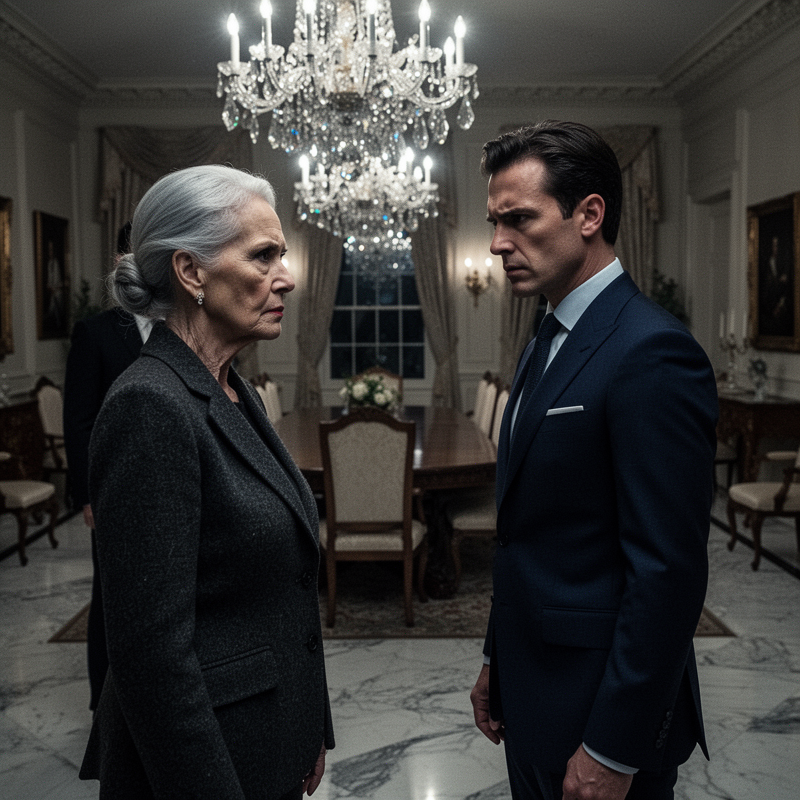
“Keep your hands where I can see them, Julian,” I said, my voice dropping an octave as my daughter, Clara, gasped from the hardwood floor, clutching her bleeding lip. My thirty-two-year-old son-in-law stood over her, his knuckles white, furious because a single droplet of sparkling water had fallen onto Beatrice Garrick’s $4,500 imported linen tablecloth. Beside him, Beatrice slow-clapped, her diamond rings catching the chandelier light as she sneered, “About time someone taught this little charity case how to behave at a family dinner.” Neither of them realized that while Clara was a soft-spoken MIT-trained chemical engineer who had been systematically isolated for three years, I was Eleanor Vance—a Cook County trial lawyer who had spent thirty-four years dismantling two hundred and fourteen abusive men in court. And in their arrogant triumph, they had just handed me the precise evidence I needed to destroy their entire empire.
The formal dining room, usually a tableau of hushed elegance, now vibrated with a raw, ugly tension. Crystal glasses shimmered under the opulent chandelier, reflecting the horrified faces of the few remaining dinner guests. Most had already made their excuses and fled, leaving a silent judgment in their wake.
Julian Garrick loomed over Clara, his chest heaving, his face a mask of purple rage. His knuckles were still bone-white from the impact of the slap, the echo of which seemed to hang in the air, mocking the refined classical music that was still playing softly from hidden speakers.
On the polished parquet floor, Clara whimpered, her hand pressed against her lip. A tiny rivulet of crimson traced a path down her chin, staining the pristine white silk of her dress.
Her eyes, wide and terrified, flickered up to mine.
Beatrice Garrick, perfectly coiffed and utterly unbothered, took another sip of her Pinot Noir. Her gaze, cold as glacial ice, lingered on the small, almost invisible wet patch on her $4,500 imported Belgian linen tablecloth.
“Honestly, Julian,” she said, her voice smooth and devoid of any maternal concern, “that tablecloth was just delivered last week. Do you know what kind of an impression this makes?”
Julian barely registered her words. His focus was entirely on Clara, who was now trying to push herself up, wobbling slightly on her hands and knees.
He took a step towards her, a dark storm brewing in his eyes.
“Get up,” he snarled, his voice low and menacing. “You embarrass me.”
Clara flinched, instinctively recoiling. Her eyes darted around the room, pleading for an intervention that no one was brave enough to offer.
My own hands were steady. My gaze, however, was not on Clara or Julian, but on the discreetly recessed lighting fixture above the grand dining table. It was one of several such fixtures I had “gifted” them three years prior, a housewarming present I’d insisted on installing through my own trusted security consultant, Marcus Thorne.
It had seemed innocuous then, a thoughtful gesture to illuminate their new home. But beneath the polished chrome and bespoke artisan glass, each fixture hummed with discreetly integrated sensors, microphones, and high-definition cameras.
My right hand, without conscious thought, slipped into the pocket of my evening gown. My fingers found the cool, smooth glass of my smartphone.
The screen lit up, displaying a secure application. A few taps, a swipe, and a green confirmation message flashed across the display: “Telemetry locked. Cloud upload initiated. Secure overwrite protocol engaged.”
A faint, almost imperceptible click resonated from the dining room ceiling. The subtle sound of a high-tech system securing its payload, lost in the chaotic aftermath of the physical assault.
Julian, his face still contorted with fury, finally turned his attention to me. His eyes narrowed, seeing not a senior Cook County trial lawyer, but a mother whose daughter he had just publicly humiliated.
“And you,” he spat, pointing a trembling finger. “You just sat there. You allowed this. Get out. Get out of my house, Eleanor.”
His voice rose with each word, echoing off the high ceilings.
“You are no longer welcome here. Take your… your charity case and leave.”
Beatrice nodded slowly, a small, triumphant smile playing on her lips. “I think that’s a wise decision, Julian. Some people just don’t understand the standards of this family.”
I met Julian’s gaze, my own eyes betraying none of the cold, calculated anger simmering beneath my calm exterior. I stood slowly, deliberately. The soft rustle of my dress was the only sound.
Clara watched me, her bleeding lip trembling. She braced herself for my retreat, for the inevitable humiliation of being escorted out.
But I simply looked at Julian.
“Your house, Julian?” I asked, my voice flat, devoid of emotion. “That’s an interesting choice of words.”
His jaw tightened. “What are you talking about? This is my home. You just witnessed your daughter deface private property and then, what, you think I’ll tolerate that?”
I took a single, measured step towards him, my phone still clutched firmly in my hand, its screen now dark.
“You just committed felony domestic battery,” I stated, each word a hammer blow in the sudden silence of the room.
His eyes widened in disbelief. Beatrice’s triumphant smile faltered.
“Don’t be ridiculous,” Julian scoffed, though a flicker of uncertainty crossed his face. “There were no witnesses. And besides, she deserved it.”
I allowed a slow, knowing smile to spread across my face.
“Oh, but there were witnesses, Julian,” I corrected him, my voice barely above a whisper, yet resonating with absolute authority. “Many of them.”
I paused, letting the implication sink in.
“That architectural lighting fixture, the one directly above your head,” I continued, gesturing vaguely upwards with my chin. “It’s integrated with uncompressed 4K video, 3D spatial motion data, and synchronized decibel telemetry.”
Julian stared blankly, trying to process the technical jargon. Beatrice merely frowned, her expression shifting from smugness to confusion.
“Every single word you just spoke,” I added, “every breath you took, every scream, every single sound, including the precise decibel level of your hand striking my daughter’s face… it’s all been recorded.”
His face paled, the rage replaced by a dawning horror.
“And the police,” I finished, my gaze unwavering as I looked him directly in the eye, “are already two minutes away.”
Part 2
Barely had the words left my mouth when the distinct wail of sirens cut through the Gold Coast night, growing louder with alarming speed. Within seconds, flashing blue and red lights painted fleeting patterns across the windows of the penthouse. The doorbell chimed, a polite counterpoint to the raw tension.
Two Chicago police officers entered, led by Detective Ray Kowalski, a man whose face I hadn’t seen in over a decade but whose integrity I respected implicitly. His gaze swept the room, pausing briefly on Clara, still huddled on the floor, before settling on Julian.
Julian, ever the polished corporate executive, instantly transformed. He smoothed his hair, pulled his jacket straight, and approached Detective Kowalski with an air of wounded indignation. “Detective, thank god you’re here. My wife, Clara, she had an emotional breakdown. Completely unprovoked. She… she attacked me with a steak knife.” He gestured vaguely towards Clara.
Beatrice, recovering her composure, stepped forward, her voice laced with feigned concern. “It was quite distressing, officer. She just snapped. The knife is still right there.” She pointed a perfectly manicured finger at a silver steak knife, glinting innocently on the parquet floor beside Clara’s hand. Clara, still stunned, barely registered the accusation.
Detective Kowalski, a man who had seen countless variations of this story, didn’t outwardly react. He met my eyes, and I gave a subtle nod. Marcus Thorne, my security consultant, who had arrived with the officers, was already handing Kowalski a rugged tablet.
“Detective,” I said, my voice clear and steady, “I believe the raw telemetry feed from this system will clarify the situation.”
Kowalski took the tablet, his eyes scanning the data stream. On the screen, the playback from the architectural fixture above us began to cycle. Frame by agonizing frame, it showed Julian, quick as a viper, bending down while Clara was still reeling from the slap. His hand went to his own dinner plate, lifted the steak knife, and with chilling precision, placed it next to Clara’s semi-conscious hand on the floor.
Julian’s face went from indignant to ashen. Beatrice gasped, a small, choked sound.
Kowalski looked up, his expression grim. “Mr. Garrick, you’re under arrest for domestic battery and evidence tampering.”
Julian spluttered, “This is preposterous! My mother, she’ll have your badge! You can’t do this!” But it was too late. The officers moved swiftly, cuffing Julian’s wrists behind his back. As they led him away, his angry protests echoing down the hallway, Beatrice sidled up to me. Her eyes, usually so calculating, burned with a cold, desperate fury.
“You may have won this round, Eleanor,” she hissed, her voice a venomous whisper in my ear, “but by morning, Clara Vance’s engineering career will be utterly destroyed.”
CHAPTER 2: The Fourteen-Hour Frame-Up
At precisely 8:00 AM the following morning, heavy iron-soled boots echoed down the tiled corridor outside Clara’s private apartment in Lincoln Park.
Three Cook County sheriff’s deputies and two armed federal marshals stood in the hallway, holding a freshly signed arrest warrant stamped with blue ink.
Clara stood in the doorway, her lower lip swollen and purple from the night before, wearing an oversized sweater that swallowed her small frame.
“Clara Vance-Garrick?” the lead deputy asked, his hand resting on his sidearm holster. “You’re under arrest for grand larceny, corporate espionage, and theft of trade secrets.”
Clara stepped back, her breath catching in her throat. “What are you talking about? I haven’t been to the lab since Friday.”
“You uploaded six point two million dollars worth of proprietary polymer formulas to an unencrypted personal cloud drive,” the deputy replied, stepping across the threshold and pulling her wrist behind her back.
I stepped out from the kitchen, holding a steaming mug of black coffee in one hand and my phone in the other.
“Take your hands off my client immediately,” I said, my voice cutting through the room like a cold razor.
The deputy paused, eyeing my crisp dark gray suit and the golden bar association pin on my lapel. “Ma’am, this is a court-ordered felony warrant.”
“And I am her lead legal counsel,” I replied, placing my phone onto the counter where Marcus Thorne was already streaming the live arrest record directly to my law firm’s server. “Execute your physical custody if you must, but if you tighten those cuffs beyond the second notch, I will file an immediate Section 1983 civil rights violation against your department before noon.”
The deputy gritted his teeth, but slacked the steel links around Clara’s wrists.
Two hours later, I walked into the Chancery Division of the Cook County Circuit Court.
Leland Sterling, Garrick Chemical’s sixty-year-old lead corporate counsel, sat at the petitioner’s table in a tailored three-piece pinstripe suit, looking quietly triumphant. Beside him sat Beatrice Garrick, holding a designer leather handbag across her knees.
“Your Honor,” Sterling announced, standing before the bench with a leather-bound folder. “Garrick Chemical Holdings seeks an emergency ex parte injunction to freeze all personal assets and personal devices belonging to Dr. Clara Vance-Garrick. She has systematically exfiltrated proprietary formulas that represent the core intellectual property of our client.”
The judge looked over his spectacles at me. “Mrs. Vance, does your client have a response to these preliminary criminal allegations?”
I did not sit down. I approached the podium, unzipping my leather briefcase with a single smooth drag of the brass teeth.
“Garrick Chemical does not own that chemical formula, Your Honor,” I said, laying a thick sheaf of verified documents onto the clerk’s desk.
Sterling chuckled softly, taking a sip from his glass of water. “The polymer variant was patented under Garrick Chemical’s corporate banner six months ago, Counsel. It is their sole property.”
“It was filed six months ago by Garrick Chemical,” I agreed, turning to face Sterling directly. “However, my client developed the entire molecular matrix two years before she ever set foot in Garrick Chemical’s research facility.”
I tapped the top sheet of the document bundle.
“This is a certified copy of a US Patent and Trademark Office provisional application, executed twenty-six months ago and held inside the Clara Vance Irrevocable Pre-Marital Trust,” I declared. “Julian Garrick didn’t invent that formula. He stole his wife’s pre-marital research, changed three active catalyst compounds, and passed it off to his board of directors.”
The judge’s gaze shifted instantly from mild indifference to intense scrutiny. He pulled the trust filings toward himself.
Sterling’s smile faltered, his hand freezing on his water glass. “Your Honor, this is an unverified surprise filing—”
“It is a public federal land and patent record, Mr. Sterling,” I snapped. “Which means Garrick Chemical’s emergency injunction is legally void.”
The judge banged his wooden gavel once. “The emergency injunction is denied. Dr. Vance-Garrick is released on her own recognizance immediately.”
Beatrice Garrick rose from her chair at the rear table, her eyes flashing with ice as she stared across the courtroom at me.
She pulled out her phone, tapped the screen twice, and leaned toward Sterling’s ear.
“If we can’t jail her for the formula,” Beatrice hissed audibly, “scrub her name off every paper, every grant, and every lab report Garrick Chemical has ever published. Erase her entirely.”
CHAPTER 3: The Patent Trap Sprung
By 2:00 PM, I had convened an emergency deposition in the top-floor conference room of my law firm in downtown Chicago.
Six members of the Garrick Chemical board of directors sat across the mahogany table, looking pale and restless beneath the recessed halogen lights.
Julian Garrick sat in the middle, wearing a stiff blue dress shirt with his collar unbuttoned. A fresh red scratch line ran along his jaw where his own cufflink had cut him during his arrest the night before.
“This deposition is a waste of corporate billable hours,” Julian sneered, folding his arms. “Clara was a junior staff scientist on salary. Anything she touched belongs to the company.”
“Let’s test that theory in front of the United States District Court,” I said, sliding a thick blue binder across the glass surface toward the board members.
The lead board member opened the cover, scanned the first page, and turned dead gray.
“What is this?” the board member asked, his voice shaking.
“That is a formal notice of federal patent infringement,” I replied calm as stone. “Garrick Chemical accepted fourteen million dollars in state infrastructure contract deposits last month based on that exact polymer formula. Since my client owns the underlying provisional patent through her pre-marital trust, every single gallon of product you have mixed, shipped, or billed constitutes active criminal infringement.”
Julian slammed his palm on the table, the glass water pitcher trembling. “She signed an intellectual property assignment agreement when we got married!”
“She signed an agreement under severe physical and emotional duress, which is legally void,” I answered. “And as of twelve minutes ago, federal court motions were filed to freeze Garrick Chemical’s primary asset line.”
“You crazy old bat,” Julian shouted, leaning halfway across the table. “I will make sure Clara dies broke in the streets!”
“Watch your mouth, Mr. Garrick,” my co-counsel warned from the corner of the room.
Julian glared at Clara, who was sitting beside me. She flinched slightly, but her chin remained held high.
Three hours after the deposition dissolved in shouting, Clara walked out to her car parked in the secured research garage near the Illinois Institute of Technology.
A shadowed figure stepped out from behind a concrete pillar.
Julian blocked the driver’s side door, his shadow stretching across the damp pavement under the buzzing fluorescent tubes.
“You think your mother can protect you?” Julian whispered, stepping so close his hot breath hit Clara’s cheek. “Sign the patent release forms by tomorrow morning, or I’ll make sure you never work in a lab anywhere on this continent.”
Clara didn’t scream. She stepped back and pointed directly at the high-definition dome security camera mounted on the ceiling beam right above his head.
“You’re out on fifty thousand dollars bail, Julian,” Clara said, her voice steady for the first time in three years. “And you just violated your emergency order of protection.”
Julian looked up at the blinking green LED light on the camera housing, his mouth dropping open in sudden realization.
Within four hours, Cook County prosecutors filed an emergency motion to revoke Julian’s bail.
Desperate to neutralize the mounting pressure, Beatrice Garrick arrived at the offices of the Illinois Attorney Registration and Disciplinary Commission late that evening.
She dropped a black leather USB drive onto the chief investigator’s desk.
“Eleanor Vance attempted to extortionately shake down my family for five million dollars during a private settlement call,” Beatrice said, her voice dripping with artificial grief. “I have the recorded audio right here. Strip that woman of her law license before sunrise.”
CHAPTER 4: The Ethics Board Ambush
At 7:30 AM on Thursday morning, a formal courier delivered a wax-sealed envelope to my desk.
It was an emergency summons from the Illinois Attorney Registration and Disciplinary Commission.
I was ordered to appear before a panel of three administrative judges in forty-eight hours to face charges of grave professional misconduct, corporate bribery, and subornation of perjury stemming from a manufactured complaint regarding an old 2012 trial.
“They’re trying to strip your license before the divorce trial even starts,” Marcus Thorne said, setting down a cup of black coffee on my desk as he looked over the filing. “Without you as lead counsel, Clara’s patent defense collapses under corporate attrition.”
“Leland Sterling played his hand too early,” I said, scanning the fake transcripts attached to the summons. “They think an ethics charge will make me scramble behind closed doors to save my reputation.”
“What are you going to do?” Marcus asked.
“I’m not going to seek a private administrative delay,” I said, reaching for my fountain pen. “I am demanding a fully open, public evidentiary proceeding with a live court reporter and public gallery access.”
“They’ll drag your thirty-four-year record through the mud in front of every legal reporter in Cook County,” Marcus warned.
“Let them try,” I said softly. “A quiet room is where dirty deals survive. Sunlight is where they disintegrate.”
That evening at 9:00 PM, a knock rattled the side door of my private firm.
Clara opened the door to find Nadia Petrov standing under the dripping street lamp, wearing a heavy winter coat with her hood pulled low over her forehead.
Nadia was the senior corporate archivist at Garrick Chemical, and Clara’s former lab assistant.
“Nadia?” Clara gasped, stepping aside. “What are you doing here? If Julian finds out you spoke to us—”
“Julian is busy trying to post fresh bail,” Nadia interrupted, her breath misting in the cold damp air. “He doesn’t know I’m here.”
She reached into her coat pocket and pulled out an encrypted metal thumb drive wrapped in anti-static plastic.
“What is this?” I asked, walking into the foyer.
“The real reason Julian was so desperate to force Clara to sign off on those chemical variance logs last winter,” Nadia said, her voice trembling with anxiety. “It isn’t just about stealing her patents, Eleanor. It’s about what they put into the public ground.”
She pressed the drive into my palm.
“Julian didn’t just steal formulas,” Nadia whispered, looking over her shoulder at the empty street. “He forced Clara’s electronic signature onto safety compliance reports for defective industrial sealants. Millions of dollars worth.”
“Where were those sealants installed?” I asked, my blood running cold.
“Public infrastructure,” Nadia answered. “Major state bridge foundations across northern Illinois.”
CHAPTER 5: The Forged Stamp Ledger
By 3:00 AM, Marcus Thorne had cracked the encryption layers on Nadia Petrov’s drive using our firm’s forensic server array.
Spreadsheets, internal emails, and high-resolution PDF scans flooded my dual monitors.
“Look at these digital signature stamps,” Marcus said, pointing at a magnified vector file on the right monitor. “The engineering stamp belongs to Dr. Clara Vance.”
“Clara never signed those,” I said, leaning closer to examine the pixel structure.
“She didn’t,” Marcus confirmed. “The cryptographic hash key on these filings matches Julian’s workstation IP address. He forged her seal on eighty-two individual quality-control reports over an eighteen-month period.”
“Why did he alter the chemical ratios?” Clara asked, staring at the raw lab analysis sheets with mounting horror.
“Cost savings,” Marcus replied, pulling up a secondary financial ledger. “Julian replaced the high-grade polymer bonding agents with cheap, industrial-grade petroleum byproducts. It saved Garrick Chemical two point eight million dollars in production costs.”
“And where were these batch lots shipped?” I asked.
“Three major Illinois Department of Transportation bridge foundation projects,” Marcus said, scrolling down the distribution list. “The concrete sealants are compromised. Under heavy freeze-thaw cycles, they’ll degrade within five years instead of fifty.”
I pulled a yellow legal pad toward me and began taking precise notes.
“This isn’t just a divorce case anymore,” I said quietly. “This is a mass federal fraud and public endangerment conspiracy.”
“The ethics hearing is in thirty-six hours,” Clara reminded me, her voice trembling slightly. “Sterling is going to use those fake extortion tapes to get your license suspended before you can bring this to a judge.”
“Then we will give Mr. Sterling the exact audience he thinks he wants,” I said, picking up my phone and dialing a direct private line.
“Who are you calling at three in the morning?” Clara asked.
“Detective Kowalski,” I answered as the phone began to ring. “And two senior regional investigators from the United States Department of Transportation Inspector General’s office.”
On Friday morning, the ARDC hearing room on West Adams Street was filled to capacity.
Leland Sterling sat at the prosecutor’s table, looking entirely confident as he tapped a stack of transcribed audio logs against the wood.
Beatrice Garrick sat in the front row of the gallery, wearing a tailored black coat, flanked by two corporate public relations advisors.
Three rows behind them, sitting in plain clothes with leather notebooks rested on their knees, were two special agents from the federal government.
Sterling stood up, clearing his throat loudly. “Members of the panel, we are prepared to present unassailable audio evidence that attorney Eleanor Vance engaged in felony extortion against Garrick Chemical Holdings.”
“Let the audio tape be played into the record,” the presiding administrative judge ordered.
Sterling smiled, gesturing to his technician, who pressed play on a digital recorder connected to the courtroom speaker system.
A tinny, distorted voice filled the room: *”If you don’t pay five million dollars to my client by Friday, I will destroy your company’s public standing…”*
Sterling folded his arms. “The evidence speaks for itself.”
I stood up slowly from my bench, holding a single black folder in my left hand.
“Does it, Mr. Sterling?” I asked softly.
CHAPTER 6: The Trojan Horse Hearing
“Your Honor,” I said, turning to face the three administrative judges on the panel. “I request permission to play the original acoustic metadata file captured simultaneously by our own secured digital recording system.”
Sterling jumped up. “Objection! Counsel is attempting to derail these proceedings with unverified technical jargon!”
“Overruled, Mr. Sterling,” the presiding judge barked. “Let us hear the original file.”
Marcus Thorne connected his laptop to the courtroom’s audiovisual array.
A clear, uncompressed stereo sound file echoed through the room.
The voice on the tape was clear, sharp, and unmistakably mine: *”If your company continues to unlawfully misappropriate Dr. Vance’s patented chemical research, we will file an immediate civil RICO lawsuit in federal court to recover damages.”*
The room went dead silent.
“The audio file submitted by Mr. Sterling,” I stated, walking toward the center aisle, “was spliced together using seven separate audio clips taken from public bar association lectures I delivered in 2018. My digital forensics team has identified twenty-four discrete editing cuts in their submitted file.”
The presiding judge turned an icy glare toward Sterling. “Is this true, Counsel?”
Sterling’s face turned bright red. “Your Honor… our client provided that audio… we were assured—”
“The complaint against attorney Eleanor Vance is dismissed with prejudice,” the presiding judge declared, slamming his gavel down so hard the wooden block cracked. “And this panel will be referring Mr. Sterling’s firm to the state prosecutor for submitting fabricated evidence.”
A ripple of murmurs ran through the packed gallery.
Beatrice Garrick stood up abruptly, preparing to exit through the rear doors.
“One moment, Mrs. Garrick,” I called out, my voice ringing across the high ceiling. “Since you are present under subpoena as a complaining witness, I am invoking my right to cross-examine you on the record regarding corporate governance.”
“This hearing is concluded!” Sterling shouted, his hands shaking as he gathered his papers.
“The record remains open for witness cross-examination,” the judge ruled firmly. “Take the witness stand, Mrs. Garrick.”
Beatrice walked reluctantly to the wooden witness box, her jaw clenched tight.
“Mrs. Garrick,” I began, pulling a sheaf of stamped engineering documents from my folder. “Are you familiar with these eighty-two quality-control reports submitted to the Illinois Department of Transportation?”
Beatrice sneered. “I am the Executive Director of Holdings. I don’t review routine field inspection forms.”
“These forms carry my daughter’s forged engineering stamp,” I said, walking right up to the witness box barrier. “They falsely certified compromised chemical sealants used on three public bridge projects, saving your firm two point eight million dollars.”
Beatrice’s eyes widened in sudden terror as she realized what was happening. “This has nothing to do with this hearing!”
“It has everything to do with federal infrastructure fraud, criminal conspiracy, and reckless public endangerment,” I said, turning toward the back row. “Which is why Special Agent Miller of the Department of Transportation is sitting right behind you.”
The two federal agents stood up in unison, pulling official brass badges from their suit jackets.
“Beatrice Garrick,” Agent Miller announced, walking down the center aisle. “You and the executive officers of Garrick Chemical Holdings are hereby served with federal grand jury subpoenas for mail fraud, wire fraud, and infrastructure corruption.”
Reporters in the gallery scrambled for the exit doors, speed-dialing their news desks.
Within forty-five minutes, financial news networks broadcast the story nationwide.
By 3:30 PM, Garrick Chemical’s public stock price plummeted by sixty-two percent in late-afternoon trading.
Inside Beatrice’s Gold Coast penthouse, total panic erupted.
“Get the private jet prepped,” Beatrice yelled into her cell phone, her hands trembling violently as she shoved stacks of financial documents into a leather briefcase. “I don’t care what the flight plan costs! Get us cleared for Zurich by midnight!”
CHAPTER 7: The O’Hare Tarmac Intercept
At 6:15 PM, Marcus Thorne’s monitors alerted him to a series of high-speed electronic funds transfers.
“Eleanor,” Marcus called out, tapping his keyboard rapidly. “Garrick Chemical’s reserve accounts just initiated four separate offshore wire transfers. They’re trying to drain four point two million dollars into private account structures in Switzerland.”
“Not on my watch,” I said, picking up my coat.
I ran down the steps of the courthouse, stepping into the back seat of Marcus’s SUV.
Within ninety minutes, I appeared before a duty judge in the Chancery Division to present an emergency ex parte motion for a temporary restraining order freezing all electronic bank accounts associated with the Garrick estate across four jurisdictions.
The judge reviewed the federal subpoenas and signed the freezing order at 8:10 PM.
Deprived of electronic wire transfers, Julian Garrick drove his Mercedes directly to a private vault facility on La Salle Street.
He used his master key to open a secure deposit box, pulling out eight hundred and fifty thousand dollars in crisp, un-traced paper bearer bonds.
He shoved the paper bonds into a dark carry-on bag, slammed the box shut, and sped toward Chicago O’Hare International Airport.
At 9:45 PM, Marcus tracked Julian’s cell phone signal moving at seventy miles per hour down the Kennedy Expressway toward Terminal 5.
“He’s heading for the private charter terminal on the south tarmac,” Marcus said, keeping his eyes on the GPS tracking screen. “A Gulfstream G450 just filed a last-minute flight plan for Zurich.”
“Contact Detective Kowalski and the state police,” I ordered. “Tell them a flight suspect is attempting international flight to avoid federal prosecution.”
Julian sprinted through the private aviation lounge at O’Hare, his leather bag slung tightly over his shoulder.
The glass automatic doors slid open, revealing the twin-engine private jet idling on the wet asphalt twenty yards away.
“Mr. Garrick!” a voice barked across the tarmac.
Julian spun around, his coat soaked instantly by the light rain falling from the night sky.
Four Illinois State Police cruisers swept across the tarmac, their red and blue strobe lights flashing against the wet pavement, cutting off his path to the boarding stairs.
Detective Ray Kowalski stepped out of the lead cruiser, holding his badge flat against his chest.
“Put the bag down, Julian,” Kowalski said firmly.
“You can’t arrest me!” Julian yelled, backing away toward the airplane wing. “I haven’t been convicted of anything! I’m taking a personal vacation!”
Two federal marshals stepped out from behind the fuel truck, pulling their handguns from their holsters.
“Julian Garrick,” the lead marshal called out. “You are under arrest for international flight to avoid federal prosecution, corporate money laundering, and evidence tampering.”
Julian looked frantically toward the cockpit of the private jet, but the pilot closed the door hatch and cut the engines.
The marshal kicked Julian’s legs out from under him, forcing him down onto the wet tarmac.
The heavy leather bag burst open on impact, scattering eight hundred and fifty thousand dollars in paper bearer bonds across the rain-slicked concrete.
Kowalski snapped the steel handcuffs around Julian’s wrists, pulling him up by his collar.
“Your flight’s been canceled, son,” Kowalski said, shoving him into the back seat of the police cruiser.
CHAPTER 8: The Destruction of Garrick Estate
By 10:00 AM on Monday morning, Beatrice Garrick sat inside a windowless federal interrogation room on South Dearborn Street, flanked by Leland Sterling and two secondary criminal defense lawyers.
Across the stainless-steel table sat Clara and me.
Beatrice looked hollowed out, her hair unstyled, her designer clothes rumpled after spending thirty-six hours under federal detention.
She pushed a legal document across the metal table toward Clara.
“Ten million dollars,” Beatrice whispered, her voice rough and raspy. “Ten million dollars in cash from my personal offshore trust. Paid into your private account before noon today.”
Clara looked at the document, then up at her mother-in-law. “In exchange for what, Beatrice?”
“You sign a legal affidavit stating that the chemical formula adjustments were made solely by you as lead research engineer,” Sterling interjected smoothly. “And that Julian was completely unaware of the modified compliance reports.”
Beatrice leaned across the table, her dark eyes desperate. “You take the administrative hit, Clara. You won’t do a single day in jail—we’ll pay the civil fines. You take ten million dollars and you walk away free. Rebuild your life anywhere in the world.”
Clara stared at the offer sheet for three full seconds.
Then, she slowly picked up the paper, tore it down the middle, and stacked the pieces quietly on the table.
“I don’t need your money, Beatrice,” Clara said, her voice completely calm.
She pulled a small silver dictaphone from her pocket and set it beside the torn offer sheet.
“What is that?” Sterling asked, his eyes narrowing.
“These are private micro-cassette audio recordings I kept in a safety deposit box at my university laboratory,” Clara said, pressing the play button.
Beatrice’s sharp, cruel voice blasted through the small room: *”If you don’t assign those patent rights to Julian by the end of the month, Clara, I will personally ensure your father’s academic foundation loses every grant they have in Cook County. Julian owns you. Get used to it.”*
Beatrice collapsed back into her chair, her face draining of all color.
Before Sterling could utter another word, the heavy door opened.
Harrison Garrick—Beatrice’s husband and the CEO of Garrick Chemical Holdings—walked into the room accompanied by his own private criminal attorney.
He didn’t even look at his wife.
“Harrison?” Beatrice gasped, her voice trembling. “What are you doing here?”
“I signed a cooperation agreement with the United States Attorney thirty minutes ago, Beatrice,” Harrison said coldly, sliding a leather folder onto the table. “I handed over the internal shadow ledgers.”
Beatrice gasped, clutching her chest. “You spineless bastard… you gave them everything?”
“Eight years of tax evasion, secret money laundering, and corporate cover-ups,” Harrison said, his voice flat and detached. “I am not going to federal prison for thirty years to protect you and your violent son.”
The legal trap was complete.
Within forty-eight hours, Garrick Chemical Holdings entered Chapter 7 bankruptcy liquidation.
All personal and corporate assets were frozen, seized, and slated for public asset auction to satisfy twenty-two point four million dollars in state infrastructure penalties, civil damages, and back taxes.
Julian Garrick pleaded guilty to federal corporate fraud, evidence tampering, and felony domestic battery, receiving an eleven-year sentence in a maximum-security federal penitentiary.
Beatrice Garrick was convicted of obstruction of justice, civil RICO violations, and conspiracy to commit fraud, sentenced to seven years without the possibility of early parole.
CHAPTER 9: The Freedom Beyond the Ruins
Six months later, the sun shone brightly through the floor-to-ceiling glass windows of the Cook County Circuit Court.
The judge signed the final decree of divorce, officially dissolving the marriage of Dr. Clara Vance and Julian Garrick.
The court awarded Clara twenty-two point four million dollars in total civil damages, restored her full maiden name, and returned absolute ownership of all chemical patents back to her pre-marital trust.
Garrick Chemical Holdings was no more.
Its physical manufacturing plants were bought at auction by an international green-technology firm, which immediately appointed Nadia Petrov as their Chief Compliance Officer with a tripled salary package.
Outside Terminal 5 at Chicago O’Hare International Airport, the crisp autumn wind carried the scent of jet fuel and dry leaves.
Clara stood beside two rolling suitcases, wearing a sharp white trench coat and a light blue silk scarf.
I stood across from her, holding my hands coat-pocket deep.
“Your flight to Zurich boards in forty minutes, Dr. Vance,” I said, a soft smile touching my lips.
Clara smiled back—a real, radiant smile that reached her eyes for the first time in four years.
“The Swiss Federal Institute of Technology gave me my own independent research team, Mom,” Clara said, her voice filled with quiet pride. “No corporate boards, no forced stamps, no altered catalyst files. Just pure science.”
She stepped forward and wrapped her arms tightly around my neck.
“Thank you,” Clara whispered into my shoulder. “For believing me when no one else would.”
“I am your mother, Clara,” I said, kissing her cheek. “I built my whole life learning how to dismantle men who think they can hurt women without paying the bill. I was never going to let them destroy you.”
We pulled back, and she picked up the handles of her suitcases.
“Call me when you land in Zurich,” I said.
“I will,” she promised, turning to walk through the sliding glass doors toward the international security terminal.
I stood alone by the curb, watching her figure recede into the brightly lit terminal until she merged with the crowd of travelers bound for distant horizons.
I turned back toward my car, looking out over the sprawling Chicago skyline in the afternoon light.
They mistook my daughter’s silence for weakness and my patience for fear; they learned too late that a mother who knows the law is the most patient predator of all.
Leave a Reply