CHAPTER 1: ** The Noise Beneath the Silk
Part 1
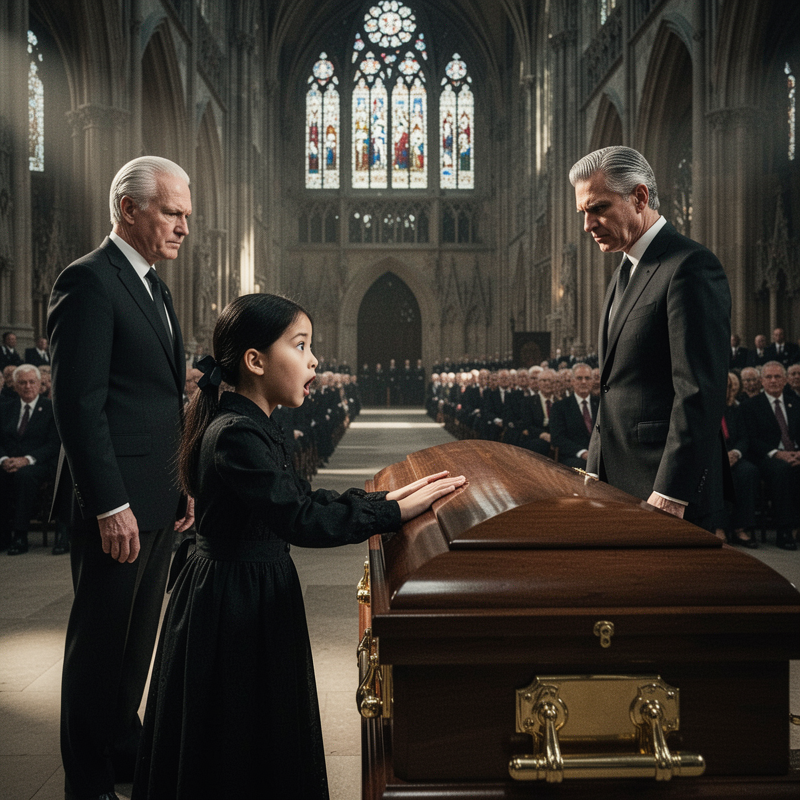
“There is a cough coming from inside Dad’s box!” ten-year-old Maya screamed, throwing her small body against the polished mahogany casket in the middle of St. Matthew’s Cathedral. Before the six uniformed Federal Marshals serving as pallbearers could react, Maya ripped away the white silk casket spray, revealing a tiny glow from an active digital smartwatch taped to the underside of the lid. My stepbrother, Dr. Julian Vance, sprinted up the altar steps yelling that the child was experiencing grief-induced psychosis and needed immediate sedation. But as he reached for Maya, the chief embalmer’s emergency transport log slipped from his jacket, showing that Arthur’s death certificate had been issued seven days before his heart supposedly stopped.
The heavy mahogany casket, gleaming under the cathedral’s vaulted ceiling, shuddered with the impact of Maya’s small frame. Its polished surface reflected the stained-glass windows, a kaleidoscope of color that suddenly seemed grotesque against the unfolding drama. A collective gasp swept through the two hundred high-profile guests.
My mother, Sarah Vance, who had been sitting quietly veiled in the front pew, let out a choked cry, her hand flying to her mouth. She looked frail, almost transparent, a wisp of a woman medicated into a haze.
“Maya, no!” I yelled, pushing past a bewildered Senator, my heels clicking on the marble floor.
I reached the altar just as Julian, his face contorted in a mask of professional concern and barely concealed fury, grabbed Maya’s arm. His grip was too tight for a comforting gesture.
“Eleanor, get control of your sister,” he hissed, his voice low but sharp. “She’s hysterical.”
His eyes darted to the glow emanating from beneath the casket lid. The smartwatch was still there, a tiny, pulsating beacon in the cavernous church.
Before Julian could pull Maya away, her small fingers fumbled in the pocket of her black dress. She triumphantly pulled out a second, identical smartwatch.
“It’s recording, Eleanor! It’s still recording!” she shrieked, her voice echoing in the sudden silence.
She thrust the watch into my hand. The small screen was bright, displaying a waveform of faint, rhythmic thumps. Below it, a line of text scrolled: “Live Audio Feed.”
I pressed the watch to my ear. A muffled, hollow thudding came through the bone-conduction speakers, accompanied by a faint, metallic scraping sound—like something shifting within an enclosed space. It was undeniably a heartbeat, though strangely reverberating, as if from a distance.
The pallbearers, fourteen imposing figures in their dark uniforms, had frozen in their positions. Their faces, previously impassive, now showed a flicker of confusion and alarm.
Julian yanked his hand away from Maya, his gaze fixed on the smartwatch in my hand. His professional composure was cracking, revealing a raw, desperate edge. He took a step towards me.
“That’s a child’s toy, Eleanor! A delusion! She needs a sedative, now!” he demanded, his voice rising, drawing the attention of every dignitary, every federal judge, every network camera crew.
From the fifth row, Detective Ray Mendez, D.C. Metropolitan Police, a man whose presence I hadn’t even registered until now, stood up. His presence was understated, but his authority was not. His eyes, dark and piercing, scanned the scene—Maya, Julian, the casket, the glowing watch.
He slowly walked towards the altar, his gaze unwavering. He moved with a practiced calm that seemed to instantly cut through the tension Julian was trying to create.
“Dr. Vance, step away from the child,” Detective Mendez ordered, his voice gravelly, but firm.
Julian hesitated, his mouth opening to protest, but Mendez’s stare brooked no argument. Julian stepped back, glaring at the detective.
Mendez stopped beside the casket, his eyes falling on the chief embalmer’s emergency transport log Julian had dropped. He bent down, picked it up, and quickly read the line about the death certificate.
A muscle in his jaw twitched. He turned to the lead pallbearer, a stern-faced U.S. Marshal.
“Stop the service,” Mendez commanded. “Do not move the casket.”
He looked directly at me, then at Maya, then back to the casket, as if putting together the pieces of a puzzle.
“This funeral is suspended.”
A low murmur rippled through the congregation. Whispers erupted, quickly growing louder. The press photographers, who had until now maintained respectful distance, began to advance, cameras flashing like strobe lights.
“On what grounds, Detective?” Chief District Judge Evelyn Harper called out from the front row, her voice sharp with indignation. “This is a federal judge’s funeral. We have protocols.”
Mendez didn’t even turn to her. His gaze remained fixed on the casket.
“On the grounds of probable cause,” he stated, his voice ringing with quiet certainty. “And evidence of a possible crime.”
He gestured to the pallbearers.
“Unseal the casket.”
A moment of stunned silence followed. The marshals exchanged uncertain glances. The lead pallbearer, a man named Agent Carter, looked from Mendez to Judge Harper, clearly torn between federal protocol and the detective’s insistent command.
“Agent Carter, I am ordering you to comply,” Mendez stated, his hand resting lightly on the butt of his sidearm. “Or I will do it myself.”
Agent Carter’s jaw tightened. He nodded grimly to his team. One by one, the marshals moved to the side of the casket, their gloved hands reaching for the brass latches. The air in the cathedral grew thick with anticipation, the silence almost deafening, broken only by the soft, rhythmic thrumming still emanating from Maya’s smartwatch.
With a series of soft, metallic clicks, the latches disengaged. The marshals slowly, carefully, began to lift the heavy lid.
A collective gasp tore through the church.
The interior silk lining, pristine moments before, was torn and bunched, as if violently pulled from the inside.
And around the wrist of the body lying within, clearly visible against the dark suit, was a hospital identification band. It was a standard Columbia Heights Memorial band, but the printed timestamp on it read 3:14 PM.
Judge Arthur Vance had been officially pronounced dead at 12:05 PM, seven days prior.
Part 2
The 3:14 PM timestamp on the hospital band was a punch to the gut. Three hours *after* he was pronounced dead. Seven days ago. My mind reeled, trying to reconcile the facts staring me down from the wrist of my deceased stepfather.
“That’s impossible,” I heard Julian splutter, his face draining of color. He looked less angry now, more genuinely terrified.
Detective Mendez, however, remained calm. “Agent Carter, seal the casket. Transport it directly to the D.C. Medical Examiner’s Office under full police escort. No detours.”
Chief Judge Harper stood up, her face a mask of outrage. “Detective, this is highly irregular! You cannot simply seize the body of a federal judge! This is an affront to the court, to his legacy!”
Mendez turned, his gaze cutting. “With all due respect, Judge Harper, a hospital ID band dated *after* a declared death time, inside a sealed coffin at a federal funeral, is grounds for investigation. We’re going by the book.” He motioned to his uniformed officers, who moved swiftly to secure the casket and prepare it for transport.
While the chaos unfolded around us, my fingers flew across Maya’s smartwatch. It was linked to a cloud-based health portal Arthur used. My legal mind demanded data. I found his digital health log, then drilled down to the toxicology reports from Columbia Heights Memorial Hospital. My eyes widened. A modification timestamp, seven days ago, 3:14 AM. The entry detailed a “routine update” to his medication schedule. But the IP address—it was Julian’s personal network, not the hospital’s.
I spun around, a cold fury rising in my chest. Julian stood by the church vestibule doors, attempting to look composed but failing miserably. I stormed over, the smartwatch still clutched in my hand.
“3:14 AM, Julian,” I spat, my voice barely a whisper, but laced with venom. “Your IP address. You accessed and altered his toxicology file seven days ago. What did you do to him?”
He didn’t flinch, didn’t argue. Instead, with a chillingly calm expression, he pulled a folded legal document from his inner jacket pocket and pressed it into my hand. My eyes scanned the header: “D.C. Child Protective Services – Emergency Notice of Inquiry.” It alleged I was “exploiting a traumatized minor for financial gain” to contest Arthur’s $4.2 million will. It was signed, Julian’s signature scrawled at the bottom.
My breath hitched. He was trying to frame me. Trying to take Maya.
Before I could react, the grand oak doors of St. Matthew’s burst open. A team of U.S. Marshals, led by a severe-looking woman in a crisp uniform, strode purposefully towards the altar. They moved with an unmistakable federal authority that made the D.C. Metro officers look like local traffic cops.
The lead Marshal held up a document. “By order of Chief District Judge Evelyn Harper,” she announced, her voice echoing through the stunned cathedral. “We are here to assume immediate federal custody of Judge Arthur Vance’s remains and all associated digital devices and evidence.”
CHAPTER 2: The Seven-Day Ghost
The basement server room of the D.C. Medical Examiner’s Office smelled of copper and cold ozone.
Dr. Aris Thorne leaned over the terminal, his fingers tapping against the glowing mechanical keyboard.
“The federal court order hasn’t hit the local network yet,” Aris whispered, pointing a thumb toward the flickering monitor. “We have maybe four minutes before Judge Harper’s team cuts our administrative access.”
“Pull the central toxicological backup from Columbia Heights Memorial,” I said, leaning over his shoulder. “Start with Arthur’s direct patient portal.”
“I am already in,” Aris said.
A dense grid of hospital lab logs populated the screen, lines of cyan text scrolling past faster than my eyes could process. Aris slammed his palm onto the desk, freezing the display on a timestamp dated seven days prior, precisely at 3:14 AM.
“Look at the dosage record,” Aris said, pointing to a highlighted line. “A standard sedative protocol for late-stage palliative care maxes out at fifty milligrams. This entry shows five hundred and twenty milligrams of phenobarbital.”
“Five hundred and twenty,” I repeated. “That would drop his central nervous system into immediate stasis.”
“It does more than that, Eleanor,” Aris turned to face me, his gray eyes wide behind his wire-rimmed glasses. “Five hundred and twenty milligrams of phenobarbital depresses brainstem reflexes to zero. It produces a clinical state completely indistinguishable from brain death without causing immediate cardiovascular collapse.”
My throat tightened as I stared at the digital authorization signature attached to the dose.
“Julian,” I said.
“Julian Vance,” Aris confirmed, hitting the print command. “He didn’t just certify the death. He chemically induced a catatonic state seven days before Arthur’s heart supposedly stopped.”
“What about the pancreatic cancer?” I asked. “The primary diagnosis?”
Aris reached into his leather bag and pulled out a sealed blue folder, laying two glass tissue slides side by side on the illuminated light box.
“I pulled the biopsy slides from Arthur’s file an hour ago,” Aris said quietly. “The tissue on the left belongs to a sixty-eight-year-old male with stage-four adenocarcinoma. The tissue on the right is Arthur’s real sample. His pancreas was entirely healthy. Julian swapped the pathology slides three months ago using records from a deceased charity patient.”
The printer began to whir, spitting out warm pages of raw server logs.
“Arthur was never dying,” I said. “He was being framed as a terminal patient.”
“He was being primed for removal,” Aris replied.
Before the last page dropped into the tray, a piercing electronic blare shattered the silence of the basement. The overhead fluorescent lights killed instantly, replaced by the dull red pulse of emergency strobes.
The heavy steel door at the end of the corridor hissed open.
Two men in unbadged tactical vests stepped through the doorway, dark visors obscuring their faces. The man on the left raised a silenced 9mm pistol, pointing it directly at Aris’s chest.
“Leave the hard drives on the desk,” the lead man said, his voice flat through an electronic modulator. “Step away from the console now.”
“This is a District government medical facility,” Aris said, taking a slow step back toward the chemical storage rack behind him.
“You have five seconds,” the guard replied, racking the slide.
CHAPTER 3: The Keycard In The Dark
Aris reached behind his back and slammed his elbow into the manual emergency override lever of the necropsy chemical wall.
A dense cloud of pressurized formalin vapor burst from the overhead nozzles, filling the server room with a suffocating, stinging fog.
The gunman coughed violently, dropping his sight line as the chemical vapor hit his eyes.
“Go! Run!” Aris shouted, shoving the printed stack of lab logs into my hands and pushing me toward the service elevator.
I lunged through the heavy fire door into the rear service shaft just as the steel containment doors slammed shut, trapping the intruder inside the hazmat zone.
I sprinted down three flights of concrete stairs, burst through the alley exit, and threw myself into the backseat of a waiting taxicab on North Capitol Street.
“K Street,” I told the driver, wiping formaldehyde tears from my burning eyes. “The twenty-four-hour diner across from the federal courthouse. Fast.”
Ten minutes later, I slid into a cracked vinyl booth at the back of the diner.
Marcus Sterling sat across from me, his silk tie loosened, his hands shaking so violently he could barely hold his coffee cup.
“You shouldn’t have called me, Eleanor,” Marcus stammered, his eyes darting toward the street outside. “Judge Harper’s clerk monitored the entire funeral. If she knows I’m talking to you—”
“Julian didn’t sign Arthur’s official death certificate,” I said, slamming the printed server logs onto the Formica table between us. “The digital certificate was authenticated through the Department of Justice portal. Who logged into the federal network?”
Marcus stared at the papers, his jaw working silently.
“Tell me, Marcus,” I demanded, leaning across the table. “You were his senior clerk. You held his administrative tokens.”
“I didn’t log into anything,” Marcus whispered. “The system verified the certificate using Arthur’s personal federal cryptographic keycard.”
“That card never left his jacket pocket,” I said. “He kept it in his internal suit coat lining.”
“I know,” Marcus said, his voice dropping to a harsh rasp. “Which means whoever authenticated that death warrant wasn’t sitting at a remote computer. They were standing directly over Arthur’s body while he was still breathing.”
“Julian,” I said.
“It required two-factor physical clearance,” Marcus said, pulling a leather court logbook from his bag. “The card key and a physical thumbprint on the reader. Eleanor, Arthur was alive when that file was finalized.”
Before Marcus could slide the logbook across the table, his phone buzzed on the Formica surface.
He glanced at the screen. All the color drained from his face.
He turned the phone toward me. On the screen was a high-resolution photograph taken less than two minutes prior, showing Marcus’s seven-year-old daughter sitting on a bench outside her school, while a black SUV sat idling at the curb behind her.
“They’re watching her,” Marcus choked out, his voice cracking. “They know.”
“Marcus, wait,” I said, reaching for his arm.
“I can’t help you!” Marcus yelled, knocking his cold coffee cup over as he scrambled out of the booth. He grabbed his briefcase and bolted through the front doors into the rain, leaving me alone with three handwritten file numbers written on a paper napkin.
CHAPTER 4: Framed in Georgetown
The napkin held three federal docket numbers, all corresponding to sealed cases assigned to Arthur’s private desk over the past six months.
I arrived at my Georgetown rowhouse at 1:15 AM, pulling my coat tight against the cold drizzle.
The front iron gate was unlatched, swinging open in the wind.
I rushed up the brick steps and found the heavy oak front door sitting open three inches, its brass lock sheared cleanly off the frame.
“Mother?” I called out, stepping into the dark entryway.
The living room was completely destroyed. Cushions had been slashed, Arthur’s mahogany bookcases turned upside down, and legal files scattered across the hardwood floor like fallen leaves.
In the center of the room sat my mother, Sarah, wrapped in a blanket on the floor, her eyes glassy and unfocused.
“They were looking for Arthur’s dark ledgers,” Sarah murmured, her speech thick and slurred. “Julian said… Julian said it was just routine court security.”
“Mother, what did Julian give you?” I asked, kneeling beside her and grabbing her wrist to check her pulse. It was unnaturally slow, heavy, and shallow.
Before she could answer, heavy boots thundered onto the front porch.
Four D.C. Metropolitan Police officers, led by Detective Ray Mendez, burst through the broken door with handguns drawn.
“Eleanor Vance! Stay where you are! Hands where I can see them!” Mendez barked, stepping over the debris.
“Detective, what is this?” I said, standing up with my hands raised. “My house was broken into. My mother has been medicated.”
“We have an emergency search warrant signed by Chief Judge Evelyn Harper,” Mendez said, producing a stamped federal document. “Anonymous tip reported active distribution of illegal controlled substances from this address.”
“That is absurd,” I said. “I am an appellate defense attorney.”
“Search the bags,” Mendez ordered his officers.
A junior officer grabbed my leather briefcase from the hallway table, unzipped the main compartment, and turned it upside down over the dining table.
Three sealed glass vials rolled across the wood, along with a pair of surgical syringes.
I stepped forward, my chest tightening. “Those aren’t mine. I’ve never seen those before.”
Mendez picked up one of the vials, reading the printed pharmaceutical label under the dim light.
“Clinical-grade phenobarbital,” Mendez said, looking at me with a cold, unreadable expression. “Five hundred milligrams per vial. Prescribed under your name from a Maryland compounding pharmacy.”
“It’s a plant!” I shouted. “Check the serial numbers! Julian Vance framed this!”
“Save it for your arraignment, Counselor,” Mendez said, pulling my arms behind my back and snapping steel handcuffs around my wrists. “You’re under arrest for possession and distribution of Schedule II controlled substances.”
As Mendez marched me out down the wet brick steps toward the waiting police cruiser, I looked across the dark Georgetown street.
Parked under the streetlight fifty yards away was a silver Mercedes.
Inside the driver’s seat sat Dr. Julian Vance, adjusting his silk tie in the rearview mirror, calmly watching the police cruiser pull away into the night.
CHAPTER 5: Fourteen Seconds of Truth
The central holding cell at the D.C. Metropolitan Police Department smelled of industrial bleach and old sweat.
I spent fourteen hours locked on a concrete bench, staring at the salt-stained cinderblock wall, before the heavy iron bar slid back.
“Vance,” the guard announced. “Bail posted. Step out.”
I walked into the intake lobby, my wrists raw from the steel cuffs.
Dr. Aris Thorne was standing by the desk, holding a manila folder and a receipt from the court cashier.
“Fifty thousand dollars,” Aris said quietly as we stepped out onto the granite steps of C Street. “I liquidated my personal retirement savings account to post your bond.”
“Aris, you shouldn’t have done that,” I said, rubbing my wrists. “Julian planted those vials in my house. Judge Harper signed the warrant within twenty minutes of the tip.”
“I know,” Aris said, leading me to his station wagon parked at the curb. “Because while you were in central holding, Maya’s smartwatch finished downloading its secondary cloud cache.”
He pulled a small digital tablet from his coat and hit play on an audio software interface.
“The bone-conduction watch didn’t just record inside the church,” Aris said. “It had an automated buffer that saved fourteen seconds of ambient room audio right before the casket was loaded into the hearse.”
He pressed the screen. Crackling static filled the quiet car, followed by the muffled sound of heavy rain and iron hinges scraping together.
Then, a clear, crisp voice echoed from the speakers—unmistakably Julian’s.
“The funeral home hearse leaves at 9:00 AM,” Julian’s recorded voice stated calmly. “Ensure the sub-basement transport is complete before the cremation crew takes the empty box.”
Another voice answered on the line—a voice I recognized as Marcus Sterling’s. “What if the pallbearers notice the weight difference?”
“The internal vault is loaded with a hundred and eighty pounds of high-density thermal rubber,” Julian replied cold and sharp. “It maintains body heat and mass. Just drive the hearse.”
The recording cut to static.
I sat frozen in the passenger seat, the realization sinking into my chest like lead.
“The casket at St. Matthew’s,” I whispered. “Arthur was never inside it.”
“No,” Aris said. “The public funeral was an elaborate shell game. Arthur was never dead, and he was never in that church. They used an empty box with a weighted dummy to get through the judicial service while they moved Arthur to an undisclosed facility to finish the job.”
“He was still breathing when we were standing in that aisle,” I said, tears finally burning my eyes. “He was somewhere else entirely.”
“And we have less than twelve hours before they execute the final cremation clearance,” Aris added, looking at his watch.
CHAPTER 6: The Missing $4.2 Million
At 2:15 PM, Aris and I slid into the private conference room of Arthur’s personal estate attorney, Harold Vance—no relation to our side of the family—on Connecticut Avenue.
Harold locked the heavy mahogany door behind us and pulled two thick leather-bound binders from a floor safe.
“Julian has spent the last forty-eight hours trying to freeze Arthur’s private accounts using a power-of-attorney document dated two months ago,” Harold said, laying a blue document on the table. “He claims Arthur intended to transfer his entire four point two million dollar estate to the hospital’s expansion fund.”
“Is the document valid?” I asked.
“It’s a total forgery,” Harold said flatly. “Three weeks ago, Arthur came to my office alone. He revoked all previous wills and created an irrevocable litigation trust.”
“Who controls the trust?” I asked.
“It is monitored directly by a federal court watchdog,” Harold replied. “The entire four point two million dollars was set aside for one explicit purpose: to fund an independent class-action lawsuit against Columbia Heights Memorial Hospital for systematic medical fraud and Medicare kickbacks.”
Harold pulled a dark silver flash drive from a sealed envelope and pushed it across the table toward me.
“Arthur left this in my vault with strict instructions,” Harold continued. “He said: ‘If I disappear or am rendered incapacitated before the next bench session, give this directly to Eleanor.’”
I plugged the drive into my laptop.
A sealed, eighty-four-page draft federal indictment opened on the screen.
The primary target was Dr. Julian Vance, listed alongside twenty-two hospital executives. But on page fourteen, my breath caught.
“Chief District Judge Evelyn Harper,” I read aloud, scanning the bold text. “Received one point four million dollars in offshore transfers routing through shell corporations in the Cayman Islands, in exchange for dismissing twelve separate medical malpractice suits against Julian’s surgical group.”
“It’s a massive judicial bribery ring,” Aris said, staring at the screen. “That’s why Harper issued the federal gag order. That’s why she signed your arrest warrant. If Arthur’s indictment hits the U.S. Attorney’s desk, her entire life is over.”
Before I could save the file to a secure cloud drive, my cell phone chimed on the table.
It was a video message sent from an encrypted number.
I tapped the screen. The video showed my mother, Sarah, strapped to a gurney inside a sterile, white-tiled isolation ward.
Julian stepped into the camera frame, wearing surgical scrubs, holding a clipboard.
“Hello, Eleanor,” Julian said smoothly into the camera. “Your mother has suffered a sudden, tragic psychological breakdown following your drug arrest. Under emergency court authorization signed by Judge Harper, I have placed her under a mandatory forty-eight-hour psychiatric hold at Columbia Heights Memorial. Do not come here. If you attempt to file those forged trust documents, I will ensure her sedation protocol becomes permanent.”
The video went black.
CHAPTER 7: The Federal Wall
I threw open the glass doors of Columbia Heights Memorial Hospital at 4:10 PM, my snow-dusted coat flying behind me.
Before I could reach the main elevator bank, four armed hospital security guards stepped into my path, forming a human barricade.
“Eleanor Vance,” the lead guard said, placing a heavy hand on his belt holster. “You are officially trespassed from this property. Step back immediately.”
“My mother is being held illegally on the fourth floor,” I said, stepping directly into his space. “Get out of my way.”
“We have a court-ordered medical guardianship directive,” the guard said, producing a paper bearing Judge Harper’s judicial seal. “Dr. Julian Vance is named as sole healthcare proxy for Sarah Vance. You step past those turnstiles, and you’ll be arrested for federal trespass.”
“Eleanor! Don’t,” Aris whispered, pulling my shoulder back. “Look at the parking garage.”
I turned and saw Detective Ray Mendez standing near an unmarked police cruiser in the lower garage bay, smoking a cigarette in the shadows.
I broke away from the security guards and marched straight toward Mendez, pulling the silver flash drive from my pocket.
“Detective,” I said, my voice shaking with raw anger. “You arrested me fourteen hours ago for drugs Julian planted in my home. I want you to look at this.”
Mendez tossed his cigarette onto the concrete and looked at the flash drive. “Counselor, I follow warrants. Judge Harper signed off on your residential search.”
“Judge Harper is taking kickbacks from the man who drugged my father!” I shouted, shoving the printout of the 84-page indictment into his hands. “Julian Vance has my mother locked in an isolation ward right now! He’s using a catatonic dose of phenobarbital to murder Senior District Judge Arthur Vance!”
Mendez scanned the first three pages of the indictment, his cynical expression slowly hardening into a scowl as he recognized the official Department of Justice prosecution stamps and bank routing numbers.
“Where did you get these bank records?” Mendez asked, his eyes fixing on mine.
“Arthur compiled them before Julian tried to bury him,” I said. “And I have a fourteen-second audio file of Julian explicitly stating the casket delivered to St. Matthew’s was empty.”
Mendez stared at the document for five long seconds, then pulled a encrypted radio from his tactical vest.
“This bypasses federal jurisdiction,” Mendez grunted. “If Harper’s dirty, I can go straight to a D.C. Superior Court judge for an emergency local search and rescue warrant. Wait here.”
Mendez turned and walked briskly into the central court liaison office in the adjacent building.
I waited in the cold garage for eleven minutes, watching the minute hand on my watch sweep past.
The glass doors of the liaison office swung open.
Mendez stepped out, but he wasn’t alone. Two uniformed U.S. Federal Marshals walked on either side of him.
“Detective Mendez,” the lead Marshal announced in a loud voice, handing Mendez a white envelope. “By order of Chief Judge Evelyn Harper, your law enforcement authority within the District of Columbia is temporarily suspended pending an internal affairs inquiry into evidence tampering at St. Matthew’s Cathedral.”
Mendez took the envelope, his hands clenching into fists, but the Marshals immediately stepped between him and me, blocking our path to the building.
“They shut down the local warrant,” Mendez said through grit teeth, looking back at me. “The federal court just impounded my entire unit.”
CHAPTER 8: The Embalming Fluid Sample
By 2:30 AM, the rain had turned into a thick, freezing fog across the suburban backroads of Maryland.
Aris and I crouched behind a rusted dumpster in the rear loading dock of the Crestview Funeral Preparation Facility—the private contractor Julian had hired to process Arthur’s remains.
“The federal injunction doesn’t cover state property in Maryland,” Aris whispered, using a handheld glass cutter to circle the lock on the low basement window. “If we find physical proof of chemical processing here, Harper’s gag order is completely meaningless.”
The glass pane popped free with a quiet *thud*.
We dropped into the cold, concrete preparation room below.
The air was heavy with the sharp, chemical stench of disinfectant and metallic drain wash.
Aris pulled a portable liquid chromatograph from his canvas bag and approached the secondary waste drainage container connected to the primary embalming station.
“If Arthur was embalmed here, this secondary containment tank will hold high concentrations of formaldehyde and glutaraldehyde,” Aris whispered, dipping a sterile sampling tube into the dark fluid at the base of the steel basin.
He plugged the sample vial into the digital chromatograph.
The small screen flickered, analyzing the chemical density of the liquid for ninety agonizing seconds.
A sharp electronic beep sounded.
“Zero formaldehyde,” Aris said, reading the digital readout, his voice trembling. “Zero chemical preservatives.”
“What is in it?” I asked, leaning over the readout.
“Four hundred and fifty milligrams of neuromuscular blocking agents,” Aris said, looking up at me. “Vecuronium bromide combined with high-dose phenobarbital. Eleanor, Arthur was never prepared for burial. They used this facility to administer a massive paralytic cocktail, making him completely immobile while keeping his respiratory organs functioning at a bare minimum.”
“He was alive when they loaded him onto the secondary transport,” I said.
“He’s still alive,” Aris whispered. “They couldn’t cremate a living body without triggering automated thermal alarm spikes in commercial incinerators. They had to keep him in a deep chemical paralysis until they could move him to an off-grid location.”
“What about my mother?” I asked.
“I called my contact in the hospital pharmacy three hours ago,” Aris said, pulling two small prescription bottles from his pocket. “I swapped Sarah’s sedative orders at Columbia Heights Memorial with harmless saline solutions before I met you tonight. Her mind will clear by morning.”
A heavy metal door at the back of the loading dock creaked open.
I pulled a heavy iron wrench from a tool rack, stepping in front of Aris.
A figure stumbled out of the darkness into the dim red light of the prep room.
It was Marcus Sterling. His coat was torn, his right cheek deeply bruised, and he was clutching a locked, blood-stained metal document box to his chest.
“Eleanor,” Marcus gasped, falling against a stainless steel preparation table. “I ran… I ran as far as I could.”
CHAPTER 9: The Clerk’s Confession
Aris caught Marcus before he hit the concrete floor, guiding him onto an overturned plastic crate.
“Marcus, what happened to you?” I asked, dropping the wrench and kneeling beside him.
“Julian’s private security team… they picked me up outside my apartment,” Marcus sobbed, clutching his ribs. “They wanted Arthur’s master encryption keys. Julian threatened to send a falsified bar complaint that would ruin my life over my old offshore gambling debts.”
“Where is Arthur, Marcus?” I demanded, grabbing his collar. “Look at me! Where is he?”
Marcus wiped blood from his lip with the back of his sleeve and looked up at me with hollow, terrified eyes.
“Sub-basement Level 3,” Marcus whispered. “Under the east wing of Columbia Heights Memorial.”
“There is no Sub-Basement Level 3 on the public hospital blueprints,” Aris countered. “I checked the municipal facility logs yesterday.”
“It’s an off-grid wing,” Marcus said, pulling a folded set of architectural schematics from the locked metal box. “It was built four years ago using unregistered construction funds from Julian’s shell companies. It’s a six-bed private ICU designed for high-net-worth foreign patients who want experimental, non-FDA-approved procedures off the books.”
Marcus pointed a shaking finger at a red-highlighted section of the floor plan labeled *Vault 3B*.
“Julian built it with independent air filtration and an unlisted service elevator that connects straight to the hospital incinerator chute,” Marcus continued, his voice shaking uncontrollably. “He logged Arthur in under a fake name—’Subject Alpha.’”
“Why hasn’t he killed him yet?” I asked. “If he wanted him gone, why wait?”
“Because Arthur set a master cryptographic lock on his private judicial servers,” Marcus explained. “The eighty-four-page indictment you found? It’s just the tip of the iceberg. The main evidence file is stored on an encrypted DOJ server that requires a live biological retinal scan from Arthur every forty-eight hours to remain suppressed. If Arthur dies before Julian gets that password, the entire file automatically publishes to every news outlet in the country.”
Marcus pulled a heavy electronic keycard and a slip of paper with a eight-digit security code from his pocket and pressed them into my hand.
“Julian’s spent the last week using painful nerve-stimulation shocks to force Arthur to talk,” Marcus said, tears streaming down his bruised face. “But Arthur refused to yield. So Julian scheduled his ‘terminal biological disposal’ for six o’clock this morning. He’s going to dump his body directly into the hospital incinerator run during the morning shift.”
I looked at my watch.
The glowing red numbers read 5:12 AM.
“We have forty-eight minutes,” I said.
CHAPTER 10: The Sub-Basement Protocol
The rain was pouring in relentless sheets when our unmarked police van blew through the security gate of Columbia Heights Memorial Hospital at 5:42 AM.
Detective Mendez, operating entirely outside official police channels, slammed the van into the rear loading bay door, shattering the wooden security barrier.
Beside him were three off-duty Metropolitan Police officers wearing tactical vests without department badges.
“We have no federal backup, no official clearance, and no legal protection if this goes wrong,” Mendez said, racking the bolt of his shotgun as we stepped out into the freezing subterranean air. “If we hit that room and Arthur isn’t there, every single one of us is going to federal prison.”
“He’s there,” I said, holding Marcus’s stolen security keycard.
We moved fast down the dimly lit service corridor, bypassing the main elevators, and stepped into a concealed hydraulic freight lift hidden behind a drywall utility panel.
I swiped the keycard and punched the eight-digit code into the recessed keypad: *0-9-4-1-8-2-6-7*.
The lift groaned, dropping three floors into the earth, deep beneath the hospital foundation.
The elevator doors slid open with a soft metallic hiss at 5:50 AM.
The hallway of Sub-Basement Level 3 was bright, clinical white, smelling heavily of ozone and concentrated bleach.
Mendez kicked open the reinforced steel door labeled *Vault 3B*.
Inside, illuminated under harsh surgical lamps, lay Senior District Judge Arthur Vance.
He was strapped to an stainless-steel operating table, dozens of clear plastic lines feeding into his neck and arms. His face was gaunt, his skin gray, but his eyes—wide, clear, and sharp—were wide open.
Standing beside the main IV manifold was Dr. Julian Vance, holding a large glass syringe filled with 20 mL of clear, concentrated potassium chloride.
“Eleanor,” Julian said softly, stopping his hand inches from the catheter port. “You really don’t know when to accept a court ruling, do you?”
“Get away from him, Julian!” Mendez roared, raising his weapon. “Hands in the air now!”
Julian didn’t flinch. He adjusted his glasses with his left hand, a cold, arrogant smile playing across his lips.
“You’re too late, Detective,” Julian said calmly. “The mahogany casket at St. Matthew’s? It was loaded with a one-hundred-and-eighty-pound thermal mannequin to trick your pathetic pallbearers into feeling life-like weight and body heat. Arthur has been sitting right here since the night before his funeral.”
I stepped past Mendez, my eyes fixing on my stepfather’s face.
Arthur couldn’t speak, his jaw locked by the paralytic, but his eyes tracked my movement across the room with burning intensity.
On a wall-mounted communication board above his head, an automated eye-tracking camera was active, spelling out a single incomplete line of text on a glowing screen: *M-A-Y-A… W-A-T-C-H*.
“He’s fully conscious, Eleanor,” Julian taunted, turning his cold gaze back to me. “He’s felt every single milligram of the paralysis. I kept him alive just long enough to extract his master decryption passwords, but his stubbornness has run out of time.”
Julian looked at his watch, then smiled directly at Arthur.
“Did you really think your little trick with Maya’s watch was going to save you?” Julian sneered. “Arthur slipped his custom bone-conduction smartwatch onto that little girl’s wrist days ago during his last conscious moment. He set an automated proximity alert to trigger an open audio broadcast if his heart rate dipped below forty beats per minute. He wanted his own funeral to explode from inside the grave.”
Julian leaned over Arthur’s face, his voice dropping to a whisper. “Too bad nobody listened until the box was already empty.”
Julian suddenly raised his arm, swinging the massive syringe toward Arthur’s central line port to inject the fatal dose.
“Drop it!” Mendez screamed.
Julian’s thumb pressed hard against the plunger.
CHAPTER 11: Eighteen Minutes
*BANG! BANG!*
Two non-lethal beanbag rounds exploded from Mendez’s shotgun, striking Julian full in the right shoulder and chest.
Julian shrieked in pain, spun backward, and crashed into a tray of stainless-steel surgical instruments, sending knives, clamps, and glass vials shattering across the tiled floor. The syringe flew from his hand, smashing against the far concrete wall.
“Clear the room!” Mendez yelled, rushing forward to secure Julian on the ground, pinning his arms behind his back.
Before Julian could fight back, the heavy double doors of Sub-Basement Level 3 were blown off their hinges with a deafening charge.
A dozen heavily armed Federal Marshals, accompanied by agents from the Department of Justice Inspector General’s office, flooded into the room with weapons drawn.
“Federal agents! Put your weapons down!” the lead DOJ Special Agent shouted.
Aris Thorne stepped out from behind the Marshals, holding an official emergency intervention order signed by the Chief Prosecutor of the United States Attorney’s Office.
“I filed a direct emergency whistle-blower report to the DOJ Inspector General twenty minutes ago,” Aris shouted above the noise, pointing at Julian. “He is attempting to murder a Senior Federal Judge!”
The lead Special Agent looked at Arthur on the operating table, then down at the shattered syringe of potassium chloride on the floor, and immediately motioned to his team.
“Cuff him!” the agent ordered.
Two Marshals dragged Julian off the floor, pulling his arms violently behind his back.
Julian, his face smeared with sweat and blood, glared at me with wild, animalistic rage.
“You’ve destroyed this family, Eleanor!” Julian screamed, his voice echoing off the concrete walls as he struggled against the steel cuffs. “You’ve dragged the Vance name through the mud for a dying old man who kept secrets from all of us!”
I walked up to Julian, pulled the printed 84-page indictment targeting his $14 million offshore kickback scheme from my coat, and stuffed it directly into his front suit pocket.
“The Vance name was clean until you put a price tag on it,” I said quietly.
Paramedics pushed past the Marshals, hooking a rapid-infusion reversal protocol directly into Arthur’s central line.
“His oxygen saturation is dropping fast,” the head paramedic announced, checking the digital cardiac monitor. “We have eighteen minutes before irreversible brainstem collapse! Administer fifty milligrams of neostigmine immediately!”
I stood beside the gurney, taking Arthur’s cold, trembling hand in mine.
His fingers, weak and stiff from days of chemical paralysis, squeezed back with a tiny, imperceptible pulse of strength.
His eyes looked up at mine, and a single tear tracked down through the dust on his cheek.
Behind us, two DOJ Special Agents walked into the hallway, escorting Chief District Judge Evelyn Harper, who was dressed in a rain-soaked coat, her hands secured in front of her with steel handcuffs.
She stared at me in total silence as she was led past the doorway, her legal career and public standing completely destroyed.
“He’s stabilizing!” the paramedic shouted, watching the green heart-rate line bounce back up to sixty-eight beats per minute. “Respirations coming back! He’s going to make it!”
I took a deep, clear breath for the first time in three days, watching the steady rhythm of my stepfather’s pulse on the monitor.
CHAPTER 12: The Quiet After the Storm
Three months later, the afternoon sun fell warm and silent across the rolling green hills of Charlottesville, Virginia.
Judge Arthur Vance sat in a wooden wheelchair on the stone patio of a small, unpretentious farmhouse miles away from the noise and marble columns of Washington D.C.
His speech was still slurred, and his left side retained a slight neurological weakness from the heavy barbiturate toxicity, but his mind was completely sharp.
“The federal court in D.C. finalized the asset recovery order this morning,” I said, handing him a warm cup of tea as I sat on the porch step beside him. “The four point two million dollars has been officially placed into the public health advocacy trust.”
Arthur took a slow sip, his weathered face breaking into a soft, tired smile.
“And… Julian?” Arthur asked, his voice low and gravelly.
“He accepted a plea bargain yesterday to avoid the capital trial,” I said. “Convicted on fourteen federal counts, including attempted first-degree murder, healthcare fraud, and judicial bribery. Sentenced to thirty-five years at ADX Florence without the possibility of parole.”
Arthur nodded slowly, looking out toward the mountains. “And Evelyn Harper?”
“Forced resignation from the bench,” I replied. “Indicted on federal obstruction charges. Her trial begins in November. Marcus Sterling received a four-year sentence at a low-security facility for his role, but his disbarment was made permanent.”
Sarah walked out onto the patio, carrying a tray of fresh biscuits, her face clear, bright, and completely free of the chemical haze Julian had subjected her to for nine long months. She placed a gentle hand on Arthur’s shoulder, resting her cheek against his hair.
I pulled a legal document from my briefcase and placed it on the small table beside Arthur.
It was my official resignation notice from my senior partner track at the D.C. appellate corporate firm.
“You’re giving up your partnership?” Arthur asked, looking down at the paper.
“I opened a small public-interest advocacy practice down here in Charlottesville,” I said, smiling up at him. “No corporate defense. No federal judicial politics. Just representing families who don’t have a voice against institutions that think they can quiet them.”
Ten-year-old Maya ran across the grass from the garden, kicking an old soccer ball ahead of her.
She skidded to a halt beside Arthur’s wheelchair, holding out her left arm.
On her small wrist, the familiar digital smartwatch glowed in the afternoon light, its bright green line displaying a calm, steady rhythm of seventy-two beats per minute—perfectly synchronized with the pulse of the man sitting beside her.
Maya looked up at me, tucked her dark hair behind her ear, and grinned before kicking the ball back across the lawn.
I watched her run freely into the open field under the blue Virginia sky, completely detached from the quiet compliance and hidden corruption of the city we had left behind.
In a city built on marble and quiet compliance, the loudest thing in the world is a child who refuses to sit down.
Leave a Reply