CHAPTER 1: The Voice from the Brass Box
Part 1
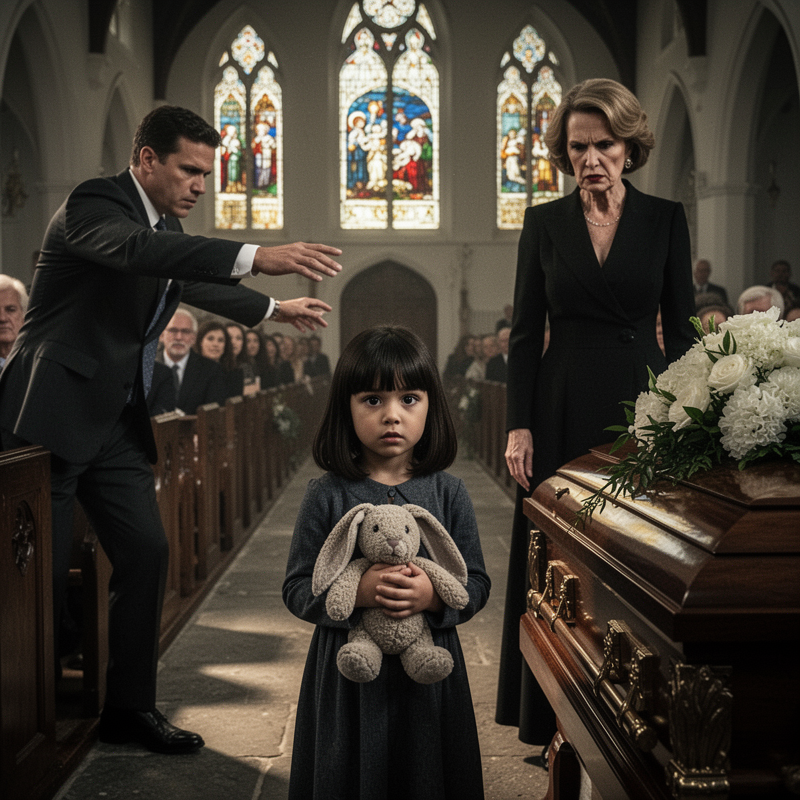
“My husband requested no autopsy, and his soul is already with God,” my stepmother Victoria announced to the 220 mourners packed inside St. Philip’s Church in Charleston. She placed a gloved hand on the mahogany casket of my father, South Carolina State Senator Arthur Vance, who had supposedly died of sudden heart failure three days prior. But before the pastor could finish the funeral blessing, my six-year-old half-sister Lily broke away from my hand, pointed directly at the sealed casket, and screamed, “Daddy is crying in there!” A second later, an electronic beep pierced the silent sanctuary—pulsing rapidly from deep inside the brass-lined coffin.
A collective gasp swept through the solemn hall.
It was not a murmur, but a unified, sharp intake of breath, like a single organism had just been struck.
Every single head in the ancient church, from the Governor in the front pew to the maintenance staff by the double doors, swiveled towards the sound.
The beep was insistent, high-pitched, and impossibly clear.
_BEEP-BEEP-BEEP-BEEP._
It pounded at an urgent rhythm, 138 beats per minute, each pulse echoing off the stained-glass windows and vaulted ceilings. It sounded exactly like a medical monitor, the kind I’d heard countless times reporting from hospital bedsides, except this one was coming from *inside* a sealed casket.
Victoria Vance, my stepmother, stiffened beside the coffin, her perfectly composed face momentarily crumbling. Her eyes darted from the casket to Lily, then to me, a flash of pure panic in their depths before she clamped down on it.
She recovered quickly, forcing a tight, dismissive smile.
“It’s nothing,” she announced, her voice a little too loud, a little too strained. “A child’s grief. A trick of the mind. Senator Vance is at peace.”
She gave the pastor a frantic, pleading look. “Please, Reverend Miller, continue with the blessing.”
Reverend Miller, a man usually unflappable, stood frozen. His mouth hung slightly open, his gaze fixed on the mahogany box. The relentless _BEEP-BEEP-BEEP_ filled the space, contradicting every word Victoria had just uttered.
My own heart hammered in my chest. Investigative journalist. That’s what I was. My mind, usually cool and analytical, was a frantic whirlwind of disbelief and a chilling sense of dread. Lily’s words, “Daddy is crying in there,” resonated with the sound.
This wasn’t a trick of the mind. This was real.
A large, imposing figure detached himself from the crowd near the back. Detective Marcus Reed, head of homicide for Charleston PD, strode purposefully down the aisle. His face was a mask of grim determination. He hadn’t been an old friend of my father’s, but they’d shared a mutual respect.
He stopped directly in front of the casket, ignoring Victoria entirely.
“Excuse me, Mrs. Vance,” he said, his voice low but cutting through the beeping. “But this sound requires immediate investigation.”
Victoria stepped in front of the casket, placing a defiant hand on the polished wood. Her eyes narrowed into cold slits.
“Absolutely not, Detective,” she snapped, her carefully cultivated Southern charm replaced by a razor’s edge. “This is a sacred space. A private family moment. You will not desecrate Arthur’s final resting place.”
Reed simply held her gaze. He didn’t raise his voice, but his authority was undeniable.
“Ma’am, a sound indicating a potential living presence from inside a sealed coffin is not a private matter. It is a police matter.”
He motioned to two uniformed officers who had quietly followed him. They moved to flank the casket.
Victoria dug her heels in. “You have no warrant! This is an outrage! I will call the Mayor!”
“You can call anyone you like, Mrs. Vance,” Reed stated, his hand already reaching for the ornate brass latch on the casket’s side. “But that sound is getting louder.”
The _BEEP-BEEP-BEEP_ indeed seemed to intensify, quickening slightly, as if whatever was inside was in growing distress. The air in the church crackled with a sickening tension, a blend of horror and morbid curiosity. Whispers erupted, quickly silenced by a harsh glance from Reed.
With a definitive click, the first latch sprang open. The sound was stark against the silence.
Victoria let out a small, enraged gasp.
The officers moved to help Reed. One grasped the lid, the other braced the mahogany box. There was a groan of stressed wood, a soft, sickening creak as the heavy lid began to lift.
Victoria shrieked. “Stop it! Stop this madness!”
But it was too late. The lid rose, slowly, agonizingly, revealing the satin-lined interior.
And there he was. My father. Senator Arthur Vance.
His eyes, beneath slightly fluttering lids, were not closed in peaceful repose as they had been in the open-casket viewing. They were open, just slits, but unmistakably so. And from those barely open slits, twin trails of clear liquid, tears, tracked through the faint makeup on his face, disappearing into the dark velvet pillow beneath his head.
His chest rose and fell, shallowly, almost imperceptibly, but it was there. He was breathing.
He was alive.
A chorus of shocked cries erupted from the mourners. Someone screamed. Another person fainted, collapsing onto the pew with a dull thud.
The sanctuary doors burst open again, and a team of paramedics, alerted by Reed, rushed in, gurneys clattering on the polished stone floor, sirens wailing faintly from outside. They moved with practiced efficiency towards the casket, their faces grim.
As they reached Arthur, unhooking wires and preparing to lift him, Victoria Vance stepped forward again, her face a mask of cold fury and desperate resolve. In her gloved hand, she held a crisp, folded piece of legal paper.
“Stop!” she commanded, her voice ringing with unexpected authority. “You cannot touch him. I have a legal document here.”
Part 2
“It’s Arthur’s advance directive,” Victoria declared, her voice now sharp and cold, entirely devoid of the previous panic. She thrust the document towards the paramedics. “Signed and notarized seventy-two hours ago. It states his explicit wishes: no life-sustaining treatment, and immediate cremation due to a terminal neurological diagnosis. You cannot interfere.”
One of the paramedics hesitated, looking to Detective Reed. My gaze, however, was fixed on the paper in Victoria’s hand. Terminal neurological diagnosis? My father had a heart condition, yes, but there had been no mention of anything terminal. And cremation? He’d always wanted to be buried next to my mother, a fact Victoria knew intimately.
“Let me see that,” I demanded, stepping forward and snatching the document from her grasp before she could react. My eyes immediately went to the signature line. “Arthur Vance.” It was a bold, almost sprawling signature, attempting to mimic his usual careful script, but it was off. My father’s handwriting had a distinct flourish, a particular way he looped his ‘A’s. This signature was stiffer, less confident, almost… a tracing.
“This is not his signature,” I stated, my voice ringing with certainty, even as my hands trembled. “This is a forgery.”
Victoria scoffed. “Don’t be ridiculous, Clara. You’re unhinged with grief.”
But Detective Reed had also leaned closer, studying the document. He looked up, his expression hardening as he met Victoria’s gaze. “Given the circumstances, Mrs. Vance, this document’s validity is now highly questionable.” He turned to the lead paramedic. “Do not move him for cremation. Senator Vance will be transported immediately to the Medical University of South Carolina. I’m placing a temporary 48-hour police hold on his body for a full medical and forensic examination.”
He barked orders to his officers. “Secure the ambulance. No one goes near Senator Vance without my explicit authorization. Maintain armed guard at the hospital.”
The paramedics, relieved to have clear instructions, nodded and carefully transferred my father from the casket to the gurney. The urgent beep from the monitor continued as they wheeled him past the stunned mourners and out the double doors, the wail of the ambulance siren growing louder, then slowly fading into the Charleston afternoon.
I stood there, watching the ambulance disappear, a mix of relief and terror warring inside me. He was alive. But he was also deeply, terrifyingly vulnerable.
As the last police car followed the ambulance, taking the last visible piece of Arthur with it, I glanced back at Victoria. She was no longer screaming, no longer defiant. Instead, she had retreated into the shadow of one of the massive oak columns near the church entrance, her back mostly to the remaining handful of bewildered mourners. She pulled out a sleek, black cellphone—one I’d never seen her use before. Her head was bowed, and I could just make out the frantic whisper of her voice as she held the phone to her ear, her eyes darting nervously around the empty churchyard. She was talking to someone. Someone she desperately needed to warn.
CHAPTER 2: The Engineer’s Secret Code
The floor of the Medical University of South Carolina Intensive Care Unit smelled of bleach and cold steel.
Through the glass wall of Room 412, my father lay motionless beneath a paper blanket. A mechanical ventilator clicked and hissed every four seconds, forcing oxygen into his lungs.
A man in a wrinkled tweed jacket stood by the water cooler. He kept shifting his weight, his eyes darting between the hallway monitors and my face.
“Clara Vance?” he asked, stepping into my path.
I stopped. My hand instinctively went to my press credential hanging around my neck.
“I’m Clara,” I said. “Who are you?”
“Dr. Aris Thorne,” he whispered, pressing his back against the wall. “I was your father’s roommate at Clemson. We need to speak where the hallway cameras don’t reach.”
I stepped into a alcove beside the vending machines.
“What is this about?” I asked.
“Six weeks ago, Arthur came to my private lab in West Ashley,” Dr. Thorne said. He pulled a heavy metal drive from his coat pocket. “He was experiencing chronic dizziness and speech slurring. He suspected someone in his household was poisoning him.”
My pulse spiked. “He knew?”
“He didn’t have proof, and he couldn’t risk going through standard hospital channels,” Thorne said. “I secretly implanted a custom cardiac neuro-pacer into his chest wall during an outpatient procedure.”
“That’s what made the sound at the church,” I said.
“Yes,” Dr. Thorne said. “The device broadcasts on an encrypted radio frequency. If his resting heart rate drops below thirty beats per minute or detects specific neuromuscular paralysis, it triggers an audible high-frequency alert at one hundred thirty-eight beats per minute.”
He held up the drive. “I have the raw telemetry data right here. It proves his heart failure was chemically induced.”
“Give it to me,” I said, reaching out my hand.
Heavy footsteps echoed down the polished tile floor before his fingers could touch mine.
Dr. Julian Sterling walked toward us, flanked by two armed hospital security guards. He held a signed yellow paper in his gloved hand.
“That will be enough, Miss Vance,” Dr. Sterling said.
“Get away from us, Sterling,” I said, stepping between him and Thorne.
“By order of the Charleston County Probate Court, you are being removed from these premises,” Dr. Sterling said, tapping the paper. “Your stepmother has been confirmed as your father’s sole legal healthcare proxy.”
“He’s breathing, Julian!” I yelled. “He was alive inside that box!”
“The patient is in an irreversible coma,” Dr. Sterling said flatly. He motioned to the guards. “Escort Miss Vance and her associate off hospital grounds immediately.”
The larger guard placed a heavy hand on my shoulder and pushed me toward the exit doors.
CHAPTER 3: What the Child Saw
The vinyl booth at the diner on Meeting Street was cracked and patched with blue tape.
Outside the rain-streaked window, downtown Charleston traffic crawled through the gray afternoon light.
Six-year-old Lily sat across from me, her small fingers clutching a mug of lukewarm hot chocolate. Her shoes didn’t touch the floor.
“Are you hungry, Lily?” I asked, sliding a plate of fries toward her.
She shook her head, keeping her chin tucked against her collar.
“Lily, at the church,” I said softly, leaning across the table. “You said Daddy was crying. How did you know?”
She reached into her yellow backpack and pulled out a spiral drawing pad. She flipped past pictures of sunshine and trees until she reached the back pages.
She laid the pad flat between us.
The page showed a crayon drawing of a bedroom. A large blue bed sat in the middle, and a figure with long black hair stood over it.
“Victoria,” I said, pointing to the black-haired figure.
Lily nodded once. She pointed to a brown crayon mark in the figure’s hand.
“She puts the clear medicine in Daddy’s night tea,” Lily said in a small, flat voice. “Every night when the clock says nine zero zero.”
“Did you see her do it?” I asked.
“Daddy told me not to drink the tea,” Lily whispered. “He said it was special tea that made his legs sleepy.”
I stared at the page. “What else did he say?”
“On the night before the big wooden box came,” Lily said, her lower lip trembling, “Daddy came into my room. He kissed my forehead.”
“What did he tell you?”
“He said he had to take a very long sleep,” Lily said, looking directly into my eyes. “He said people would think he was gone, but his heart would keep beating for me. He said I had to listen for it.”
A cold shudder ran down my back.
My father hadn’t been ambushed. He had known the poison was in the cup.
He had let himself be paralyzed on purpose.
“Come on, Lily,” I said, packing her drawing pad into my coat. “We’re going to the paper’s office.”
CHAPTER 4: The Poison Merchant
The basement of the MUSC toxicology building was silent except for the low hum of centrifuges.
I swiped my old press credential through the secondary door scanner at 8:45 PM. The light flickered green and the lock clicked open.
Inside, rows of glass vials and mass spectrometers stretched under fluorescent lights.
I walked straight to the secure terminal near the rear lab hood. Dr. Thorne had given me his master login code before the security guards escorted him out.
I typed the sixteen-digit passkey into the green screen.
A file directory opened: *VANCE, ARTHUR – PRELIMINARY BLOOD PANEL.*
I opened the breakdown report and printed the first three pages.
The primary compound listed in the bloodstream was tetrodotoxin derivative B-4, a military-grade neuromuscular paralytic agent.
I opened a secondary browser tab and ran a federal procurement cross-reference on the compound’s chemical structure.
Only one domestic corporation held a distribution license for that specific derivative: Aegis Health Systems.
I pulled up the South Carolina Secretary of State corporate registry for Aegis Health Systems.
The registered agent was listed as a Delaware holding firm. I clicked through the shell corporate tree until I found the primary board address.
1420 Gervais Street, Suite 800, Columbia, South Carolina.
It was the exact same address registered to State Senator Wayne Calloway’s principal re-election political action committee.
“Calloway,” I whispered to the empty room.
The state senator who had spent six months fighting my father over the port infrastructure vote had supplied the nerve agent.
I hit the print command on the terminal to duplicate the corporate cross-reference sheets.
The printer motor whirred twice, then stopped dead.
The computer screen flickered white. All text vanished, replaced by a single red line: *SYSTEM PURGE INITIATED – REMOTE CLEARANCE GRANTED.*
“No,” I said, slamming my hand onto the key desk.
The drive clattered as the hard disk wiped itself clean. Across the lab, the network router lights went dark one by one.
I grabbed the three pages already sitting in the tray, shoved them into my coat, and ran for the emergency exit.
CHAPTER 5: The Emergency Motion
The mahogany doors of Charleston County Probate Court swung open at 9:00 AM sharp.
Stepmother Victoria sat at the plaintiff’s table in a black silk suit, accompanied by two corporate attorneys in navy blazers.
Judge Walter Harris presided over the bench, shuffling through a thick stack of legal filings.
“This is an emergency motion to execute the estate provisions of State Senator Arthur Vance,” Victoria’s attorney began, standing up. “Due to the patient’s terminal condition, my client requests immediate authorization to liquidate the fourteen-point-five million dollar real estate holdings and transfer the assets into the primary family trust.”
“Objection, Your Honor!” I shouted, walking down the center aisle toward the bar.
Judge Harris struck his gavel against the wooden block. “Miss Vance, you are out of order. Sit down.”
“I have physical evidence of attempted murder and corporate fraud,” I said, holding up the toxicology printout and Lily’s drawing pad.
Victoria didn’t turn around, but her shoulders went rigid under her jacket.
“Your Honor,” Victoria’s lawyer said calmly. “Miss Vance is emotionally distraught and has been harassing hospital staff. Her father signed an updated codicil four days ago.”
“The signature on that codicil is a forgery,” I said, reaching the railing. “And the compound in his blood came from Aegis Health Systems.”
The side door of the courtroom opened.
Senator Wayne Calloway walked in, flanked by a young aide carrying a leather briefcase. He took a seat in the front row right behind Victoria.
Judge Harris looked from the papers in my hand to Senator Calloway, then back to the bench.
“Miss Vance,” Judge Harris said slowly. “These are severe allegations. I am placing a temporary twelve-hour stay on all estate asset transfers until the coroner’s office submits a formal report.”
He struck the gavel once. “Court is adjourned until four o’clock.”
The room began to clear. Senator Calloway stood up and adjusted his silver tie as I passed him in the aisle.
“You’re making a catastrophic mistake, Clara,” Calloway said in a low voice, leaning close so only I could hear. “Your father was a broken man who couldn’t protect his own family. You have twenty-four hours before your name is ruined in every newspaper in this state.”
“Stay away from my sister, Wayne,” I said, leaning directly into his space.
“Watch your step, reporter,” Calloway said softly, smiling as he walked past me through the tall double doors.
CHAPTER 6: Four Taps on the Wrist
At 1:15 AM, the fourth-floor corridor of MUSC ICU was completely silent.
The guard stationed outside Room 412 sat slumped in a vinyl chair, his head leaned back against the wall, snoring softly. A paper cup of cold coffee sat on the floor near his boot.
I slipped past him, turning the brass handle slowly until the door gave way.
The room was dark, lit only by the green pulse of the heart monitor.
I walked to the side of the bed and reached through the plastic guardrail to grab my father’s cold hand.
“Dad,” I whispered. “It’s Clara. I’m here.”
His fingers were motionless. His skin felt like thick wax.
I leaned down close to his ear. “Lily is safe. We know about the tea.”
His eyelid twitched.
I froze.
Slowly, his right index finger lifted off the white sheet and pressed hard against my wrist.
*Tap.*
Then three quick taps.
*Tap. Tap. Tap.*
He paused for two seconds, then tapped four times.
*Tap. Tap. Tap. Tap.*
He finished with two sharp taps.
3-1-4-2.
His hand went completely limp again, and the monitor beeped in a slow, steady rhythm.
The door behind me swung open with a soft metallic click.
Dr. Julian Sterling stepped into the room holding a tray covered by a blue towel. He wore rubber gloves and carried a pre-filled syringe with a long needle.
“You shouldn’t be in here, Clara,” Sterling said, closing the door behind him.
“What is in that syringe, Julian?” I asked, stepping between him and the IV line.
“It’s a mild sedative to assist his breathing,” Sterling said, advancing toward the bedside. “Step aside now, or I will have you arrested for trespassing.”
He reached out to grab my shoulder.
I grabbed the heavy metal IV pole beside the bed and swung it sideways with both hands.
The aluminum bar hit Sterling hard across his right collarbone.
He screamed, dropping the syringe onto the linoleum floor. The glass tube shattered, spilling clear liquid across the tiles.
I slammed my palm down onto the red emergency crash button on the wall above the bed.
Alarms began blaring down the entire length of the hallway.
CHAPTER 7: Box 3142
The grand lobby of First Reliance Bank on Broad Street opened at 8:30 AM.
I walked straight to the vault desk in the back, holding my father’s heavy brass safe deposit key in my palm.
A grey-haired vault manager looked at the key, then checked his ledger.
“Box three-one-four-two,” I said.
“I need your signature and the master combination, Miss Vance,” the manager said, pushing a card across the counter.
I took the pen and signed my name. Below the line, I wrote the four digits: 3 – 1 – 4 – 2.
The manager checked the combination against a sealed card in his desk drawer, then nodded.
“Follow me,” he said.
He led me into the cold steel vault, inserted his master key into the upper lock, and turned my brass key in the lower lock.
The heavy door swung open.
I pulled out the long metal box and carried it to a private viewing booth inside the vault.
I lifted the lid.
Inside lay a black digital audio recorder and a silver thumb drive wrapped in a handwritten note signed by my father.
The note read: *FOR CLARA. PUBLISH EVERYTHING.*
I plugged the thumb drive into my portable tablet.
Six months of audio files were cataloged by date and time.
I clicked on an entry dated three weeks prior.
A woman’s voice came clearly through my headphones.
“Arthur won’t budge on the port expansion bill,” Victoria’s voice said. “He’s going to vote against the eighty-five million dollar appropriation on Tuesday.”
Senator Calloway’s voice answered immediately.
“Then we proceed with the secondary timeline,” Calloway said. “Use the Aegis doses. Once he’s incapacitated, you sign the proxy transfer, and my firm handles the Cayman shell routing. Two point five million goes into your account the moment the land titles clear.”
My hand trembled as I hit the upload button, sending the digital files straight to my newspaper’s secure off-site server.
Heavy shoes clattered on the marble floor outside the vault door.
Two uniformed police officers stepped into the narrow booth, their hands resting on their holstered sidearms.
“Clara Vance,” the lead officer said. “Step away from the table.”
CHAPTER 8: The Brother’s Betrayal
The interrogation room at the Charleston Police Department smelled of old cigarettes and stale sweat.
Detective Marcus Reed opened the door, motioning for the two arresting officers to wait outside.
“She’s with me,” Reed said, shutting the door.
“Marcus, I have the audio files,” I said, stepping toward him. “Calloway paid Victoria two point five million dollars.”
“I know,” Reed said quietly. “Sit down, Clara.”
He stepped aside. Sitting at the wooden table in the corner was my twenty-eight-year-old brother, Gavin.
Gavin was wearing a gray sweater, his hands cuffed to a steel ring mounted in the center of the table. His eyes were red, and his face was pale and blotchy.
“Gavin?” I said, taking a step back. “What are you doing here?”
Gavin looked down at the scratched wood, tears streaming down his cheeks.
“I didn’t have a choice, Clara,” Gavin sobbed. “I swear to God I didn’t have a choice.”
“Choice about what?” I asked.
“The offshore sports book in North Charleston,” Detective Reed said, leaning against the wall. “Gavin built up three hundred fifty thousand dollars in illegal gambling debt with an outfit controlled by Calloway’s political machine.”
“They were going to kill me, Clara!” Gavin cried, slamming his hands against the table. The cuffs rattled violently. “Two men came to my apartment three weeks ago. They showed me pictures of my apartment building. They said they’d break both my legs and put me in the river if I didn’t help them!”
“Help them do what, Gavin?” I yelled, grabbing the edge of the table.
“Victoria had the vials from Aegis,” Gavin whispered, his voice cracking. “She needed someone inside the house to swap Dad’s daily heart medication with the neurotoxin doses when she wasn’t there.”
“You poisoned our father?” I asked, my voice falling flat.
“I thought it was just a sleeping agent!” Gavin wept. “They told me it would just make him sick so he’d resign from the Senate! I didn’t know they were trying to kill him!”
“He’s going to sign a sworn federal affidavit right now,” Detective Reed said. “It puts Calloway and Victoria directly at the scene of the distribution.”
“Sign it,” I told my brother, turning my back on him as he wept into his hands.
CHAPTER 9: Thermal in the Dark
At 2:15 AM, every light in the Medical University of South Carolina flickered once and died.
The emergency exit signs dimmed to a dull red glow, and the distant hum of the air handlers cut out completely.
“Substation failure,” Dr. Aris Thorne whispered from the corner of Room 412. “They cut the main line on Calhoun Street.”
We sat in the pitch black of my father’s ICU room.
Dr. Thorne was sitting on an upturned trash can, holding a handheld thermal imaging camera connected to a battery-powered cellular unit on the bedside table.
The camera’s small screen glowed bright green and yellow, projecting a thermal signature of the room and the hallway outside.
“They’re coming,” Thorne said, pointing his finger at the screen.
A bright red human shape moved slowly down the dark corridor, completely silent.
The thermal silhouette paused outside Room 412, then pressed its hand against the door handle.
“Keep the stream running,” I whispered, pulling my phone out to confirm the cellular signal. “Marcus is watching the live feed in his car downstairs.”
The door swung open without a sound.
The intruder moved directly toward my father’s bed, holding a bright yellow heat signature in his right hand—a heavy pair of surgical clamps.
The intruder leaned over the bed and reached toward Arthur’s main ventilation tube, raising the clamps to pinch the primary oxygen line shut.
“Stop right there!” Dr. Thorne yelled, flipping on a heavy tactical flashlight attached to his belt.
The bright beam caught the intruder square in the face.
He was dressed in dark blue scrubs, a surgical mask covering his mouth, but his eyes were instantly recognizable.
It was Senator Calloway’s chief security director, a former state trooper named Ray Vance.
Ray lunged across the bed, throwing his elbow into Dr. Thorne’s chest. Thorne crashed backward against the supply cart, spilling metal trays onto the floor.
Ray grabbed my shirt collar and slammed me against the wall, his hand crushing my windpipe.
“You should have stayed out of Columbia, girl,” Ray growled, raising the steel clamps toward my face.
Heavy boots slammed against the hallway tile outside.
“Charleston PD! Drop the weapon!” Detective Reed shouted, bursting through the door with his service weapon drawn.
Ray threw me aside and bolted toward the secondary fire exit at the end of the hall.
CHAPTER 10: The Federal Raid
By 7:30 AM, rain was pouring over downtown Charleston.
I stood inside the main newsroom of the *Charleston Post and Courier*, surrounded by empty coffee cups and printouts of the wiretap transcripts.
“We go live on the website in twenty minutes,” my senior editor said, pointing to the layout screen. “We have Gavin’s affidavit, the audio files, and the thermal video of the attack.”
“Publish it nationwide,” I said. “The stay on the estate expires at noon.”
The glass doors at the front of the newsroom shattered inward.
Six men in black tactical vests bearing the letters *DHS* pushed through the entrance, led by a man in a gray suit holding a rolled-up document.
“Department of Homeland Security!” the man in the suit announced. “All staff step away from your workstations!”
“What is the meaning of this?” my editor shouted, stepping forward.
“Federal search warrant issued by the District Court of Columbia,” the agent said, handing a paper to my editor. “All digital assets, hard drives, servers, and physical notes related to the state port infrastructure project are seized under national security authority.”
Two agents walked straight to my desk, unplugging my hard drive and shoving my notebooks into heavy brown bags.
“You can’t do this!” I yelled, reaching for my tablet. “This is an ongoing murder investigation!”
An agent grabbed my arm and shoved me back into my chair. “Touch that device again, Miss Vance, and you will be detained under federal obstruction charges.”
“Calloway arranged this,” I said, watching them carry our primary server out of the room. “He used his federal committee contacts.”
“They took everything, Clara,” my editor said, staring at the empty desks. “We don’t have a single local server left to broadcast the story.”
I looked at my watch. 10:15 AM.
“They took our network,” I said, grabbing my raincoat off the chair. “But they didn’t take my press pass for the State House.”
“What are you going to do?” my editor asked.
“Calloway is holding his gubernatorial announcement in Columbia at eleven-thirty,” I said. “I’m going to give him his headline.”
CHAPTER 11: The Climax — Live from Columbia
The main auditorium of the South Carolina State House in Columbia was packed with four hundred spectators, politicians, and news crews.
High-powered broadcast lights blinded the crowd as Senator Wayne Calloway stood behind a oak podium adorned with American flags.
Stepmother Victoria sat in the front row, wearing a cream coat, smiling for the television cameras.
“Our great state stands at a crossroads,” Calloway spoke into the bank of microphones, his voice echoing through the hall. “Today, we push forward with the eighty-five million dollar port modernization project that will bring prosperity to thousands!”
I stood in the secondary media balcony above the floor, wearing a borrowed sound technician’s lanyard around my neck.
Dr. Thorne sat beside me at the main audio patch bay, plugging his secondary encrypted mobile transmitter directly into the building’s master soundboard feed.
“We have three million viewers on the live state network feed,” Thorne whispered, checking his signal bar. “Feed is live in three… two… one.”
Thorne slammed the master fader switch upward.
Calloway’s speech suddenly cut off.
A loud burst of static filled the auditorium, followed by the crisp, high-definition audio recording of Victoria and Calloway’s telephone conversation.
*”Once he’s incapacitated, you sign the proxy transfer, and my firm handles the Cayman shell routing,”* Calloway’s recorded voice boomed through the four thousand watt hall speakers. *”Two point five million goes into your account the moment the land titles clear.”*
The auditorium erupted into chaos. Reporters leapt from their chairs, cameras swinging toward Victoria, who froze in her seat, her face turning white as chalk.
Calloway grabbed the sides of the podium, his face twisting in rage. “Cut the sound! Cut that off right now!”
“That won’t be necessary, Senator,” a voice called out from the back of the auditorium.
The heavy mahogany doors at the rear of the room swung open.
A man walked down the center aisle, flanked by four federal agents wearing FBI corruption task force badges.
He moved with a slow, deliberate limp, leaning slightly on a wooden cane, but his head was held high.
It was my father, Senator Arthur Vance.
The room erupted into screams and flashing camera strobes.
Victoria stumbled backward out of her chair, knocking over her handbag. “Arthur… you’re… you were dead!”
Arthur stopped ten feet from the podium, looking directly into Calloway’s eyes.
“I knew about your poison six weeks ago, Wayne,” Arthur’s voice resonated through the house. “I took micro-doses of an antidote provided by Dr. Thorne to keep my brain protected while your toxin paralyzed my body.”
He looked down at Victoria. “And when my little girl came near my casket, I used a tongue-switch installed behind my rear tooth to manually trigger the pacer’s secondary alarm.”
“You… you staged it all?” Calloway stammered, stepping back from the microphones.
“I had to,” Arthur said calmly. “It was the only way to get you and Victoria to sign those fraudulent estate transfers on camera and expose your offshore Cayman accounts to federal prosecutors.”
An FBI agent stepped forward and slapped steel handcuffs onto Calloway’s wrists right at the podium.
A second team of agents moved in on Victoria, handcuffing her as she tried to reach the side exit.
Arthur looked up at the balcony, caught my eye, and gave me a single, quiet nod.
CHAPTER 12: Sunlight over Broad Street
Three weeks later, the afternoon sun cast long golden shadows across the porch of our family home on Broad Street.
The federal trial was already set for October. Victoria Vance and Wayne Calloway were held without bail at the Charleston County Detention Center, facing charges of attempted capital murder, RICO conspiracy, and wire fraud carrying up to thirty-five years in federal prison.
Dr. Julian Sterling had officially surrendered his medical license and faced twelve years for evidence tampering.
Gavin had entered a state diversion program, working off his debt through community service while residing in a supervised recovery facility in Greenville.
I sat on the porch steps, my laptop open on my knees, finishing the final chapter of my investigative manuscript for the publisher.
The front screen door opened softly.
My father walked out onto the porch carrying two glasses of iced tea. His movements were slow, his left hand retaining a permanent tremor from the neurotoxin’s residual damage, but his eyes were clear and steady.
He handed me a glass and sat down on the wooden rocker beside me.
Lily ran out behind him, carrying her sketchbook, and jumped onto his lap.
“How does the ending sound?” I asked, looking up at him.
“You tell me,” Arthur said, smoothing Lily’s hair. “You were the one who wrote it.”
He looked out over the quiet Charleston street, where the oak trees dipped low over the historic cobblestones.
“I resigned from the Senate this morning, Clara,” he said softly. “The governor accepted it an hour ago.”
“Do you regret leaving?” I asked.
Arthur looked down at Lily, who was busy drawing a bright yellow sun across the top of her page.
“I spent twenty years chasing titles in Columbia while people I trusted built a nightmare around us,” Arthur said, his voice quiet and firm. “They built a coffin out of lies and expected me to lie down quietly inside it, but they forgot that a daughter raised on truth will dig through stone to bring her father into the light.”
Leave a Reply