CHAPTER 1: The Deed at Sunday Dinner
Part 1
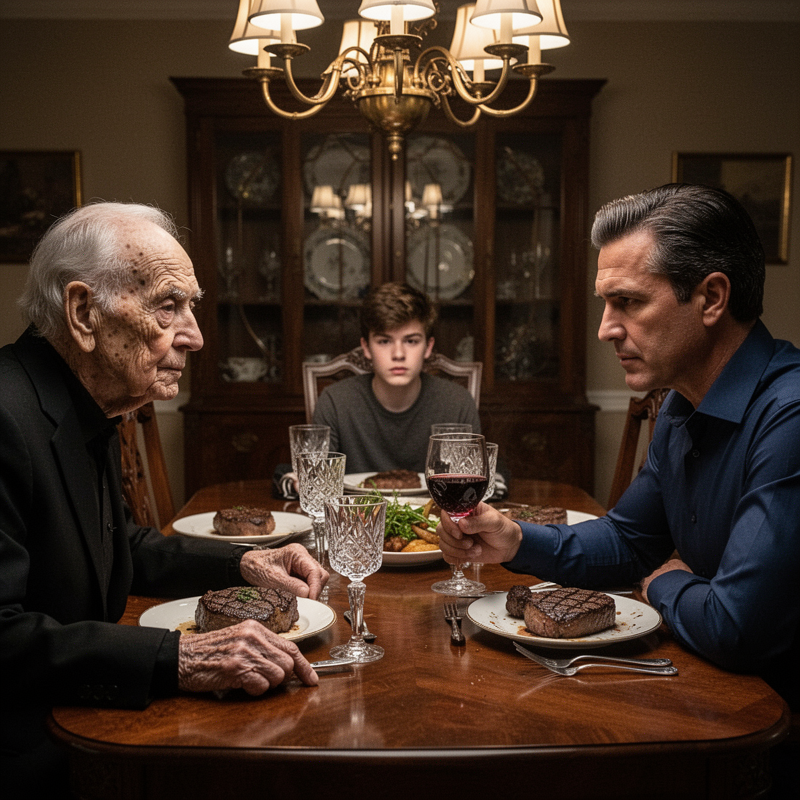
“Wait… are you actually paying rent to live in your own parents’ house?” my grandfather asked, setting down his fork during Sunday dinner. Before I could answer, my father casually waved his hand and interrupted, “Leo earns a good salary as an analyst, while his sister Megan has two kids to raise. She needs our financial support far more than he does.” I sat frozen in my chair as my grandfather’s eyes narrowed at my father. He slowly folded his napkin, placed it on the table, and said four words that transformed our entire family dynamic: “Richard, show me the deed.”
The clinking of silverware and the murmur of conversation that usually filled Sunday dinner at the Miller home in Austin abruptly ceased. My mother, Patricia, who had been laughing at something Megan’s husband, Derek, had said, visibly stiffened. Megan herself, mid-story about a new organic dog food brand she was promoting on her social media, paused, her phone half-raised to snap a picture of her plate.
All eyes were now on my father, Richard, who picked up his own napkin and began meticulously folding it, though his movements were far less deliberate than Arthur’s had been. A flush crept up his neck, just visible above the collar of his polo shirt.
“The deed, Richard,” Grandfather Arthur repeated, his voice low but cutting through the silence like a sharp blade.
“Arthur, please,” my mother interjected, her voice suddenly strained. “It’s Sunday dinner. Can’t we discuss this later? The kids are here.”
Megan’s six-year-old, Liam, looked up from his spaghetti with wide, curious eyes. His two-year-old sister, Clara, babbled happily in her high chair, oblivious to the sudden shift in atmosphere.
“This *is* the discussion, Patricia,” Arthur stated, his gaze not leaving my father. “My grandson just confirmed he’s sending you two $2,450 every month. I want to know why.”
My father finally looked up, offering a tight, forced smile. “Arthur, it’s nothing, really. Just Leo contributing a little to the household. He’s a grown man, he understands how expensive things are.”
He gestured vaguely around the dining room, as if the antique mahogany table and the crystal chandelier were direct evidence of financial hardship. This house, the very one we were sitting in, was valued at $680,000. It had always felt like a fortress of comfort and stability.
“Expensive?” Grandfather scoffed, a muscle twitching in his jaw. “Richard, this house has been paid off for twelve years. You haven’t had a mortgage payment since 2012.”
My mother let out a small, choked gasp. My father’s forced smile vanished, replaced by a dark scowl. He shot a furious look at Grandfather, a silent warning passing between them.
I felt a cold dread spread through my stomach. Paid off? For twelve years? My parents had always hinted at “rising property taxes” and “unexpected maintenance” as reasons for my monthly contribution. I had swallowed it, eager to help, to be a good son.
“Well, yes, but there are still… expenses, Arthur,” Richard stammered, his eyes darting to Megan, then back to my grandfather. “Upkeep. Utilities. And Megan, with her two children, needs constant support.”
Megan nodded emphatically, reaching for her wine glass. “It’s true, Grandpa. Leo’s being really helpful. We’re just trying to keep Clara and Liam in a good school district, you know? Organic everything adds up.”
Grandfather Arthur ignored her entirely. He leaned forward, his elbows resting on the table. “Richard, where is the original deed for this house? The one from when I bought it for your mother and me, and later signed over to you and Patricia?”
“It’s… in the safe deposit box at the bank, Arthur. Why does it matter?” Richard’s voice was tight, betraying a nervousness I’d never heard from him before.
“It matters,” Arthur said, his voice now a low rumble, “because when your grandmother, bless her soul, got sick, she and I established an irrevocable trust. A smart woman, your grandmother. Always thinking ahead.”
He paused, letting the words hang in the air. The silence in the dining room was so profound I could hear the faint hum of the refrigerator in the kitchen.
“On Leo’s 25th birthday, exactly two years ago today,” Arthur continued, his eyes now fixed on me, “she wanted to make sure he had a secure foundation. She put fifty percent of the property title of this very house into that trust, in Leo’s name.”
My breath hitched. My 25th birthday. I remembered that day. A small, quiet celebration. No mention of trusts. No mention of property. Just a new watch from my parents, a “welcome to true adulthood” card.
“Meaning, Leo,” Grandfather finished, his gaze sweeping from me to my father, who sat rigid and pale, “you already own half of this house.”
The words hit me with the force of a physical blow. I felt a sudden, disorienting rush of nausea. My own house. The house where I’d been diligently transferring $2,450 every month, believing I was helping my struggling parents. I was paying rent to live in a home that was half mine. My vision blurred for a moment, the faces around the table swimming out of focus. My mother’s eyes were wide with panic. My father’s jaw was clenched, a vein throbbing in his temple.
Arthur’s gaze landed on Richard, steely and unwavering.
“You’ve been charging Leo rent on his own property, Richard.”
Part 2
My head spun. The room seemed to tilt, and the indignant looks on my parents’ faces barely registered. All I could think about was the money, $2,450 every month, diligently sent, for two full years. Two years of paying for a house I already legally co-owned.
Grandfather Arthur wasn’t done. He pulled out his phone, his movements precise and calm despite the chaos he’d just unleashed. “Evelyn Vance,” he said into the receiver, his voice clear. “I need you to open up that trust ledger. Tonight. And I need a forensic accountant on retainer by morning.”
My mother burst into tears, dramatically burying her face in my father’s shoulder. Richard, still pale, glared at Grandfather. “Arthur, you’re overreacting! This is a family matter!”
“This stopped being a ‘family matter’ the moment you started defrauding your own son,” Arthur retorted, hanging up the phone. He turned to me, his expression softening slightly. “Leo, do not send them another penny.”
The very next day, a sharp, no-nonsense attorney named Evelyn Vance had retrieved the original trust documents. Marcus Reed, a forensic accountant with piercing eyes and a quiet demeanor, began to trace every single one of my payments.
It didn’t take him long. Four days later, Arthur called another impromptu family meeting, this time at Evelyn’s downtown office. My parents arrived looking defensive and angry. Megan and Derek, surprisingly, were also there, fidgeting nervously.
Marcus clicked through a projection of bank statements on a screen. “Mr. Miller, your $2,450 payments, totaling $117,600 over the past 48 months, were never deposited into any account associated with this property’s taxes, maintenance, or utilities.”
My heart hammered against my ribs. “Then where did it go?”
Marcus pointed to a line item. “Every payment was immediately funneled into a private LLC.” He clicked to another screen, displaying registration documents. “This LLC, ‘Influencer Innovations LLC,’ is registered under the names Megan Miller-Vaughn and Derek Vaughn.”
A stunned silence filled the room. Megan gasped, clutching Derek’s arm. Derek himself looked like a deer caught in headlights.
My mother’s tears suddenly dried, replaced by a furious flush. “That’s ridiculous! That’s Megan’s business account for her online boutique!”
“Your boutique, which you told me was funded by venture capital,” I said, my voice shaking with a mixture of betrayal and anger.
“It is!” Megan insisted, but her voice was weak. “This is a setup!”
Richard, however, had gone completely silent. His face was a mask of cold fury, but also desperation. He looked from Marcus to Arthur, then to me, a flicker of fear in his eyes.
Then, with a sudden, jerky movement, he reached inside his jacket pocket. His hand reappeared, clutching a neatly folded, printed paper document. “You’re all wrong,” he snarled, his voice trembling with forced defiance. “Leo knew exactly what he was doing. He signed a formal tenant contract, waiving his trust rights, agreeing to pay market rent.”
CHAPTER 2: A Signature Carved in Lies
Evelyn Vance held the printed sub-lease document under the bright kitchen light. Her pen point tracked down the second page, stopping at the bottom margin.
“The typography on page two does not match page one,” Evelyn said. She looked up at my father, her expression completely flat. “And the signature block lacks the standard notary seal required by Texas property law.”
My father stood by the counter, crossing his arms tight against his chest. “Leo signed that online two years ago. He was living under my roof, taking advantage of our hospitality.”
“I never signed a sub-lease, Dad,” I said.
Marcus Reed opened his heavy laptop on the dining table. He plugged in a portable flash drive containing the raw PDF file my father had sent to the bank.
“Let us look at the metadata,” Marcus said. His fingers tapped rapidly across the mechanical keyboard.
The screen flashed with lines of technical code. Marcus pointed his finger at a timestamp on the monitor.
“This PDF was generated three weeks ago,” Marcus said. “The signature image was cropped from a 2021 tax return file stored in your shared family drive. The resolution pixel density matches the tax form down to the single DPI.”
My father’s face turned blotchy and red. He cleared his throat loudly and took a step back toward the hallway.
“Fine,” my father said, his voice rising. “Maybe the paperwork was simplified for administrative convenience. But every dollar of that money went directly into maintaining this house. Roofing, plumbing, structural repairs. Do you have any idea what it costs to keep a property standing?”
My grandfather reached into his leather briefcase, pulled out a thick blue folder, and dropped it onto the glass table. The impact echoed across the quiet room.
“Every repair on this house since 2012 has gone through my personal desk,” my grandfather said. “Here are the original paid invoices from Texas Shield Roofing and Premier Plumbing. $34,000 in total. I paid every single cent out of my personal account.”
My father stared at the blue folder. He did not touch it.
“Where did my $117,600 go, Dad?” I asked.
He glared at me, his fists clenching at his sides. “You owe this family more than money, Leo.”
CHAPTER 3: The Group Chat Weapon
At 7:15 AM on Monday morning, my phone began vibrating continuously on my desk. Notifications flooded my screen in a rapid sequence.
Megan had posted a long text message in the Miller Family WhatsApp group, which included over twenty extended relatives across Texas.
“Leo is suing Mom and Dad to kick us out on the street,” the message read above a photo of her six-year-old son eating cereal. “He makes six figures in tech and wants to make his own nephew and niece homeless.”
Within twenty minutes, Aunt Sarah and Uncle David dropped aggressive messages into the chat.
“You should be ashamed of yourself, Leo,” Aunt Sarah wrote. “Family comes first. Your parents raised you.”
I sat at my desk, my chest tight, watching the messages pile up. My hands were cold.
My phone rang. It was my grandfather.
“Do not respond to a single message,” my grandfather said calmly over the speakerphone. “Come to my house.”
By noon, my grandfather sat at his dining table with Evelyn Vance and Marcus Reed. He reviewed a three-page certified summary of Marcus’s preliminary bank audit.
“Evelyn,” my grandfather said. “Send this summary to every person in that group chat. Then freeze Megan’s monthly trust disbursement check.”
“The $3,500 monthly living allowance?” Evelyn asked, opening her laptop.
“Effective immediately,” my grandfather said. “She wants to use public opinion as a weapon. She can feel the real weight of it.”
Ten minutes later, Evelyn dropped the certified audit report into the family WhatsApp group. The document detailed the exact transfers of my rent money directly into Megan and Derek’s private LLC account.
The group chat went completely silent. No one typed another word.
At 1:15 PM, Megan called my phone three times in a row. I did not answer.
CHAPTER 4: The Ghost Loan
On Wednesday morning, Marcus Reed handed me a printed credit report pulled from Equifax. He highlighted a line item near the middle of page four with a red marker.
“You need to look at this line, Leo,” Marcus said.
My eyes scanned the highlighted text. It showed an active Home Equity Line of Credit worth $45,000, opened eight months ago against the house address.
My name was listed as the primary guarantor.
“I never applied for a HELOC,” I said, leaning over the table. “I don’t even have a credit card with this lender.”
“The loan application was submitted digitally,” Marcus said. “The bank records show a signed trust consent form attached. Your mother’s handwriting is on the application witness line.”
“What about the contact phone number?” I asked.
Marcus flipped to the next page of the bank file. “The contact phone number on the loan application belongs to Derek Vaughn.”
I grabbed my coat and drove straight to my grandfather’s house. Marcus met us there with the bank’s withdrawal records.
The paper trail showed three major cash transfers from the $45,000 credit line within forty-eight hours of approval.
“Where did the money go?” my grandfather asked, his voice steady but low.
“The funds were wired to an off-shore payment clearing account in Curaçao,” Marcus said. “It is a third-party gateway used exclusively by Bovada and BetOnline.”
My grandfather looked at me. “Derek’s sports gambling debts.”
“Thirty-eight thousand dollars was cleared in a single week,” Marcus added. “The rest was pulled out in cash at an ATM three blocks from Derek’s apartment.”
I felt a cold lump form in my throat. They had attached forty-five thousand dollars of illegal debt directly to my legal identity.
CHAPTER 5: Locked Out at Dawn
I pulled into the driveway at 6:30 AM on Tuesday after finishing an overnight data integration shift at the office. The street was quiet, wrapped in morning fog.
I walked up the front steps and inserted my key into the deadbolt. The key turned halfway and stopped cold.
The lock had been replaced.
I walked around to the side entrance leading to my home office studio. That lock had been changed too, replaced with a heavy electronic keypad.
Inside that room sat three custom data servers worth $15,000, containing my independent consulting code and proprietary client databases.
The front door opened. My father stood in the doorway holding a single printed piece of paper.
“You don’t live here anymore, Leo,” my father said, extending the paper toward me. “This is a twenty-four-hour notice to vacate.”
“You changed the locks on property I legally own?” I asked, staying on the bottom step.
“You’re a tenant who refused to pay proper market rent,” he said. “You have until tomorrow morning to clear your clothes out of the garage. The office stays locked.”
I didn’t argue. I turned around, walked back to my car, and called Evelyn Vance from the driver’s seat.
By 8:15 AM, two Travis County Sheriff deputies pulled their cruisers into the driveway. Evelyn arrived two minutes later, holding a certified copy of the 1998 trust deed and the property title.
Deputy Miller walked up to my father on the porch.
“Sir, this young man is a registered fifty percent title owner of this residential property,” Deputy Miller said, pointing to the legal deed. “You cannot lock a co-owner out of his own premises without a district court order.”
“He’s my son!” my father shouted. “This is a family matter!”
“It is a legal matter, sir,” the deputy replied, placing his hand on his belt. “Open the doors immediately, or we will assist him in forcing entry to recover his property.”
My father stood frozen on the porch, his face pale, as he slowly pulled a ring of fresh keys from his pocket.
CHAPTER 6: Reclaiming the Steering Wheel
The Travis County Probate Courtroom was quiet at 9:00 AM on Thursday. Judge Patricia Hernandez sat behind the elevated wooden bench, reviewing the emergency petition filed by Evelyn Vance.
My father sat at the defense table beside his attorney, staring straight ahead at the courtroom wall.
Evelyn stood at the podium, placing three neat stacks of documents on the bench clerk’s tray.
“Your Honor,” Evelyn said. “We have submitted forensic proof of document forgery, an unauthorized $45,000 HELOC encumbrance against trust assets, and systemic conversion of property revenue.”
“Counsel,” Judge Hernandez said, turning her eyes toward my father’s attorney. “Has your client provided any documentation refuting the digital signature analysis?”
My father’s attorney stood up slowly. “Your Honor, my client acted in what he believed was the overall financial interest of the family household.”
“That is not a legal defense to identity fraud,” Judge Hernandez said sharply.
My grandfather walked slowly to the podium, leaning lightly on his cane. He picked up the microphone.
“Your Honor,” my grandfather said. “As the original grantor of the Miller Family Trust, I hereby formally invoke Clause 14B of the trust agreement.”
He paused, looking directly at my father.
“Clause 14B requires the immediate and mandatory removal of any trustee who commits intentional financial fraud against a named beneficiary,” my grandfather said.
Judge Hernandez reviewed the original trust charter, flipping to page twelve. She signed her pen across the official order with a firm stroke.
“The court finds cause,” Judge Hernandez stated. “Richard Miller is immediately removed as co-trustee of the property. Sole management authority is transferred jointly to Arthur Miller and Leo Miller.”
My father slouched forward in his chair, dropping his head into his hands.
CHAPTER 7: The Embezzled Vault
On Friday afternoon, Marcus Reed sat in my grandfather’s living room, surrounded by six years of secondary bank statements pulled under the new court order.
My mother, Patricia, sat on the edge of the sofa across from him. Her hands were trembling around a handkerchief.
Marcus pulled a red ledger spreadsheet up on his laptop screen.
“When Arthur established his medical reserve fund in 2021,” Marcus said, “he placed $100,000 into a restricted money market account for future home nursing care.”
My mother looked down at the floor, refusing to make eye contact with my grandfather.
“Over thirty-six months,” Marcus continued, “sixty-two thousand dollars was siphoned out of that medical account through small recurring transfers of $1,500 to $2,000.”
“Where did those transfers go, Marcus?” my grandfather asked.
“They were paid directly to wholesale clothing suppliers in Los Angeles,” Marcus said. “To cover unpaid inventory invoices for Megan’s boutique clothing line.”
My mother burst into sudden tears, pulling the handkerchief tight against her face.
“Megan was drowning, Arthur!” my mother sobbed. “Her business was going under! They were going to repossess her car! What was I supposed to do?”
“You stole from my medical fund to buy boutique dresses for a business that went bankrupt anyway,” my grandfather said, his voice terrifyingly quiet.
“I was going to put it back!” she cried. “As soon as her sales picked up, we were going to pay every dollar back!”
“That is grand larceny, Patricia,” Evelyn Vance said from the armchair near the door. “That is not a family mistake. That is a felony offense.”
My mother covered her face completely, sobbing loudly into the silence of the room.
CHAPTER 8: The Secret Listing
Evelyn Vance set a manila folder on the coffee table right in front of my mother.
“Patricia,” Evelyn said. “The district attorney’s office is reviewing the $45,000 HELOC identity theft documents as we speak. If you want any leniency regarding criminal charges, you need to tell us everything right now.”
My mother wiped her eyes with her damp tissue, looking nervously toward the front door. My father was not in the house.
“Richard had a plan,” my mother whispered, her voice barely audible.
“Speak clearly, Patricia,” my grandfather said.
“Richard signed an agreement with a real estate agent last month,” she admitted, her body shaking. “A private pocket listing for this house. Six hundred and eighty thousand dollars.”
I sat up straight on the chair. “He tried to sell the house behind our backs?”
“He was going to close the sale silently,” my mother said, looking at the floor. “He was going to use the liquid money to clear Megan’s debts and buy a townhome in Megan’s name.”
“And what was going to happen to Arthur?” Evelyn asked.
My mother swallowed hard, tears spilling over her cheeks again.
“Richard found a state-subsidized care facility in San Antonio,” she whispered. “He was going to move Arthur there at the end of the summer. He said… he said Arthur didn’t need a four-bedroom home anymore.”
My grandfather sat completely motionless in his armchair. His hands remained resting on his cane.
He did not yell. He did not raise his voice. He simply stared at his daughter-in-law with an expression of cold, utter finality.
“Thank you for telling us, Patricia,” my grandfather said quietly. “Now leave my house.”
CHAPTER 9: The Settlement and the Boundary
Three weeks later, we gathered in Evelyn Vance’s conference room downtown to sign the final settlement agreement.
My father sat on one side of the long oak table, looking noticeably thinner, signed paper documents stacked in front of his attorney.
Under the binding terms of the legal settlement, $162,600 was deducted directly from my father’s vested sales pension fund.
Out of that money, $117,600 was transferred into my personal investment account to repay four years of stolen rent. The remaining $45,000 was paid directly to the bank to satisfy the fraudulent HELOC loan in full.
To avoid criminal grand larceny charges for the medical fund, my mother signed over her full inheritance shares and surrendered her personal jewelry portfolio valued at $62,000 back to my grandfather.
Evelyn passed the final eviction notice across the table.
“Megan and Derek have exactly thirty days to clear all personal belongings out of the guest house,” Evelyn stated. “Their $3,500 monthly living allowance is permanently revoked.”
My grandfather picked up his pen and signed the bottom of the new master trust document.
The entire property title was formally transferred into a locked educational trust, dedicated exclusively to funding the future college educations of Megan’s two young children, completely out of reach of their parents.
My father looked at me across the table, his hand hovering over his pen.
“I suppose this means you’re done calling us your parents,” my father said, his voice bitter.
I looked at him, feeling no anger left in my chest—only a quiet, clear distance.
“I’m starting my own life now, Dad,” I said.
Two weeks later, I moved into a sunlit two-bedroom apartment in downtown Austin, using my recovered capital to launch my independent data analytics firm.
My grandfather came over on Sunday afternoon, bringing two cups of hot coffee. We sat on the balcony, looking out over the city skyline in peaceful silence.
A house built on silent sacrifice is just a prison with painted walls; true family begins only when you demand the keys to your own life.
Leave a Reply