CHAPTER 1: Five Seconds to Midnight in the Catskills
Part 1
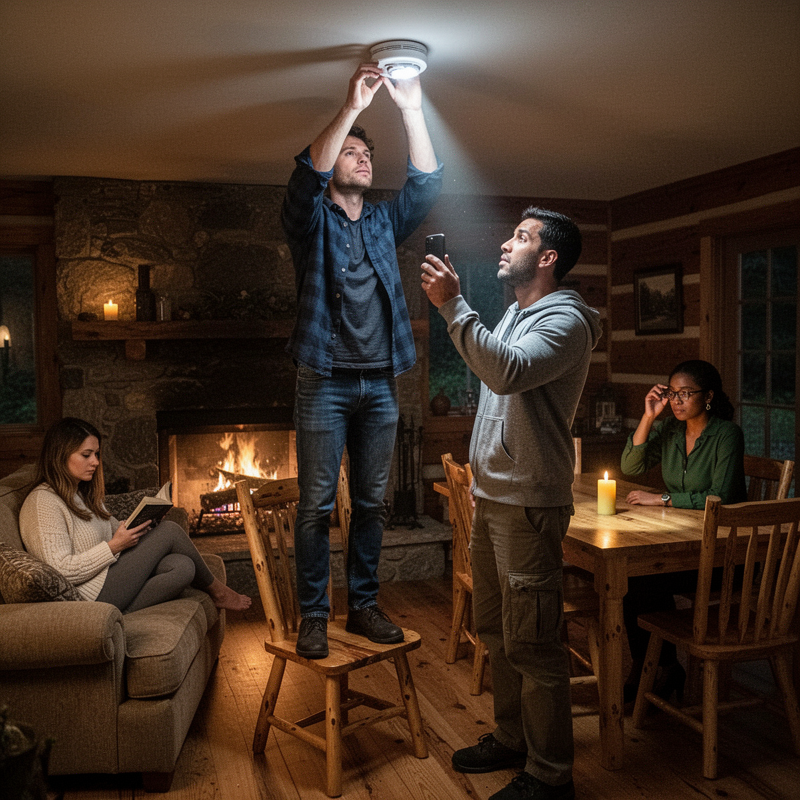
“Hold the flashlight steady, Marcus—it’s just a loose plastic housing chirping,” Tyler said, standing on top of the dining chair inside the secluded Catskills rental cabin. He twisted the round white smoke detector counterclockwise, expecting to find a drained nine-volt battery. Instead, thick copper wire harness slid out from the ceiling drywall, pulling down a brass cylinder filled with swirling amber liquid and a crimson LED display flashing “00:00:05.” Before anyone in the room could speak, a deafening mechanical whine erupted behind the walls, and heavy steel security shutters slammed down over every window and door in unison, locking four friends inside total darkness.
The fire in the stone fireplace had been a comforting presence just moments before. Now, its soft crackle seemed entirely out of place, a distant memory of peace.
Chloe had been laughing, a light, carefree sound that felt impossible to recall. She was curled on the plush sofa, lost in her paperback, completely oblivious.
Samira, ever meticulous, had been polishing her glasses, her movements calm and unhurried by the gentle glow of a beeswax candle.
Marcus, his hand still aloft, cast a wavering spotlight from his smartphone onto the ceiling. The chirping had been a minor inconvenience.
“Are you absolutely sure you know what you’re doing, Ty?” Marcus asked, his voice betraying a hint of unease. His hand holding the phone was noticeably less steady than before.
The irritating, rhythmic chirping had started around 11:15 PM, a relentless pulse from above the dining table. It had slowly but surely chipped away at their relaxed evening.
Tyler, always the one to tackle a problem head-on, had confidently declared it a simple battery issue. “It’s a classic Airbnb thing,” he’d said, pulling a sturdy pine chair to the center of the room.
He’d stretched, his fingers searching for purchase on the smooth, white plastic casing of the smoke detector. It looked larger than the standard ones he was used to, with a more modern, sleeker profile.
He felt a slight click.
Then, an unexpected resistance. It wasn’t the easy twist-and-pull mechanism he’d envisioned for a simple battery swap.
“Just give it a good tug, maybe?” Chloe suggested, looking up from her book with a faint smile. Her expression was one of mild amusement, completely unburdened.
Samira set her freshly cleaned glasses back on her nose, her eyes now intently fixed on Tyler. Her usual quiet demeanor seemed to hold a subtle tension.
Tyler gritted his teeth, applying more force. He heard a faint grinding sound from within the ceiling, a mechanical groan that seemed far too complex for a simple fixture.
Suddenly, the resistance gave way. Tyler stumbled, momentarily losing his balance on the wobbly chair.
He instinctively snatched his hand out to steady himself, bringing the detached device down with him.
It settled into his palm with an unexpected, heavy weight.
The white plastic cover, now fully separated, lay in two pieces. Beneath it, there wasn’t a battery compartment.
Instead, a dense tangle of thick copper wires snaked out.
These weren’t the standard thin gauge wires he recognized from household electronics. They were robust, almost industrial, braided tightly together.
They were connected to something else entirely.
A cylindrical object, crafted from gleaming brass, began to slide slowly out of the ceiling drywall. It descended, pulled by the taut copper harness.
It hung suspended in the air, rotating gently on its axis.
Inside the brass cylinder, a thick, viscous amber liquid swirled hypnotically. It caught the faint firelight, radiating an unsettling, internal glow.
But it was the small, rectangular panel embedded within the brass that instantly seized all of their attention.
A crimson LED display pulsed with stark, digital clarity.
“00:00:05.”
Chloe’s paperback slipped from her grasp, hitting the wooden floor with a soft, unnoticed thud.
Samira gasped, a sharp, choked sound, her hand flying to cover her mouth.
Marcus’s flashlight beam, which had been tracking Tyler’s every move, now centered on the terrifying device. His hand shook uncontrollably, sending the light dancing.
“What… what is that?” Chloe whispered, her voice barely a breath. The last vestige of her easy laughter had been brutally stripped away.
Tyler stared at the numbers. Five seconds. Then four.
He tried to force words out, but his throat felt constricted, suddenly bone dry. His mind, usually sharp and analytical from his biomedical lab days, raced through a dizzying array of impossible, horrifying possibilities.
This was no ordinary smoke detector. This was something far, far worse. Something alive and counting down.
“Get away from it, Tyler! Now!” Samira finally cried out, her voice cracking with raw panic.
“00:00:03.”
A deep, guttural growl ripped through the walls around them. It was a mechanical sound, monstrous and powerful, vibrating through the very air.
The entire cabin began to tremble. The wine glasses on the dining table chattered violently against the polished wood.
“What in God’s name is happening?” Marcus screamed, finally dropping the flashlight. It clattered to the floor, its beam spinning wildly, illuminating fleeting glimpses of frantic faces.
“00:00:02.”
The growl intensified, escalating into a deafening mechanical whine that seemed to emanate from every surface of the cabin. It felt as if the entire structure was on the verge of tearing itself apart.
Then, with a series of terrifying, bone-jarring clangs, four massive 4mm steel security shutters slammed down.
The first one descended over the front door, obliterating their only clear exit with a final, echoing crash that reverberated through the core of the house.
Another roared down over the large picture window facing the Catskills lake, plunging that entire side of the room into an instant, oppressive blackness.
The remaining two followed in rapid, earth-shaking succession, one sealing the back door, the other engulfing the smaller window in the kitchen nook.
Each impact sent a shudder through the very foundation of the building, a visceral blow.
The sudden, absolute absence of light was disorienting, suffocating. They were plunged into a darkness so complete it felt physical.
Tyler, still perched on the dining chair, lost his footing. He tumbled hard to the wooden floor, landing on his side, the brass cylinder still clutched in his trembling hand.
He scrambled to sit up, his heart hammering against his ribs, a frantic drum in the sudden, echoing silence.
A faint, crimson glow caught his eye.
Above him, still hanging by its thick, ominous copper wires from the ceiling drywall, the digital display on the brass cylinder pulsed.
“00:00:01.”
Part 2
The crimson glow on the ceiling vanished. The moment “00:00:01” disappeared, a sharp, pressurized hiss erupted from the brass cylinder still dangling from the wires. It wasn’t loud, but in the profound silence that followed the crashing shutters, it was unnervingly clear. A fine, almost invisible mist began to stream out of tiny vents along the cylinder’s sides, diffusing into the air around them.
Tyler, still disoriented on the floor, coughed, a dry, involuntary hack. A faint, unfamiliar scent reached him—something bitter, like almonds, but metallic, clinging to the back of his throat. He fumbled for his phone, frantically trying to locate it in the dark.
Then, one by one, beams of light cut through the black. Marcus’s phone, Chloe’s, and Samira’s illuminated the chaos. They found Tyler scrambling to his feet, the brass device now swaying silently above them. Their flashlights swept across the room, confirming their worst fears. The wide picture window was gone, replaced by a solid, unyielding sheet of dull gray steel. The front door, the back door, the kitchen window—all sealed tight by identical industrial panels. The cabin had become a windowless, doorless box.
The mist, catching the light, swirled around them, seemingly drawn towards the main HVAC return vent near the floor. It was a subtle current, but undeniable.
Samira, ever observant, lowered her phone, pointing its beam at the baseboards. “Look,” she whispered, her voice tight with terror. Small, round grates, barely noticeable before, now clicked open along the bottom of the walls. A faint, continuous suction noise emanated from them, like tiny, hungry mouths drawing in air. “It’s… it’s pulling the air back in,” she choked out, her eyes wide with dawning horror. “Our breath. It’s collecting our breath.”
Tyler watched the mist vanish into the return vent, then looked at the suction ports, then back at the now inert brass cylinder. The pieces clicked into place with sickening clarity. This wasn’t some accidental carbon monoxide trip, or a panic room for a paranoid owner. This was an airtight system. It was designed to trap and contain whatever had just been released into the air, with them inside it.
CHAPTER 2: The Almond Mist in the Air Ducts
I pulled the neck of my cotton t-shirt over my nose and mouth, grabbing Samira by the upper arm. “Master bathroom, right now!” I yelled over the echoing metallic thud that still vibrated through the floorboards. “Cover your faces! Don’t inhale deeply!”
We stumbled down the dark hallway, guided only by the shaky, bouncing beams of our phone flashlights. Marcus shoved past me, his shoulders trembling as he threw open the bathroom door.
I hauled two plush bath towels off the chrome rack, ran them under the sink cold water tap, and jammed them flush against the crack at the bottom of the door frame. “Seal it tight,” I said, my voice muffled by my shirt. “Samira, check the ceiling vents in here.”
“They’re pull-only,” Samira whispered, her light trembling against the white subway tile. Her chest was heaving in short, shallow gasps. “The baseboards are sucking air out. I heard three distinct mechanical solenoids click open near the floor.”
“It’s not an instant neurotoxin,” I said, leaning my back against the locked bathroom door. “If it were cyanide or sarin, we would already be convulsing. The bitter almond smell is an organic carrier solvent. It’s a bio-aerosol tracer engineered to bind directly to human airway lining for real-time biometric tracking.”
Chloe didn’t wait to discuss the chemistry. She lunged back into the dark living room, her beam locking onto the heavy iron fireplace poker resting by the hearth.
She slammed the sharp clawed end into the narrow seam where the 4mm industrial steel shutter met the wooden window casing. She threw her entire body weight onto the iron bar, her knuckles turning bone-white.
The metal didn’t yield a fraction of a millimeter. Instead, a sharp, two-tone electronic chime pierced the darkness from a hidden ceiling speaker.
“Structural pressure tampering detected on Zone 1 access vector,” a smooth, synthesized male voice announced from the ceiling. “Initiating secondary atmospheric containment. Ambient oxygen inflow restricted by twenty percent.”
A soft, low-frequency hiss started above our heads as the airflow noticeably weakened.
“My phone has zero bars,” Marcus stammered, holding his screen up to the dark ceiling. His face was slick with sudden sweat. “Not searching for service, not SOS—it says jammed. Completely blocked.”
“It’s an active localized signal blocking box,” Samira said, her fingers tapping rapidly on her phone screen as she checked the network diagnostics. “A broad-spectrum radio frequency jammer hidden directly inside the cabin walls. We aren’t getting a call out to emergency services.”
“Then we don’t look for a signal,” I said, turning toward the kitchen. “We look for a way down.”
CHAPTER 3: Telemetry on the Cellar Rack
In the back corner of the kitchen, beneath a heavy woven area rug, Chloe spotted a recessed steel ring handle flush against the oak floorboards.
She didn’t hesitate. Swinging a heavy cast-iron skillet from the counter, she smashed the decorative brass padlock securing the hatch in two hard, ringing blows.
The wooden cellar door creaked open, exhaling a draft of cold, damp air that smelled of wet earth and copper. I led the way down eight narrow wooden steps, my flashlight beam cutting through the damp darkness of an unfinished stone basement.
There were no circuit breakers or emergency toolkits down here. Instead, mounted flush against the far stone wall, stood an industrial steel server rack, its cooling fans humming quietly in the chill air.
“This isn’t a residential setup,” Chloe whispered, stepping around a stack of dry cedar firewood.
Four high-frequency bio-telemetry receivers glowed behind tinted glass panels. Beside them, an integrated digital monitor panel flickered with four distinct live graph lines, displaying continuous real-time data waves.
I stepped closer to the glass screen, my pulse hammering in my throat. The four display rows were labeled with precise digital tags, tracking heart rates, skin core temperatures, and blood-oxygen saturation levels down to the decimal point.
“Look at the upper right quadrant,” I said, pointing a finger at the top line. “Heart rate 114, blood oxygen ninety-seven percent, skin temp ninety-eight point six. That’s my exact resting profile right now.”
“They’re monitoring our vitals,” Samira breathed, stepping back as if the machine itself might touch her. “How is it picking us up through the floorboards?”
I leaned down and examined the rear ethernet assembly plugged into the primary sub-router. A tiny green link light flickered rapidly at five-gigahertz intervals.
“The mesh processors inside the smoke housing,” I said, reading the raw diagnostic text scrolling across the bottom log terminal. “The micro-aerosol we inhaled acts as an acoustic responder. It amplifies cellular vibrational signals and bounces them straight to these receivers.”
I tapped the terminal spacebar to pull up the active routing table.
“The local data isn’t staying in the Catskills,” I said, watching an encrypted IP packet stream refresh every two seconds. “It’s being uploaded live via a roof-mounted satellite dish directly to a dark-web telemetry server registered in Zurich, Switzerland.”
CHAPTER 4: The Intercom Demand
Before Chloe could swing her iron poker into the glass front of the server rack, a harsh metallic static burst from a small black intercom speaker mounted above the basement stairs.
“I wouldn’t damage the rack hardware if I were you, Tyler,” a calm, digitally flattened male voice said through the grille.
Marcus froze, his flashlight beam dropping to his boots. “Who is that? Are you the Airbnb host?”
“You may address me as Host Julian,” the speaker replied smooth and unhurried. “What you experienced upstairs was an automatic safety lockdown triggered by unauthorized tampering with property safety equipment. The cabin is currently sealed under emergency protocol level four.”
“Let us out of here right now!” Chloe roared, taking two steps toward the speaker. “There are four of us, and we will break this entire house down board by board!”
“You will exhaust your remaining oxygen long before you clear a single steel plate, Miss Bennett,” Julian answered. “The airborne containment system will execute a full toxic gas scrub unless a manual override code is entered.”
He paused, the light static humming on the line.
“I am prepared to issue a remote release code immediately. My offshore wallet address has just been transmitted to the local terminal display. The price for your release is fifty thousand dollars in un-traceable Bitcoin, payable within thirty minutes.”
“Fifty grand?” Marcus gasped, his voice cracking violently. “We don’t have that kind of money!”
I held up a hand, signaling everyone to remain completely silent. I leaned my ear closer to the metal speaker enclosure, listening intently to the subtle ambient sound behind Julian’s voice.
Beneath the faint digital filter, I heard a distinct, rhythmic sound—a double hooting call of a eastern screech owl echoing softly in the background audio layer.
At that exact second, the same hollow hoot echoed directly through the high stone foundation vent from the dark forest outside the cabin.
“He’s lying,” I whispered quietly to the group, pointing my thumb toward the cellar ceiling. “He’s not sitting in a control center in Europe or managing an automated property management system. The audio lag is less than fifty milliseconds. He’s standing outside right now on this twelve-acre lot.”
CHAPTER 5: The Owner in the Pantry
“If he’s sitting outside watching us,” Chloe said, her voice dropping to an intense whisper, “he’s not going to unlock those doors even if we give him fifty thousand dollars.”
“We need structural access to the outer wall framing,” I said, turning away from the intercom.
We followed the stone foundation wall down a narrow side corridor behind the stairs. At the far end stood a reinforced steel pantry door secured by a double commercial deadbolt.
“This wasn’t on the rental listing floorplan,” Samira said, pointing her light at the raw steel door frame set into the rough fieldstone.
Chloe stepped forward with a three-foot iron crowbar we pulled from the woodpile. She jammed the wedge end directly into the strike plate gap and braced her foot against the stone masonry.
With a brutal metallic screech that echoed down the corridor, the secondary deadbolt sheared clean through its brass housing. The thick door swung open on heavy grease hinges.
Cold air hit us instantly—a deep, unnatural freeze that made our breath plume into white clouds.
Inside the small, windowless storage room, resting on a stainless steel prep table beneath a stiff blue plastic tarpaulin, lay a heavy human shape.
I reached out and pulled the edge of the blue tarp back.
Beneath the plastic lay the frozen body of an older man with gray hair, dressed in a faded red flannel shirt and heavy canvas work pants. His skin was pale and dusted with frost.
“Oh god,” Samira gasped, clapping both hands over her mouth as she stumbled backward against the door frame.
I pulled a wallet from the jacket pocket on the body and opened the clear plastic driver’s license sleeve under my flashlight beam.
“Arthur Pendelton,” I read aloud, my voice flat. “Age sixty-two. This is the real property owner listed on the Ulster County land records.”
I pulled out a folded tax assessment document tucked behind his license, dated eight months ago.
“‘Host Julian’ didn’t build this cabin,” I said, looking up at the cold ceiling joists. “He murdered Arthur eight months ago, took over the property listing, and turned this entire remote vacation rental into an active, live-subject bio-testing lab.”
Above us, a heavy solenoid valve slammed shut with a metallic bang, and the faint hum of circulating fresh air died completely.
CHAPTER 6: Heat in the Airflow
“He cut the passive intake,” Chloe said, looking up as the dust in the air settled motionless. “We’re on sealed internal air now.”
“The primary manual shutter controls have to run off a centralized low-voltage relay panel,” I said, racing back up the cellar stairs into the dark main entryway. “If I can short the primary twenty-four-volt loop, the system defaults to a fail-open emergency position.”
I used the claw end of the fireplace poker to tear open a three-foot section of drywall right next to the front door frame.
Behind the plaster, a heavy yellow plastic junction box held three thick bundles of color-coded copper wiring. My biomedical equipment training kicked in—I identified the high-gauge blue control wire that fed the primary magnetic shutter catches.
“Hold your breath,” I told Chloe.
I jammed the steel tip of the poker directly across the exposed copper terminal terminals to ground the circuit.
A bright blue electric arc flashed across the dark hall, snapping like a firecracker.
Instantly, wild yellow alarm strobes began flashing across every ceiling panel, and a deafening, two-tone siren started wailing at two-second intervals through every room.
High above our heads, the industrial HVAC blower didn’t shut down—it screamed to life at maximum velocity.
“Warning,” the automated system voice boomed through the screeching sirens. “Control circuit breach detected. Initiating environmental thermal purge sequence.”
Within ten seconds, the air coming out of the ceiling vents turned violently hot. A blast of dry, searing heat hit my face like opening an oven door at maximum temperature.
The digital temperature gauge on the hallway wall began ticking upward at an alarming rate: 88°F… 95°F… 102°F.
Julian’s voice returned over the blaring alarm system, cold and mockingly amused.
“A crude electrical hack, Tyler,” Julian said. “You just activated the thermal sterilization protocol designed to destroy all biological sample residue. The cabin interior will reach one hundred and thirty degrees Fahrenheit within thirty minutes. You will bake inside your own quarantine box.”
CHAPTER 7: The Voice on the Mesh
The air in the living room grew thick and stifling, the wooden floorboards warm to the touch. Samira collapsed onto her knees near the couch, her skin flushed dark red, panting heavily as the ambient temperature crossed 112°F (44.4°C).
“I can’t… I can’t catch my breath,” Samira wheezed, clutching her throat. “The heat… it’s drying out my lungs.”
“Stay low on the floor!” I shouted, pulling her up by her armpits and dragging her toward the cooler stone tiles of the kitchen. “The hot air rises!”
Samira pulled her laptop out of her backpack with trembling, sweat-slicked hands. “The cellular band is jammed… but raw low-level Bluetooth diagnostic utility protocols operate on an un-monitored sub-layer.”
She popped open a terminal window, running a raw hardware MAC address scan across local unlicensed spectrums.
A single open local mesh node flashed onto her screen: `OVERRIDE_DEV_99`.
Before she could type a command, a text terminal window forced itself open on her desktop, scrolling plain white text across the black screen.
`DON’T ANSWER THE INTERCOM,` the message read. `THIS IS GEARS. I DESIGNED THE SHUTTER ACTUATORS FOR THIS SITE.`
Samira typed back frantically: `WHO ARE YOU? WE ARE DIEING IN HERE. IT’S OVER 115 DEGREES.`
`MY NAME IS VANCE KOWALSKI,` the text replied. `I LIVE IN A TRAILER TWO MILES DOWN BEAR MOUNTAIN ROAD. JULIAN HIRED ME THREE YEARS AGO TO BUILD HIGH-SECURITY PANIC SHUTTERS FOR A Supposed EXECUTIVE ESTATE. HE STOLE MY AUTOMATION PATENTS AND MODIFIED THE INSTALLATION.`
I leaned over Samira’s shoulder, staring at the screen. “Ask him what was in the ceiling cylinder!” I yelled over the roar of the hot air vents.
`AEGIS BIO-LABS FORMULATION 99,` Kowalski’s message scrolled. `IT’S AN EXPERIMENTAL SYNTHETIC RNA TRACER AEROSOL. HE’S RUNNING LIVE FIELD TRIALS ON UNMONITORED SHORT-TERM RENTERS TO SELL TRANSMISSION DATA TO OFFSHORE BUYERS. YOU HAVE TO TRICK THE CENTRAL ATMOSPHERIC LOGIC BOARD.`
`HOW?` Samira typed back, her tears evaporating almost instantly on her hot cheeks.
`THE SYSTEM IS PROGRAMMED TO PROTECT ITSELF FROM STRUCTURAL FIRE DAMAGE,` Kowalski responded. `IF YOU TRIGGER A CATASTROPHIC HULL-FREEZE FAULT AT THE MAIN RETURN SENSOR, IT THINKS THE OUTER FRAME HAS CRACKED OPEN AND IT WILL TRIP THE EMERGENCY OVERPRESSURE EXHAUST VENTS TO PREVENT VACUUM IMPLOSION.`
CHAPTER 8: The Nitrogen Trick
“A catastrophic hull-freeze,” I repeated out loud, the ambient heat now reaching a brutal 118°F (47.7°C). Sweat was dripping continuously into my eyes, stinging them shut.
I slammed my hand down on the kitchen counter. “The culinary Dewar tank!”
“What?” Marcus yelled, slumping against the lower cabinets, his shirt completely soaked through.
“The catering listing!” I shouted, sprinting back toward the cellar stairs. “The fake Airbnb profile advertised a luxury molecular gastronomy kitchen setup down in the lower prep area!”
I crashed down the basement stairs, my lungs burning with every breath of hot air. In the corner of the cold storage pantry, tucked behind a steel shelving unit, stood a heavy twenty-liter stainless steel Dewar flask filled with liquid nitrogen, fitted with a brass transfer valve.
I grabbed the insulated rubber carrying handles and hauled the eighty-pound container up the wooden cellar steps, my muscles straining against the weight.
“Chloe! Get the stepladder!” I roared.
Chloe slammed the aluminum ladder down beneath the main HVAC return duct on the living room ceiling.
I climbed to the top step, hoisting the heavy cryogenic tank onto my shoulder. The main sensor probe—a small brass tip wire—protruded through the center of the return intake vent, glowing faintly blue under the heating system’s diagnostic power.
I twisted the Dewar valve wide open.
A white cloud of sub-zero cryogenic fog erupted from the nozzle with a deafening freeze roar. I dumped three gallons of pure liquid nitrogen directly onto the brass sensor assembly.
The reaction was instantaneous.
The brass probe frosted over in a fraction of a second, coating in thick white ice as its local micro-environment plummeted instantly to -40°F (-40°C).
High above us, the master logic board malfunctioned under the impossible mathematical conflict: ambient internal air reading 120°F while the primary structural core sensor registered minus forty.
A sharp, mechanical warning horn blasted three loud bursts.
“Catastrophic structural hull breach detected,” the automated system voice announced, glitching violently. “Initiating emergency pressure equalization.”
With a heavy pneumatic hiss, a two-foot-wide emergency exhaust flap on the lower kitchen wall unlocked and slid open, exposing a twenty-four-inch square opening directly to the cool, crisp night air of the Catskills.
CHAPTER 9: The Perimeter Wall
“Out! Everyone out now!” I screamed, pulling Samira toward the opening.
Chloe shoved Marcus through the twenty-four-inch portal first. He tumbled out onto the damp, muddy grass outside, coughing violently as he drew in his first breath of cold, forty-five-degree outdoor air.
Samira squeezed through second, followed closely by Chloe. I threw my legs through the vent last, kicking myself clear of the scorching kitchen, and tumbled shoulder-first into the cold mud.
I lay on my back for three seconds, gasping at the freezing air, my chest heaving as the cold wind chilled the sweat clinging to my skin.
“We have to hit the mountain road,” I said, forcing myself up and grabbing Samira’s arm. “Kowalski said his trailer was two miles down.”
We sprinted blindly through the pitch-black woods, using the moonlight filtering through the bare autumn trees.
We hadn’t run seventy yards through the brush before Marcus slammed full-force into a heavy metallic barrier, bouncing backward onto the leaf-covered ground with a painful groan.
I flashed my phone light ahead.
Stretching as far as the eye could see through the dense timber stood a ten-foot-high heavy chain-link perimeter fence topped with razor wire.
Mounted every twenty feet along the top rail were heavy grey acoustic horn speakers, humming with a low-frequency vibration that made the teeth in my jaw ache.
“Get back!” I shouted, but it was too late.
As Chloe took two steps closer to examine the wire, the acoustic emitters unleashed a concentrated pulse of high-frequency directional sound.
A wave of intense, sickening nausea hit me instantly, driving me to my knees. My ears burst with excruciating pain, a sharp metallic taste filling my mouth as blood began trickling from my left nostril.
“It’s an acoustic shock-fence,” I gasped, pressing both hands against my ears, unable to stand upright.
Bright white LED spotlights suddenly lit up the dark tree line behind the fence, blinding us completely.
Four men in tactical black uniforms carrying modular carbine rifles stepped out from the darkness of the woods, wearing fake New York State Park Ranger patches velcroed to their chest vests.
“Hands on your heads! Down on your knees right now!” the lead guard bellowed through a megaphone. “Do not move or lethal force will be authorized!”
CHAPTER 10: The Burning Mandate
We raised our trembling hands, dropping into the cold mud near the base of the acoustic fence line.
The lead tactical guard stepped up to the chain-link mesh, raising an industrial tactical radio to his collar mic.
“Host Julian,” the commander said into the radio, his voice flat and impersonal. “Subjects have breached primary structural containment. They are corralled at perimeter sector four.”
A frantic, high-pitched voice screamed back over the speaker from Julian’s radio channel.
“Recapture them!” Julian yelled from his hidden underground bunker beneath the detached garage. “Get them back into the lower holding cell before they ruin the entire trial dataset!”
The mercenary commander unclipped a heavy thermite canister from his tactical belt, looking down at us with zero emotion.
“Negative, Julian,” the commander said calmly into the radio. “You triggered a level-four containment failure. Aegis corporate directives are explicit. Protocol requires total site incineration to prevent federal data capture.”
“What?!” Julian screamed over the radio link, his voice breaking into a terrified screech. “You can’t burn the site! I’m still inside the subterranean server vault! Unlock the hatch!”
“Your contract has been terminated, Dr. Vance,” the commander replied, tossing the radio onto the ground. He turned to his three men. “Set thermite charges along the cabin foundation and prep the subjects for disposal.”
I stared at Marcus. He was sitting on his knees in the mud, but he wasn’t shivering, and he wasn’t looking at the armed guards. His head was bowed, tears streaming down his mud-streaked face.
“Marcus?” I whispered, my voice trembling. “What is this?”
Marcus covered his face with his hands, sobbing openly. “I’m sorry, Tyler… I’m so sorry. I owed them one hundred twenty thousand dollars… illegal sports gambling debts to a dark-web collection broker.”
Chloe stared at him in utter disbelief. “You brought us here?”
“They told me all I had to do was select this specific rental link and make sure four people with rare blood types checked in by 10:00 PM!” Marcus wept, shaking uncontrollably. “They said it was just a harmless sleep study monitor! I didn’t know!”
He suddenly lifted his head, looking me straight in the eye.
“But I couldn’t do it, Tyler,” Marcus whispered, his hand reaching into his ripped jacket pocket. “Two hours before dinner… while you guys were unpacking… I snuck up into the attic crawlspace.”
He pulled out a small, empty glass cylinder stamped with a bio-hazard symbol.
“I swapped the viral RNA aerosol cylinder with a sterile saline and salicylic acid mixture I bought at the pharmacy in town,” Marcus confessed, his voice breaking. “The tracer in your lungs is completely harmless salt water.”
He reached into his phone casing and pulled out a small, glowing green circuit chip.
“And when I realized what Julian was doing,” Marcus added, snapping the plastic casing to activate the internal battery, “I activated a federal emergency tracking beacon I took from my uncle’s state police depot.”
CHAPTER 11: Hazmat Raid on Bear Mountain
Before the mercenary commander could raise his rifle toward Marcus, the night sky above the forest exploded with deafening, thunderous noise.
Two black, unmarked Sikorsky UH-60 Black Hawk helicopters dropped straight out of the low cloud cover directly over the cabin clearing, their heavy rotor wash flattening small trees and whipping clouds of mud and leaves into a blinding storm.
Blinding ten-million-candlepower searchlights pinned the four armed mercenaries in place, flooding the perimeter in daylight.
“FEDERAL AGENTS! DROP YOUR WEAPONS IMMEDIATELY!” a voice boomed from the lead helicopter’s PA system.
Fast-ropes dropped from both side doors, and twelve heavily armed tactical operators wearing full CBRN bio-hazard suits and FBI Bio-Terrorism Task Force patches slid down to the ground, landing with disciplined precision.
“DROP THE WEAPONS! ON THE GROUND NOW!”
The four private mercenaries slammed their carbines into the mud, throwing their hands into the air as FBI agents swarmed them, forcing them face-down and zip-tying their wrists behind their backs within ninety seconds.
A secondary tactical unit carrying heavy hydraulic breaching gear sprinted toward the detached garage on the estate property.
They slammed a hydraulic ram into the concrete floor hatches beneath the garage workbench, blowing the reinforced steel lock pins clean through the frame.
Two minutes later, federal agents dragged a screaming, soot-covered Dr. Julian Vance out of his subterranean control room, kicking and thrashing as he was shoved face-first onto the hood of an armored tactical truck.
Agent Rachel Vance, leading the federal strike team, unclipped her radio as hazmat forensics teams secured three glowing server towers pulled directly from Julian’s bunker.
“Command, this is Field Unit One,” Agent Vance reported into her headset. “We have secured the site. Target Julian Vance is in custody. Offshore dark-web crypto wallets totaling fourteen point two million dollars have been successfully seized and frozen by federal cyber units.”
CHAPTER 12: Markers in the Blood
Six weeks later, the air inside the federal bio-quarantine facility in Albany, New York, smelled of harsh industrial antiseptic and clean linen.
I sat on the edge of a stainless-steel examination table, watching a white-coated federal medical technician draw three vials of clear blood from my inner arm. Chloe sat beside me, sipping water from a paper cup, while Samira rested quietly in an armchair nearby.
Marcus was not in the room with us. He was currently held in a secure federal detention wing three floors down, awaiting formal sentencing for his initial involvement in the syndicate recruitment scheme.
Thanks to his last-minute swap of the aerosol cylinder and his activation of the federal beacon, federal prosecutors had agreed to a reduced plea arrangement of three years in federal prison.
The heavy glass door slid open, and Agent Rachel Vance stepped into the room holding three thick medical file folders.
“Your final blood panels just cleared secondary verification,” Agent Vance said, placing the folders on the stainless-steel table. “Dr. Julian Vance and three corporate officers from Aegis Bio-Labs have been formally indicted under federal bio-terrorism and murder statutes. Aegis has been slapped with forty-five million dollars in federal court fines and permanently shut down.”
“When do we get to go home?” Chloe asked quietly, her voice still carrying a faint rasp from the thermal damage to her throat.
Agent Vance looked at the three of us, her expression heavy with uncomfortable truth.
“You’re cleared for physical release today,” she said slowly. “Marcus’s swap saved your lives—you didn’t inhale the active viral agent. But the synthetic salicylic carrier compound he used carried a proprietary industrial marker fluid.”
She pulled up an X-ray scan on her tablet, showing three bright, luminescent micro-particles permanently bonded to the lining of our bronchial tissue.
“The synthetic markers are completely non-toxic,” Agent Vance explained gently. “They won’t cause physical illness. But they will trigger high-sensitivity biological detection equipment at airports, international borders, and federal facilities for the rest of your lives. You will be required to carry federal medical clearance documentation everywhere you travel.”
I looked out the high glass window of the facility at the distant blue ridge of the Catskill Mountains resting against the autumn horizon.
We had survived the trapped cabin, exposed an international crime ring, and brought down the men who tried to sell us as experimental data. But as I took a deep, clear breath of sterile hospital air, I felt the permanent metallic prickle deep in my lungs.
They built a vault to study us like lab specimens, forgetting that trapped creatures eventually learn how to dismantle the cage from the inside.
Leave a Reply