CHAPTER 1: The Eight-Word Warning at Thirty-Seven Thousand Feet
Part 1
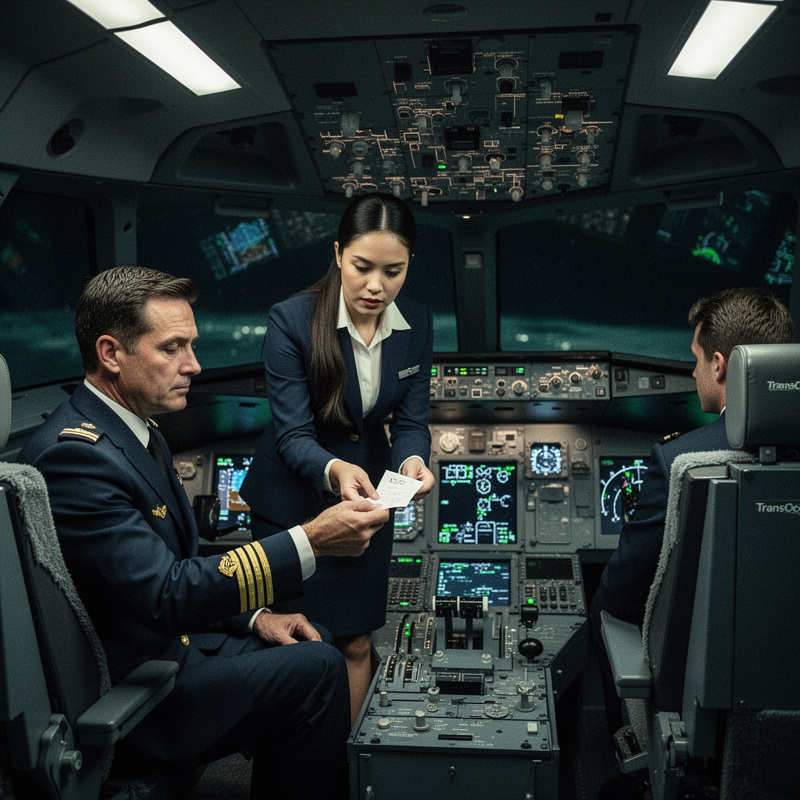
“Captain, you need to read this immediately, before you make the scheduled position report to Gander ACARS,” Purser Sarah Lin whispered, sliding a folded piece of thermal printer paper into Captain Thomas Vance’s palm inside the cockpit of TransOceanic Flight 412. Thomas opened the slip at 37,000 feet over the North Atlantic to find eight words printed in red ink: “All business class passengers are dead people.” When he pulled up the digital passenger manifest for seats 1A through 4K, all 14 faces matched official US National Transportation Safety Board deceased profiles from disasters occurring between 2018 and 2023. Before Thomas could hit the silent hijack transponder code, his co-pilot reached down and unclipped his holster.
I stared at the thermal paper in my palm.
The red ink looked fresh, almost wet under the dim green glow of the flight deck instruments.
“All business class passengers are dead people.”
Outside the cockpit windshield, there was nothing but black ocean seven miles below us.
The twin GE90 engines hummed at a steady ninety-two percent power, pushing our Boeing 777 through the night at five hundred and thirty knots.
Sarah Lin stood beside my left shoulder.
Her hands gripped the back of my seat so tightly her knuckles were white.
“Where did you get this, Sarah?” I asked softly.
“Emergency medical kit in the forward galley,” she whispered. “Inside the automated defibrillator case.”
Her voice trembled.
“I opened it to check the seal like I do every flight. The paper was folded inside the battery compartment.”
I looked at the flight display clock.
02:14 UTC.
We were forty minutes away from the Gander Oceanic FIR boundary.
In eight minutes, air traffic control would expect our routine position report over waypoint 50N 030W.
I pulled my electronic flight bag tablet out of its cradle.
My thumb swiped across the glass, opening the secure passenger manifest for TransOceanic Flight 412.
Business class consisted of four rows in a two-by-two configuration.
Fourteen occupied seats.
I tapped on Seat 1A.
A high-resolution passport photo popped up on the screen, accompanied by a name: Marcus Thorne.
He was fifty-two years old, listed as a corporate consultant traveling to London on a standard business visa.
I opened the secondary encrypted NTSB archive tab on the airplane’s satellite communications system.
My fingers flew across the glass keying in Thorne’s full legal name and Social Security number.
The database loaded in three seconds.
A bright red banner flashed across the top of the tablet screen:
*CASE CLOSED — DECEASED.*
I stared at the screen.
According to the federal record, Marcus Thorne had died on October 14, 2021.
He had been a passenger on a private twin-engine Beechcraft that crashed into a mountain ridge in western Pennsylvania.
No survivors.
I tapped Seat 1K.
*CASE CLOSED — DECEASED.*
Died in a chartered flight crash off the coast of South Carolina in August 2019.
I tapped Seat 2A.
*CASE CLOSED — DECEASED.*
Died in an engine fire over Ohio in June 2018.
My throat went completely dry.
One by one, I tapped through every seat from 1A to 4K.
All fourteen passengers currently sitting in our upper cabin, sipping champagne and eating warm nuts thirty-seven thousand feet above the Atlantic, were dead on paper.
They had all died in small aviation disasters over the last five years.
Every single case had been investigated, closed, and sealed by federal authorities.
I scrolled down to the bottom of the fourth digital death certificate.
My breath caught in my chest.
Beneath the seal of the state medical examiner’s office, there was a digitized signature written in sharp, familiar blue cursive.
*Dr. Julian Vance, M.D.*
My mind went completely numb.
Julian.
My younger brother.
Three years ago, Julian had been the chief medical examiner in Delaware before he vanished from public life after a high-profile corruption scandal ruined his career.
We hadn’t spoken since the funeral of our father.
I swiped to the next record.
Seat 2B.
*Certified by: Dr. Julian Vance.*
Seat 3A.
*Certified by: Dr. Julian Vance.*
Every single one of the fourteen fake death certificates bore my brother’s legal signature and official medical seal.
This was no coincidence.
Someone had handpicked this airplane, this flight crew, and this route.
“Thomas…” Sarah whispered, her thumb pressing hard into my shoulder pad. “What is happening?”
“Don’t go back out there yet,” I said softly, keeping my eyes fixed on the navigation display. “Act completely normal. Make sure the curtain between galley one and business class stays pulled.”
“Captain,” she said, her chest heaving slightly. “Who are those people?”
“I don’t know,” I said. “But my brother certified their bodies.”
To my right, First Officer Mark Davis sat in the co-pilot’s seat.
His eyes were fixed straight ahead on the dark horizon.
He hadn’t said a word since Sarah walked into the flight deck six minutes ago.
Mark was thirty-four years old, a former military transport pilot who had joined the airline two years prior.
He was usually talking constantly about his sports bets or his upcoming boat payment.
Tonight, he was stiff.
His hands rested flat on his thighs, his knuckles white against his black uniform trousers.
“Mark,” I said, keeping my voice steady and professional. “Did you review the secondary customs manifest before we pushed back from the gate in Newark?”
Mark didn’t turn his head.
“Customs was cleared, Thomas,” he said. His voice was flat, totally devoid of tone. “Everything was green.”
“Fourteen dead people just walked onto our plane, Mark,” I said.
A heavy silence settled over the cockpit, thick and suffocating over the hum of the air conditioning vents.
Outside, a soft patch of light turbulence bumped the airframe, making the control yokes twitch slightly in our hands.
I looked down at the transponder control panel situated on the center pedestal between our seats.
The transponder code was currently set to 5214, assigned by New York Center before departure.
If I turned the small black knob four clicks to the right, I could enter code 7500.
Code 7500 instantly broadcasts an automated, un-silenced hijack alert directly to every military air defense radar station in North America and Western Europe.
It bypasses all radio communications.
It requires no verbal confirmation.
I slowly shifted my weight in the left seat.
My hand drifted off the thrust levers, sliding silently down toward the center pedestal.
My fingers hovered three inches above the transponder keypad.
*Click.*
The sound was small, but sharp enough to cut clean through the engine rumble.
It was the distinct mechanical snap of a heavy leather holster strap releasing.
I froze.
My hand stopped in mid-air.
Beside me, Mark slowly turned his head.
His face was completely pale in the faint green glare of the primary flight displays.
His right hand was tucked down beside his right hip, drawing a black Sig Sauer 9mm pistol from his Federal Flight Deck Officer holster.
Sarah let out a sharp, choked gasp behind me.
“Don’t touch that dial, Thomas,” Mark said softly.
He brought the weapon across the center console, keeping the barrel angled downward so it couldn’t be seen from the cockpit door window.
He pressed the cold steel muzzle directly into the right side of my ribs.
The pressure was hard enough to bite through my cotton shirt and bruise the bone underneath.
“Mark, what the hell are you doing?” I said, keeping my hands entirely visible above the glare shield.
“Take your hand away from the pedestal,” he commanded, his thumb sliding the thumb-safety off with a heavy click.
“Mark, put that down!” Sarah cried out, taking a step backward toward the flight deck door.
“Stay right where you are, Sarah!” Mark yelled, his head snapping toward her for a split second. “If you unlock that door or touch the interphone, I will shoot him in the side and take this aircraft down myself!”
Sarah froze, her hand hovering over the door keypad, tears brimming in her eyes.
I felt the metal of the barrel push deeper into my ribs.
“Look at me, Thomas,” Mark whispered, his breath coming faster now, hot against my cheek.
I slowly turned my neck and met his eyes.
His pupils were dilated, wild with adrenaline.
“You’re going to disconnect the oceanic satellite link right now,” Mark said, his jaw locked tight. “And then you’re going to turn us thirty degrees north.”
Part 2
“Thirty degrees north takes us toward Iceland,” I said, my eyes tracking the barrel pressing against my ribcage.
“Hofn Airfield,” Mark snapped, his breath short and uneven. “There’s an unmonitored strip on the coast. We’re landing there.”
“Why, Mark? What is this?”
“Because I have one point two million dollars sitting in an offshore account right now,” he spat, sweat pouring down his temple. “My debts are cleared, Thomas. All I have to do is give them this airplane on that runway.”
Before he could react, a shadow moved in the galley behind Sarah.
The cockpit door was kicked fully open.
A heavily built man in plain clothes—Federal Air Marshal Ray Miller—lunged straight into the cockpit.
In a brutal six-second blur, Miller slammed his forearm into Mark’s throat and grabbed his right wrist, twisting the gun upward toward the overhead panel.
A loud joint crack echoed through the flight deck.
Mark screamed as the 9mm clattered onto the floor.
Miller wrestled Mark down onto the center pedestal, dragged his arms behind his back, and locked them together with heavy plastic zip-ties before shoving him violently onto the jumpseat.
“Federal Air Marshal,” Miller panted, kicking the weapon safely behind my heel. “Captain, take back control.”
“Thanks,” I said, reaching out for the controls.
Before my fingers touched the yoke, a loud, continuous warning horn shrieked through the flight deck speakers.
Every single electronic display screen across the glass cockpit instantly turned bright, solid red.
A bold white warning message flashed across the primary flight display:
*REMOTE ACARS OVERRIDE ACTIVATED — NEWARK GROUND CONTROL.*
I grabbed the yoke with both hands and pulled back with all my strength.
The controls were completely dead. The fly-by-wire system rejected all manual inputs.
The nose of our Boeing 777 heavy pitched downward into the dark, entering an uncommanded steep dive directly toward the Atlantic Ocean at three thousand feet per minute.
CHAPTER 2: The Red Screen Over the Atlantic
The vertical speed indicator on the flight display dropped violently, registering a descent rate of three thousand feet per minute.
Thomas slammed his hands onto the dual yokes, pulling back with all his weight. The column felt weightless and unresponsive, the digital fly-by-wire system refusing to acknowledge his physical commands.
“The electronic flight system is locked out!” Thomas shouted, his voice cutting through the cockpit’s master warning chimes. “It’s completely bypassing local control!”
Beside the jumpseat, Air Marshal Ray Miller tightened a heavy plastic zip-tie around First Officer Mark Davis’s wrists. Davis’s face was pressed hard against the carpeted bulkhead, his breathing ragged.
“Davis wasn’t acting alone,” Miller said, shoving the disarmed 9mm pistol into his jacket pocket. “He took a one-point-two-million-dollar offshore wire to force this plane to land in Hofn, Iceland. But he didn’t initiate this dive.”
“Then who did?” Thomas demanded, fighting the altitude loss as green ocean telemetry numbers rapidly turned bright crimson.
“Arthur Kemp,” Miller said flatly. “Vice President of Flight Operations. He’s running the satellite override directly out of his office at Newark Liberty.”
Sarah Lin burst through the cockpit door, holding a black rubberized thumb drive she had pulled from the heart defibrillator casing in the forward galley.
“I pulled the file directory on the cabin tablet,” Sarah said, her fingers trembling against the frame. “Kemp isn’t just hiding passengers. He’s been collecting four hundred and ten million dollars in fraudulent corporate life insurance payouts by legally declaring live executives dead, giving them clean offshore identities, and wiping their records.”
Before Thomas could answer, a loud metallic clunk echoed through the airframe behind the cockpit bulkhead.
On the overhead fuel panel, six high-pressure valve lights illuminated in solid amber.
“Fuel jettison pumps six through eight just opened,” Thomas said, staring at the digital totalizer as the numbers began rapidly tumbling backward. “He’s dumping eighteen thousand gallons of jet fuel directly into the ocean.”
“We have less than forty-two minutes before total engine starvation,” Thomas warned, staring at the dark expanse of the North Atlantic below.
CHAPTER 3: Cargo Bay and Concrete Caskets
“Take the seat, Miller,” Thomas ordered, unclipping his shoulder harness. “Keep your eyes locked on the standby artificial horizon. If that pitch angle drops past eight degrees down, pull the manual trim wheel by your right knee.”
Miller stepped over the bound co-pilot and slid into the right seat, placing his hands on the heavy control yoke.
Thomas opened the narrow aluminum access hatch in the cockpit floor and descended into the freezing, dark belly of the lower maintenance bay. The hum of the air circulation fans was deafening beneath the pressurized floorboards.
He squeezed through the narrow wiring tunnel, illuminated only by his emergency penlight, until he reached the forward edge of Cargo Hold 2.
Stacked along the central tie-down rails sat fourteen heavy, industrial shipping containers wrapped in reinforced steel strapping.
Thomas pulled a cargo pry-bar from the bulkhead emergency kit and snapped the security seal on the nearest container. He levered the wooden lid open.
Inside lay a solid gray slab of poured concrete, molded into the exact shape of a shipping casket. Stenciled across the top in black paint was an exact weight label: *1,820 LBS TOTAL.*
Thomas leaned closer, running his hand over the cold masonry. Fourteen caskets. 1,820 pounds—the exact aggregate weight of fourteen adult business class passengers and their luggage.
He straightened up as the cold air hit his face, the horrifying realization clicking into place.
Kemp had loaded fourteen weighted caskets into the belly so that when Flight 412 crashed into the deep oceanic trench, search teams would find physical debris matching the exact total weight of the manifest.
It was never a smuggling operation. It was a engineered ocean burial meant to destroy every trace of the fake deaths forever.
CHAPTER 4: The Whistleblower in Seat 1A
Thomas pulled himself back up through the floor hatch into the forward galley, wiping grease and cold sweat from his forehead.
“Sarah, bring Seat 1A into the galley now,” Thomas said. “Do it quietly.”
A moment later, Marcus Thorne walked through the curtain. The former biotech executive looked pale, his hand clutching a worn leather briefcase to his chest.
“You’re not fugitives, are you?” Thomas said, his voice low and hard. “You’re witnesses.”
Thorne swallowed hard, looking toward the closed cockpit door.
“We paid twenty-five million dollars combined to an asset protection broker to vanish,” Thorne whispered. “We discovered Kemp was dumping toxic industrial solvents into municipal water tables across three states to save twelve million dollars in processing fees. When we threatened to go to the Department of Justice, our names suddenly appeared on federal death certificates.”
“Kemp told you this flight was taking you to safe jurisdiction in Zurich,” Thomas said.
“Yes,” Thorne replied, his voice breaking. “He told us we would land, receive new European documentation, and live our lives.”
“He lied,” Thomas said. “There are fourteen concrete caskets sitting directly beneath your feet right now. He’s dumping our fuel.”
From inside the cockpit, First Officer Davis suddenly began screaming against his restraints.
A high-pitched electrical whine squealed through the cabin speakers, followed immediately by the acrid smell of burning ozone and plastic insulation.
“Thomas!” Miller shouted from the flight deck. “The central avionics bay is spiking past four hundred degrees Fahrenheit! Kemp just sent an electrical surge command through the satellite transponder!”
CHAPTER 5: Cutting the Wire
Dense gray smoke began pouring out of the floor vents beneath the flight deck instruments, filling the cramped cockpit within seconds.
“The automated flight control computer is locking the nose down!” Miller yelled, coughing violently as he strained against the heavy mechanical yoke. “We’re passing fourteen thousand feet!”
Thomas grabbed a pair of heavily insulated ten-inch cable cutters from the emergency fire ax bracket behind the captain’s seat.
“If I do this, we lose every piece of digital automation on this aircraft,” Thomas said, looking Miller straight in the eye. “No autopilot, no satellite navigation, no electronic flight envelope protection. We will be flying two hundred and thirty tons of metal entirely by steel cables and physical muscle.”
“Do it,” Miller grunted, his arms shaking from the effort of holding the yoke against the mechanical servo motors. “Because right now, Newark is flying this plane into the water.”
Thomas dropped to his knees in the smoking galley hatch and reached deep into the primary avionics trunk line.
He identified the thick, blue-sheathed digital bus cable connecting the satellite ACARS receiver to the primary hydraulic servo actuators.
He positioned the heavy blades of the cutters around the bundle and squeezed with both hands.
A bright blue arc light flashed in the dark floor bay, throwing violent sparks against the metal ribs of the airframe.
Instantly, every digital display screen on the instrument panel snapped to black. The deafening warning horns abruptly died, replaced by the rush of wind outside the windshield.
The electronic resist-force on the control column evaporated, leaving the heavy mechanical controls slacking in Thomas’s hands.
CHAPTER 6: Flying by Cable and Pulse
Thomas leaped back into the left pilot seat, wrapping both hands around the cold leather yoke.
He pulled back, feeling the heavy, direct mechanical drag of the elevator cables running four hundred feet back to the tail structure.
Slowly, painfully, the horizon indicator on the tiny, battery-powered standby glass settled level. The aircraft stopped its descent at precisely fourteen thousand feet.
“Airspeed indicator is reading two hundred and forty knots on the pneumatic standby,” Thomas said, wiping smoke ash from his eyes. “We are manually stable.”
Miller pulled a compact, hardened satellite comm unit from his chest rig and flipped the emergency switch.
“This is Special Agent Ray Miller, HSI Tactical Operations,” Miller said into the handset. “I have secured the flight deck of TransOceanic 412. The digital flight computers have been physically isolated.”
“Agent Miller, this is Director Vance at Washington HSI Command,” a voice crackled back through static. “We have federal agents currently breaking the front doors at Arthur Kemp’s corporate office in Newark. But Kemp is not on site.”
“Where is he?” Miller asked.
“He fled the building six minutes ago,” the director replied. “Before he left, he executed a hard-coded satellite lockout on your main fuel isolation valves. You have twenty minutes of engine fuel remaining before the pumps cavitate completely.”
Thomas looked out the side window into the dark storm clouds gathered over the Atlantic.
“We don’t have enough fuel to reach mainland Europe,” Thomas said into the comm mic. “We need an immediate tactical diversion.”
CHAPTER 7: Cryptographic Death Certificates
Sarah Lin leaned over the center console, setting the crew tablet between the two pilot seats.
“While you were cutting the power lines, I ran a deep file search on the thumb drive Julian left in the defibrillator kit,” Sarah said.
Thomas stared at his brother’s name glowing on the small screen: *Dr. Julian Vance, Chief Medical Examiner.*
“Look at the cryptographic serial numbers attached to the bottom of all fourteen fake death certificates,” Sarah pointed out, tapping the digital document. “The last eight digits aren’t standard state file codes.”
Thomas squinted at the numbers. *44.5982, -75.5421.*
“They’re geographic coordinates,” Thomas whispered.
“Your brother knew Kemp was forcing him to sign those fraudulent documents under threat of violence,” Sarah said. “Julian embedded the exact latitude and longitude coordinates of Kemp’s secret private server farm in Wilmington, Delaware directly into the digital notary seals.”
“He didn’t betray the medical board,” Thomas said, a knot loosening in his chest. “Julian built the entire evidence trail right under Kemp’s nose.”
“FBI teams just cleared that server farm ten minutes ago based on those exact coordinates,” Miller added, listening to his radio headset. “They recovered every offshore transaction, including the payout logs for your co-pilot.”
Miller looked up at Thomas.
“Your brother just gave the Department of Justice the entire corporate syndicate on a silver platter,” Miller said. “Now we just have to land this plane.”
CHAPTER 8: The Intercept at RAF Mildenhall
The low fuel caution lights began flashing in pale yellow on the analog standby panel as Flight 412 crossed into United Kingdom sovereign airspace.
“Fuel totalizer is down to two thousand one hundred pounds,” Thomas announced. His shoulders burned with intense muscle fatigue from holding the manual flight controls steady through heavy Atlantic turbulence. “That’s twelve minutes of burn time.”
“London Air Traffic Control is refusing landing clearance at Heathrow,” Miller reported, listening to the standby radio receiver. “Because our digital transponder is dead, ground radar can’t verify our control status. They’re ordering us to turn east toward the open waters of the North Sea to ditch.”
“I am not ditching two hundred and ninety-four people in forty-degree water,” Thomas said firmly.
Through the heavy rain-streaked windshield, two grey shadows tore through the thick cloud layer at Mach 1.2.
Two Royal Air Force Eurofighter Typhoons pulled up parallel on either side of Flight 412’s wingtips, their navigation lights flashing brightly against the gloom.
“TransOceanic 412, this is RAF Flight Leader,” a British voice barked through the emergency radio guard frequency. “You are entering restricted airspace under unverified status. Turn to heading zero-nine-zero immediately or face tactical intervention.”
Thomas gripped the nose landing light switch on the overhead panel.
Using his index finger, he manually toggled the high-intensity landing lights in rapid, rhythmic succession, flashing international Morse code into the night air: *D-O-J-C-L-E-A-R-A-N-C-E-K-E-Y-7-7-0-0.*
The lead Eurofighter dipped its wings sharply, pulling slightly ahead of the Boeing’s left engine.
“TransOceanic 412, DOJ authorization confirmed,” the RAF pilot radioed back. “We are escorting you directly into RAF Mildenhall. Runway Eleven is cleared for emergency landing.”
CHAPTER 9: The Manual Touchdown
“We have one shot at this,” Thomas said, his hands tight on the control wheel as the storm winds battered the heavy jet. “No flaps control, no automatic speed brakes, and no digital autothrottle. I’m bringing her in purely on pitch, power, and muscle.”
The runway lights of RAF Mildenhall cut through the driving rain three miles ahead. Crosswinds gusted across the tarmac at thirty-five knots, pushing the tail of the massive aircraft sideways.
At three hundred feet above the trees, both jet engines coughed violently, choked, and sputtered out as the fuel tanks ran completely dry.
The sudden silence inside the cockpit was deafening.
“Engine flameout on left and right!” Miller shouted. “We are a two-hundred-ton glider!”
Thomas didn’t respond. He kicked the left rudder pedal with all his strength, aligning the heavy, dead-stick aircraft with the runway center line as the rain slammed into the glass.
The main landing gear slammed onto the wet concrete with a deafening screech, throwing plumes of white water fifty feet into the air.
Thomas stood up in his foot pedals, jamming his full body weight against the manual hydraulic brake pedals.
Underneath the wings, the emergency steel brake assemblies glowed bright white, melting into liquid metal under the intense friction.
The massive aircraft skidded wildly down the slick tarmac, slowing rapidly as the end of the runway approached.
With a final heavy jolt, Flight 412 came to a complete rest. The nose wheel sat precisely one hundred and twenty feet from the safety barrier at the very edge of the airfield.
Outside the windows, dozen of red emergency lights lit up the darkness as British Special Air Service vehicles and US federal transport vans raced across the grass to surround the aircraft.
CHAPTER 10: The Ground Raid at Newark
The yellow emergency evacuation slides deployed down the sides of Flight 412 within ninety seconds of stopping on the taxiway.
British medical crews and US federal marshals guided all two hundred and eighty economy passengers and the fourteen business class whistleblowers safely onto the rain-soaked tarmac.
Four thousand miles away, at Teterboro Airport in New Jersey, Arthur Kemp walked hurriedly across a dark hangar floor, clutching a heavy leather duffel bag.
He reached the air-stairs of an unregistered Gulfstream private jet, its twin engines already whining at idle speed.
“Stand down! Federal agents!” a voice screamed from the darkness.
Dozens of high-intensity tactical lights illuminated the hangar interior, blinding Kemp as he spun around. Heavy-armored HSI agents flooded through the side doors, weapons raised.
Agent Karen Vance stepped through the perimeter line, holding a printed federal arrest warrant.
“Arthur Vance-Kemp,” Agent Vance said calmly. “You are under arrest for attempted mass murder, aviation sabotage, and four hundred and ten million dollars in federal wire fraud.”
Kemp dropped the duffel bag onto the tarmac. It split open, revealing stacks of unrecorded fourteen million dollars in international bearer bonds.
“My attorneys will have this warrant thrown out before sunrise,” Kemp spat, his hands trembling as an agent forced his arms behind his back.
“I wouldn’t bet on it,” Agent Vance replied, holding up a digital tablet displaying the cryptographic death certificates signed by Julian Vance. “Your entire paper trail was decrypted two hours ago from three thousand feet in the air.”
CHAPTER 11: The Cost of Altitude
Six weeks later, the morning sun shone brightly through the floor-to-ceiling windows of the Federal Aviation Administration headquarters in Washington, D.C.
Captain Thomas Vance sat at a long mahogany conference table, dressed in a sharp navy suit. Beside him sat Lead Attendant Sarah Lin and his brother, Dr. Julian Vance.
Across the table, a panel of five senior FAA administrators reviewed a thick stack of flight telemetry logs.
“Dr. Julian Vance has been fully exonerated of all professional misconduct charges,” the panel chairman announced, reading from the official record. “His cooperation with federal authorities resulted in the complete dismantling of a four hundred and ten million dollar corporate fraud syndicate.”
The chairman turned a page.
“Arthur Vance-Kemp has been sentenced to forty-five years in federal prison without the possibility of parole,” the chairman continued. “Former First Officer Mark Davis received eighteen years for his role in the sabotage plot.”
The chairman folded his hands, looking directly at Thomas over his glasses.
“Captain Vance, your actions aboard Flight 412 saved two hundred and ninety-four lives,” the chairman said slowly. “However, by physically severing the primary digital bus lines of a commercial aircraft and disobeying explicit international air traffic control diversion directives, you committed severe procedural safety violations.”
The chairman picked up an official administrative order.
“Effective immediately, your airline transport pilot license is suspended for a period of twelve months.”
Thomas stood up slowly, looking the panel in the eye. He reached down, unpinned his gold captain’s wings from his lapel, and set them gently on the wooden table.
“I would cut those wires again every single time,” Thomas said quietly.
He turned and walked out of the hearing room, flanked by Sarah and Julian, stepping out into the bright morning air of the capital city.
An aircraft instrument panel can tell you every physical metric of altitude and speed, but it will never calculate the moral cost of remaining silent at thirty-seven thousand feet.
Leave a Reply