CHAPTER 1: The Sound Behind the Brick
Part 1
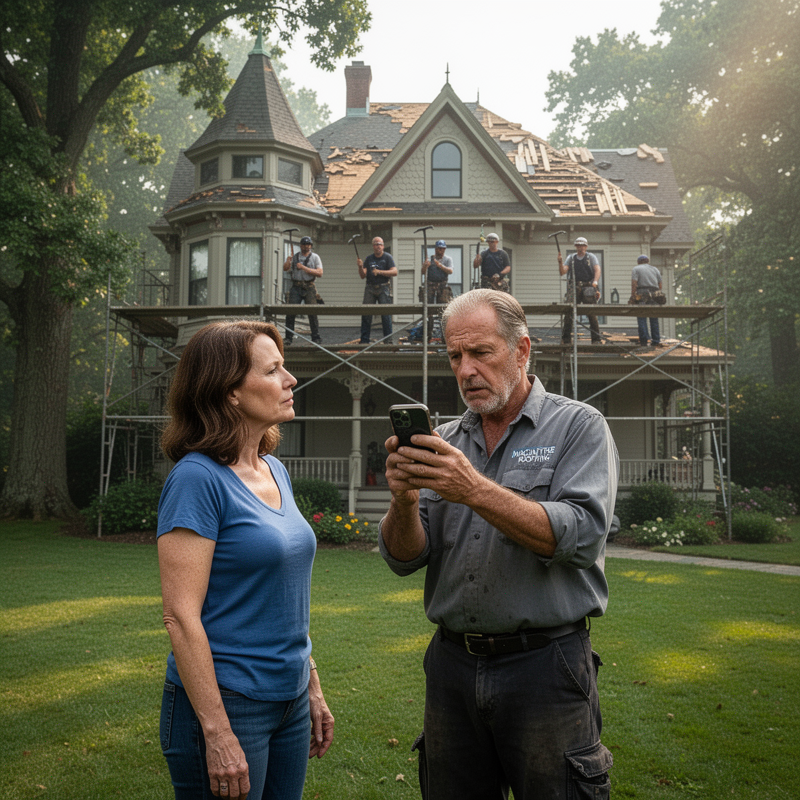
I was standing on the front lawn of our 1890s Victorian home in Rhinebeck, New York, watching the roofing crew tear off rotten shingles, when the site supervisor ran down the ladder with his phone on speaker. “Mrs. Vance, stop the crew right now,” he said, his voice shaking as he held the receiver to my ear. “My rig operator dropped a moisture probe into your attic wall void, and this sound has been repeating on our acoustic sensor for forty-two minutes.” Through the speaker static came a sharp, rhythmic metallic tapping against brick—three short taps, three long, three short—coming from inside the double-walled study that had been dead-bolted and sealed shut since my husband Gabriel’s death three years ago. When the supervisor ran the acoustic pattern through his military-grade signal app, he turned pale and read the screen aloud: “It’s spelling S-O-S in distress code, and the transmitter is pulling fresh electrical power from the roof line we just unsealed.”
Ray “Mac” MacIntyre, the fifty-two-year-old owner of MacIntyre Roofing, wiped a bead of sweat from his forehead and motioned for his crew to halt.
Four workers on the upper staging froze mid-stroke, heavy crowbars held motionless against the exposed timber.
“Mac, that study has been dead-bolted since the crash three years ago,” I said, my voice barely audible over the hum of the neighborhood traffic. “Gabriel locked it before he left that morning. Nobody has walked into that room.”
Mac adjusted the digital receiver strapped to his left wrist, his fingers tapping the touch screen to filter out ambient wind noise.
“The signal isn’t coming from inside the room, Mrs. Vance,” Mac said, pointing a calloused finger toward the second-story exterior masonry. “It’s coming from inside the three-and-a-half-inch brick cavity between the chimney stack and the study drywall.”
The front screen door clicked open, and my seventeen-year-old daughter, Chloe, ran down the porch steps with her laptop balanced across her arm.
“Mom, look at the home network monitor,” Chloe said, holding the screen toward me. “The main breaker panel shows an active electrical draw from the attic line.”
“How much?” Mac asked, stepping closer to read the screen.
“Twelve hundred watts,” Chloe whispered. “It spiked the exact second your crew stripped the flashing off the roof ridge.”
Mac pulled a heavy rubber mallet from the side pocket of his work belt.
He walked over to the exposed brick column at the edge of the wrap-around porch, directly beneath the sealed study window.
“If this sound is just pipe expansion or structural settling, it won’t pay attention to us,” Mac said. “If there is an active intelligence operating in that void, it will answer.”
He pressed his left ear flat against the cool, weathered brickwork.
With his right hand, he raised the mallet and struck the brick three times in rapid succession.
Tap. Tap. Tap.
He paused for two seconds.
Then he delivered three heavy, deliberate strikes against the masonry.
Tap. Tap. Tap.
He finished the sequence with three quick, light taps.
Tap. Tap. Tap.
Silence fell across the front lawn at 8:15 AM.
The breeze died down in the surrounding oak trees.
On the upper staging, one of the roofers dropped a copper nail, and the faint metallic ping echoed off the driveway gravel.
Four seconds passed.
Then, from deep within the solid brick core of the house, a series of hard, metallic impacts answered back.
Clack. Clack. Clack.
A pause held in the air.
Clack. Clack. Clack.
Then three rapid strikes rattled the mortar.
Clack. Clack. Clack.
Mac’s handheld acoustic app illuminated with a bright yellow warning graphic across its display.
The automated signal decoder refreshed its text feed instantly.
Mac read the fresh translation line off the screen, his jaw tightening as he spoke.
“S-O-S NEED AIR.”
Chloe took a sharp step back, her hands flying to her mouth.
“Dad died three years ago,” Chloe said, her voice breaking. “Who is trapped behind that wall?”
Mac turned toward his utility truck parked in the driveway and unlatched the heavy aluminum tool box.
He pulled out a commercial rotary hammer drill fitted with a eighteen-inch carbide masonry bit.
“We aren’t waiting for a key or an official permit,” Mac said, snapping a high-capacity lithium battery into the base of the power tool. “I’m opening a two-inch inspection portal into that cavity right now.”
He stepped up onto the second step of the porch, raising the heavy drill to chest height against the mortar line.
The electric motor whined as he squeezed the safety trigger.
Before the carbide tip touched the mortar, high-pitched tires screeched at the end of the driveway.
A black Lincoln Town Car rounded the hedge line at forty miles an hour, spraying loose blue stone across the manicured grass.
The car slammed to a halt behind Mac’s work truck, its rear tires leaving dark rubber marks on the asphalt.
The front passenger door swung open before the engine was cut off.
Out stepped my late husband’s elder brother, Julian Vance, his bespoke gray suit immaculate despite the humid morning air.
Right behind him came Todd Albright, the municipal building inspector for the town of Rhinebeck, carrying a roll of yellow plastic warning tape and a clipboard stacked with official notices.
Julian marched across the lawn, his leather shoes sinking into the turf as he pointed a finger directly at Mac’s chest.
“Shut that drill down right now!” Julian ordered, his voice booming across the yard.
Albright stepped up beside Julian, holding out an official yellow stop-work document printed with bold red lettering.
“Emergency municipal lockdown order,” Albright shouted, stepping between Mac and the brick pillar. “This site is officially condemned under town safety code!”
Part 2
Albright unrolled a bright red notice from under his arm and slammed a heavy industrial staple gun against the wooden trim of our front doorframe.
“Hazardous asbestos contamination,” Albright announced, his voice loud and rehearsed. “By order of the town building department, this residence is condemned. You have fifteen minutes to vacate the premises or face an immediate ten-thousand-dollar fine.”
Before Albright could drive a second staple into the wood, Mac stepped directly between him and the threshold, his tall frame completely blocking the door.
“You’re lying, Todd,” Mac said flatly.
Mac reached into his tool vest and pulled out a hand-held, military-grade optical particle counter. He clicked the power toggle and held the lit LCD display an inch from Albright’s eyes.
“I run air quality scans before every roof tear-off on historic homes,” Mac said. “Current particulate count sitting right here on your intake sensor is 0.02 PPM. That’s pristine air. There is no asbestos in this line.”
Julian stepped forward, his leather shoes grinding into the dirt as he pointed a finger directly at Mac’s face.
“Touch that wall with a drill, contractor, and I will personally file a two-hundred-and-fifty-thousand-dollar tortious interference suit against your company before noon,” Julian snarled. “Nora has no legal authority to alter structural walls without estate probate consent.”
Mac didn’t even flinch. He pulled his mobile phone from his pocket, hit a single speed-dial key, and held the speaker up to his ear.
“Marcus? It’s Mac,” he said calmly into the mic. “I need you at the Vance house on Rhinebeck Road immediately. I’ve got a compromised municipal inspector trying to shut down an active distress response.”
Within minutes, the marked patrol cruiser of Detective Marcus Thorne—Mac’s former Navy Reserve unit teammate—turned off the main road and pulled onto our driveway.
Thorne killed the engine and stepped out onto the gravel, adjusting his duty belt as his eyes scanned the tense circle on the lawn.
Before Thorne could utter a single word, a sharp, metallic hydraulic hiss echoed from the second-story sealed study window directly above our heads.
It was immediately followed by a frantic, rapid double-time knocking banging hard against the glass.
CHAPTER 2: Thermal Shadows and Legal Threats
The narrow hallway outside Gabriel’s sealed study smelled of ancient dust and cold plaster.
I stood beside Detective Marcus Thorne while Mac adjusted the power cable on his military-grade Forward-Looking Infrared camera.
Behind us, heels clicked sharply on the hardwood floor.
A tall woman in a slate-gray suit stepped around the corner, holding a thick leather folder.
“I am Pamela Sterling, lead counsel for Julian Vance,” she announced, her voice echoing off the high ceilings. “Any attempt to damage structural walls will result in immediate felony trespass charges.”
“This is an active investigation into a distress signal, counsel,” Thorne said, not looking back.
“It is an unlawful intrusion on an estate in probate,” Sterling replied smoothly. “And Mrs. Vance lacks the legal capacity to authorize it.”
Mac ignored her, pressing the rubber lens of the thermal scope directly against the floral wallpaper.
A high-resolution visual bloomed across Thorne’s rugged tablet screen.
The bright yellow and deep purple heat map showed the solid brick chimney stack. But right beside it, between the masonry and the study floorboards, a dark blue box stood out clearly.
“Look at those dimensions,” Mac whispered, tracing his thumb over the grid lines. “That’s a six-by-eight-foot hidden void.”
“And look at the temperature reading,” Thorne said, leaning closer. “It’s sitting at sixty-eight degrees Fahrenheit on the dot. That’s climate-controlled.”
“That’s impossible,” I said, my hand trembling against the wall. “This wall is solid.”
“It’s not solid, Mrs. Vance,” Mac said, adjusting the contrast knob. “And look at this red line running down the stud line.”
A thick thermal thread glowed crimson along the baseboard, tracing back toward the floorboards.
“That’s a live one-hundred-and-twenty-volt electrical bypass,” Mac said. “It’s drawing power right now from an underground junction box.”
Thorne tapped the screen, opening a quick digital signal trace. “The utility hookup isn’t billed to this house. It’s registered to an offshore corporate entity.”
“Apex Holdings LLC,” Thorne read aloud from his screen. “Registered in Nevis.”
“That proves nothing,” Sterling cut in, stepping between Thorne and the wall. “My client owns several holding companies.”
She reached into her folder and pulled out a crisp white legal document bearing a red wax seal.
“This is an emergency petition filed thirty minutes ago with the Dutchess County Probate Court,” Sterling said, handing the papers to Thorne.
Thorne glanced at the top line. “An emergency guardianship petition?”
“Mrs. Vance has been suffering from documented grief-induced psychosis since her husband’s passing,” Sterling said, looking at me with cold pity. “These claims of auditory signals behind walls are classic auditory hallucinations.”
“I am not hallucinating,” I said, stepping toward her. “We all heard the tapping.”
“A roofing mallet against old pipes, Mrs. Vance,” Sterling said coldly. “This petition freezes all structural modifications and grants temporary conservatorship of the property to Julian Vance pending a full psychiatric evaluation.”
Thorne tucked the document into his coat pocket without signing the acknowledgment slip.
“A probate petition isn’t an executed injunction, Ms. Sterling,” Thorne said softly. “I’m not leaving this hallway.”
Before Sterling could respond, a sudden metallic clatter echoed from inside the wall, followed by the deep, pressurized hiss of a cycling air valve.
CHAPTER 3: The Unverified Certificate
Detective Thorne turned to Mac as the metallic hiss faded into the wall.
“Keep your eyes on this hallway, Mac,” Thorne said, pulling his coat tight. “I need to verify Gabriel’s original file at the county courthouse before this petition hits a judge’s desk.”
“I’ll monitor the acoustic sensors from the attic,” Mac replied, slinging his cable bag over his shoulder.
I walked Thorne to the front porch as rain began to drizzle over the lawn.
“Detective, Gabriel died three years ago in that car fire,” I said, my voice cracking. “How could there be power running behind his wall?”
“That’s what I’m going to find out, Nora,” Thorne said, unlocking his cruiser. “Hold tight and don’t sign anything Sterling hands you.”
Twenty minutes later, Thorne stood in the basement archive room of the Dutchess County Courthouse, scanning through microfiche records.
The clerk handed him a yellowed folder labeled *Vance, Gabriel — Accidental Fatality — 2021*.
Thorne opened the file and flipped directly to the medical examiner’s signature line.
“Dr. Evelyn Reed,” Thorne muttered under his breath.
He scanned the attached forensic notes. The body had been completely incinerated in a highway explosion on Route 9. Identification was based entirely on dental fragments provided directly by Julian Vance.
Thorne pulled out his phone and accessed the county financial audit registry from his department portal.
He cross-referenced Dr. Reed’s private research foundation against corporate transactions from three years ago.
A transfer entry flared on his screen: $120,000 paid from an unlisted corporate account directly to Reed’s foundation.
The date stamp was exactly forty-eight hours before Gabriel’s remains were released for immediate cremation.
There was no secondary coroner verification signature anywhere on the certificate.
Thorne dialed Dr. Reed’s direct line at the regional medical center.
“Dr. Reed, this is Detective Marcus Thorne, Dutchess County Sheriff’s Office,” he said as soon as she picked up.
“Detective,” her voice sounded thin and strained over the speaker. “I’m in the middle of rounds.”
“I’m looking at Gabriel Vance’s death certificate from three years ago,” Thorne said coldly. “I’m also looking at a hundred and twenty thousand dollar wire transfer to your research fund from Apex Holdings.”
Silence hung on the line for five full seconds.
“I didn’t have a choice,” Reed whispered, her voice trembling. “Julian brought the fragments himself. He said if I delayed the signature, he’d destroy my practice with malpractice suits.”
“He coerced you to falsify a death certificate without secondary review?” Thorne asked.
“He dictated the report,” Reed choked out. “The teeth didn’t even match the dental records I had on file.”
Thorne hit the recording button on his phone console. “I need you at the station in one hour, Evelyn.”
As Thorne hung up and started his engine, my phone rang back at the house.
I answered it in the kitchen while watching Mac climb into the attic crawlspace.
“Nora!” Mac’s voice yelled down through the ceiling vent. “Get up here right now! The pneumatic line just cycled again!”
CHAPTER 4: The 2024 Supply Line
The attic smelled of old cedar and damp insulation.
I squeezed past dusty cardboard boxes toward the narrow crawlspace directly above the study chimney stack.
Mac lay flat on his stomach, wearing a halogen headlamp and holding a thick black rubber cable.
“Look at this feed,” Mac said, pointing to a portable monitor resting on a ceiling beam.
He had routed an endoscopic snake camera down through a two-inch ventilation gap running alongside the main brick flue.
The tiny camera lens illuminated a narrow aluminum chute suspended inside the wall void.
A small motorized metal tray sat resting at the bottom of the track.
Inside the tray were three small, clear glass vials nestled in soft foam packaging.
“Zoom in on the labels, Mac,” I whispered, leaning over his shoulder.
Mac pinched the screen, expanding the digital image until the black lettering on the glass became legible.
*Humalog Insulin — 100 units/mL.*
Below the product name, a crisp black barcode was printed next to a expiration stamp: *EXP 08/2026 — BATCH #4409-MARCH 2024.*
My heart hammered against my ribs.
“March 2024,” I breathed, touching the cold glass of the monitor screen. “That was manufactured six months ago.”
“Someone is actively feeding medical supplies into this chamber,” Mac said, his jaw tightening. “This isn’t an automated relic from three years ago. This line is being re-stocked.”
“My father-in-law, Arthur,” I said, tears flooding my eyes. “He was a severe diabetic. He used this exact brand before he passed away five years ago.”
“Before Julian said he passed away,” Mac corrected gently.
“My God,” I whispered. “Arthur isn’t dead.”
“Not yet,” Mac said. “That pneumatic shuttle is built to deliver supplies from an outside loading port.”
He shifted his camera probe lower down the pipe, searching for the intake mechanism.
“There has to be an entry hatch somewhere in the lower basement,” Mac muttered. “A drop point where someone can insert fresh vials.”
Before Mac could push the camera any further, a loud, heavy hum vibrated through the attic floorboards.
The halogen light on Mac’s headlamp flickered violently.
Downstairs, the hum of the refrigerator died instantly, and the low buzz of the attic ventilation fans cut out completely.
The entire house plunged into pitch-black darkness.
“What happened?” I asked, scrambling back toward the attic ladder.
Mac pulled out his tactical flashlight, shining the beam down the stairwell.
I looked out the dusty dormer window facing the street.
A commercial bucket truck belonging to the local electric utility was parked directly beneath our overhead power line.
A worker in a yellow hardhat was lowering an insulated cutting arm away from our main service drop cable.
The cut ends of our power lines dangled uselessly in the rain over the lawn.
“They just severed our main power grid,” Mac swore, swinging his legs over the attic hatch. “And that means the air scrubbers inside that vault just lost primary power.”
CHAPTER 5: The $1.5 Million Offer
I ran down the front porch stairs into the pouring rain.
Julian stood at the foot of the driveway, wearing a sleek black trench coat and holding a heavy leather briefcase.
Behind him, two massive black vans with tinted windows blocked the entrance to our drive.
Four broad-shouldered men in plain security uniforms stood beside the vehicles, watching us silently.
“What did you do to our power line, Julian?” I shouted over the sound of the rain.
Julian stepped onto the porch, wiping rain drops from his silver hair with a silk handkerchief.
“The utility company flagged an illegal electrical bypass on the property line, Nora,” Julian said smoothly. “They were legally obligated to disconnect the drop for public safety.”
He set his briefcase on the porch table and popped the brass latches open.
Inside lay three thick stacks of legal documents and a certified cashier’s check made out to my name.
“One million, five hundred thousand dollars,” Julian said, turning the check so I could see the prominent blue lettering. “Drawn directly on Chase Bank.”
“What is this?” I asked, backing away toward the front door.
“It is a complete, unconditional cash buyout for this property,” Julian said, taking a pen from his breast pocket. “You sign the quitclaim deed today. You pack your personal belongings and leave within two hours.”
“And what happens to the house?” I asked.
“My construction crew will have it demolished by sunrise tomorrow,” Julian said without blinking. “The land will be cleared and sold for commercial re-development.”
He leaned closer, lowering his voice to a conspiratorial whisper.
“Chloe is seventeen, Nora. She starts applying to universities in three months. This money secures her tuition, her trust, and your entire future. You won’t ever have to work again.”
“And what about what’s inside that wall?” I screamed.
“There is nothing inside that wall except old asbestos and your own tragic grief,” Julian said, his eyes turning cold as ice. “Sign the paper, Nora. Take the money before the probate judge declares you incompetent and leaves you with nothing.”
Behind me, the front door swung open.
Chloe stepped onto the porch, holding her mobile phone on a short tripod base.
“We’re live on the Dutchess County Local News Facebook page, Uncle Julian,” Chloe said, her voice clear and unbroken. “There are three thousand people watching this porch right now.”
Julian’s face tightened into a furious snarl. “Turn that camera off, Chloe.”
“Nora, don’t you dare,” Mac called out, stepping onto the porch carrying his heavy tools.
I looked at the cashier’s check for $1,500,000.
Then I picked up the single-page quitclaim deed lying beside it.
I looked Julian square in the eye, took the paper in both hands, and ripped it down the middle.
I folded the pieces together and ripped them again, dropping the white scraps onto the wet porch floor.
“Get off my property, Julian,” I said softly.
Julian stared at the torn paper, his jaw working silently.
He snapped his briefcase shut and turned to the security guards waiting at the gate.
“Block both ends of the driveway,” Julian commanded them. “No unauthorized vehicles enter or leave this property. We are securing estate assets.”
“Try blocking my truck,” Mac growled, stepping past Julian onto the lawn.
Mac walked directly to his heavy-duty Ford F-350 service truck parked on the shoulder.
He hauled a massive three-phase diesel generator out from the truck bed, dragging heavy rubber power cables across the wet grass.
He slammed the quick-connect lead into our home’s external emergency transfer box and yanked the starter cord.
The diesel engine roared to life with a deep, rhythmic thrum.
Inside the house, the hallway lights flickered back on.
And up in the attic vent, a tiny, faint metallic speaker suddenly crackled with static, carrying the sound of a weak human voice whispering through the flue.
CHAPTER 6: Blueprints in the Attic Radio
We gathered in the sunroom surrounding the dining table as the generator hummed outside.
A horn honked at the perimeter gate, followed by the sound of shouting.
A moment later, an old rusted pickup truck pushed past Julian’s security blockade, tire rubber smoking against the asphalt.
The driver’s door opened, and Uncle Arlo Vance stepped out into the yard, leaning heavily on a wooden cane.
He was seventy-four years old, his thick grey hair wild in the wind, holding a long, faded yellow leather draughtsman tube under his arm.
“Arlo?” I called out, running to the porch to meet him.
“Get inside, Nora,” Arlo panted, his chest heaving as he climbed the steps. “I saw Chloe’s broadcast on the news. I brought the originals.”
Mac locked the heavy oak front door behind us as Arlo unrolled a large sheet of thick blue architectural paper across the dining table.
The drawing was dated November 14, 2019, bearing Gabriel’s bold signature in the title block.
“Gabriel came to my workshop five years ago,” Arlo said, his hands shaking as he smoothed the curling edges of the blueprint. “He told me Julian was slowly draining Arthur’s trust fund while Arthur was bedridden in that Albany care facility.”
“So Arthur wasn’t dead?” I asked, gripping the table edge.
“Julian moved him in secret to a private medical wing,” Arlo said, pointing to a detailed cross-section diagram on the paper. “Gabriel found out Julian was planning to sign an end-of-life directive to take complete control of the eight-point-five million dollar family trust.”
“What did Gabriel do?” Chloe asked, leaning over the blueprint.
“He built this,” Arlo said, tapping a thick drawn section labeled *Reinforced Panic Sanctuary*. “He modified the foundation behind the study chimney. Four-inch concrete reinforced with rebar, acoustic insulation, and an independent air scrubber.”
“He hid Arthur in our own house?” I whispered, my voice caught in my throat.
“Gabriel rescued his father from that facility in the middle of the night,” Arlo said tears glistening in his faded eyes. “He brought him here to keep him alive while he gathered proof of Julian’s embezzlement.”
“Why didn’t Gabriel tell me?” I asked, tears finally slipping down my cheeks.
“Because Julian had corporate fixers watching every move,” Arlo said gently. “Gabriel knew if you were involved, Julian would target you and Chloe directly.”
Mac bent over the blueprint, studying the locking mechanism detail.
“Look at this access door,” Mac said, pointing to a small circle near the base. “It’s a four-inch solid steel hydraulic blast hatch.”
“How does it open?” Thorne asked, stepping into the room after locking the front gate behind Arlo.
“It’s secured by a dual-frequency radio lock,” Arlo said, pulling a vintage 1978 radio calibration unit out from his coat pocket. “Gabriel set the mechanism to respond only to two specific acoustic frequencies broadcast simultaneously against the wall.”
“Where are the frequencies?” Thorne asked.
“Gabriel kept the code sequence stored in his archived ham radio logs,” Arlo said, looking toward the den stairs. “In his old equipment room upstairs.”
“And where is the secondary entry portal?” Mac asked, tracing his finger along the lower basement wall.
Arlo pointed to a small rectangular hatch drawn at the bottom of the foundation sheet.
“Right here,” Arlo said softly. “Directly beneath the old basement coal chute.”
CHAPTER 7: The Voice in the Flue
Mac moved quickly back into the attic, carrying a long flexible directional microphone with an acoustic amplifier.
He fed twelve feet of slender black cable down through the ventilation pipe until the digital gain meter on his receiver bounced into the green zone.
Down in the living room, Thorne plugged the audio output directly into a portable speaker resting on the coffee table.
A low, static hiss filled the room, accompanied by the rhythmic beat of a mechanical air pump.
Then, a cough echoed through the speaker—dry, raspy, and weak.
“Gabriel…” the voice whispered, crackling over the wire. “Gabriel, is that you?”
I covered my mouth with both hands.
“Arthur?” I called out toward the ceiling vent, my voice shaking. “Arthur, can you hear me? It’s Nora!”
There was a long pause filled with static.
“Nora?” the frail voice came back, clearer this time. “Nora, child… Julian cut the power line in the driveway… the oxygen scrubber battery is at eleven percent… please hurry.”
Chloe burst into tears, grabbing my arm tightly.
“Arthur, we’re right outside!” Thorne said, stepping close to the microphone. “This is Detective Marcus Thorne with the Sheriff’s Office. We have a rescue team on site. How long have you been without main power?”
“Three hours…” Arthur rasped over the intercom. “The primary backup line went dead three days ago… when Julian came to the basement wall.”
Thorne’s face hardened. “Julian came to the basement three days ago?”
“He spoke through the intake tube…” Arthur whispered, his breath catching in his throat. “He told me Gabriel was dead in Canada… he said no one was coming for me… and then he turned off my water intake valve.”
“That cold-blooded monster,” Mac growled from the attic access ladder.
“Arthur, listen to me,” Thorne said urgently into the microphone. “Gabriel built a dual-frequency override lock on the main hatch. Do you know where the secondary frequency key is stored?”
“Gabriel… recorded the frequency sequence on his shortwave radio server…” Arthur said, his voice fading slightly. “He monitored my vitals from Montreal every night… through the telemetry link…”
“Montreal?” I repeated, my breath stopping in my chest. “Arthur, what do you mean Montreal? Gabriel died three years ago!”
“No, child…” Arthur breathed, his voice barely audible over the crackling speaker. “Gabriel didn’t die… Julian staged the car crash to eliminate him… Gabriel had to flee across the border to stay alive…”
The static on the speaker suddenly surged, drowning out Arthur’s voice as a sharp digital alarm tone began to beep steadily inside the wall.
“Battery at nine percent,” Mac called down from the attic stairs. “We have less than twenty minutes before his air scrubber shuts down completely!”
CHAPTER 8: Telemetry from Montreal
Chloe didn’t wait for another word.
She sprinted down the hallway into Gabriel’s old den, flipping open the wooden cabinet that housed his vintage shortwave ham radio console.
The rig glowed with green digital numbers powered by the generator line Mac had run through the window.
“Mom, look at this display!” Chloe shouted.
I ran into the room behind Thorne and Arlo.
On the main monitor screen connected to the radio server, a digital logbook was actively scrolling line after line of green code.
A steady 144 MHz frequency ping was pulsing on the spectrum analyzer display.
“That’s an automated telemetry signal,” Chloe said, her fingers flying across the keyboard as she accessed the system diagnostics. “It’s transmitting encrypted vital data out through our attic antenna every sixty seconds.”
She clicked on the network routing table, tracing the origin IP address linked to the incoming control ping.
The screen refreshed, displaying a geographical server location map.
*Node Origin: Quebec Telecommunications Facility — Montreal, Canada.*
A loud digital chime echoed from the laptop speakers.
A secure, encrypted text window popped open on the center of the screen, displaying crisp white lettering.
*INCOMING TRANSMISSION — SATELLITE RELAY 09:*
*NORA THIS IS GABRIEL. DO NOT OPEN THE FRONT HATCH WITHOUT THE SECONDARY FREQUENCY. JULIAN RIGGED A SOLENOID TRIPWIRE ON THE MAIN DOOR IN 2021. IF BREACHED FORCIBLY IT WILL DESTROY THE VAULT VENTILATION VALVE.*
I stared at the screen, my heart pounding so hard I felt dizzy.
“He’s alive,” I whispered, tears blurring my vision. “Gabriel is alive.”
The text on the screen continued to update rapidly.
*I HAVE BEEN MONITORING ARTHUR’S VITALS FROM MONTREAL VIA TELEMETRY. JULIAN CUT MY PRIMARY DATA LINE THREE DAYS AGO. THE DUAL-FREQUENCY OVERRIDE CODE IS 432 HZ AND 880 HZ BROADCAST SIMULTANEOUSLY AGAINST THE BASEMENT MASONRY. HURRY. ARTHUR HAS LESS THAN TEN MINUTES OF OXYGEN.*
“We have the frequencies!” Chloe screamed, printing the screen text instantly.
“Arlo, grab your radio unit!” Thorne ordered, turning toward the hallway. “We’re going into the basement right now!”
Before Thorne could reach the door, a heavy metallic thud echoed from the bottom of the basement stairs.
The wood frame groaned as the thick oak basement door was kicked open violently from the inside.
A cloud of heavy grey mist began pouring up the cellar stairwell, smelling strongly of raw, suffocating gas.
CHAPTER 9: Sabotage in the Basement
Detective Thorne drew his sidearm from his holster, holding his tactical flashlight parallel to the barrel.
“Stay behind me!” Thorne ordered, moving slowly toward the basement stairs.
Mac grabbed a heavy brass wrench from his utility belt, following right behind Thorne, with me three paces back.
The thick, pungent odor of unburned propane hit my nose, making my eyes sting instantly.
We descended the concrete steps into the cool, dark cellar.
In the center of the room, standing beside the massive five-hundred-gallon propane storage tank, was Julian.
He wore heavy leather work gloves and held a three-foot industrial pipe wrench in his hand.
The brass valve stem on the main supply line had been sheared clean off, and liquid propane was hissing violently into the air, creating a dense white fog that rolled across the floorboards.
“Julian, drop the wrench!” Thorne shouted, aiming his weapon directly at Julian’s chest.
“Don’t move, Detective!” Julian yelled back, his voice wildly manic.
He reached into his coat pocket with his free hand and pulled out an industrial arc-lighter.
A small blue pilot spark flared at the tip of the metal wand.
“One spark, Thorne!” Julian screamed, holding the flickering lighter six inches from the rising gas cloud. “One single spark and this entire basement, this house, and every piece of evidence inside it goes up in a fireball!”
“You’re out of options, Julian!” Thorne said, taking a cautious step sideways to draw Julian’s eye away from Mac. “Dr. Reed already confessed. The court knows about the falsified death certificate!”
“I don’t care about your court!” Julian spat, his eyes bulging with hysteria. “If I go down, this entire property burns with me! No one leaves this house alive!”
Outside, the air shattered with the sound of approaching sirens.
Red and blue light flashed through the high basement windows as three Dutchess County Sheriff cruisers and a heavy black SWAT extraction van pulled onto the front lawn, blocking all exits.
“It’s over, Julian!” Thorne shouted over the hiss of the gas. “Put the lighter down!”
“Never!” Julian roared, raising his thumb to press the ignition trigger.
CHAPTER 10: The Override Key
Before Julian’s thumb could depress the trigger, Mac moved with terrifying speed.
He hurled his heavy brass wrench through the air.
The heavy tool struck Julian squarely across his right wrist with a loud crack.
The arc-lighter flew from Julian’s hand, clattering harmlessly across the damp concrete floor into a puddle of water.
Julian screamed in pain, dropping the pipe wrench.
Thorne lunged forward, tackling Julian to the floor, pinning his arms behind his back and snapping heavy steel handcuffs over his wrists.
“Mac, the gas!” Thorne yelled, holding Julian down.
Mac sprinted to the main exterior cut-off valve near the foundation wall.
He grabbed the brass emergency handle, throwing his full weight against it.
The heavy valve turned ninety degrees with a loud metallic clank, shutting off the flow from the main tank within eighteen seconds.
Mac immediately grabbed an industrial electric blower fan from his work kit, plugging it into the emergency generator lead and aiming the duct out the lower basement window to clear the trapped fumes.
Upstairs, Uncle Arlo ran down the basement stairs carrying the shortwave radio transmitter unit.
He pressed a heavy rubber transducer pad flat against the reinforced concrete wall directly beside the old coal chute.
“Chloe set the frequencies to four-thirty-two and eight-eighty hertz!” Arlo shouted over the hum of the fan.
He flipped the toggle switch on his vintage unit.
A high-pitched, dual-frequency chime vibrated through the concrete wall, humming loudly through the masonry.
Inside the wall, a series of heavy mechanical clunking sounds echoed in rapid succession.
Three two-inch solid steel locking bolts retracted inside the frame with a deep hydraulic hiss.
The heavy four-inch steel blast door groaned against its seals and swung outward six inches into the basement floor.
CHAPTER 11: The Climax Unsealed
Thorne and Mac stepped forward together, grabbing the heavy iron handle of the blast door and pulling it wide open.
Bright, warm white LED light flooded out from inside the hidden six-by-eight-foot chamber.
Inside, sitting upright in an adjustable motorized medical bed, was eighty-two-year-old Arthur Vance.
He was thin and pale, wearing a clean blue medical gown, but his eyes were bright and sharp.
Clutched tightly against his chest was a heavy black military-grade hard drive sealed in a clear plastic casing.
“Arthur,” I cried out, dropping to my knees beside his bed and wrapping my arms around his frail shoulders.
“Nora…” Arthur said softly, his weak hand coming up to touch my cheek. “You found me, child.”
He reached out and handed the black hard drive directly into Detective Thorne’s hands.
“This contains five years of internal financial ledgers, recorded telephone calls, and corporate bank transfer records,” Arthur said, his voice gaining strength. “It documents every dollar Julian stole, every official he bribed, and every instruction he gave to stage Gabriel’s crash.”
“This is the master key,” Thorne said, looking at the drive in awe.
Sirens cut out on the lawn outside as heavy footsteps marched down the front porch steps.
A moment later, a large black federal SUV pulled up beside Thorne’s cruiser.
The rear door opened, and a tall man in a navy suit stepped out onto the driveway, accompanied by two FBI Special Agents from the Organized Crime Division.
I walked out the front door into the sunlight, my hand gripping Chloe’s.
The tall man turned toward the porch, removing his sunglasses.
My breath caught in my throat.
The sharp jawline, the dark hair silvering at the temples, the familiar brown eyes.
“Gabriel,” I breathed, my knees buckling.
Gabriel ran across the lawn, catching me in his arms before I hit the ground, pulling Chloe into the embrace with us.
“I’m sorry, Nora… I’m so sorry,” Gabriel sobbed, holding us tightly against his chest. “I had to stay in the dark to protect you… the federal indictment needed to be unsealable.”
“You’re alive,” Chloe wept, burying her face in his jacket. “Dad, you’re really alive.”
“I never left you,” Gabriel whispered, kissing her hair.
Two FBI agents marched Julian up the basement steps in handcuffs, pushing him toward a waiting federal transport vehicle.
Gabriel stepped in front of Julian, blocking his path on the driveway.
“The five hundred thousand dollar life insurance policy you claimed three years ago, Julian,” Gabriel said coldly, looking his brother in the eye. “Federal prosecutors placed those funds into a monitored escrow account thirty-six months ago.”
Julian stared at him, his mouth open in horror.
“Last week, that escrow account was used to purchase every defaulted mortgage on your law firm’s properties,” Gabriel continued softly. “Every asset you own has been seized by the federal government. You don’t have a dollar left to pay a lawyer.”
Julian bowed his head in complete silence as the agents loaded him into the back of the black van and slammed the doors shut.
CHAPTER 12: Clear Skies Over Rhinebeck
Eleven days later, the morning sun broke brightly over the Victorian gables of our home in Rhinebeck.
The air smelled of fresh asphalt and slate dust.
Up on the roof, Mac’s crew was securing the final row of dark blue slate shingles over our unsealed attic line, their hammers tapping a steady, cheerful rhythm in the warm breeze.
I sat on the sunlit front porch, holding a warm mug of coffee, watching Chloe help Arthur settle into a comfortable reclining chair near the garden.
Gabriel stepped out through the front door, carrying the morning newspaper, and sat beside me on the porch bench.
The front page of the *Dutchess County Sentinel* displayed a prominent headline:
*FEDERAL RICO INDICTMENT UNSEALED: JULIAN VANCE SENTENCED TO 25 YEARS WITHOUT PAROLE FOR KIDNAPPING, FRAUD, AND ATTEMPTED ARSON.*
The article detailed the complete collapse of Julian’s legal network.
Municipal inspector Todd Albright had been stripped of his license and sentenced to four years in state prison after investigators uncovered his eighty-four thousand dollar gambling debt payoff from Julian.
Lawyer Pamela Sterling faced formal bar association sanctions and a seventy-five thousand dollar fine for filing fraudulent emergency petitions without medical backing.
Dr. Evelyn Reed had formally surrendered her medical license in exchange for a plea agreement cooperating with federal authorities.
Full legal title to the entire four-point-two million dollar Vance family estate had been permanently restored to Gabriel and me.
Arthur had already transferred his remaining eight-point-five million dollar trust fund into an irrevocable educational trust for Chloe, with the remainder dedicated to funding a regional community STEM center bearing Gabriel’s name.
Mac walked down the roof ladder, wiping his hands on a rag, and stepped onto the porch.
“Roof’s completely sealed, Nora,” Mac said with a wide smile. “No leaks, no bypasses, and zero structural interference.”
“Thank you, Mac,” I said, shaking his hand tightly. “For everything.”
Gabriel stood up and shook Mac’s hand, offering him a finalized contract payment check.
“You delivered more than a roof, Mac,” Gabriel said sincerely.
“Just doing the job right,” Mac grinned, tipping his hat as he walked toward his truck.
I leaned back against Gabriel’s shoulder, looking out across the peaceful green lawn, watching the morning light reflect off the newly restored Victorian tower.
They thought three inches of brick and three years of lies could keep the truth silent, but love speaks in frequencies that no wall can ever contain.
Leave a Reply