CHAPTER 1: The Blade in the Waiting Room
Part 1
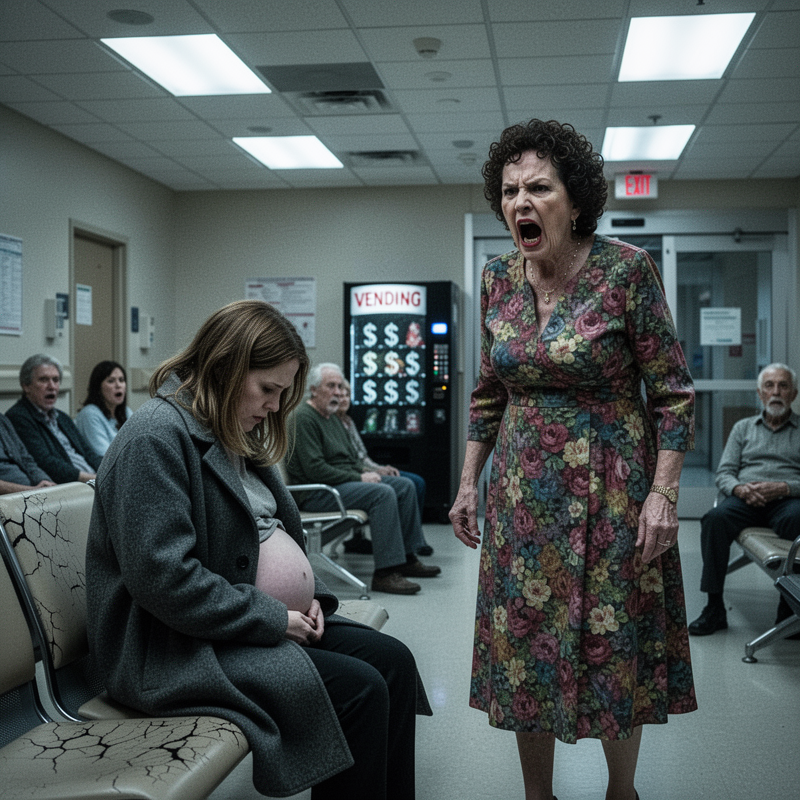
“You’re a disgusting liar who made up a fake belly just to steal my property!” my landlord, Evelyn Croft, screamed across the hospital waiting room.
Before the security guards could react, she rushed me, slammed my back against the hard tile floor, and plunged a five-inch utility knife straight into my midsection.
She believed she was cutting through foam padding to expose a fake pregnancy scam meant to stop her from evicting me.
Instead, blood soaked through my torn coat, revealing a real 22-week pregnancy and a secret that would force the city’s deadliest criminal underworld to step in.
The harsh fluorescent lights of the emergency room waiting area usually cast a dull, sterile glow, but tonight they seemed to sharpen every edge, every shadow. I had tried to shrink into the cracked vinyl seat, hoping to become invisible, just another anonymous face among the tired and the worried.
The low hum of the vending machine and the hushed whispers of other patients had been a strange comfort until Evelyn Croft burst through the automatic doors.
Her voice, shrill and venomous, cut through the quiet like a rusty saw.
“You’re a disgusting liar who made up a fake belly just to steal my property!”
Every head in the room snapped toward her. Then, toward me. My cheeks burned. I instinctively pulled my worn, oversized coat tighter around my swollen midsection. It was a reflex, a desperate attempt to protect a secret I wasn’t ready to share.
My heart hammered against my ribs, a trapped bird desperate to escape. Evelyn, her face contorted in a mask of rage, was already halfway across the waiting room before the two weary-looking security guards at the entrance even registered her presence.
Her eyes, usually cold and calculating, blazed with a manic intensity. She was coming for me. There was no doubt.
My hands flew up, a futile gesture of defense.
“Evelyn, no!” I gasped, pushing myself back into the seat, trying to flatten myself against the wall.
But she was too fast. A blur of floral print and flailing arms. Her hand shot out, grabbing a fistful of my collar. The cheap fabric ripped under her grip.
Then, a sudden, jarring impact. My head cracked against the hard tile floor. A dull thud echoed in my ears, momentarily drowning out the shouts that had erupted around us. Spots danced in my vision. The sterile smell of the hospital mixed with something metallic, something acrid.
Her weight pressed down on me, heavy and suffocating. I struggled, twisting, but her grip was like iron. My breath hitched in my throat.
“You think you’re clever, don’t you?” she hissed, her face inches from mine, eyes narrowed into slits of pure hatred. “Playing the victim. But I know your little game.”
And then, I saw it. The glint of steel. A utility knife, its five-inch blade gleaming under the fluorescent lights. My eyes widened in terror. This wasn’t just a physical assault. This was something far worse.
The blade descended in a swift, brutal arc.
A searing, blinding pain exploded in my midsection. It was as if a red-hot poker had been plunged into me. A gasp tore from my lips, ragged and choked. I instinctively tried to curl in on myself, to protect the fragile life growing inside me.
I heard her grunt with effort. The knife twisted, then pulled away with a sickening tearing sound.
“There! See?” Evelyn screamed, a triumphant, unhinged laugh bubbling up from her throat. “Just foam! A pillow! You disgusting, lying little—”
Her words died in her throat. Her eyes, still wide with fury, dropped to where the blade had been.
My worn coat, already ripped from her initial attack, now bore a darker, spreading stain. It wasn’t the dull, dusty grey of foam or the bright red of cheap dye. It was a deep, crimson red. A rich, dark red that blossomed rapidly across the fabric, soaking into the threads, spreading outwards from the point of impact.
A collective gasp swept across the waiting room. Someone dropped a magazine. It clattered loudly against the floor.
Evelyn’s face, a moment ago contorted in triumph, now froze in a mask of horrified disbelief. Her jaw went slack. Her gaze flickered from the spreading stain to my face, then back again. Her eyes, which had burned with malice, now held a flicker of something new: pure, unadulterated terror.
I felt a warm, sticky wetness seeping through my thin t-shirt beneath the coat. My vision swam. The pain was immense, overwhelming, stealing the air from my lungs.
Suddenly, a flurry of motion. Two nurses, their faces grim and professional, were at Evelyn’s side, pulling her away. Security guards, finally reacting, moved in.
“Get off her!” one of the nurses barked, her voice sharp with urgency. “What have you done?!”
Evelyn didn’t resist. She was staring at the blood, her hands now covered in it, her earlier rage replaced by a terrifying stillness. She looked like she’d seen a ghost.
More nurses rushed forward. A gurney, its wheels squeaking, was pushed expertly next to me. Strong, calm hands were everywhere, cutting away my ruined coat, pressing sterile pads against the wound.
“Patient 22 weeks pregnant!” someone shouted, her voice cutting through the ringing in my ears. “Trauma response! STAT!”
My body, already heavy with pain, suddenly felt lighter, disconnected. I could hear their frantic voices, the rapid-fire medical jargon, but it was all muffled, distant. The only thing that felt real was the warmth spreading inside me, the crushing pain, and the chilling realization.
She hadn’t cut through foam. She had cut through me. And the baby.
Part 2
My world narrowed to the squeak of the gurney wheels. Faces blurred above me, urgent whispers. “Pulse weakening, get her to trauma!” a voice yelled. I felt myself being pushed, a cold rush of air as we wheeled through swinging doors. The bright lights in the trauma bay were blinding, harsh against my throbbing head.
A new voice, calm and deep, cut through the chaos. “I’m Dr. O’Reilly. What do we have?”
“Nineteen-year-old female, Maya Lin, 22 weeks pregnant, landlord altercation,” a nurse rattled off. “Stab wound to the abdomen. Possible fetal involvement.”
Hands were everywhere, cutting the last remnants of my clothing. The pain was a constant, throbbing drum. I couldn’t focus, couldn’t breathe properly. My only thought was of the life inside me.
Dr. O’Reilly’s voice was close now, examining the wound. “Alright, let’s get a good look.”
He gently peeled back the sterile dressing they’d applied. I braced myself, expecting to hear the worst. Instead, there was a momentary pause, a subtle shift in the room’s frantic energy.
“Wait a minute,” Dr. O’Reilly murmured. He pressed lightly around the wound. “There’s something here.”
He carefully pulled away more of the torn fabric. Beneath my t-shirt, strapped tightly around my belly, was a thick canvas belt. It was a maternity support belt, rigid and stiff, one I’d bought online to help with the growing back pain. It was stained crimson, but the blade had only partially pierced through its dense material.
“She was wearing a support belt,” Dr. O’Reilly announced, his voice carrying a note of surprise, then relief. “The blade was deflected. It went through the outer layers of the canvas, but lost most of its force.”
He quickly moved to the ultrasound machine. The room fell silent except for the soft whirring. My eyes were fixed on the screen as the probe moved over my belly. A tiny, flickering heartbeat appeared, strong and steady.
“Fetus appears stable,” he said, his voice firm. “No direct penetration to the uterus. The belt saved the baby.”
A wave of dizzying relief washed over me, so potent it almost made me black out. The baby was safe. My baby was safe.
But Dr. O’Reilly’s expression, as he meticulously examined the trajectory of the deflected cut and the pattern of the blood on the belt, shifted. His brow furrowed. He looked at the knife wound again, then back at the belt, his jaw tightening.
He didn’t speak, but his gaze grew colder, more analytical. This wasn’t just a random act of violence, I could tell. He saw something in the wound’s angle, in Evelyn’s calculated aim.
His eyes met mine for a fleeting second, a look of profound concern mixed with a chilling understanding. This attack, he seemed to realize, was precise. It was deliberate. It was targeted.
CHAPTER 2: A Calculated Accusation
Evelyn Croft paced across the polished linoleum of the hospital lobby, her heels clicking like sharp gunfire against the quiet walls.
She waved a thick packet of printed paper in front of two uniformed hospital security guards.
“She staged the whole thing,” Evelyn shouted, her voice echoing into the adjoining hallways. “The girl is a fraud! She used commercial fake blood and a foam cushion under her coat to dodge four thousand two hundred dollars in back rent!”
The guards shifted their weight, eyes darting between Evelyn’s trembling hands and the trauma room doors behind her.
“Ma’am, you need to lower your voice,” the taller guard said, stepping forward with his hands open.
“Read the printouts!” Evelyn slammed the paper packet against the security desk counter. “These are text messages from her phone! She admitted to planning this extortion scheme three days ago!”
I pulled the white cotton blanket higher over my chest inside the cubicle, my fingers brushing against the thick canvas edge of my back-support belt.
Dr. Julian O’Reilly pulled back the curtain, his green surgical scrubs spotted with dark brown water marks near the hem.
He didn’t look at the security guards. He walked straight toward Evelyn, his heavy leather soles making no sound on the floor.
“Mrs. Croft,” Dr. O’Reilly said, his voice flat and steady as granite. “I just removed a three-inch steel blade from this young woman’s outer garment.”
Evelyn stopped mid-gesture, her arm frozen in the air.
“She is twenty-two weeks pregnant,” Dr. O’Reilly continued, leaning close enough that only Evelyn and the guards could hear. “The fetal heart rate is one hundred and forty beats per minute. That blood on your coat cuff belongs to a child.”
Evelyn’s mouth opened, but no sound came out for three full seconds.
“She fake-printed those text records herself,” Dr. O’Reilly added, taking the paper packet directly from the counter and dropping it into a yellow biohazard bin. “If you step foot past these double doors again tonight, I will have city transit officers handle your removal.”
Evelyn pulled her leather handbag tight against her ribs, her knuckles turning chalky white under the fluorescent ceiling lights.
She took two steps backward toward the automatic glass doors, her eyes locked on Dr. O’Reilly’s face.
“This isn’t over, Doctor,” she whispered, her voice tight and trembling. “You don’t know what that girl is hiding under my roof.”
The glass doors slid open, letting in a gust of damp midnight air as Evelyn disappeared into the dark street.
Dr. O’Reilly turned back toward my bed, his face pale under the clinical light.
“She isn’t going to stop with fake text messages, Maya,” he said softly, checking the IV line dripping into my left arm. “What is really inside that building?”
CHAPTER 3: The Document in the Heater
The memory hit me as the hospital pain medication began to warm my blood.
Fourteen days before the knife cut my coat, the brownstone basement smelled of rusted iron, damp coal dust, and sour mildew.
I had taken a flashlight down the narrow concrete steps, searching for my missing foster-care transition checks that had stopped arriving in the lobby mailbox.
The building’s main boiler rattled in the corner, leaking a steady trickle of brown water across the dirt floor.
Beside the furnace stood an abandoned heavy steel heater box from 2018, its outer panel hanging loose by a single stripped screw.
I set my flashlight on an overturned crate and pulled the heavy panel away from the frame.
Inside the dark air void, resting on top of a heap of yellowed fiberglass insulation, sat a flat plastic pouch wrapped in blue duct tape.
My fingers left clean grey streaks in the dust as I sliced the tape open with my thumbnail.
Inside was a folded legal document stamped with a raised gold notary seal from the Kings County Clerk’s office.
My eyes ran across the top line: *ORIGINAL WARRANTY DEED — 412 WALNUT STREET*.
The document listed the sole legal owner of the one hundred and fifty thousand dollar brownstone.
It was not Evelyn Croft.
Printed clearly in black ink on line four was the name *Leo Croft*.
Footsteps scuffed the wooden floorboards directly above my head, sending a shower of fine grey plaster dust down into my hair.
“Maya?” a voice called down the stairwell, thin and raspy. “Are you down there?”
I shoved the document into the inner lining of my denim jacket and pressed my back against the cold brick wall.
“Just checking the water line, Leo!” I called back, my heart hammering against my ribs.
Leo Croft stood at the top of the stairs, holding a quarter-empty bottle of cheap whiskey, his frame shadowed by the dim hallway bulb.
He didn’t come down the steps. He just stared into the darkness, his hand trembling against the wooden handrail.
CHAPTER 4: Bloodline and Brick
The neon clock on the wall of the twenty-four-hour diner read 2:15 AM.
Leo Croft sat across from me in the corner booth, his eyes rimmed with red, his fingers endlessly spinning a paper diner napkin into tight white ropes.
“She takes fourteen hundred dollars a month from every room on the second floor,” Leo whispered, looking over his shoulder toward the empty counter. “She doesn’t put a single dollar into the property.”
“The deed in the basement has your name on it, Leo,” I said, keeping my voice down to a murmur. “Not hers.”
Leo swallowed hard, his throat clicking in the quiet booth.
“My father left the building to me in his 2018 will,” Leo said, his eyes dropping to his scarred knuckles. “He wanted me to have something before he died.”
“Then why are you sleeping on a cot in the laundry room?” I asked.
“Because she keeps the prescription bottles in her safe,” Leo said, his voice cracking. “She gives me just enough every morning so I can’t think straight enough to walk into a lawyer’s office.”
He reached across the formica table and laid his cold, trembling palm over my hand.
“If she finds out you know about that deed, Maya, she won’t just evict you,” he said. “She’ll tear this entire block down.”
“She can’t evict me,” I said, touching the bulge under my heavy sweater. “I’m carrying your baby, Leo. The law protects pregnant tenants from summary removal.”
Leo pulled his hand back as if he had touched a hot stove, his face turning gray under the yellow booth light.
“You don’t understand,” Leo stammered, his teeth chattering slightly. “That makes it ten times worse.”
“What are you talking about?”
“My father’s deed has a survival clause,” Leo whispered, leaning across the table until his breath smelled of sour rye. “If I die, the legal title to the property transfers automatically to my direct blood heir.”
He gripped the edge of the table until his knuckles turned yellow.
“To her, that baby isn’t my child,” Leo said. “That baby is a legal weapon that strips her of a hundred and fifty thousand dollars.”
CHAPTER 5: Posters on the Boulevard
By noon the following Tuesday, the neighborhood was covered in red and yellow ink.
Paper flyers six inches wide were stapled to every wooden utility pole along Walnut Street and taped to the glass storefronts of the local bodegas.
My face looked back at me from a grainy black-and-white printout above the laundromat window.
*WARNING: PROFESSIONAL SQUATTER AND FAKE-PREGNANCY EXTORTIONIST*, the headline read in thick capital letters.
Below my photo, Evelyn had printed my former foster-system case ID number alongside a fabricated list of criminal trespass warnings.
I pulled my scarf up over my chin and kept my hands deep inside my coat pockets as I walked toward the grocery corner.
Mr. Vance, the butcher who had let me buy milk on credit since last autumn, pulled down his storefront metal gate as I approached.
“Don’t come around the counter today, Maya,” he said through the iron bars, not looking me in the eye. “Evelyn came by with her lawyer this morning. She said the city is closing the building for health violations because of you.”
“Mr. Vance, those flyers are fake,” I said, stopping three feet back on the concrete. “She’s trying to force me out before the housing court date.”
“I have three kids to feed, girl,” the butcher muttered, snapping a padlocked chain around his door handle. “I can’t have code inspectors hanging around my shop because you’re fighting your landlord.”
A group of three college students from the third-floor front apartment stood across the street, holding their laundry bags.
When I looked toward them, Sarah Delgado turned her head away, staring down at her boots while her roommate pointed at the flyer on the lamppost.
My phone buzzed in my pocket—a text from an unknown number containing a single photograph.
It was a picture of my apartment front door taken from inside the hallway, with a bright orange eviction notice tacked across the deadbolt.
Beneath the notice, handwritten in thick black marker, were the words: *4,200 DOLLARS DUE IN 24 HOURS OR THE LOCKS ARE CHANGED*.
I stood on the curb while a passing delivery truck splashed icy grey puddle water across the bottom of my jeans.
My hands shook as I dialed Leo’s number, but the call went straight to an automated recording: *This line has been disconnected by the primary account holder.*
CHAPTER 6: The Secret Heir
The metallic latch on my fire escape window clicked open at 3:00 AM.
I sat up on the mattress, grabbing the heavy iron flashlight from my bedside table.
Leo slid through the narrow window frame, dropping heavily onto the hardwood floor with a dull thud.
His left eye was swollen shut, purple and red skin bulging over the socket, and his lip was split wide near the corner.
“Leo!” I dropped the flashlight onto the blanket and reached for him.
“Don’t turn on the light,” he rasped, pressing his back against the brick wall beneath the windowsill. “She searched my room while I was at the clinic.”
He pulled a crumpled piece of glossy paper from his coat pocket and dropped it onto my lap.
It was my twenty-two-week ultrasound scan, the faint gray outline of our baby’s spine visible under the white hospital print header.
“She found it inside my winter jacket,” Leo whispered, wiping blood from his chin with the back of his sleeve. “She had two guys from the corner garage hold me down while she went through my things.”
“Did she do this to your face?” I asked, my blood running cold.
“She told me I was useless,” Leo said, his voice dropping to a harsh rattle. “She said if the baby is born alive, your name goes on the court record as the legal guardian of my heir.”
He reached out and touched the edge of my thick canvas back-support belt through my shirt.
“She isn’t going to wait for housing court, Maya,” Leo said, looking at the door handle with wide, terrified eyes. “She realized that if there is no baby, there is no legal heir to block her deed transfer.”
“She stabbed me in a hospital waiting room, Leo,” I said, my voice shaking. “She doesn’t care who sees her.”
“She thought the waiting room was safe because she had those fake text messages printed,” Leo said. “She thought everyone would believe you were wearing a foam belly.”
He pulled a small brass key from his shoe and pressed it into my palm.
“This opens her filing cabinet in the back office,” Leo said. “The double-ledger for the syndicate tax is in there. Take it to the hospital doctor. He’s the only one who didn’t take her money.”
CHAPTER 7: Crossing the Line
Dr. Julian O’Reilly sat behind his grey steel desk on the third floor of the St. Jude Trauma Center.
The digital clock on his computer screen read 8:45 PM.
His office door clicked open, and Mr. Henderson, the senior hospital administrator, walked in without knocking, carrying a thin blue cardboard folder.
“Julian,” Henderson said, setting the file down on top of O’Reilly’s desk. “We need to update the admission summary on the Lin girl from last night.”
Dr. O’Reilly didn’t look up from his monitor. “The medical record is finalized, Arthur.”
“The landlord’s insurance carrier called our legal team twenty minutes ago,” Henderson said, tapping the folder with his index finger. “The language in your report says ‘deliberate abdominal penetration with a five-inch utility blade.’ That creates massive liability for the hospital lobby security team.”
“It was a five-inch blade, Arthur,” Dr. O’Reilly said, raising his eyes. “It pierced three layers of clothing and stopped against a dense canvas frame.”
“We are amending the chart to read ‘accidental superficial laceration during a tenant dispute,’” Henderson said softly. “The board has already approved the revision.”
Dr. O’Reilly leaned back in his leather chair, the leather creaking under his weight.
“Evelyn Croft paid off the security supervisor, didn’t she?” O’Reilly asked.
“Evelyn Croft’s real estate group donates fifty thousand dollars a year to our pediatric wing, Julian,” Henderson replied, his voice hardening. “Sign the amended discharge order by midnight, or I will have the chief of surgery place you on administrative leave.”
Henderson turned and walked out, pulling the door shut behind him with a sharp click.
Dr. O’Reilly sat motionless in the dim office for two full minutes.
He reached into his desk drawer, pulled out a encrypted USB flash drive, and plugged it into his computer tower.
He dragged Maya Lin’s complete medical file, the high-resolution photographs of the canvas belt, and the high-density CT scans onto the drive.
Then he grabbed his heavy wool coat from the coat rack, pulled the flash drive from the slot, and walked out the back stairwell, bypassing the main lobby security desk entirely.
CHAPTER 8: The Shadow Court
The back room of *Da Nico*, an Italian restaurant on 18th Avenue, smelled of garlic, old red wine, and damp tobacco smoke.
Dominic Rossi sat at a round wooden table near the cold fireplace, taking a slow sip from a glass of sparkling water.
He was sixty-two years old, wearing a tailored charcoal suit with no tie, his gray hair cropped tight against his skull.
Dr. Julian O’Reilly walked through the kitchen doors, escorted by two heavy-set men in dark leather jackets who checked his coat pockets before letting him pass.
“Julian,” Rossi said, gesturing toward the empty wooden chair opposite him. “You haven’t set foot in this room since my brother’s bypass surgery seven years ago.”
“I need five minutes, Dominic,” Dr. O’Reilly said, taking the seat without removing his coat.
He placed two items onto the white tablecloth: the encrypted USB drive and the dusty 2018 property deed Maya had pulled from the heater panel.
Rossi didn’t touch the items. He looked at O’Reilly’s face.
“What am I looking at?” Rossi asked.
“That deed belongs to Leo Croft,” O’Reilly said. “The building at 412 Walnut Street is currently being managed by his mother, Evelyn.”
“I know who manages 412 Walnut,” Rossi said, his voice lowering to a quiet rumble. “She pays her neighborhood street assessment every quarter. Mostly on time.”
“She isn’t paying you out of her own revenue, Dominic,” O’Reilly said, sliding the original deed closer to the glass. “She’s running off-the-books sub-leases on former foster kids, collecting cash deposits, and using your name to keep building inspectors away.”
Rossi’s eyes narrowed slightly, the skin around his temples tightening.
“And the medical drive?” Rossi asked.
“Last night, she walked into my ER lobby and tried to put a five-inch utility knife through a nineteen-year-old girl who is carrying Leo Croft’s baby,” O’Reilly said. “The hospital administration is burying the police report tonight.”
Rossi remained silent for ten seconds, his fingers tapping a slow rhythm against the rim of his glass.
“A knife in a hospital waiting room,” Rossi said softly, shaking his head once. “She brought uniform cops and hospital suits into my territory over a residential dispute?”
“She did,” O’Reilly said.
Rossi raised one finger toward the shadow near the kitchen entrance. A man stepped forward immediately.
“Bring Leo Croft here,” Rossi ordered. “And pull the 412 Walnut ledger from the safe.”
CHAPTER 9: Unpaid Debts
The paper ledger lay open on the table between Dominic Rossi and Dr. O’Reilly.
Its pages were covered in neat blue-ink columns recording monthly cash payments collected from properties across the West Side.
“She told my accounting people that 412 Walnut was half-empty due to structural repairs,” Rossi said, his voice flat and terrifyingly cold. “She filed hardship forms to reduce her quarterly street tax from six thousand dollars down to twelve hundred.”
He turned a page, pointing at a column stamped with red ink.
“She owes eighty-five thousand dollars in uncollected syndicate assessments over four years,” Rossi said. “She used fake youth leases to hide the extra revenue from my accountants and the city tax board at the same time.”
“She told the tenants you would break their legs if they spoke to housing inspectors,” O’Reilly added.
Rossi’s right hand closed slowly into a fist against the tablecloth.
“I don’t shake down nineteen-year-old kids living on foster vouchers,” Rossi said. “And I don’t let slumlords use my family name to cover up eighty-five grand in stolen street tax.”
He looked up at his associate standing near the door.
“Where is Evelyn Croft right now?”
“She’s at the regional health clinic on 5th Street,” the associate replied. “Setting up a private civil settlement with the tenant’s former foster agency to drop the fraud charges.”
Rossi stood up, buttoning his suit jacket with deliberate precision.
“She thinks she can pay off a hospital administrator and clear eighty-five thousand in debt with a printed sheet of fake text messages,” Rossi said.
He looked across the table at Dr. O’Reilly.
“Get the girl out of the hospital, Doctor,” Rossi said. “Have her sitting in the diner on 4th Street by three o’clock. This business finishes before the sun goes down.”
CHAPTER 10: The Price of Safety
The vinyl booth at the back of the 4th Street Diner was quiet, tucked behind a tall plastic palm tree.
I sat across from Rossi’s chief associate, a broad-shouldered man named Marco who wore a dark grey coat and didn’t touch his coffee.
Dr. O’Reilly sat beside me, his hands folded over a fresh Manila folder on the table.
“Here is the situation, Maya,” Marco said, his voice low and raspy. “You have the original deed. You have the ultrasound. Legally, under state law, you can file a petition in Kings County Supreme Court on behalf of your child.”
“I can claim the building?” I asked, my voice barely audible above the hum of the diner’s refrigerator.
“You can fight for it,” Marco corrected. “It will take two years of public court battles. Evelyn’s lawyers will drag your foster records into open court. Every paper in the city will print your name.”
He leaned forward, laying a black fountain pen on the table beside a two-page legal document.
“Or you sign this paper right now,” Marco said. “You surrender all legal claims to 412 Walnut Street. You transfer the property title directly to a holding company controlled by Mr. Rossi.”
“And what happens to me?” I asked, my hand trembling near my stomach.
“Mr. Rossi gives you ten thousand dollars in cash today,” Marco said. “A clean driver’s license with a new name. A train ticket to an upstate town where nobody knows Evelyn Croft or your former foster case file.”
“What about my university scholarship?” I asked, my chest tightening. “I spent two years fighting for that place.”
“If you stay in the city, Evelyn’s associates will know where your classrooms are,” Dr. O’Reilly said gently, laying his hand over mine. “The court system cannot protect you from people who operate in the shadows, Maya.”
“If I sign this… I walk away with nothing?” I looked at the dark blue ink on the paper. “No building, no degree, no public justice for what she did to me?”
“You walk away with your life,” Marco said flatly. “And your baby stays completely invisible to everyone who wants to hurt her. You have three minutes to decide.”
CHAPTER 11: The Parking Lot Gathering
The afternoon sun hit the glass front of the 5th Street Regional Health Clinic at 3:45 PM.
Evelyn Croft walked through the automatic sliding doors, adjusting her leather gloves and clutching a brown leather briefcase under her arm.
She smiled slightly to herself, stepping onto the asphalt parking lot toward her dark blue luxury sedan parked near the rear fence.
Across the street, three tenants from 412 Walnut—including Sarah Delgado—stood near the bus shelter, watching Evelyn walk.
As Evelyn reached her driver’s side door and inserted her silver key into the lock, a black SUV pulled up silently behind her vehicle, blocking the rear bumper.
A second silver sedan pulled up to the front, cutting off any exit path toward the street.
Four men in dark, unbuttoned overcoats stepped out from the vehicles simultaneously.
They didn’t draw weapons. They didn’t raise their voices. They simply lined up along the sides of her car, closing off all four escape angles.
Evelyn’s smile vanished. Her key rattled against the door handle as her hand began to shake.
“What is this?” she yelled toward the sidewalk, her voice high and thin. “Get away from my vehicle! I’m calling the precinct!”
She pulled her cell phone from her handbag, but a heavy hand reached over her shoulder and calmly pressed the lock button on the screen.
“Put the phone away, Evelyn,” Marco said, stepping around from the passenger side. “Mr. Rossi wants to have a word about your accounting.”
CHAPTER 12: An Awkward Departure
Dominic Rossi stepped out from the back seat of the silver sedan, walking slowly across the bright, sunlit asphalt.
A group of four local shopkeepers gathered near the corner bodega, watching the scene from fifty yards away.
Evelyn backed up against her car door, her shoulder pressing hard against the glass window.
“Dominic,” Evelyn stammered, her face turning grey in the harsh afternoon light. “I… I was coming to your office tomorrow morning. I have the quarterly tax payment right here in my bag.”
Rossi didn’t look at her briefcase. He pulled a yellow ledger sheet from his inside jacket pocket—a sheet signed in Leo Croft’s messy handwriting detailing four years of uncollected rent.
“Evelyn,” Rossi said, his voice soft, almost conversational. “You told me the second floor was vacant due to dry rot.”
“It was!” Evelyn muttered, her eyes darting frantically toward the tenants watching from the bus stop across the street. “The city inspectors locked those rooms! I didn’t take a single dollar from those kids!”
“Leo gave us the bank deposit slips twenty minutes ago,” Rossi said quietly.
Evelyn’s mouth moved silently, her tongue clicking against her teeth. She looked at the four men surrounding her, then down at her polished black shoes.
“I can get you the eighty-five thousand by Friday,” she mumbled, her voice cracking into a dry whisper. “I’ll mortgage the building.”
“You don’t own the building,” Rossi said. “And you never did.”
He held out his open right hand.
Evelyn stared at his palm for five seconds. Her fingers trembled so violently she almost dropped her keychain as she unhooked the brass ring containing all eighteen master keys to 412 Walnut Street.
She dropped the keys into Rossi’s hand.
“Get in the back of the car, Evelyn,” Marco said softly, opening the rear door of the black SUV.
Evelyn didn’t shout. She didn’t call for the security guards fifty feet away. She lowered her head, pulled her coat tight around her shoulders, and stepped quietly into the back seat.
The door shut with a heavy, muffled click, and the black vehicle pulled away slowly into the afternoon traffic.
CHAPTER 13: The Uncompensated Choice
Dr. O’Reilly’s grey sedan sat parked under the shadows of the elevated train tracks outside the county transit station.
The rain had started again, heavy drops drumming against the glass windshield.
I sat in the passenger seat, a blue plastic pen resting in my hand above the surrender document.
On my lap lay a plain manila envelope containing ten thousand dollars in unrecorded hundred-dollar bills, a new social security card under the name *Elena Miller*, and a one-way bus ticket to a small farming community three hundred miles north.
“If you sign this, Maya,” Dr. O’Reilly said softly from the driver’s seat, “you can never come back to this borough. You can never claim a single dollar from that property.”
“And Evelyn?” I asked, looking at my reflection in the dark window glass.
“She will never own another square inch of property in this city,” O’Reilly said. “The syndicate took total control of her assets to cover her debt. She is gone.”
I looked down at the paper. The line for my signature was blank.
If I walked into the city courthouse, I could be a property owner. I could have a hundred and fifty thousand dollars in equity. I could stay at the university and finish my degree.
And every night for the next twenty years, I would look out my window waiting for Evelyn’s associates or Rossi’s collectors to find my front door.
I touched the lower curve of my belly through my coat, feeling the faint, rhythmic kick of my twenty-two-week-old baby.
I pressed the pen point to the paper and signed the name *Maya Lin* for the final time.
I handed the folder back to Dr. O’Reilly, took the manila envelope, and pulled my canvas backpack over my shoulders.
“Thank you, Doctor,” I said, opening the car door.
“Live a good life, Elena,” he said, his voice barely audible over the sound of the rain.
I stepped out into the cold downpour, pulled my hood over my head, and walked up the wet iron stairs toward the dark train platform.
CHAPTER 14: Five Years Later
The November rain washed over the concrete alley behind 412 Walnut Street, turning the fallen leaves into a slippery brown paste along the curb.
Five years had passed since the night the blade cut through my coat.
I stood across the street, wrapped in a worn, faded green coat from a thrift store, holding the small, warm hand of my four-year-old daughter, Lily.
The old brownstone had been completely transformed.
The rusted heater unit in the basement was gone, replaced by pristine black wrought-iron window guards and fresh limestone molding around the front entryway.
A sleek brass plaque beside the double doors read: *WALNUT MANAGEMENT ASSOCIATES*.
A young couple stepped out of the lobby, laughing as they opened a blue umbrella, completely unaware of the blood that had once stained the hallway tile.
I worked five shifts a week scanning register items at a regional grocery store in rural upstate New York.
My hands had calluses along the palms, my bank account held less than eight hundred dollars, and my name was registered on no property deeds, no college diplomas, and no public registry in Kings County.
Lily tugged at my sleeve, looking up at me with large, clear dark eyes—the exact dark eyes Leo Croft had when he looked at the basement deed five years ago.
“Mommy, why are we standing in the rain?” she asked, her small boots splashing in a puddle. “The bus is coming.”
I looked up at the third-floor window of my old apartment, where a bright yellow lamp shone peacefully behind clean glass.
No one followed us. No process servers knew our location. No syndicate collectors recorded our names in a blue-ink ledger.
I kneeled down on the wet pavement, pulled her red knit cap down over her ears, and smiled into her face.
I left behind a hundred and fifty thousand dollars and my own name on that concrete street, but when I look at my daughter’s peaceful sleep, I know I paid the exact price freedom required.
Leave a Reply