CHAPTER 1: A Glass of Wine at The Bellevue.
Part 1
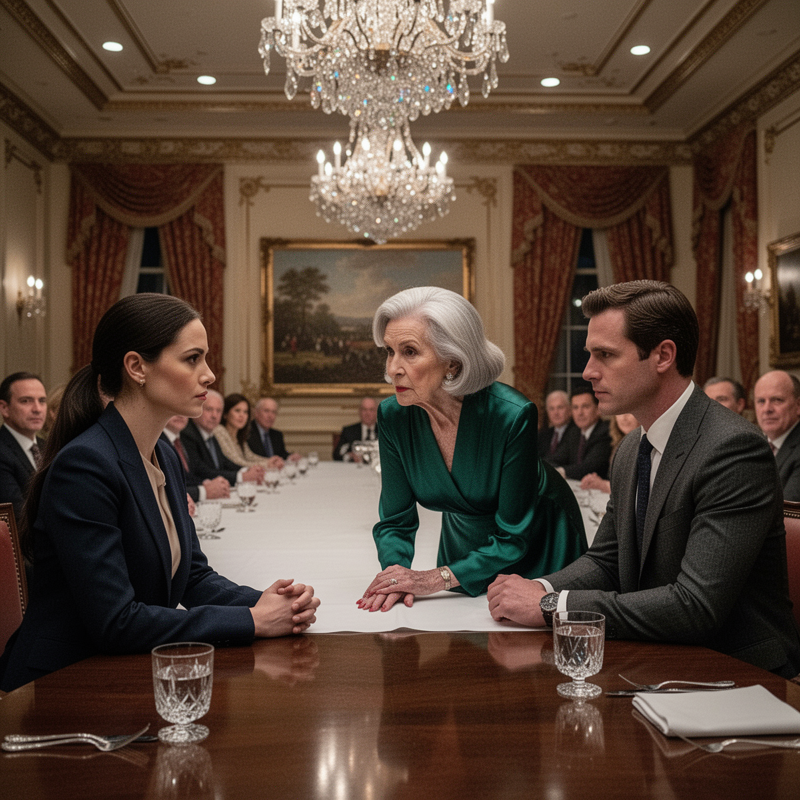
“You will sign over the title to your Walnut Street office building tonight, Clara, or we will ruin your late father’s memory,” Eleanor Delancy said across the Bellevue Hotel private dining table.
When Clara refused to surrender her $340,000 personal inheritance to cover Marcus’s $85,000 campaign deficit, Marcus—her closest friend and campaign candidate of 14 years—stood up and smashed a heavy ceramic platter directly across her forehead.
The platter shattered, leaving a deep gash requiring nine stitches above her left eyebrow, while 20 family members and high-profile donors sat in total, paralyzed silence.
Bleeding onto the crisp white tablecloth, Clara reached into her handbag and dialed 911 right in front of them.
Someone was finally going to pay for fourteen years of forced silence.
The silence in the opulent private dining room was suffocating, thick enough to drown in. Not a single person among the 20 prominent guests moved, their faces frozen in various masks of shock and disbelief.
A faint, metallic smell began to permeate the air.
My hand, already sticky, went to my forehead. When I pulled it back, my fingers were slick with warm, dark red. The gash above my left eyebrow throbbed, a sharp, insistent pain.
Marcus Delancy stood over me, his chest heaving, ceramic shards clinging to the lapels of his tailored suit jacket. His eyes, usually so calculating and composed, were wide and wild.
He looked like a child caught in a tantrum, utterly devoid of the mayoral candidate persona he’d meticulously crafted for over a decade.
Eleanor Delancy, Marcus’s mother, was the first to stir. Her pristine white linen napkin, clutched in her manicured hand, seemed to tremble.
“Marcus,” she breathed, her voice a low, strangled whisper. It wasn’t a question, or even an accusation, but a sound of pure, unadulterated panic.
Not for me, but for the scandal unfolding around her.
Across the table, a donor—a city councilman from the 7th ward, I think—instinctively reached for his phone, then hesitated, his gaze darting to Eleanor. He swallowed hard and slowly lowered his hand, his eyes wide with a strange mix of fear and complicity.
No one moved to help me. No one offered a napkin, a kind word, or even a glass of water.
The waiter, who had been setting down a plate of roasted asparagus just moments before, stood rigidly by the service door, his tray still in hand. His face was pale, his eyes fixed on the splatter of blood now blossoming on the pristine white tablecloth.
The expensive china, a gift from some obscure European dignitary, lay in jagged pieces on the polished parquet floor. One large fragment, still bearing a hand-painted crest, had landed near the toe of my pump.
I could feel a slow trickle of blood running down my temple, past my ear, and into my hairline. It felt oddly warm, a stark contrast to the suddenly icy room.
My vision was still a little blurry from the impact, but the faces around me were clear enough: the horror, yes, but also the calculation, the weighing of loyalties, the quiet decision to remain silent.
Fifteen years. Fourteen years I’d spent protecting Marcus, building his image, calming his volatile temper behind closed doors. Now, in front of everyone, he had shown them all exactly who he was.
And they still chose silence.
I took a deep, shaky breath, the metallic taste of blood in my mouth. My fingers fumbled inside my clutch, searching for my phone. Every movement was deliberate, defiant.
My thumb found the familiar cold glass screen. I pressed the emergency services shortcut.
“Clara, don’t,” Marcus finally managed to say, his voice raw. He took a hesitant step toward me, then stopped, as if suddenly remembering what he had just done.
Eleanor sprang from her seat. “Marcus, sit down! Clara, put that away, please. This is a private matter. We can handle this privately.”
Her eyes, cold and sharp, were fixed on my phone, not on my bleeding forehead.
I ignored her. The phone was ringing.
The crisp voice of the 911 operator came through the speaker. “Philadelphia Emergency Services, what is your emergency?”
A collective gasp swept across the room. Someone dropped a glass. It shattered violently, echoing the ceramic platter just moments before.
“Yes,” I said, my voice steady, surprising even myself. “My name is Clara DeWitt. I’m at the Bellevue Hotel, in the Walnut Room, and I’ve just been assaulted.”
Marcus let out a choked sound, a mixture of rage and terror. He looked wildly around the room, as if pleading with his silent audience to intervene.
Eleanor rushed towards me, her hand outstretched. “Clara, stop this! Think of the campaign! Think of what this will do to Marcus!”
I leaned away, protecting the phone. “The assailant is Marcus Delancy, City Council President.”
A woman’s voice, quiet and urgent, reached my ear from behind me. “Clara, hold still.”
It was Gemma Delancy, Marcus’s sister-in-law, his campaign press director. She had been sitting at the far end of the table, silent until now.
She moved with a quiet efficiency, already by my side, a crisp white napkin in her hand. Gently, she dabbed at the blood on my forehead, her touch unexpectedly tender.
Her eyes met mine for a fleeting second—a flicker of something that looked like sorrow, or perhaps a desperate apology.
“It’s going to be okay,” she murmured, her voice barely audible above the rising murmurs in the room.
As she pulled her hand away, wiping a fresh streak of blood from my cheek, I felt a small, hard object slide into the outer pocket of my coat, which was draped over the back of my chair.
Her fingers brushed mine, a subtle, almost imperceptible pressure.
I didn’t look down. I didn’t acknowledge it.
My gaze remained fixed on the 911 operator’s face on the screen, waiting for her next question.
Part 2
“Yes,” I confirmed, my voice still surprisingly steady. “The Walnut Room. Thank you.”
The next few minutes were a blur of flashing lights and official voices. Police officers arrived, their uniforms a stark contrast to the elegant chaos. Statements were taken, questions asked. Marcus was visibly sweating, his mother Eleanor still barking hushed, frantic instructions at him.
I felt a strange detachment as Officer Albright, a kind-faced woman with tired eyes, helped me to a waiting ambulance. The throbbing in my head had intensified to a dull roar. The paramedic applied a temporary dressing, his movements gentle and professional.
At Pennsylvania Hospital, the emergency room was bright and sterile, a stark contrast to the Bellevue’s opulent warmth. A doctor with a calm demeanor informed me I’d need stitches. Nine, he said, above my left eyebrow. Each needle prick was a fresh jab of pain, but I focused on the quiet hum of the machines around me, on anything but the lingering image of Marcus’s furious face.
Later, in a small private room, a nurse brought me a cup of weak tea and my coat. My fingers, still trembling slightly, brushed against something hard in the outer pocket.
Gemma’s secret.
I pulled out the small, black USB drive. It looked innocuous, almost forgotten.
My tablet was in my bag. With a fresh surge of adrenaline, I fumbled to connect the drive. A folder popped up on the screen, labeled “DELANCY CAMPAIGN – FINANCIALS.”
Inside were spreadsheets, bank statements, and a series of scanned invoices. I scrolled through them, my heart pounding faster with each line.
The numbers didn’t add up. Not even close. There were unauthorized inter-account transfers, large sums shuffled between obscure shell entities, all trying to disguise an $85,000 campaign deficit.
Then, I saw it. Tucked away in a subfolder, an encrypted file named “AUDIT\_2012\_CONFIDENTIAL.”
The year hit me like a physical blow. 2012. That was the year Marcus launched his first campaign, the one that propelled him onto the City Council. The year my father’s union reputation was inexplicably tarnished.
A cold dread spread through me. This wasn’t just about an $85,000 deficit. This wasn’t just about tonight.
This was about everything.
CHAPTER 2: The Smear Begins
The morning news broadcast played on a muted six-inch screen in the corner of my living room while I applied fresh sterile dressing over the nine stitches above my left eyebrow.
I stopped my hand mid-motion when my own face flashed across Channel 6.
It was grainy security camera footage from the lobby of the Bellevue Hotel, dated from two nights prior.
The video had been clipped to three short seconds. It showed me standing abruptly from a corridor chair, raising my hand toward a campaign aide, and tossing a stack of printed schedules onto the marble floor.
There was no sound. There was no context.
“Breaking news in the race for City Hall,” the news anchor announced, her voice rising with practiced urgency. “Supporters of City Council President Marcus Delancy confirm that his longtime campaign director, Clara DeWitt, has stepped down following a high-stress emotional incident during a donor dinner.”
The broadcast cut to a recorded statement from Marcus’s official press office.
“Clara has given fourteen years of dedicated service to this city,” the voiceover read. “We ask for privacy as she takes the necessary time away from public life to recover from severe professional exhaustion.”
I sat frozen on the edge of my sofa, holding a piece of medical tape between my fingers.
They had framed a violent attack as a mental breakdown.
My phone chimed on the coffee table. It was a mass text sent to forty-two committee members, signed by the campaign treasurer.
Effective immediately, my credentials, media authority, and security badges were revoked.
Fourteen years of strategic work had been erased in less than two minutes of local television.
I stood up, pulled on my coat, and picked up my keys. I needed to access my physical files at headquarters before they purged my records entirely.
CHAPTER 3: The Broken Trust
The brass-rimmed glass doors of campaign headquarters on Walnut Street were locked tight when I arrived at seven in the morning.
Inside the lobby, two broad-shouldered men in navy security uniforms stood behind the reception desk.
I reached into my bag, pulled out my key card, and pressed it against the electronic scanner.
The light flashed solid red.
“You can’t be in here, Miss DeWitt,” the taller security guard said, pushing the heavy glass door open just two inches.
“My personal journals and financial logs are in the corner office,” I said, keeping my voice steady despite the throb behind my left eye. “I built this office.”
“Orders came down at midnight,” he replied, looking down at his clipboard. “No access for unassigned personnel.”
A black town car pulled up to the curb behind me, its engine idling against the morning exhaust.
The rear door clicked open, and Eleanor Delancy stepped onto the sidewalk. She wore a pristine camel-hair coat and held a slim Manila envelope in her leather-gloved hands.
“You shouldn’t be standing on the street in broad daylight, Clara,” Eleanor said, stopping two steps away. “It lacks dignity.”
She handed me the envelope.
“What is this?” I asked.
“A formal notification from the bank,” Eleanor said calmly. “As legal trustee of the Delancy Political Action Committee, I have executed the emergency administrative clause. All joint operations accounts are frozen pending a full forensic audit.”
My breath caught in my throat.
“My personal consulting retainer is in that account,” I said. “Forty-two thousand dollars of my own earned income.”
Eleanor adjusted the lapel of her coat without looking at my bandaged forehead.
“You’ll get what is yours once the accounting firm confirms no funds were misplaced during your breakdown,” she said softly. “Go home, Clara.”
She walked past me and stepped through the glass doors, which the guard unlocked from the inside.
CHAPTER 4: The Key in the Floorboard
By three in the afternoon, two local news crews were parked outside my apartment building in Fairmount.
I packed my laptop into a canvas shoulder bag, slipped out through the rear alleyway exit, and caught a southbound bus to South Philadelphia.
My late father’s old union office on Washington Avenue had been vacant since his death five years ago.
The two-story brick building had belonged to the District 4 Labor Union, where Donald DeWitt had served as business manager for twenty-two years.
I unlocked the heavy oak door, stepping into the damp, cold room filled with dust and old metal filing cabinets.
The air smelled like old paper, machine oil, and stale coffee.
I sat down behind my father’s heavy mahogany desk, pulling out the bottom drawers to clear out old campaign schedules I had stored there years ago.
As I yanked the lowest drawer off its wooden tracks, a metallic click echoed through the empty room.
I knelt on the cold floorboards and shined my phone’s flashlight into the dark cavity beneath the desk frame.
Taped securely to the raw underside of the wood was a small brass key.
I pulled it free, peeling off the yellowed masking tape.
Stamped into the brass was the coat of arms for Fulton Bank on Chestnut Street, along with a four-digit number: 0412.
It matched the hidden account reference number I had seen on the encrypted USB drive Gemma Delancy had slipped into my coat pocket during the Bellevue dinner.
My father had never mentioned a box at Fulton Bank.
CHAPTER 5: The Unopened Box
The vault manager at Fulton Bank on Chestnut Street led me into a small, windowless viewing room painted pale green.
He placed safe deposit box #412 on the brass table, bowed his head slightly, and left the room, closing the heavy door behind him.
My hands trembled as I turned the brass key in the lock.
Inside lay a single yellowing Manila folder and a heavy linen envelope stamped with the year 2012.
The envelope was unsealed.
I pulled out three pages of lined yellow legal pad paper, covered in thick, energetic handwriting I recognized immediately.
It was written by Marcus Delancy, dated June 14, 2012.
It was addressed to his own father, the late Senator Marcus Delancy Senior.
“Dad,” the letter began. “The union audit is closing in. If the missing $120,000 from the pension fund is linked to my early exploratory committee, my career is over before it starts.”
I held my breath as I turned to the second page.
“Donald DeWitt trusts me,” Marcus had written. “He signed the blank authorization vouchers for the equipment lease last month without checking the ledger codes. I moved the paper trail into his administrative ledger today. He won’t realize the discrepancy until the state review in September, and by then the assets will be settled. It’s the only way to clear my path.”
My father had died five years ago with a clouded reputation, quietly forced into early retirement under a cloud of suspected financial mismanagement.
Marcus had not just stolen from his campaign.
He had systematically destroyed my father to launch his own career twelve years ago.
CHAPTER 6: Retaliation Round 1
At eight o’clock the following morning, I met investigative reporter Julian Rossi at a small corner diner on Race Street in Chinatown.
I laid the scanned copies of the 2012 financial ledgers on the Formica table between our coffee cups.
Julian put on his reading glasses, scanning the numbers with a practiced eye.
“This shows double-entry bookkeeping on the 2012 union account,” Julian murmured, tracing a column with his pen. “If Marcus fabricated these ledger entries, it invalidates his entire inaugural campaign treasury.”
“It clears my father,” I said.
Before Julian could answer, his cell phone buzzed against the table. He picked it up, listened for three seconds, and looked across at me.
“Marcus just held a flash press conference on the steps of the Criminal Justice Center,” Julian said.
He turned his phone screen toward me.
Marcus stood behind a microphone, surrounded by two attorneys in dark suits.
“This morning, our legal team filed an emergency civil injunction against former employee Clara DeWitt,” Marcus announced to the assembled reporters, his voice firm and composed. “Miss DeWitt has illegally removed proprietary voter databases and confidential campaign financial records from our server network.”
“He’s preempting you,” Julian said softly.
“The court has issued a temporary restraining order,” Marcus continued on screen. “Miss DeWitt is strictly prohibited from possessing, distributing, or discussing any internal operational documents of the Delancy campaign.”
My phone vibrated in my coat pocket.
It was a formal court summons delivered by electronic service.
If I released the documents to the press now, I would be in direct violation of a court order and subject to immediate arrest.
CHAPTER 7: The Unlikely Ally Steps Forward
That night at ten o’clock, a text from an unknown number appeared on my screen.
*Under the elevated train tracks. Passyunk and 5th. Come alone.*
I drove through the light drizzle to South Philadelphia, parking beneath the roaring steel girders of the train line.
A figure in a dark rain parka stepped out from the shadow of a concrete pillar.
It was Gemma Delancy, Marcus’s sister-in-law and the campaign’s press officer.
She opened the passenger door of my sedan and slid into the seat, pulling her damp hood back. Her face was pale in the yellow streetlamp light.
“I saw what he did with the platter at the Bellevue,” Gemma said, her voice barely louder than a whisper. “I sat there and said nothing while you bled onto the table.”
“Why did you give me the USB drive, Gemma?” I asked.
“Because I found the 2012 audit files in Eleanor’s house three weeks ago,” Gemma said, pulling her gloves off. “She keeps duplicates of every bribe, every payoff, every ledger change in her floor safe. She uses them to keep Marcus under her thumb.”
Gemma reached into her purse and pulled out a small black leather notebook.
“Marcus didn’t act alone,” Gemma said, handing the book to me. “When your father was framed, six senior ward leaders were paid to look the other way.”
I opened the notebook.
Listed in neat blue ink were dates, bank account transfers, and names.
At the very top of the list was Arthur Pendelton, the most powerful political kingmaker in Philadelphia.
CHAPTER 8: Shifting Loyalties
“Arthur Pendelton was at the Bellevue dinner,” I said, studying the names in the leather notebook. “He walked out before the police arrived.”
“He didn’t walk out because he was angry at Marcus,” Gemma said, looking out the rain-streaked windshield. “He walked out because he was disgusted with himself.”
“Why?”
“Arthur knows what Marcus is,” Gemma said. “He’s known since 2012. But Eleanor has owned Arthur for a decade.”
“How?” I asked.
“Arthur’s son, Ryan, ran up forty-five thousand dollars in illegal gambling debts with a firm in Atlantic City ten years ago,” Gemma explained. “Eleanor paid the debt directly from her private trust account. In exchange, Arthur agreed to deliver the 1st, 2nd, and 5th Ward endorsements to Marcus for every election cycle.”
I closed the notebook.
“Arthur is seventy-two years old,” I said. “He’s retiring at the end of this term.”
“He’s tired, Clara,” Gemma said. “He hates Eleanor. But he’s terrified of public exposure.”
“He doesn’t need to be exposed to the public,” I said slowly. “He just needs to see what he’s been protecting.”
Gemma turned toward me, her eyes wide. “What are you going to do?”
“I’m going to pay Arthur a visit at his home.”
CHAPTER 9: The Private Confrontation
Arthur Pendelton’s three-story brick rowhouse in Fairmount smelled of pipe tobacco and old wool carpet.
He opened the door himself, wearing a brown cardigan and holding a reading glass.
He looked at the white bandage above my left eyebrow, then stepped back to let me enter.
“I expected you three days ago, Clara,” Arthur said, leading me into his quiet, book-lined study.
I sat in the leather armchair across from his desk.
I didn’t offer a greeting. I simply opened my bag, pulled out the original handwritten 2012 letter Marcus had written to his father, and placed it on the green blotter between us.
Arthur put on his glasses and picked up the paper.
He read the three pages slowly, his hand motionless. The only sound in the room was the ticking of a grandfather clock in the hallway.
When he finished, he set the paper down and rested his chin in his hands.
“I didn’t know he framed Donald,” Arthur said, his voice raspy. “I knew there were missing union funds, Clara. I knew Eleanor covered the gap. But I was told your father took an early buyout.”
“You took forty-five thousand dollars from Eleanor to protect Marcus,” I said quietly.
Arthur winced, looking away toward the cold fireplace.
“My son was facing jail, or worse,” Arthur whispered. “Eleanor offered me an exit. I took it.”
“My father died with people believing he was a thief, Arthur,” I said. “Fourteen years of my life were spent making Marcus look like a leader. And two nights ago, he smashed a plate across my head because I wouldn’t give him my inheritance.”
Arthur looked back at me, his eyes wet.
“What do you want me to do?” he asked.
“Stop protecting him,” I said.
CHAPTER 10: Escalation Round 3
Marcus responded to his slipping momentum by escalating his public campaign to an aggressive new level.
On Thursday morning, a twelve-thousand-dollar television commercial buy hit three local network affiliates.
The ad opened with black-and-white photos of me, overlaid with dramatic red text.
“Who is Clara DeWitt?” a booming voiceover asked over ominous music. “A bitter, disgruntled former employee demanding money after being removed for misconduct. Marcus Delancy stands for integrity. Don’t let corporate extortion ruin Philadelphia’s future.”
I sat in my kitchen, watching the commercial run three times in a single hour.
The phone rang at noon.
It was Sarah, the head of the campaign’s volunteer field office in North Philadelphia.
“Clara,” Sarah said, her voice shaking with emotion. “Did you see the TV ad?”
“I saw it, Sarah.”
“Twelve of us just packed up our boxes and walked out of the Broad Street headquarters,” Sarah said. “We’ve worked with you for ten years. We know who did the work in that office. We know Marcus couldn’t draft a single housing policy without you.”
“Sarah, don’t endanger your positions—”
“It’s done,” Sarah interrupted. “We left our keys on the desk. All twelve precinct captains are sitting in my living room right now. We’re done running Marcus’s campaign.”
The public smear was meant to isolate me.
Instead, it was fracturing Marcus’s own ground operation.
CHAPTER 11: The Tipping Point
At six o’clock on Friday evening, my home phone rang.
The caller ID displayed a private line.
I picked up the receiver and pressed the record button on a small audio capture device I had connected to the landline base.
“Clara,” Eleanor Delancy’s voice came through the speaker, crisp and measured.
“Hello, Eleanor,” I said.
“This unpleasantness has dragged on far too long,” Eleanor said without preamble. “It is destroying Marcus’s polling in the 3rd District, and it is exhausting my patience.”
“You ran television ads calling me a criminal,” I said.
“Marcus ran those ads,” Eleanor corrected coldness in her tone. “I am offering you a practical solution. I will personally transfer one hundred and twenty thousand dollars in cash from my private account directly into your personal bank account tonight.”
I remained silent, letting the tape roll.
“In exchange,” Eleanor continued, “you will surrender the original 2012 letter, sign a full mutual non-disclosure agreement, and leave Pennsylvania by the end of the month.”
“You want to buy my silence about my father,” I said into the receiver.
“I am buying peace for my family, Clara,” Eleanor replied sharply. “You have no leverage. The press believes Marcus. The courts have issued an injunction against you. Take the money and rebuild your life somewhere else.”
“No,” I said.
“Think carefully, Clara,” Eleanor said. “If you refuse, Marcus will make sure you never hold an administrative license in this state again.”
“The answer is no, Eleanor.”
I hung up the phone.
I held the small recording device in my palm. I had just captured Eleanor Delancy attempting to pay a six-figure bribe to suppress evidence of historical union fraud.
CHAPTER 12: Escalation Round 4
Marcus launched his final escalation on Monday morning.
At eight-thirty, a marked municipal vehicle pulled up in front of my inherited commercial building on Walnut Street—the three-story property worth $340,000 that my father had left me.
A city building inspector taped a bright orange legal notice to the front glass door.
It was an Emergency Municipal Safety Lien, citing structural masonry violations and ordering the immediate condemnation of the premises.
If the lien stood, the city would seize administrative control of the property within forty-eight hours, dragging me into a protracted bankruptcy fight that would bleed my remaining savings dry.
The inspector had been dispatched directly by the Department of Licenses and Inspections—a division overseen by Marcus’s closest ally on the City Council committee.
I stood on the sidewalk, holding the orange notice in my hand, when my cell phone rang.
It was Arthur Pendelton.
“Did they post the lien?” Arthur asked directly.
“They just taped it to the front door,” I said.
“Don’t panic,” Arthur said, his voice calm and sharp. “I still chair the Municipal Zoning Oversight Committee. Marcus tried to push that lien through without my signature.”
“Can he enforce it?”
“Not anymore,” Arthur said. “I just signed an administrative override freezing the lien indefinitely. Marcus overreached, Clara. He thinks he owns City Hall. He forgot that the committee chairs still hold the gavels.”
Arthur paused, taking a slow breath.
“It’s time to assemble the leadership,” Arthur said. “Call Gemma. Tell her to schedule Room 400 for tomorrow at four o’clock.”
CHAPTER 13: Gathering the Circle
Room 400 of Philadelphia City Hall was a high-ceilinged caucus room lined with dark mahogany paneling, bronze chandeliers, and heavy velvet curtains.
It was traditionally reserved for executive party endorsements and budget negotiations.
By three-forty-five on Tuesday afternoon, all fifteen Democratic ward leaders from across the city had arrived, filling the high-backed leather chairs along the central conference table.
Among them sat the party elders, the labor representatives, and the neighborhood brokers who controlled the precinct machinery.
Gemma Delancy sat near the end of the table, holding a black leather briefcase.
Marcus knew nothing about the true purpose of the meeting.
Gemma had sent him an urgent text an hour earlier, stating that Arthur Pendelton had convened an emergency closed-door session to finalize his formal mayoral endorsement before the weekend press deadline.
At precisely four o’clock, the heavy oak doors opened.
Marcus walked in, wearing his tailored navy suit, a silk tie, and a broad smile.
He was accompanied by his chief media manager, holding a leather folder for photo opportunities.
“Arthur, good afternoon,” Marcus said loudly, walking toward the head of the table with his hand extended. “I appreciate you gathering the ward chairs on such short notice.”
None of the fifteen men and women at the table stood up.
Nobody smiled.
Marcus’s hand remained hovering in the air.
The room was completely, suffocatingly quiet.
CHAPTER 14: The Quiet Caucus
Marcus slowly pulled his hand back, his smile fading as his eyes scanned the silent faces around the table.
Arthur Pendelton sat at the head of the table, his arms folded over a thick paper folder.
“Sit down, Marcus,” Arthur said quietly.
Marcus looked around, noticing for the first time that no reporters or news cameras were in the room.
“What is this?” Marcus asked, his tone dropping its polished public pitch. “Where is the press core?”
“Sit down,” Arthur repeated, pointing to the empty chair at the foot of the table.
Marcus adjusted his jacket, pulled out the chair, and sat down. His press officer remained standing by the door, visibly uncomfortable.
Arthur reached into his folder and pulled out two stapled sets of paper.
He slid the first set down the long polished mahogany table.
It was a printed copy of the official Philadelphia Police Department assault report filed at Pennsylvania Hospital, detailing the nine stitches to my forehead.
Marcus glanced at it, his jaw tightening. “That was a private personnel dispute that was misconstrued by—”
Arthur held up a hand, cutting him off mid-sentence.
He then pulled the second document from the folder.
It was the original three-page handwritten letter written by Marcus in June 2012, along with the audio transcript of Eleanor’s phone call offering the $120,000 cash bribe.
Arthur slid the documents down the table until they rested directly in front of Marcus’s hands.
“Read page two, Marcus,” Arthur said softly.
CHAPTER 15: The Awkward Defeat
Marcus picked up the yellowed pages.
As his eyes hit his own handwriting from twelve years prior, the color drained completely from his face.
His fingers began to tremble slightly against the paper.
“This… this is an unverified draft,” Marcus stammered, his voice cracking on the second word. “This is twelve years old. It was written during a period of extreme personal stress… it has no legal standing.”
He looked around the table, searching for an ally among the fifteen ward leaders.
“Frank, you’ve known me for a decade,” Marcus said, turning to the 3rd Ward leader. “You know how Clara operates. She’s orchestrating this to get money for her property—”
Frank looked down at his glass of water and said nothing.
“Arthur, listen to me,” Marcus tried again, his voice rising, breathless and awkward. “We can manage this. We can issue a joint statement clarifying the union accounting…”
“There will be no joint statement, Marcus,” Arthur said flatly.
Arthur reached into his coat pocket, pulled out the official party mayoral nomination petitions, and laid them on the table.
“All fifteen ward chairs have formally removed their signatures from your nomination papers,” Arthur said. “As of four o’clock today, the party mechanism is withdrawn. You will not have the line.”
Marcus stared at Arthur, his mouth open. He looked back toward the end of the table where his mother, Eleanor, had quietly entered through the rear staff door moments earlier.
Eleanor stood near the wall, staring at Marcus with cold, unblinking eyes.
She had just learned from Gemma thirty minutes prior that Marcus had secretly gambled away $85,000 of her private retirement pension to cover his early campaign deficit.
“Mother…” Marcus whispered, turning toward her.
Eleanor slowly turned her head away, looking out the tall window toward City Hall courtyard, refusing to meet his eyes.
Marcus stood up abruptly, knocking his chair back two inches against the carpet.
He opened his mouth to deliver a speech, but no sound came out.
He looked at the silent ward leaders, who all sat staring straight ahead, refusing to acknowledge him.
Without another word, Marcus grabbed his coat off the adjacent chair, stumbled over his own feet as he turned, and walked stiffly toward the exit doors.
The heavy oak doors clicked shut behind him.
The fifteen ward leaders remained in total silence as the elevator indicator lights slowly ticked down to the ground floor.
CHAPTER 16: The Falling Dust
Forty-eight hours later, a terse two-paragraph press release was issued by Marcus Delancy’s personal office.
He announced his immediate resignation from the Philadelphia City Council and his withdrawal from public life, citing “a desire to focus on private family matters.”
There was no press conference. There were no cameras on the steps of City Hall.
To avoid a public trial, Marcus quietly agreed to pay a $10,000 civil battery penalty to resolve the Bellevue assault filing, paid directly from his remaining private savings.
On Friday morning, Arthur Pendelton called me into his office one last time.
He sat behind his desk, looking older and tired.
“The party executive committee met last night, Clara,” Arthur said, sliding an official appointment document across the desk toward me. “We want you to take over as Chief Strategic Director for the upcoming municipal transition team. High salary, full authority, public recognition.”
I looked down at the crisp white paper bearing the city seal.
Fourteen years ago, this document would have been everything I ever wanted.
I looked at Arthur. I thought about the night at the Bellevue Hotel—how twenty people in expensive suits had sat in dead silence while I bled onto a white tablecloth, calculating their political futures before deciding whether to hand me a napkin.
“No, thank you, Arthur,” I said quietly.
“Clara,” Arthur said, leaning forward. “You won. You proved your father was innocent. You cleared your name.”
“I didn’t win, Arthur,” I said, rising from the leather chair. “I just stopped playing.”
I walked out of City Hall, leaving the appointment document untouched on his desk.
CHAPTER 17: A Quiet Desk
A long time later.
The basement level of the Municipal Records Building on Arch Street was always cool, smelling faintly of dried ink, old cardboard, and concrete dust.
Rows of gray steel filing cabinets stretched thirty yards down narrow, dimly lit aisles.
My desk sat in the far corner, near the historical land deed section, illuminated by a single brass desk lamp.
My job was simple: cataloging and digitizing Philadelphia property records from the early twentieth century.
No press releases. No campaign deadlines. No political donors demanding favors at midnight.
A small local newspaper lay folded on the edge of my desk, dated from three weeks ago.
On page fourteen, a small business note mentioned that former Council President Marcus Delancy had taken an entry-level clerk position at a suburban commercial real estate firm in Montgomery County.
His political backing was gone. His elite social network had vanished. He spent his days filing commercial lease permits in total obscurity.
My cell phone sat beside my keyboard, dark and quiet.
I had cut ties with everyone from my old life—the ward leaders, the campaign staff, even Gemma.
The white scar above my left eyebrow had faded to a fine, silver line that I barely noticed in the mirror anymore.
I reached for a fresh folder, opened a heavy parchment deed from 1914, and began typing the serial numbers into the municipal archive log.
I spent fourteen years carrying a man on my shoulders, only to learn that freedom doesn’t feel like a victory parade; it feels like quiet room where nobody expects you to bleed for them anymore.
Leave a Reply