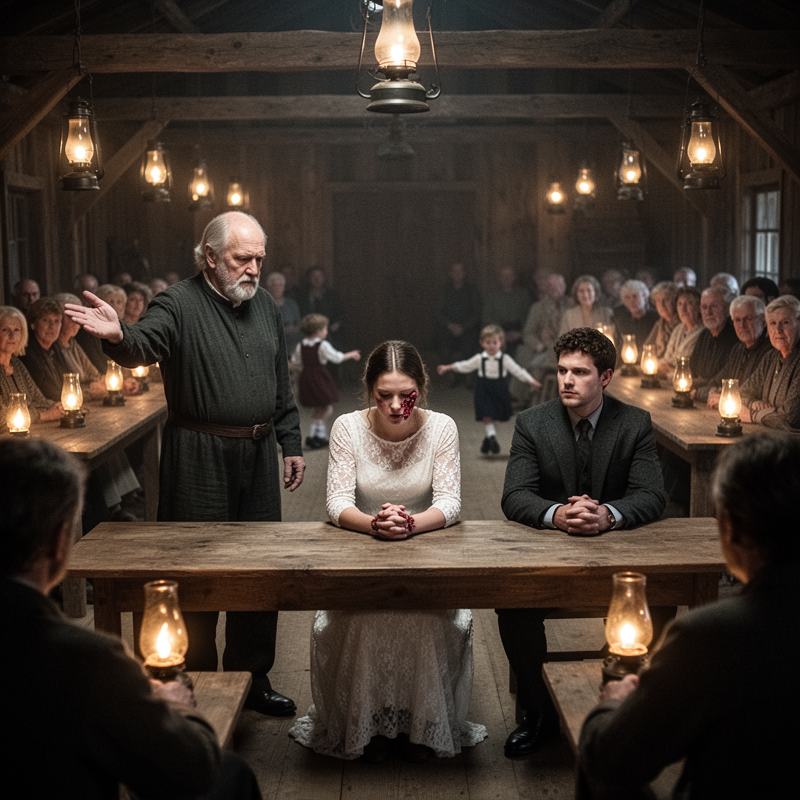
CHAPTER 1: The Feast of Ashes
Part 1
“She is a ruined vessel, marked by divine wrath, and you are a fool for taking her,” my father-in-law shouted in front of all seventy guests at the wedding feast.
Silas Albright, head shepherd of the Sanctified Fellowship in Boundary County, spat on the wooden floor right at his daughter Ruth’s scarred feet.
Ruth kept her eyes locked on the floor, her hands trembling under her lace sleeves as the congregation burst into cruel laughter.
I stood up from the head table, pulled the master land deed from my coat pocket, and looked Silas straight in his eyes.
He did not know that the scars burning across Ruth’s face came from dragging my body out of his locked burning sanctuary two years ago.
And he did not know that I owned every single acre of land his holy commune sat upon.
The scent of roasting lamb and pine needles filled the Sanctified Fellowship assembly hall, usually a comforting aroma. Tonight, it felt cloying, a suffocating sweetness under the harsh glare of oil lamps. Seventy guests, mostly members of the commune, sat at long wooden tables, their faces illuminated by the flickering light.
A few children, dressed in their Sunday best, chased each other between the benches, their giggles echoing off the rough-hewn timber walls.
They seemed oblivious to the sudden, terrible silence that had fallen over the room moments before.
All eyes were fixed on the head table, specifically on Ruth and her father, Shepherd Silas Albright.
Ruth, in her simple white lace gown, seemed to shrink into herself, her shoulders hunched. The left side of her face, a landscape of puckered, crimson scars, was more pronounced in the stark lamplight.
Shepherd Silas, a man whose voice usually boomed with righteousness and scripture, now used it to flay his own daughter. His eyes, usually gleaming with evangelical fervor, were cold and hard.
“Look at her!” Silas bellowed, his voice raw with contempt, sweeping an arm towards Ruth.
“A broken thing. A vessel God himself has seen fit to mar.”
A low murmur rippled through the gathered guests, quickly silenced by a sharp glance from Silas.
Ruth’s aunt, Miriam Albright, a stern woman with an unforgiving gaze, let out a high-pitched cackle that scraped against the silence. Her cousin, a young man named Seth, snickered beside her, covering his mouth with a calloused hand.
The humiliation burned in Ruth’s cheeks, a fire far hotter than any she had endured two years ago.
She gripped the edge of the table, her knuckles white. I could feel the tremor in her hand, even from my seat beside her. My own blood simmered, a quiet boil beneath my skin.
This was supposed to be a celebration. Our wedding feast. Instead, it was an inquisition.
Silas stepped closer to the head table, his shadow falling over Ruth like a shroud.
He leaned in, his voice dropping to a harsh whisper that still carried to every corner of the silent hall.
“And you, Noah Croft,” he sneered, his gaze flicking to me, “you only took her out of pity. What man truly wants a ruined vessel?”
He spat the words like venom.
I felt the heat rise in my face, a dangerous flush that threatened to betray my carefully maintained composure. Ruth flinched beside me, a small, involuntary movement.
The children’s giggles had stopped completely. The entire hall held its breath.
My hand tightened around the heavy manila envelope in my coat pocket. Its crisp edges pressed into my palm, a reminder of the power it contained.
I pushed my chair back, the scrape of wood against wood echoing loudly in the sudden, cavernous silence.
Every eye in the room snapped to me. Silas watched me, a smirk playing on his lips, expecting capitulation.
I stood to my full height, taller than Silas, and met his gaze evenly. He had always tried to diminish me, to make me feel small and insignificant, an outsider from the worldly city of Seattle.
I reached into my coat pocket.
The rustle of the paper felt amplified, a loud, defiant sound. I pulled out the sealed manila envelope, held it up, and broke the red wax seal with a deliberate, audible crack.
Silas’s smirk faltered slightly. His brow furrowed, a flicker of genuine curiosity, then dismissive scorn, in his eyes.
“What is this, boy?” he scoffed, waving a hand. “A pledge? A foolish promise you cannot keep?”
I ignored him, slowly, carefully, extracting the folded document from the envelope. It was thick, heavy parchment, covered in official stamps and legal jargon.
“It’s not a pledge, Shepherd,” I said, my voice low but clear, cutting through the thick tension in the room.
“It’s a deed.”
Deacon Thomas Halloway, the commune treasurer, who had been sitting hunched over his plate, choked on his water, coughing violently. Miriam Albright’s triumphant cackle died in her throat, replaced by a sudden, rigid stillness.
I unfolded the document, holding it so that the prominent title was visible to anyone who dared to look. The official seal of Boundary County gleamed under the lamplight.
“Three weeks ago,” I continued, letting the words hang in the air, “I purchased the entire mortgage note for the Sanctified Fellowship lands.”
Silas Albright’s face went slack. His jaw dropped, and the triumphant glint in his eyes was replaced by naked, unadulterated shock.
“All two point eight million dollars of it,” I said, my gaze never leaving his.
“Which makes me, Shepherd,” I finished, the weight of the document in my hands feeling immense, “the new sole owner of every single acre of land your holy commune sits upon.”
Part 2
Silas Albright stood frozen, his face a mask of disbelief. The seventy guests were silent, their eyes darting between me and their Shepherd, a man who had commanded their unquestioning loyalty for decades. Deacon Halloway looked like he might faint, clutching his chest.
I took a deep breath, letting the moment hang heavy in the air. This wasn’t just about land; it was about shifting power.
“Effective immediately, Shepherd,” I said, my voice cutting through the silence like a blade, “you are removed from the Sanctified Fellowship’s land administration board.”
A gasp rippled through the congregation. Miriam Albright, her face pale, stared at me with wide, disbelieving eyes.
“And I expect you and your family to vacate the head pastoral residence by the end of the month.”
The words hung in the air, a final, unchallengeable decree. Silas’s mouth opened and closed, no sound coming out. The color drained from his face, replaced by a livid red that crept up his neck.
Then, slowly, a cold, predatory smile spread across his lips. It wasn’t the smile of a defeated man, but of a cornered animal preparing to strike.
“You think you’ve won, boy?” he scoffed, his voice regaining its venom. He turned to face the congregation, his gaze sweeping over their stunned faces. “You think worldly deeds can undo God’s will?”
He pointed a finger at Ruth, who was now trembling visibly beside me.
“Her scars,” he announced, his voice booming with renewed authority, “were not an accident, as this outsider would have you believe.”
The hall fell silent again, every eye fixed on him, on Ruth.
“No,” Silas continued, his voice dropping to a theatrical whisper, “they were a divine fire. A punishment brought down upon her when, at sixteen years of age, she attempted to burn the holy books in the chapel sanctuary.”
Ruth gasped, a choked sound, her hands flying to her scarred cheek. Her eyes, wide with horror, filled instantly with tears, not of anger, but of a terrible, suffocating self-doubt.
“I will reveal the proof,” Silas promised the congregation, his voice dripping with righteous conviction, “of her wickedness.”
CHAPTER 2: The Forged Record
Silas did not blink as the murmurings of seventy congregation members filled the assembly hall.
He reached inside his heavy black clergy coat and withdrew an old, leather-bound journal. The cracked leather binding was dark with age, bound by a fraying cord.
“You speak of earthly paper and worldly banks, engineer,” Silas said, his voice echoing off the pine rafters. “But the spirit keeps its own books.”
He unspooled the leather cord and held up a yellowed page.
“This is Ruth’s personal journal, written in her own hand when she was sixteen years old,” Silas announced, turning the book toward the crowd.
Ruth stiffened beside me. Her hand rushed to cover the textured, pink skin-graft scar along her cheekbone.
“Read it yourself, Deacon Halloway,” Silas commanded, passing the book down the table.
Deacon Thomas Halloway adjusted his gold-rimmed wire spectacles. His voice trembled as he read the shaky script aloud.
“‘Lord, the wickedness in this chapel burns in my heart. If I must burn the holy sanctuary to cleanse my father’s house, I will welcome the fire.’”
A collective gasp rippled across the room. Aunt Miriam crossed her arms, nodding in bitter vindication.
Ruth shrank backward into her chair. Her eyes were wide, fixed on the handwriting that looked unmistakably like her own high-school cursive.
“No…” Ruth whispered, her knuckles turning white against her lace lap. “I never… I didn’t write that.”
“You wrote it after I disciplined you for reading worldly books, Ruth,” Silas said, his tone dropping into a soft, sorrowful frequency. “You brought the strike-anywhere matches from the pantry. Your soul was black with rebellion long before the flames touched your skin.”
I reached out and slammed my palm onto the journal, jerking it out of Halloway’s hands.
“This is a forgery,” I said, inspecting the ink. “The ink isn’t even oxidized properly.”
Ruth pulled her hand back from mine. Her eyes were glazed with tears, floating in two years of buried trauma.
“Noah,” she whispered, her voice cracking under the weight of the room. “What if… what if I did? What if God made me forget?”
“He didn’t make you forget anything, Ruth,” I said firmly, but she was already looking away.
Silas smiled, a sharp, terrible curling of his thin lips.
“The girl knows her own corruption, Mr. Croft,” Silas said softly. “You bought the land, but her soul still belongs to the ledger.”
CHAPTER 3: Poison in the Medicine Cabinet
The front door of our small off-grid timber cabin clicked shut behind us as night fell over the mountain ridge.
Ruth sat at the small kitchen table, staring blankly at her hands. The deep purple nerve scars on her left arm were twitching rhythmically.
“I’ll get your pain medication,” I said, walking into the bathroom.
I opened the mirrored medicine cabinet and picked up the brown plastic prescription bottle labeled Gabapentin. It had been refilled three days ago by Aunt Miriam at the commune’s dispensary clinic.
I popped the cap and poured two tablets into my palm.
Something felt wrong. The pills were flat, chalky white rounds with no imprinted identification numbers or scoring lines.
I brought one to my tongue. It dissolved instantly into pure, sugary sweetness.
It was compressed sugar.
I marched into the bedroom and grabbed the two previous bottles Ruth had used over the past six months. Every single tablet inside both bottles was identical.
My throat tightened. For six months, Ruth had been screaming into her pillow at midnight from severe phantom nerve pain, believing her body was punishing her.
I grabbed the bottle and drove straight down the gravel road to the commune’s main tractor barn, where Silas was overseeing the evening grain inventory.
The heavy wooden barn doors groaned as I threw them wide open.
Silas was standing beside a stack of hay bales, holding a lantern. Deacon Halloway stood behind him with a clipboard.
I tossed the pill bottle directly at Silas’s chest. It hit his leather vest and clattered onto the dirt floor.
“You’ve been giving her sugar pills for six months,” I said, stepping directly into his personal space. “She was screaming in agony while you told her God was burning her sins out of her.”
Silas didn’t even look down at the plastic bottle. He set his lantern on a grain barrel.
“Physical pain breaks the hard heart, Mr. Croft,” Silas said, his voice flat and unbothered. “If her skin burned, it was because her spirit was resisting grace.”
“She dragged me out of that fire, Silas!” I shouted. “She lost 38% of her skin surface saving my life!”
“And yet her soul remains unrepentant,” Silas replied coldly. “Pain is the shepherd’s rod. Take her medicine away entirely, and she will crawl back to the altar within a week.”
CHAPTER 4: The Shadow of Doubt
The next afternoon, I drove forty miles north to Sandpoint to file an emergency property injunction at the Bonner County courthouse.
When I returned to the cabin at four o’clock, the front door was unlocked.
Inside, Silas was sitting in the wooden rocking chair near the stove. Ruth sat on the floor near his knees, her head bowed low.
“Ruth,” I said, dropping my keys onto the counter. “I told you not to open the door to anyone from the compound.”
Silas stood up slowly, picking up his broad-brimmed felt hat from the table.
“A father does not need an invitation to visit his child, engineer,” Silas said gently. He patted Ruth on top of her head, the way someone comforts a confused pet.
Ruth did not look up at me. Her shoulders were slouched forward, wrapped in a faded wool shawl.
Silas walked past me toward the door. He paused at the threshold, turning his head slightly.
“Remember what we spoke of, daughter,” Silas said softly. “The world gives you deed titles and chemical pills. The Fellowship gives you eternal life.”
He closed the door quietly behind him.
I walked over and knelt down beside Ruth on the rug.
“Ruth, look at me,” I said, touching her shoulder.
She flinched violently at my touch, flinching away as if my skin were hot metal.
“Don’t,” she whispered.
“What did he say to you?” I asked, my blood running cold.
Ruth looked at me, her eyes red-rimmed and hollowed out by sleep deprivation.
“He said you came here to divide us,” Ruth whispered. “He said you paid the bank so you could isolate me from my family.”
“I bought the debt to keep him from kicking you off the land!” I said.
“He showed me my old Bible, Noah,” Ruth said, her voice shaking violently. “The spine was scorched. He said I set the fire because I hated the elders. What if my mind made up the rescue? What if you’re helping a monster?”
“You saved my life, Ruth,” I said fiercely, grabbing her hands despite her trembling. “Look at my back! Look at the scars on my shoulders!”
She pulled her hands free and pressed them against her temples, weeping silently. The psychological cage her father built around her spent eighteen years hardening, and its bars were still intact.
CHAPTER 5: The $500,000 Paper Trail
By Thursday morning, I knew I couldn’t fight Silas with spiritual arguments. I needed irrefutable facts.
I drove back to the county records office in Sandpoint and requested the historical commercial registry filings for the Sanctified Fellowship property.
The clerk handed me two thick manila folders stamped with closed insurance claim files from two years ago.
I sat at a wooden desk under the fluorescent lights and began turning the pages.
On page forty-two, I found a commercial property insurance policy issued by North Idaho Mutual.
The policy was taken out on the main sanctuary building for $500,000.
The issue date was June 11th, two years ago.
The sanctuary fire had occurred on June 14th—exactly 72 hours later.
My fingers gripped the edge of the paper so tightly the corner tore.
I flipped to the investigator’s report attached to the back.
The insurance carrier had denied the $500,000 payout six months after the fire. The report cited clear evidence of industrial accelerants found near the rear furnace intake.
The investigator noted that the claim was signed solely by Shepherd Silas Albright as the named beneficiary.
Silas had never told the congregation about the insurance policy. He had told them the chapel burned because of divine wrath and Ruth’s secret sins, while privately trying to cash a half-million-dollar check.
The insurance company had dropped the case without filing criminal charges because the accelerant samples were ruined by local volunteer fire department water hoses.
Silas had walked away without the cash, but he used the ashes to tighten his grip on every soul in the valley.
I had the paper trail proving financial fraud, but I still didn’t have the key piece of evidence: proof of who physically locked the chapel doors that night.
CHAPTER 6: The Excommunication Threat
When I returned to the compound that evening, a crowd had gathered near the central flagpole in the middle of the commune lawn.
Silas stood on an overturned wooden crate, holding a black leather Bible high above his head.
Fourteen-year-old Sarah, Ruth’s younger sister, stood on the dirt path below him. Her face was pale, tears running down her cheeks as Aunt Miriam held her firmly by both shoulders.
“Hear the judgment of the assembly!” Silas barked, his voice carrying across the valley in the crisp mountain air.
Ruth stepped out of our truck, watching in terror.
“Sarah Albright has harbored rebellious thoughts,” Silas proclaimed, pointing a finger down at his youngest daughter. “She has spoken secretly with her fallen sister Ruth!”
“Father, please!” Sarah sobbed, her thin hands clasped together in prayer. “I only asked if she was warm in her cabin!”
“Silence!” Silas roared. “Under Rule Fourteen of the Sanctified Covenant, Sarah is hereby cut off from the table. She shall be delivered to the Grace Reform Farm in Sanders County, Montana, by sunup tomorrow!”
Ruth gasped, taking three running steps toward her sister.
“No! Silas, stop!” Ruth screamed. “She’s fourteen! You can’t send her away!”
Aunt Miriam shoved Sarah backward, preventing Ruth from reaching her.
Silas stepped off the wooden crate and walked slowly toward Ruth.
“There is one way to spare your sister from the mountain farm, Ruth,” Silas said, stopping three feet away.
“What do you want?” Ruth choked out, her entire frame shaking.
“Repent of your marriage to this outsider,” Silas said, pointing at me. “Move back into the pastoral house tonight. Submit to the elders’ cleansing, and Sarah stays home.”
“She isn’t going anywhere with you,” I said, stepping between Silas and my wife.
Silas glared at me, his blue eyes icy and vacant.
“You have until midnight, Ruth,” Silas said softly. “Choose your husband, or lose your sister forever.”
CHAPTER 7: A Child’s Memory
We sat on the porch steps of our cabin as the sun dipped behind the western pine ridges, casting long, dark shadows across the valley.
Ruth was inconsolable, her face buried in her knees as she wept for Sarah.
Seven-year-old Eli, Ruth’s nephew, was sitting three steps down on the porch stairs. He was quietly playing with a ring of heavy, rusted iron keys he had found near the old sawmill.
I sat beside Eli, trying to clear my head to think of our next legal move.
“Eli, where did you get those keys?” I asked softly, trying to break the heavy silence.
“From the tool shed behind the old chapel ruins,” Eli said, clinking two thick iron skeleton keys together.
He pointed a small finger across the meadow toward the charred timber footprint of the burned sanctuary.
“Grandpa told me never to go in there,” Eli said casually, spinning a key on his thumb. “He said the devil lives in the ashes.”
“He’s wrong, buddy,” I murmured.
Eli looked up at me, his round hazel eyes completely clear and innocent.
“I know,” Eli said, leaning closer. “Grandpa was the one who was there that night. I saw him from behind the woodpile.”
My heart hammered against my ribs. I froze, keeping my voice entirely level.
“What did you see, Eli?” I asked quietly.
“I was playing hide and seek before bedtime,” Eli said, kicking his boots against the wooden step. “Grandpa came out of the furnace door with a big yellow tin. Then he pulled the iron latch bar down on the heavy outside doors.”
“He pulled the latch bar?” I asked, my knuckles locking.
“Yeah,” Eli said, nodding firmly. “He dropped the heavy iron bar into the wall bracket on the outside. Then he clicked the big padlock shut. Right before the black smoke started coming out the top windows.”
The air left my lungs in a sharp, painful cold rush.
The sanctuary doors didn’t swell shut from the heat. The wooden doors hadn’t jammed from warped framing.
Silas had intentionally dropped the heavy exterior iron latch bar from the outside and locked it with a padlock before lighting the accelerant.
He knew I was inside inspecting the roof trusses. And he didn’t care that his own eighteen-year-old daughter was inside preparing the altar linens.
He locked his daughter in a furnace for $500,000, then spent two years telling her that her burnt flesh was the mark of God’s wrath.
CHAPTER 8: The Betrothal Announcement
I stood up from the porch step so fast Eli dropped his keys onto the dirt.
“Ruth,” I said, my voice dangerously calm. “Get in the truck.”
Ruth looked up, her eyes red and confused. “Noah, what is it? What did Eli say?”
“Get in the truck, Ruth. Right now.”
I drove Ruth straight out of Boundary County, forty-five minutes down Highway 95 to a quiet motel on the edge of Sandpoint.
I paid cash for the room, ushered her inside, and locked the bolt.
“You stay here,” I said, turning to face her. “Do not answer the door for anyone except me.”
“Noah, what are you going to do?” Ruth pleaded, grabbing my coat sleeve. “Sarah is still at the compound! They’re taking her to Montana at dawn!”
“It’s worse than that,” I said, looking her dead in the eyes. “Deacon Halloway just called a commune meeting for eight o’clock tonight.”
I held up my phone, showing a text message alert sent to all commune land residents from Halloway’s number.
The text read: *Emergency Convocation: Betrothal Announcement of Sarah Albright to Deacon Thomas Halloway.*
Ruth backed away, her hands flying to her mouth in horror. Deacon Halloway was fifty-two years old. Sarah was fourteen.
Silas was binding Halloway to the inner circle forever to guarantee Halloway would never talk to federal bank auditors about the missing commune money.
“He’s selling her,” Ruth whispered, dropping onto the edge of the bed. “He’s selling my little sister.”
“He isn’t selling anyone,” I said, pulling the property deed and the insurance files out of my leather briefcase. “Stay here. Lock this door.”
I turned and walked out into the cold night, slamming the motel door shut behind me.
CHAPTER 9: Face to Face in the Study
At 11:30 PM, the lights inside the pastoral manor were dim.
The main assembly hall across the green was dark now—the betrothal ceremony was finished, and the followers had retired to their quarters.
I walked up the front porch steps of Silas’s heavy timber home. I pushed the front door open without knocking.
The manor smelled of pine wax, old paper, and unwashed wool.
I walked down the long hardwood hallway straight to Silas’s private back study.
Silas was sitting behind a massive oak desk, counting small stacks of cash from a green metal box. A glass of dark tea sat beside his brass lamp.
I walked into the room, reached behind me, and turned the heavy brass deadbolt in the door.
Silas looked up slowly. He didn’t reach for a drawer or show a flash of surprise.
“You are trespassing on sacred ground, engineer,” Silas said quietly, closing the cash box.
“I own the ground,” I said, stepping up to the edge of his desk.
I dropped three documents onto the blotter in front of him.
First, the $500,000 insurance policy denial notice from North Idaho Mutual.
Second, the structural deed transfer from the county land office.
Third, a signed written affidavit detailing 7-year-old Eli’s eyewitness statement regarding the exterior iron latch bar.
Silas glanced down at the papers. His eyes lingered on Eli’s name for two seconds before he raised his head.
“A child’s dream holds no weight in a court of law,” Silas said, leaning back in his tall leather chair.
“Eli isn’t dreaming, Silas,” I said, my voice dropping to a low, lethal whisper. “You dropped the iron bar into the wall bracket on the outside door. You locked the padlock. You walked away with a jerrycan while your daughter and I were breathing carbon monoxide.”
Silas stared at me. The soft, pastoral mask he wore for seventy followers slowly dissolved, revealing the cold, predatory grease beneath it.
He didn’t deny it. He didn’t even blink.
“The chapel was heavily mortgaged,” Silas said, his voice completely flat. “The bank was coming for the land two years ago. I did what was necessary for the survival of the Fellowship.”
“You locked your daughter in a fire for five hundred thousand dollars,” I said.
Silas leaned forward, resting his forearms on the desk.
“And look at her now,” Silas sneered softly. “She thinks she did it. She spent two years weeping at my feet, begging for my absolution. You can take this house, Croft. You can take every square inch of dirt in this valley.”
He smiled, a dark, terrifying glint in his pale eyes.
“But you will never clean her mind,” Silas whispered. “Every time she looks in the mirror, she sees my work. She sees her own damnation. You lost before you ever set foot on my land.”
CHAPTER 10: Broken Chains and Lingering Shadows
By six o’clock the following morning, three Boundary County Sheriff patrol cars were parked in a line outside the pastoral manor, their red and blue lights flashing against the morning fog.
Deputy Sheriff Miller stood on the porch, handing Silas an official order of immediate eviction and a felony summons for arson and child endangerment.
I stood by my truck on the gravel drive as Silas stepped off the porch, wearing his black coat.
He looked broken in the harsh daylight, but his head remained held high.
I walked past the deputies directly to the side porch where Sarah was sitting, holding a small canvas duffel bag.
“Sarah,” I said gently, crouching down to her eye level. “It’s over. Your sister is waiting in town. Come with me.”
Sarah looked at me. Her face wasn’t filled with relief. It was filled with pure, terrifying hatred.
“Get away from me!” Sarah screamed, jumping backward against the house wall.
“Sarah, please,” I said, holding my hands open. “Your father locked that chapel door. He hurt Ruth. He lied to all of you.”
“You are the devil!” Sarah shrieked, her voice echoing across the courtyard as congregation members watched from their windows. “Father said the deceiver would come with blue lights and paper legal deeds! You are sending him to prison because he serves God!”
“Sarah—”
“I will never go with you!” she screamed, tears streaming down her face as she clutched a small wooden cross to her chest. “I’d rather starve in the woods than live with an infidel!”
Aunt Miriam stepped up behind Sarah, wrapping her arms around the girl’s shoulders and glaring at me with cold venom.
“She belongs to the Lord, engineer,” Miriam spat. “You can take the dirt. You can’t take her soul.”
I stood there in the cold morning air as the deputies ushered Silas into the back of a cruiser.
I had stripped him of his land. I had stripped him of his ministry. I had exposed his insurance fraud to the county courts.
But as I looked at Sarah clinging to Aunt Miriam, screaming curses at me in the rising fog, I realized the absolute horror of what Silas had done.
He had built a cage without iron bars. And his youngest daughter was holding the door shut from the inside.
CHAPTER 11: The Empty Chair
The following month, winter settled heavy across the Pacific Northwest.
Ruth and I sat down for dinner at six o’clock inside our small, sunlit craftsman house in Spokane, Washington, sixty miles away from the valley.
The room was warm. The kitchen smelled of roasted chicken and fresh bread.
Ruth reached across the table and took my hand.
The skin grafts on her cheek were softening under modern medical treatments, turning from dark purple to a pale pink. Her hands no longer trembled when she reached for a cup.
She had spent four weeks speaking with a trauma specialist in town, slowly dismantling the decades of psychological poisons her father had fed her. She knew now that she hadn’t set the fire. She knew she wasn’t a broken vessel.
Yet, as she picked up her fork, her eyes drifted to the left side of the room.
At the far end of our small dining table stood a third wooden chair.
It was completely empty.
Two days after Silas’s arrest, the remaining loyalists of the Sanctified Fellowship had dissolved the compound.
Instead of returning to normal society, Aunt Miriam and Deacon Halloway had taken twenty deeply indoctrinated followers—including fourteen-year-old Sarah—and moved north across the border into an off-grid tent encampment in rural British Columbia.
Silas was awaiting trial in the Boundary County jail on bail he could not afford, but his doctrine lived on in the wilderness, keeping Sarah trapped in the dark.
Every state child welfare petition I filed was stalled in international legal jurisdiction delays.
Ruth looked down at her plate, a single tear slipping past her scar line and tracing down her neck.
She didn’t speak. She didn’t have to.
I reached across the table and squeezed her hand tighter, pulling her gently back into the light of the room.
We built a home far away from the valley, but every time two plates are set where three should sit, the quiet reminds us that some doors, once locked, leave scars time can never heal.
Leave a Reply