CHAPTER 1: The Cost of Blood
Part 1
“If you don’t hand over that sixty-five thousand dollars right now, you aren’t leaving this house alive.”
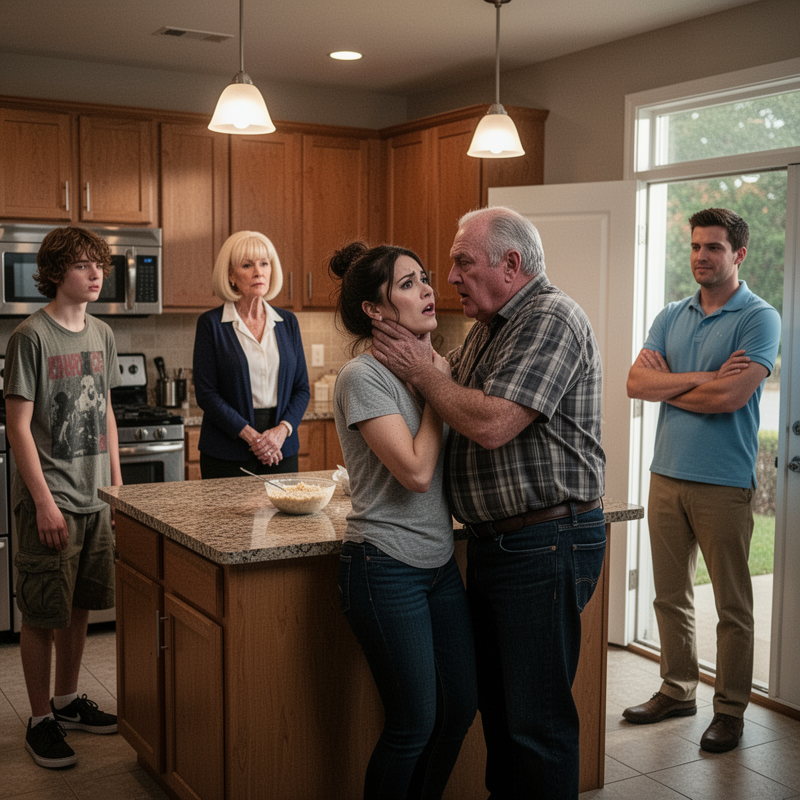
My father’s fingers locked around my throat in the kitchen of our Oakhaven home, pinning me against the counter while my mother and brother stood by, watching in cold approval.
My ex-fiancé, Brad, had convinced my family that my medical savings belonged to him to settle my brother’s gambling debt, threatening to ruin our family’s name in our small town if I didn’t comply.
What they didn’t know was that two hours earlier, I had already wired every cent of my cancer surgery fund into an untraceable medical trust.
And my phone, resting face-up on the counter, was recording every single second of their assault.
The pressure intensified against my windpipe. The kitchen lights, usually so warm and inviting, blurred into a single, harsh halo above Arthur’s rage-contorted face. My lungs burned, demanding air that wouldn’t come.
My father’s grip was absolute, cutting off breath, cutting off sound. His eyes, usually a calm, steady blue, were now dark and desperate, fixed not on my face but on some terrifying future where the Higgins name in Oakhaven was dragged through the mud.
He leaned in closer, his stale breath hot against my ear.
“You’re going to give Brad the money, Clara,” he rasped, the words vibrating through his hand into my throat.
“You’re going to pay for Caleb’s mistake.”
My vision started to speckle at the edges. A dull throb began behind my temples. The cold Formica counter pressed into my back, a stark contrast to the burning heat building inside me.
I tried to speak, to beg, to reason, but only a choked gasp escaped. My hands flew up, not to fight, but to claw uselessly at his iron-tight fingers, trying to pry them away.
Across the pristine granite island, my mother, Evelyn, stood perfectly still. Her hands were clasped in front of her, knuckles white. Her gaze was distant, almost serene, as if she were watching a distant play unfold, not her own daughter being suffocated.
A plate of half-eaten oatmeal sat on the counter beside her, a spoonful still resting in the bowl. It was so ordinary, so out of place.
Caleb, my younger brother, shifted his weight from foot to foot. He wouldn’t meet my eyes. His face was pale, glistening with a cold sweat that had nothing to do with the cool air conditioning.
He just looked at his shoes, then at the stainless steel refrigerator, anywhere but at me.
Brad Jensen, my ex-fiancé, stood casually by the kitchen doorway, blocking any exit. A small, self-satisfied smile played on his lips. His arms were crossed over his chest, his posture relaxed, almost bored.
He watched my struggle with a detached amusement, as if I were performing for him.
“She’ll come around, Arthur,” Brad said, his voice smooth and even, cutting through the silence of my choking.
“She always does. She cares about her family’s reputation too much.”
He took a step into the kitchen, his gaze finally landing on me, a predatory glint in his eyes.
“Sixty-five thousand dollars, Clara,” he repeated, articulating each word slowly.
“It’s just money. Caleb owes it. And you’re sick. You’re not going to need it much longer anyway, are you?”
The insult, the casual cruelty, sliced through the fog in my brain. It was a new wave of pain, sharper than the physical compression in my throat.
My diagnosis, my lymphoma, my upcoming surgery – it was all just leverage to them.
My fingers, still scrabbling at Arthur’s, suddenly froze. I lowered them to my sides, clenching them into fists. A slow, cold resolve began to replace the panic.
I could feel Arthur’s fingers digging deeper, his patience fraying. He let out a low growl, a desperate sound.
“The money, Clara!” he hissed, his face inches from mine. “Right now!”
My eyes, still watery from the lack of oxygen, flickered to the right. My phone. It lay on the counter, just beyond Arthur’s elbow, its screen a dark, silent rectangle.
It had been recording everything since Brad walked in. Every threat, every demand, every choking gasp. Not just recording to its internal memory, but streaming it live.
I managed to push a tiny bit of air past the obstruction in my throat. It came out as a desperate, guttural sound, not a word.
But it caught Arthur’s attention. He paused, his grip loosening just enough for me to force out a single, raspy syllable.
“Look.”
My gaze, still locked with my father’s, subtly flicked to the phone. He didn’t follow it at first, still too consumed by his rage.
Brad, however, with his keen eye for any shift in a negotiation, noticed the direction of my desperate glance. His head tilted slightly. Evelyn, too, seemed to register the subtle cue, a slight twitch in her jawline.
Caleb’s eyes, finally lifting from the floor, landed on the device.
The screen of my phone, previously dark, suddenly flickered. A small, red circular icon pulsed steadily in the top right corner.
Live.
Brad’s smirk vanished. His eyes narrowed, focusing on the screen. Arthur, sensing the change in the air, his grip wavering, finally followed their collective gaze.
His eyes widened as he saw the small, red dot, throbbing on the screen, indicating an active recording, a live stream.
He stared at it, then back at my face, a slow, dawning horror spreading across his features.
The living room clock chimed softly, a hollow, echoing sound in the sudden, absolute silence of the kitchen.
Then, a small, barely perceptible notification popped up on the phone screen, superimposed over the live camera feed: “2 viewers currently watching.”
Part 2
Arthur’s grip around my throat finally went slack. He stumbled back a step, his eyes still fixed on the screen, then on Brad. Brad, however, let out a short, sharp laugh. It wasn’t a laugh of surprise or concern, but of pure, cold amusement.
“You think that little recording matters?” he scoffed, shaking his head. “Clara, you really are pathetic.”
He pushed himself off the doorframe, walking purposefully towards the counter, ignoring the red dot pulsing on my phone. He glanced at my father, who was still staring, dumbfounded.
“Arthur, don’t worry about her little theatrics. It’s all irrelevant now.”
Brad stopped beside me, close enough for me to smell his expensive cologne. He leaned down, his voice dropping to a low, mocking whisper intended only for my ears, but loud enough for the phone to pick up.
“You see, I’m always one step ahead. While you were busy setting up your little live show, I was busy making sure your money was going nowhere.”
He straightened up, addressing everyone now, his voice dripping with condescension.
“This morning, before the banks even opened, I filed a civil lien. A very specific, very iron-clad lien against Clara’s primary checking account.”
He smirked, looking directly at my mother and brother, who were now watching him with growing confusion. My father, though, still seemed lost in the moment of the live stream.
“By the time you decided to play hero, Clara, your sixty-five thousand dollars was already frozen,” Brad continued, his voice oozing triumph. “Legally locked down. You can’t touch it, can’t move it. It’s just sitting there, waiting for me to collect it as payment for Caleb’s debt.”
He paused, letting his words sink in, clearly enjoying the look of shock on their faces. Even my father finally seemed to pull himself together, a flicker of relief replacing his fear.
“So, you can record all you want, Clara,” Brad concluded, a triumphant sneer on his face. “It doesn’t matter. The money’s mine. You don’t have a choice.”
My throat was still raw, but a new strength flowed through me. I met his gaze, my own eyes cold and steady. A small, slow smile touched my lips.
“You’re right, Brad,” I rasped, my voice hoarse but firm. “The money is frozen.”
He chuckled, a short, self-satisfied sound. “See? She gets it.”
“But not by your lien,” I continued, ignoring his interruption. “And not in that account.”
His smile faltered. His brow furrowed slightly. “What are you talking about?”
I took a deep, shaky breath, the words tasting like victory. “Two hours before you even thought about your little lien, Brad,” I said, looking from his confused face to my father’s, then to my mother and Caleb, “I transferred every single penny of that sixty-five thousand dollars.”
Their faces went blank, a collective disbelief taking hold.
“It’s now in an irrevocable, out-of-state medical trust,” I finished, my voice growing stronger with each word, “completely beyond your reach.”
CHAPTER 2: Shadows Over Oakhaven
Brad pulled up his banking app, his face turning pale in the harsh kitchen overhead light.
“It says zero,” Brad muttered, his thumb swiping wildly across the glass. “There’s a balance of fourteen dollars and twenty-two cents.”
My father stood frozen beside the island, his fingers still twitching from where he had held me against the counter. He looked from Brad’s phone screen back to me.
“Where is it?” Arthur barked, stepping forward until his boots clicked against the linoleum. “Where is the sixty-five thousand, Clara?”
“It’s in an irrevocable out-of-state medical trust,” I said, keeping my voice steady despite the raw ache in my throat. “It’s beyond your reach, Brad. Beyond any civil lien you filed this morning.”
Brad shoved his phone into his coat pocket. His jaw tightened so hard a muscle twitched near his ear.
“You think you’re smart,” Brad said, stepping in so close I could smell the stale coffee on his breath. “You think some out-of-state trust protects you in this town?”
My mother, Evelyn, wrung her dish towel into a tight knot by the sink, refusing to look at me. Beside her, my brother Caleb stared at the floorboards, his knuckles white.
“Get out,” Arthur said, pointing a shaking finger toward the back door. “Get out of my house. You aren’t my daughter anymore. Don’t you ever step foot on this land again.”
I picked up my phone from the counter, making sure the live audio stream had saved to my secure cloud backup.
As I turned to open the door, Brad leaned down until his mouth was inches from my ear.
“You just ruined whatever life you had left in Oakhaven,” he whispered. “By tomorrow morning, nobody in this county will look you in the eye.”
I walked out into the pouring rain without looking back.
CHAPTER 3: The Campaign Begins
The rain had stopped by seven o’clock the next morning, leaving a thick fog over Main Street.
I drove into downtown Oakhaven to grab my prescriptions from the local pharmacy. As I pulled into the parking space, I noticed a bright neon-red sheet of paper taped to the glass storefront.
I stepped out of the car, my coat pulled tight against the damp chill.
“STOLEN CHARITY FUNDS,” the bold header read in thick black ink.
Beneath it was a photo of my face taken from an old holiday dinner. The text accused me of embezzling sixty-five thousand dollars from the Oakhaven Grace Church relief fund and claiming a fake Stage II Lymphoma diagnosis to evade police.
My chest tightened as I looked down the block. The exact same red flyer was posted on the window of the diner, the hardware store, and the bulletin board outside the post office.
Inside the pharmacy, old Mr. Gable looked up from behind the counter. When his eyes met mine, he turned his back and walked into the storage room without saying a word.
My phone chimed in my pocket. It was an alert from my local bank account.
I opened the app and saw a red flag hovering over my personal checking ledger.
When I called the branch office on Speaker, the teller’s voice was icy.
“Ms. Higgins, your auxiliary accounts have been administratively frozen pending a formal community fraud inquiry,” she said.
“On whose authority?” I asked.
“Multiple board members filed affidavits this morning,” she replied before hanging up.
CHAPTER 4: The Cold Shoulder
I walked down the sidewalk toward the town square, the heavy fog clinging to the brick buildings.
Mrs. Higgins, my third-grade teacher, was sweeping the porch outside her bakery.
“Good morning, Mrs. Higgins,” I said quietly, stopping near the step.
She didn’t look up. She swept a pile of dried leaves straight over my shoes and pushed the heavy wooden door shut, turning the key in the lock.
Across the street, two men sitting on the bench outside the barber shop lowered their newspapers and stared at me in silence.
My phone rang in my coat pocket. The screen showed my mother’s name.
“Mom?” I answered, stepping into the mouth of an alleyway out of the wind.
“Don’t call me that,” Evelyn’s voice came through, sharp and trembling. “Do you have any idea what you’ve done to your father? He couldn’t even go to the lodge this morning.”
“Brad is lying, Mom,” I said. “He threatened me. He tried to take my surgery fund for Caleb’s debt.”
“Brad is trying to save this family!” Evelyn snapped. “You publicly apologize to him and hand over those trust documents today, Clara, or don’t ever call this number again. You are dead to us.”
The line went dead.
I pulled the phone away from my ear, staring at the blank screen as a cold wind swept through the alley.
CHAPTER 5: Uncovering the Deck
I knew I couldn’t stay on Main Street, so I drove to a quiet diner on the edge of town near the county line.
Marcus, an old acquaintance who used to manage the back bar at the local lounge, was sitting in a booth near the rear exit. I slid into the vinyl seat across from him.
“You shouldn’t be seen with me,” Marcus said, keeping his eyes on his coffee cup. “Brad’s guys were asking about you last night.”
“I need to know about Caleb’s debt, Marcus,” I said, leaning across the table. “He owes fifty thousand dollars. How does a twenty-two-year-old run up that kind of money in Oakhaven?”
Marcus set his cup down with a soft clatter.
“It wasn’t a normal game, Clara,” he said, lowering his voice. “It was in the back room of the adjusting agency after hours. Brad ran it himself.”
“Brad ran the game?” I asked.
“He brought in guys from outside the county,” Marcus whispered. “He fed Caleb drinks, let him win three thousand the first night, then bumped the stakes to ten grand a hand. It was stacked from the start.”
My hands closed into fists on the tabletop.
“Brad let him sink on purpose,” I said.
“Of course he did,” Marcus said. “He wanted your dad’s land, and he wanted leverage over you. Caleb was just the mark.”
CHAPTER 6: Paper Titles
An hour later, I was sitting in the basement archives of the Stark County Records Office in Canton, thirty miles away from Oakhaven.
The air smelled of old paper and damp concrete. A heavy ledger sat open on the wooden table in front of me.
I ran my finger down the property history column for my parents’ address on Elm Street.
There was an entry dated six weeks ago—a second mortgage deed filed under a secondary LLC.
I pulled the corresponding file folder from the clerk’s stack and opened the blue cover sheet.
Arthur Higgins had signed over the primary title deed of our family home as collateral for a fifty-thousand-dollar private loan issued directly by Brad’s corporate entity.
My father hadn’t just protected Caleb; he had handed the roof over their heads directly to Brad.
The document carried a default clause: if the balance wasn’t settled in full within ninety days, full ownership of the house transferred automatically to Brad’s agency.
My family weren’t just siding with Brad out of loyalty. They were his captives.
I pulled out my phone and took clear photographs of every single signed page.
CHAPTER 7: The Appraiser’s Visit
When I pulled up to my small rental apartment on the edge of Oakhaven late that afternoon, a black sedan was idling near the driveway.
Greg Callahan, the town’s chief real-estate appraiser, stepped out of the driver’s side as soon as I cut my engine. He was clutching a leather briefcase against his chest, his hairline slick with sweat.
“Clara,” Callahan said, blocking the narrow walkway leading up to my porch steps. “We need to speak. Right now.”
“Get off my property, Greg,” I said, holding my car keys tightly between my fingers.
“Just listen to me for one minute,” Callahan said, stepping closer. He unzipped his briefcase just enough for me to see rows of hundred-dollar bills wrapped in bank bands. “There’s ten thousand dollars here. Cash.”
I stopped on the bottom step.
“What is that for?” I asked.
“You delete that audio recording from your phone,” Callahan said, his voice shaking. “You pack your bags, you take your medical fund, and you go get your treatment in Columbus. Leave Oakhaven out of it.”
Inside his open briefcase, right beside the stacks of cash, I spotted two heavy steel stamps bearing the official crest of the Oakhaven Municipal Appraiser’s Office.
They were labeled *Approved Flood Loss Relief*.
“You’re signing off on fake damage reports for Brad’s insurance company,” I said, looking up into his nervous eyes.
Callahan slammed the briefcase shut, his knuckles turning red.
“You take the money, Clara,” he growled. “Or things get a lot worse for you than a few red flyers.”
CHAPTER 8: The Sworn Affidavit
Instead of going inside my apartment, I drove straight to a small trailer park five miles south of the city line.
Brenda Hensley opened her front door just three inches, the safety chain engaged. She had worked as the chief administrative clerk at Brad’s insurance office for four years before being abruptly fired six months ago.
“I told you on the phone, I don’t want any trouble,” Brenda said through the gap, her eyes dark with exhaustion.
“He’s using fake flood stamps, Brenda,” I said, standing on the narrow aluminum porch. “He’s using Greg Callahan to falsify claims. He’s going to sink my family, and he’s going to blame everyone else when it blows.”
Brenda stared at me for a long moment. She looked at my pale face, my thin neck, and the white medical band still sitting in my purse from my last oncology appointment.
She unhooked the chain and swung the door open.
“I kept copies,” Brenda said, pointing toward a plastic storage bin sitting in the corner of her kitchen. “Every under-reported claim from the three-county flood two years ago.”
For two hours, we sat at her kitchen table. Brenda typed out a five-page document while I watched, detailing how Brad and Greg Callahan underpaid local storm victims while pocketing four hundred thousand dollars in state disaster relief kickbacks.
When she finished, we drove together to a 24-hour notary counter at a truck stop gas station on the interstate.
Brenda signed her name at the bottom, and the clerk stamped the red notary seal over the signature.
I had my first sworn piece of evidence.
CHAPTER 9: The Sheriff at the Door
At eight o’clock the following morning, a sharp knock rattled the front door of my apartment.
I opened it to find two local Oakhaven sheriff’s deputies standing on the porch. Deputy Miller, a man who had gone to high school with my older brother, looked down at a clipboard in his hand.
“Clara Higgins?” Miller asked, his tone flat.
“Yes,” I replied.
“We have a warrant for your arrest,” he said, pulling a set of steel handcuffs from his belt. “Formal complaint filed by Arthur Higgins for financial exploitation of the elderly and grand larceny.”
“My father filed a warrant?” I asked, my voice barely above a whisper.
“Signed it two hours ago at the station,” Miller said, stepping into the doorway. “You need to step out here and turn over all personal digital storage devices, including your phone and laptops.”
I took a step back, keeping my hands visible.
“The charge is a misdemeanor based on an unverified civil complaint,” I said, reading the top line of the paper in his hand. “You don’t have a search warrant for this residence, Deputy. Only an arrest warrant.”
Miller hesitated, looking at his partner.
“Hand over the phone, Clara,” Miller said, his hand resting on his holster.
“No,” I said clearly. “I am coming with you to the station, but my devices stay on my person until I speak with a representative from the State Insurance Commissioner’s Office.”
CHAPTER 10: The Digital Drop
The holding room at the Oakhaven Sheriff’s Department was dark, smelling of bleach and old floor wax.
Deputy Miller placed a landline telephone on the metal table in front of me.
“You get one call,” Miller said. “Local attorney or family.”
“I don’t need a lawyer,” I said.
He left the room, slamming the heavy door behind him.
I didn’t dial a lawyer. I picked up the receiver and dialed a toll-free number written on a slip of paper I had memorized the night before—the direct line to Agent Sarah Albright at the Ohio State Insurance Fraud Division.
When the automated system answered, I entered a ten-digit verification pin that Brenda Hensley had provided.
“State Insurance Fraud Unit,” a voice answered.
“My name is Clara Higgins,” I said into the receiver. “I am currently being held at the Oakhaven Sheriff’s Department on false charges. Five minutes ago, an encrypted digital upload containing Brenda Hensley’s notarized affidavit was submitted to your secure portal.”
There was a brief silence on the line, followed by the rapid sound of typing.
“Miss Higgins?” Agent Albright’s voice came back, sharp and alert. “We see the file. It includes the flood loss kickback ledgers for Stark County?”
“Yes,” I said. “And if I am held here past noon, those same files go directly to the regional press.”
“Hold tight,” Albright said. “Nobody touches your devices. State troopers are en route.”
CHAPTER 11: Midnight Break-In
By four in the afternoon, the local magistrate had no choice but to release me on personal recognizance after state officials intervened regarding the custody of my phone.
I drove back to my apartment in total silence, the sky turning a bruise-like purple as dusk fell.
When I pushed my front door open, I froze.
The living room had been torn apart. Cushions were sliced open, drawers were dumped onto the carpet, and my desk was turned on its side.
A shadow moved near the back bedroom closet.
I reached for the heavy brass lamp sitting on the entry table and flipped the wall switch.
My father was standing over my opened wooden trunk, holding an iron pry bar in his hand. My backup hard drives were scattered across the floor at his feet.
“Dad?” I whispered.
Arthur turned around, his face flushed red, sweat soaking the collar of his work shirt. He didn’t look startled; he looked furious.
“Where are the rest of them?” he demanded, pointing the iron bar at me. “Where did you put the ledger copies Brad was talking about?”
“You broke into my home,” I said, tears finally burning the edges of my eyes. “You came here to steal evidence for the man who is taking your house?”
“He isn’t taking my house!” Arthur roared, taking a step toward me. “He promised to burn the mortgage if I got your files! You are destroying this family, Clara! You are a selfish, bitter girl!”
I stood my ground, staring directly into the eyes of the man who had raised me.
“Leave,” I said, my voice cold and entirely calm. “Leave now, or I swear to God I’ll add breaking and entering to the state dossier.”
Arthur spat on the floor at my feet, dropped the iron bar, and shoved past me into the night.
CHAPTER 12: State Troopers in Oakhaven
At nine o’clock the next morning, the quiet routine of downtown Oakhaven was shattered.
Three unmarked grey sedans and two marked State Highway Patrol cruisers pulled up to the curb directly in front of Brad Jensen’s adjusting firm on High Street.
I watched from across the square, leaning against the fender of my car.
Agent Sarah Albright stepped out of the lead vehicle, holding a thick white envelope in her gloved hand. Four state investigators followed her up the concrete steps.
Within ten minutes, a crowd of shopkeepers and local residents began gathering on the sidewalk.
Mrs. Higgins from the bakery stood near the curb, her hands clasped over her apron as state troopers carried out four metal computer towers from Brad’s front office.
Brad was led out through the glass doors moments later. He wasn’t in handcuffs yet, but his face was deathly pale, his designer suit jacket unbuttoned as he argued furiously with Agent Albright on the sidewalk.
“This is a local civil matter!” Brad shouted, his voice echoing across the quiet square. “You have no jurisdiction here!”
Agent Albright didn’t even look up from her clipboard. She pointed toward a waiting state vehicle, and a trooper opened the back door.
Across the street, Brad’s eyes locked onto mine.
I didn’t smile. I didn’t wave. I just stood there, watching his clean image fall apart in front of the entire town.
CHAPTER 13: The Settlement Offer
Two hours after the raid, my phone rang. It was an unfamiliar local number.
“Miss Higgins,” a smooth, professional voice said. “My name is Arthur Vance. I represent Mr. Brad Jensen. We would like to offer an immediate meeting at the Oakhaven Diner.”
Ten minutes later, I sat in a booth near the front window of the diner.
The attorney sat across from me, placing a manila folder on the table. He opened it to reveal three signed legal documents and a certified cashier’s check.
“Mr. Jensen is prepared to execute a full release of all civil claims against you and your family,” the lawyer said, sliding the papers toward me. “He will issue a written retraction regarding the church flyers to every newspaper in the county.”
He placed the cashier’s check on top of the stack. It was made out to me for twenty thousand dollars.
“And what do I have to do?” I asked.
“You sign this non-disclosure agreement,” he said, tapping a red line at the bottom of the page. “And you submit a formal request to the State Insurance Fraud Division stating that your previous submission was based on a personal misunderstanding.”
I looked down at the check. Twenty thousand dollars would easily cover my living expenses during my upcoming chemotherapy cycles.
I looked up at the lawyer’s neutral face.
“He stole from flood victims,” I said softly.
“He is offering you peace, Miss Higgins,” the lawyer replied. “Take the money and fix your health.”
I picked up the pen from the table, held it over the signature line for three seconds, and then laid it down flat on top of the paper.
I didn’t say a word. I simply stood up, pulled my coat around my shoulders, and walked out the door.
CHAPTER 14: The Final Parcel
I drove directly from the diner to the main Oakhaven Post Office on 4th Street.
The lobby was empty except for the clerk behind the counter.
I laid three heavy, cardboard mailing envelopes onto the scale. Each package was secured with heavy reinforced tape and bore a red sticker that read: *PRIORITY MAIL EXPRESS — CERTIFIED EVIDENCE*.
They were addressed directly to the Office of the United States Attorney for the Northern District of Ohio in Cleveland.
“Do you want signature confirmation on these?” the clerk asked, weighing the first parcel.
“Yes,” I said. “And immediate tracking.”
Inside those three envelopes were the complete digital and physical records: the audio recording of the kitchen extortion, Brenda’s notarized testimony, the falsified flood appraiser stamps, and the land registry documents showing the illegal mortgage on my parents’ home.
I paid the postage in cash, taking the three long white tracking receipts from the clerk’s hand.
As I walked back out to my car, I sat in the driver’s seat and watched the mail truck pull up to the rear loading dock.
There were no more negotiations. There were no more settlement offers.
The wheels were turning, and nothing in Oakhaven could stop them now.
CHAPTER 15: The Confession Letter
Three days later, the storm fully broke over Oakhaven.
A federal grand jury in Cleveland issued a formal sealed indictment against Brad Jensen and Greg Callahan for federal wire fraud, extortion, and conspiracy to commit insurance fraud.
The key turning point arrived in a written confession letter delivered directly to the State Attorney General’s office by Greg Callahan’s criminal defense lawyer.
Facing twenty years in federal prison, Callahan had broken.
In his written statement, Callahan confessed that Brad had orchestrated the entire scheme to extort sixty-five thousand dollars from my cancer fund because a state audit had uncovered a massive hundred-thousand-dollar deficit in his agency’s trust account.
Brad needed my surgery money to cover his missing funds before state regulators locked his doors.
Furthermore, Callahan’s letter revealed that the bright red flyers posted across Oakhaven accusing me of charity fraud had been printed using funds drawn directly from a stolen regional disaster relief grant.
Brad hadn’t just tried to ruin my reputation—he had used stolen public disaster money to pay for the smear campaign.
The local police department could no longer protect him. The town could no longer look away.
CHAPTER 16: The Broken Hearth
On Friday morning, state troopers escorted Brad Jensen out of the county courthouse in iron handcuffs. A team of local news cameras filmed every step as he was loaded into the back of a transport van.
That afternoon, the bank served my parents with an immediate notice of civil asset seizure.
Because Arthur had signed the fraudulent mortgage paperwork with Brad, the house on Elm Street was frozen as part of the state’s asset forfeiture proceedings against Brad’s agency.
At six o’clock, my phone rang one last time.
I answered it, standing in my empty apartment among packed cardboard boxes.
“Are you happy now?” Arthur’s voice boomed through the speaker, raspy and choked with rage.
“Dad—”
“Don’t call me Dad!” he screamed. “They’re taking the house! Your mother is packing her clothes in trash bags! We’re ruined! Everyone in this town knows what you did to us!”
“Brad ruined you,” I said, my voice steady, though tears ran silently down my face. “You traded me to him, and he took everything anyway.”
“You cursed this family!” Arthur spat into the receiver. “You are no daughter of mine. I hope you die alone in that hospital!”
The line went dead.
I took the phone, turned off the power, and dropped the device into the trash can by the kitchen sink.
CHAPTER 17: The Morning Intake
The next morning at 6:15 AM, the world was completely gray.
I sat on a vinyl chair in the waiting room of the James Cancer Hospital in Columbus, Ohio, sixty miles away from Oakhaven.
The room smelled of floor disinfectant and industrial floor wax. Fluorescent light fixtures hummed softly overhead.
In my lap, I held a thick clipboard filled with my surgical intake paperwork, my cold hands resting over the pages.
Beside me, my phone lay entirely silent on the plastic side table. No calls from my mother. No text from Caleb. No apology from my father. No neighbors sending well wishes.
I was twenty-eight years old, my body broken by illness, without a family, and without a home to return to.
A nurse in blue scrubs stepped through the heavy double doors at the end of the hall, holding a chart in her hand.
“Clara Higgins?” she called out into the quiet room.
I stood up slowly, pushing myself off the plastic armrests, adjusting my small travel bag over my shoulder.
I looked back at the empty waiting room one last time, turned around, and walked through the doors toward the operating room.
They thought they could trade my life to protect their pride, but survival isn’t something you ask permission for.
Leave a Reply