CHAPTER 1: The Dinner at St. Helena
Part 1
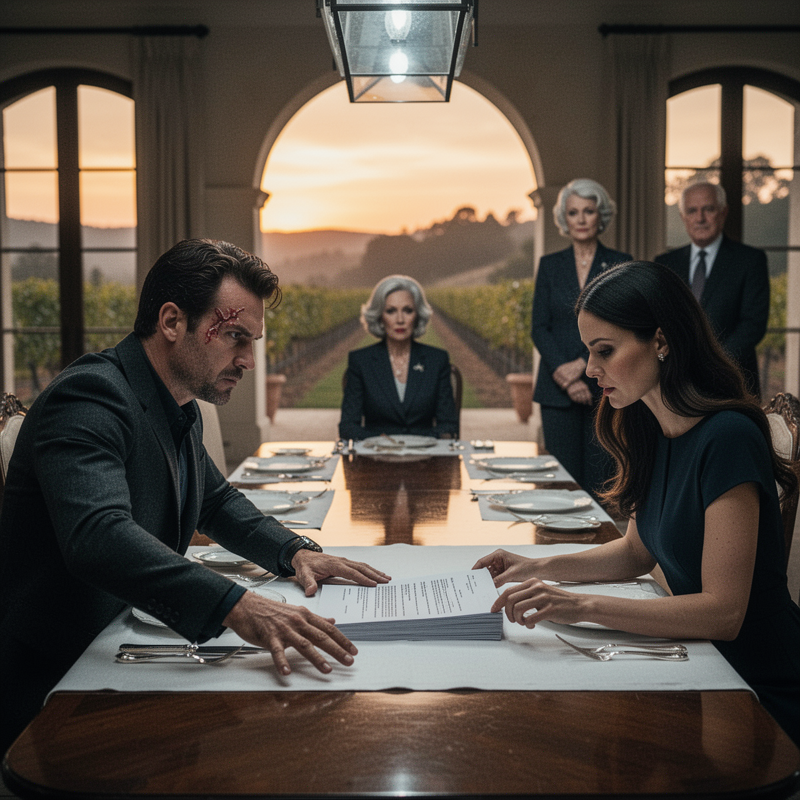
My ex-partner Julian slammed his hand onto the dinner table at his family’s Napa Valley estate and demanded I sign over the title to my pre-marital coastal orchard along with a $2,500 monthly living stipend.
When I refused, he grabbed a heavy ceramic serving platter and smashed it across the side of my head, sending me bleeding to the hardwood floor while his family watched without moving.
His mother stepped past my slumped body to lock the terrace doors, but I managed to reach the wall phone in the pantry and dial the emergency operator.
Before the authorities arrived, Julian’s sister-in-law slipped into the pantry and shoved a worn leather folder into my hands.
Inside was an unrecorded wartime inheritance clause that would shatter the family’s wealth and draw a dangerous criminal syndicate directly to their doorstep.
The scent of grilled salmon and crisp Chardonnay still lingered in the elegant dining room, a stark contrast to the acid building in my stomach. Beyond the wide archways, the last slivers of an orange Napa Valley sunset bled across the vineyards, painting the world outside in impossible beauty.
Inside, the light was too bright, the linen too white, the silverware gleaming like a silent threat.
Julian’s mother, Maeve O’Connell, sat at the head of the polished mahogany table, her expression a mask of stony disapproval. Her eyes, usually sharp with judgment, were currently fixed on her son, but offered no intervention.
Her husband, Julian’s father, pretended to examine the label on his wine bottle, his face carefully neutral.
Across from me, Julian leaned forward, a vein throbbing in his temple. He had been like this for weeks, ever since his latest land speculation venture went sour. But tonight, there was a new desperation in his eyes, a glint of something truly dangerous.
He pushed a stack of legal papers across the table with a theatrical flourish, nearly knocking over a crystal water glass.
“Just sign them, Clara,” he said, his voice low but laced with a barely contained fury. “It’s over. The orchard belongs with the rest of the estate. It always should have.”
My late father’s coastal orchard. The only thing I had left of him. It was mine, legally, unequivocally mine, secured long before my ill-fated marriage to Julian, protected by generations of careful planning.
I looked down at the documents. The words swam before my eyes: “Quitclaim Deed,” “Release of Interest,” “Monthly Stipend of $2,500.” A pittance, an insult, designed to make me dependent on his continued ‘generosity.’
“No,” I said, my voice barely a whisper. It felt thin, fragile, against the heavy silence of the room.
Julian slammed his hand onto the table again, this time with a force that made the silverware jump.
“Don’t be foolish, Clara!” he hissed, his face reddening. “This is your last chance. Do you really want to make things difficult?”
“The orchard isn’t yours to demand, Julian,” I replied, finding a surge of strength I didn’t know I possessed. “It’s mine. My father’s legacy. It’s not part of your failing ventures.”
A collective intake of breath swept around the table. Maeve stirred, her lips pressed into a thin line, but she said nothing, merely watched the drama unfold as if from a distance.
Julian’s eyes narrowed to slits. He glanced at his mother, then back at me. A chilling smile played on his lips, devoid of warmth.
His hand shot out, not toward the papers, but toward the elaborate ceramic serving platter, still warm from the roasted vegetables it had held just moments before. It was a heavy, hand-painted piece, an heirloom that Maeve prized above all else.
He snatched it, his grip surprisingly strong, and swung it with brutal force.
A sharp, sickening crack echoed through the dining room.
Pain exploded behind my right ear, blinding me for a split second. The platter shattered into a dozen jagged pieces, scattering across the linen and tinkling onto the hardwood floor like broken glass chimes.
I gasped, a wet, choking sound, and slumped forward, my chair scraping backward.
My hand flew to the side of my head. Warm, sticky wetness bloomed beneath my fingers. Blood.
My vision blurred, the room tilting crazily, the faces around the table morphing into distorted, unmoving masks. I heard a distant ringing in my ears, not quite the shattered ceramic, but something deeper, more insistent.
My body hit the polished oak floor with a thud, a dull ache reverberating through my skull. The aroma of expensive wine and fading dinner mingled sickeningly with the metallic tang of my own blood.
From my crumpled position, I saw Maeve O’Connell rise slowly from her seat. She didn’t come towards me. She didn’t even glance at Julian, who stood frozen, breathing heavily, the broken remnants of the platter still clutched in his hand.
Instead, she walked with deliberate steps toward the wide terrace doors that led out to the manicured gardens and vineyards. With a soft click, she engaged the heavy brass lock, securing us all inside.
No one spoke. No one moved. The air was thick with a silence more terrifying than any shout.
A wave of dizziness washed over me, but a primal urgency cut through the haze. I had to get out. I had to get help.
I crawled, scraping my knees on the hardwood, pulling myself toward the swinging kitchen door. Each movement sent fresh stabs of pain through my head. The metallic taste in my mouth intensified.
The kitchen was brightly lit, a welcome escape from the suffocating dining room. I pushed through the pantry door, its familiar scent of spices and stored apples a momentary comfort.
Against the far wall, a cream-colored rotary phone, anchored to the plaster, stood out like a beacon.
My fingers fumbled with the receiver, slippery with blood and sweat. I pressed the cold plastic to my ear, listening to the dial tone, and then, with trembling precision, punched the three numbers.
Nine. One. One.
“Emergency operator,” a calm voice answered.
“I need help,” I whispered, my voice ragged, hoarse. “At the O’Connell estate. My husband, Julian—he hit me.”
A sudden shadow fell over me. I flinched, expecting Julian to snatch the phone away, to silence me forever.
But it wasn’t Julian.
It was Evelyn O’Connell, Julian’s meek sister-in-law, her face pale, her eyes wide with a terrified urgency I had never seen before. She rarely spoke above a whisper, often retreating into herself when Julian was in one of his moods.
She moved with an astonishing swiftness, her gaze darting to the pantry door, ensuring no one followed.
Without a word, her hand shot out. It wasn’t to grab the phone, or to stop me.
Instead, she shoved something into my free hand. It was a worn leather folder, surprisingly heavy, its corners dog-eared and its surface scuffed from years of handling.
Her fingers brushed mine, cold and trembling. Her lips moved, forming a single, urgent word, so soft I almost didn’t hear it over the operator’s distant voice:
“Run.”
Part 2
The emergency operator’s voice crackled, asking for more details, but Evelyn’s urgent whisper still echoed in my ears: “Run.”
I clutched the worn leather folder, its edges digging into my palm, and forced myself to reply to the operator, confirming the address, my voice still hoarse. Moments later, I heard the faint, distant wail of a siren. It was coming. Hope, cold and fragile, sparked in my chest.
I stumbled out of the pantry, the folder tucked against my side, trying to look composed, trying to appear normal. Julian and Maeve were already in the dining room. He had cleared the shattered ceramic from the table, and Maeve was smoothing the linen tablecloth, a serene, almost innocent expression on her face. The blood was still drying on my temple, a grotesque badge.
The sirens grew louder, closer, until a county patrol car’s bright headlamps swept across the terrace doors.
A knock. Firm. Official.
Julian straightened his jacket, adjusting his tie. Maeve gave a curt nod. It was a practiced performance, one I’d seen many times before when the family wanted to present a certain image.
Julian opened the heavy front door. Outside, under the porch light, stood Marshal Thomas Danforth, the county’s chief lawman. He was a barrel-chested man with a thick mustache and eyes that had seen too much, but usually chose to see too little. He nodded at Julian, then his gaze, cold and assessing, found me.
“Julian,” Danforth said, his voice a low rumble. “Report of a domestic disturbance.”
Julian stepped closer to the Marshal, lowering his voice conspiratorially. “Just a misunderstanding, Thomas. My wife, Clara, she’s been a little… emotional lately. Stress from her father’s passing, you understand.” He gestured vaguely toward my head, then smoothly pulled a thick, cream-colored envelope from his inner jacket pocket.
Danforth’s eyes flickered to the envelope, then back to Julian. He took it, his movements quick and discreet, tucking it into his own pocket without breaking eye contact.
“I see,” the Marshal said, his tone shifting, becoming less formal, more understanding. He pulled a small notebook from his uniform pocket, scribbled a few lines, then deliberately tore out the page. With a slow, deliberate motion, he crumpled it into a tight ball.
My breath caught in my throat. I stared at the crushed paper, then at the envelope in his pocket, then at Julian’s smug face. The siren, the hope, the call to 911—it was all for nothing.
The Marshal wasn’t here to help me. He was here to make sure no one ever knew what happened.
I was still bleeding. And I was trapped.
CHAPTER 2: The Reporter at the Gate
Cold autumn mist clung to the grapevines as I stumbled down the unpaved access road, the blood on the left side of my neck tacky and stiff.
The heavy oak gates at the edge of the property loomed ahead in the dark.
A dark sedan was parked on the shoulder with its headlights cut. A man stepped out from the shadow of the gatehouse, raising his hands slightly to show they were empty.
“Clara Driscoll?” he asked.
I pulled the leather folder tighter against my ribs and backed away toward the tree line.
“I called the county sheriff,” I said. “If you are one of Julian’s friends, stay back.”
“I am not his friend,” the man said, pulling a brass-bound press credential from his coat pocket. “Jack Dempsey. San Francisco Chronicle. I’ve been sitting on this road for three days.”
“He hit me,” I said, my voice shaking. “He took the title deeds.”
Jack pointed his small flash-camera toward the folder tucked under my arm.
“I didn’t come here for a domestic dispute, Clara,” Jack said quietly. “I came because your ex-husband spent forty thousand dollars on black-market grain futures in 1968, and the paper trail leads directly back to a 1942 war-profiteering audit.”
He gestured toward the gatehouse porch light.
“Show me what you’re holding, and I’ll tell you why the sheriff isn’t coming.”
CHAPTER 3: The Hidden 1942 Codicil
Inside the drafty wooden gatehouse, Jack clicked on a small pocket penlight and laid the leather folder across a rusted iron table.
The paper inside was yellowed at the edges, stamped with an official war-production seal from November 1942.
“Look at the third line,” Jack said, tracing his thumb over the faint typewriter ribbon ink. ” signed by Arthur O’Connell, Julian’s grandfather.”
I leaned down, the skin across my scalp pulling tight where the platter had struck me.
“The federal government granted the estate emergency agricultural loans during the war,” I said, reading the text aloud. “Five hundred thousand dollars.”
“Read the clause below it,” Jack said.
“If any portion of these funds or the land secured by them is used for unapproved private speculation or third-party mortgages,” I read, “the entire property title forfeits immediately to the private holding trust established in Chicago.”
Jack looked up from the table, his eye narrow under the weak light.
“Your ex-husband doesn’t own this vineyard,” Jack said. “He hasn’t owned it for thirty years. He has been squatting on land that belongs to an underworld syndicate.”
CHAPTER 4: Bribes and Badges
The beam of a high-powered spotlight sliced through the gatehouse window, sweeping across the cedar wall.
Heavy gravel crunched outside under thick rubber tires.
“Clara!” Julian’s voice shouted through a megaphone from two hundred yards up the driveway. “Come back to the house! You aren’t in your right mind!”
I ducked beneath the sill beside Jack as a county patrol cruiser came to a stop near the gates.
Marshal Thomas Danforth stepped out of the driver’s side, his leather holster creaking as he walked toward Julian.
“She went down toward the lower boundary,” Danforth said, his voice carrying clearly through the damp night air. “I destroyed the emergency call log at the station house like you asked.”
“I need that brown folder, Thomas,” Julian said, his voice tight with panic. “There is another five thousand in cash in my study if you put her in cell restraints before midnight.”
“She’s your ex-wife, Julian,” Danforth said. “If she talks to the state troopers, five thousand won’t cover my pension.”
“I’ll make it fifteen,” Julian replied. “Declare her hysterical. Take her to the county ward.”
Jack grabbed my elbow and motioned toward the back door of the gatehouse, pointing toward the shadow of the old crushing shed.
CHAPTER 5: Darkness in the Vaults
We slipped into the shadow of the old crushing shed just as Danforth’s flashlight beam washed over the gatehouse porch.
Suddenly, every floodlight across the thirty-acre estate flickered twice and died.
The main house went dark, its massive brick outline melting into the surrounding black oak trees.
“Evelyn,” I whispered. “She pulled the main circuit breaker in the basement.”
“This is our chance to clear out,” Jack said, touching my shoulder.
“My car keys are still inside the ground-floor office,” I said. “Along with my late father’s land patents. I am not leaving them for Julian to burn.”
I turned back toward the rear staff entrance of the main house, staying low along the stone foundation wall.
The thick iron door to the lower cellar was unlatched, swinging slightly in the night wind.
I stepped inside the narrow stone corridor, the smell of damp oak and old wine surrounding me instantly.
Behind me, heavy iron heels clicked against the concrete steps leading down from the kitchen.
CHAPTER 6: The True Collateral
I ducked into the small alcove behind the cellar desk, my lungs burning as I pulled my purse out from beneath a stack of accounting ledgers.
I pulled open the leather folder Jack had examined, searching for my father’s original 1951 orchard deed.
A folded sheet of legal paper fell from the inner pocket.
It was a property survey dated March 14, 1944, stamped with a notary seal from Cook County, Illinois.
My eyes scanned the handwritten legal description at the bottom of the page.
Section 4, Parcel B—the precise twenty acres of coastal orchard my father had willed to me before his death.
It was listed as the primary physical collateral for the 1942 syndicate loan.
Julian had not been trying to take my orchard to pay off simple bank debts.
He needed to surrender my land title to the Chicago group before they realized he had defaulted on the historical interest payments.
If I refused to sign, the syndicate would take the entire Napa estate from his family by morning.
CHAPTER 7: Paper Trails and Shadows
Jack appeared in the office doorway, his shoes making no sound against the damp floor.
He held a black leather ledger he had pulled from the top desk drawer in the main office above.
“Look at this,” Jack whispered, flipping the pages under his pocket light.
A carbon copy receipt showed a wire transfer dated three weeks prior.
Julian had accepted a forty-thousand-dollar cash deposit from an overseas buyer for my orchard.
“He sold property he didn’t own,” Jack said, taking two quick photographs of the ledger with his camera. “To cover a debt on land he never possessed.”
“He was going to forge my signature tonight,” I said.
“It’s worse than that,” Jack said. “The buyers aren’t developers. The money came from a holding firm linked directly to Sal Moretti.”
A loud metallic crash echoed from the courtyard above, followed by the sound of breaking glass.
CHAPTER 8: The Arrival of the Syndicate
We crept up the short flight of stone steps that led to the high arched windows overlooking the drive.
A sleek black Chrysler sedan had parked directly across the main fountain circle, blocking Danforth’s patrol car.
Two men in dark tailored suits stood beside the open rear doors.
A third man stepped out—Sal Moretti, wearing a gray wool overcoat with his hands folded neatly in front of him.
Marshal Danforth walked toward them, his hand resting on the grip of his sidearm.
“This is private property,” Danforth said, stepping into the sedan’s headlight beams. “You need to turn that vehicle around.”
Moretti did not look at the officer. He pulled a gold cigarette case from his pocket and clicked it open.
“We hold the senior mortgage on this parcel, Marshal,” Moretti said, his voice calm and unhurried. “Recorded in 1944.”
“The O’Connell family owns this land,” Danforth said, though his voice dropped an octave.
“Arthur O’Connell died owing my principal eighty thousand dollars,” Moretti said. “Julian O’Connell tried to sell our collateral last Tuesday. We are here to collect the deed.”
CHAPTER 9: A Marshal’s Retreat
Julian ran out onto the stone veranda, his cream-colored shirt stained with dried wine from the dinner table.
“Thomas!” Julian shouted at the marshal. “Arrest these men! They are trespassing on private grounds!”
Moretti’s two escorts shifted their positions slightly, their hands remaining inside their heavy coat pockets.
Marshal Danforth looked at Moretti, then back at Julian standing on the porch steps.
The officer pulled the thick envelope of cash Julian had given him out of his jacket pocket.
He looked down at the bills, then looked at the two silent men standing beside the Chrysler.
Without saying a word, Danforth unpinned his metal county badge and dropped it onto the hood of his patrol car.
He got into the driver’s seat, started the engine, and backed the cruiser down the long gravel driveway into the darkness.
“Thomas!” Julian screamed, running down two steps. “Get back here!”
Moretti blew a slow trail of smoke toward the night sky and turned toward his men.
CHAPTER 10: Cornered in the Cellar (Build-up)
Julian spun around and bolted back inside the main house, slamming the heavy mahogany front doors behind him.
I heard the sound of a metal drawer violently opening in the library above us.
“He’s going for his gun,” Jack whispered, grabbing my arm. “We need to get out through the aging room.”
We ran down the central corridor of the subterranean cellar, past rows of five-hundred-gallon oak casks.
The heavy iron door at the far end of the vault was locked from the outside with a thick chain.
“It’s dead-ended,” I said, my back hitting the damp stone wall.
Footsteps echoed sharply from the top of the cellar stairs.
Julian stepped into the vault light, holding a snub-nosed revolver in his right hand.
His eyes were bloodshot, his hair disheveled, and sweat glistened across his forehead.
“Give me the folder, Clara,” Julian said, his arm trembling as he pointed the barrel at my chest. “Give it to me right now, or neither of us walks out of this cellar.”
CHAPTER 11: The Codicil Unsealed (Climax)
I stepped forward, putting myself between the barrel of the gun and Jack.
The damp air in the deep vault was ice cold, smelling of crushed grape skins and old earth.
“It’s too late, Julian,” I said, my voice steady.
“It is not too late!” he shouted, his voice bouncing off the stone arches. “Sign the transfer sheet! I have the notary stamp in my pocket! Sign it!”
“I don’t have the folder,” I said softly.
Julian lowered the gun two inches, his jaw tightening. “What did you say?”
“I handed the 1942 codicil to Sal Moretti ten minutes ago while you were shouting at Danforth on the porch,” I said.
Julian stared at me, his eyes widening in total disbelief.
“You didn’t just lose the orchard,” I continued, taking one step closer to him. “The moment that codicil was unsealed, the automatic forfeiture clause activated. You don’t own this winery. You don’t own the house. You owe the Chicago trust three hundred thousand dollars in back interest, and you have no legal title to a single vine.”
The gun in his hand began to shake violently.
CHAPTER 12: Underworld Reckoning
Heavy, deliberate footsteps sounded on the stone stairs behind Julian.
Sal Moretti stepped into the vault, accompanied by his two silent associates.
One of the men stepped forward smoothly, clamped his hand over Julian’s wrist, and twisted the revolver out of his fingers before he could react.
Julian did not fight back. He slumped against a large oak cask, his head hanging down toward his chest.
“Mr. O’Connell,” Moretti said, pulling his leather gloves tight over his fingers. “You have two hours to remove your mother and your personal effects from the premises.”
“This is my grandfather’s land,” Julian whispered, his voice cracking.
“Your grandfather used mob money to build his estate,” Moretti said flatly. “And you tried to sell mob paper to an overseas syndicate.”
Upstairs, the front doors were thrown open.
Through the cellar grate, I could hear Maeve O’Connell weeping as two men escorted her toward a waiting taxi in the courtyard.
No sirens sounded. No police were called.
Two accountants in suits stepped past us into the main office, pulling new sets of iron keys from their briefcases.
CHAPTER 13: The Burnt Still
By midnight, the estate was quiet under the dark Napa sky.
I walked across the property boundary to the far edge of the land, stopping at the charred stone foundation of my late father’s old copper-still barn.
The wood had burned thirty years ago, but the cold stone walls still stood against the hill.
Jack Dempsey walked up behind me, wrapping his coat tight against the night wind.
“I have enough material for three front-page exposes,” Jack said. “Are you going to file formal assault charges against Julian with the state prosecutor?”
I looked down at the dark valley below, where the lights of the Chrysler were parked outside the dark mansion.
Julian sat alone inside a grey rental sedan parked at the outer estate gates, his headlights staring uselessly into the fog.
He had no money, no title, and nowhere left to run from the men who now owned his family’s legacy.
“It doesn’t change what happened in that room,” I said quietly.
Jack did not ask another question. He turned and walked slowly back down the dirt path toward his car.
I stayed beside the cold stone ruins, watching the mist drift through the silent vineyard.
Some wounds never heal with a verdict; they simply sit in the quiet darkness, waiting for the smoke to clear.
Leave a Reply