CHAPTER 1: The Assault at St. Jude’s
Part 1
My ex-partner Nadia burst into the private syndicate clinic at 8:15 PM while my wife was in active labor.
She bypassed the security guards, shouting that I had stolen $450,000 from our underworld operations.
Before I could grab her, Nadia hurled a heavy leather luggage trunk weighing forty pounds directly into my wife Sarah’s abdomen.
Sarah gasped once and collapsed onto the tile floor, unconscious as blood stained her hospital gown.
I stood over my wife, realizing that saving her life and proving my innocence meant confronting the woman who knew every secret I had.
The sterile white walls of St. Jude’s Private Medical Annex usually hummed with a quiet, efficient calm. Not tonight.
Tonight, the quiet was broken by Sarah’s soft groans, each one a twist of pain that tightened my gut.
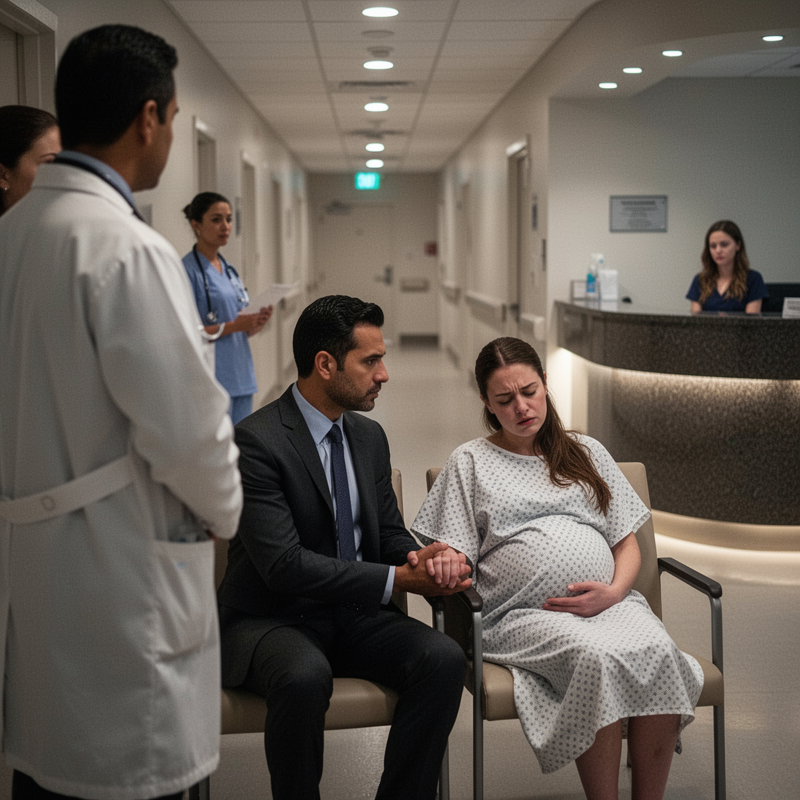
Her 34-weeks-pregnant belly was taut under the flimsy hospital gown, a vulnerable curve that made my breath catch every time she winced.
“Just a little longer, my love,” I whispered, holding her hand. “They’re almost ready for you.”
Dr. Mendez, a man whose crisp white coat seemed almost too bright for the dim hallway, nodded reassurance.
“The labor ward is prepped, Mr. Driscoll. We just need to finalize the admittance forms.”
He gestured vaguely towards the reception desk, a sleek curve of polished granite manned by a young woman whose smile felt a little too practiced, a little too permanent.
I squeezed Sarah’s hand one last time, an unspoken promise in the gesture.
Her eyes, clouded with pain, managed a weak smile.
“Go on,” she whispered, her voice raspy. “Don’t want to keep our little one waiting.”
Leaving her with a nurse, I walked over to the desk, the air of quiet urgency giving way to the mundane task of paperwork. The clock above the reception desk read 8:15 PM.
The form in my hand was standard, unremarkable, asking for insurance details and next of kin. My pen hovered over a line, considering Sarah’s mother’s number.
Then, a sudden commotion erupted in the lobby.
The main entrance doors, usually kept under strict electronic lock, burst inward with a metallic clang.
Two security guards, burly men in dark suits who moved with the contained menace of syndicate enforcers, stumbled backward.
A figure in a sharp black suit strode past them, her dark hair wild, her eyes blazing with a fury that froze the air.
Nadia.
My heart hammered against my ribs, a warning drumbeat that was already too late.
She swept into the reception area, her gaze locking onto the cluster of syndicate associates scattered in the waiting chairs—men I recognized from various Rossi operations, their faces now turned in startled curiosity.
“Leo Driscoll!” Nadia’s voice cut through the sterile quiet, sharp as a switchblade. It echoed off the polished floors, making the young receptionist flinch.
“He’s a thief! A liar!”
My pen clattered onto the desk. The security guards, now regaining their footing, moved to intercept her.
“Ma’am, you need to calm down!” one of them yelled, reaching for her arm.
Nadia shrugged him off with surprising force, her eyes fixed on the men in the waiting area.
“He embezzled $450,000! From *our* operational fund!”
A ripple went through the waiting associates. Heads turned, murmurs started. Some even looked at me, suspicion already brewing in their eyes.
I took a step forward, a frantic apology forming on my lips, but the words died in my throat.
Nadia wasn’t looking at them anymore. Her gaze had darted past me, past the reception desk, directly into the open doorway of the labor ward.
Into Sarah’s room.
“Get her!” I roared, pushing past the desk, knocking a stack of pamphlets to the floor.
But she was already moving. Faster than the security guards, faster than I could react.
She carried something heavy in her hand, a thick leather luggage trunk, old and worn, like something from our past life.
“Nadia, stop!” I yelled, my voice cracking, but she ignored me.
She was through the doorway in an instant, a dark blur against the soft lighting of the treatment room.
A nurse gasped.
A sickening thud echoed through the hallway.
Then, a single, sharp cry—Sarah’s.
I burst into the room to see Sarah crumpling to the floor, her body twisted, one hand clutching her distended belly.
The heavy leather trunk lay next to her, a dark, menacing presence.
A smear of crimson blossomed on her hospital gown, spreading rapidly over the white fabric.
The rhythmic *beep-beep-beep* of the fetal monitor in the corner suddenly morphed into a frantic, high-pitched shriek. The alarm blared, a piercing wail of pure terror.
Part 2
A team of doctors and nurses swarmed into the room, their faces grim, their movements quick and practiced. One of them, a woman with tight grey hair, barked orders into a headset.
They surrounded Sarah, cutting away her gown, shouting medical terms I couldn’t understand. Blood, so much blood.
“Get her to surgery!” someone yelled.
I tried to reach her, to hold her hand, but a heavy arm clamped down on my chest.
“Easy, Leo.”
It was Jimmy DeLuca, Boss Rossi’s enforcer. His grip was like iron, pinning me against the wall as Sarah was rushed out on a gurney, the alarm still screaming behind her.
Nadia stood in the doorway, the empty leather trunk now lying by her feet. Her chest rose and fell rapidly, but her eyes were cold, triumphant.
Then, Boss Dom Rossi appeared, his usual calm demeanor replaced by a look of severe displeasure. His eyes, usually assessing, were now fixed solely on Nadia. Maria Rossi, the matriarch, stood behind him, her face a mask of stone.
Nadia didn’t hesitate. She bent down, pulled open the trunk, and began yanking out thick, bound ledgers. Old accounting books, filled with handwritten entries and brittle pages.
“Here!” she practically shrieked, thrusting them at Dom. “Proof! He’s been siphoning off funds for two years, Boss! All in these books. The $450,000, it’s all there, hidden.”
Dom Rossi took the ledgers, his gaze flicking from the books to me, then back to Nadia. The silence that followed was heavy, broken only by the fading wail of Sarah’s monitor down the hall.
“DeLuca,” Dom said, his voice low and dangerous, “take Driscoll to the annex. Basement. Keep him under guard.”
Jimmy’s grip tightened, turning me. “Yes, Boss.”
“Leo,” Dom continued, his eyes piercing mine, “you have twenty-four hours to explain this. To account for every cent of that $450,000.”
He gestured vaguely at the ledgers in his hand. “Or you’ll answer to the syndicate. And that won’t be in a hospital.”
The meaning was clear. Execution.
Jimmy began dragging me down the hall, away from the chaos, away from the lingering scent of Sarah’s blood. As we descended into the sterile, quiet depths of the clinic’s basement, I could hear fragments of hushed conversations from the nurses’ station above.
Then, a nurse, her voice urgent and strained, said, “Emergency C-section successful. The baby’s out.”
A tiny spark of hope flickered, then died, as Jimmy shoved me into a cold, windowless room. The steel door clanged shut, the bolt sliding with a heavy *thunk*.
I was locked in. My wife, my child, both just rooms away.
But I was forbidden from seeing them until the financial dispute was settled.
CHAPTER 2: The Whisper Campaign
The steel door of the twelve-by-fourteen-foot holding cell vibrated every time a heavy footstep passed in the corridor outside.
Jimmy DeLuca stood directly on the other side of the reinforced glass panel. His six-foot-four frame blocked the corridor light, casting a long shadow across the bare concrete floor.
I paced from the narrow wooden cot to the bolted desk, counting my steps. Five steps forward. Five steps back.
At 10:15 PM, the small laundry hatch at the bottom of the door clicked open. A folded white towel slid across the floor, followed by a plastic tray with a cold bottle of water.
Inside the folds of the towel lay a small, encrypted black smartphone. A folded note from an orderly I had paid off two months ago rested beside the screen.
I powered on the device. The screen illuminated my knuckles, throwing sharp blue light across the ceiling.
Nadia had not simply brought physical ledgers into the building. She had uploaded high-resolution scans of doctored wire receipts directly into the syndicate’s private network.
The notification log showed six unread alerts broadcast across the regional capo channels in Chicago.
“Driscoll bled $450,000 from the emergency relief fund,” the main header read above a PDF attachment. “Fallen crew families received nothing while the corporate accountant built a war chest.”
My chest tightened as I scrolled through the comment threads. Capos from the West Side and the South Loop had already replied with solid red flags.
In the underworld, an outsider who touched money meant for widows and orphans did not get a sit-down. He got a quiet ride to an industrial canal.
I erased the handset’s cache, dropped the device into the water bottle, and jammed the plastic cap tight before sliding it back into the laundry hatch.
No one in the Rossi organization was coming to defend me. If I stayed in this room until morning, the capos would make the decision for Dom before sunrise.
I stared at the heavy iron chair bolted to the floor in the corner. The upper support bolt on the left leg was rusted, exposed where the damp basement wall met the cement frame.
I sat on the cold steel seat, gripped the metal leg with both hands, and pulled upward with everything I had.
CHAPTER 3: Confined by Order
The heavy deadbolt threw three metallic clicks across the room at precisely midnight.
Boss Dominick Rossi stepped over the threshold, his dark cashmere coat damp from the rain outside. Two armed enforcers flanked him, their hands resting flat over their jacket pockets.
Jimmy DeLuca remained in the doorway, his shoulders framed by the bright fluorescent hallway light.
“You’re making a lot of noise in here, Driscoll,” Dom said, his voice flat and dry like dry leaves on pavement.
“The numbers Nadia showed you are modified,” I said, keeping my hands resting flat on the wooden table surface. “Give me twenty minutes at the central terminal down the hall.”
Dom reached into his inner pocket, pulled out a thick silver cigar case, and tapped it against his palm without opening it.
“Frankie from the North Side called me ten minutes ago,” Dom said. “Sal from the docks called five minutes after that. Both of them want you dumped in a scrap yard before the morning shift starts.”
“They’re looking at altered JPEG files,” I said. “I built the syndicate’s financial structure two years ago. Every real line item has an encrypted double-entry hash stored in the basement server.”
“You’re an outsider, Leo,” Dom replied, stepping closer until his shadow covered the table. “You married into the periphery. You do our taxes and clean our offshore accounts, but you don’t carry the name.”
He snapped the silver case shut with a sharp metallic pop that echoed in the tiny cell.
“The council convenes at eight o’clock tomorrow morning,” Dom said. “If you don’t have absolute, physical proof on this table by seven-forty-five, I sign the order myself.”
“And Sarah?” I asked, my voice dropping. “The baby?”
Dom turned toward the open doorway, his face showing no emotion under the pale overhead light.
“Your wife is in the ICU on the second floor,” Dom said. “Her blood pressure dropped after the impact. The doctors delivered a girl twenty minutes ago.”
My heart hammered against my ribs. “Let me see them.”
“You don’t cross the threshold of the medical wing until your balance sheet reads zero,” Dom said.
He stepped out into the hallway, and the steel door slammed shut, locking the deadbolt in place.
CHAPTER 4: The Vault Beneath
At 2:30 AM, the shift change began in the basement corridor.
I heard Jimmy DeLuca’s heavy boots fade down the hallway toward the guard room for the ten-minute relief swap.
I wedged the loosened iron chair leg into the gap behind the electronic latch assembly. Sweat poured down my forehead, stinging my eyes as I applied full leverage against the casing.
With a sharp pop of tearing plastic and a shower of orange sparks, the solenoid spring snapped out of its housing.
The steel door swung outward three inches.
I slipped into the corridor, keeping my back pressed against the cold painted brick work. The smell of damp concrete and industrial floor cleaner hung heavy in the air.
Two floor-guards passed the far end of the hallway, their shadows stretching against the yellow walls as they talked in low whispers about the rainy weather outside.
I ducked behind the laundry linen cart, waiting for their footsteps to echo up the northern stairwell before darting toward the maintenance room.
The heavy steel door leading to the clinic’s server room required a six-digit administrative passkey.
I leaned against the keypad frame, my fingers moving automatically across the rubber buttons: 0-4-1-9-8-2. It was the original system configuration code I created when I set up the network two years ago.
The lock beeped green. The pneumatic seal hissed softly, releasing a blast of frigid, conditioned air into my face.
Inside, row upon row of blue indicator lights flickered across four black server racks.
I pulled a folding chair to the main console, plugged a hard-encrypted flash drive into the primary master port, and brought up the raw banking portal for the syndicate’s Swiss holding accounts.
The monitor’s screen reflected off my damp shirt as millions of raw transaction lines began scrolling downward across the black interface.
CHAPTER 5: The Paper Trail
By 3:45 AM, the terminal fan was humming loudly in the freezing room.
I filtered the query parameters by exact transaction amounts between $400,000 and $500,000 over the past eighteen months.
A single wire entry flickered onto the screen in glowing red text: Transaction ID 884-Delta-9.
The record showed a wire transfer of exactly $450,000 executed fourteen months ago on a Tuesday afternoon.
My fingers flew across the mechanical keyboard, unmasking the routing numbers behind the shell company’s intermediary bank.
The destination account was not registered in my name, nor was it linked to any offshore shell corporation under my management.
The money had been routed directly into an account held by Apex Capital Asset Recovery, a commercial debt collection firm registered in Jersey City.
Apex Capital was not an ordinary accounting firm. It was a well-known front operation managed by Mickey “The Hammer” Vane, a ruthless loan shark operating out of Northern New Jersey.
I opened the secondary database, pulling up the confidential risk files I had archived during my first six months with the Rossi organization.
Three outstanding lien notices appeared on the monitor screen, all tied to Anton Volkov—Nadia’s younger brother.
Anton had died in a violent single-vehicle crash on Interstate 90 two winters ago. The public story was an icy road and high speeds.
The internal ledger told a completely different story: Anton owed Mickey Vane $450,000 in personal gambling debts with a forty-eight-hour execution window attached to the principal.
CHAPTER 6: Shadows of the Past
I leaned closer to the warm glare of the monitor, opening an encrypted sub-ledger buried beneath the primary wire transfer routing slip.
Attached to the bottom of the digital authorization form was Anton Volkov’s digital signature stamp, stamped forty-eight hours before his fatal accident.
Anton had misused his sister’s master access clearance to initiate the transfer from the syndicate’s emergency relief fund, attempting to save his own life before the loan shark’s collectors reached him.
Nadia had discovered the missing funds six months after Anton’s death during an internal inventory check.
Because I was the only strategist with system-level clearance to re-route ledger anomalies, she assumed I had stolen the money and pinned the missing balance on her dead brother to clean my own books.
I sat back in the metal chair, staring at the flashing cursor.
Two years ago, when Anton first came to my office sweating and trembling with a $120,000 marker hanging over his head, I had quietly paid off his initial debts from my private consulting fees.
I had never told Nadia. I had wanted to protect her from knowing how deeply her brother had fallen into the city’s worst gambling dens.
My silence had not protected anyone. It had allowed a toxic lie to fester inside her for twenty-four months, growing into the rage that had brought her through the clinic doors tonight.
A sudden mechanical hum broke the silence as the secondary printer beside the desk began spooling white paper across the output tray.
I grabbed the warm sheets, checking the timestamp on the top right corner.
It was 4:15 AM.
CHAPTER 7: Hidden Mercy
I cleared the search filter and prepared to scrub my terminal session logs when an unexpected system flag caught my eye.
A secondary sub-account tagged with Sarah’s medical identification number lit up at the bottom of the screen.
I opened the detail view, expecting to find standard clinic admission charges and standard Rossi family health coverage items.
Instead, a line item dated three weeks prior stood out against the dark blue screen.
It was an anonymous wire transfer of $85,000 deposited directly into the St. Jude Specialized Obstetric Care Fund under Sarah Driscoll’s patient ID.
I expanded the originating bank routing profile, decrypting the source clearing house through the Chicago regional network.
The originating account code was NV-409-Private.
It was Nadia’s personal operational reserve account—the money she kept entirely separate from syndicate oversight for her own retirement fund.
I stood frozen beside the humming rack towers, staring at the line item on the screen.
Three weeks ago, when Sarah experienced her first severe medical complications at thirty-one weeks, the top neonatal specialists from Northwestern Hospital had mysteriously agreed to staff the private clinic on twenty-four-hour rotation.
I had assumed Boss Rossi had arranged the specialists as a professional courtesy for my financial work.
Nadia had funded the entire specialist team out of her own pocket while preparing her public smear campaign against me.
She hated me for what she believed I had done to her brother, yet she had spent her personal savings to make sure my pregnant wife received the best care in the state.
CHAPTER 8: The Solitary Choice
At 7:15 AM, the grey morning light began filtering through the high narrow windows of the basement corridor.
I stepped quietly down the hallway, holding the three printed sheets of bank statements rolled neatly inside my jacket sleeve.
The holding cell door remained slightly ajar, the broken electronic housing still resting where I had forced it hours earlier.
I slipped back inside the room, pulled the heavy steel door closed until the latch sat flush against the frame, and sat down at the bolted table.
At 7:45 AM sharp, heavy boots echoed outside in the hallway.
Jimmy DeLuca pulled the steel door open, his hand resting on the handle of his sidearm as two junior enforcers stood behind him.
“Time’s up, Driscoll,” Jimmy said, his dark eyes scanning the small room before settling on me. “The Boss is waiting on three.”
I stood up slowly, keeping my hands visible at waist height.
“Is Sarah stable?” I asked.
Jimmy hesitated for a fraction of a second, his jaw tightening before he gave a single, curt nod.
“She woke up twenty minutes ago,” Jimmy said. “The kid is in an incubator. Both are breathing on their own.”
I let out a slow, quiet breath and tucked the single, folded sheet of bank evidence into my right front palm.
“Let’s go,” I said.
I did not ask for guards, and I did not ask for my legal counsel. I walked down the long corridor ahead of Jimmy, holding the paper loosely at my side.
CHAPTER 9: The Gathering Storm
Rain beat heavily against the tall double-paned glass windows of the third-floor boardroom overlooking the clinic’s inner courtyard.
Boss Dominick Rossi sat at the head of the twenty-foot mahogany table, an unlit cigar held between his knuckles.
To his left sat Matriarch Maria Rossi, wearing a simple black dress, her face set like carved marble as she stared down at the polished table surface.
Nadia stood near the heavy draperies on the far side of the room. Her winter coat was draped over a chair, her black hair pulled back tightly. Her hands were clenched into tight fists at her sides.
Jimmy DeLuca stepped into the room behind me, locking the heavy oak doors with a soft click.
“Seven-fifty-eight,” Boss Rossi said, glancing down at his gold wrist watch before looking up at me. “You’re on time, Leo.”
Nadia did not look at me. Her eyes remained fixed on the rain streaming down the glass behind her.
“The capos are waiting on an encrypted conference line in five minutes,” Dom continued, gesturing toward the bronze conference speaker sitting in the middle of the table. “They want a resolution before the markets open.”
“There is no need for a vote,” I said quietly.
I walked slowly toward the center of the room, my shoes making no sound against the thick Persian rug.
I did not look at Dom, and I did not address Maria.
I stopped directly opposite Nadia, reached into my jacket pocket, and pulled out the single sheet of paper containing the unmasked transaction log.
I laid the document face down on the polished mahogany table directly in front of her.
“This is the complete wire path for the $450,000,” I said, my voice low and steady. “Read it.”
CHAPTER 10: The Unspoken Reckoning
Nadia did not move for five long seconds.
Then, her right hand trembled slightly as she extended two fingers and flipped the white sheet of paper face up on the table.
Her eyes scanned the top header, moving quickly down through the routing numbers until they locked onto the bottom signature block.
Anton Volkov’s digital authorization stamp sat clearly beside the Jersey City debt clearing house receipt, complete with the timestamp from fourteen months ago.
Her breathing stopped.
She stared at her brother’s signature, her fingers pressing so hard against the mahogany surface that her knuckles turned white.
She looked up at me, her blue eyes wide, searching my face for any sign of victory, anger, or deceit. She found none.
I stood motionless across the table, maintaining absolute silence as the rain continued to rattle against the glass frame beside us.
She realized everything in a single, silent moment: Anton had stolen the money, I had protected his name from the Rossi council after his death, and I had chosen to take the syndicate’s suspicion on my own shoulders rather than tear down her family’s memory.
Nadia reached slowly into her left coat pocket.
She pulled out her silver syndicate signet ring—the symbol of her regional authority and her crew leadership within the Rossi organization.
Without uttering a single word, she placed the heavy ring on top of the printed bank statement.
She bowed her head toward me by a fraction of an inch—a silent gesture of acknowledgment that held two years of unexpressed debt and unspoken apology.
She turned around, picked up her dark coat from the chair, and walked out of the boardroom.
The heavy oak door closed softly behind her without a sound.
Boss Rossi leaned forward, picked up the paper, and read the transaction log in silence for thirty seconds.
He picked up his desk phone, pressed a single speed-dial button, and spoke into the receiver.
“Cancel the council call,” Dom said quietly. “The account is settled.”
CHAPTER 11: Silent Aftermath
Thirty minutes later, the air inside the third-floor corridor smelled of fresh coffee and rain coming through the open terrace door.
Boss Rossi walked out of his private office, holding a signed release slip in his left hand.
“Your standing is restored, Driscoll,” Dom said, handing me the paper. “The capos have been informed that the ledger discrepancy was an internal system error from an obsolete account.”
“Thank you, Boss,” I said.
“Don’t thank me,” Dom replied, looking down the quiet hallway. “Thank the fact that your books were clean.”
Jimmy DeLuca stepped up beside me, his attitude entirely changed. He motioned toward the elevator bank at the end of the hall.
“Room 304,” Jimmy said softly. “The doctor said she’s ready for visitors.”
I walked down the quiet corridor of the recovery wing on the third floor, my heart beating fast as I stopped outside the wooden door marked 304.
I pushed the door open gently.
Sarah lay back against two white pillows, her face pale but her eyes bright and clear as she looked up from the small transparent bassinet beside her bed.
Inside the plastic crib, wrapped in a light pink fleece blanket, our daughter was sleeping quietly, her tiny hands folded near her chin.
“Leo,” Sarah whispered, reaching out her hand.
I rushed to her side, dropping to my knees beside the bed and wrapping my fingers tightly around hers.
“Is she okay?” I asked, my voice cracking for the first time in twelve hours. “Are you okay?”
“We’re both fine,” Sarah said, smiling weakly as she stroked my hair. “The surgeon said everything went perfectly.”
I looked over at the small wooden bedside table.
Resting next to a glass of water was a polished silver baby rattle wrapped in a white silk ribbon.
Beneath the rattle lay a cashier’s check made out to St. Jude Private Medical Annex for $42,500—covering the full remaining balance for Sarah’s surgery and private room.
The signature line at the bottom was written in clear, sharp cursive: Nadia Volkov.
CHAPTER 12: A Sunday Morning in the Kitchen
The early morning sun cast long, soft bars of yellow light across the wooden floorboards of our small kitchen in Evanston the following Sunday.
The house was completely quiet except for the steady drip of the coffee maker on the counter and the gentle ticking of the wall clock above the stove.
Sarah sat at the small round breakfast table in a warm grey sweater, cradling a mug of black coffee in her hands.
Beside the kitchen island, our seven-day-old daughter slept peacefully in a wicker bassinet, her chest rising and falling in steady, soft rhythms.
A quiet, tentative knock sounded at the back porch door.
I set my coffee cup down on the counter and walked across the linoleum floor, pulling back the light linen curtain covering the glass panel.
Nadia stood on the wooden porch steps under the cool spring air. She wore a simple dark wool coat with her hands tucked deep into her pockets.
I opened the door, stepping out onto the threshold into the crisp morning breeze.
Neither of us spoke for a long moment. The neighborhood was dead silent except for a distant train horn miles to the west.
Nadia reached into her coat pocket and pulled out a thick, plain brown paper envelope.
She held it out to me. Inside were the original property deeds to our Evanston home, complete with three official county clerk stamps certifying that every remaining financial lien against the house had been fully satisfied and cleared.
I accepted the envelope, holding it loosely in my right hand.
Nadia looked at me, her eyes clear and free of the burning rage that had consumed her a week ago.
She did not offer a grand speech, and she did not ask for words of forgiveness that could never fully erase the terror of that rainy night at the clinic.
She simply reached out, placed her gloved hand gently on my right shoulder, and pressed down lightly for two seconds—an unspoken promise that the past was finally laid to rest.
She turned around, walked down the three wooden steps, and made her way down the concrete driveway toward her black sedan parked at the curb.
I watched her car turn the corner at the end of the block before stepping back inside and sliding the porch door closed against the chill.
Sarah looked up from the table, her soft brown eyes meeting mine as I set the brown envelope down next to the coffee pot.
She did not ask who was at the door, and I did not offer an explanation.
I walked over to the table, sat down in the chair beside my wife, and reached into the bassinet to gently touch my daughter’s tiny fingers.
Some debts are never settled with blood or gold, but with the quiet courage to let the truth sit between two people in silence.
Leave a Reply