CHAPTER 1: The Shredded Lapel at the Anniversary Gala
Part 1
“Apologize to Evelyn right now, Eleanor, or you’ll never set foot on this corporate campus again,” my junior partner Julian barked as 300 executives watched in silence.
My next-door neighbor and board chair, Evelyn DeWitt, had just ripped the tailored lapel of my presentation suit in front of the entire company, claiming an impoverished 64-year-old widow had no right to hold voting power.
I stood frozen in the middle of the anniversary gala while security moved in to escort me out.
Then the facility director walked past the board, dropped to one knee, and handed me the original master land deed for the $18 million corporate estate.
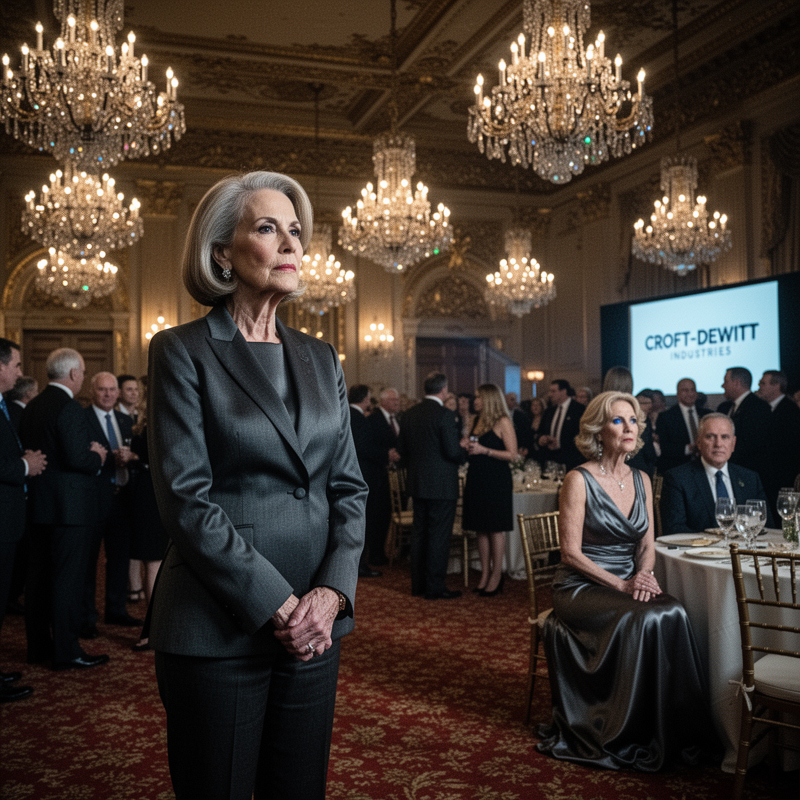
The Grand Ballroom of the Palmer House Hilton in downtown Chicago shimmered under the soft glow of hundreds of chandeliers.
Three hundred of the city’s most influential executives, investors, and clients filled the opulent space, their conversations a polite hum.
This was the 30th Anniversary Gala of Croft-DeWitt Industries, a night meant to celebrate three decades of tireless innovation and my life’s work.
I, Eleanor Croft, co-founder at 64, stood near the podium, waiting for my cue to address the assembly.
My tailored suit, a rich charcoal silk blend, felt perfectly crisp.
The presentation I was about to give had been rehearsed a hundred times.
Every detail of the evening, from the custom ice sculptures to the live jazz ensemble, was impeccable.
Then, a sudden shift in the air.
A ripple of unease spread from the head table where Evelyn DeWitt, our board chair and my next-door neighbor in Oakridge Enclave, sat.
Her gaze, usually cool and composed, was fixed on me with an unsettling intensity.
A tension, palpable and sharp, began to prickle the festive atmosphere.
I tried to catch her eye, offer a reassuring nod, but her expression remained hard, unyielding.
Julian Marsh, my 34-year-old junior partner, leaned in close to me, his voice a low murmur.
“Everything alright, Eleanor?” he asked, his brow furrowed with a hint of concern, or perhaps, impatience.
I barely had time to reassure him before Evelyn rose abruptly from her seat.
Her movements were unusually swift, almost aggressive, for a woman of 62 in a floor-length gown.
A few conversations near her table died out. Heads began to turn.
She bypassed the security detail and the other board members with a singular, determined stride, her silk dress rustling with each urgent step.
My heart gave a nervous flutter. What was she doing?
She stopped directly in front of me, so close I could smell her expensive perfume, a scent usually associated with pleasant evening garden parties at her Oakridge home.
Her eyes, usually a calm blue, were stormy.
“Eleanor,” she began, her voice low, but carrying an ominous edge that silenced the nearest conversations.
Then, without warning, she lunged.
Her fingers, adorned with a single, elegant emerald ring, clamped around the lapel of my jacket.
A collective gasp swept through the room, a wave of stunned silence.
I felt a sharp tug, then the unmistakable, brutal sound of tearing fabric.
RIIIP.
It was impossibly loud in the suddenly silent ballroom.
My suit, bought specifically for this occasion, now hung lopsided.
The meticulously stitched charcoal lapel, designed by my favorite Chicago atelier, dangled precariously by a few threads.
Evelyn held a strip of the expensive material in her hand, her chest heaving.
Her face was a mask of furious contempt.
“You have no business here, Eleanor!” she shrieked, her voice echoing off the high ceilings.
“A penniless, cognitively declining widow has no right to hold voting power in this company!”
The words hit me like a physical blow.
Penniless? Cognitively declining? I was the co-founder, still active, still sharp.
I searched the faces around us, desperate for some sign of support, but most were simply frozen in disbelief.
Julian Marsh, who had been about to step forward and begin my introduction, recoiled as if struck.
His eyes, usually filled with a carefully cultivated ambition, widened in something akin to horror.
He glanced frantically at the investors in the front rows, then back at the spectacle before him.
His career, his stock options, his plans for the CEO seat – all flashing before him, I was sure.
He stepped closer, placing a hand on my arm, his grip surprisingly firm.
He wasn’t comforting me. He was positioning me.
His voice, though hushed, cut through the buzzing silence like a knife.
“Eleanor,” he ground out, barely moving his lips. “Apologize to Evelyn right now, Eleanor.”
His eyes pleaded, then hardened.
“Or you’ll never set foot on this corporate campus again.”
The ultimatum hung heavy in the air, a public excommunication from the company I had built.
A deafening gasp swept across the ballroom.
Someone, somewhere in the back, dropped a glass. It shattered violently against the marble floor, the sound impossibly sharp against the quiet.
My vision blurred. This couldn’t be happening. Not at my own gala.
Suddenly, two dark suits detached themselves from the edge of the room.
Security.
Their strides were measured, professional, cutting a clear path through the stunned guests.
Their eyes were fixed on me.
They were moving in.
To escort me out.
To remove me from my own celebration, from my own legacy, from the company I had helped forge.
I stood frozen, the shredded lapel a shameful testament to Evelyn’s fury, the grand ballroom closing in around me like a trap.
The first guard was almost there, his shadow falling over me like a pall.
Part 2
But before his hand could make contact, a new voice cut through the horrified silence. It wasn’t Julian’s, nor Evelyn’s. It was Marcus Finch, our usually reserved facility director, striding purposefully from the side of the ballroom. His face, normally impassive, was set with a grim determination I’d never seen.
He walked directly past Julian, who stood rigid with shock, then swept past Evelyn, who actually flinched at his disregard. Three hundred pairs of eyes, now wide with confusion, followed his every move.
Marcus stopped squarely in front of me, a respectful distance from the two security guards, who had frozen mid-stride, uncertain. Then, to the utter astonishment of every executive, every investor, every client in the Grand Ballroom, he dropped to one knee.
It was a gesture steeped in a solemn, almost ancient, reverence. Not for me, but for something else. In his outstretched hand, he held a thick, worn leather binder. It looked decades old, its cover embossed with a faded, intricate crest that I vaguely recognized from my late father’s study.
He held it out to me, his gaze meeting mine with unwavering loyalty, a silent plea for understanding. My fingers, still trembling from Evelyn’s assault, carefully took the heavy book. It was cool to the touch, surprisingly weighty, and smelled faintly of old paper and leather.
Marcus rose, his voice now clear and resonating, carrying easily through the stunned ballroom, silencing even the lingering whispers. He addressed the entire room, his eyes sweeping over the bewildered, pale faces of the board members at the head table.
“Ladies and gentlemen,” he announced, his voice steady. “While Croft-DeWitt Industries holds ownership of the operating company, the land on which our $18 million corporate estate campus sits is governed by a separate, older agreement.”
He paused, letting the full, unexpected implication sink into the collective consciousness. Julian’s mouth hung open, a flicker of panic in his ambitious eyes. Evelyn’s face drained of all color, her furious mask replaced by sheer disbelief.
“Under the original 1994 master land deed,” Marcus continued, his voice firm, “this entire commercial campus, including all buildings and grounds, is personally owned by Ms. Eleanor Croft.”
A collective gasp, even louder and more profound than before, ripped through the room. This wasn’t just a corporate detail; it was a bombshell. He looked directly at me, his gaze conveying a silent ‘you know what to do,’ then back at the assembly, leaving no room for doubt. “As the sole personal owner, Ms. Croft retains the absolute authority to evict any individual, including all members of the board and management, from these premises at her discretion, effective immediately.”
CHAPTER 2: The Unwitting Accomplice in Public Relations
The keycards stopped working at 8:15 AM, but my legal deed opened every door.
I set up my operational center inside the glass-walled administrative suite on the third floor of the corporate tower. Marcus Finch posted two off-duty security guards outside the glass doors, holding the original 1994 land survey blueprints across his desk.
Downstairs in the main lobby, junior PR coordinator Sarah Jenkins carried a stack of red-stamped manila folders toward the press desk.
“Mr. Marsh said these need to go out with the morning media kits,” Sarah whispered, her fingers trembling against the smooth cardstock.
She set forty press packages on the media table, entirely oblivious to the highlighted financial audit tucked inside page six.
My phone vibrated against the polished mahogany table at 8:42 AM. My younger brother David’s voice filled the line before I could speak.
“Eleanor, turn on the business channel,” David said, his voice flat and thin. “They’re reporting that you mismanaged two point four million dollars from the employee retirement fund.”
I looked through the glass partition. Down in the courtyard, reporters held microphones while reading directly from the printed documents Sarah had just distributed.
“The audit summaries bear your digital signature, Eleanor,” David continued. “They claim the transfers occurred throughout the fall of 2021.”
Across the courtyard, Evelyn DeWitt stood behind the tinted window of her corner office, watching the camera crews gather.
CHAPTER 3: The Hospital Timestamp
David arrived at my house in Oakridge Enclave at 10:15 PM, carrying a thick binder of printed transaction logs.
Rain rattled against the glass of my study while he spread the electronic wire transfer confirmations across the coffee table.
“Look at the timestamp on the primary withdrawal,” David said, pointing a index finger at the third line item. “Two point four million dollars routed to an offshore holding account on October 14, 2021, at exactly 2:15 PM.”
I stared at the black ink on the white paper.
“October fourteenth,” I said softly.
“You weren’t at a keyboard that afternoon, Eleanor,” David said, pulling a blue plastic folder from his briefcase. “You weren’t even conscious.”
He laid a blue hospital wristband beside the wire report.
On October 14, 2021, at 1:50 PM, an ambulance took me to the emergency room at St. Jude Medical Center after I collapsed in the administrative annex.
The emergency intake sheet logged my blood pressure at eighty over forty, with complete loss of consciousness recorded from 2:00 PM until 6:30 PM.
“Whoever executed that transfer used your digital key while you were lying on a gurney in the intensive care unit,” David said.
The electronic signature was a forgery, authorized while I was completely incapacitated.
CHAPTER 4: The Betrayal of Credential Access
I stepped into Julian Marsh’s fourth-floor office at 7:30 the following morning.
Julian looked up from his tablet, his knuckles white against the desk frame. “You shouldn’t be in this wing, Eleanor.”
I dropped the printed St. Jude emergency intake log directly over his screen.
“Read the timestamp,” I said. “Then explain how I authorized a wire transfer from a hospital bed.”
Julian picked up the paper, his eyes scanning the medical code stamps and the emergency room physician’s signature.
He spun his leather chair around and logged into the central security system, pulling up the administrative system access logs for October 14, 2021.
His face lost all color.
“These transfers weren’t made from your terminal,” Julian murmured, his finger tapping the glowing monitor. “They were authorized using my executive override code.”
“Your code?” I asked.
“I was in London attending the European distribution conference,” Julian said, his voice cracking. “Evelyn had administrative mirror access to my credentials while I was overseas.”
Julian pulled open his top desk drawer, retrieved a silver flash drive, and pushed it across the desk toward me.
“That contains every internal memo Evelyn sent the board regarding your health records over the last eighteen months,” Julian said, looking away. “I won’t take the fall for financial fraud.”
CHAPTER 5: The Emergency Competency Petition
At 4:00 PM, a courier delivered a red-sealed legal packet to my desk in the temporary command suite.
Evelyn DeWitt had filed an urgent petition with the corporate governance board, requesting an emergency injunction to strip my voting shares.
Attached to the motion was a copy of an internal executive wellness evaluation from late 2021, signed by a company-retained physician.
The document claimed I suffered from severe neurological decline, rendering me legally unfit to manage corporate assets or exercise property rights over the eighteen-acre campus.
“The vote is scheduled for eight o’clock tomorrow morning,” Marcus Finch said, leaning against the doorway with a dark expression. “If the board approves the motion, they freeze your voting shares instantly.”
“They need a majority board quorum to pass it,” I said, reviewing the signatures on the motion.
“She already has three board members locked in,” Marcus replied. “They’re citing your recent memory lapses from 2021 as proof of cognitive instability.”
I held the corporate wellness document under the desk lamp. The signature page had been re-attached from a different file, the staple holes misaligned by two millimeters.
We had less than fourteen hours to prove the medical report was fraudulent before the board vote locked me out forever.
CHAPTER 6: The Sealed Medical Intake File
At 11:45 PM, David drove into the basement parking structure of St. Jude Medical Center, using his historical archivist credential to gain entry to the subterranean records wing.
The basement smelled of old paper, cold concrete, and floor wax.
David pulled file drawer 1994-B from the secure medical archive, tracing his thumb down the physical paper files until he reached my original October 2021 intake jacket.
He unsealed the yellow tape on the physical folder.
The original physician’s hand-written notes sat untouched inside the plastic sleeve.
Dr. Harrison’s handwritten assessment contained no mention of age-related dementia, Alzheimer’s, or degenerative cognitive loss.
Instead, the primary diagnosis read in bold, red ink: *Acute toxic systemic poisoning due to prolonged chemical aerosol exposure.*
“Environmental toxin,” David whispered to the empty room, shining his pocket flashlight onto the secondary blood toxicology panel.
The chemical compound listed in my blood stream was tri-chloroethylene—an industrial solvent used exclusively in the metal cleaning vats of Croft-DeWitt Tech’s original 1994 testing facility.
The corporate wellness report submitted to the board was not just an exaggeration; it was a total fabrication designed to cover up a toxic leak inside the plant.
CHAPTER 7: The Uncontained Chemical Leak
David spread the medical intake documents across my study table at 2:00 AM, the bright desk light illuminating the chemical analysis sheets.
“The board knew about the leak in the old facility,” David said, pointing to an internal email attached to the medical jacket. “They discovered the faulty ventilation seal in August 2021.”
I stared at the technical schematics of the 1994 workshop.
“My memory loss, the tremors, the collapse,” I said, my voice barely audible. “It wasn’t a degenerative brain disease.”
“It was environmental poisoning,” David confirmed. “The board kept quiet because they were preparing the secondary stock offering for forty million dollars.”
If public health inspectors had learned that co-founder Eleanor Croft was poisoned by an uncontained chemical leak in the company’s primary facility, the stock price would have crashed to zero overnight.
“Evelyn suppressed the real medical file,” I said, looking out the window toward her dark, silent house next door. “She told the board I was losing my mind to protect the company’s valuation.”
“She let everyone believe you were unfit rather than admit the facility was toxic,” David said.
The misunderstanding had lasted two years, destroying my reputation while protecting the firm’s balance sheet.
CHAPTER 8: The Neighbor’s Secret File
As David repacked the medical jacket, a stapled blue document slipped out from behind the primary toxicology report.
“Wait,” David said, pulling the loose paper from the rug. “This wasn’t filed under your name.”
He held the paper under the lamp light.
The document was an intake summary from the St. Jude Nephrology Department, dated November 12, 2021.
The patient name at the top was Evelyn DeWitt.
I leaned over David’s shoulder, reading the lines of dense medical text.
The report listed a diagnosis of end-stage renal disease, accompanied by severe structural kidney damage and an estimated life expectancy of less than thirty-six months without an immediate transplant.
I sat down heavily in the armchair.
For two years, my next-door neighbor had been leading board meetings, directing corporate strategy, and fighting me in public while undergoing aggressive dialysis three nights a week in absolute secrecy.
“She never told a single shareholder,” I whispered.
“She didn’t tell anyone,” David said. “Her name isn’t listed on any public medical registry.”
CHAPTER 9: The Hidden Lien Escrow
David spent the next two hours tracing the routing numbers listed at the bottom of the two point four million dollar pension transfer file.
He ran the bank clearing codes through the state corporate registry database.
“The money didn’t go to an offshore bank, Eleanor,” David said at 4:15 AM, turning his laptop screen toward me.
The screen showed a specialized escrow trust account held by the Cook County Circuit Court.
“What is this escrow for?” I asked.
“In August 2020, right before he died, your late husband Richard took out a fraudulent three point one million dollar commercial mortgage against your family’s shares,” David said quietly.
I stared at Richard’s digital signature on the secondary mortgage contract.
“He hid the debt,” David said. “When he passed away, the federal tax authorities placed a silent lien against your personal estate and your voting stock.”
“If that lien had gone to public auction, I would have lost everything,” I said.
“Evelyn moved the two point four million dollars into the court escrow account to freeze the federal foreclosure,” David explained. “She paid off Richard’s secret debt using corporate escrow funds to prevent federal marshals from seizing your house and your stock.”
If she hadn’t made that transfer, I would have been completely bankrupt two years ago.
CHAPTER 10: The Gala Strategy Revealed
At 5:30 AM, David pulled up a draft of a private legal memorandum saved on Evelyn’s personal attorney’s server, recovered through the financial audit sub-files.
The memo was dated three days before the 30th Anniversary Gala.
“Read this section,” David said, pointing to paragraph four.
The memo outlined a specific strategy for the gala: *In order to protect the corporate campus land from federal debt attachment during the upcoming SEC audit, the board chair will provoke the primary landholder into asserting the 1994 master land deed clause.*
My breathing slowed.
“She tore my jacket suit at the gala on purpose,” I said, my fingers shaking as I touched the torn fabric resting on the back of my desk chair.
“She needed you to enforce the land deed in front of three hundred witnesses,” David said. “The moment you declared personal ownership of the eighteen-acre estate, the land was legally insulated from Richard’s corporate liabilities.”
She made herself look like an aggressive monster so I would use my strongest legal weapon to protect myself.
“She sacrificed her entire public reputation,” I said, tears burning my eyes. “She did it to save my life’s work.”
CHAPTER 11: The Gathering Storm
By 7:00 AM, the sun rose over the corporate park, casting long shadows across the concrete plaza.
Marcus Finch stood in my administrative office, holding a fresh set of brass lock cylinders and a formal board eviction notice.
“We have enough evidence to remove Evelyn from the board permanently,” Marcus said, his voice hard. “The altered medical records, the unauthorized credential access—it’s enough to strip her of her chair status by nine o’clock.”
I looked at the lock cylinders on the desk, then at the hospital files showing Evelyn’s terminal diagnosis.
“If we execute a public board removal right now, Marcus,” David said quietly from the corner, “it will destroy her public legacy weeks before she dies.”
“She humiliated Eleanor in front of three hundred people,” Marcus countered. “She let the entire industry call Eleanor unfit.”
“She took the arrows for Richard’s theft,” I said, standing up from the desk.
I took the eviction notice from Marcus’s hand and tore it into four pieces.
“Cancel the security guards,” I said to Marcus. “Tell the board members I want a private meeting in the executive annex at eight o’clock. Just Evelyn and me.”
CHAPTER 12: The Unspoken Reconciliation
The executive annex was completely silent when I stepped through the heavy wooden doors at 7:55 AM.
Evelyn DeWitt sat alone at the far end of the thirty-foot conference table, wearing a tailored charcoal suit. Her face was pale, her hands resting flat against the polished dark wood.
There were no lawyers, no junior partners, and no reporters.
I walked down the length of the room and placed the St. Jude medical intake file, the chemical toxicity report, and the court escrow receipts directly in front of her.
Evelyn did not touch the papers. She looked down at the blue hospital intake form, her expression unreadable.
“You knew about Richard’s three point one million dollar mortgage,” I said softly, sitting in the leather chair opposite her.
“Richard was a fool,” Evelyn said, her voice thin and raspy. “He was going to lose your house, your dignity, and your father’s legacy.”
“Why didn’t you tell me?” I asked.
“Because you were grieving,” Evelyn said, looking up at me with dark circles beneath her eyes. “And because you were too proud to let me pay his debts. You would have fought me, Eleanor. You would have let the federal marshals take the land before accepting my money.”
“So you made me hate you,” I said.
“I needed you to act like a owner, not a victim,” Evelyn said quietly. “I needed you to pull out that 1994 deed and reclaim what was yours before the SEC auditors stepped into this building.”
She pulled a single sheet of paper from her leather portfolio—a signed, unconditional resignation from the board of Croft-DeWitt Industries.
“The campus is clean,” Evelyn whispered, pushing the resignation across the table. “The debt is settled. The land is yours.”
She stood up slowly, leaning heavily against the table edge for support, then turned and walked toward the private exit without looking back.
CHAPTER 13: The Aftermath of Victory
At 9:30 AM, the board of directors voted unanimously to confirm me as Executive Chair of Croft-DeWitt Industries.
Julian Marsh was demoted to regional operations manager, his executive access revoked pending internal review.
Sarah Jenkins was formally cleared of all PR misconduct and reassigned directly to my personal office with a promotion.
By noon, national business blogs published glowing headlines celebrating my tactical maneuver, praising my decades of vision and my decisive reclaim of the corporate estate.
Congratulatory flower arrangements flooded the executive lobby, filling the third-floor hallway with the scent of lilies and roses.
I stood by the floor-to-ceiling glass window in the chief executive office, holding a hot cup of black tea.
Across the green lawn of Oakridge Enclave, the blinds were drawn tightly across the windows of the grand brick house next door.
A quiet moving van sat parked in Evelyn’s driveway, loading two small suitcases into the trunk.
I had achieved complete corporate control, absolute financial security, and total public vindication.
Yet as I watched the dark car pull away from the empty house next door, my victory felt cold and hollow.
CHAPTER 14: The Old Testing Workshop
Exactly two years later, I pushed open the rusted iron doors of the original 1994 testing workshop on the far southern boundary of the corporate campus.
The cold autumn wind whistled through the broken glass of the high transom windows, stirring grey dust across the concrete floor.
Evelyn had passed away fourteen months prior in a quiet private hospice in Maine, having refused all corporate memorial services, public honors, or posthumous awards.
I walked past the old steel vats where we had mixed our first chemical compounds thirty years ago, my shoes echoing in the cavernous space.
I set a small framed photograph on the wooden workbench near the entrance.
It showed two young women in paint-stained sweatshirts in October 1994, holding a hand-drawn blueprint for a company that had not yet earned its first dollar.
I smoothed my suit jacket—the new one, fitted perfectly without a tear.
I looked down at the yellowing pages of our original 1994 partnership agreement resting on the dusty workbench, tracing the faded blue ink of Evelyn’s young signature.
I spent years fighting to secure my seat at the head of the table, never realizing my enemy had been taking the arrows meant for my back.
Leave a Reply