CHAPTER 1: The Empty Fortress
Part 1
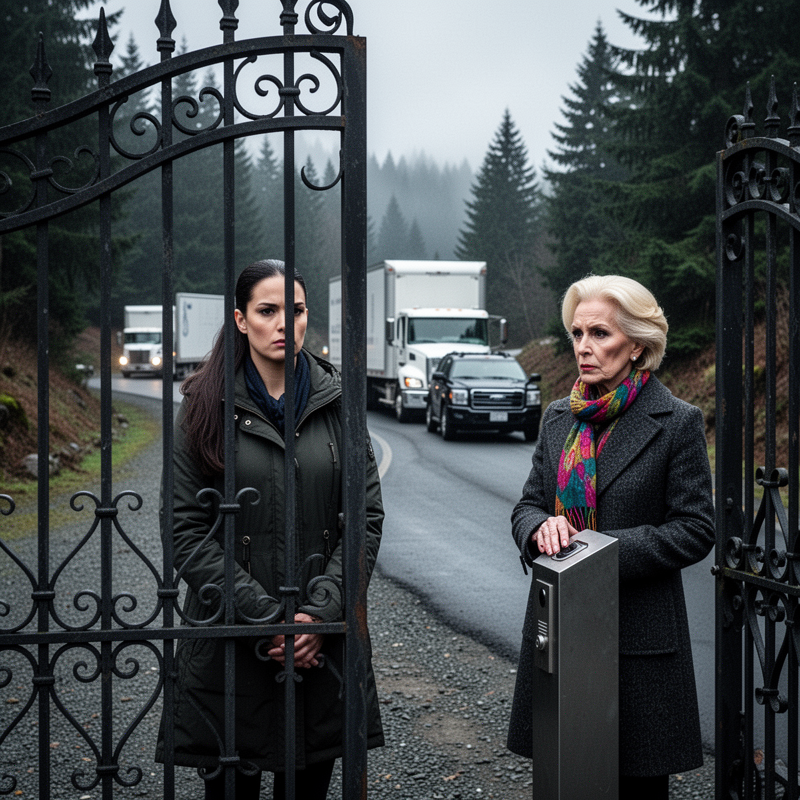
“We are moving into the Pine Creek estate today, Elena, so hand over the gate codes,” my ex-mother-in-law shouted through the intercom, two heavy commercial moving trucks idling behind her vehicle on the mountain road.
I stood behind the locked iron gates of the isolated Oregon property my late parents had built, watching my ex-husband Marcus step out of his car with a crowbar in his hand.
He assumed that because our divorce decree had just been finalized that morning, he could physically seize the $1.8 million compound before the legal paperwork caught up.
What Marcus and his family did not realize was that while they spent months planning to strip me of everything I owned, I had already spent the last seventy-two hours taking action of my own.
The air, thick with the scent of damp pine and impending snow, bit at my cheeks. My breath plumed white in front of me, but I felt no chill. A strange, quiet calm had settled over me.
Evelyn Albright, my ex-mother-in-law, stood at the intercom pedestal, her face a mask of pinched impatience. Her designer scarf, a vibrant splash of color against the drab winter landscape, seemed incongruous with the hostility radiating from her.
Behind her, two massive moving trucks idled, their diesel engines rumbling a low, threatening growl. The drivers, bundled in heavy coats, watched the scene with detached curiosity.
Marcus Albright, my ex-husband, walked deliberately from his black SUV toward the gate motor. The crowbar in his hand glinted dully under the overcast sky. He moved with the practiced confidence of someone who believed he was reclaiming what was rightfully his.
A tight knot formed in my stomach, but it was not fear. It was a cold resolve.
“Elena, don’t make this harder than it has to be,” Marcus called out, his voice echoing slightly in the mountain stillness. He gripped the crowbar, testing its weight. “The judge signed the papers. This property is mine now.”
Evelyn, sensing my silence, pressed the intercom button again.
“Did you hear him?” she shrieked, her voice distorted by the speaker. “You have no legal right to delay us. We have movers on the clock!”
I remained silent, watching Marcus. My gaze was steady, unwavering.
He reached the gate motor, a heavy industrial unit bolted to a concrete pillar. The crowbar scraped against the metal housing as he inserted the tip into a seam. The sound was harsh, grating.
He put his weight into it, grunting with effort. The motor cover groaned, protesting the forced entry.
A flash of impatience crossed Marcus’s face. He leveraged the crowbar with more force, muscles straining under his jacket. There was a sharp crack as the plastic housing split, followed by the screech of metal tearing.
Sparks flew, a brief, bright shower against the gray sky.
He yanked the cover off, exposing a tangle of wires and gears. Without hesitation, he plunged the crowbar deeper, severing a thick bundle of cables.
The heavy iron gates, which had stood firm for years, shuddered. Then, with a slow, grinding moan, they began to retract, pulling inward on their tracks.
A triumphant smirk spread across Marcus’s face. He tossed the crowbar aside, a defiant clang against the asphalt.
“Finally,” Evelyn muttered, stepping away from the intercom. She smoothed down her expensive coat, already envisioning the sprawling estate beyond.
The moving trucks began to roll forward, slowly following Marcus’s SUV through the now-open entrance. They navigated the winding, gravel driveway toward the main house, a grand structure of stone and timber nestled among the ancient firs.
I watched them pass, the exhaust fumes momentarily obscuring my view. The movers exchanged glances, their faces unreadable.
When the last truck had rumbled past, I stepped away from the gate. I didn’t need to be there anymore. My part was done, at least for now.
Marcus strode up the wide stone steps to the massive oak front doors of the estate. He produced a key from his pocket, a heavy brass one he’d kept since our wedding day, and inserted it into the lock.
It turned smoothly. He pushed the door inward, a theatrical flourish.
“Welcome home, Evelyn,” he announced, stepping across the threshold.
Evelyn followed, her heels clicking crisply on the polished stone foyer. The moving crew began to unload their ramps from the trucks, ready to sweep in and fill the house with furniture.
But the echo of Marcus’s voice lingered in the sudden, cavernous silence that met them inside.
Evelyn stopped dead in the entryway, her smile dissolving. She looked around, her eyes wide with disbelief, then confusion.
Marcus, a few steps ahead, turned slowly. His gaze swept from the soaring ceiling to the expansive floor.
The $1.8 million mountain compound, the Albright estate, was completely empty. Not a single piece of furniture, not a light fixture, not even a curtain rod remained. The walls were bare concrete, the floors stripped down to their sub-level, unpolished and cold. Every room, from the grand living area to the kitchen, was hollowed out, a vast, echoing shell of what it once was.
Part 2
Marcus stood frozen. Evelyn shrieked, a high-pitched, incredulous sound that bounced off the exposed studs where walls once were. Her face was a grotesque mask of disbelief, slowly twisting into fury.
He spun around, his eyes darting from room to room. The grand fireplace mantel was gone, revealing raw brick. The elegant built-in shelves in the library? Just empty recesses in the concrete. He moved with a sudden, frantic energy, his expensive shoes crunching on the dust and debris that littered the sub-flooring.
He burst into the kitchen. Where a gourmet island and custom cabinetry once stood, there was only a rough concrete slab. The sink, the high-end appliances, even the range hood—all stripped away. Bare wires dangled from the ceiling where recessed lighting should have been. He bent down, running a hand over the floor, and saw that the very copper pipes beneath the sink area were gone, leaving only jagged ends sticking out of the wall.
I watched him through the security monitor, a small screen flickering in the corner of my rented cottage. The chill in my own small space felt like a welcome blanket compared to the icy fury I imagined radiating from him. Evelyn’s muffled screams were a distant, irritating buzz through the tiny speaker attached to my monitor, a sound I had learned to tune out years ago.
Marcus stumbled through the house, a man possessed, yelling Evelyn’s name. He checked the bathrooms, finding only empty spaces where toilets and vanities had been, the plumbing lines crudely capped or completely removed. He ran his hand over a wall, confirming the light switches were pulled clean out, leaving gaping holes. He peered into the floor, where vents used to be, now just open shafts. Even the heating registers had been removed.
It wasn’t just furniture. It was the skeleton. The organs. The very lifeblood of the house had been systematically drained. Every internal system, every fixture, every piece of functional infrastructure was gone.
He stopped in the vast, empty master bedroom, chest heaving. His triumphant smirk was long gone, replaced by a dawning horror. He wasn’t just standing in an empty house; he was standing in a hollowed-out carcass, a shell utterly devoid of function. He realized, with a sickening lurch, that what he had physically seized was an unlivable, unplumbable, un-wirable husk that could never pass a bank appraisal.
CHAPTER 2: Recovered Threads
Tires crunched over gravel behind Marcus’s idling pickup truck. A dusty gray sedan pulled onto the shoulder just past the property line, and my legal advisor, Warren Cross, stepped out into the freezing mountain air.
Warren carried a battered leather briefcase under his arm. He didn’t look at Marcus or Evelyn as he walked up to the iron gate where I stood.
He pulled a thick sheaf of printed paper from his briefcase and slid it through the iron bars directly into my hands.
“I pulled these off the cloud server twenty minutes ago,” Warren said, his voice flat and calm. “Your ex-husband forgot that his old business phone was linked to the shared cloud account your parents created.”
Marcus stepped forward, his knuckles still white around the crowbar.
“Whatever garbage he’s handing you doesn’t matter, Elena,” Marcus barked. “The divorce decree was signed at eight o’clock this morning. I have an equitable interest in this land.”
I turned the top page over. It was a printed log of text messages spanning fourteen months, sent from Marcus’s phone number to a registered agent in Salem.
“He didn’t just neglect the estate tax notices,” Warren said, pointing a gloved finger at the second page. “He specifically instructed his accountant to withhold all tax payments starting fourteen months ago.”
I read the highlighted text aloud into the intercom speaker.
“Let the county property tax default roll for three cycles,” the message read. “Once the foreclosure auction triggers, Apex Holdings LLC will buy the tax certificate for pennies on the dollar before she even knows the land is delinquent.”
Marcus froze. His arm lowered slightly, the heavy crowbar tipping toward the slush on the road.
“Apex Holdings is registered to your cousin in Idaho, Marcus,” I said.
Evelyn’s mouth snapped shut. She glanced sideways at her son, her hands clutching her designer coat collar against the rising wind.
“That text chain constitutes deliberate tax fraud and civil conspiracy,” Warren told Marcus. “If you step foot past these gates today, those prints go straight to the county prosecutor’s desk.”
Marcus took a slow step backward, but his face hardened into a sharp, bitter sneer.
“You think you’re clever, Elena,” Marcus muttered. “You think you can hide behind paper while you sit on two million dollars of dirt.”
He tossed the crowbar into the bed of his truck with a loud metal clang that echoed across the valley.
“You still have to eat, Elena,” Marcus said, leaning toward the gate. “And you still have to come down this mountain.”
CHAPTER 3: The Whisper Campaign
The snow started falling heavily by eight o’clock the next morning. I drove my old truck down the winding pass into town to buy diesel fuel for the generator and supplies for the long week ahead.
When I pulled up to Miller’s Feed & Supply, the open sign was lit, but the heavy glass door was locked from the inside.
Old man Miller stood behind the glass counter, staring straight through me without moving a muscle.
I knocked twice on the glass. He slowly walked over, unlocked the door three inches, and kept his arm planted against the frame.
“I can’t extend your account, Elena,” Miller said, his voice cold and dry as dry shavings. “Your ex-mother-in-law was in here yesterday afternoon with two women from the church board.”
“Evelyn was here?” I asked.
“She showed everyone a bank ledger printout,” Miller replied, refusing to meet my eyes. “Said you cleaned out five hundred thousand dollars from your family’s private trust fund before your parents passed. Said you’re unhinged and taking money from local businesses.”
A cold pit formed in my stomach.
“That trust fund paid for my mother’s home hospice care,” I said quietly. “Every single dollar was accounted for in probate court.”
“I don’t get involved in domestic messes,” Miller said, closing the door until only a crack remained. “Cash only from now on. And folks around town aren’t too keen on doing business with someone who robs her own blood.”
He slid the deadbolt shut before I could reply.
My phone buzzed in my pocket three times in quick succession. I pulled it out to find voicemail notifications from my Aunt Clara and two cousins in Eugene.
I tapped the screen and played Aunt Clara’s message on speaker.
“How could you do this to Marcus and his mother after everything they suffered during your parents’ illness?” her trembling voice blared through the truck cabin. “Evelyn said you locked them out and ran off with half a million dollars. You should be ashamed of yourself, Elena.”
I sat in the idling truck as the heater blew lukewarm air over my hands.
Evelyn wasn’t trying to win in court anymore. She was poisoning every square foot of soil I had to walk on.
CHAPTER 4: A Guard’s Conscience
By mid-afternoon, two black SUVs with dark tinted windows pulled up to the bottom of the private access road. Three men in tactical gear began unloading orange traffic cones and collapsible metal barricades across the asphalt.
I walked down the interior fence line to where a tall man with short gray hair was standing near the gate motor. He wore a patch that read *Kane Tactical Security*.
“This is private land,” I said through the steel mesh. “You’re blocking an active county right-of-way.”
The lead guard turned. His tag read *D. Kane*. He held a clip-board with a thick plastic folder attached to it.
“We were hired by Marcus Albright to establish a physical perimeter,” Kane said. His voice was deep, clipped, and strictly professional. “We have an emergency lockout order issued by the county court.”
“Let me see that order,” I said.
Kane paused. He stepped up to the gate and slid the laminated sheet into the document pass-through slot.
I looked at the top header. The document carried a state seal image pasted over a standard civil affidavit, but there was no court docket number, no clerk stamp, and no signature from a circuit judge.
“Look at the bottom corner,” I said, pointing to the blank line where the judicial seal was supposed to be embossed. “That’s an affidavit draft, not an enforceable order. His lawyer typed this up yesterday afternoon.”
Kane took the page back and held it up to the gray sunlight. He ran his thumbnail across the paper where the raised state seal should have been.
He reached into his tactical vest, pulled out a satellite radio, and keyed the mic button.
“Unit Two, stand down on the gate barricade,” Kane commanded into the radio. “Do not unload the secondary fencing.”
“What’s the issue, chief?” a voice crackled back over the speaker.
Kane looked through the iron bars at me. His eyes were hard, calculating, and cold.
“Client provided fraudulent documentation,” Kane said into the radio. “We do not enforce illegal self-help lockouts. Pack the trucks.”
He lowered the radio and turned back to me.
“Your ex-husband told my agency this was a routine commercial eviction,” Kane said softly. “My team doesn’t do private muscle work for deadbeats.”
CHAPTER 5: The Redistribution
I met Sam Hollis at the lower timber yard two miles down the valley road. The snow was falling thicker now, covering the stacks of freshly cut cedar logs under heavy white sheets.
Sam stood by his flatbed truck, holding a warm paper cup of coffee. He was a local mountain logistics contractor who had lived in the county for forty years.
“Your ex-husband called my dispatcher three times this morning,” Sam said, spitting onto the slushy gravel. “Offered double rate if I brought two crane trucks up to the estate to help him haul out the heavy timber.”
“What did you tell him?” I asked.
“Told him my fuel lines were frozen,” Sam grunted. “Told him they’d stay frozen till spring.”
He walked to the back of his flatbed and pulled back a heavy blue canvas tarp, revealing two solid oak dining tables, a set of hand-carved cabinets, and four stacks of brass light fixtures.
“Every bit of it is accounted for, Elena,” Sam said. “Delivered three dining sets to the Miller family down in Oak Creek this morning. Delivered the workshop tools to young Jimmy Vance.”
“Did Jimmy take them?” I asked.
“He almost cried,” Sam said, wiping his nose with his sleeve. “Marcus walked away from Jimmy’s framing crew two years ago owing them eighteen thousand dollars in unpaid labor. Jimmy’s kids were sleeping on floor mats after Marcus filed that bogus bankruptcy.”
I looked down at the hand-carved wood my father had spent three winters crafting in his workshop.
Marcus had spent months making inventories of those items, valuing them for his private liquidation spreadsheets. He believed I was hoarding them in a hidden storage vault inside the mountain compound.
“He thinks I sold it all for cash,” I said softly.
“Let him think whatever he wants,” Sam said, throwing the canvas tarp back over the load. “Every family he cheated in this valley now has a piece of his collateral sitting in their living room.”
CHAPTER 6: The Revoked Loan
At ten o’clock on Thursday morning, a clean silver sedan with county rental plates navigated the sharp curves of the mountain road.
A sharp-featured woman in a tailored wool coat stepped out, holding a tablet computer wrapped in a rugged rubber case.
Marcus rushed out from his parked truck to meet her, his face flushed with nervous energy.
“Ms. Vance,” Marcus said, extending his hand quickly. “Thank you for coming up personally. As you can see, the structure is intact, concrete exterior is reinforced, high-value real estate.”
“I’m here to complete the site verification for Apex Capital’s bridge loan, Mr. Albright,” the woman said coldly. She didn’t shake his hand. “We don’t disburse one point two million dollars on paper appraisals alone.”
I opened the pedestrian side-gate from the internal security console and walked toward them.
“Ms. Vance,” I called out calmly. “If you are conducting a property assessment for a commercial loan, you need to see the interior utility status.”
Marcus lunged forward, placing himself between me and the bank inspector.
“She doesn’t have authority to grant access!” Marcus shouted, his voice cracking under the strain. “The court transfer is pending!”
“I am the sole registered title holder on the county land registry,” I replied, handing Ms. Vance a certified copy of the current deed jacket. “And as owner, I invite you to inspect the structure.”
Ms. Vance pushed past Marcus without a word, stepping through the wide front threshold into the lower foyer.
The glare of her flashlight illuminated bare gray concrete floors, exposed wall studs, and empty junction boxes where copper wiring had been clipped back to the main breaker board.
She walked into the master bathroom. Where a stone tub and copper plumbing fixtures had once been, only open PVC drain caps remained sticking up out of the subfloor.
Ms. Vance stopped. She tapped her tablet screen four times, taking photos of the bare walls and exposed joists.
“There are no functional plumbing fixtures, no secondary electrical distribution, and no residential utility connections,” she said, her voice dripping with professional disdain.
“It’s just cosmetic repairs!” Marcus pleaded, trailing behind her with sweat shining on his forehead. “I have contractors on standby! A hundred thousand dollars in sweat equity!”
“This property is an uninhabitable shell, Mr. Albright,” Ms. Vance said, tapping her screen one final time. “It fails basic secondary collateral guidelines. Your bridge loan application is formally terminated as of this second.”
She turned on her heel and walked out, leaving Marcus standing in the middle of the dark, unheated hall.
CHAPTER 7: Crossing the Line
I sat in the passenger seat of my brother Caleb’s pickup truck behind a closed diner off Route 22.
The rain was turned to sleet, rattling against the windshield like thrown gravel. Caleb gripped the steering wheel tightly, his knuckles red from years of hard sawmill work. We hadn’t spoken more than ten words to each other since our father’s funeral three years ago.
A dark SUV pulled into the spot next to us. Derek Kane got out, pulled his collar up against the rain, and opened Caleb’s rear truck door.
He slid a thick Manila envelope onto the back seat.
“What is this?” Caleb asked, turning around sharply.
“Your brother-in-law hired my firm to conduct twenty-four-hour surveillance on your sister’s storage units down in Eugene,” Kane said, his tone voice completely stripped of emotion. “He brought in a private locksmith crew from Portland two hours ago.”
I reached into the back and opened the folder. Inside were printed GPS tracking logs, timestamped photos of my downtown storage unit, and text logs between Marcus and a grey-market transport crew.
“He’s planning to breach the off-site storage lockers at midnight,” Kane said. “He thinks your parents’ liquid assets and cash reserves are stored in those lockers.”
“Why are you giving us this?” I asked, looking up at him. “He’s paying your firm thousands of dollars a day.”
Kane pulled a faded metal key tag from his pocket and held it out under the truck’s dome light. It was stamped with the logo of my father’s old logging equipment company from fifteen years ago.
“Your dad hired my older brother when he came back from his second deployment with bad legs,” Kane said softly. “Kept him on the payroll for two years when nobody else in this county would give him a job.”
He closed his hand over the key tag.
“Marcus Albright pays my invoice,” Kane said. “But he doesn’t own my conscience. Get your storage units cleared out before midnight.”
CHAPTER 8: The Mother’s Risk
Caleb pulled his truck straight up to the curb outside the town’s only high-end coffee shop on Main Street.
Evelyn Albright sat inside by the window, wearing a pearl necklace and reading a real estate magazine over a white porcelain cup.
Caleb slammed his truck door shut and walked straight inside. I followed two steps behind him.
Evelyn looked up, her expression turning into a mask of pure condescension as Caleb dropped a set of legal papers right next to her coffee saucer.
“This is a private establishment, Caleb,” Evelyn said, keeping her voice low and even. “I suggest you leave before I call the city marshal.”
“Call him,” Caleb said, leaning down until he was eye level with her. “Ask him to take a look at page four of the secondary mortgage application Marcus filed with West Coast Financial last Tuesday.”
Evelyn’s hand hesitated mid-air over her cup.
“Marcus used your personal home on Cedar Lane as secondary cross-collateral for his personal hard-money loans,” Caleb said. “He signed your name on the guarantor line using a power of attorney document he had drafted three months ago.”
Evelyn stared at the paper. The color slowly drained from her face, leaving her pale skin looking dry and papery.
“That’s… that’s impossible,” she whispered, her voice losing its composure for the first time. “Marcus told me the bridge loan was secured exclusively by the Pine Creek land.”
“The bridge loan was denied an hour ago,” I stepped forward and said. “The hard-money lenders are calling in his high-interest personal notes by Friday afternoon. If he defaults, your house goes on the county auction block right alongside his corporate shell.”
Evelyn looked between the two of us, her fingers trembling as she picked up the document.
“He’s my son,” she said, her voice barely audible over the hum of the espresso machine behind the counter. “He’s fixing his life.”
“He’s drowning, Evelyn,” Caleb said coldly. “And he dragged you into the deep water with him.”
She didn’t answer. She sat frozen, staring at her own forged signature on the secondary lien agreement, too proud to cry and too terrified to speak.
CHAPTER 9: The Pass Blockade
At dawn on Friday, the roar of heavy diesel engines echoed down the narrow canyon road leading up to Pine Creek.
Marcus was riding in the passenger seat of a massive flatbed transport carrying a commercial bulldozer and an industrial generator rig. Behind him were two utility vans loaded with private construction workers he had brought in from out of state.
The mountain pass narrowed to a single lane between two sheer rock walls half a mile below my gate.
As the transport round the final turn, five massive logging trucks swung out from the gravel pull-off, completely blocking the asphalt from shoulder to shoulder.
The lead truck was an old blue Peterbilt with Sam Hollis at the wheel. Caleb’s red rig sat right next to it, its giant tires turned sharp against the double yellow lines.
The flatbed transport slammed on its air brakes, coming to a halt less than ten feet from Sam’s front bumper.
Marcus jumped out of his cab, screaming over the loud idle of the diesel engines.
“Move these trucks!” Marcus yelled, waving his arms violently. “This is a public highway! I have a commercial transport permit!”
Sam Hollis opened his cab door, stepped down onto the running board, and folded his arms over his chest. He didn’t say a word.
Behind him, four other local drivers stepped out of their rigs, holding heavy iron tire irons and wood hooks. They stood in a silent line across the narrow asphalt.
“You’re committing a federal transport violation!” Marcus screamed, his face turning dark purple. “I’ll have every single one of your commercial licenses revoked by noon!”
Caleb walked out from behind his rig, his thick work boots crunching on the frozen slush.
“Road’s closed for weight maintenance, Marcus,” Caleb said, his voice easily carrying over the engine rumble. “County code says private commercial haulers over twenty tons need a local clearance permit during freezing conditions.”
“Where’s the county commissioner?” Marcus demanded, looking around wildly.
“You’re looking at the mountain road committee,” Sam Hollis said quietly. “Turn those trucks around, boy. You’re not bringing heavy iron up this hill today.”
Marcus looked at the five heavy trucks, then at the silent men standing in front of them. Slowly, reluctantly, he turned and motioned for his transport driver to start backing down the winding pass.
CHAPTER 10: Framed in the Dark
A howling snowstorm hit the mountain at midnight, dropping five inches of white powder across the estate in less than two hours.
Inside the compound’s off-grid control room, the primary power monitors suddenly chimed. A sharp red warning light began flashing on the main inverter panel, followed by a sudden, dead silence as the heavy backup generator choked and died.
I threw on my thermal coat, grabbed a heavy flash-light, and walked out to the metal utility shed located fifty yards behind the main house.
The lock on the shed door had been sheared off with bolt cutters. Inside, the heavy copper wiring harness connecting the six-cylinder diesel generator to the main transfer switch was severed and hanging in shredded strips.
Headlights flashed through the snow outside.
A county sheriff’s cruiser pulled up to the shed, its blue and red lights painting the falling snow in bright flashes.
Marcus stepped out from the passenger side of the cruiser, followed closely by Deputy Miller.
“There she is!” Marcus shouted, pointing his finger directly at me as I stepped out of the shed holding my flashlight. “She ruined the industrial power infrastructure! That’s three hundred thousand dollars in commercial equipment! That’s high-grade industrial sabotage!”
Deputy Miller walked over, his hand resting casually on his hip belt.
“Elena,” Miller said, looking tired. “Mr. Albright called the dispatch center twenty minutes ago reporting active destruction of property on the parcel.”
“I didn’t cut those wires,” I said calmly. “I came out here three minutes ago when the inverter alarm went off in the house.”
“She’s lying!” Marcus yelled, taking a step toward me. “She’s tearing the place apart so I can’t take possession!”
Derek Kane stepped out from the shadow of the nearby pine trees. He wore a heavy snow parka and held a small yellow plastic digital storage drive in his gloved hand.
“Deputy,” Kane said, his voice cutting cleanly through the wind. “I installed high-definition motion cameras along this utility corridor six hours ago to protect my security firm’s liability.”
Marcus froze mid-stride.
Kane stepped up to the cruiser, plugged the yellow drive into the dashboard computer, and tapped the screen.
Clear, crisp video played on the screen: Marcus himself, wearing a dark coat, walking into the shed with a pair of long-handled wire cutters forty-five minutes earlier, methodically snipping the generator’s main copper feed lines.
Deputy Miller stared at the screen, then looked up at Marcus with deep disgust.
“Get in the back of the car, Marcus,” Deputy Miller said softly. “Now.”
CHAPTER 11: The Cost of Winning
By Saturday afternoon, the storm had passed, leaving a bright, blinding blue sky over the white slopes of the valley.
I sat at the wooden kitchen table inside Warren Cross’s small law office down in town. A thick stack of legal filings sat between us, illuminated by the bright fluorescent light above.
“We have him on tax fraud, document forgery, and filing a false police report,” Warren said, tapping his pen against his yellow legal pad. “If we go to full trial, we will win clear title to Pine Creek.”
“How long, Warren?” I asked, looking out the window at the snow-covered street.
“Five years,” Warren said flatly. “At minimum. His legal team will file interlocutory appeals, stay motions, and jurisdiction challenges at every level. They will drag this through three separate circuit courts.”
“And how much will it cost?”
“Three hundred and fifty thousand dollars in direct court fees, expert witness retainers, and property maintenance escrow,” Warren replied. “You’ll have to take out secondary mortgages on the land just to pay the legal bills.”
I closed my eyes.
For twelve years, I had worked three jobs to pay off Marcus’s failed business debts. I had spent four years nursing both of my parents as they slowly died in that big stone house on the hill.
I had spent my entire adult life acting as a caretaker to brick, stone, and another person’s endless, hungry ambition.
“If I win,” I said slowly, “I get an empty, unheated stone compound on an isolated mountain, three hundred thousand dollars in legal debt, and five more years of seeing his face across a courtroom table.”
“Yes,” Warren said quietly. “That is what winning looks like in the civil court system.”
“That’s not winning,” I said. “That’s just buying a bigger cage.”
CHAPTER 12: The Decision to Let Go
That night, I stayed in a small twenty-foot rented trailer parked on Caleb’s lower timber acreage.
The oil heater hummed quietly in the corner, throwing a warm orange glow across the plywood walls. My entire life—three suitcases of clothes, my mother’s photo albums, and a box of old hand tools—sat stacked on the narrow bench next to me.
Caleb came in carrying two mugs of hot tea and sat down across from me.
“Sam said he can get a crew up to the mountain house next week to fix the wiring,” Caleb said, setting a mug down in front of me. “We can make it livable again by spring, Elena.”
“I’m not going back, Caleb,” I said softly.
Caleb stopped, his mug halfway to his mouth.
“What are you talking about?” he asked. “That’s Dad’s land. He built every square foot of that house with his own hands.”
“Dad built a home for us,” I said, looking my brother straight in the eyes. “Marcus turned it into a financial weapon. As long as my name is on that deed, Marcus will never stop digging, lying, and dragging our family through the mud.”
“So you’re just going to give it to him?” Caleb’s voice rose, a flash of his old hot temper flaring up. “After everything he did?”
“I’m not giving him a home, Caleb,” I said gently. “I’m giving him the trap he built for himself.”
I pulled a single sheet of paper from my coat pocket and laid it on the table. It was a voluntary quitclaim deed, transferring full, unencumbered ownership of the Pine Creek estate directly to Marcus Albright.
“Without me to fight, he inherits the property tax defaults, the unpaid contractor claims, the unlivable shell, and every debt lien attached to that dirt,” I said. “He thinks he’s taking my inheritance. He’s actually taking my chains.”
Caleb looked at the paper for a long time. Slowly, his shoulders dropped, and he let out a long, quiet breath.
“You’re really going to walk away with nothing?” he asked quietly.
“I’m walking away with my life,” I said. “That’s not nothing.”
CHAPTER 13: Isolation on the Mountain
Word of the mountain pass blockade and the forged court documents spread through the small county like wildfire over the weekend.
On Monday morning, Marcus pulled his pickup truck into the county diesel depot to fill his equipment tanks.
The owner, an old man who had worked with my father for thirty years, walked out, flipped the lock on the fuel pumps, and turned the main power switch off inside the office.
“Pump’s down,” the owner said through the window, without looking up from his paper.
“The lights are on in your shop!” Marcus shouted, banging on the glass. “I need two hundred gallons of diesel for the site heaters!”
“Pump’s down for you, Albright,” the man said flatly. “Try Portland.”
Marcus drove to the hardware store, the local auto parts shop, and the lumber yard. At every stop, the story was the same.
Mechanics suddenly had three-week waiting lists for basic repairs. Supply yards claimed their inventories were fully committed. Local day laborers turned their backs and walked into break rooms when his truck pulled up to the curb.
He was completely isolated on his frozen mountain compound.
Without local contractors willing to set foot on the land, the unheated mansion began to freeze from the inside out. Water trapped in the un-drained secondary lines expanded, cracking the internal copper manifolds inside the walls.
Marcus spent his nights sitting in his truck with the heater running, staring at the pitch-black, hollow structure he had spent two years fighting to own.
He had won physical control of the dirt, but the mountain had completely shut him out.
CHAPTER 14: The Silent Standoff
On Tuesday afternoon at two o’clock, Marcus called Warren Cross and demanded an immediate emergency meeting at the Pine Creek gate.
The sky was heavy and gray, threatening another round of snow as Warren’s car pulled up to the iron gate. Caleb, Derek Kane, and I stepped out onto the cold gravel driveway.
Marcus was waiting on the other side of the gate, looking thin, unwashed, and hollow-eyed. His expensive leather jacket was stained with black motor oil, and his hands were raw and red from the cold.
Evelyn sat inside his idling truck thirty feet behind him, looking straight ahead through the fogged windshield.
“You brought your whole entourage,” Marcus spat, his voice raspy from the cold air. “Are you ready to sign the property release, or do we spend the next five years in court until you’re completely bankrupt?”
I didn’t answer him. I walked up to the gate, carrying a thick black leather folder in my hands.
Warren Cross stepped up beside me and laid a wooden folding table across the iron crossbars of the gate.
“My client is prepared to execute a full quitclaim deed today, Mr. Albright,” Warren said calmly. “Transferring one hundred percent of her right, title, and interest in the Pine Creek compound directly to you.”
Marcus’s eyes widened slightly. A nervous, triumphant smile broke across his chapped lips.
“I knew you’d fold,” Marcus sneered, pulling a pen from his pocket. “You never had the stomach for a real fight, Elena. Hand it over.”
I didn’t say a word. I opened the folder, laid the quitclaim deed on the table, and signed my name on the bottom line in front of the notary Warren had brought along.
Marcus snatched the signed deed off the table before the ink was even dry, holding it up to the light like a prize.
“It’s mine,” he laughed, a frantic, unhinged sound. “The whole estate. One point eight million dollars.”
“You should read the attached schedule, Marcus,” Warren said quietly.
CHAPTER 15: The Transfer and the Liens
Warren reached into his briefcase and pulled out a bright yellow county property jacket, sliding it across the table directly into Marcus’s hands.
“What is this?” Marcus asked, his smile instantly fading.
“Three years ago, while you were acting as the unlisted manager for Apex Holdings, you ordered three commercial transport trucks to dump six hundred yards of industrial drywall waste and toxic solvent drums into the ravine on the north forty acres,” Warren said.
Marcus stared at the yellow jacket.
“The Department of Environmental Quality completed their formal site assessment yesterday morning,” Warren continued, his voice steady and relentless. “Because you are now the sole, unencumbered title owner of the real property, all attached municipal remediation orders transfer directly to you as the primary party of record.”
Marcus turned the page over with trembling hands.
“The mandatory environmental cleanup order is four hundred and twenty thousand dollars,” Warren stated. “It carries an automatic tax lien against the title, accruing interest at twelve percent per annum. It cannot be discharged through personal bankruptcy.”
Marcus’s face turned gray.
“That’s not all,” Derek Kane stepped forward and said.
Kane pulled a white envelope from his coat and dropped it on top of the yellow file.
“I submitted the text logs, the forged court order, and the generator video directly to the State Board of Financial Regulation this morning,” Kane said. “They issued an emergency administrative freeze on all bank accounts associated with Apex Holdings half an hour ago.”
Marcus looked from the signed deed in his left hand to the debt orders in his right.
“Elena…” Marcus stuttered, his arrogant posture completely collapsing as he looked up at me through the iron bars. “Elena, wait… we can work out a settlement… you can’t just leave me with this…”
I looked at him in total silence. I didn’t yell. I didn’t deliver a speech. I didn’t offer a single word of anger or triumph.
I simply turned my back on him, walked to Caleb’s truck, and opened the passenger door.
CHAPTER 16: The Departure
Inside Marcus’s truck, the passenger door opened sharply.
Evelyn stepped out into the freezing wind, holding the secondary mortgage papers Caleb had given her days before. She walked up to the iron gate where Marcus stood frozen.
She looked over his shoulder at the yellow environmental folder, reading the four-hundred-and-twenty-thousand-dollar lien figure printed in bold black ink at the top of the state document.
“Is this real, Marcus?” Evelyn asked. Her voice wasn’t loud or angry—it was completely empty.
“Mother, listen to me,” Marcus stammered, grabbing her arm. “I can fix this! I can get another investor! I just need time!”
Evelyn pulled her arm out of his grip. She looked at him for three long seconds, as if seeing him clearly for the very first time in her life.
She turned around, walked over to her own car parked behind the transport trucks, got inside, and started the engine.
Marcus’s sister, who had driven up with them, silently stepped out of the second vehicle, pulled her bag from his truck bed, and got into Evelyn’s passenger seat.
Without a word, Evelyn backed her car down the narrow mountain road, her taillights disappearing around the snow-covered curve.
Marcus stood alone on the gravel driveway.
The heavy iron gates sat wide open behind him. The hollowed-out, cold stone house stood high on the hill above him, dark, silent, and entirely unlivable.
He held the title to a multi-million dollar estate, wrapped in mountain mud, surrounded by hostile neighbors, and burdened with debts he would spend the rest of his natural life trying to pay off.
Caleb put his truck in gear, and we drove down the mountain pass, leaving Marcus standing in the middle of the empty road.
CHAPTER 17: Five Years Later
Five years later, the alarm went off at four-thirty in the morning.
I woke up in a small, quiet bedroom on the second floor of a rented cottage in a quiet coastal town two hours west of the valley.
Outside my window, the ocean rain tapped softly against the glass, steady and calm.
I pulled on a warm fleece jacket, drove ten minutes through the quiet streets, and unlocked the side entrance of Miller & Son Hardware Supply.
I didn’t own the store. I didn’t own the land it sat on. I worked the counter four days a week, managing the morning inventory and helping local fishermen pick out brass brassware and marine paint.
At seven o’clock, I took my break in the small, fluorescent-lit breakroom behind the main retail floor.
The room smelled of old coffee, fresh cedar sawdust, and rain coats hanging on wall hooks.
I poured a cup of black coffee from the glass pot and sat down at the plain formica table by the window, opening a local newspaper.
On page six, buried in the public notices section under municipal legal judgments, was a small entry for the county probate court back in the valley.
Marcus Albright’s wage garnishment order had been extended for another thirty-six months to satisfy ongoing civil tax liabilities. The Pine Creek land remained tied up in state environmental receivership, an overgrown lot of concrete and trees that nobody could buy and nobody could use.
I folded the paper, laid it face down on the table, and took a sip of my warm coffee.
My bank account was modest. My apartment was rented. I didn’t own a single square foot of mountain estate or a single dollar of inherited property.
But when my phone sat on the table beside my coffee cup, it remained completely silent. No angry calls from relatives, no legal notices from process servers, no frantic demands from a desperate man drowning in his own lies.
I used to believe holding onto my family’s land was the only way to preserve my worth. Now I know that peace isn’t a place you own—it’s the silence you enjoy when everyone who tried to break you no longer has your number.
Leave a Reply