CHAPTER 1: The Cold Zinc Tunnel
Part 1
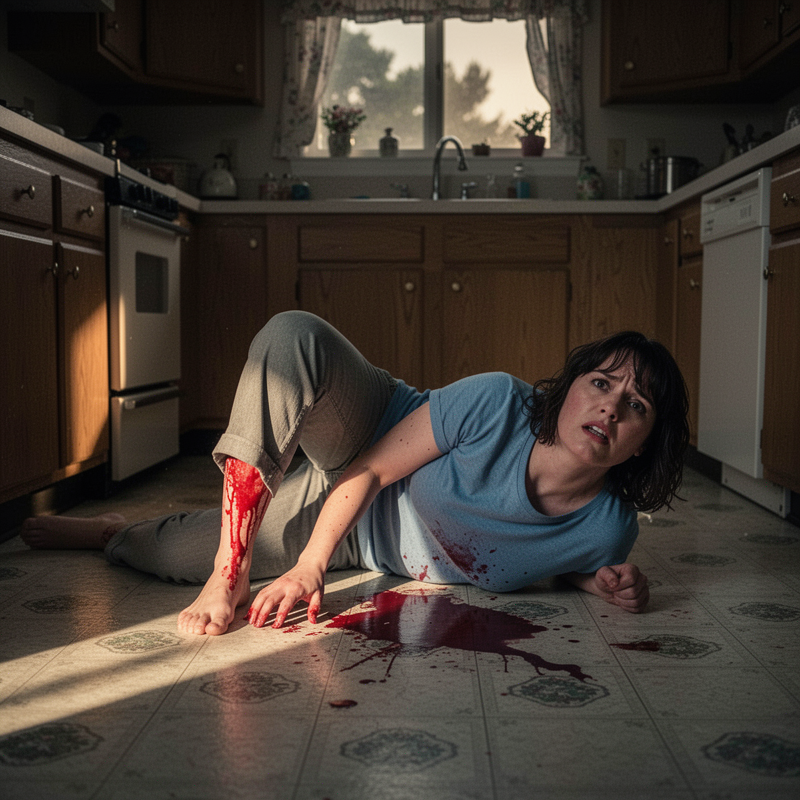
“You brought this on yourself by disrespecting my mother’s kitchen,” my husband Arthur said as he stepped over my bleeding body on the linoleum floor.
He carried the bowl of oversalted beef broth back to the dining room where his 86-year-old mother was already eating.
Ten minutes earlier, I had begged him to stop her from drinking the sodium-heavy soup because of his father’s fatal stroke history, only for Arthur to shatter my right femur with a marble rolling pin.
With my leg twisted at an impossible angle, I pulled myself across the cold tile toward the narrow crawlspace duct behind the pantry.
I dragged my useless leg through four yards of rusted zinc piping into the winter night before collapsing on the hospital delivery driveway.
I swore then that Arthur and his family would pay for every inch I crawled.
The metallic tang of blood filled my mouth, thick and coppery. My right leg lay splayed, a gruesome sculpture of bone and flesh. The knee was bent backwards, the shin twisted grotesquely, an impossible angle where my femur had once been whole. Pain, sharp and merciless, pulsed from the shattered bone, echoing through every nerve ending.
A small pool of scarlet liquid began to spread slowly on the cool, patterned linoleum beneath me, a macabre Rorschach test of my fading life. Each beat of my heart sent another surge of agony, a dizzying throb that threatened to pull me into unconsciousness.
But I wouldn’t let it.
Not yet.
From the adjacent dining room, I heard the delicate clinking of silverware against ceramic. Arthur’s voice, calm and steady, carried through the thin wall, utterly devoid of urgency.
“More broth, Mother?” he asked, as if the world hadn’t just violently fractured in two.
Agnes, his 86-year-old mother, made a soft, dismissive sound that was almost a purr.
“This is perfectly seasoned, Arthur. Your wife simply has no taste for a proper meal. Always complaining, that one.”
Her words, sharp and laced with a familiar venom, sliced through the haze of my pain. They stung more than the broken bone.
They had left me here. Left me to bleed on the floor.
My fingers, sticky with a mixture of my own blood and sweat, scrabbled against the cold linoleum. I tried to push myself up, but a fresh wave of blinding white agony shot through my leg. My vision blurred. A guttural cry escaped my throat, but it was lost, absorbed by the sterile quiet of the house.
Arthur and Agnes continued their dinner, oblivious or uncaring. The aroma of rosemary and simmering beef, once comforting, now felt like a cruel mockery.
I couldn’t stay. I couldn’t lie here, a forgotten stain on their perfect kitchen floor. The thought of them finding my lifeless body hours later, perhaps even tomorrow morning, filled me with a terror colder than any winter night.
My eyes scanned the familiar kitchen, desperate, searching for any escape. The back door was locked, bolted from the inside. The windows were too high, too small, and the thought of falling again… no.
Then I saw it. Tucked away behind the bulky, seldom-used pantry cabinet, barely visible, was the old, rectangular grate of the HVAC floor vent. A relic from when the house was first built in the 1950s, a forgotten access point to the network of zinc piping that snaked beneath the foundation.
It was narrow. So narrow. But it was there.
A sliver of hope, sharp as broken glass, pierced through my despair. I had to reach it.
The crawl began. I braced my left arm, gritted my teeth, and pushed. My shattered right leg dragged behind me, an anchor of excruciating pain. The linoleum tiles, usually so mundane, felt like a vast, icy desert. Each inch was an eternity.
Sweat beaded on my forehead, mixing with tears of agony and frustration. My breath hitched in ragged gasps. I focused on a single point: the dull, metallic gleam of the vent grate.
The sounds from the dining room faded in and out, a distant hum. Agnes chiding Arthur about something. Arthur making a placating reply. Their normalcy was a nightmare I had to escape.
I pulled again, my fingernails scraping against the tile, leaving faint, bloody trails. The friction of my clothes against the floor, the metallic scent of my own fear and blood, the constant throb in my femur – these were my only companions.
Finally, after what felt like an hour but could only have been minutes, my outstretched fingers brushed against the cold, dusty metal of the vent. Relief, potent and momentary, washed over me.
Now, to get it open.
With trembling hands, I fumbled with the rusted screws. My fingers were slick, making the task nearly impossible. I grunted, straining, trying to twist the stubborn fasteners. One. Two. They gave way with a screech that seemed deafening in the otherwise silent kitchen.
I lifted the heavy metal grate, pushing it aside with a clatter. A blast of frigid, stagnant air wafted up from the dark opening, carrying the smell of damp earth and old dust. It was a suffocating, confined space, barely 14 inches wide.
Too small, a voice in my head whispered. You’ll never fit.
But I had to. I had no other choice.
My shoulders scraped against the rough edges of the zinc as I awkwardly maneuvered myself, headfirst, into the opening. The cold metal pressed against my skin, a shocking embrace. My fractured leg caught on the lip of the vent, sending a fresh jolt of white-hot agony through me. I bit down hard on my lip, drawing more blood.
Inch by agonizing inch, I pulled. My left arm, then my right, my elbows scraping raw against the corrugated metal of the duct. The darkness was absolute, suffocating. I could hear my own heart hammering against my ribs, a frantic drumbeat in the confined space.
The duct twisted. I had to pivot my body, dragging my useless limb through the tight turns. Every movement was a fresh torment, every vibration a reminder of the raw, exposed bone. I imagined the jagged edges of my femur grinding together, each one screaming its own protest.
Cold air, sharp and biting, began to filter in, signaling an exit. The zinc tunnel, a suffocating tomb just moments before, now offered a glimmer of hope. I pushed harder, a desperate, animalistic urge to escape driving me forward.
The tunnel finally widened slightly, allowing me to push through a final section. I saw a faint, grey light ahead. With a last, monumental effort, I pushed, my head bursting out into the freezing night air.
Snow. It was everywhere. A thick, fresh blanket of white covering the ground. The sharp winter air bit at my exposed skin, but it was a welcome sting after the stale, dusty confines of the duct.
I landed awkwardly, tumbling out onto the snowy ground. My clothes were torn, my body bruised, and the agony in my leg was a constant, searing fire. I looked around, disoriented.
Trees, heavy with snow, lined a distant fence. A large, brick building loomed nearby, its windows glowing with a soft, clinical light. A sign, illuminated by a flickering streetlamp, confirmed my location: Pinecrest Medical Center.
I had made it.
Then, the cold, the pain, and the sheer exhaustion finally overwhelmed me. My eyelids fluttered, heavy and unwilling. The world spun. The pristine white snow began to look like a canvas, and my own pooling blood a vibrant, defiant crimson. My muscles gave out.
I collapsed onto the icy ground, the crisp, cold snowflakes kissing my face as darkness claimed me.
Part 2
My next sensation was a jarring rush of movement, cold air on my face, then a sudden halt. Muffled voices, a piercing siren that faded as quickly as it rose, and the sharp scent of antiseptic filled what little awareness I had. I felt myself being lifted, then lowered onto something firm and wheeled rapidly.
Lights, stark and unblinking, assaulted my eyes when they finally fluttered open. I was on a narrow gurney, surrounded by a flurry of activity. Faces, masked and serious, moved in and out of my limited vision.
“Trauma Room 3,” a voice announced crisply. “Compound fracture, right femur. Hypothermia.”
A man with kind, but intense eyes leaned over me. Dr. Ethan Caldwell, his name tag read. His hands, gloved and expert, gently palpated my leg, sending fresh waves of nausea through me. I whimpered, a weak, broken sound.
He spoke to a nurse, his voice low and urgent. “This isn’t just a fall, Clara. Look at the patterns. Localized crushing. This was significant blunt force. Her femur didn’t just break; it was *crushed*.”
The words hung in the air, a chilling confirmation of my nightmare. Arthur. He hadn’t just accidentally hurt me. He had *crushed* my bone.
Before I could fully process the doctor’s words, another sound pierced the sterile hum of the ER. Arthur’s voice. Loud, demanding, cutting through the hospital’s hushed efficiency.
“I need to see my wife, Eleanor Albright. She’s elderly, suffers from severe psychiatric dementia. She must have had another one of her episodes. I’m here to take her home.”
A jolt of pure terror coursed through me, sharper than any physical pain. He was here. He was trying to take me back. My eyes darted to Dr. Caldwell, who had frozen, his gaze fixed on the doorway.
His expression hardened. He turned to the nurse, his voice a low, firm command. “Nurse Kincaid. Mark Mrs. Albright’s chart as ‘In Surgery.’ She’s not going anywhere with him.”
CHAPTER 2: The Unlisted Recovery Room
The sterile smell of rubbing alcohol filled my lungs as consciousness slowly dragged me back.
I was lying on a narrow steel gurney, my right leg suspended in heavy traction. Fluorescent tubes flickered overhead, casting long shadows across the concrete ceiling.
A silver-haired man in blue scrubs stood at the foot of the bed, reviewing a clip chart.
“Mrs. Albright?” his voice was low and cautious. “I’m Dr. Ethan Caldwell. You’re inside Pinecrest Medical Center.”
“Arthur,” I rasped, my throat raw from swallowing sub-zero air in the vent. “Is he here?”
Before Dr. Caldwell could answer, shouting echoed down the corridor outside the double doors.
“She is my wife!” Arthur’s voice boomed through the metal doors. “She suffers from acute psychotic episodes! She threw herself down the cellar stairs!”
I gripped the cold gurney rail, my knuckles turning white. “Don’t let him in here. Please.”
Dr. Caldwell stepped over to a grey telephone mounted on the wall and punched three numbers.
“Security, this is Trauma 1,” Dr. Caldwell said smoothly. “Escort the gentleman at the intake desk to the main lobby. The patient in question is currently in operating room four.”
He hung up the phone and looked back at me.
“You’re not in operating room four,” Dr. Caldwell murmured. “This is an unlisted sub-basement suite. We use it for unrecorded emergency overflow.”
“Why did you lie to him?” I asked.
“Because a fall down the stairs doesn’t snap a femur cleanly across the shaft,” Dr. Caldwell replied, gesturing toward my X-ray mounted on a light box. “That damage was caused by a heavy, direct strike from an object.”
He pulled a thin Manila folder from his coat pocket and set it on my tray table.
“Your husband brought your legal power-of-attorney documents to the front desk five minutes ago,” Caldwell continued. “He filed a temporary medical incompetence petition against you two weeks ago. Every single one of your personal bank accounts is completely frozen.”
CHAPTER 3: The Blood-Stained Receipt
Nurse Clara Kincaid slipped through the double doors, holding a clear plastic bag containing my frozen, dirt-caked winter coat.
“I went back down to the maintenance dock to clear your personal belongings,” Clara said softly, laying the bag near my feet.
She unzipped the plastic and reached into the deep right pocket of my coat.
“This was tucked inside your glove,” she said, pulling out a small slip of thermal paper.
It was folded tight, stained dark brown around the edges with dried blood. Nurse Clara carefully unfolded it on my bed tray.
It was a printout from a private compound pharmacy on the dark side of Oak Ridge. The date was stamped three days prior.
The line items listed high-potency sodium nitrate solutions and cardiac depressants. The total at the bottom read $4,200, paid in physical cash.
“He was buying it in secret,” I whispered, my eyes burning as I stared at the numbers. “Arthur was putting it in his father’s food. He wanted his father gone, and he was setting me up to take the blame.”
Dr. Caldwell leaned in, studying the pharmacist’s unregistered license number at the header of the receipt.
“This isn’t standard medication,” Dr. Caldwell said, his brow furrowing. “These are controlled chemical depressants.”
“Arthur wanted control of my $480,000 medical trust,” I said, my voice trembling with cold fury. “His mother helps him. They want me declared insane so they can clear the account.”
Dr. Caldwell picked up the receipt with latex gloves and sealed it inside an evidence envelope.
“If Arthur signed these purchase receipts,” Caldwell said, “he isn’t just trying to isolate you. He is draining every asset you own.”
CHAPTER 4: The Poisoned Narrative
By mid-afternoon, the landline beside my hospital bed rang twice.
I lifted the plastic receiver with a trembling hand. “Hello?”
“Eleanor?” my brother Richard’s voice came through the speaker, heavy with fatigue. “Thank God Arthur finally reached me.”
“Richard,” I gasped, leaning forward despite the agonizing pull in my thigh. “You have to help me. Arthur broke my leg. He has me locked in the sub-basement—”
“Eleanor, stop,” Richard interrupted, his tone flat and scolding. “Arthur sent me the scans from the neurological clinic in Knoxville.”
I froze. “What scans?”
“The brain scans from six months ago,” Richard said softly. “The ones showing severe vascular dementia. Arthur told me you’ve been accusing the neighbors of stealing and hurting yourself in the kitchen.”
“That’s a lie!” I screamed into the receiver. “He forged those records, Richard! He hit me with a marble rolling pin!”
“He said you would say that,” Richard sighed. “He told me you had a major stroke last night and fled into the snow. Please, Eleanor. Stop fighting the doctors and let Arthur bring you home.”
The line went dead before I could speak another word.
I slammed the receiver back onto the cradle, my heart hammering against my ribs.
Nurse Clara entered the room, carrying a fresh bag of intravenous saline. She looked at me with deep sympathy.
“He called your former coworkers at the archivist office too,” Clara said quietly. “He told them you’ve been placed in full-time hospice care due to severe violent hallucinations.”
I sank back into the pillows, staring at the white tile floor. Arthur had cut every line to the outside world. To everyone who knew me, I was already gone.
CHAPTER 5: The Shadow Fixer
Dr. Caldwell paced the floor of the sub-basement room, his hands jammed deep into his coat pockets.
“The administration just issued a formal directive,” Caldwell said, looking at the security monitor mounted near the door. “Arthur presented the legal guardianship papers to the hospital board. They are ordering me to release you into his transport unit by eight o’clock tonight.”
“If I go back to that house,” I said, “I will not survive the night.”
Dr. Caldwell stopped pacing and looked at the closed door.
“The police won’t intervene in a civil guardianship dispute,” Caldwell said quietly. “Not when Arthur has certified court documents. But there is another way to stall him.”
He pulled out a burner cell phone from his desk drawer.
“Who are you calling?” I asked.
“A man named Leo D’Angelo,” Caldwell replied. “He runs a private medical debt collection firm across the county line.”
“Why would a debt collector help me?”
“Because Arthur owes D’Angelo’s syndicate $310,000,” Caldwell said, tapping the screen. “Arthur took out an illegal black-market loan six months ago to pay for unregistered private dialysis equipment for his late father.”
Caldwell brought the phone to his ear.
“Leo,” Caldwell said into the receiver. “It’s Caldwell. Arthur Albright is about to liquidate his wife’s $480,000 trust fund and skip town. If you want your money, you need to grab him before eight o’clock.”
CHAPTER 6: The Interception on Route 9
The winter sky turned pitch black outside the high security windows of the hospital basement.
Three miles away, Arthur’s silver sedan sped down the ice-slicked pavement of Route 9, heading toward his bank’s main branch.
His grey wool coat sat folded on the passenger seat, right next to a leather binder holding my trust liquidation paperwork.
Suddenly, a heavy black SUV swung hard out of an unmarked industrial driveway, cutting across both lanes.
Arthur slammed on his brakes, the tires screeching loudly on the frozen asphalt.
Before he could throw the sedan into reverse, a second dark vehicle pulled directly behind his bumper, boxing him against the concrete guardrail.
Two men in dark coats stepped out of the SUV, their faces obscured by ski masks.
One of them shattered the driver’s side window with a heavy steel flashlight, showering Arthur in safety glass.
“Out of the car, Albright,” a broad-shouldered man said, grabbing Arthur by his collar and hauling him into the slush.
“Listen to me!” Arthur screamed, his voice cracking with terror. “I have the money! I’m on my way to clear the trust right now!”
Leo “The Hammer” D’Angelo stepped out of the front passenger seat, holding a lit cigarette between his fingers.
“You’re late, Arthur,” D’Angelo said calmly, leaning down to inspect Arthur’s face. “And my boys don’t like waiting in the cold.”
CHAPTER 7: The Dialysis Receipts
D’Angelo’s men dragged Arthur into the back of an abandoned warehouse off the highway, throwing him onto a metal folding chair.
One of the enforcers tossed the leather binder from Arthur’s sedan onto a wooden crate in front of D’Angelo.
D’Angelo flipped through the transparent plastic sleeves inside the binder.
Instead of trust fund certificates, the first twenty pages were covered in hand-written medical logs and private pharmacy receipts.
“What is this?” D’Angelo asked, tapping a finger on a red-stamped bill for $45,000.
“It’s the receipts,” Arthur sobbed, his nose bleeding onto his white collared shirt. “For the off-grid kidney machine.”
“You told me your father died of natural heart failure six months ago,” D’Angelo said, narrowing his eyes.
“He didn’t!” Arthur yelled, clutching his bruised chest. “His kidneys failed because my wife kept turning off his automated dialysis machine! She was turning the valves backwards every single night!”
D’Angelo paused, staring at the dates on the receipts.
Every single payment was dated over the past six months—exact installments of $50,000 paid to underground medical suppliers to keep the equipment running in secret.
“She didn’t know what she was doing,” Arthur whispered, tears streaming down his face. “She was losing her mind, Leo. I had to buy black-market supplies because no legitimate hospital would let her near the equipment!”
D’Angelo looked up from the folder, his cold blue eyes fixing directly on Arthur.
“So you took out a $310,000 debt with my syndicate,” D’Angelo said, “just to cover up your wife’s medical mistakes?”
CHAPTER 8: The Toxicology Discrepancy
Back in the sub-basement room at Pinecrest, the door opened quietly.
Dr. Caldwell walked in carrying a yellow laboratory printout, his face pale and completely drained of color.
“Dr. Caldwell?” I called out, reaching for my glasses on the nightstand. “Did the debt collector catch Arthur?”
Caldwell didn’t answer immediately. He walked over to the IV pole and checked the drip rate before looking down at me.
“I ran a full metabolic and toxicology panel on the blood samples we took from you when you arrived,” Caldwell said slowly.
“Did you find the poison Arthur gave me?” I asked, my blood running cold.
“No, Eleanor,” Caldwell whispered. “There was no poison in your system.”
He placed the laboratory sheet on my tray table, pointing to a highlighted section at the top.
“Your blood sodium levels are extremely high,” Caldwell explained. “Not from an acute dose, but from months of massive, daily over-consumption.”
“Arthur was putting extra salt in my food too,” I insisted, my voice rising in panic. “He was trying to give me a stroke!”
“Eleanor,” Caldwell said, his tone painfully gentle. “We found high concentrations of vascular plaque and microscopic tissue damage consistent with advanced multi-infarct dementia. It’s an aggressive form of vascular memory loss.”
He pulled a small leather-bound notebook from my coat pocket and opened it to a page marked with green ink.
“This is the kitchen journal we found in your purse,” Caldwell said. “Look at the handwriting.”
CHAPTER 9: The Broken Shield
I took the small journal with trembling fingers, bringing it closer to my eyes.
The pages were filled with my own neat handwriting, dated every single day for the past eight months.
*October 12: Added 4 spoons of sodium compound to the soup for flavor. Father seemed tired.*
*November 3: Turned off the noisy kidney pump at midnight so Father could sleep better.*
*December 14: Father was cold. I disconnected the saline line to give him warm tea.*
My breath caught in my throat. The room seemed to tilt beneath me.
“No,” I gasped, dropping the notebook onto the blanket. “No, this isn’t my writing! Arthur made me write this!”
“It’s your handwriting, Eleanor,” Dr. Caldwell said softly. “You’ve been suffering from severe vascular amnesia for over a year. Your brain creates vivid false memories to fill in the gaps of what you forget.”
“I remember the rolling pin!” I shrieked, tears springing to my eyes. “I remember Arthur stepping over me on the linoleum! He called me a disgrace to his mother’s kitchen!”
“He did hit you with the rolling pin,” Caldwell admitted, looking down at the floor. “But not because he wanted to steal your money.”
The sub-basement door suddenly swung open with a loud metallic crash, slamming hard against the concrete wall.
CHAPTER 10: The Syndicate Arrives
Leo D’Angelo walked into the room, flanked by two towering men in heavy winter coats.
Between them, they dragged Arthur. His lip was split, his eye swollen shut, and his navy suit jacket was ripped at the shoulder.
“Get away from her!” Arthur rasped, trying to wrench himself free from the enforcers’ grip. “Eleanor, don’t look at them!”
D’Angelo stepped up to my bed, throwing Arthur’s financial folder directly onto my lap.
“Dr. Caldwell,” D’Angelo said, his voice flat and terrifyingly calm. “You gave me a tip on a debtor, but you didn’t tell me the whole story.”
“Leave her out of this, Leo,” Caldwell said, stepping forward. “She’s a patient.”
One of D’Angelo’s men shoved Caldwell back against the wall, holding him there with a heavy hand against his chest.
“Arthur here owes my organization $310,000,” D’Angelo said, pulling a legal document stamped with a notary seal from his inner coat pocket. “And since he used your joint trust fund as collateral for the black-market medical loans, this debt belongs to the household.”
“She didn’t sign those loan papers!” Arthur yelled, coughing blood onto the floor. “She didn’t know! Take me, but leave her trust alone!”
“The syndicate doesn’t care who signed what, Arthur,” D’Angelo said cold-heartedly. “As of five minutes ago, your house, your accounts, and your wife’s medical trust are officially seized.”
CHAPTER 11: The Climax Build-Up
The air in the sterile holding bay turned ice-cold.
Arthur slumped against the foot of my bed, his chest heaving as he stared up at me with a combination of raw terror and exhaustion.
“Eleanor,” Arthur whispered, his voice shaking violently. “I tried… I tried so hard to keep them away from you.”
“Why did you hit me, Arthur?” I wept, clutching the bedsheets tightly. “Why did you break my leg?”
Arthur looked at D’Angelo’s men, then back at me, tears cutting clean tracks through the dirt on his cheeks.
“You don’t remember, do you?” Arthur said softly. “You don’t remember what happened twenty minutes before you crawled into that vent.”
“You were eating soup with your mother!” I shouted. “You were letting her drink sodium!”
“No, Eleanor!” Arthur screamed, his voice filling the tiny room. “My mother wasn’t drinking the soup! You were trying to force a double-dose of liquid digoxin down my mother’s throat!”
I stared at him, my mouth opening, but no sound came out.
“You thought she was an intruder!” Arthur sobbed. “You had a kitchen knife in one hand and a syringe in the other! You were screaming that she was trying to murder my father! I tried to grab the syringe from you, but you ran for the front door to go out into the freezing storm!”
CHAPTER 12: The Interrupted Reckoning
“I didn’t strike you because of the soup, Eleanor!” Arthur shouted, his voice cracking as he took a step toward my bed. “I struck you because you were loading a syringe with double-dose digoxin to give to my father, and you refused to drop it—I had to break your leg to stop you from committing murder!”
He reached into his pocket with a trembling hand, pulling out a crumpled piece of paper.
“I have the toxicological report from the Knoxville clinic right here!” Arthur cried out, holding the paper toward me. “It proves you were suffering from acute vascular—”
Before Arthur could finish his sentence, D’Angelo’s head enforcer stepped forward and grabbed Arthur by the back of his neck.
The enforcer twisted Arthur’s arm behind his back with a sharp crack, forcing him down to his knees.
“Enough theatricals, Albright,” D’Angelo interrupted smoothly, sliding his silver watch back under his cuff. “Your medical drama doesn’t change the balance on my ledger.”
“Let me show her!” Arthur begged, his face pressed against the cold floor tile. “Just let her read the doctor’s signature! She needs to know I was protecting her!”
“You’re out of time, Arthur,” D’Angelo said, waving his hand toward the exit. “Haul him to the van.”
The two men dragged Arthur backward toward the heavy metal double doors. His shoes squeaked helplessly against the linoleum as he fought against their grip.
“Eleanor!” Arthur screamed, his eyes wide with desperate horror as the doors began to swing shut. “Don’t let them take the trust! You won’t survive without the—”
The doors slammed shut, cutting his voice off instantly.
CHAPTER 13: The Aftermath
Silence descended over the sub-basement suite, heavy and suffocating.
D’Angelo walked slowly over to my tray table. He picked up the yellow lab report and Arthur’s folded notebook, sliding them neatly into his coat pocket.
“Your husband is going to a processing facility in Indiana,” D’Angelo said, his voice entirely devoid of emotion. “He’ll be working off his $310,000 balance in our private salvage yards for a very long time.”
“You can’t take him,” I whispered, my strength completely drained. “He’s my husband.”
“Your husband was the only thing standing between my collectors and your bank accounts, Mrs. Albright,” D’Angelo said, leaning over my gurney. “He spent six months taking the beatings, taking the debt, and hiding your medical records so the state wouldn’t lock you in an asylum.”
He pulled a thick white envelope from his pocket and set it gently on my chest.
“That’s the formal notice of asset foreclosure,” D’Angelo said. “Since Arthur is permanently unavailable, you are now legally classified as the surviving head of household. Every penny of your $480,000 medical trust belongs to us.”
He turned on his heel and walked toward the double doors.
“Dr. Caldwell,” D’Angelo called over his shoulder without looking back. “You have one hour to clear this patient out of your unlisted room before my legal team attaches a lien to this hospital wing.”
The double doors swung shut behind him, leaving only the hum of the overhead fluorescent lights.
CHAPTER 14: The Unresolved Epilogue
It was late evening on the same day, and I sat alone in the cold, fluorescent light of the hospital observation bay.
The traction harness held my right leg completely still. The pain in my femur was a dull, rhythmic throb that matched the pulsing light of the heart monitor beside my head.
Dr. Caldwell stood silently by the grey metal door, his hands clasped in front of him, staring down at the floor. He didn’t offer a defense. He didn’t offer comfort. He had called the syndicate to save me, only to hand us both over to them.
On my tray table lay the folded prescription receipt, stained with dried blood.
I picked up the small slip of paper, staring at the numbers. $4,200 for cardiac depressants.
Not to poison me. Not to steal my money.
Arthur had bought them to replace the drugs I had ruined, trying frantically to keep his father alive while hiding my decaying mind from the world.
He had hit me with the rolling pin because I was running into a sub-zero blizzard with a deadly syringe in my hand.
He had let me believe he was a monster because the truth—that I was destroying everything around me—would have shattered what little remained of my sanity.
Now, Arthur was gone. The house was gone. My trust fund was gone.
Nurse Clara entered the room quietly, holding a chart. She didn’t look me in the eye as she attached a discharge transfer tag to my plastic wristband.
Outside the frosted window of the bay door, two men in dark suits waited silently in the hallway, holding clipboard folders stamped with syndicate seals. They were waiting for the nurses to unhook my IVs.
My mind felt cloudy, the edges of my memory already beginning to fray and slip away like smoke in the winter air.
I looked down at my broken leg, bound in white bandages, and finally understood what I had done.
I fought so hard to tear down the walls of my prison, never realizing those same walls were the only thing keeping the wolves outside.
Leave a Reply