CHAPTER 1: The Blood on the Commemorative Plaque
Part 1
“She is just an eight-year-old girl, and you hit her until she bled,” I said, my voice shaking as I held my granddaughter against my chest in the middle of the crowded ballroom.
My mother-in-law, Senatorial candidate Victoria Montgomery, wiped a spot of blood off her wooden commemorative donor plaque and didn’t even blink.
“Your granddaughter stole an encrypted campaign phone containing state security clearance data, Eleanor,” Victoria told the room, her voice echoing over the silent banquet hall. “If you make a scene, child services will have her in a shelter before midnight.”
Nobody in the room stood up for us, not even my own daughter.
The air in the Grand Magnolia Hotel ballroom had been thick with the scent of lilies and ambition moments before. Crystal chandeliers glittered overhead, casting a soft, golden glow on the polished mahogany tables. Guests in their finest silks and tuxedos had milled about, murmuring congratulations and sipping champagne, the clinking of glasses a constant, gentle hum. It was the crowning event of Victoria Montgomery’s senatorial campaign in Charleston, South Carolina.
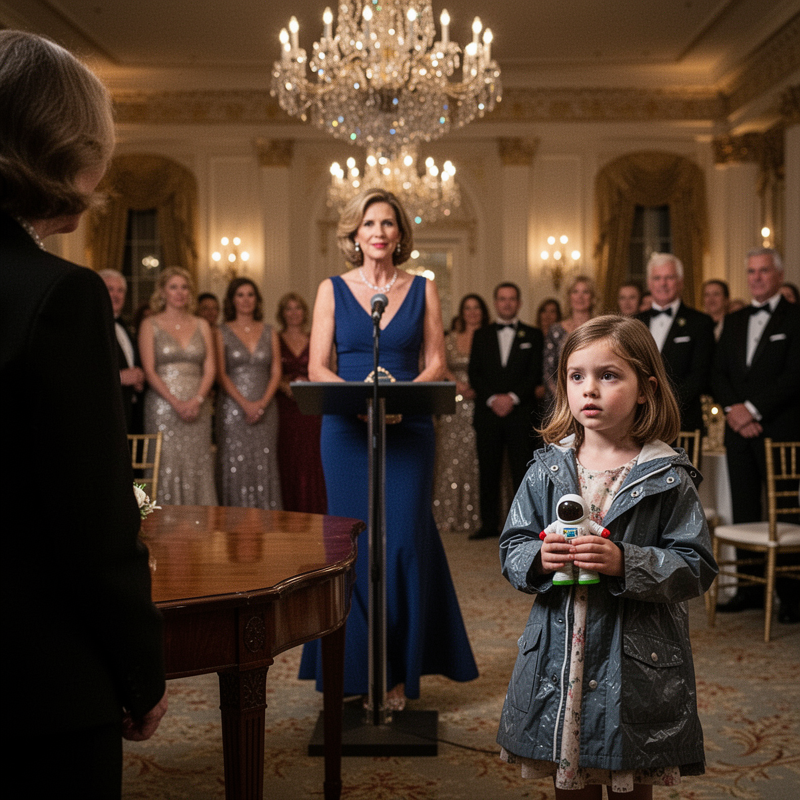
My granddaughter, Sophia, had been standing near the edge of the large stage, clutching a small plastic toy astronaut. She was shy, accustomed to being overlooked in the grand spectacle of the Montgomery family’s political life. Her eight-year-old eyes, usually bright with curiosity, had been wide with a mixture of awe and intimidation, darting from face to unfamiliar face.
I had just managed to catch her attention from across the room, offering a small, reassuring wave. She’d given a tentative smile in return, a brief flicker of light in the overwhelming opulence.
Then, Victoria Montgomery, radiant in a sapphire blue gown, had stepped forward to accept a large, engraved wooden plaque. It was heavy, a solid slab of polished oak, commemorating her largest campaign donors. The crowd had erupted in polite applause.
As the applause began to fade, Victoria’s gaze, sharp and unyielding, had swept over the room, settling on Sophia. A sudden, chilling silence fell, deeper than any I had ever heard. Every murmur, every clink, every breath seemed to cease.
Victoria’s voice, amplified by the microphone still clipped to her lapel, cut through the hush.
“There she is,” she had declared, not a question, but a pronouncement. “The one who thinks campaign property is fair game.”
Sophia’s head had snapped up, her eyes widening further, confused and terrified. She didn’t understand. She just clutched her toy astronaut tighter.
“Your granddaughter, Eleanor,” Victoria had continued, her tone dangerously calm, “has possession of a highly sensitive device.”
A ripple of nervous whispers spread through the room. Victoria held up a hand, and the whispers died instantly. She commanded attention like no one else.
“An encrypted campaign phone,” she specified, her gaze boring into the child. “Containing state security clearance data.”
Sophia, overwhelmed and singled out, had started to tremble. Her lips quivered.
“I… I don’t…” she mumbled, her small voice barely audible.
Her face crumpled, and tears welled in her eyes, threatening to spill. The toy astronaut slipped from her grasp and clattered to the floor.
Victoria’s eyes narrowed. “Don’t you dare lie to me, child.”
The raw fear on Sophia’s face was palpable. She wasn’t defiant, just utterly lost. A single tear traced a path down her cheek.
Victoria’s jaw tightened. She took a step towards Sophia.
“Stop that sniveling,” she ordered, her voice low but laced with steel. “Give it back now.”
Sophia, paralyzed with terror, could only stand there, tears now streaming freely. She shook her head, a pathetic, small gesture of denial.
That’s when Victoria, without a word, brought the heavy wooden plaque down. Not a full swing, but a forceful, deliberate strike. It connected with the side of Sophia’s head with a sickening thud.
A collective gasp swept across the yard. Someone dropped a glass. It shattered violently, the sound piercing the sudden, deafening quiet.
Sophia didn’t cry out. She just stumbled, a blank, stunned look on her face as she pitched forward.
I had already been rushing toward them, propelled by a primal fear. I caught Sophia just as her knees buckled, pulling her against my chest. Her small body felt limp and unresponsive.
My heart seized. I saw the glint of something dark and wet on her temple, blooming against her pale skin. Blood.
Victoria, meanwhile, had not moved. Her eyes were fixed on the crumpled raincoat Sophia had been wearing, which had fallen to the floor when I caught her. A small, sleek device, dark and unfamiliar, had spilled from one of its pockets.
With a practiced, almost surgical motion, Victoria bent down. She didn’t look at Sophia, or at me, or at the horrified faces of the guests. Her gaze was solely on the phone. She picked it up, her fingers closing around it with an odd, almost possessive urgency.
I watched her, a chill running through me that had nothing to do with the cool evening air seeping in from the open doors. Her movements weren’t those of an indignant person recovering stolen property. They were the swift, efficient actions of someone retrieving a crucial, misplaced item. The quick, relieved flicker in her eyes as her fingers closed around the device was undeniable, betraying a calculation that had nothing to do with justice for a stolen phone and everything to do with something far more sinister.
Part 2
I barely registered Victoria’s movements. My world had shrunk to Sophia’s small, limp body in my arms. Panic surged, hot and cold, through me. “Someone call an ambulance!” I screamed, my voice raw, finally breaking the horrified silence of the ballroom.
A few staff members rushed forward, their faces pale. Victoria, still holding the phone, gave a sharp, almost imperceptible nod to one of her security detail, who immediately moved to block off Sophia and me from the rest of the gawking crowd. My daughter, Claire, finally emerged from the stunned faces, her eyes wide, but she didn’t come to me. She went directly to Victoria.
The emergency room was a blur of fluorescent lights and hushed urgency. Doctors and nurses moved with practiced efficiency around Sophia, whose small head was being bandaged. I sat beside her gurney, numb, my hands still trembling.
Sheriff Thomas Holbrook, a man I’d known for years from county events, eventually came to speak with me. His usual friendly demeanor was replaced with a stiff, professional mask.
“Eleanor,” he said, his voice quiet, “we’ve received a preliminary statement regarding the incident at the Grand Magnolia.”
My blood ran cold. “Preliminary statement? Sophia was assaulted, Sheriff. Victoria Montgomery hit her with a plaque.”
He looked uncomfortable, avoiding my gaze. “Yes, ma’am. But we also have a signed affidavit here. From her mother, Claire Montgomery-Delaney.”
He held up a clipboard, not letting me read it, but the words “parental statement” and “mentally disturbed” were visible. My breath hitched. “What?” I whispered, my voice barely there.
“It states that Sophia has a history of… violent outbursts, ma’am,” he continued, his tone carefully neutral. “And that the incident was an accidental collision during a tantrum, not an assault. It says the child was distressed and bumped her head against the display.”
My vision blurred. Claire. My own daughter. She had signed this? To protect Victoria?
The words twisted in my gut, a bitter, sickening realization. It wasn’t just Victoria against us. It was everyone. My own family, my own daughter, had willingly sacrificed Sophia, and me, to the monster. They had chosen the Montgomery name, the political power, over an injured, innocent child.
CHAPTER 2: The Erased Footage of Room 402
The carpeted hallway of the Grand Magnolia Hotel smelled of wet brass cleaner and stale champagne.
I walked up to the security office on the basement level at 8:15 AM. A heavy brass plaque on the door read *Loss Prevention*.
I pushed the door open. Arthur Pendelton sat behind a laminate desk, tapping a gold Montblanc pen against a leather-bound ledger.
“Eleanor,” Arthur said, without looking up. “You shouldn’t be down here.”
“I need the video feed from the Grand Ballroom,” I said. “Room 402’s corridor camera faces the double doors. It caught the entire thing.”
Arthur set the pen down on the blotter. He smoothed the lapel of his tailored charcoal suit.
“The server array underwent a routine maintenance wipe,” Arthur said. “It happened at 11:45 PM last night.”
“That was fifteen minutes after the paramedics took Sophia out on a gurney,” I said.
“Schedules are automated, Eleanor,” Arthur replied, leaning back in his leather chair. “A hotel of this size manages terabytes of data daily.”
“Victoria paid you to clear it,” I said.
Arthur reached into his desk drawer and pulled out a manila envelope. He slid it across the desk toward me.
“There is a voucher inside for $10,000,” Arthur said softly. “It covers hospital incidentals. Sign the receipt, and we agree this was a regrettable misunderstanding.”
I picked up the envelope, tore it down the middle, and dropped the pieces onto his ledger.
“My granddaughter is eight years old,” I said. “She has a fractured skull.”
Arthur didn’t flinch. He picked up his pen and returned to his figures.
“The hotel logs show no record of an assault, Mrs. Delaney,” Arthur said. “And as of midnight, neither do the security drives.”
CHAPTER 3: The Secret in the Raincoat Pocket
The pediatric intensive care unit was silent except for the rhythmic click of the heart monitor.
Sophia lay under a thin yellow blanket. Her small face looked pale against the white hospital sheets, and a white bandage wrapped tightly around her crown.
I pulled a wooden chair close to the mattress and took her small hand in mine.
“Grandma?” her voice came out thin, barely above a whisper.
“I’m right here, sweetie,” I murmured, brushing a lock of dark hair from her forehead.
“I didn’t steal the dark phone,” Sophia whispered. Her chest heaved twice as she swallowed hard.
“I know you didn’t,” I said.
“We were playing hide-and-seek near the big flower pots,” she said, her brown eyes fixed on the ceiling tiles. “The lady with the gold ring came behind me.”
I leaned in closer. “Victoria?”
“She put the heavy phone into my raincoat pocket,” Sophia said softly. “She stroked my hair and said, ‘Hold this for a second, little mouse.’ Then she walked back into the big lights and shouted.”
My blood went cold in my veins.
Victoria hadn’t just accused Sophia on the spur of the moment. She had deliberately planted the encrypted device on an eight-year-old child to stage a recovery performance for the donors.
The door behind me swung open. Nurse Brenda walked in carrying a tray of IV fluids.
“Mrs. Delaney,” the nurse said softly, looking at the vitals monitor. “The neurologist is coming down. He needs to review her latest brain scan.”
Sophia’s eyes closed again, her breathing growing shallow as the pain medication kicked in.
CHAPTER 4: The Unrelated Reporter
The fluorescent lights of the 24-hour diner across from Charleston General Hospital buzzed with a low hum.
I sat in a corner booth, staring into a black cup of coffee that had long gone cold.
A man in a wrinkled trench coat carrying a worn leather messenger bag sat down in the booth across from me without asking.
“Mrs. Eleanor Delaney?” he asked, placing a heavy digital camera on the Formica tabletop.
“I’m not giving interviews,” I said, reaching for my purse.
“I’m Marcus Reyes with the *State Sentinel*,” he said, keeping his voice below a whisper. “I don’t care about the political fundraiser drama, Mrs. Delaney. I’ve been tracking Arthur Pendelton for eleven months.”
I paused, my fingers gripping the strap of my purse. “Arthur?”
“Pendelton runs three shell corporations registered out of the Cayman Islands,” Marcus said. He pulled a thick folder of bank statements from his bag. “They funnel dark-money contributions directly into Victoria Montgomery’s senatorial campaign fund.”
“What does that have to do with my granddaughter?” I asked.
“Arthur was outside the Grand Magnolia Hotel at 11:30 PM last night,” Marcus said, tapping a printout photograph. “I was tailing him. He didn’t just wipe the hotel servers—he handed a black leather briefcase to Victoria’s head of security right beside the valet stand.”
I looked at the photograph. The timestamp read 11:32 PM.
“They aren’t just covering up an assault,” Marcus said, leaning closer. “The encrypted phone Victoria dropped contains the private ledger key for $4.2 million in illegal offshore wire transfers.”
“They hurt a child over a bank account,” I said, my voice trembling.
“Victoria will burn down the whole state before she lets anyone look inside that phone,” Marcus replied.
CHAPTER 5: The Circle of Silence
The heavy mahogany doors of the Montgomery estate in West Ashley opened at 4:00 PM.
Victoria stood at the head of the long dining table, wearing a cream-colored wool suit. My brothers, Thomas and Richard, sat on her right. My sister-in-law, Martha, sat on her left.
I stepped into the dining room, holding a copy of Sophia’s preliminary hospital report.
“Eleanor,” Victoria said smoothly, gesturing to an empty chair at the foot of the table. “Please sit down. We were just discussing your health.”
“My health?” I said, looking at my brothers. “Thomas, Richard, what is this?”
Thomas cleared his throat and looked down at his polished fingernails.
“Victoria brought us in to discuss things, Eleanor,” Thomas said softly. “You’ve been under an immense amount of stress since your retirement from the county clerk’s office.”
“She hit Sophia with a heavy wooden plaque,” I said, slamming the hospital paper onto the table. “Her skull is fractured!”
“Eleanor is confused,” Victoria said, her tone filled with quiet, practiced sympathy. “She suffered a severe panic attack at the gala. She began screaming at guests and threw a glass vase.”
“That is a complete lie!” I shouted.
“We consulted Dr. Aris,” Victoria continued smoothly, addressing my family as if I were not standing in the room. “He believes Eleanor is showing early signs of vascular dementia and acute paranoia. She is fabricating stories to handle the guilt of letting Sophia wander off.”
“Richard,” I looked directly at my younger brother. “You know me. Look at me!”
Richard shifted uncomfortably in his seat.
“Victoria offered to pay for Sophia’s long-term private care, Eleanor,” Richard whispered. “If you keep making these wild accusations, the family will have no choice but to support a legal petition for adult guardianship over you.”
They had already bought everyone in the room.
CHAPTER 6: The Diagnosis That Broke the Night
Dr. Evans pulled the light-board sleeve down over the gray film scans in Room 304.
The room was freezing. The air smelled of rubbing alcohol and scrubbed stainless steel.
“Mrs. Delaney,” Dr. Evans said, adjusting his round wire-rimmed glasses. “We completed the second high-contrast MRI scan on Sophia.”
I gripped the metal frame of Sophia’s hospital bed. “What does it show?”
“The blow from the object caused more than a localized bone fracture,” Dr. Evans said quietly. “It triggered a focal micro-vascular stroke in the left temporal region.”
My breath caught in my throat. “A stroke? She is eight years old.”
“The impact shattered tiny blood vessels supplying Broca’s area,” Dr. Evans explained, pointing a silver pen at a dark shadow on the brain scan. “The tissue swelling is extensive.”
“What does that mean for her recovery?” I asked, my knees shaking.
“The loss of language function is permanent,” Dr. Evans said, looking directly into my eyes. “Sophia will retain cognitive awareness, but she will never regain the ability to produce spoken words.”
I looked down at Sophia. Her tiny hand rested limply on the white sheet.
“Never?” I whispered.
“We can begin physical therapy next week,” Dr. Evans said gently. “But she will remain non-verbal for the rest of her life.”
I pulled Sophia’s little body against my chest and wept silently into her hair, the cold weight of the reality sinking into my bones.
CHAPTER 7: The Valet Stand Camera
Marcus Reyes met me behind an abandoned auto body shop three blocks from the county courthouse.
Rain dripped steady streams from the rusted corrugated roof above us.
“Look at this,” Marcus said, opening his laptop on the hood of his sedan.
A grainy video played on the screen. The angle came from an elevated position across the avenue.
“Where did you get this?” I asked.
“The valet company uses an unlinked backup camera mounted on a utility pole across King Street,” Marcus said. “It records directly to an offsite cloud driver that Pendelton didn’t know existed.”
On the screen, Victoria stepped out through the side doors of the Grand Magnolia Hotel.
Her aide slipped a heavy black phone into the pocket of a small red raincoat hanging on a nearby rack.
Sophia walked into the frame, putting on the red raincoat.
Seconds later, Victoria turned around, seized the child’s arm, pulled the wooden donor plaque off an easel, and struck the girl directly across the side of her head.
Sophia collapsed onto the marble steps like a ragdoll.
“It caught everything,” I breathed, tears welling in my eyes. “The frame, the planted phone, the strike.”
“This is criminal battery and evidence tampering,” Marcus said, closing the laptop case with a sharp snap. “We hold the entire campaign by the throat.”
CHAPTER 8: The Price of Silence
At 8:00 PM, a black Lincoln Navigator pulled onto the gravel driveway of my small brick bungalow.
Victoria Montgomery stepped out, followed closely by Arthur Pendelton. Arthur carried a thick leather briefcase.
I stood on the front porch, keeping the screen door closed between us.
“Get off my porch,” I said.
“Let’s not be dramatic, Eleanor,” Victoria said, stepping up to the top brick step. “Arthur, open the file.”
Arthur unlocked the briefcase and held up a set of legal documents bound in blue cardstock.
“This is an irrevocable medical trust fund,” Arthur said in a flat voice. “It guarantees $500,000 paid out over ten years for Sophia’s continuous specialized care.”
“In exchange for what?” I asked.
“You execute a complete release of liability,” Victoria said, her cold blue eyes locking onto mine. “And you sign over full legal guardianship of Sophia to a state-appointed administrative conservator selected by my office.”
“You want me to surrender my granddaughter to a bureaucrat?” I asked.
“You cannot afford her care, Eleanor,” Victoria said, leaning closer against the screen. “Her speech is gone. Her medical bills will exceed $40,000 a year. You live on a clerk’s pension of $2,200 a month.”
“I would rather starve than take a single penny from you,” I said.
“If you refuse, Arthur files the dementia petition with Sheriff Holbrook tomorrow morning,” Victoria said, her tone smooth and lethal. “You will lose her anyway, and she won’t get a dime.”
I stepped back and slammed the solid wood front door in her face.
CHAPTER 9: The Mobile HQ Vault
Arthur Pendelton sat alone inside a darkened parked car near the waterfront marina at 1:00 AM.
He pulled a heavy stainless-steel thumb drive from his suit jacket and inserted it into a ruggedized tablet.
On the screen, hundreds of wire-transfer logs began loading—each one showing direct payments from offshore shell companies to Victoria Montgomery’s personal account.
Arthur picked up his phone and dialed a secure line.
“It’s done,” Arthur said into the receiver.
“Did you scrub the secondary campaign server in the mobile bus?” a voice replied over the speaker.
“I transferred the master ledger to the bus vault as instructed,” Arthur lied smoothly. “Victoria thinks she’s safe.”
Arthur disconnected the call and looked at the dark windows of the custom 45-foot campaign bus parked in the rally staging lot.
He knew Victoria was preparing to name him as the sole accounting manager in an upcoming grand jury inquiry.
He locked the physical hard drives inside the bus’s reinforced electrical bay cabinet, keeping the master key hidden in his coat.
If Victoria tried to throw him to the prosecutors, he would use her own campaign headquarters to send her to prison.
CHAPTER 10: The Daughter’s Awakening
The doorbell rang at 6:30 AM, short and erratic.
I opened the front door to find my daughter Claire standing on the porch in a drenched light coat, her mascara running down her cheeks.
“Claire?” I said, standing back.
She rushed inside, collapsing onto the entryway bench and sobbing into her hands.
“I signed the affidavit, Mom,” Claire wept. “I signed the paper saying Sophia was emotionally unstable.”
“Why are you here, Claire?” I asked coldly, keeping my distance.
“Victoria lied to me,” Claire choked out, pulling a folded sheath of documents from her purse. “She made me sign non-disclosure forms, saying it was to protect the family trust.”
“And what did you find?” I asked.
“I found the corporate tax filings in her office safe last night,” Claire said, holding out the papers with trembling hands. “Victoria set up a shell company in my husband’s name. She routed $1.2 million in illegal corporate contributions through David’s personal business account.”
“She’s setting David up to take the fall for the financial fraud,” I said softly.
“She’s going to destroy my husband, take my child, and ruin us,” Claire sobbed, looking up at me with raw terror in her eyes. “She doesn’t care about any of us, Mom. She never did.”
“I told you that three days ago,” I said, my voice empty of comfort.
“What do we do?” Claire whispered.
“You sit down and write a sworn retraction of that affidavit,” I replied. “Because tomorrow, we take down Victoria.”
CHAPTER 11: The Sky Over the Pavilion
By 3:00 PM, over two thousand supporters gathered at the Cooper River Waterfront Park for Victoria Montgomery’s final pre-election rally.
A massive white canvas pavilion tent covered the main stage. High-powered speaker towers boomed Victoria’s campaign jingle across the lawn.
I stood near the media riser at the back of the crowd beside Marcus Reyes.
“The satellite truck is hooked into the local network feed,” Marcus whispered, checking his handheld monitor. “We push the valet tape in eight minutes.”
Suddenly, the wind violently shifted.
The high-altitude clouds above the river turned a dark, bruised shade of purple. The temperature dropped twelve degrees in less than sixty seconds.
“Look at the water,” a man standing nearby yelled, pointing toward the bay.
A massive wall of white foam and gale-force wind—a freak coastal derecho storm—swept across the water at sixty miles an hour.
“Clear the pavilion!” a security guard shouted over a megaphone.
The first wind blast hit the park like a freight train. The massive wooden support poles of the main stage tent snapped with loud, gun-shot cracks.
Heavy iron light trusses fell into the panicked crowd. The campaign’s 45-foot mobile headquarters bus tipped violently onto its side, crashing directly through the staging platform.
People screamed, scattering in every direction as black rain tore across the park.
CHAPTER 12: The Act of Fate and Broadcast
Chaos swallowed the riverfront park as emergency sirens wailed through the driving storm.
Victoria Montgomery was trapped under the collapsed steel frame of the VIP grandstand, her white suit stained with red mud.
Arthur Pendelton lay stuck inside the overturned mobile campaign bus, screaming for help through a shattered side window.
Marcus Reyes scrambled up the back steps of an abandoned news truck that remained connected to the primary broadcast tower.
“Give me three minutes!” Marcus shouted to the technician inside, forcing the digital interface drive into the console.
“The storm cut the live feed to the station!” the technician yelled back.
“Override it with the emergency weather feed!” Marcus ordered, sliding the valet video and Arthur’s offshore ledger documents into the live queue.
At 3:42 PM, across every television screen and mobile device in South Carolina monitoring the storm emergency, the weather broadcast abruptly cut away.
The high-definition video of Victoria Montgomery slamming the wooden plaque into eight-year-old Sophia’s head played on a continuous loop.
Below the video, red text scrolled across the screen detailing the $4.2 million in illegal foreign wire transfers traced back to Victoria’s private accounts.
On the ruined park lawn, state troopers pulled Victoria out from under the twisted metal frame, their wrist radios blaring with direct orders from the State Police Headquarters.
“Victoria Montgomery!” a senior trooper yelled, pulling out steel handcuffs as the storm raged around them. “Stay on the ground!”
CHAPTER 13: The Collapse of the Dynasty
By midnight, the storm had passed, leaving the city streets strewn with torn tree branches and downed power lines.
Inside the State Police Headquarters downtown, fluorescent lights glared off floor-to-ceiling windows.
Federal prosecutors and FBI agents filled the main briefing room.
Arthur Pendelton sat at an interrogation table in handcuffs, his expensive suit ruined, singing every detail of the tax fraud scheme to avoid twenty years in federal prison.
Victoria Montgomery sat in an adjoining holding cell, her hands cuffed behind her back, refusing to speak to her court-appointed lawyer.
Marcus Reyes stood in the hallway, handing a stack of certified thumb drives to the Lead Assistant United States Attorney.
“The valet footage, the erased server logs, and the offshore bank entries match perfectly,” the prosecutor said, skimming the digital files. “She’s facing federal wire fraud, witness tampering, and felony child abuse charges.”
My daughter Claire sat on a wooden bench outside the holding area, her head in her hands, listening to the officers read the formal charges against her mother-in-law.
The Montgomery political empire had been completely erased in a single afternoon.
I stood by the window looking out at the dark harbor, feeling no surge of triumph, no feeling of victory.
The system had processed the criminal, but the quiet room at the hospital was still waiting for me.
CHAPTER 14: The Empty Victory
Two weeks later, the county courthouse released its final administrative orders.
Victoria Montgomery pled guilty to federal campaign corruption and severe child endangerment charges, receiving a sentence of fourteen years in a federal correctional facility.
Arthur Pendelton accepted a eight-year plea agreement for his role in the tax evasion network.
I sat at my kitchen table, staring at a official envelope from the State Department of Health and Human Services.
The legal battle was completely over. The campaign was gone, Victoria was locked away, and the press had moved on to the next state scandal.
The house was suffocatingly quiet.
I walked down the hall to Sophia’s bedroom.
She sat on the edge of her small bed, playing with a set of wooden stacking blocks.
“Sophia,” I said softly, sitting beside her.
She looked up at me with large, clear brown eyes. She reached out and patted my arm twice.
She opened her mouth to speak, but only a small, strained puff of air came out.
She tried again, her tiny brows furrowing with effort, but no sound formed.
She let her arms drop back to her lap and turned her eyes back down to her blocks.
I squeezed my eyes shut against the cold, empty silence that filled the bedroom.
CHAPTER 15: The Unspoken Words
A knock came at the front door late that afternoon.
I opened it to find Claire standing on the porch holding a small suitcase.
“Mom,” Claire whispered, her cheeks sunken and pale. “David and I sold the house to pay off the legal fees. I… I was wondering if I could stay in the spare room for a while.”
I looked at my daughter. The ambition that had blinded her for years was entirely gone, replaced by a dull, permanent shame.
“I can help take care of Sophia,” Claire said, tears filling her eyes. “I can help with her therapy exercises.”
“You signed the paper, Claire,” I said, my voice flat and even. “You signed a document stating your eight-year-old daughter was mentally disturbed to protect a politician.”
“I was terrified!” Claire sobbed, dropping her hands to her sides. “Victoria promised she would take care of us!”
“You chose Victoria over your own flesh and blood,” I said.
Sophia walked slowly down the hallway, holding her stuffed rabbit, and stopped behind my legs. She looked at Claire without a single expression on her face.
Claire fell to her knees on the porch floor, extending her hands toward her daughter.
“Sophia, sweetie,” Claire wept. “Say something to Mommy. Please, just say one word.”
Sophia looked at her mother for a long moment, then quietly turned around and walked back down the dark hallway into her room.
“You can stay in the spare room,” I said to Claire, stepping back from the doorway. “But some things can never be repaired.”
CHAPTER 16: The Fading Autumn Light
A long time later, the autumn wind blew crisp and dry through the oak trees surrounding the grounds of the Greenbriar Neurological Care Center outside Columbia.
Orange and red leaves drifted down onto the manicured grass, settling near the stone walking paths.
I sat on a wooden park bench, wrapped in a thick wool cardigan, holding a warm thermos of tea.
Sophia sat beside me in a high-backed ergonomic wheelchair. She was older now, her long dark hair pulled back into a neat braid.
Her eyes followed a blue jay as it flew from an oak branch down to the grass.
I reached over and gently took her hand. Her fingers brushed against mine, soft and cold in the afternoon breeze.
Victoria Montgomery had died six months ago in a federal medical prison facility in West Virginia, sick and completely abandoned by her former political allies.
The dark-money accounts had been liquidated by federal marshals, and the Montgomery name had vanished from every public building in the state.
People in town still occasionally stopped me at the grocery store to tell me how brave I had been to stand up to a political dynasty.
They called it a triumph for justice.
I looked at Sophia’s profile against the pale autumn sky—her quiet face, her gentle brown eyes that held no memory of words, her silent life bound forever to the damage inflicted on a forgotten evening years ago.
They told me the truth had finally won, but as I sat beside my silent child in the fading autumn light, I knew that victory is just a word people use when they have nothing left to lose.
Leave a Reply