CHAPTER 1: The Feast of Unworthy Hands
Part 1
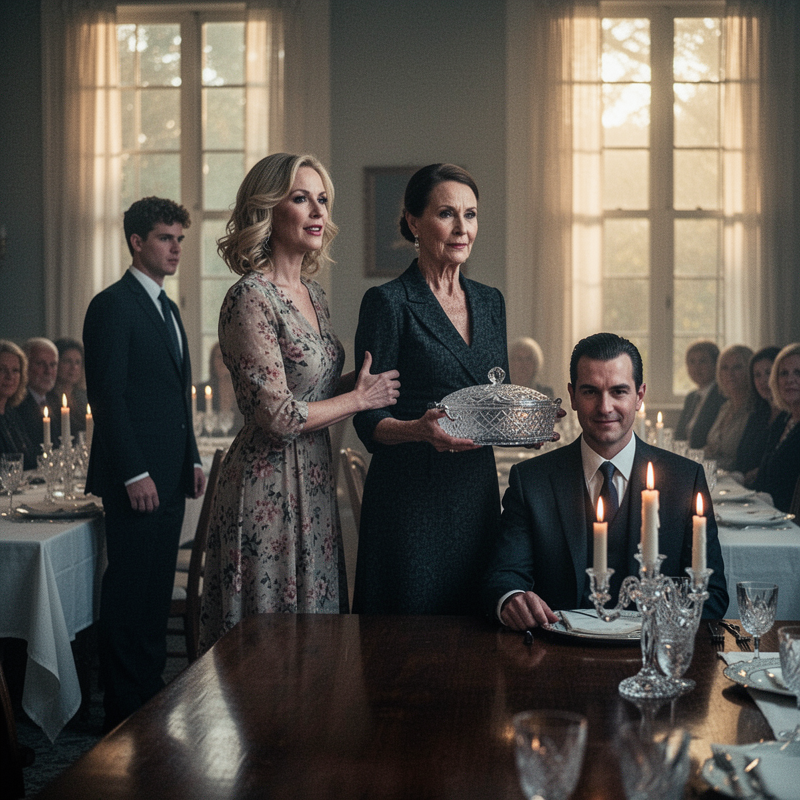
My daughter-in-law Chloe took the crystal serving tray from my hands and pushed me toward the back exit of my own dining hall.
Before fifty gathered members of the New Dawn Covenant, she loudly announced that an unbaptized outsider had no right to serve the sacred birthday feast.
My son Caleb stood three feet away, staring at the floor, refusing to meet my eyes while Marcus Broderick, our tenant and cult leader, smiled approvingly.
I walked to the kitchen, removed my linen apron, and picked up the sealed yellow envelope I had prepared that morning.
The chill in the air was immediate, a deep freeze that seeped into my bones even as the summer breeze from the open windows fluttered the white linen tablecloths. Fifty pairs of eyes, once warm with the glow of collective faith, now burned with judgment. Each gaze felt like a brand, etching Chloe’s words onto my skin.
An unbaptized outsider.
In my own home. On the land I had built, acre by precious acre, over thirty years. The very ground where I had poured my sweat and tears, raising Caleb, nurturing this homestead that had grown into a $2.8 million enterprise.
The injustice was a hot coal in my chest, but I refused to let it show. My jaw remained set, my posture straight. I was Abigail Kincaid, not some quivering convert.
I took the steps Chloe had indicated, each one a slow, deliberate act of defiance. My feet carried me past the kitchen door, past the pantry, and into the cool, silent sanctuary of the back prep kitchen, away from the communal dining hall.
The air in here was thick with the scent of fresh-baked bread and roasted vegetables – remnants of the feast I had spent all morning preparing. Chloe had dismissed my hands as unworthy, but those hands had kneaded every dough, peeled every potato, seasoned every dish with care.
I pulled the starched linen apron over my head, untying the strings at my waist. The fabric, once a symbol of my hospitality, now felt like a shroud of shame. I folded it neatly, placing it on the butcher block.
My gaze drifted to the sturdy oak cabinet where I kept my important papers. On top lay a thick, yellow legal envelope. It was sealed, its edges crisp and uncreased. I had placed it there just this morning, a preemptive measure, a quiet act of rebellion tucked away for a moment I knew was coming.
My fingers brushed against the smooth paper, the weight of it surprisingly substantial. It wasn’t the birthday card Chloe expected. It wasn’t a transfer of property, as Marcus so arrogantly assumed I’d offer him eventually.
It was something else entirely. Something firm, undeniable.
A small, almost imperceptible tremor ran through my hand, but my resolve solidified. This wasn’t a retreat. This was an intermission.
I turned from the silent kitchen, the envelope clutched firmly in my hand, and walked back towards the murmur of voices from the dining hall. The collective hum grew louder, then softened, as my reappearance registered.
The chatter died away, replaced by a ripple of surprise. Fifty heads swiveled towards me, their expressions shifting from pious judgment to bewildered curiosity. Chloe, her face still flushed with triumphant piety, froze mid-sentence, her smile faltering.
My son, Caleb, still stood by the head table, now looking up, his eyes wide and uncertain. For a brief moment, our gazes met across the expanse of polished wood and flickering candlelight. His eyes pleaded, a silent apology mixed with fear. Fear of Marcus, fear of disappointing his wife.
I held his gaze for a beat longer than was comfortable, then broke away. Caleb was a man lost, adrift in the currents of Marcus’s charismatic tide. I could not save him yet, not in the way he needed. But I could fight for what was mine.
Marcus Broderick, seated at the head of the table like a king on his throne, merely raised an eyebrow. A slow, knowing smile spread across his face, a silent assumption that I was returning to beg, to apologize, perhaps to offer a formal surrender. He leaned back in his chair, radiating an air of smug superiority.
The clink of cutlery against porcelain, the soft scrape of chairs, had all ceased. The only sound was the rhythmic beat of my own heart against my ribs, a steady drum in the cavernous silence.
I walked past the long tables laden with the remnants of the feast. Roast turkey, glazed carrots, fresh green beans. The food, once meant to symbolize abundance and community, now felt like a prop in a meticulously staged play.
My eyes scanned the faces. Old Mr. Henderson, whose family had known the Kincaids for generations, looked conflicted. Young Sarah, who often helped me with the chores, seemed to hold her breath. No one dared to speak, to break the potent tension.
I reached the head table. The centerpiece, a towering birthday cake adorned with sugar roses, sat precisely in front of Marcus. It was Chloe’s birthday, after all.
My steps slowed as I approached the linen-draped table. The cake’s sweet frosting, the flickering candles, the air of celebration felt entirely out of place, a stark, painful contrast to the cold hostility that had been directed at me moments before.
I stopped directly beside the cake, close enough to smell its sugary sweetness. I could feel Marcus’s eyes on me, heavy and expectant. Chloe was watching too, her lips pressed into a thin line, her earlier confidence replaced by a flicker of apprehension. Caleb’s gaze was fixed on my hands.
Slowly, deliberately, I extended my arm.
The thick, yellow envelope was clearly visible as I placed it flat on the pristine white tablecloth, directly beside the base of the birthday cake. Its simple, legal form felt like an intruder in the festive scene.
Then, I turned.
My eyes locked onto Marcus Broderick’s, a challenge in their depth. The complacent smile vanished from his face, replaced by a flicker of confusion, then outright suspicion.
Part 2
Marcus’s initial confusion quickly gave way to his usual bluster. He let out a condescending chuckle, loud enough for everyone to hear. “Well, Sister Abigail,” he said, picking up the yellow envelope with a flourish, “I trust this isn’t another one of your charming attempts to… *organize* my affairs. Perhaps a new recipe for the sacred feast? Or,” he paused, giving a theatrical wink to the congregation, “is our dear Abigail, bless her heart, a little confused by her advancing age? Expecting a birthday gift from her?”
A few nervous titters rippled through the room. Chloe managed a thin, forced smile, glancing at Marcus for approval. Caleb’s head was down again, his shoulders slumped. Marcus tore open the envelope with a dramatic rip, then pulled out the thick stack of papers inside. He unfurled them, his eyes scanning the first page, still smiling, no doubt expecting to see a deed of transfer, some formal surrender of more Kincaid land to his ‘ministry’.
But as his gaze moved down the page, his smile faltered. The easy confidence drained from his face, replaced by a subtle tremor of disbelief. His eyes widened slightly, then narrowed. He read a line, then another, his lips moving almost imperceptibly.
The room, which had been buzzing with hushed anticipation, fell utterly, completely silent. Not a fork clinked, not a chair scraped. Every eye in the dining hall was fixed on Marcus, watching his transformation.
He flipped to the second page, then back to the first. The legal language, stark and official, stared up at him. “Notice to Vacate,” the header declared in bold, uncompromising letters. “30-Day Termination of Lease Agreement. Fifteen (15) Acres, New Dawn Covenant Sanctuary Property.”
The color drained from his face, leaving a pale, mottled grey. His jaw tightened, and the paper in his hands crinkled as he gripped it harder. His eyes, usually so full of calculated charm, went cold, hard, and utterly furious. His expression turned dark.
CHAPTER 2: The Phantom Signature
Marcus Broderick stepped out from behind the head table, his black wool coat swinging open as he smoothed his hands through his neatly trimmed gray beard. He smiled, setting a gentle hand on my son Caleb’s trembling shoulder.
“Sister Abigail is tired,” Marcus told the fifty gathered members, his deep voice carrying easily across the wooden dining hall. “The weight of managing eighty-five acres at her age has clouded her mind.”
He reached into his inner breast pocket and pulled out a laminated sheet of parchment stamped with a red wax seal.
“In July of 2018, during her private covenant baptism at the river, Abigail signed this binding spiritual land waiver,” Marcus said, holding the paper high. “She surrendered all worldly land rights to the New Dawn ministry in exchange for eternal sanctuary.”
I stepped past Caleb and walked up to the podium microphone, unzipping my leather handbag.
“That document is a fraud, Marcus,” I said, my voice echoing through the PA speakers.
“Abigail, please,” Marcus whispered, leaning close so only the front row could hear. “Do not let confusion ruin your standing.”
“On July 14, 2018, the date stamped on your notarized seal, I wasn’t at the Moyie River,” I said.
I pulled three faded paper slips from my bag and slapped them onto the podium desk right next to his laminated sheet.
“These are my round-trip airline ticket receipts from Spokane to Columbus, Ohio,” I said into the microphone. “And this is my sister’s death certificate, issued by Franklin County on July 12, 2018.”
A collective murmur rippled through the rows of folding chairs.
“I was twelve hundred miles away burying my sister,” I said, staring directly into Marcus’s cold eyes. “Who signed my name on your holy covenant?”
Marcus’s smile faltered, his posture stiffening as he glanced at the red stamp on the paper.
“A clerical error on the date does not invalidate your spiritual commitment,” Marcus said, his voice dropping an octave.
“It invalidates the notary seal under Idaho state law,” I replied. “And that makes your document a forgery.”
CHAPTER 3: Ghost of the Juvenile Court
Marcus took a slow step backward, folding the laminated paper into his coat pocket. He adjusted his silver collar clasp and looked up at the ceiling, letting out a soft, theatrical sigh.
“I hoped we would never have to speak of the dark mud from which you were pulled, Abigail,” Marcus said, turning back to face the congregation.
Caleb lifted his head, his face pale as he looked between Marcus and me.
“In November of 1989, a young woman was committed to the Hillcrest Youth Correction Facility in Salem, Oregon,” Marcus said loudly, pacing the lip of the stage. “Fourteen months for theft and criminal trespass under the name Abigail Vance.”
Chloe gasped loudly from the front row, clasping her hands over her mouth.
“Fourteen months in a juvenile lockup,” Marcus repeated, his voice echoing off the timber rafters. “Is this the woman whose word you trust over the covenant leadership? An ex-convict who hid her record behind a fresh marriage certificate?”
Several elder members leaned toward each other, shaking their heads in hushed disapproval.
“I was sixteen years old, Marcus,” I said, taking a step toward him on the stage. “I was sleeping in an abandoned delivery van in Portland, freezing to death, when I stole a coat and four cans of soup.”
“Crime is crime in the eyes of the righteous,” Chloe called out from her front-row chair.
“I served my fourteen months,” I said, looking Chloe straight in the eye. “I learned how to work, I got my high school equivalency, and I bought this initial fifteen acres of dirt with my late husband twenty-five years ago.”
I turned back to Marcus, my hands resting steady on the edge of the podium.
“Surviving a starving youth didn’t make me weak,” I said. “It taught me exactly how to recognize a thief in a thousand-dollar suit.”
“You have no moral authority to govern this land!” Marcus snapped, his control breaking for a fraction of a second.
“I don’t govern your soul, Marcus,” I said. “I own the title.”
CHAPTER 4: The Elder’s Ledger
Marcus signaled to two young men wearing black covenant waistcoats standing near the side doors.
“Escort Sister Abigail to the gate,” Marcus ordered, waving his hand toward the back exit. “She is bringing discord into the sanctuary.”
Before the two men could reach the stage, the double oak doors at the main entrance creaked open.
An eighty-four-year-old woman leaned heavily on an unpolished hickory cane, her heavy wool cardigan wrapped tight against the mountain wind blowing through the doorway.
“Touch her and I’ll have the county marshal on this property before the sun hits the ridge,” Aunt Ruth Kincaid said, her raspy voice cutting through the silent room.
Caleb rushed down the aisle, his hands outstretched. “Aunt Ruth, you shouldn’t be out in this cold.”
“Sit down, Caleb,” Ruth said, sweeping her cane sideways to block his path.
She shuffled toward the stage, carrying a scuffed oilcloth binder tied with a thick red ribbon under her arm.
“Marcus Broderick built his entire presence on this ranch on a single lie,” Ruth said, stopping at the base of the stage stairs. “He told this valley in 1996 that he was the biological father of Caleb through an early sanctified marriage in Montana.”
Marcus stepped forward, his knuckles white against the podium rail. “That covenant line is sacred history, Ruth.”
“It’s a fairy tale you invented to bypass our family land transfer rules,” Ruth said, untying the red ribbon on her binder.
She pulled out a yellowed court document bearing a raised blue state seal from 1996.
“This is the official paternity dismissal from Flathead County, Montana,” Ruth announced, turning to face the fifty members. “Marcus claimed three different women’s sons to secure land trusts across two states.”
Marcus’s face flushed deep crimson as he took a step back from the microphone. “That filing was dismissed without prejudice!”
“Because you fled the county before the blood test was ordered,” Ruth replied calmly.
CHAPTER 5: Bloodline and Fraud
Aunt Ruth reached deep into her leather coat pocket and pulled out a fresh, sealed white envelope stamped with the emblem of Boise Legal Genetics.
She walked past the podium and thrust the envelope directly into the hands of Brother Thomas, Marcus’s senior deputy elder.
“Read page two out loud, Thomas,” Ruth ordered. “Or I’ll let the reporter in the back read it for you.”
Thomas broke the paper seal with a trembling thumb and unfolded the certified laboratory report. He scanned the lines of text, his eyes widening.
“What does it say, Thomas?” a woman from the third row called out.
Thomas cleared his throat, looking nervously at Marcus before reading from the page.
“The probability of paternity between Marcus Jonathan Broderick and Caleb Daniel Kincaid is 0.0 percent,” Thomas read, his voice cracking on the last word.
The room erupted into a wave of sharp gasps and sudden chatter.
“It’s a fabricated document!” Chloe shouted, springing to her feet and glaring at Ruth. “My father is the spiritual patriarch of this land!”
“Clause Four of Marcus’s fifteen-acre agricultural lease states that the lease remains valid only so long as a direct blood covenant exists with the Kincaid family,” I said into the microphone. “Without that bloodline, the lease agreement is dead.”
Marcus lunged forward to snatch the paper from Thomas’s hands, but a sudden flash of white light illuminated the stage.
A woman stepped out from behind the sound booth partition holding a high-definition camera mounted on a stabilization rig.
“Hannah Croft, North Idaho Regional News,” the journalist said, holding up a microphone linked to a battery pack on her belt. “We are currently broadcasting this gathering live to forty-five thousand regional viewers.”
Marcus froze, his hand suspended in mid-air above the paper.
“Turn those cameras off!” Marcus demanded, his voice echoing wildly off the high wood ceiling.
“You’re on public spectrum streaming, Mr. Broderick,” Hannah said, keeping the lens fixed on his face. “And the viewers are asking very specific questions about your lease.”
CHAPTER 6: Confessions in the Kitchen
The main hall dissolved into loud arguments as members swarmed Brother Thomas to read the genetic test results.
I grabbed Caleb by his sleeve and pulled him through the side door into the quiet commercial kitchen behind the main stage.
Stainless steel tables stretched under fluorescent lights, stacked high with untouched birthday platters.
“Look at me, Caleb,” I said, backing him against the cold edge of a prep sink.
Caleb covered his face with both hands, his shoulders shaking as he leaned against the steel counter.
“I didn’t have a choice, Mom,” Caleb sobbed, his voice muffled by his palms. “Marcus told me he’d excommunicate Chloe and me if I didn’t sign as the witness on that 2018 waiver.”
“You knew it was a forged date?” I asked, my voice barely above a whisper.
“I signed it six months ago in his private office,” Caleb said, looking up with bloodshot eyes. “He backdated it to 2018. He said if you ever tried to sell the back fifty acres, he’d use it to freeze the property in chancery court.”
“You betrayed your own home to protect his lie,” I said, the cold truth settling heavy in my chest.
“He threatened to destroy us, Mom!” Caleb cried, reaching out to grasp my forearm. “I thought if I signed it, he’d leave you alone!”
“Fear doesn’t erase a crime, Caleb,” I said, pulling my arm out of his grip. “And it won’t stop the sheriff from enforcing this land.”
The stainless steel door swung open, and Hannah Croft stuck her head inside the kitchen, holding her camera low at her side.
“Abigail, two Boundary County sheriff cruisers just pulled up to the main gate,” Hannah said quietly. “Your stream broadcast just passed sixty thousand views.”
CHAPTER 7: The Broadcast Escalation
The overhead fluorescent lights suddenly flickered and died, plunging the kitchen into dark gray shadow as the steady hum of the refrigeration units ceased.
“He cut the main breaker,” I said, moving toward the side door.
“It doesn’t matter,” Hannah said, pointing to a glowing blue indicator light on her camera rig. “My mobile transmitter runs on lithium field batteries. We’re still live.”
We pushed back through the door into the main hall.
Dozens of covenant members were using their cell phone lights to navigate the darkened aisles, the beams crisscrossing through the rising dust.
The heavy front doors swung open, framing Sheriff Arthur Miller and two uniformed deputies against the fading afternoon light outside.
“Marcus Broderick!” Sheriff Miller called out, his flashlight beam pinning Marcus against the back wall behind the stage.
“This is a private religious gathering, Sheriff!” Marcus shouted back, stepping into the beam with his hands raised. “You have no warrant to enter a house of worship!”
“I don’t need a warrant to respond to a civil disturbance call, Marcus,” Sheriff Miller said, stepping down the central aisle. “And I have a verified land title complaint filed by Abigail Kincaid sitting on my dashboard.”
Chloe rushed out from the front row, stepping directly into Sheriff Miller’s path.
“My husband’s family has leased this sanctuary for eight years!” Chloe yelled, her voice screeching in the dark room. “You can’t kick us off our sacred ground!”
A woman’s voice cut through the commotion from the side wall—Marcus’s wife, Evelyn, stepped into the light of a deputy’s torch.
“Shut your mouth, Chloe!” Evelyn barked, her eyes wide with panic. “You’re the one who let that old woman into the ledger room last Tuesday!”
“She had the original keys, Mother!” Chloe screamed back, turning on her mother with raised fists. “You’re the one who left the office unlocked!”
“Quiet, both of you!” Sheriff Miller ordered, turning his flashlight toward Marcus. “Broderick, the county will recognize Abigail Kincaid’s thirty-day notice to vacate pending tomorrow’s hearing. You have until sunset to secure your personal property.”
CHAPTER 8: The Trust Deed Unsealed
Aunt Ruth stepped forward from the shadow of the stage, resting both hands on her hickory cane as she faced Sheriff Miller.
“You won’t need to wait thirty days, Arthur,” Ruth said, reaching into her inner coat pocket.
Sheriff Miller lowered his flashlight slightly, nodding respectfully toward the elderly woman. “Evening, Ruth. What do you have there?”
Ruth handed him a thick, ribbon-bound legal document with yellowed edges and hand-drawn black ink margins.
“This is the original 1994 Kincaid Family Land Trust,” Ruth said, her voice clear and firm. “Recorded in the county archives thirty years ago before Marcus Broderick ever set foot in Boundary County.”
Sheriff Miller adjusted his reading glasses and shone his light directly onto the front page of the trust deed.
“Section Seven,” Ruth said, pointing a gnarled finger at the ink text. “No commercial, corporate, or non-familial religious entity may encumber, lease, or occupy any portion of the eighty-five-acre parcel without unanimous written consent from all living Kincaid blood relatives.”
“Marcus’s ten-year lease was signed in 2016 by my late husband alone,” I added, standing beside Ruth. “Without Ruth’s consent, and without a blood relative leading his organization, that lease was illegal from the day it was printed.”
Sheriff Miller read down the page, his finger tracing the official county seal stamped at the bottom.
“She’s right, Marcus,” Sheriff Miller said, looking up from the paper. “Under Idaho property law, an encumbrance violating an active family land trust is void from inception.”
Marcus’s jaw tightened, his breathing shallow as he looked around the darkened room at his silent followers.
“You have no valid lease, Marcus,” Sheriff Miller said, folding the document and handing it back to Ruth. “You are officially trespassing on private agricultural property.”
CHAPTER 9: The Fracture of the Faithful
A heavy silence fell over the hall, broken only by the crackle of a deputy’s shoulder radio.
Brother Thomas stepped forward from the group of elders, holding his cell phone up to illuminate a printed bank ledger he had pulled from his coat.
“Marcus,” Thomas said, his voice shaking with restrained rage. “Where did the monthly twelve-hundred-dollar land maintenance tithes go for the last three years?”
Marcus took a step back toward the locked office door behind the stage. “Those funds are held in sacred trust for the future sanctuary.”
“This account statement says Broderick Holdings LLC in Boise,” Thomas said, holding the paper under the light of a deputy’s torch. “It’s an offshore personal holding account! You weren’t paying into a land fund—you were buying private stock!”
Shouting erupted from the middle rows as older covenant members pushed past the wooden chairs toward the stage.
“Where is our winter feed money?” a farmer yelled from the crowd.
“We gave our savings for the sanctuary title!” a woman shouted, holding a young child by the hand.
“Clear the hall!” Marcus shouted, pulling a set of brass keys from his pocket and unlocking the heavy steel door to his sanctuary office. “All faithful members return to your assigned residential cottages immediately!”
“We aren’t going anywhere until we see the books!” Brother Thomas yelled, shoving past Marcus’s two waistcoat security guards.
Marcus slipped through the office door, slammed it shut behind him, and threw the heavy deadbolt from the inside.
Outside in the parking lot, car horns began honking as confused families gathered around their vehicles, yelling across the gravel drive while deputies tried to maintain order.
CHAPTER 10: The Divide
I walked out the front doors of the sanctuary hall onto the gravel driveway, the cool mountain night air striking my face.
Aunt Ruth walked beside me, leaning on her cane, while Hannah Croft kept her camera running behind us.
Dozens of covenant members stood in small, panicked groups around the parked pickup trucks, their voices rising in heated arguments under the security lights powered by an emergency generator.
I walked to the bed of my farm truck, stepped up onto the bumper, and called out to the crowd.
“Listen to me!” I shouted, my voice carrying over the wind.
The shouting gradually slowed, heads turning toward my truck.
“Anyone who wants to leave this covenant tonight has safe harbor on the upper seventy acres of my land,” I said, pointing toward the north pasture. “You can bring your livestock, your trailers, and your families. I will not let Marcus Broderick hold your lives hostage over a fraudulent deed.”
A woman in a floral headscarf broke away from a group and walked toward my truck, leading her two young daughters by the hand.
“Thank you, Sister Abigail,” she whispered, tears glistening on her cheeks.
Within minutes, a dozen families began walking toward the northern fence line, carrying duffel bags and pulling livestock trailers.
I stepped down from the truck bed and looked around for Caleb.
He was standing fifty yards away near the locked sanctuary office door, his arm wrapped tightly around Chloe’s waist.
“Caleb!” I called out, taking a step toward him. “Come with us to the main house. It’s over.”
Caleb looked at me, his eyes filled with a desperate, conflicted panic. He looked down at Chloe, who gripped his wool coat with both hands.
“I can’t, Mom,” Caleb said, his voice barely audible across the gravel. “Chloe’s family is staying. I swore an oath.”
He turned his back on me and walked beside Chloe toward the locked office door where Marcus’s radical core was assembling.
I stood in the cold night air, watching my only son step across the gravel line to stay with the man who had lied to him for years.
CHAPTER 11: The Eve of Eviction
Two days passed under a heavy leaden sky that hung low over the Boundary County hills.
State police cruisers and county civil processors parked in a line along the main gravel entrance, their yellow emergency lights flashing silently against the tall ponderosa pines.
I sat at my oak kitchen table with Aunt Ruth, a steaming mug of black tea resting between my hands.
Through the curtained window, I could hear the faint, rhythmic sound of group chanting coming from the fifteen-acre sanctuary parcel lower down the slope.
“They aren’t going to go quietly, Abigail,” Ruth said, setting her glass of water on a cloth napkin.
“Sheriff Miller gave them until noon today,” I said, looking at the brass clock on the wall. “The court order is clear. Marcus has no legal standing.”
At 2:00 AM that morning, a commercial moving truck had arrived under police escort to remove the ministry’s shared agricultural equipment.
But half the congregation had refused to load their personal belongings into their vehicles.
Instead, they had dragged dozens of heavy canvas tents, wood stoves, and propane tanks out to the edge of the property, erecting a dense encampment right along the public road right-of-way.
A sharp knock sounded on the kitchen door.
I opened it to find Sheriff Miller standing on the porch, his rain-slicker glistening with droplets of mountain drizzle.
“Abigail,” Sheriff Miller said, taking off his hat. “The lock-change contractors are here for the sanctuary hall. But Broderick has barricaded the main gate with two tractor trailers.”
“Is my son down there?” I asked.
Sheriff Miller looked down at his boots before meeting my eyes. “He’s sitting on the hood of the front tractor, Abigail. He’s holding a microphone.”
CHAPTER 12: The Gate Confrontation
I walked down the muddy road toward the lower boundary line, flanked by Sheriff Miller and four uniformed deputies.
A heavy diesel contractor’s truck sat idling behind us, its orange roof light rotating slowly against the mist.
Across the wooden gate, two John Deere tractors were parked nose-to-nose, completely blocking the driveway entrance to the sanctuary hall.
Marcus stood on an overturned wooden crate behind the tractors, holding a battery-powered bullhorn to his mouth.
Behind him, thirty remaining cult members stood shoulder-to-shoulder in the mud, holding hand-painted wooden signs.
“Abigail Kincaid!” Marcus’s voice boomed through the bullhorn, distorted and screeching with static. “You are executing a tyrant’s judgment against a holy congregation! You may possess paper titles, but you will never erase our spiritual right to this dirt!”
Caleb sat on the tire of the lead tractor, his jacket soaked through with gray drizzle, looking at the ground.
“Marcus Broderick!” Aunt Ruth called out, stepping up to the wooden fence post with her hickory cane raised. “You can stop shouting into that plastic toy!”
Ruth pulled a white envelope stamped with a red state seal from her coat pocket and held it against the wire fence.
“This came by courier from the Idaho State Attorney General’s office twenty minutes ago,” Ruth shouted, her voice cutting sharp through the cold rain.
Marcus lowered the bullhorn slightly, his brow furrowing. “The AG has no jurisdiction over an active land dispute!”
“They do when it involves felony tax fraud,” Ruth replied. “An emergency freeze has been placed on every personal and corporate account registered to Broderick Holdings LLC. The state has seized your assets pending a tax evasion indictment.”
Marcus stared at the paper in Ruth’s hand, his lips parting as the bullhorn slipped an inch in his grip.
Brother Thomas, who was standing right behind Marcus, turned around immediately and looked at the rest of the senior elders.
“He lied about the tax exemption,” Thomas whispered loudly.
Thomas dropped his painted wooden sign into the mud, turned around without saying another word, and began walking toward his parked pickup truck.
Three other senior lieutenants followed him, climbing into their vehicles and starting their engines.
Marcus dropped the bullhorn into the wet grass, the static squeal dying instantly as his remaining inner circle dissolved behind him.
CHAPTER 13: The Aftermath at the Fence
The contractor’s metal saw whined loudly through the rainy air as the steel chain locking the main gate snapped in two.
Sheriff deputies guided the two contractor trucks onto the sanctuary property, escorting Marcus Broderick toward a white sedan parked at the edge of the turnout.
“Mr. Broderick,” Sheriff Miller said, holding the rear door open. “You have twenty minutes to collect your personal clothing from the residential cabin. The property is cleared.”
Marcus walked slowly, his fine wool coat mud-splattered at the hem, his head turned toward the ground as he stepped into the car.
He wasn’t taken to jail—he remained free on administrative bail while the tax audit proceeded—but he was stripped of every inch of land he had claimed for ten years.
His sedan pulled fifty yards down the gravel public road and parked on a small leased turnout belonging to a sympathetic neighbor, his presence still lingering right outside our border.
I walked over to the front tractor where Caleb was still sitting on the heavy rubber tire.
“Caleb,” I said softly, reaching out to touch his wet shoulder. “The hall is locked. It’s over. Come home.”
Caleb looked up at me, his eyes dark with an overwhelming, silent exhaustion.
Chloe stepped out from behind the tractor, grabbing Caleb’s wrist and pulling him back toward the line of canvas tents pitched along the public right-of-way.
“He’s staying with his family, Abigail,” Chloe said, her voice bitter and sharp. “We aren’t leaving this road.”
Caleb didn’t fight her pull. He stepped down into the mud and walked toward the tent line without looking back at me.
I walked slowly through the open doors of the empty sanctuary hall.
The high wooden room was silent and freezing cold.
Abandoned birthday decorations, half-eaten cake plates, and discarded prayer pamphlets lay scattered across the pine floorboards.
The sanctuary he had built on my land was empty, but the price of clearing it lay heavy in the dark quiet.
CHAPTER 14: Three Days Later
Three days after the public confrontation, a thick, cold mountain drizzle hung low over the Boundary County ridges, turning the soil into heavy black clay.
I walked the southern perimeter fence along the boundary line of my eighty-five acres, carrying a canvas tool bag filled with heavy brass padlocks and fresh steel chain.
The air smelled of damp pine needles and woodsmoke.
Across the four-strand barbed-wire fence, twenty remaining cult members sat inside a row of canvas wall tents pitched on the mud-slicked county road right-of-way.
Gray smoke rose lazily from small tin stovepipes sticking out through the tent flaps, drifting through the wet Douglas firs.
Marcus’s black SUV remained parked at the edge of the public turnout fifty yards away, its engine idling silently in the gray mist, exhaust curling into the cold air.
Caleb stood beside a stack of damp firewood near the lead tent, wearing a wet canvas coat.
He turned his head and saw me standing by the fence line.
We stared at each other across fifty yards of wire and mud for a long, silent minute.
He didn’t wave, and he didn’t turn away. He just stood there in the rain, trapped between the choice he had made and the home he had left behind.
I picked up the heavy brass padlock, slid the hardened steel shackle through the new chain wrapped around the main timber gate, and snapped it shut with a firm, metallic click.
The legal battle was won, the forged lease was broken, and the land was mine again.
Yet across the wire fence, the tents remained, and my son stood among them in the cold drizzle.
You can sign away your silence, but you can never deed away the dirt under your own fingernails.
Leave a Reply