CHAPTER 1: Blood on the White Linen
Part 1
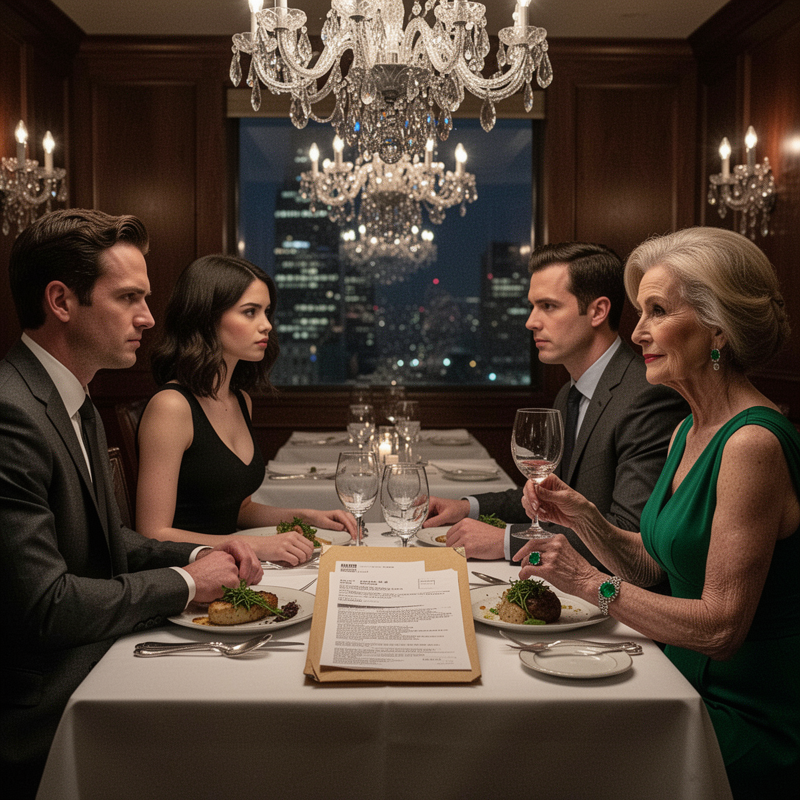
“Hand over the commercial deed to your independent design studio and forty percent of your monthly career earnings to your mother-in-law, or you don’t leave this dining room tonight,” my husband demanded, slamming his fist onto the table.
When I calmly refused, he grabbed a heavy ceramic dinner plate and smashed it across my forehead, splitting my skin open and leaving blood dripping onto the pristine white tablecloth while my mother-in-law watched with cold indifference.
Nobody offered a napkin; instead, my mother-in-law casually took a sip of her red wine and told me to sign the property transfer paperwork before the police were called to escort me out.
They thought a nineteen-year-old junior associate would crumble under the sight of her own blood and physical intimidation.
They didn’t realize I had already pressed redial on my phone under the table, broadcasting the entire extortion attempt live to our company’s legal compliance hotline.
The air in the private dining room hung thick with the smell of expensive French cuisine and unspoken threats. Chandeliers, heavy with crystal, glittered overhead, reflecting off the polished silverware and the nervous sheen on Julian Albright’s forehead.
It was an executive family dinner, ostensibly. But the tension had been building for an hour, ever since Victoria Albright, my mother-in-law, had pushed the heavy manila envelope across the dark mahogany table.
Inside were legal documents, clearly visible from my side. They outlined a demand for the full commercial deed to my $850,000 design studio.
There was also a clause for forty percent of my monthly career earnings.
All of it, to be signed over to her.
Julian, my husband, sat opposite me, his jaw clenched, eyes darting between his mother and me. He was meant to be my partner, but tonight, he was her loyal enforcer.
“Chloe,” Victoria said, her voice smooth as silk, entirely incongruous with the steel in her gaze. She took a dainty sip from her crystal wine glass, a cabernet sauvignon, leaving a slight red stain on her lips.
“We’ve discussed this. It’s for the family, for the firm.”
I met her gaze, keeping my own expression neutral. I was nineteen, yes, but I had built that studio from the ground up, brick by brick, grant by grant. It was mine.
“My studio is independent, Victoria,” I replied, my voice steady despite the tremor in my chest. “It’s not part of Albright Architecture. You know that.”
“It should be,” she countered, her smile not reaching her eyes. “Considering where your loyalties should lie.”
Julian shifted in his seat, his leg bumping against mine under the table. It wasn’t a comforting touch. It was a warning.
The aroma of seared scallops, which had seemed so appealing an hour ago, now made my stomach churn. Outside the sound-proofed room, I could imagine the quiet chatter and clinking glasses of other diners, completely unaware of the drama unfolding within these walls.
“It will always be for the firm, Chloe,” Julian interjected, his voice tight. “Don’t make this difficult.”
“Difficult for whom, Julian?” I asked softly.
He flinched, stung by the question. His face, usually a mask of suave corporate confidence, was now contorted with a mixture of anger and desperation. He was an executive by title, but a puppet by nature.
Victoria watched us, a slight, knowing smirk playing on her lips. She had orchestrated this entire evening. She enjoyed the power.
“Sign the papers, Chloe,” she stated, her voice dropping to a low, dangerous register. “It’s a simple transaction. Assets consolidated. A united front.”
“It’s coercion,” I said, finally letting a hint of my frustration show. “And it’s illegal.”
A muscle in Julian’s jaw twitched. He picked up his heavy ceramic dinner plate, still half-full of untouched salmon. He rotated it slowly, the glazed surface reflecting the glittering lights of the chandelier.
My heart began to pound a frantic rhythm against my ribs. I knew that look. I’d seen it before.
“Chloe, don’t be foolish,” Victoria said, her voice sharp. “You’re a junior associate. You have no standing against us.”
I reached for my phone, which I had placed face down in my lap, under the pristine white tablecloth. My fingers moved swiftly, silently. I found the last number called. The company’s legal compliance hotline. I had added it to my speed dial months ago, just in case.
My thumb hovered over the redial button.
“Hand over the commercial deed to your independent design studio and forty percent of your monthly career earnings to your mother-in-law, or you don’t leave this dining room tonight,” Julian demanded, his voice escalating, slamming his fist onto the table with a force that rattled the silverware.
The crystal glasses chimed.
“No,” I replied, meeting his furious gaze. My thumb pressed redial. The call connected silently, the recording software on the other end activated. The microphone on my phone was surprisingly sensitive.
Julian’s face twisted into a mask of pure rage. He raised the heavy ceramic dinner plate. It was a blur of white and gold.
Then, a sickening thud.
Pain exploded across my forehead. A sharp, searing agony that made my vision swim. I heard a muffled gasp, but it wasn’t from Victoria.
Warm, viscous liquid immediately began to trickle down my face, hot against my skin. My hand instinctively flew up, fingers touching something wet and slick.
Blood.
It dripped onto the pristine white tablecloth, spreading rapidly, a stark crimson blotch against the immaculate linen. The ceramic plate, now broken into sharp shards, clattered to the floor, leaving a fine dust of white ceramic on the dark wood.
I blinked, trying to clear the haze from my eyes. The pain was dizzying.
Victoria watched, her expression utterly devoid of concern. Her hand, adorned with an impressive emerald ring, slowly raised her wine glass.
She took another casual sip.
“Sign the property transfer paperwork, Chloe,” she said, her voice completely calm, as if discussing a mundane business deal.
“Before the police are called to escort you out.”
Part 2
The sirens cut through the elegant restaurant’s muffled sounds, growing louder, closer. Within minutes, two police officers and a pair of paramedics were standing in the doorway of our private dining room. The sudden intrusion shattered the air of calculated calm Victoria had maintained.
Julian, his face pale with a mix of shock and anger, immediately started talking, his voice a frantic rush. He claimed I’d stumbled, fallen against a glass display cabinet in the hallway. Victoria nodded gravely, dabbing her eyes with a napkin, putting on a show of distress I knew was entirely fake.
The paramedics, however, were gentle. They cleaned the blood from my face, pressed gauze to the gash, and led me out past the officers. I could feel Victoria’s cold stare on my back, even as I was wheeled out on a stretcher, the restaurant guests murmuring and pointing.
At the emergency room, the sterile white walls were a stark contrast to the opulent dining room. A doctor expertly stitched the wound on my forehead, five precise stitches that pulled the edges of my skin together. The pain was dull now, a throbbing ache that was overshadowed by the cold fury rising within me.
Victoria arrived an hour later, still playing the role of the concerned mother-in-law. She hovered by my bedside, her voice hushed, repeating the story of my “tragic household fall.” She even managed to shed a few crocodile tears. The police officer present seemed to accept her story, making notes on his pad. I just watched her, silent, letting her weave her deceit.
I was discharged a few hours later, exhausted but resolute. The doctor prescribed pain medication and rest. I returned to my apartment, the silence heavy around me. I knew this was far from over. Victoria wouldn’t stop at physical intimidation.
And she didn’t. Two days later, a thick legal envelope arrived. Inside, I found an official notice: Victoria had secretly filed a corporate lien against my independent design studio, claiming I had forged corporate signatures on documents dating back to before my eighteenth birthday.
CHAPTER 2: The Grant Foundation
The white bandage across my forehead felt tight as I sat in the corner office of Albright Architecture’s headquarters.
Evelyn Cross tapped her pen against the glass desk top. The Chief Compliance Officer adjusted her thin wire glasses and stared at the red velvet folder resting between us.
“Victoria claims the eighty-five thousand dollar deposit on your commercial space originated from corporate reserves,” Evelyn said.
“Victoria lied,” I said.
I pulled a black leather folder from my bag and laid three stamped federal certificates onto the glass.
“This is the award documentation for the National Youth Design Grant,” I said. “Six hundred and fifty thousand dollars, awarded to me independently when I was seventeen.”
Evelyn picked up the top sheet, her thumb tracing the embossed silver seal of the federal arts committee.
“The Albright account was never touched,” I added. “Every dollar used to acquire my studio came from that grant and my personal savings.”
“She told the board you were using company capital,” Evelyn murmured, staring at the bank transaction logs attached to the back. “She called you emotionally unstable.”
“Check the routing numbers,” I said.
Evelyn typed for thirty seconds on her computer terminal. Her eyebrows rose.
“The transfer originated from a federal escrow account in Chicago,” Evelyn said. “It never entered Albright Architecture’s books.”
The heavy oak door to Evelyn’s office swung open without a knock.
Victoria stood in the doorway, wearing a tailored charcoal suit with silver lapel pins. She did not look at the fresh bandage on my face.
“Evelyn,” Victoria said, stepping into the room and closing the door behind her. “This internal inquiry is a waste of corporate resources. Chloe is nineteen years old and clearly experiencing stress from her recent household accident.”
“It wasn’t an accident, Victoria,” Evelyn replied, keeping her voice level. “And the financial documents Chloe just provided show zero corporate funds were used for her studio.”
Victoria’s hand tightened around her leather handbag.
“I advise you to remember who approves the compliance department’s annual budget,” Victoria said.
“And I advise you to remember federal whistleblower protections,” Evelyn said, leaning back in her leather chair. “An official internal investigation is now open.”
Victoria turned her eyes to me, cold and unblinking.
“You are destroying your place in this family, Chloe,” Victoria whispered.
“My studio is mine,” I said. “And the compliance file stays open.”
CHAPTER 3: The Broken Promise
The frosted glass door of my private studio office clicked shut at six o’clock that evening.
Julian stood near the blueprint drafting board, his hands shoved deep into his suit pockets. His knuckles were still red.
“You need to walk into Evelyn’s office tomorrow morning and withdraw the complaint,” Julian said.
“I’m not withdrawing anything,” I said, setting my digital pen onto the desk.
“You’re making a massive mistake,” Julian said, taking three steps toward my desk. “Do you want a career in this city or not?”
“You smashed a plate over my head because I wouldn’t sign over my business,” I said.
Julian glanced away, his throat working as he swallowed.
“My mother promised me fifty percent of the flagship division,” Julian said, his voice dropping into a tight whisper. “Sole directorship. The day you sign that studio deed over to her, she transfers the shares to my name.”
“She ordered you to hit me?” I asked.
“She told me to do whatever was required to get your signature before the quarter ended,” Julian said. “She said you were a teenager and you’d fold if we pushed hard enough.”
I reached under the edge of my desk and tapped the silent recording toggle on my office security console.
“So the assault was her condition for your promotion?” I asked.
“She said I’d never run a division if I couldn’t even control my own wife,” Julian snapped, stepping closer and slamming his open palm onto my desk. “Sign the paper, Chloe. Stop ruining this for me.”
“No,” I said.
Julian stared at me for three seconds, his breath heavy in the quiet room.
“You’ll regret this,” he said, turning sharply toward the door.
The heavy door slammed behind him.
I reached under the desk, saved the high-definition video file to two encrypted cloud servers, and downloaded a backup copy to a black flash drive.
“Conspiracy to extort,” I whispered to the empty room.
CHAPTER 4: The Unwitting Accomplice
The tall glass atrium of the Albright flagship building echoed with the sound of dress shoes on polished marble.
Victoria walked beside a tall man with silver hair and a dark blue navy coat. Harrison Blake, managing partner of Blake Venture Capital, carried a slim leather folio under his arm.
Victoria gestured toward me as I crossed the main lobby carrying a stack of elevation drawings.
“Harrison, I’d like you to meet one of our junior associates,” Victoria said, her voice smooth and warm. “Chloe.”
Harrison extended a hand. His grip was firm and disciplined.
“Chloe,” Harrison said. “Victoria was just telling me about your work on the harbor project.”
“I designed the structural framework,” I said.
Victoria stepped between us slightly, turning her shoulder toward me.
“Chloe has had some trouble adjusting to our corporate structure,” Victoria said, addressing Harrison directly. “When family members join the firm at such a young age, entitlement sometimes gets in the way of professional unity.”
Harrison looked down at me, his forehead lining with concern.
“Corporate unity is essential if Albright Architecture wants our fifteen million dollar expansion funding,” Harrison said, his tone authoritative. “Personal ambition cannot interfere with institutional health, young lady.”
“Personal ambition hasn’t touched my work, Mr. Blake,” I said.
“Victoria mentioned you’ve been filing internal grievances over routine property restructuring,” Harrison said, adjusting his watch. “At nineteen, taking a long-term view of family legacy is usually the wiser path.”
I looked directly into Harrison’s gray eyes.
“Do you recognize me, Mr. Blake?” I asked.
Harrison frowned slightly, searching my face.
“Two years ago,” I said softly. “The National Youth Architectural Design Summit in Chicago. You were the keynote speaker who presented my first-place grant trophy.”
Harrison stopped moving. His eyes dropped to the small white bandage near my hairline, then returned to my eyes.
Victoria immediately stepped forward, placing a hand on Harrison’s arm.
“Harrison, our tour of the executive suites is scheduled for two o’clock,” Victoria said quickly. “We shouldn’t keep the board waiting.”
Harrison did not move for two full seconds.
“Right,” Harrison said quietly, his eyes remaining fixed on me before he slowly turned toward the elevators.
CHAPTER 5: The Morality Trigger
My studio computer screen glowed in the quiet office at nine o’clock that night.
I attached three PDF documents to an email addressed directly to the legal compliance team at Blake Venture Capital.
The first attachment was the official police incident report from the dinner assault, marked with the active case tracking number.
The second attachment was the forensic photo taken at the hospital showing the deep laceration above my eye.
The third attachment was a certified copy of the Blake Venture Capital institutional charter, which I had downloaded from public financial filings.
Section 8.4 was highlighted in yellow: *Mandatory Capital Freeze in the Event of Executive Criminal Investigation or Domestic Violence Proceedings.*
I hit send.
At eight o’clock the following morning, Victoria’s high-heeled steps rattled down the hallway outside my office.
She threw my door open so hard the brass handle dented the drywall.
“What did you send to Blake Capital?” Victoria hissed, her hands trembling as she held her ringing smartphone.
“The truth,” I said without looking up from my monitor.
“Harrison just froze the twelve million dollar bridge loan,” Victoria said, her voice cracking with rage. “The wire transfer was supposed to hit our payroll escrow at nine A.M.!”
“Then you should probably check Section 8.4 of his fund agreement,” I said.
“You ruined a twelve million dollar liquidity line over a personal dispute!” Victoria yelled, slamming both hands on the front of my desk.
“You brought Harrison Blake into my workplace to intimidate me,” I said, leaning back in my chair. “I simply provided his legal team with public police records.”
Victoria’s face drained of color as her phone began ringing again in her hand.
“This company will destroy you before sunset,” Victoria whispered.
“Your phone is ringing, Victoria,” I said.
CHAPTER 6: The Custody Threat
At four o’clock that afternoon, I pulled my compact car into the driveway of my small house on Maple Street.
Two men in grey suits stood on my front porch beside the wooden porch swing.
Julian stood near the end of the driveway, leaning against his sports car with his arms crossed over his chest. A cold, flat smile rested on his face.
“Chloe Albright?” the taller man in the suit asked as I stepped out of my car.
“Yes,” I said.
He handed me a thick manila envelope sealed with a red legal stamp.
“Emergency petition for temporary legal custody,” the process server said. “Family Court Division.”
I opened the top flap. Victoria’s signature sat at the bottom of the petition in dark blue ink.
The document claimed my nineteen-year-old status, erratic professional behavior, and high-stress workload made me an unfit mother for my three-year-old son, Leo.
“She filed this two hours ago,” Julian said from the driveway, his voice dripping with spite. “You think you can mess with our corporate funding and just walk away?”
“Leo is three years old, Julian,” I said, my voice dangerously quiet. “He is your son.”
“He’s an Albright,” Julian said, taking a step toward me. “And my mother isn’t going to let a teenager raise the heir to our family estate while she destroys our company.”
“You know this is a lie,” I said.
“Sign the non-disclosure agreement and transfer the studio deed,” Julian whispered, leaning in close. “Or the custody hearing is in seventy-two hours. My mother hired the best family lawyers in the state. You won’t win.”
I folded the paper neatly and slid it back into the envelope.
“Tell your mother I’ll see her in court,” I said.
“You’re going to lose your kid, Chloe,” Julian called out as I walked past him toward the front door.
I unlocked the door, walked inside, and locked it behind me.
CHAPTER 7: Forensic Marks
The forensic medical clinic smelled of antiseptic and fresh paper rolls.
Dr. Sarah Vance, a state-appointed forensic pathologist, adjusted the bright overhead examination lamp directly over my forehead.
She used a high-resolution camera with a macro lens to capture twelve close-up photographs of the neat row of five black stitches.
“Hold completely still,” Dr. Vance said, clicking the shutter.
She placed a clear plastic grid ruler against my skin.
“Your husband claimed to the responding officers that you fell into a glass display cabinet during an argument,” Dr. Vance noted, reviewing a clipboard held by an assistant.
“That is what he told them,” I said.
Dr. Vance brought a handheld ultraviolet scanner across the scar tissue.
“Glass display cabinets create multi-directional impact lacerations with irregular tearing,” Dr. Vance said, pointing to the high-magnification screen on the wall. “This injury shows a linear blunt-force impact caused by a thick ceramic rim.”
She pulled up a digital rendering of the ceramic plate fragments collected by the police from the dining room floor.
“The curve of the laceration matches the outer edge of an eight-inch dinner plate angled at forty-five degrees,” Dr. Vance continued. “Furthermore, the downward trajectory proves the blow was delivered from above while you were seated.”
“It disproves the fall?” I asked.
“Completely,” Dr. Vance said, signing her name to a digital report terminal. “This was a direct, overhead strike delivered with heavy force. It is physically impossible to sustain this pattern from a forward trip or fall.”
Ten minutes later, Detective Miller entered the examination room holding a black folder.
“Dr. Vance’s physical findings were just uploaded to the district attorney’s portal,” Detective Miller said.
“What does that mean for the case?” I asked.
“We are officially upgrading Julian Albright’s charges,” Detective Miller said, closing his folder. “Simple misdemeanor assault is off the table. He is now facing felony domestic assault with a dangerous weapon.”
“Does Victoria know?” I asked.
“The arrest warrant was signed twenty minutes ago,” Detective Miller replied.
CHAPTER 8: Manufactured Rumors
On Monday morning, my studio phone began ringing at seven-thirty.
By eight o’clock, four national architecture journals had published identical online articles citing an anonymous insider source at Albright Architecture.
The headlines claimed an internal audit was under way regarding two hundred thousand dollars in missing client deposits from my independent studio.
My lead assistant, Maya, rushed into my office holding a tablet screen.
“Apex Development just called,” Maya said, her voice shaking. “They’re threatening to freeze our sixty-thousand-dollar contract for the downtown plaza.”
“Show me the article,” I said.
The text cited leaked corporate memos suggesting I used my dual access to company accounts to siphon funds into my personal design firm.
I picked up my desk phone and dialed Marcus Davenport, a senior forensic financial auditor with an independent national accounting firm.
“Marcus,” I said when he answered. “I need an immediate, full-scope forensic audit of all accounts associated with my studio.”
“An audit like that takes three days and costs twelve thousand dollars, Chloe,” Marcus said over the line.
“I don’t care,” I said. “I want every dollar tracked from the day the grant money hit my account to this morning.”
“Are you sure?” Marcus asked. “If we open a full forensic audit, we have to examine the cross-clearing accounts connected to Albright Architecture’s main corporate server.”
“Do it,” I said. “Open every ledger. Trace every transfer.”
An hour later, I posted an official press statement on my studio’s website.
*I have voluntarily initiated a full, independent forensic audit conducted by Davenport Financial. All corporate ledger books are open to public scrutiny.*
My desk phone stopped ringing.
In her executive suite downtown, Victoria sat staring at my public statement, her glass of water untouched on her desk.
CHAPTER 9: The Pension Hole
Marcus Davenport unrolled a massive ledger spreadsheet across my studio conference table three days later.
He took off his glasses and rubbed the bridge of his nose.
“Your personal studio accounts are spotless, Chloe,” Marcus said. “Every cent of your six hundred and fifty thousand dollar grant is accounted for down to the penny.”
“What about the two hundred thousand dollar claim?” I asked.
“Pure fabrication,” Marcus said. “But while tracing the cross-clearing transaction tags between your studio’s server and the Albright main network, my software flagged an anomaly in their institutional accounts.”
He highlighted a row of numbers in bright pink marker.
“What is that?” I asked.
“The Albright Architecture Employee Pension Fund,” Marcus said, leaning over the table. “Over the last fourteen months, one million four hundred thousand dollars was transferred out of the staff retirement escrow into a shell company called Horizon Coast Holdings.”
“Who owns Horizon Coast Holdings?” I asked.
Marcus flipped to the next page of his report and pointed to the state incorporation registry signature.
Victoria Albright.
“She was using employee pension capital to cover losses on private beachfront real estate investments in Florida that failed last year,” Marcus said flatly.
“She stole from her own employees?” I asked.
“It’s federal pension fraud,” Marcus said. “And because your audit was registered under corporate compliance protocols, this report automatically triggers an emergency notification to the board of directors.”
At two o’clock that afternoon, an emergency courier delivered a red-stamped board order to Victoria’s office.
Her executive credentials were instantly suspended pending a formal board hearing.
CHAPTER 10: The Secret Settlement Offer
Rain tapped against the window of the quiet corner coffee shop two blocks from the courthouse.
Julian sat across from me in a dark green hoodie, looking pale and gaunt. He kept checking his phone every thirty seconds.
“My mother doesn’t know I’m here,” Julian whispered, leaning across the small wooden table.
“Why did you ask to meet, Julian?” I asked, keeping my hands resting on my lap.
He pulled a folded legal document from his jacket pocket and slid it across the table.
“It’s a full divorce agreement,” Julian said quickly. “Unconditional surrender of all custody claims to Leo. You get complete legal and physical custody. I walk away.”
I looked down at the document without touching it.
“What do you want in return?” I asked.
“You have to tell Marcus Davenport to restrict his audit to your studio,” Julian begged, his eyes wide. “Tell the DA that the dinner incident was a misunderstanding. I can’t go to prison, Chloe.”
“Why did you go along with her, Julian?” I asked softly.
Julian let out a bitter, shaky breath and looked down at his coffee cup.
“Since I turned eighteen, she’s held my trust fund hostage,” Julian said, his voice cracking. “Every dollar I have is in accounts she controls. If I didn’t do what she wanted, she threatened to cut me off and kick me out of the firm.”
“You chose to hurt me to save your trust fund,” I said.
“I didn’t have a choice!” Julian said, his voice rising before he caught himself and looked around the café. “She controls everything, Chloe. She’s been manipulating both of us.”
“You always had a choice,” I said, pushing the folded paper back toward him. “I’m not stopping the audit. And I’m not lying to the prosecutor.”
Julian stared at the paper, his hands trembling.
“She’s going down,” Julian whispered. “And she’s taking me with her.”
“You took yourself down,” I said, standing up from the table and pulling my coat around my shoulders.
CHAPTER 11: The Patent Injunction
On Thursday morning, a red federal notification popped up on my studio design terminal.
Victoria’s attorneys had filed an emergency intellectual property injunction with the United States Patent and Trademark Office.
The filing claimed that all proprietary architectural framework algorithms developed by my studio belonged to Albright Architecture under an employee assignment clause.
Maya ran into my office with a printout of the filing.
“They’re trying to freeze our digital design library,” Maya said. “We can’t submit the city plaza blueprints if this injunction holds.”
I called my intellectual property attorney, Arthur Vance.
“Arthur, look at the digital signature on page four of their filing,” I said, opening the document on my monitor.
Arthur logged into the federal portal from his office across town.
“They attached a signed assignment agreement dated June 14th of three years ago,” Arthur noted.
“I was seventeen years old on June 14th of three years ago,” I said. “And the digital timestamp on the metadata shows the document was signed using a corporate key created just six months ago.”
Arthur let out a low whistle over the line.
“They backdated a digital signature on a minor’s purported contract to make it look like a pre-existing employment agreement,” Arthur said.
“Is that legal?” I asked.
“It’s federal corporate forgery,” Arthur replied. “The Patent Office system has an automated fraud detection algorithm for backdated metadata tags. I’m filing an emergency strike motion right now.”
Two hours later, the United States Patent Office issued an automatic administrative flag against Albright Architecture’s corporate account.
The injunction was dismissed with prejudice, and the matter was referred directly to the federal inspector general’s office for criminal review.
In her home office, Victoria watched her patent portal account turn red with a permanent restriction notice.
CHAPTER 12: The Capital Flight
At ten o’clock the following morning, a sleek black sedan pulled up outside my coastal design studio.
Harrison Blake stepped out, wearing a tailored dark suit. He walked into my reception area alone, holding a leather briefcase.
“Chloe,” Harrison said, stopping near my drafting table. “Do you have ten minutes?”
“In my office, Mr. Blake,” I said.
He sat down across from me and opened his briefcase, pulling out a thick set of financial reports.
“I met with Marcus Davenport this morning,” Harrison said, his voice calm and grave. “He showed me the pension audit files. And my legal team reviewed the backdated patent filings.”
“I see,” I said.
“I was lied to,” Harrison said, looking me directly in the eyes. “Victoria presented you as an ungrateful teenager trying to dismantle a family enterprise. She used my presence to pressure you.”
“She needed your fifteen million dollars to cover her shortfalls,” I said.
“She will not be getting a single dollar,” Harrison said. He pulled a signed legal document from his briefcase and laid it on my desk. “This is the official notice of partnership cancellation. Blake Venture Capital has terminated all negotiations with Albright Architecture.”
“What happens to their stock?” I asked.
“Word of the capital pullout hit off-market trading thirty minutes ago,” Harrison said, checking his watch. “Albright stock is down thirty-two percent. Creditors are already calling in their short-term notes.”
Harrison stood up and offered his hand.
“I apologize for judging your character based on Victoria’s words,” Harrison said. “Your talent and integrity speak for themselves.”
“Thank you, Mr. Blake,” I said, shaking his hand.
As Harrison drove away, my monitor showed Albright Architecture’s stock ticker tumbling in deep red numbers.
CHAPTER 13: The Condemned Headquarters
Facing total liquidity failure, Victoria made a desperate move on Tuesday afternoon.
She arranged an emergency sale-leaseback transaction with a regional real estate investment trust to sell the corporate headquarters building for eight million dollars in quick cash.
The buyer’s legal team arrived at the municipal zoning office to complete the deed transfer.
As the clerk pulled up the building’s digital title file, an automatic red structural hold flashed across the screen.
The buyer’s lead attorney frowned, tapping the monitor.
“What is this hold?” the attorney asked the clerk.
“Notice of Structural Non-Compliance,” the clerk replied, reading the screen. “Filed two years ago by Chloe Albright, Associate Apprentice.”
The report contained thirty pages of detailed engineering measurements documenting severe foundation stress and unapproved load-bearing alterations in the subterranean parking garage.
“This building has an active municipal repair mandate that was never cleared,” the clerk said. “By law, the title cannot be transferred or sold until four million dollars in structural remediation is completed.”
The buyer’s attorney closed his folder immediately.
“The deal is dead,” he said, turning to Victoria’s real estate agent. “We aren’t purchasing a condemned structural liability.”
Victoria received the news while sitting in her car outside the municipal building.
The eight million dollar lifeline was gone.
Her company had less than forty-eight hours before total debt default.
CHAPTER 14: The Deposition Betrayal
The federal prosecutor’s conference room on the fifth floor was cold and silent.
Julian sat at the long wooden table beside his public defender, facing two federal prosecutors and Detective Miller.
Microphones stood in the center of the table, recording every word.
“Julian,” the lead prosecutor said, leaning forward. “We have the forensic medical reports, the backdated patent filings, and the pension audit logs. You are looking at significant prison time for felony assault and corporate conspiracy.”
Julian pulled his hood down, his eyes bloodshot and tears streaming down his face.
“It was all her,” Julian sobbed, his hands shaking violently on the table. “She planned every bit of it!”
“Julian,” his attorney warned quietly.
“No!” Julian shouted, pulling a white flash drive from his pocket and slamming it onto the table. “I’m not going to prison for her!”
“What is on that drive?” the prosecutor asked.
“Every email chain from the last six months,” Julian stammered, wiping his nose with his sleeve. “She told me exactly how to hit Chloe at the dinner table so it wouldn’t leave a permanent scar on her cheek. She drafted the embezzlement press leaks. She ordered the pension transfers.”
The prosecutor took the flash drive and inserted it into a laptop.
Files flashed across the screen—detailed step-by-step instructions sent from Victoria’s private email address detailing the extortion scheme and financial cover-up.
“This confirms primary criminal intent,” the prosecutor said, looking up at Detective Miller.
“Issue the federal summons for Victoria Albright,” Detective Miller said, standing up.
Julian buried his face in his hands on the table, weeping silently as the recorder clicked off.
CHAPTER 15: The Pre-Gala Tension
The grand ballroom of the Grand Hyatt Hotel sparkled under crystal chandeliers on Friday evening for the Annual Regional Architecture Gala.
Over four hundred corporate executives, venture capitalists, and industry journalists filled the polished floor.
Victoria arrived in an immaculate emerald silk gown, her hair styled perfectly, carrying a silver clutch. She moved through the crowd with a practiced smile, maintaining a front of total stability despite the falling stock price.
This gala was her last chance to convince private angel investors to provide an emergency five-million-dollar rescue loan before Monday morning’s debt deadline.
I walked into the ballroom wearing a simple black evening dress. In my left hand, I carried a sealed black leather briefcase.
Maya walked beside me, looking nervously around the massive room.
“Why are we here, Chloe?” Maya whispered. “Victoria is telling everyone the rumors are fake.”
“She can tell them whatever she wants,” I said softly.
I walked toward the side of the main auditorium stage where invited nominees were instructed to wait. My independent studio was nominated for the Regional Innovation Award.
Near the front row, three-year-old Leo sat safely beside my trusted nanny, playing happily with a small wooden toy wagon he insisted on bringing.
Inside my briefcase rested the physical evidence sealed in clear evidence bags: the original blood-splattered commercial deed and the heavy ceramic plate fragment recovered from the dining room floor.
Victoria caught my eye from across the room and raised her wine glass with a cold, mocking smirk.
She believed she had survived the storm.
CHAPTER 16: The Innocent Reveal
At eight o’clock, the master of ceremonies took the podium.
“And now, for our keynote presentation on corporate legacy, please welcome Senior Executive Vice President, Victoria Albright,” the announcer broadcast over the loudspeakers.
Applaus echoed through the ballroom as Victoria stepped onto the stage, adjusting the microphone with polished grace.
Giant high-definition projection screens behind her displayed her face to the entire room and live industry stream.
“Architecture is about foundations,” Victoria began, her voice echoing clearly. “It is about strength that withstands the tests of time and temporary turbulence—”
From the side stage entrance, three-year-old Leo innocently wandered out onto the brightly lit hardwood floor, pulling his wooden toy wagon behind him.
The heavy black briefcase rested inside his wagon.
The crowd chuckled softly at the sight of the toddler on stage. Victoria froze mid-sentence, her eyes flashing with panic as she spotted Leo.
“Leo, sweetie, come back here,” I whispered from the wings, stepping forward slightly.
Leo reached the center of the stage near the podium, pulled on the briefcase handle, and the dual metal latches snapped open with a loud *clack* that echoed through the podium microphone.
Leo reached into the open case, curious and playful, and pulled out the clear sealed bag containing the heavy, broken ceramic plate fragment stained with dark, dried blood.
Attached to the fragment was the original commercial property deed, stained with clear, bloody handprints.
Leo held the shiny sealed bag high in the air under the intense stage lights, showing it to the audience as if displaying a toy.
The automated overhead camera system zoomed in on the object in the toddler’s hands, projecting a forty-foot high-definition image of the blood-stained deed onto the giant screens behind Victoria.
The distinct dried palm prints of Victoria and Julian were instantly visible across the legal text.
Gasps erupted across the ballroom. Camera flashes exploded from the press row.
Victoria turned, looked up at the giant screen displaying her bloody handprint, and her face went completely white.
CHAPTER 17: Natural Collapse
Within four minutes of the reveal, the ballroom descended into chaos.
Investors pulled out their phones, cancelling bailout meetings on the spot. The angel investor group sitting in the front row stood up and walked out of the auditorium in silence.
Two federal marshals and Detective Miller entered through the rear doors of the ballroom, their badges visible on their belts.
They walked down the center aisle as the crowd parted.
Victoria stood frozen near the podium, her hands shaking so violently she dropped her microphone, creating a loud screech through the speakers.
“Victoria Albright,” Detective Miller announced, stepping onto the stage. “You are under arrest for federal pension embezzlement, corporate forgery, and evidence tampering.”
The marshals placed iron handcuffs around Victoria’s wrists right in front of the press cameras.
At the same time, two police officers took Julian into custody in the hotel lobby following his felony domestic assault indictment.
By midnight, Albright Architecture’s primary lenders triggered immediate default clauses on all outstanding loans.
With zero cash reserves and all assets encumbered by fraud claims, Albright Architecture filed for involuntary Chapter 7 liquidation on Monday morning.
There was no artificial intervention required.
The systemic weight of their own corruption dismantled the entire corporate empire in less than seventy-two hours.
CHAPTER 18: Coastal Horizons
Five years later.
The morning sun washed over the polished concrete floors of my new architectural studio overlooking the Pacific Ocean in San Diego.
Floor-to-ceiling glass walls opened onto a quiet wooden deck where the ocean breeze blew softly.
My firm now employed twelve full-time architects, working on major sustainable projects across the country.
Outside in the sunlit courtyard, eight-year-old Leo laughed as he threw a frisbee for our rescue dog. He was happy, safe, and thriving.
Maya walked into my office and laid a newspaper on my desk.
“The final bankruptcy liquidation of the Albright estate concluded this morning,” Maya said quietly. “Every asset was sold to satisfy the pension fund debt.”
“And Julian?” I asked, looking out at the water.
“His prison sentence ended last week,” Maya said. “He has no assets remaining and left the state.”
Victoria remained in a federal correctional facility in California, serving her six-year sentence for corporate fraud.
I picked up a pen and looked out at the endless blue horizon, hearing my son’s laughter echoing from the courtyard.
They thought youth meant weakness and blood meant defeat, but they forgot that foundations built on intimidation always crumble under the weight of their own corruption.
Leave a Reply