CHAPTER 1: The Weight of Steel and Heel
Part 1
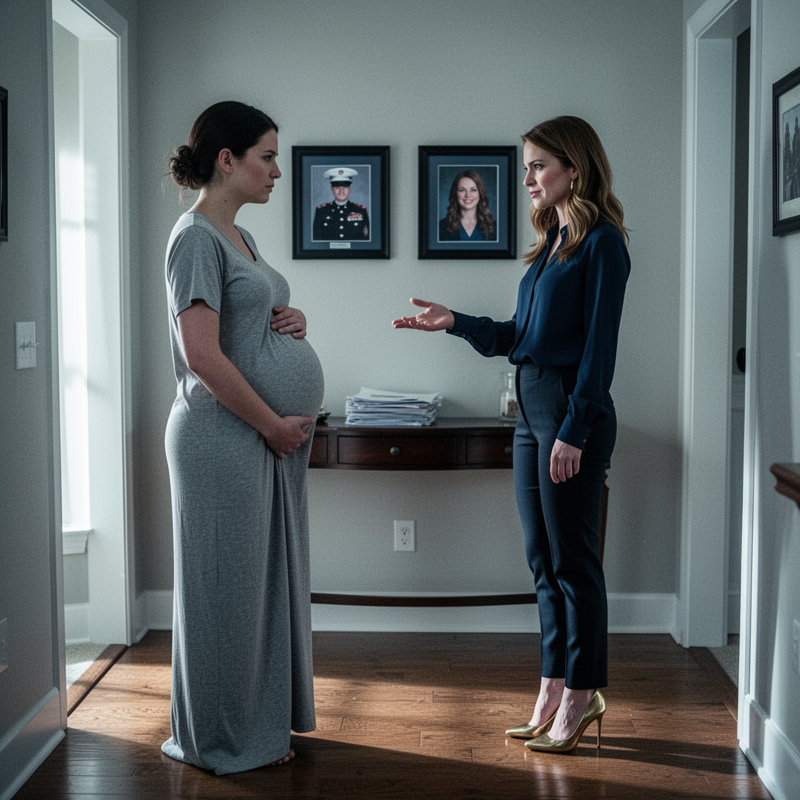
“You will sign over the housing power-of-attorney and the $185,000 survival annuity, or your baby won’t live to see Fort Bragg,” my former protege, Evie Dunbar, sneered inside my own hallway.
She slammed me against the radiator and drove her three-inch brass heel directly onto my wrist until my fingers went numb.
At eight months pregnant, I collapsed onto the hardwood as she grabbed a framed vase, shattered it against her own shoulder, and began screaming for help to make it look like I attacked her.
She thought her secret affair with my deployed husband gave her total control over my home.
She had no idea I was done keeping quiet.
My body hit the polished wood with a sickening thud, the impact jarring through my swollen belly. A sharp, burning pain pulsed in my wrist, radiating up my arm.
But it was the dull ache of the baby shifting inside me that stole my breath.
Evie’s screams echoed in the empty house, a shrill, theatrical performance designed for any passing neighbor.
“Oh god, she’s trying to kill me!” she shrieked, her voice thin and panicked.
A shard of the ceramic vase, a wedding gift from Daniel’s aunt, glinted on the floor beside my face. It smelled faintly of potpourri and dust.
I pushed myself up onto one elbow, a guttural groan escaping my lips. My vision swam.
The hallway light caught the sheen of a tear on Evie’s cheek, but her eyes held only cold triumph. She took a step back, angling her body so that the fake injury on her shoulder was clearly visible.
“Get up, Clara,” she commanded, dropping the pretense of terror. Her voice was low and venomous now. “You think falling will save you?”
My fingers still tingled, a dead weight at the end of my arm. I tried to flex them, but they refused to respond. The brass heel had left a dark, angry bruise blossoming beneath my skin.
“The papers,” Evie insisted, gesturing towards a stack of documents lying innocently on the console table. They were the power-of-attorney forms, granting her control over everything.
“Sign them now, Clara. Or do you want the MPs to find you like this?”
She kicked a loose piece of ceramic towards me. It skittered across the floor, stopping inches from my shoe.
I leaned against the wall, using its sturdy surface to slowly, painstakingly, push myself to a standing position. Every muscle screamed in protest.
“You really think this will work?” I asked, my voice raspy, barely a whisper.
Evie laughed, a short, sharp sound that grated on my ears.
“Of course, it will work. Pregnant woman, unstable, trying to hurt herself. Everyone on base knows you’re ‘fragile,’ Clara.”
Her eyes flicked down to my belly, a cruel smirk twisting her lips.
“And soon, everyone will know you attacked me.”
A throbbing pain shot through my head, but it wasn’t just physical. It was the weight of two years of manipulation, two years of trusting this woman who now stood over me, demanding my entire life.
I looked at the framed photos on the wall – Daniel in his dress blues, me smiling beside him, a life that felt like a distant dream.
My gaze settled on Evie. She stood there, regal despite her torn shirt and faked distress, her chest heaving dramatically.
“You really think you’re clever, don’t you, Evie?” I said, my voice gaining a surprising strength.
A flicker of irritation crossed her face.
“Don’t flatter yourself, Clara. You’re an inconvenience. A hurdle.”
She picked up the power-of-attorney forms again, shaking them.
“This is just business. Daniel’s orders for Kuwait are sealed. He needs someone to look after his affairs. Someone he *trusts*.”
The implication hung in the air: *someone he trusts more than you*.
My stomach churned, but not from fear. From a cold, burning resolve.
I remembered the sleepless nights, the hours spent hunched over my laptop, the screen illuminating my face in the dark.
The scrolling through endless pages of archived messages.
“You always were good at hiding your tracks,” I conceded, my eyes locked on hers.
She preened, mistaking my quiet tone for defeat.
“It’s called discretion, Clara. Something you know nothing about.”
“Discretion?” I scoffed, a dry, bitter sound. “You mean like the discretion you showed on the Fort Bragg FRG message board?”
Evie’s smile faltered. Her shoulders, previously rigid with false indignation, slumped almost imperceptibly.
“What are you talking about?” Her voice was suddenly flat, thin.
“January 2001,” I continued, my voice growing stronger with each word. “User handle ‘WarriorPrincess83’.”
Her eyes widened, a raw, primal fear dawning in them. The performance dissolved completely, leaving only a pale, stunned young woman.
“You posted every step of your plan,” I explained, a slow, grim satisfaction building in my chest. “How you’d targeted Daniel specifically for his officer benefits. How you knew his deployment schedule from the public registry.”
“Eighteen months of posts, Evie,” I said, stepping closer, ignoring the searing pain in my wrist. “Detailing every single calculated move you made to get into my home, into my husband’s life.”
“I have it all,” I finished, a single, devastating sentence. “Every single word of your little diary, printed and saved.”
Part 2
Evie’s pale face, which had moments ago been a mask of false terror, now twisted into an ugly snarl. The last shred of pretense vanished.
“You really think you’ve won, Clara?” she spat, her voice laced with venom.
Her hand shot into her purse, rummaging frantically. She pulled out a small flip phone, her fingers flying over the keypad.
“Halloway? It’s Evie,” she barked into the receiver, her eyes never leaving mine. “You need to get over here. She’s completely lost it. Raving. I had to defend myself.”
She paused, listening, then continued, “Yes, exactly. Unhinged. I’m telling you, the high-risk pregnancy has finally sent her over the edge. She just attacked me. I’m calling from her house.”
She snapped the phone shut, her chest heaving with a fresh wave of manufactured outrage.
“You like to keep records, don’t you, Clara?” Evie sneered, pulling a crisply folded document from a hidden pocket in her handbag. “So do I.”
She unfolded the paper with a triumphant flourish. It was an official Fort Bragg Housing Authority form, complete with a seal and a signature.
My stomach dropped. Every fiber of my being screamed.
“This,” Evie announced, waving the document like a flag of victory, “is an emergency eviction order. Signed by SFC Marcus Halloway himself. Effective immediately.”
My gaze darted to the bold print: *Immediate Vacate Order due to documented psychological distress and domestic endangerment*.
“Your little forum diary won’t save you from this, Clara,” she hissed. “My calls, my ‘injuries’—they’re all documented now. They confirm you’re a danger to yourself and others. Especially that baby.”
The words hit me like a physical blow, even harder than her heel had. The base, the very institution I’d served for years, was being weaponized against me.
A faint, distant siren wailed somewhere on base, a sound that usually meant training, but today felt like a warning.
I stood in the wreckage of my hallway, the broken vase at my feet, the throbbing pain in my wrist, the chilling paper in Evie’s hand.
My home, my sanctuary, was being ripped away.
A shadow fell across the frosted glass of my front door.
Then a sharp knock. Two uniformed figures stood on my porch.
CHAPTER 2: The Drained Account
SFC Marcus Halloway stood in the hallway doorway, his thumb hooked into the webbed belt of his duty fatigue trousers.
Evie adjusted her coat shoulder, dabbing a speck of dust off her lapel where the ceramic vase had shattered against her collarbone minutes earlier.
“You have forty-eight hours to clear the premises, Mrs. Higgins,” Halloway said, his eyes scanning the floor instead of looking at my face. “Base housing policy regarding domestic instability is clear.”
“My mother-in-law is in the back bedroom on oxygen,” I said, holding my swollen right wrist against my apron. “She cannot be moved.”
Halloway pulled a yellow carbon-copy notice from his clipboard and slapped it onto the entryway console.
“Forty-eight hours,” he repeated.
When the front door clicked shut behind them, I walked into the kitchen nook and flipped the power toggle on the beige Gateway desktop monitor.
The dial-up modem whined through three distinct tones before connecting to the First Command Military Bank portal.
I entered Daniel’s officer service number and pulled up our joint wartime emergency savings account.
The balance line read $114.12.
Twenty-one days prior, the balance had been $42,114.12.
A series of three wire transfers had moved fourteen thousand dollars each out of the account, flagged under the ledger memo: *Deployment Field Operations Allowance.*
The receiving account was registered to an off-base credit union in Spring Lake, listed under the primary holder name Evie L. Dunbar.
From the back bedroom, the hum of the oxygen concentrator skipped a beat.
“Clara?” Janet called out, her voice raspy across the dark hallway. “Is Daniel home yet?”
I pressed my cold palm against the warm plastic casing of the computer monitor and stared at the empty ledger.
“Not yet, Janet,” I called back. “He’s still in Kuwait.”
—
CHAPTER 3: Paper Trails in the Clinic
At two in the morning, the yellow streetlamp outside filtered through the blinds, casting slatted shadows over the dining room table.
My hand was wrapped in a makeshift elastic bandage from the hall first-aid kit.
I navigated to the archived message directories of the 2001 Fort Bragg Support Forum using an administrator backup file I had saved on a blue 100MB Zip disk two years ago.
Deep inside the base clinic’s public volunteer logs from November 2001, an entry flagged my attention.
It was an official memorandum regarding missing Schedule II prescription pads from the Womack Army Medical Center triage desk.
The log included an attached digital statement signed by Evie Dunbar, who was nineteen at the time and working as a non-appropriated funds clerk.
In the statement, Evie accused a junior volunteer—the nineteen-year-old wife of a deployed Private First Class—of slipping the pads into her purse.
The junior volunteer was quietly banned from base facilities and her husband’s command was notified.
Two paragraphs below the signed statement, a redacted internal audit note was appended by an assistant chief of nursing.
The note stated that five unused sheets from the missing pad were later discovered inside a locked drawer assigned to Evie Dunbar during a routine sanitation check.
No military charges had been filed; Evie had simply been quietly reassigned to the civilian support network desk without a formal administrative mark on her civilian record.
I printed the archived page on the dot-matrix printer, listening to the loud mechanical head slide across the paper.
Evie had not started her scheme when Daniel deployed to the Persian Gulf.
She had been testing the base system for three full years.
—
CHAPTER 4: The Housing Officer’s Debt
At seven-thirty the following morning, the front door handle rattled before three sharp knocks vibrated through the frame.
I opened the door, keeping the brass chain latch hooked in the track.
SFC Halloway stood on the porch holding a grey metal toolbox and two deadbolt cylinders.
“Unlatch the door, Mrs. Higgins,” Halloway said. “We’re executing the early lock transfer per base housing regulation 210.”
I didn’t reach for the chain.
Instead, I slid a single printed page of paper through the three-inch gap in the door.
Halloway looked down at the sheet.
It was a transcript copy from an archived April 2002 forum thread titled *Spring Lake Card Games – Off-Limits List.*
Highlighted in yellow marker was an entry detailing an illegal backroom poker game operating out of an auto body shop three miles outside the base gate.
“Your name appears sixteen times in those log sheets, Sergeant,” I said through the gap. “Eighteen thousand dollars in personal debt notes signed over to a civilian named Raymond Dunbar.”
Halloway’s hand froze on the handle of his toolbox.
“Raymond is Evie’s older brother,” I said. “She bought those debt notes off him six months ago, didn’t she?”
Halloway shifted his weight, his eyes darting toward the empty street behind him.
“You’re enforcing a fraudulent housing eviction because a twenty-six-year-old clerk holds your military retirement pension in her desk drawer,” I whispered.
Halloway swallowed hard, his Adam’s apple bobbing against his stiff collar.
He lowered the metal toolbox to the porch floor.
“You have seventy-two hours,” he muttered, turning his back and walking down the concrete path toward his government truck.
—
CHAPTER 5: Static across the Ocean
The black landline phone on the kitchen wall rang at four in the afternoon.
I picked up the receiver, hearing the heavy satellite delay crackle across six thousand miles of ocean cable.
“Clara?” Daniel’s voice was thin, clipped by compression. “Are you there?”
“Daniel,” I said. “Evie was in the house yesterday.”
Silence hung on the line for four long seconds.
“I know,” Daniel said softly. “She called my unit’s orderly room on the DSN line two hours ago.”
“She took forty-two thousand dollars from our First Command account,” I said. “And she tried to force me to sign over the survival annuity.”
Daniel let out a long, ragged breath through the speaker.
“Clara, listen to me,” Daniel said, his tone turning sharp. “You cannot file a formal report with the Military Police.”
I held the receiver tighter against my ear.
“She put her heel on my wrist, Daniel. She shattered a vase and called base housing.”
“If you press criminal charges, she’s going to submit sworn statements to the Eighteenth Airborne Corps promotion board,” Daniel said, his voice dropping to a harsh whisper. “She has copies of my government travel vouchers from last spring. She claims I used military fuel cards for her personal car.”
“Did you?” I asked.
The satellite line hissed with white noise.
“It doesn’t matter if I did or didn’t,” Daniel snapped. “A investigation freezes my Major’s board packet instantly. My career is finished if that file reaches the general.”
“Your wife is sitting in quarters with a swollen arm and an empty bank account,” I said.
“Drop the report, Clara,” Daniel said. “We can sort out the money when the battalion rotates back to Fort Bragg in September.”
The line dead-toned before I could answer.
—
CHAPTER 6: The Stolen Scan
The fluorescent light in the examination room at Womack Army Medical Center hummed at a low, irritating pitch.
Dr. Arlene Finch wiped the ultrasound gel from my lower abdomen with a paper towel and pulled down my maternity shirt.
“The baby’s heart rate is strong, Clara,” Dr. Finch said, sitting down on her rolling stool. “One hundred and forty beats per minute. But your blood pressure is dangerously high.”
“I need a copy of my medical chart,” I said, sitting up slowly.
Dr. Finch adjusted her half-moon reading glasses.
“I heard the talk in the FRG meeting yesterday,” Dr. Finch said softly. “Evie Dunbar has been telling the battalion wives that she’s sixteen weeks pregnant with Daniel’s child.”
“I know,” I said.
Dr. Finch walked over to a gray filing cabinet, unlocked it with a small brass key, and pulled out a thin blue folder.
“Evie brought a printout of an ultrasound scan to the base housing office last week to claim priority family placement,” Dr. Finch said, sliding a thermal printout across the counter.
I looked at the black-and-white image.
In the upper left corner, the patient tracking ID number was partially covered by a piece of white correction tape, but the machine serial number at the bottom was fully visible.
“That machine serial number belongs to transducer four in room three,” Dr. Finch said. “It was decommissioned and sent to medical salvage three months ago.”
“She stole a discarded scan,” I said.
“She took it out of a medical waste disposal bin in the hallway behind radiology,” Dr. Finch replied. “Evie Dunbar has never been a patient in this clinic.”
—
CHAPTER 7: Bypassing the Chain
I sat at the kitchen table with three blue Iomega Zip disks laid out in a row.
On the first disk, I loaded the eighteen months of archived Fort Bragg forum logs detailing Evie’s calculated scheme to target deployed officers.
On the second disk, I saved the bank transfer receipts from First Command showing the $42,000 draining into her brother’s off-base account.
On the third disk, I copied the certified medical statement from Dr. Finch proving the ultrasound scan was a fraud, along with the clinic’s 2001 prescription theft audit.
The local Provost Marshal Office at Fort Bragg was stalling my domestic report because SFC Halloway had placed an administrative hold on the housing log.
I knew the local chain of command was protecting itself from an embarrassing scandal during a war invasion.
I put on my coat, picked up my car keys, and drove past the main gate of Fort Bragg.
Instead of turning toward the base administrative building, I took Highway 24 into downtown Fayetteville.
I parked outside the brick building housing the Regional Armed Forces Disciplinary Control Board—an independent military oversight body that operated outside the local base commander’s authority.
I walked up to the clerk’s desk, placed the three blue Zip disks onto the counter, and laid my military dependent ID card on top of them.
“I am reporting systemic financial fraud and housing coercion involving active-duty personnel,” I said to the duty Sergeant. “And I am not leaving this office until a regional inspector signs the intake receipt.”
—
CHAPTER 8: Rumors on the Block
By Thursday morning, the atmosphere in the housing complex had turned ice-cold.
When I carried two heavy bags of groceries up the front walk, Sarah Miller—whose husband served in Daniel’s same logistics company—was standing on her porch across the street.
I raised my uninjured left hand to wave.
Sarah turned her back instantly, grabbed her daughter’s arm, and walked inside, slamming her screen door shut.
At the base commissary an hour earlier, the cashier had hesitated before sliding my military privilege card through the register, eyeing my wrapped wrist with cold suspicion.
Evie had utilized the FRG emergency telephone chain with terrifying speed.
The story circulating through the neighborhood was that my high-risk pregnancy had triggered severe prenatal psychosis.
The rumor claimed I had attacked Evie in a fit of delusion, smashed my own home furnishings, and was fabricating financial records to ruin my husband’s military standing.
Inside my house, the silence was suffocating.
Janet sat in her wheelchair by the living room window, holding a cold cup of tea in her liver-spotted hands.
“The girls from the support committee aren’t coming over for Tuesday morning sewing, are they, Clara?” Janet asked quietly.
“Not this week, Janet,” I said, putting the canned goods into the pantry.
“Daniel built this house on lies, didn’t he?” she asked, her voice trembling slightly.
I closed the pantry door and met her gaze.
“We are going to keep this house, Janet,” I said. “That is all you need to worry about.”
—
CHAPTER 9: The Broken Door
At eleven-fifteen that night, the rain started coming down in heavy sheets against the roof tiles.
SFC Halloway was on duty at the main gate shift, meaning base housing security was down to a single roving patrol car.
I was sitting in the dark nursery, rocking gently in the wooden chair, when a sharp metallic scrape sounded from the back porch door.
I froze.
The glass pane on the kitchen door groaned under pressure, followed by a loud, sudden crack as the wood trim split.
Someone was picking at the secondary deadbolt from the outside.
I stood up slowly, keeping my weight off the creaking floorboards.
I reached into the brass umbrella stand beside the nursery door and pulled out a heavy, thirty-inch wrought-iron fire poker.
Through the hallway frame, I saw a dark silhouette moving through the kitchen, illuminated only by the green standby light of the microwave oven.
It was Evie.
She was carrying a black nylon messenger bag, heading straight for the kitchen nook desktop where the master Gateway computer sat.
She pulled a heavy brass screwdriver from her pocket and jammed it into the back casing of the hard drive tower, trying to pry the hard disk out of the steel frame.
I stepped back into the nursery, slid the door shut, and pushed the heavy oak dresser across the hardwood floor until it jammed firmly against the knob.
I sat on the floor with my back against the crib frame, holding the iron poker across my knees, listening to the metallic scraping sounds echoing from the hallway.
—
CHAPTER 10: Gathering at the Terminal
The next morning at nine, I called Evie’s off-base landline directly.
“Meet me at the base housing administrative building in thirty minutes,” I said before she could speak. “I have the signed power-of-attorney documents for the survival annuity, and the original Zip disks.”
“You finally grew a brain, Clara,” Evie sneered over the line.
“We do it in the terminal room,” I said. “Where the notary seal is kept.”
Thirty minutes later, I walked into the rear terminal room of the Fort Bragg Housing Office.
The room contained two administrative desks, a heavy green ledger safe, and a dual-feed digital terminal connected to the base network.
Evie was already standing by the counter, wearing a beige trench coat and leather gloves, looking completely composed.
“Lay the disks on the counter,” Evie said, holding out a pen. “And sign the three waiver sheets.”
I reached into my bag and pulled out two blue Zip disks, placing them on the laminate desk surface.
What Evie didn’t notice was the small black cable running from the base of the terminal keyboard directly into the wall interface box above the desk.
Ten minutes before she arrived, I had used my administrative FRG network login to initiate a direct digital link test with the Provost Marshal’s dispatch precinct desk downstairs.
The terminal’s internal microphone and diagnostic camera were active, transmitting a live feed directly to the duty sergeant’s monitoring screen in the basement office.
“Explain the forty-two thousand dollars again, Evie,” I said, keeping my voice steady and clear. “Before I sign.”
—
CHAPTER 11: The Siren Cut Short
Evie scoffed, resting her hands on her hips.
“Daniel gave me that money because he’s terrified of his own shadow,” Evie said, stepping closer to the microphone pickup on the desk. “He transferred it from your joint account because I told him I’d hand his fuel card receipts to the general if he didn’t.”
She leaned over the desk, her face inches from mine.
“And as for the assault on Tuesday,” Evie continued, smiling thinly. “You think anyone cares about a bruised wrist on an unhinged FRG volunteer? I smashed that vase over my own shoulder, Clara. I wrote the domestic report myself on Halloway’s clipboard.”
“And the pregnancy?” I asked.
“A five-dollar stolen scan from the trash,” she laughed. “It worked, didn’t it? Half the block thinks you’re insane.”
The heavy oak door behind us swung open with a bang.
Two Military Police officers stepped into the room, their boots clicking loudly on the linoleum floor.
“Evie Dunbar,” the lead MP said, unclipping a pair of steel handcuffs from his utility belt. “Step away from the counter and keep your hands visible.”
Evie’s face went dead white. She took a sharp step backward, bumping against the desk edge.
“This is a administrative misunderstanding,” Evie stammered, raising her gloved hands. “She lured me here—”
Before the MP could close the distance to her wrists, a deafening, high-pitched air-horn wail tore through the building ceiling speakers.
*BLARE. BLARE. BLARE.*
The red emergency strobe lights in the hallway began flashing instantly.
“Attention all personnel,” a mechanized voice boomed over the base PA system. “Red-3 Emergency Deployment Lockdown in effect. All administrative processing suspended immediately. Clear the facility.”
The lead MP paused, his hand halting over his belt.
“Orders are orders,” the second MP barked, grabbing his supervisor’s shoulder. “Red-3 means total perimeter lock. Move to your assembly sectors now!”
The two officers turned and ran out into the corridor toward their emergency deployment posts.
Evie looked at the empty doorway, then at me.
In the chaotic rush of personnel scrambling down the hall, she slipped out the side exit door into the crowd, her arrest left completely unexecuted.
—
CHAPTER 12: Aftermath in Limbo
Forty-eight hours after the Red-3 lockdown was declared, Captain Daniel Higgins walked through the front door of our home on emergency compassionate leave.
His desert camouflage fatigues were stained with dust, and his eyes were bloodshot from thirty hours of continuous travel from Kuwait.
We sat opposite each other at the dark oak kitchen table while rain tapped steadily against the glass.
In the corner sat Captain Richard Vance, a military defense attorney Daniel had hired using what little credit he had left.
“Here is where we stand, Mrs. Higgins,” Vance said, opening a thick leather briefcase on the table. “Evie Dunbar has been released on administrative bail by civilian authorities in Fayetteville because of jurisdictional confusion.”
“Jurisdictional confusion?” I asked.
“The offense occurred in military housing, but she is a civilian,” Vance explained, sliding a document toward me. “The military police cannot prosecute her directly without a civilian federal magistrate, and the local county court refuses to take the case while the base is under Red-3 wartime deployment status.”
I looked at Daniel. He was staring down at his coffee cup, avoiding my eyes.
“Daniel,” I said quietly. “If you sign the witness affidavit regarding the extortion and the forty-two thousand dollars, the federal prosecutor can move forward immediately.”
Daniel cleared his throat, his jaw muscles clenching tightly.
“I can’t sign it, Clara,” Daniel muttered.
“Why?”
“If Captain Higgins signs that sworn affidavit,” Vance interrupted calmly, “he admits to official travel voucher irregularities under UCMJ Article 132. His officer commission will be revoked, and his accrued pension will be frozen indefinitely.”
“So you’re going to stay silent,” I said to my husband.
Daniel didn’t answer. He just took a slow sip of his cold coffee.
—
CHAPTER 13: The Following Month
One month later, the spring rain was softer, running down the living room window in long, thin streams.
I sat in the rocking chair beside the crib, holding my newborn daughter, Hannah, close against my chest.
Her small fingers curled around my thumb, her rhythmic breathing warm against my neck.
In the back room, Janet was sleeping soundly, the quiet hum of her medical monitor filling the hallway.
In the guest bedroom down the hall, Daniel was asleep on top of the covers, his dress uniform hanging on the closet door frame, ready for his upcoming administrative review board in Norfolk.
The black kitchen wall phone rang once, and I picked it up on the second ring before it could wake the baby.
“Mrs. Higgins?” a tired female voice asked. “This is the clerk’s office at the Cumberland County Courthouse.”
“Yes,” I said softly.
“We are calling to notify you that the civil fraud hearing regarding Dunbar v. Higgins has been postponed indefinitely due to unresolved jurisdictional stays between the state prosecutor and the military magistrate.”
“I understand,” I said.
“There is no new court date scheduled,” the clerk added. “You are still listed as the primary occupant of the base housing unit for the duration of the current deployment cycle.”
“Thank you,” I said, and hung up the receiver.
I walked back into the living room and stood by the front window.
I looked down at my right wrist.
The swelling was gone, leaving only a faint, thin white scar across the skin where the heel had pressed into the bone.
Down the street, the tires of a slow-moving base security patrol car CRUNCHED over the wet gravel, its yellow amber lights flashing rhythmically against the damp oak trees before fading into the dark.
I used to think peace was something someone gave you when the fight was over. Now I know peace is just the silence between two siren calls, and I am still standing in the hallway.
Leave a Reply