CHAPTER 1: Blood Pressure on Room 408
Part 1
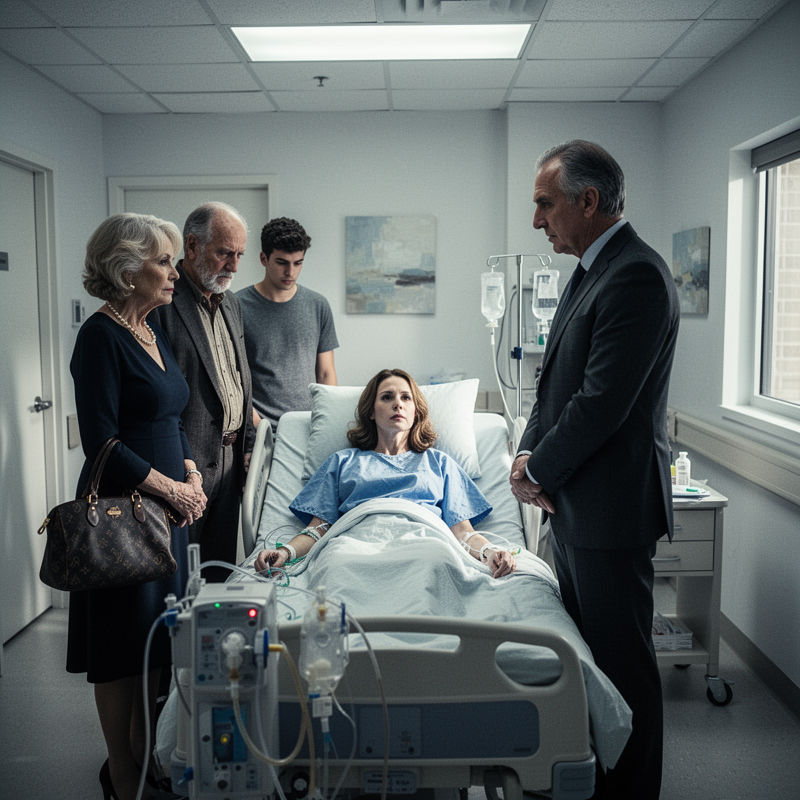
My landlord Carmine Falco stood at the foot of my hospital bed while I lay hooked to a kidney dialysis machine.
Beside him stood my mother, my father, and my younger brother Sean, all looking down at me.
They demanded I immediately sign over $250,000 of my life savings to fund Sean’s new business venture.
When I refused because I needed every penny for my organ transplant, my mother lost her temper.
She grabbed the heavy hospital blood pressure monitor from the wall mount and swung it straight at my head.
My father moved to block the window sightline so no medical staff in the hallway could see what was happening inside.
I knew right then that if I didn’t act within seconds, I would never leave that room alive.
The sterile white walls of Room 408 felt like a cage. The rhythmic hum of the dialysis machine was the only constant sound, a mechanical heartbeat keeping me tethered to life. Tubes snaked from my arm, feeding my blood through the cleansing filters.
My body felt heavy, weary, but my mind was sharp. Too sharp, perhaps, for the scene unfolding before me.
Carmine Falco, impeccably dressed in a dark, tailored suit that seemed out of place in the medical setting, loomed at the foot of my bed. His eyes, dark and unblinking, held a predatory stillness.
Beside him, my mother, Beatrice Devlin, stood with a forced smile that didn’t reach her eyes. She clutched a designer handbag, her knuckles white.
My father, Patrick, shifted uncomfortably, his gaze darting around the room, avoiding mine. He looked smaller, frailer than I remembered.
Sean, my younger brother, stood slightly behind them, fidgeting. A nervous energy vibrated around him, a mix of entitlement and desperate urgency.
They had burst in moments ago, bypassing the front desk, Carmine’s presence apparently enough to wave them through.
“Clara,” Carmine’s voice was low, smooth, yet carried an undeniable weight. “We need to talk. This can’t wait.”
I tried to push myself up, but the tubes held me fast. A wave of dizziness washed over me.
“I’m in the middle of a session,” I managed, my voice raspy. “Can’t this wait until tomorrow?”
Beatrice stepped forward, her smile tightening. “Don’t be dramatic, Clara. This is important. More important than your little nap.”
My “little nap” was a four-hour session of life support. The words stung, but I was used to it.
Carmine cut to the chase. “We need you to sign these papers, Clara.” He held up a thick manila folder. “A quarter of a million dollars.”
My breath hitched. “$250,000? What are you talking about?”
“For Sean’s new business venture,” Beatrice interjected, her voice rising slightly. “It’s a huge opportunity. He needs startup capital.”
Sean finally spoke, his voice strained. “It’s a sure thing, Clara. Just a temporary loan. I’ll pay you back. With interest!”
I stared at them, disbelief warring with a familiar sense of dread. “That’s my transplant fund,” I said, my voice barely a whisper. “Every penny. I need it for my new kidney. I’m on the accelerated donor list.”
A humorless laugh escaped Beatrice. “Transplant, schmant. You’ll get one eventually. Sean needs this *now*.”
Patrick finally found his voice, a weak mumble. “It’s Carmine’s money too, Clara. He’s invested. We can’t… we can’t let him down.”
My eyes flicked to Carmine. He hadn’t moved, but his gaze felt like a physical pressure. He was the conductor of this twisted symphony.
“That money is my life,” I repeated, louder this time. “It’s all I have. You know that.”
My refusal hung in the air, a stubborn barrier against their demands.
Beatrice’s face hardened. The forced smile vanished, replaced by a mask of cold fury. A flicker of something truly dangerous ignited in her eyes.
She looked around the room, her gaze settling on the wall beside my bed. The heavy, grey plastic blood pressure monitor, with its coiled black hose and cuff, was mounted securely there. It hummed softly, a stark contrast to the escalating tension.
With a sudden, furious jerk, she grabbed the monitor. The mounting bracket groaned, then ripped free from the wall with a sickening tear of plaster. Dust scattered.
The heavy device was now a weapon in her hand. Its rigid plastic casing and metal components gave it considerable weight.
“You selfish girl!” Beatrice shrieked, her voice echoing off the sterile walls. “Always about you! Sean’s future depends on this!”
She raised the monitor high, not pausing, not hesitating. Her arm, surprisingly strong, swung down in a swift, brutal arc.
I saw it coming, a blur of grey plastic and black tubing, but I was hooked to the machine, my body immobilized, my reflexes dulled by illness.
A sharp, searing pain exploded behind my left temple. My vision blurred, a kaleidoscope of white and black spots. A warm, sticky liquid immediately bloomed on my skin, trickling down my cheek.
A muffled cry escaped my lips. The monitor clattered to the floor beside the bed, the ripped wires sparking faintly for a moment.
Through the haze of pain, I saw Patrick. He wasn’t rushing to my side, wasn’t yelling at Beatrice. Instead, he moved swiftly, almost mechanically, toward the small window in my room.
He pressed his body against the glass, his broad back filling the frame. Anyone in the hallway, any passing nurse, would now see only his silhouette. The view into Room 408 was completely obstructed.
Carmine Falco stepped closer to my bedside. His face remained impassive, betraying no emotion. He simply watched the blood welling from my scalp, then picked up a pen from the small bedside table.
He pressed it into my shaking, unresponsive hand.
“Sign the papers, Clara,” he ordered, his voice still low, but now laced with a chilling finality. “Or this won’t be the worst thing that happens today.”
The metallic tang of blood filled my mouth. My head throbbed, a relentless drumbeat against my skull. The hum of the dialysis machine seemed to fade. All I could hear was the frantic pounding of my own heart.
They weren’t leaving. They weren’t going to stop.
My eyes, still swimming, darted to the small, red emergency call button mounted on the wall above my pillow, just an arm’s length away.
Part 2
My eyes, still swimming, darted to the small, red emergency call button mounted on the wall above my pillow, just an arm’s length away.
With a desperate, shaky hand, I lunged. My fingers, slick with blood from my temple, fumbled for a second, then slammed down on the cold plastic button.
A piercing, insistent alarm immediately shrieked through the room, cutting through the tense silence. It was a harsh, jarring sound, designed to demand immediate attention. The small red light on the button pulsed furiously.
Carmine Falco, who had been leaning over me with the pen, reacted with astonishing speed. His impassive mask shattered for a split second, replaced by a flicker of annoyance. He swiftly bent down, scooped up the blood pressure monitor from the floor, and, with practiced ease, shoved it behind the dialysis machine, out of sight.
His demeanor shifted instantly. When the door burst open and two nurses rushed in, their faces etched with alarm, Carmine was already composed. He looked distraught, but in a carefully controlled way.
“She had a seizure!” Carmine exclaimed, his voice laced with concern, his eyes wide. “A sudden, violent uremic seizure. She lashed out and hit her head on the blood pressure monitor.” He gestured vaguely towards where the device had been mounted, now just a torn patch of plaster.
The lead nurse, a stern woman named Ms. Jenkins, hurried to my side. She saw the blood on my temple, the frantic pulsing light of the alarm, and my dazed, struggling expression.
“Miss Devlin? Clara, can you hear me?” she asked, her voice calm but firm. She gently felt for a pulse on my neck.
I tried to speak, to refute Carmine’s outrageous lie. I opened my mouth, but no coherent words came out. My throat felt constricted, and the pain in my head made my thoughts a confused jumble. All I could manage was a guttural gasp, my eyes watering.
“See?” Carmine said, his voice quiet, almost mournful. “She’s disoriented. It was quite sudden.”
My mother and father, Beatrice and Patrick, exchanged a quick, almost imperceptible glance. Sean, looking relieved that attention had shifted, began to back away slowly, easing towards the door.
Ms. Jenkins, distracted by checking my vitals, didn’t notice their quiet exit. The family slipped away as Clara struggled to speak through her trauma.
CHAPTER 2: The Conservatorship Trap
The morning light through Room 408 was cold and gray. My dialysis machine hummed a steady, rhythmic pumps-per-minute cycle while the IV drip burned in my arm.
The door handle clicked open at 8:15 AM.
Carmine Falco stepped into the room wearing a tailored charcoal suit that smelled of damp wool and cigar smoke. He did not come alone. Beside him was a man in a rumpled brown trench coat carrying a manila legal accordion folder.
“You look terrible, Clara,” Carmine said, setting a heavy leather briefcase onto my bed tray table, crushing my untouched plastic cup of apple juice.
“Get out,” I whispered. My throat felt scraped raw from the oxygen tube they had removed hours earlier. “I told the nurses I don’t want you here.”
“The nurses answer to hospital policy, kiddo,” Carmine replied softly. He leaned over my bed, his calloused thumb pressing down on the plastic armrest of my mattress. “And policy changes when family steps in.”
The man in the trench coat pulled a stapled eight-page legal document from his folder.
“This is an emergency petition for temporary adult conservatorship,” the attorney said, his voice flat and clinical. “Signed draft pending before a county magistrate.”
“What are you talking about?” I rasped, pulling my left hand away from Carmine’s reach.
“Uremic toxic shock,” Carmine said, smiling without showing his teeth. “The blood tests from last night show elevated blood urea nitrogen and severe creatinine spiking. Your toxins are through the roof. You’re confused, Clara. You attacked your own mother with a blood pressure cuff yesterday.”
My breath hitched in my chest. “She hit me. You blocked the door.”
“That’s not what the family statement says,” Carmine said gently, patting my leg over the paper blanket. “Your mother, your father, and Sean all signed sworn affidavits. You had a violent uremic episode. You’re non-compos mentis. You can’t manage a quarter-million dollars in your condition.”
He unclipped a silver Montblanc pen from his breast pocket and laid it directly on my chest, right above my central venous catheter line.
“Sign the temporary transfer to your father,” Carmine ordered quietly. “Before the judge signs the conservatorship order and takes every penny anyway.”
I stared at the silver pen resting against my hospital gown.
A floor nurse carrying a tray of prepped syringes stepped past the open doorway. I didn’t hesitate. I slammed my right elbow hard against the stainless-steel bedside rail, creating a loud, echoing metal clang.
“Nurse!” I screamed with every ounce of air left in my failing lungs. “Nurse! Security!”
The nurse halted, her eyes widening as she saw Carmine leaning over my bed. Within ten seconds, two uniformed hospital security officers pushed into the room.
“Is there a problem here?” the lead officer asked, his hand resting near his belt.
“These men are harassing me,” I said, pointing a shaking finger at Carmine. “I am fully coherent. I want a red-flag restriction put on my chart right now. No visitors. No family. Nobody.”
Carmine slowly retrieved his pen from my chest, sliding it back into his pocket. He turned to the security guard with a calm, practiced shrug.
“We’re just worried about her mental state, officer,” Carmine said smoothly. “The toxins affect her head.”
“Out,” the lead guard said firmly, stepping between Carmine and my bed. “Now.”
Carmine looked back at me once before turning toward the door. His eyes were cold, dead glass.
“You have twenty-four hours to think about where this ends, Clara,” he whispered as he walked past the threshold.
CHAPTER 3: The Reporter’s Lead
By 2:00 PM, my fever had spiked to 101.4 degrees. The ward was quiet except for the squeak of rubber soles on tile and the distant ding of the elevator banks.
A woman with short dark hair, wearing a wet yellow raincoat and carrying a canvas messenger bag, walked past the nurse station. She paused outside Room 408, checking a small spiral notebook against the room number plaque.
“Clara Devlin?” she asked softly from the doorway.
I pulled my blanket up to my collarbone. “If you’re with Carmine or my parents, security is right outside.”
“I’m not with Carmine,” she said, stepping inside and pulling a press ID badge from her coat pocket. “My name is Sarah Lin. I’m an investigative reporter.”
I blinked, my eyes grainy with fatigue. “A reporter? I don’t have anything to say to the press.”
“I wasn’t looking for you,” Sarah said, dropping into the visitor chair beside my bed. “I was tracking municipal building code bribery in the Third Ward. Carmine Falco’s front company, Northside Holdings LLC, owns twelve residential buildings, including the one you live in on 14th Street.”
She flipped open her notebook.
“I monitor the precinct police blotters and hospital incident logs,” Sarah continued. “A code-orange patient disturbance flag was raised for this room last night at 11:30 PM. Carmine Falco’s name was on the visitor entry log.”
“He’s my landlord,” I said faintly.
“He’s more than a landlord,” Sarah said, leaning forward. Her eyes were sharp and focused. “He’s under informal surveillance by the Waterfront Organized Crime Task Force. They suspect his property management firm is a laundering vehicle for illegal sports bookmaking.”
She looked directly at my bruised forehead where my mother had struck me the night before.
“Why was a mob-linked slumlord standing over a kidney patient’s bed at midnight?” Sarah asked quietly.
I swallowed hard. The silence in the room felt heavy, almost dangerous.
“He wants my life savings,” I said, my voice barely audible above the machine hum. “Two hundred and fifty thousand dollars. Money I saved over fifteen years for a private organ donor transplant.”
Sarah froze, her pen poised over the paper. “Why does Carmine care about your savings?”
“My younger brother Sean owes him,” I said. “And Carmine told my parents that if I don’t sign the cash over to clear Sean’s debt, he’s going to destroy us.”
Sarah stared at me for a long moment before scribbling rapidly in her notebook.
“Your building on 14th Street,” Sarah said, looking up. “How long have you lived there?”
“Fifteen years,” I replied. “I’ve been the building manager since 2009. I collect the rent checks, clean the hallways, handle the boiler maintenance.”
Sarah leaned back in her chair, her face turning pale.
“Clara,” Sarah said slowly. “Carmine Falco doesn’t just want your savings to clear a debt. He wants you isolated so you can’t talk about how that building is run.”
CHAPTER 4: Family Re-Enforcements
At 6:00 PM, my cell phone buzzed violently on the bedside table. It was a video call notification from my apartment building’s smart doorbell system—an app I had installed five years ago on my phone.
I tapped the screen with a trembling thumb.
The live camera feed showed the dimly lit second-floor hallway outside my apartment door, Apartment 3B.
My Uncle Arthur was standing in front of my door holding an electric power drill. Beside him were two of my adult cousins, Tommy and Greg, carrying heavy steel toolboxes.
“What are they doing?” I whispered to the empty room.
On the screen, Uncle Arthur set the drill bit against my brass deadbolt casing. The high-pitched whine of metal grinding against metal came through my phone speaker. Within seconds, the old lock cylinder popped out of the wood frame, falling onto the hallway linoleum.
Tommy slid a heavy steel HASP bracket across the door seam, driving three-inch lag bolts directly into the door frame. Greg unclipped a massive yellow steel padlock, snapped it through the latch, and locked it tight.
They were locking me out of my own home.
My father, Patrick Devlin, stepped into the camera frame carrying two heavy plastic contractor trash bags stuffed full of paper files.
“Get all the file boxes from her closet,” Uncle Arthur shouted over the sound of the drill. “Carmine said every bank statement, every tax return, every lease record has to be out of the apartment before midnight.”
“What about her kidney medication?” my cousin Greg asked, holding up a clear plastic bin full of my prescription bottles. “The anti-rejection primers and hypertension pills?”
My father grabbed the bin of medication from Greg’s hands and unceremoniously dumped the bottles straight into a black trash bag.
“She doesn’t need them if she’s staying in the ward,” my father said coldly, his voice echoing through my phone speaker. “Carmine said if we clear her records out, the bank won’t have any paper trail to verify her signatures.”
“Dad!” I screamed into the phone microphone. “Dad, stop! That’s my medical documentation! Those are my bank records!”
My father paused for a fraction of a second, hearing my voice crackle through the small speaker on the smart doorbell camera mount. He looked directly at the lens.
His expression was hollow, devoid of any remorse. He reached up with his thumb and smashed the camera glass, cutting the feed to black.
I pulled the phone away from my face. My chest felt squeezed by an iron band. Every physical document I owned—my bank passbooks, my organ donor registry confirmation, my medical power of attorney drafts—was now in the hands of the people who were trying to destroy me.
CHAPTER 5: The Ledger of Debts
The rain came down in sheets against the windows of St. Jude’s Hospital. At 9:30 PM, Sarah Lin returned to my room, pulling off wet gloves and dropping a manila folder onto my lap.
“I found your brother,” Sarah said, her coat dripping water onto the floor tiles.
I looked up from my pillows. “Where?”
“A sports betting parlor on 5th Avenue,” Sarah replied, taking a breath. “A place called The Golden Cue. It operates out of the back room of a pool hall owned by one of Carmine Falco’s lieutenants.”
“Did you talk to him?”
“I confronted him in the alley while he was taking a smoke break,” Sarah said. She opened the folder, revealing a series of grainy telephoto photographs showing my brother Sean standing next to a tall, thick-set man in a leather jacket.
“Sean didn’t want to talk at first,” Sarah continued. “Then I showed him a photograph of Carmine standing in your hospital room. I told him I was writing a story for the paper about Carmine’s extortion racket, and that his name was going to be in the headline.”
“What did he say?” I asked, my blood running cold.
“Sean started crying, Clara,” Sarah said softly. “He admitted everything. He didn’t lose money on a ‘business venture.’ He’s been betting on college basketball and illegal dog fights for two years.”
She pointed to the photo of the thick-set man beside Sean.
“That’s Frankie ‘Pines’ Varga,” Sarah said. “He’s Carmine’s chief collector. Sean ran up a debt of one hundred and eighty thousand dollars six months ago. With compound interest and street vigorish, the debt hit exactly two hundred and fifty thousand dollars three weeks ago.”
I closed my eyes. The truth hit me like a physical blow.
“My savings,” I whispered. “It wasn’t for a new start for Sean. It was to pay off his mob tab.”
“It’s worse than that,” Sarah said, leaning in closer. “Sean didn’t just owe money to Carmine. Carmine owes money to his own syndicate bosses in Manhattan. Carmine is using Sean’s debt as an excuse to seize your private cash reserves to clear his own debt to the syndicate upper management.”
“They’re using my organ transplant fund as a mob bailout,” I said.
“Yes,” Sarah replied firmly. “And if you don’t sign that transfer, Carmine told Sean that Frankie Pines will dump him in the East River before the week is out.”
She looked at me intently.
“Your family isn’t just asking for your help, Clara. They’ve decided your life is worth less than Sean’s bad choices.”
CHAPTER 6: Cold Rooms and Cut Lines
At 7:00 AM the following morning, the ambient room noise changed. The low hum of the floor heating vents stopped dead, replaced by a sudden, metallic clanking inside the radiator pipes.
Within an hour, the temperature in Room 408 plummeted. The cold air rushed off the glass windowpanes, sinking into the room.
I shivered beneath my thin hospital blankets, my knuckles turning blue. Dialysis patients have notoriously poor thermoregulation, and within thirty minutes, my body was violently shaking.
I pressed the call button.
My primary nurse, a sharp woman named Nurse Jenkins, hurried into the room wearing a heavy wool fleece over her scrubs.
“What’s going on with the heat?” I asked, my teeth clicking together.
“It’s not just your room,” Nurse Jenkins said, her face grim as she checked my temperature with an infrared forehead scanner. “The entire East Wing outpatient recovery annex lost heating and hot water an hour ago. The main boiler valve in the basement failed.”
“Can’t the hospital fix it?”
“That’s the problem,” Nurse Jenkins said, looking around nervously before lowering her voice. “This recovery wing isn’t owned directly by St. Jude’s Medical Center. The physical building was purchased four years ago under a municipal lease-back program by a commercial entity named Annex Property Management.”
“Carmine Falco,” I whispered.
“The facilities manager for Annex called twenty minutes ago,” Nurse Jenkins said, wrapping a thick secondary thermal blanket around my shoulders. “They claimed a major pipe ruptured in the sub-basement. They said replacement parts have to be shipped from Chicago, and repairs won’t start until Monday.”
“That’s four days away,” I said. “I can’t survive four days in freezing temperatures while on dialysis.”
“The hospital administration is trying to transfer patients to the main building,” Nurse Jenkins said. “But all four hundred beds in the main tower are at capacity due to the winter flu outbreak. They’re telling us patients who can be discharged will have to go home.”
“I can’t go home,” I said, my voice trembling. “They padlocked my apartment.”
A quiet knock sounded at the door.
Uncle Arthur stepped into the icy room. He was wearing a heavy black parka and holding a thermos of coffee. He didn’t look at Nurse Jenkins. He walked straight to the side of my bed and dropped a fresh single-page document onto my cold blanket.
“Carmine says the heat turns back on ten minutes after you sign this wiring release,” Uncle Arthur said softly, his breath misting in the freezing air of my room. “Otherwise, the hospital discharges you into the street by noon.”
“Get out of here, Arthur,” I gasped, clutching the thermal blanket around my chest.
“Look at yourself, Clara!” Uncle Arthur hissed, leaning over me. “You’re dying anyway! You have end-stage renal disease! What do you need two hundred and fifty thousand dollars for? To buy a few extra months attached to a machine? Sean has his whole life ahead of him!”
“I spent fifteen years taking care of all of you,” I choked out, tears burning against my freezing cheeks. “Every single one of you.”
“And now it’s time to pay the family bill,” Uncle Arthur snapped. “Sign the paper, or die in the cold.”
CHAPTER 7: Behind the Radiator
By 2:00 PM, Sarah Lin had snuck past the ground-floor security barrier at my residential building on 14th Street.
She called my mobile phone from a low, hushed voice while standing on the third-floor fire escape platform outside my padlocked apartment window.
“I’m outside Apartment 3B,” Sarah whispered over the receiver. I could hear the whistle of the wind in the background. “The window latch on your kitchen window is rusted out. I can pop it open with a putty knife.”
“Be careful,” I said, my voice weak from the room’s lingering chill. “If Carmine’s workers see you, they’ll call the police.”
“I’m in,” Sarah said after a brief metallic snap.
The phone audio picked up the squeak of her rubber boots stepping onto my kitchen linoleum.
“The place is trashed, Clara,” Sarah reported, her tone rising in anger. “They flipped your mattress, tore open every cabinet in the living room, and took every document from your desk drawers. They were looking for financial records.”
“Did they leave my backup medical folder?” I asked. “The blue plastic folder in the hall closet?”
“It’s gone,” Sarah said. “They cleared the entire closet out.”
I heard her footsteps moving down the narrow hallway toward my bedroom.
“Wait,” Sarah said suddenly. The rustle of her coat stopped.
“What is it?” I asked, sitting up as much as my IV lines would allow.
“The floorboard next to the cast-iron radiator in your bedroom,” Sarah said. Her voice was focused, methodical. “The wood molding along the baseboard is warped. There’s fresh sawdust on the floor.”
“I haven’t moved that radiator in ten years,” I said.
“They tried to pry the radiator away from the wall to look for cash,” Sarah said. “When they pulled the iron casing back, they cracked the old pine wallboard behind it.”
The audio picked up the heavy scrape of wood being shifted.
“There’s a hollow wall compartment behind the radiator heat shield,” Sarah said, her voice dropping to a sharp whisper. “It’s lined with old tar paper.”
“What’s inside?”
“An old manila document envelope,” Sarah said. I heard the sound of paper tearing open. “It’s covered in heavy black coal dust. The postmark date on the corner stamp is October 14, 1998.”
My heart began to hammer against my ribs. “1998? That was before Carmine bought the building.”
“Clara,” Sarah said, her breath catching in her throat as she unfolded a thick, handwritten sheet of paper. “This isn’t a bank statement. It’s a formal handwritten statement signed by Arthur Pendelton.”
“Arthur Pendelton?” I repeated, searching my memory. “The man who owned the building before Carmine?”
“The man who disappeared twenty-six years ago,” Sarah corrected her voice trembling with excitement. “And Clara… this letter isn’t about rent money.”
CHAPTER 8: The Ghost Deed
“Read it to me,” I said, my hand gripping the phone so tightly my knuckles turned white.
Sarah’s voice came through the speaker, clear and precise, reading the handwritten script from October 1998:
“‘To whoever finds this document: My name is Arthur Pendelton, legal owner of the residential property at 412 East 14th Street. For six months, Carmine Falco and his associates have subjected me to continuous extortion, threatening to burn this property to the ground with thirty tenants inside if I do not sign over the master deed to Northside Holdings LLC for zero consideration.’”
Sarah took a sharp breath before reading the next paragraph.
“‘Yesterday, October 13, 1998, Carmine Falco brought two armed enforcers to my basement office. They forced me at gunpoint to sign a blank property transfer deed. Carmine stated that once the deed was recorded at the county registrar, I would be buried beneath the concrete foundation of the new commercial garage on 8th Avenue.’”
“My God,” I whispered. “Pendelton didn’t abandon the building. Carmine murdered him.”
“‘I am hiding this original duplicate letter and my certified original land grant title behind the radiator wall panel in Apartment 3B,’” Sarah continued reading. “‘If I am missing or dead when this letter is discovered, let it serve as proof that Carmine Falco holds no legal title to this building, and that any deed filed under his name is a forged instrument derived from murder.’”
Silence stretched over the phone line.
“Is the original land grant title in the envelope?” I asked.
“Yes,” Sarah said, her paper rustling. “It’s an official blue-ribbon municipal title deed dated 1982, stamped by the city clerk, naming Arthur Pendelton as the sole legal owner.”
“Carmine never owned the building,” I realized out loud. “For twenty-six years, he’s been collecting rents, taking out commercial mortgages, and using this property as collateral for his mob syndicate… on a forged deed.”
“And you’ve been managing the building for fifteen years,” Sarah added. “Which means every lease you had tenants sign, every maintenance contract, every rent payment Carmine processed through his corporate bank accounts was built on an illegal land grab.”
“If this letter goes to the authorities,” I said, “Carmine doesn’t just lose my two hundred and fifty thousand dollars. His entire property empire collapses, and he goes away for first-degree murder.”
“I’m taking high-resolution photos of these documents right now,” Sarah said. “And then I’m walking straight to my editor’s desk at the newspaper.”
“Sarah, be careful,” I warned. “Carmine killed Pendelton for that paper.”
“He doesn’t know we have it,” Sarah replied grimly. “Not yet.”
CHAPTER 9: Spiked Headlines
By 11:00 AM the following morning, Sarah Lin sat at her cubicle in the newsroom of the city daily paper, typing furiously.
Her front-page draft headline read: *THE GHOST OF 14TH STREET: HOW A MOB LANDLORD STOLE A PROPERTY EMPIRE AND COVERED UP A 1998 MURDER.*
She attached digital scans of Arthur Pendelton’s handwritten confession, the 1982 original title deed, and municipal records showing Carmine’s corporate entities.
At 1:30 PM, her desk phone rang. It was the executive editor, Arthur Vance.
“Lin,” Vance’s voice was clipped over the intercom. “My office. Now.”
Sarah grabbed her hard-copy file and walked down the glass-walled corridor into the editor’s spacious corner office.
Vance wasn’t alone.
Sitting on the leather sofa across from Vance’s desk was a man in a navy three-piece suit—Carmine Falco’s chief corporate attorney, Richard Sterling.
“Sit down, Sarah,” Vance said, without looking up from his computer screen.
Sarah remained standing. She looked at Sterling, who smiled faintly and took a slow sip from a porcelain coffee mug.
“I submitted the Falco investigative draft to the desk two hours ago,” Sarah said directly to Vance. “It’s fully sourced. We have forensic document verification on Pendelton’s signature.”
“The story is spiked,” Vance said flatly.
Sarah took a step forward. “What? What are you talking about? That letter proves a twenty-six-year-old murder and multi-million-dollar housing fraud!”
“That letter is an unverified piece of paper found in a private apartment during an illegal trespass,” Sterling said smoothly from the sofa. “Miss Lin broke into Apartment 3B through a fire escape window. That’s breaking and entering, burglary, and spoliation of private property.”
“I had permission from the tenant, Clara Devlin!” Sarah snapped.
“Clara Devlin does not own the building,” Sterling replied, leaning back. “And according to a temporary emergency legal filing submitted to the probate court this morning, Miss Devlin is currently suffering from severe uremic encephalopathy. She lacks the legal capacity to grant entry to anyone.”
Sarah turned her eyes back to her editor. “Arthur, you can’t let him do this. Look at the land grant title! Carmine Falco forged the transfer!”
“The newspaper’s board of directors received a formal legal notice thirty minutes ago, Sarah,” Vance said, his voice cold and flat. “If we publish one word of this story, Northside Holdings will file a fifty-million-dollar libel suit against this paper. Furthermore, they will press criminal trespass charges against you personally.”
“You’re letting a mob killer buy your silence!” Sarah yelled, her face flushed with anger.
“Hand over your press pass, Sarah,” Vance said, pointing to the desk. “You’re suspended without pay, effective immediately. Leave your notebook and flash drives on my desk, or security will escort you from the building.”
Sarah stared at her editor, her chest heaving. She reached down, unclipped her brass press badge, and slammed it onto the oak desk.
“You can spike the story in the paper, Vance,” Sarah said, looking Sterling dead in the eye. “But you can’t spike what’s coming next.”
CHAPTER 10: A Mother’s Tearful Confession
At 2:15 AM, the heavy wooden door to Room 408 creaked open.
I awoke instantly, my heart hammering against my ribs. The room was dark, save for the green ambient glow of the dialysis monitor screen.
A small figure stepped through the darkness toward my bed, wrapped in a dark winter coat.
“Clara?” a broken voice whispered.
It was my mother, Beatrice Devlin. Her eyes were red and swollen, her gray hair tangled and unbrushed. She looked shrunken, stripped of the furious aggression she had shown two nights ago when she struck me with the blood pressure monitor.
“Get away from me,” I said, pulling the emergency nurse call pendant toward my fingers.
“Don’t press it, please,” my mother sobbed, dropping to her knees beside my hospital mattress. She reached out with shaking hands, trying to touch my blanket, but I pulled away. “Please, Clara… just listen to me for two minutes.”
“You hit me, Ma,” I said, my voice cold and hard as ice. “You blocked the room while Carmine tried to rob me.”
“He was going to kill Sean!” Beatrice cried out, burying her face in the hospital sheets. She was shaking violently, wet tears soaking through the thin cotton fabric over my feet. “He brought two men to our house on Tuesday night, Clara! Two men with guns!”
I froze, my fingers resting on the plastic call button.
“What are you talking about?” I asked.
“Carmine sat in our kitchen,” Beatrice wept, looking up at me with terrified, bloodshot eyes. “He put a heavy black revolver on the kitchen table right next to the salt shaker. He told your father that Sean owed two hundred and fifty thousand dollars to a syndicate group in Brooklyn.”
She grabbed the edge of my bedframe, her knuckles turning white.
“Carmine said if the debt wasn’t cleared by Friday at midnight, Frankie Pines would bring Sean to an abandoned warehouse in Red Hook and shoot him in the back of the head,” Beatrice whispered. “And then he said… he said he’d burn down our house while your father and I were sleeping inside.”
“So you came here to attack me instead?” I said, my voice trembling with bitter disgust.
“Carmine told us you had the money!” Beatrice screamed quietly, her voice cracking. “He said you were sitting on two hundred and fifty thousand dollars in cash that you didn’t even need! He said you were dying anyway, Clara! He said your kidney disease was terminal, and that keeping that money was selfish when it could save your brother’s life!”
“It’s my transplant money, Ma!” I yelled back, tears spilling over my lashes. “It’s my life! You wanted me to die so Sean could pay off his gambling debts!”
“We were scared!” Beatrice sobbed, grabbing her hair with both hands. “We didn’t know what else to do! Carmine said if we didn’t help him force you to sign, he’d kill all of us!”
I looked down at my mother kneeling on the linoleum floor. For fifteen years, I had paid their bills, fixed their home, managed their lives, and sacrificed every personal ambition I had to keep the family comfortable.
And when a monster came to their door, they didn’t protect me. They handed me over as the sacrifice.
“Get up, Ma,” I said, my voice dead and emotionless.
“Clara, please…”
“Get up and get out,” I said, looking away from her toward the dark window. “Because if you don’t leave this room right now, I’m calling the police and reporting the threat on Sean’s life myself.”
Beatrice stood up slowly, wiping her wet face with her coat sleeve. She looked at me with a mix of terror and shame, turned, and disappeared into the dark hallway.
CHAPTER 11: The Account Freeze
At 9:00 AM on Friday morning, a young woman wearing a sharp gray suit walked into my hospital room carrying a thick white binder. She was accompanied by a representative from the St. Jude Medical Center financial billing office.
“Clara Devlin?” the woman in the suit asked.
“Yes,” I said, sitting up straight in bed.
“My name is Assistant Registrar Karen Walsh from the County Civil Probate Court,” she said formally. “I am here to serve you with an emergency judicial freeze order issued under Docket Number 88-410-C.”
She handed me a stamped legal document.
I scanned the top lines of the paper. My name was bolded at the top, right beneath the header: *IN RE: TEMPORARY RESTRAINT OF ASSETS AND FINANCIAL ACCOUNTS OF CLARA DEVLIN.*
“What is this?” I asked, my hands beginning to shake.
“A petition was filed at 8:00 AM today by Northside Holdings LLC and attorney Richard Sterling,” the billing clerk explained, her tone completely devoid of sympathy. “The filing presents sworn affidavits from your immediate family asserting that two hundred and fifty thousand dollars currently held in your private savings account at First National Bank of Brooklyn represents co-mingled property management funds originating from Northside Holdings.”
“That’s a lie!” I shouted, dropping the paper onto my lap. “Every dollar in that account came from my personal salary over fifteen years! I worked as a property manager! I paid income taxes on every cent!”
“The court has issued an ex-parte temporary administrative freeze pending an evidentiary hearing in three weeks,” Registrar Walsh said flatly. “All liquid funds in account ending in 4092 are frozen immediately. No withdrawals, wire transfers, or cashier’s checks can be issued.”
The billing clerk stepped forward, opening her binder.
“Because your primary savings account is frozen, Clara,” the billing clerk said, “the private organ donor registry payment of forty-five thousand dollars due to the Regional Transplant Consortium today cannot be processed.”
“No,” I whispered, the blood draining from my face. “No, no, no.”
“Your status on the regional private donor list has been suspended,” the clerk continued, pulling a red pen across her form. “You have been moved off the active private match queue and transferred back to the general public assistance waitlist.”
“The public waitlist is six years long!” I cried out, grabbing the edge of the clerk’s sleeve. “I don’t have six years! My kidney function is under six percent!”
“Until the legal freeze on your bank account is lifted by a probate judge, St. Jude’s cannot advance private donor reservation fees,” the clerk said, pulling her sleeve out of my grip. “I’m sorry. It’s hospital policy.”
They turned and walked out of the room, leaving me alone in the cold silence.
Carmine didn’t need to force me to sign the paper anymore. By freezing my account, he had stripped away my transplant, guaranteeing that time would finish the job for him.
CHAPTER 12: Crossing to the Feds
At 11:30 AM, Sarah Lin pulled her vintage sedan into the underground parking garage of the Federal Building on Cadman Plaza in downtown Brooklyn.
She carried a thick leather briefcase containing the original 1998 Pendelton confession letter, the original 1982 land grant title, her photograph evidence of Sean’s gambling debts, and six months of audited rent roll records she had collected from former tenants on 14th Street.
She took the elevator to the 6th floor: *OFFICE OF THE UNITED STATES ATTORNEY — EASTERN DISTRICT OF NEW YORK.*
Ten minutes later, she was sitting in a windowless conference room across from Assistant United States Attorney David Kravitz and FBI Lead Special Agent Marcus Brody.
Kravitz was a sharp, razor-thin prosecutor in his late thirties with dark circles under his eyes. Agent Brody was a broad-shouldered man wearing a worn tweed jacket and holding a steaming paper cup of black coffee.
“Miss Lin,” Kravitz said, looking at Sarah’s press credentials on the table. “Your paper notified us an hour ago that you were suspended. Why are you coming to federal prosecutors?”
“Because my paper was threatened by Carmine Falco’s attorneys,” Sarah said directly. “And because municipal police won’t touch this case. Carmine has three precinct commanders on his payroll.”
She unzipped her briefcase and laid Arthur Pendelton’s dust-covered 1998 envelope on the center of the mahogany table.
“What is this?” Agent Brody asked, setting down his coffee cup.
“This is the written murder confession and property title that Carmine Falco killed Arthur Pendelton for twenty-six years ago,” Sarah said.
Kravitz pulled on a pair of clear latex gloves, reached into the envelope, and carefully unfolded the fragile, yellowed paper. He read the handwritten script in silence for five full minutes, his eyes moving back and forth across the lines.
Agent Brody leaned over Kravitz’s shoulder, scanning the text.
“Jesus,” Brody muttered under his breath. “Pendelton. We opened a missing person file on Pendelton back in November 1998. We always suspected Falco buried him, but we never found a body or a paper trail.”
“Is this legally admissible?” Sarah asked Kravitz.
“It’s an ancient document under Federal Rule of Evidence 803(16),” Kravitz said, his eyes gleaming with sudden intensity. “Found in a natural place of custody, over twenty years old, free from suspicion of alteration. Combined with the original blue-ribbon 1982 title deed? This is a bomb, Miss Lin.”
Kravitz looked up at Sarah.
“Carmine Falco isn’t just a slumlord,” Kravitz said. “He’s a targeted lieutenant in the Bonanno crime family’s Brooklyn extortion racket. We’ve been trying to pin a federal Racketeer Influenced and Corrupt Organizations—RICO—charge on him for three years, but we lacked the predicate enterprise predicate act.”
“A twenty-six-year-old land-grab murder verified by a handwritten confession is your predicate act,” Sarah said.
“Where is the witness who manages this building now?” Agent Brody asked, pulling out a small notepad.
“Her name is Clara Devlin,” Sarah said. “She’s lying in Room 408 at St. Jude’s Hospital, dying of renal failure, while Carmine and her family try to steal her life savings.”
Kravitz stood up instantly, buttoning his suit jacket.
“Marcus,” Kravitz said to Agent Brody. “Get a federal magistrate on the phone right now. We need emergency search warrants for Carmine’s commercial headquarters on 8th Avenue before he realizes what Miss Lin found behind that radiator.”
CHAPTER 13: Smoke and Search Warrants
At 3:15 PM, three black unmarked FBI SUVs pulled up onto the sidewalk outside Northside Holdings LLC’s commercial headquarters on 8th Avenue.
Inside the second-floor executive office, Carmine Falco stood by a wide tinted window, looking down at the street. His phone rang. It was his lookout stationed on the ground floor.
“Boss,” the lookout shouted through the speaker. “Feds! Federal agents with a battering ram! They’re coming up the front stairs!”
Carmine slammed the phone down. His face flushed deep purple.
“Frankie!” Carmine roared, turning toward his chief enforcer sitting in the corner. “The furnaces! Now!”
Frankie Pines grabbed two heavy metal cans of industrial lighter fluid from a utility closet. Carmine ran to his wall safe, spun the dial rapidly, and yanked the heavy door open, grabbing armfuls of paper ledgers, cash transaction receipts, and handwritten bookmaking ledgers.
They ran down the back spiral staircase into the windowless basement furnace room.
The large industrial coal-and-oil furnace roared in the center of the concrete floor, its red heat glowing through the iron grate vents.
“Burn everything!” Carmine screamed, dumping thirty years of off-the-books syndicate financial ledgers straight into the roaring flames. “Burn the cash sheets! Burn the property records!”
Above them, the heavy iron security doors on the first floor splintered open with a thunderous crash.
“FBI! Federal Search Warrant!” echoed down the stairwell. “Stay where you are!”
Frankie Pines doused a stack of property transfer deeds in lighter fluid and threw them into the open furnace door. Black smoke erupted into the basement room, filling the air with choked, acrid chemical fumes.
“Clear the office safe!” Carmine yelled, shoving another thick binder of forged land titles into the fire. “If they don’t have paper ledgers, they don’t have a RICO case!”
A heavy steel door at the top of the basement stairs was smashed open with an iron sledgehammer.
Agent Marcus Brody descended the concrete stairs, his Glock 19 drawn and pointed straight at Carmine’s chest. Ten heavily armed FBI SWAT agents poured into the basement behind him, their weapon tactical lights cutting through the thick black smoke.
“Get your hands up! On the floor! Face down right now!” Brody shouted, his voice ringing out over the sound of the roaring fire.
Frankie Pines dropped his lighter fluid can and raised his hands immediately, dropping to his knees.
Carmine stood over the open furnace door, his face covered in soot, a thick stack of burning paper held in his right hand. He looked at Agent Brody with a sneer and tossed the burning papers directly into the center of the flames.
“You’re too late, Brody,” Carmine laughed, coughing through the black smoke as iron handcuffs slammed around his wrists. “Paper burns. Everything burns.”
Brody stepped forward, pointing his weapon at Carmine’s head, while two agents rushed past with heavy chemical fire extinguishers, blasting freezing white foam into the furnace belly.
“You burned your ledgers, Carmine,” Agent Brody whispered in his ear, pulling his hands roughly behind his back. “But you didn’t burn what we found behind the radiator on 14th Street.”
Carmine froze. The smug grin vanished from his face, replaced by a sudden, terror-filled pale shock.
CHAPTER 14: The Grand Jury Risk
At 8:00 AM on Monday morning, a specialized medical transport van parked outside the United States District Courthouse in downtown Brooklyn.
Inside the van, I sat in an adjustable wheelchair, wrapped in three heavy wool blankets. Beside me sat Nurse Jenkins, monitoring a portable intravenous dialysis pump connected to my arm graft.
My doctor had explicitly warned me two hours earlier: leaving the hospital ward in my weakened state carried an extreme risk of septic shock, cardiac arrest, or fatal kidney failure.
“Clara,” Nurse Jenkins said gently, holding an oxygen mask over my face. “Your blood pressure is 85 over 50. If you feel dizzy or faint for one second, we stop and go straight back to the ICU.”
“No,” I rasped through the plastic mask. “We go inside.”
The van doors opened. Sarah Lin and Assistant US Attorney David Kravitz were waiting at the ramp with two federal marshals.
They wheeled me up the granite steps, past rows of flashing news cameras and shouting reporters, straight into the private elevator leading to the 4th-floor Grand Jury suite.
The double doors opened to reveal a large, circular oak court chamber filled with twenty-three grand jurors sitting in tiered seats.
At the front table sat Carmine Falco, wearing a orange federal inmate jumpsuit, his hands restrained by waist chains. Beside him sat his attorney, Richard Sterling. On the far side of the room sat my mother, my father, and my brother Sean, all guarded by federal marshals.
Kravitz stood up before the grand jury.
“The United States calls Clara Devlin,” Kravitz declared.
They wheeled my chair to the center of the room, right in front of the jury box. Nurse Jenkins adjusted my IV line, hanging a fresh saline bag on the portable metal pole beside me.
I looked directly at Carmine Falco. He glared back at me, his jaw clenched tight, his eyes burning with silent fury.
“Miss Devlin,” Kravitz said gently. “Can you state your name and your relationship to the defendant, Carmine Falco?”
“My name is Clara Devlin,” I said, my voice quiet but trembling with unmistakable strength. “For fifteen years, I was the property manager at 412 East 14th Street. Carmine Falco was my landlord.”
For the next ninety minutes, I laid out everything.
I testified about the fifteen years of cash rent collections Carmine forced me to process without receipts. I testified about his illegal wiretapping of tenant apartments, his threats of violence against elderly residents who complained about lack of heat, and his mob collection network operated out of the basement.
Then, I turned my head and looked directly at my family.
“I testify under oath,” I said, my tears falling onto my hospital gown, “that on Thursday night, my mother Beatrice Devlin physically assaulted me in my hospital bed while my father Patrick Devlin blocked the door view. They did this under the instruction of Carmine Falco to extort two hundred and fifty thousand dollars of my life savings to pay off my brother Sean’s illegal mob gambling debts.”
A loud collective gasp echoed across the grand jury chamber.
Several grand jurors leaned forward, taking rapid notes, their faces twisted in horror and disgust.
Carmine’s attorney slammed his pen onto the table, jumping to his feet. “Objection! The witness is severely ill and medically incompetent!”
“This is a grand jury proceeding, Mr. Sterling,” the foreperson snapped immediately. “Sit down.”
I leaned forward in my wheelchair, looking Carmine dead in his eyes.
“For fifteen years, you made me feel like I was your property,” I said softly, every word ringing out in the silent room. “You made my family believe that loyalty meant destruction. But today… nobody owns me.”
CHAPTER 15: The Lockbox in the Ashes
While my grand jury testimony was wrapping up on the 4th floor, FBI forensics specialists were still sifting through the flooded, ash-covered basement floor of Northside Holdings LLC on 8th Avenue.
Agent Marcus Brody stood in the damp basement air, illuminated by heavy halogen work lights set up in the corners.
A forensic technician using a heavy metal detector moved his sensor head across the flooded concrete slab beneath the charred furnace foundation.
The detector emitted a high-pitched, continuous iron signal.
“Agent Brody!” the technician shouted. “We’ve got something dense three feet beneath the ash pit floor.”
Brody walked over, holding a flashlight. “Break it open.”
Two agents used electric jackhammers to shatter the six-inch layer of concrete directly beneath the furnace burner plate. Beneath the broken stone lay a heavy, fireproof, quarter-inch steel lockbox bolted directly into the bedrock foundation.
The technicians used a hydraulic jaw spreader to pop the heavy steel lock mechanism.
Inside the lockbox, protected by thick asbestos heat shields, was a pristine leather ledger and a sealed, notarized document envelope dated November 2, 1998.
Agent Brody pulled on yellow latex gloves and carefully lifted the sealed envelope out of the steel box.
The red wax seal on the flap bore the thumbprint stamp of Sal “The Barber” Tesauro—Carmine Falco’s original senior mob partner who had died in federal prison in 2005.
Brody unsealed the envelope and pulled out a four-page notarized affidavit.
“What is it, Marcus?” an assistant agent asked, leaning over his shoulder.
“It’s Carmine’s insurance policy,” Brody said, his eyes widening in utter disbelief. “Sal Tesauro made Carmine sign a full written murder confession before the syndicate agreed to back his fraudulent deed for the 14th Street property in 1998.”
Brody read the notarized text out loud in the quiet basement:
“‘I, Carmine Falco, hereby acknowledge that on October 14, 1998, I personally suffocated Arthur Pendelton in the basement office of 412 East 14th Street after forcing him to execute a blank land deed. I dumped his body in the concrete slurry pour for the foundation pier of the 8th Avenue garage. This affidavit is held in trust by Sal Tesauro to ensure complete financial compliance with syndicate distribution rules.’”
Brody looked up at the halogen lights, a slow, triumphant grin spreading across his face.
“Carmine tried to burn his current paper ledgers today,” Brody said, holding the notarized murder confession high in the air. “But twenty-six years ago, his own mob boss made sure he kept the paper that sends him to the electric chair.”
CHAPTER 16: The Cost of Conviction
Three days later, United States District Court Judge Thomas Callahan presided over the formal indictment hearing in Courtroom 9B.
The courtroom was packed to absolute capacity—reporters, federal agents, city officials, and members of the public filled every wooden bench.
Assistant US Attorney David Kravitz stood before the bench holding two clear plastic evidence bags.
In his left hand was the 1998 Pendelton letter retrieved by Sarah Lin behind the radiator. In his right hand was the notarized mob confession letter recovered from the furnace lockbox by Agent Brody.
“Your Honor,” Kravitz announced, his voice echoing off the high marble walls. “The United States formally unseals Exhibit A and Exhibit B—the complete, written murder confessions of Carmine Falco, detailing the 1998 execution of Arthur Pendelton and twenty-six years of systematic RICO predicate racketeering.”
Carmine Falco sat at the defense table, his head slumped into his hands. Beside him, his attorney Sterling sat motionless, unable to offer a single legal defense against his client’s own notarized thumbprint signature.
“The court finds these documents fully unsealed, verified, and legally binding,” Judge Callahan ruled, slamming his gavel down. “Bail for Carmine Falco is revoked permanently.”
Then, Kravitz turned to face the bench again, his expression darkening with a somber, painful solemnity.
“Your Honor,” Kravitz said slowly. “There is a secondary statutory matter regarding the co-mingled enterprise assets.”
I sat in my wheelchair in the front row of the spectator gallery, Nurse Jenkins holding my hand.
“During our forensic audit of Northside Holdings LLC,” Kravitz explained to the judge, “federal auditors discovered that the two hundred and fifty thousand dollars held in Clara Devlin’s private savings account was deposited over fifteen years via direct monthly payroll transfers from Northside Holdings’ primary commercial account.”
My heart stopped. “What?” I whispered.
“Under Title 18, United States Code, Section 1963—the Federal Civil RICO Forfeiture Statute,” Kravitz continued, his voice trembling slightly as he looked back at me, “all funds, assets, and capital derived from or co-mingled with a verified criminal enterprise are strictly subject to mandatory federal forfeiture.”
“Mr. Kravitz,” Judge Callahan interjected, looking down from the bench with concern. “Miss Devlin is the victim of this extortion scheme. That money represents her personal savings for a vital organ transplant.”
“I understand, Your Honor,” Kravitz said, his head bowed. “And it breaks my heart. But Carmine Falco’s legal defense team has already filed a technical appeal motion arguing that if the court exempts Miss Devlin’s account from civil forfeiture, it creates a fatal procedural loophole that invalidates the overall RICO asset seizure chain.”
Kravitz walked over to my wheelchair and dropped to one knee beside me.
“Clara,” Kravitz whispered, tears brimming in his eyes. “If we fight the forfeiture to save your two hundred and fifty thousand dollars, Carmine’s attorneys will use that technicality to challenge the entire RICO indictment on appeal. He could walk free on a procedural mistrial in eighteen months.”
He pulled a single piece of federal asset forfeiture paperwork from his folder and laid it on my lap.
“To guarantee that Carmine Falco receives a non-appealable life sentence without parole,” Kravitz said, “you must voluntarily surrender your entire two hundred and fifty thousand dollars to federal civil forfeiture. Uncompensated. You will get nothing back.”
The entire courtroom fell completely silent.
I looked across the aisle at Carmine Falco. For the first time, Carmine was looking at me with a spark of desperate hope in his eyes—hoping I would refuse, hoping I would choose my money, hoping I would leave him a procedural door to escape.
I looked down at the paper on my lap. Two hundred and fifty thousand dollars. Every shift I worked, every apartment floor I scrubbed, every dollar I saved to buy myself a second chance at life.
Without that money, I would never afford a private organ transplant. I would remain on the public waitlist, dependent on public health clinics, living in poverty until my body gave out.
I looked back at Carmine.
I picked up the black ballpoint pen from Kravitz’s hand.
With a firm, steady hand, I signed my name across the bottom line of the federal forfeiture surrender form: *Clara Devlin.*
I pushed the paper back into Kravitz’s hands.
“Lock him up,” I said.
CHAPTER 17: The Verdict and Aftermath
Six weeks later, the final sentencing proceedings concluded in Federal District Court.
Judge Callahan read the final judgments from the bench with brutal, unyielding finality.
Carmine Falco was convicted on all counts: First-Degree Murder, Federal RICO Conspiracy, Extortion, Deed Forgery, and Witness Tampering. He was sentenced to life imprisonment without the possibility of parole, to be served at ADX Florence Federal Supermax Penitentiary in Colorado. His entire forty-million-dollar real estate empire was permanently seized by the US Marshals Service and liquidated.
Then came the second row of the defense table.
My mother, Beatrice Devlin, my father, Patrick Devlin, and my brother, Sean Devlin, were all convicted of Federal Extortion Conspiracy and Complicity in Mob Asset Laundering.
Sean was sentenced to eight years in federal prison. My father received four years. My mother received three years of federal incarceration.
Their family home in Brooklyn, which had been put up as secondary loan collateral to Carmine’s fronts, was foreclosed upon and sold at auction by the federal government to satisfy enterprise fines. They lost everything. Every house, every car, every dollar. They were rendered completely penniless.
I sat in the back row of the courtroom gallery as the federal marshals lined them up in handcuffs.
As my mother was led past my row, she stopped, her face thin and pale, her wrists chained to her waist. She looked at me through a haze of tears.
“Clara…” Beatrice sobbed, reaching out her hand as far as the steel chain would allow. “Clara, please… we’re your family. Don’t leave us like this. Help us.”
I sat perfectly still in my wheelchair.
I didn’t speak. I didn’t nod. I didn’t cry.
I looked past her, staring straight at the empty wooden bench ahead of me until the heavy wooden doors closed behind them, cutting off the sound of her crying forever.
Sarah Lin walked up beside my wheelchair, placing a warm hand on my shoulder. She had been fully reinstated at a national news magazine, her investigative piece winning a national press award.
“Where will you go, Clara?” Sarah asked softly. “The government seizure of the 14th Street building means everyone has to relocate by the end of the month.”
I looked out the high arched windows of the courthouse toward the distant harbor horizon.
“Somewhere far away from Brooklyn,” I said. “Somewhere where nobody knows my name.”
CHAPTER 18: A Room Overlooking the Water
A long time later.
The morning sun rises over the grey Atlantic Ocean, sending streaks of gold across the salt-crusted windowpane of a small ground-floor rented room in a quiet coastal town in Maine.
The room is very small—barely twelve feet by twelve feet. It holds a single twin bed, a small wooden desk, a worn rocking chair, and a single black leather suitcase sitting in the corner containing everything I own in this world.
I have no bank savings. I have no property. I have no family who calls me, and no inheritance waiting for me anywhere on earth.
Every Monday, Wednesday, and Friday at 6:00 AM, I walk three blocks down the hill to the County Public Health Clinic. I sit in a vinyl armchair for four hours while a public assistance dialysis machine cleans my blood, keeping my failing body alive one more day at a time while I wait on the six-year public donor list.
I live on a modest monthly disability stipend that covers my rent and plain tea.
I sit in my wooden rocking chair by the open window, feeling the cold sea breeze blow across my face.
The air smells of pine, salt water, and absolute silence.
I spent fifteen years being a caretaker for people who viewed my existence as a resource to be consumed. I spent a quarter of a million dollars to buy my freedom from the monsters who thought they owned my life.
I traded my savings and my family’s approval for a small room by the sea and a quiet conscience. I may be dying on a public donor list, but for the first time in my life, nobody owns me.
Leave a Reply