CHAPTER 1: Whispers in Ward Four
Part 1
On Easter Sunday, my 21-year-old daughter Chloe called me from a restricted hospital ward, whispering that she was being secretly subjected to dangerous off-label drug injections.
Her mother—my ex-wife and former medical partner Dr. Eleanor Kincaid—had put her under an involuntary medical hold to conceal severe liver failure caused by an unauthorized clinical trial.
When I rushed to the hospital to demand her release, Eleanor had me physically escorted from the premises by security and threatened me with immediate arrest.
I was a disgraced surgeon, eighteen months sober and working a minimum-wage intake job, with no legal power to fight her multi-million-dollar health network.
All I had left was an old locked briefcase in my trunk containing the original dissolution records of our former practice.
And I was about to open it.
The phone slipped from my grasp, clattering against the dashboard of my beat-up sedan. Chloe’s frantic whisper still echoed in my ears. Dangerous off-label drugs. Liver failure. Ward 4B.
Eleanor.
The name tasted like ash. My ex-wife, Dr. Eleanor Kincaid, the woman who had built her empire on the ashes of my career, was holding our daughter captive.
I slammed the car into drive. The old engine coughed, then roared to life, spitting gravel as I peeled out of the County Hospital parking lot. St. Jude Metropolitan Hospital was across town, a gleaming monument to Eleanor’s success, where I was now persona non grata.
Every traffic light felt like an eternity. My hands gripped the steering wheel so hard my knuckles were white. Chloe’s voice, raw with fear, replayed in my head.
“Dad, please. You have to get me out.”
I arrived at St. Jude’s twenty minutes later, a desperate blur. The hospital’s grand entrance, usually a calm, hushed space, now felt like the mouth of a beast. I ignored the valet, leaving my car haphazardly near the curb, engine still running.
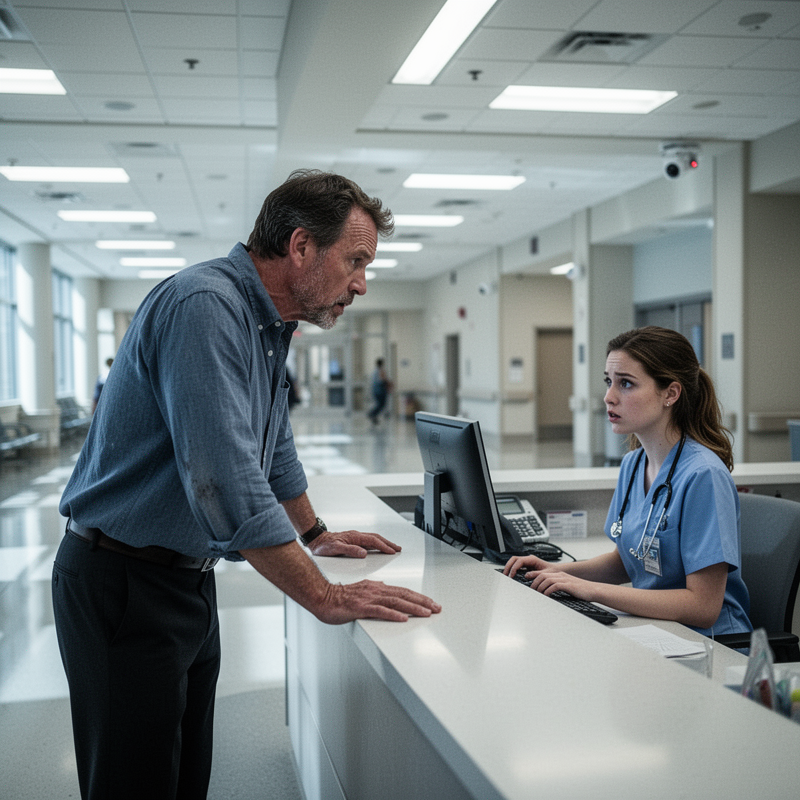
Inside, the polished floors reflected the fluorescent lights, making everything seem cold and sterile. I strode directly to the information desk.
“Ward 4B,” I demanded, my voice raspy. “I need to see my daughter, Chloe Brooks.”
The woman behind the counter, a young nurse with kind eyes, typed for a moment. Her expression shifted to confusion.
“I’m sorry, sir. There’s no patient by that name listed in Ward 4B. That ward is currently restricted access.”
A cold dread seeped into my bones. Eleanor was already hiding her.
“She’s there,” I insisted, leaning over the counter, my voice rising. “My name is Dr. Daniel Brooks. Her mother is Dr. Eleanor Kincaid. This is an emergency.”
Just then, a familiar voice cut through the air, sharp and precise.
“There’s no emergency here, Daniel.”
Eleanor emerged from a discreet side door, impeccably dressed in a pristine white lab coat, a slight, almost imperceptible smirk playing on her lips. She moved with the predatory grace I knew so well.
“As I told you,” she continued, her voice flat, “Chloe is under an involuntary hold for her own protection. You are not authorized to be on these premises.”
My blood ran cold. “Her own protection? You’re poisoning her, Eleanor! She just called me!”
Her eyes, usually cold, now gleamed with a chilling satisfaction. She gestured subtly with her chin.
“Security.”
Two hulking men in dark blue uniforms appeared as if from nowhere, moving with practiced efficiency. They were already walking towards me before I could even process the command.
“Don’t you dare touch me,” I snarled, backing away a step.
One of them, a man with a thick neck and an impassive face, placed a heavy hand on my arm. His grip was like iron.
“Sir, you need to leave. Immediately.”
“I’m her father!” I yelled, trying to shake him off, but he held firm. “You can’t keep me from my daughter!”
Eleanor stepped closer, her voice dropping to a low, venomous whisper intended only for my ears.
“Try anything, Daniel, and I’ll have your probation officer notified by morning. You’ll lose your medical clerk license. Everything. Think about what that means for your precious ‘sobriety’.”
My heart hammered against my ribs. The threat was real. My license, my last shred of self-respect, the only thing keeping me from complete collapse.
The security guard began to pull me towards the exit. My feet dragged against the polished floor. I twisted, looking back at Eleanor, but she had already turned her back, dismissing me, a queen disdaining a beggar.
Outside, the Easter Sunday sun felt blindingly bright, a cruel joke against the suffocating darkness in my chest. The valet was trying to move my car, but I waved him off, fumbling for my keys.
I sank into the driver’s seat, the humiliation a burning knot in my stomach. What could I do? I had no power, no influence. Just a minimum-wage job and a past I was trying to outrun.
My gaze fell to the passenger seat, where a battered leather briefcase sat, half-hidden beneath a stack of old hospital intake forms. It was the only thing I’d grabbed from my old office when everything fell apart. The dissolution records of Brooks-Kincaid Medical Group.
Eleanor thought she had me cornered. She thought she was invincible, protected by her corporate lawyers and her gleaming hospital.
I reached for the briefcase, my hands shaking. The leather was worn smooth in places, the brass clasp tarnished. I remembered the day I’d locked it, the finality of it all.
This was a long shot. A desperate gamble. But it was all I had left.
I pressed the small button, and with a soft click, the clasp sprang open. The lid creaked as I lifted it, revealing stacks of yellowed paper, legal documents detailing the messy end of our partnership, our marriage. I pulled out the original dissolution agreement, the thickest sheaf of all, its pages crackling as I opened them. My eyes scanned the dense legal clauses, the boilerplate language, searching for anything, a loophole, a forgotten detail.
And then I saw it. Page 17, Section 4. “Indemnification Clause for Future Liabilities.” It explicitly stated that for a period of five years following the dissolution of Brooks-Kincaid Medical Group, both partners would be mutually protected from any and all legal and financial liabilities arising from each other’s medical practice decisions.
I held my breath, my finger tracing the date it was signed, five years and one month ago. The clause had been a mutual protection. A safety net. But here, clearly typed, was the expiration date.
Thirty days prior.
Part 2
The date burned into my mind: March 24th. Thirty days. The indemnity clause, the one thing that tied Eleanor and me together legally, protecting us from each other’s mistakes for half a decade, was gone. Expired. She was exposed.
A jolt of adrenaline, cold and fierce, shot through me. This changed everything.
I didn’t bother trying to re-enter St. Jude. She wouldn’t let me within a mile. Instead, I drove to the nearest coffee shop, the dissolution agreement spread across a sticky plastic table. My hands trembled as I took a grainy photo of Page 17, Section 4, then sent it to Eleanor’s direct office line – a number I hadn’t dialed in years.
“Look familiar?” I typed, my fingers clumsy on the small screen. “Your shield is gone. Let Chloe go.”
My phone rang almost immediately. Not Eleanor, but her attorney, a clipped, aggressive voice I knew too well.
“Dr. Brooks,” he began, without preamble. “My client has instructed me to inform you that a temporary restraining order is being filed against you. Any attempt to contact Dr. Kincaid or enter St. Jude Metropolitan Hospital will result in immediate arrest and notification to your probation officer. And believe me, Dr. Brooks, we’re well aware of your history with ‘self-medication’.”
The call ended. The threat was clear, and it hit my most vulnerable point. My sobriety. My last chance.
But then, a follow-up email pinged. It was from Eleanor’s legal team, an official notice attached. The restraining order. And then, a second attachment, a PDF labeled: “Chloe Brooks – Consent for Experimental Protocols.”
My heart seized. It was old. Dated five years ago, around the time Eleanor and I were divorcing, before Chloe even knew what a clinical trial was. The document detailed generic, broadly worded consent for “future innovative treatments” for Chloe, citing a vague family history of “hepatic predisposition.”
And at the bottom, there it was. A signature. Mine.
My name, Dr. Daniel Brooks, scrawled beneath a line I had no memory of ever signing. It wasn’t just a forgery; it was a perfect, chilling replica of my own sloppy hand. The document was initialed by a witness and stamped by the “St. Jude Metropolitan Hospital Claims Department,” overseen by an adjuster named Gary Higgins.
They were claiming I had signed off on Chloe’s treatment years ago.
CHAPTER 2: A Chance Meeting in Triage
I walked out of the administrative wing with my hands wrapped around the handles of my old briefcase. The fluorescent lights overhead hummed in the quiet corridor of the ground-floor triage unit.
I sat on a cracked plastic chair near the emergency exit, resting my elbows on my knees. Across from me, a man in a rumpled corduroy jacket set two paper coffee cups on the small table between us.
“Dr. Brooks, right?” he asked, tapping a small digital recorder against his palm.
I looked up, my hands tightening on the leather of my bag. “I don’t know you.”
“Name’s Marcus Brody,” he said, sliding one of the coffee cups toward my side of the table. “Independent health reporter. I’ve been sitting in this ER waiting room for six hours tracking patient transfer logs.”
“I have nothing to say to a reporter,” I said, leaning back.
“I’m not looking for a quote about your past,” Marcus said softly. “I’m looking at Ward 4B. Specifically, Dr. Kincaid’s experimental protocol.”
I froze.
Marcus pulled a worn leather notebook from his coat pocket and flipped through several dense pages of handwriting.
“Eighteen days ago, a twenty-two-year-old college student came in for routine dehydration,” Marcus said, pointing to a highlighted entry. “Transferred to 4B. Acute hepatic failure forty-eight hours later.”
I stared at the paper.
“Ten days ago,” Marcus continued, “a nineteen-year-old track athlete. Same ward. Same drug protocol. Sudden organ failure.”
“That’s two,” I whispered.
“There was a third one last Tuesday,” Marcus said, looking directly at me. “A twenty-year-old woman. That makes three young patients with zero history of liver toxicity, all placed on experimental off-label injections under Eleanor’s direct oversight.”
A cold weight settled in my chest.
“Chloe isn’t an isolated case,” Marcus said, closing the notebook with a sharp thud. “She’s the fourth one this month.”
“Eleanor told me it was a genetic reaction,” I said, my voice barely audible over the hum of the vending machine.
“She lied to you,” Marcus replied simply. “And if we don’t get those blood panels out of that building, your daughter won’t be the last.”
CHAPTER 3: The Escalation of Threats
The heavy glass doors of the emergency room clicked open, and two men in tailored grey suits walked straight toward my table.
The taller man pulled an envelope from his jacket and dropped it onto my lap.
“Dr. Daniel Brooks,” he said, his voice flat and practiced. “You have been officially served with a preliminary injunctive order from St. Jude Metropolitan Hospital.”
I picked up the white envelope. The official red stamp of the county circuit court glistened under the lights.
“You are barred from entering Ward 4B or approaching Dr. Eleanor Kincaid,” the process server stated. “Any breach will result in immediate custodial arrest.”
Before I could pull the papers out, Gary Higgins walked around the corner from the administration hallway, adjusting his silk tie. He motioned with his chin toward the quiet side exit.
“Step outside for a moment, Daniel,” Higgins said, opening the heavy metal door into the cold night air.
I followed him into the narrow ambulance bay. Rain was beginning to coat the asphalt in a slick layer of water.
Higgins pulled a leather checkbook from his inner pocket, along with a printed intake agreement.
“Your probation officer gets a call at eight tomorrow morning if you stay in this city,” Higgins said, resting his hand against the brick wall. “Or, you sign this paper right now.”
“What is this?” I asked.
“A full release of parental claims and an immediate voluntary check-in to Green Valley Recovery Center in Ohio,” Higgins said. He unscrewed a silver pen. “Paid in full for six months. Plus a cash certified draft for one hundred and fifty thousand dollars.”
He held out the pen, its tip hovering over the line.
“Take the money, Daniel,” Higgins whispered, leaning in closer. “Go get clean somewhere far away. You can’t win this fight against a fifteen-million-dollar pharmaceutical grant.”
“And Chloe?” I asked, looking at the check in his hand.
“Chloe remains in specialized care,” Higgins said smoothly. “Where the hospital makes all long-term decisions.”
I reached out, took the paper, and slowly tore it into four equal pieces. I let them fall onto the wet concrete between his polished shoes.
Higgins’s face went stiff. “You just sealed your daughter’s fate.”
“No,” I said, staring into his eyes. “I just realized how terrified you actually are.”
CHAPTER 4: The Expired Clause Exploited
Marcus sat in the passenger seat of my old sedan, a battery-powered book light clamped to the dashboard as he spread out the yellowed dissolution contract.
“Look at paragraph fourteen,” Marcus said, tracing his fingernail across the faded print. “The indemnification agreement.”
“I signed that five years ago when we split the practice,” I said, leaning over the center console. “It gives Eleanor sole medical authority over clinical trials.”
“Read the fine print at the bottom of page nine,” Marcus urged.
I focused on the tiny block of text near the original signatures.
*’This indemnification clause shall remain binding for a period of exactly sixty months from the date of execution, after which all primary liability protections revert to joint standard corporate terms.’*
My eyes flew to the date stamped on the front cover: April 12th.
“It expired thirty days ago,” I whispered.
Marcus nodded slowly. “Which means Eleanor doesn’t have personal legal immunity anymore. And more importantly, St. Jude’s umbrella insurance policy contains a strict rider.”
“What rider?” I asked.
“Primary malpractice coverage is completely voided for off-label experimental trials if the overseeing physician is personally uninsured,” Marcus said, tapping his notebook. “The hospital board thinks Eleanor is protected by your old dissolution contract.”
“They don’t know the clause expired,” I said.
“They have no idea,” Marcus said, pulling his phone from his pocket. “If Eleanor’s trial causes organ failure, the hospital is on the hook for every single dollar of liability out of their own reserve capital.”
“The board won’t shield her if they realize they’re uninsured,” I said.
“Not for a second,” Marcus said, opening his laptop on his knees. “We don’t need to defeat Eleanor in court, Daniel. We just need to show the board chairman what her ego is costing them.”
CHAPTER 5: Smuggled Blood Panels
At two in the morning, my phone vibrated against the driver’s side door panel. The caller ID was an unknown internal extension from the hospital.
I clicked answer immediately. “Daniel speaking.”
“Meet me at the south loading dock in two minutes,” Nurse Clara Mendez said in a quiet, urgent whisper. “Security is changing shifts.”
I pushed my car door open and ran low across the dark parking lot, sticking to the shadow of the brick pillars near the delivery bay.
Clara stood behind a tall stack of folded linens, holding a sealed yellow biohazard envelope against her chest. Her breath showed white in the chilly air.
“She’s getting worse, Daniel,” Clara said, her voice shaking as she handed me the envelope. “Eleanor increased the dosage of the experimental compound at midnight.”
I opened the folder under the yellow loader light and pulled out the latest lab printouts.
“Her ALT and AST liver enzymes are over twelve hundred,” I said, my fingers shaking against the paper. “Bilirubin is at seven point four.”
“Acute stage-three liver toxicity,” Clara confirmed. “Eleanor put a note in the chart claiming it’s a genetic metabolic defect. She’s using that to justify keeping her isolated in Ward 4B.”
“It’s not genetic,” I said, pointing to the toxicological screen on the second page. “Look at the synthetic polymer markers. That’s a direct reaction to the trial drug.”
A sudden beam of light swept across the brick wall beside us. Heavy footsteps echoed down the concrete ramp.
“Nurse Mendez!” a voice barked from the darkness. It was the head of hospital security, flanked by two armed guards. “Step away from that door.”
Clara shoved the remaining papers into my hands. “Go! Take the side stairs!”
“Clara—” I started.
“Run, Daniel!” she yelled, stepping into the path of the approaching guards. “Save your daughter!”
I turned and bolted down the dark alleyway, holding the real medical records tightly against my chest.
CHAPTER 6: Public Exposure
By four in the morning, Marcus’s laptop screen lit up the small diner table three blocks from the medical center.
“The national health news desk just verified the lab markers,” Marcus said, resting his hand on his mouse. “They confirmed the drug toxicity profile.”
“What about the expired contract?” I asked, setting down two untouched black coffees.
“I uploaded the five-year dissolution contract, the lapsed clause, and Chloe’s stage-three blood panel directly to the board members’ private portal,” Marcus said. “I cc’d six regional news outlets and the state medical licensing board.”
“Will they read it before morning?” I asked.
Marcus hit the enter key. “It’s already going viral on social media. A whistleblower page picked up the lab reports ten minutes ago.”
Within forty-five minutes, my phone began ringing continuously. Unknown numbers from media outlets in Chicago, New York, and Atlanta flooded the screen.
Marcus pointed his finger at his phone display. “Look.”
A breaking news alert appeared on the screen: *Emergency Inquiry Launched into Off-Label Clinical Trials at St. Jude Metropolitan Hospital.*
“The board chairman just scheduled an emergency executive session for six o’clock,” Marcus said.
“Eleanor won’t back down easily,” I said. “She’ll try to claim the records are forged.”
“She can try,” Marcus said, looking out the diner window as the first light of dawn washed over the hospital tower. “But the stock price for St. Jude’s parent company just dropped eight percent in pre-market trading.”
CHAPTER 7: The Board’s Shift
At six-fifteen, Marcus and I stood in the glass atrium outside the board of directors’ conference room on the tenth floor.
Through the heavy double doors, Dr. Samuel O’Connor, the chairman of the hospital board, was gesturing sharply at a large screen displaying the expired indemnification clause.
Eleanor stood on the far side of the mahogany table, her arms crossed tight over her white lab coat.
“You guaranteed us full personal indemnity, Eleanor!” O’Connor’s voice leaked through the heavy doors. “Our primary carrier just pulled coverage for Ward 4B!”
“The trial data is solid, Samuel!” Eleanor’s voice came back, strained and sharp. “We are weeks away from a major breakthrough!”
“The patient has stage-three liver failure!” O’Connor yelled, slamming a binder down onto the table. “And her father has the original lapsed contract!”
The side door of the board room swung open, and Gary Higgins slipped out into the hallway, his face pale and his forehead glistening with sweat.
I stepped directly into his path.
“Daniel,” Higgins stammered, looking around frantically at the security cameras. “I was just doing my job for the claims department.”
“The audit logs, Gary,” I said, holding out my hand. “Give them to Marcus, or the state insurance commissioner gets the record of your payout offer to me.”
Higgins fumbled in his briefcase with trembling hands, pulled out a black USB drive, and pressed it into Marcus’s palm.
“It’s all on there,” Higgins whispered, staring at the floor. “Eleanor personally ordered me to alter the intake forms. She knew the trial was toxic two weeks ago.”
Marcus immediately plugged the drive into his tablet. “Got it. Original timestamps intact.”
CHAPTER 8: The Impasse
By nine in the morning, two black sedans bearing state government license plates pulled up to the main entrance of St. Jude Metropolitan Hospital.
Four state health regulators, accompanied by two uniformed state troopers, marched through the lobby toward the administration elevators.
The emergency session in the board room had ended in total silence.
I stood near the central nursing station on the fourth floor as the state officials crossed the threshold into Ward 4B.
Eleanor walked out of her corner office, her shoulders stiff and her face completely devoid of color. She carried no files, no briefcase, and no tablet.
She stopped three feet in front of me. Her eyes were dull, staring right through me as if I weren’t standing there at all.
“The transport team is downstairs,” I said, keeping my voice low and steady. “Chloe is being transferred to the University Medical Center.”
Eleanor didn’t answer. She didn’t offer an excuse, she didn’t mention the pharmaceutical grant, and she didn’t raise her voice.
She simply turned away and walked back into her office, pulling the heavy blinds shut behind her.
Nurse Clara pushed Chloe’s gurney out of room 412. Chloe’s eyes fluttered open, her skin pale under the yellow hospital lights, but her vitals monitor showed steady, regular rhythms.
“Dad?” Chloe whispered, her voice weak as she reached out her hand.
I grabbed her fingers and held them tight against my chest. “I’m right here, sweetheart. We’re leaving now.”
CHAPTER 9: Silent Collapse
At eleven o’clock, the news broke without any grand press conference or public statement from the board.
Marcus sat beside me in the lobby of University Medical Center as we monitored the official updates on his tablet.
“The pharmaceutical sponsor pulled all remaining grant funding forty-eight hours ago,” Marcus said, reading the internal memo. “They caught three unrecorded toxicity reports in their own internal audit.”
“And Eleanor?” I asked.
“She signed her voluntary surrender of her medical license twenty minutes ago,” Marcus said, closing the tab. “The state agreed not to pursue criminal charges in exchange for her immediate, permanent departure from practice.”
“What about Higgins?”
“Fired by the insurance group,” Marcus replied. “His company is launching an internal fraud audit into his entire claims history.”
There were no speeches on the courthouse steps. There was no public trial. Ward 4B at St. Jude’s was quietly cleared, the specialized equipment packed away into unmarked wooden crates by afternoon contractors.
The multi-million-dollar experimental unit simply ceased to exist, stripped clean in less than six hours to prevent further financial liability.
Eleanor left the hospital through the basement service door, slipping past a small group of local reporters without making a single sound. Her thirty-year career in medicine ended in total, absolute quiet.
CHAPTER 10: The Transfer
Inside the clean, brightly lit room at University Hospital, the gentle hum of the IV drip was the only sound.
The head of gastroenterology walked in, checking Chloe’s updated lab reports on his digital tablet.
“Her liver function markers have dropped by forty percent since the experimental compound was flushed from her system,” the doctor said, smiling faintly. “The tissue regeneration has already begun.”
Chloe sat up against the soft white pillows, a faint touch of color returning to her cheeks.
“How did you find that contract, Dad?” she asked, looking at the old leather briefcase sitting in the corner chair.
“It was just sitting in the trunk,” I said, leaning over to tuck the blanket around her shoulders. “Waiting for the right time.”
“Is Mom going to call?” Chloe asked quietly, looking down at her hands.
“I don’t think so, Chloe,” I answered honestly. “She packed her office this afternoon.”
Chloe nodded slowly, accepting the answer without tears. “Thank you for coming to get me.”
I kissed her forehead. “I’ll always come to get you.”
By five o’clock that evening, the hospital board issued a one-sentence public statement confirming that Ward 4B was permanently closed for administrative restructuring.
CHAPTER 11: Three Days Later
Three days later, the rain was falling hard against the thick glass of the ground-floor intake window at County Hospital.
It was eleven-thirty at night. The flickering fluorescent tube overhead hummed with its familiar, dull buzz.
I sat behind the Formica desk in my blue scrub top, staring at the long queue of uninsured patients waiting in the cold triage line.
My wooden clipboards were stacked in neat rows beside the old black desk phone.
A young man pushed through the double doors, clutching a blood-soaked rag around his wrist, looking around frantically for help.
“Name and date of birth,” I said gently, pulling a fresh paper form from the top tray and sliding a pen toward him.
Across the room, the television mounted high on the wall showed a brief fifteen-second regional news segment. The anchor mentioned that St. Jude Metropolitan Hospital had appointed a new executive administrator to oversee its reorganized clinical operations.
The new administrator’s statement used the exact same legal language, the exact same corporate policy loopholes, and the exact same insurance compliance phrases that Eleanor had used for five years.
Nothing had changed in the system. The machine had simply replaced one part with another, leaving the walls standing just as high as before.
I checked the young man’s pulse, recorded his blood pressure on the intake sheet, and flagged his chart for the attending nurse on duty.
Medicine doesn’t heal the systemic greed that built these walls; it only gives us a chance to survive another shift.
Leave a Reply