CHAPTER 1: The Price of Silence
Part 1
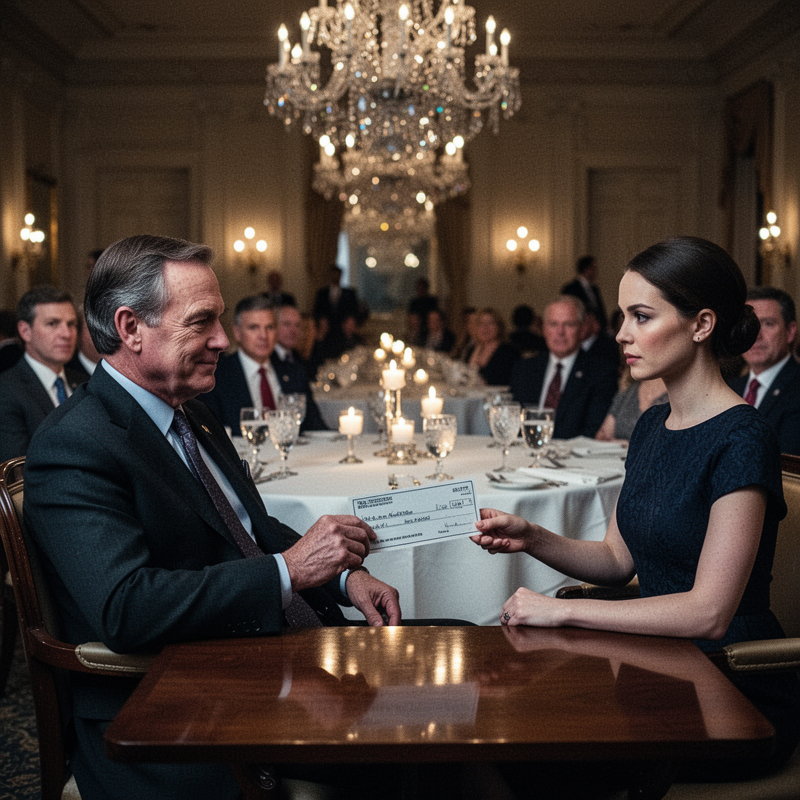
“Take this $250,000 check and sign the waiver, Clara,” Senator Arthur Kincaid said across the candlelit table at his gubernatorial fundraiser, holding out a signed cashier’s check. “You’re a low-level hospice worker dragging down my campaign with imaginary claims about your brother’s illness.”
I looked at the check, then pulled out my private banking token and dialed my family’s legacy trustee in front of twenty stunned political donors.
“Deidre,” I said into the speakerphone, “buy out the $14.2 million primary mortgage debt on Senator Kincaid’s Virginia estate, ‘The Crown Jewel,’ effective immediately.”
Within forty-eight hours, the stranger who tried to buy my silence realized he had targeted the one person who held his financial survival in her hands.
The air in the grand ballroom of the Jefferson Hotel in Richmond was thick with the scent of aged bourbon and the hushed murmurs of powerful people. Chandeliers dripped crystal light onto tables set with pristine white linen and flickering votives. Senator Arthur Kincaid, immaculate in a bespoke suit, leaned back in his chair, a patronizing smile playing on his lips.
His gaze swept over me with an air of dismissive pity.
He had just finished a stirring speech about economic development and community investment. Now, here at his exclusive gubernatorial fundraiser, he had chosen this private moment at our table to make his offer.
It wasn’t a negotiation. It was a declaration.
The cashier’s check lay flat on the polished mahogany, an obscene white rectangle against the rich wood. Two hundred and fifty thousand dollars. A pittance, really, for the kind of silence he was trying to buy.
A server glided past, refilling a water glass with silent efficiency. The clinking of silverware from other tables sounded impossibly loud in the sudden, sharp silence that had fallen around us.
“Clara, honestly,” Senator Kincaid continued, his voice dropping slightly, “this whole situation is making things incredibly difficult. You’re a dedicated caretaker, I’m sure, but your emotional attachment to your brother is, well, clouding your judgment.”
He paused, letting his words hang in the air, a thinly veiled insult wrapped in false concern.
“These absurd allegations about my development projects impacting his health? It’s simply not true. You’re a hospice worker, Clara, not an environmental toxicologist.”
His gaze flicked to the other donors at the table – titans of industry, influential lawyers – as if inviting them to share in his magnanimous pity for the deluded young woman. A few offered strained smiles, their eyes darting nervously between Kincaid and me.
I met his gaze steadily. My hands, usually calloused from twelve years of caring for Toby, felt surprisingly steady as I reached into my purse.
The silver-dollar-sized banking token felt cool against my thumb. It was a discreet, unassuming device, meant for secure, high-value transactions. Most people at this table would recognize it, but they wouldn’t expect *me* to carry one.
My parents had established the O’Connell Legacy Trust to ensure Toby’s long-term care, and in their absence, I was its sole managing trustee. A non-profit care trust, worth just over $40 million. My “low-level hospice worker” salary was a carefully crafted illusion.
I tapped the token, activating the speakerphone. The small, clear voice of my family’s managing trustee, Deidre Walsh, filled the space above the soft jazz.
“Deidre Walsh, O’Connell Legacy Trust. How may I assist you, Clara?” she said, her tone crisp and professional.
Senator Kincaid’s confident smile faltered for a fraction of a second. His brow furrowed, a flicker of irritation in his eyes. He clearly expected me to be making a pathetic plea for more money.
“Deidre,” I said, my voice calm, “I need you to execute a specific transaction for me, effective immediately.”
I glanced at Kincaid, who was now openly staring at the banking token, trying to process what he was seeing. The other donors had stopped their quiet conversations altogether. Their attention was now fully on our table.
“I need you to buy out the $14.2 million primary mortgage debt on Senator Kincaid’s Virginia estate. It’s listed as ‘The Crown Jewel.’”
A wine glass clinked softly as someone at the adjacent table set it down a little too hard. The soft jazz seemed to fade into unreality.
Kincaid’s face, which minutes ago had been so full of smug assurance, now looked like a mask struggling to hold its shape. He blinked, a slow, bewildered motion.
“The Crown Jewel?” he echoed, his voice barely a whisper.
“Yes, Senator,” I confirmed, my gaze unwavering. “The property you cherish so deeply.”
On the speakerphone, Deidre Walsh’s voice remained perfectly level, a calm island in a sudden storm of stunned silence.
“Understood, Clara. Initiating the acquisition of the senior lien on Senator Kincaid’s property, ‘The Crown Jewel,’ valued at $14.2 million.”
She paused for only a beat.
“Confirming the immediate transfer of the primary mortgage debt to the O’Connell Legacy Trust. Processing now.”
A long, excruciating silence stretched across the table, across the entire section of the ballroom. Twenty pairs of eyes, previously polite and indifferent, were now wide with disbelief. A prominent donor choked on his champagne.
Senator Kincaid’s mouth opened and closed soundlessly, like a fish out of water. The color drained from his face, leaving it a sickly gray. His hands, which had been so confidently presenting the $250,000 check, now trembled slightly. He snatched the check back as if it had suddenly become toxic.
“Transaction complete,” Deidre’s voice announced, cutting through the thick quiet. “The $14.2 million primary mortgage debt on ‘The Crown Jewel’ is now wholly owned by the O’Connell Legacy Trust.”
Part 2
“You think you’ve won something?” Kincaid finally choked out, his voice hoarse with suppressed rage. He shoved his chair back so hard it scraped across the polished floor and nearly toppled. “I’ll bury you, Clara O’Connell. I’ll take this story to every newspaper, every television station. I’ll expose your fraudulent little trust and your pathetic attempts to extort a public servant.”
He snatched his coat from the back of his chair, ignoring the aghast stares of the donors, and stormed out of the ballroom, the heavy double doors swinging shut with a decisive thud behind him. The sound seemed to reverberate in the sudden, echoing silence he left in his wake.
The other donors at the table, now thoroughly uncomfortable, averted their eyes, whispering nervously amongst themselves. My own pulse thrummed, a mix of adrenaline and a chilling dread for what Kincaid might do next. I knew he was not a man who took public humiliation lightly.
The drive home through the quiet Richmond streets was a blur. A strange mix of triumph and heavy apprehension churned in my stomach. I had stood up to him, truly stood up. But Kincaid was a senator, a man who wielded power and public opinion like a weapon. He wouldn’t let this go. I gripped the steering wheel, my knuckles white, preparing myself for whatever came next. Toby’s face flashed in my mind – his weak smile, his unwavering trust. I had to protect him.
As I turned onto our residential street, my heart plummeted. The familiar, peaceful lane was now a frantic scene of flashing lights and parked vehicles. News vans, emblazoned with local station logos, lined the curb like vultures. Reporters and camera crews milled about, their microphones held aloft, their eyes scanning every arriving car. My home, Toby’s sanctuary, was under siege. Kincaid hadn’t waited for the morning; he had already spun his narrative, and they were waiting for me.
CHAPTER 2: The Campaign of Lies
The morning news broadcast opened with a flattering studio portrait of Senator Arthur Kincaid smiling beside a American flag.
Below his picture, the yellow news ticker read: *Gubernatorial Candidate Addresses Unhinged Harassment Campaign.*
I stood in my kitchen, holding a steaming mug of black coffee, watching Kincaid sit across from a sympathetic anchor on the Channel 6 morning show.
“It is a deeply unfortunate situation,” Kincaid said, placing a hand over his heart with rehearsed solemnity. “We are dealing with a local caretaker who is clearly suffering from severe caregiver burnout and psychiatric fatigue.”
He leaned toward the camera, his voice dripping with condescending sympathy.
“This individual has fabricated wild stories about industrial contamination to explain her brother’s tragic medical decline,” Kincaid continued. “It is a classic case of projection born from grief.”
In the back bedroom, the rhythmic hum of Toby’s oxygen concentrator rattled against the thin drywall.
I walked into his room and rested my palm against his arm. His skin was pale, papery, and cold to the touch.
“Don’t listen to the TV, Clara,” Toby whispered, his nasal cannula shifting as he spoke. “I know what made me sick.”
“I know you do, Toby,” I said softly, tucking the blanket around his feet. “Focus on breathing. I’ll handle the rest.”
My phone vibrated violently against the bedside table. It was Deidre Walsh, calling from the legacy trust’s headquarters in downtown Richmond.
“Clara, turn off the news,” Deidre said the moment I answered. “Kincaid’s legal team just filed an emergency motion in county court to freeze all active accounts attached to the O’Connell Legacy Trust.”
“On what grounds?” I asked, stepping back into the hallway.
“They filed an ex parte petition claiming you are mentally incapacitated and unfit to manage institutional capital,” Deidre replied, her voice taut with anger. “He’s trying to lock your liquidity before you can execute the mortgage foreclosure on his estate.”
CHAPTER 3: The Condemnation Order
At 8:15 AM, three vehicles pulled up to the curb outside St. Jude’s Care Facility, where Toby had spent his weekday physical therapy sessions for two years.
Two county sheriff cruisers parked bumper-to-bumper, framing a dark grey state SUV.
Julian Croft stepped out of the SUV holding a ruggedized tablet with a bright orange county inspection sticker on the casing.
I met him on the concrete ramp outside the front entrance.
“You’re out of your depth, Miss O’Connell,” Croft said, pulling a folded paper from his suit jacket. “This building has been declared an immediate structural hazard.”
He slapped a red poster onto the double glass doors.
“You have twenty-four hours to clear every patient out of this facility,” Croft said.
“This facility was inspected six months ago and scored a ninety-eight percent structural rating,” I said, stepping between him and the door. “Show me the engineering report.”
Croft sneered, holding his tablet at a slight angle as he tapped through screens.
“Soil subsidence,” Croft said flatly. “The foundation is shifting. It’s unsafe.”
I took a sharp step forward, catching a glance at the open application on his tablet screen before he could tilt it away.
He was manually dragging a slider bar, changing the recorded ground shift metric from 0.02 inches to 4.8 inches in real time.
“You just faked that reading in front of me,” I said, looking him dead in the eye.
“Prove it,” Croft muttered, turning his back on me and signaling to the deputies behind him. “Twenty-four hours, Clara. Get your brother out, or the marshals will move him to a state ward.”
CHAPTER 4: Poison in the Ground
By noon, I was standing in the wooded drainage easement directly behind Senator Kincaid’s fourteen-million-dollar estate, “The Crown Jewel.”
The air smelled sharply of sulfur and old metal.
I cut through the overgrown brush near the property line, following the natural decline of the slope that ran downward toward the hospice center’s groundwater pump station.
Hidden beneath a pile of heavy wooden pallets and black plastic tarps, I found it.
Two thick, eight-inch PVC pipes protruded directly from the concrete foundation retaining wall of Kincaid’s newly built underground motor garage.
A steady stream of discolored, milky-grey runoff was bubbling out of the pipe, running directly into the unlined ditch that fed the lower aquifer.
I pulled out my phone and took twelve clear, high-resolution photographs of the illegal drainage bypass, capturing the municipal property marker in the frame.
An hour later, I walked into Julian Croft’s commercial appraisal office on Main Street and dropped a printed stack of the photographs onto his desk.
Croft looked at the photos, then slowly leaned back in his leather chair.
“That’s industrial chemical runoff from Kincaid’s underground construction site,” I said. “It’s routed directly into the facility’s water pump.”
Croft picked up a silver pen and clicked it twice.
“You’re a hospice worker, Clara,” Croft said, smiling faintly. “I am a licensed chief municipal appraiser. No judge in this state will ever take a grieving sister’s camera phone pictures over my certified state seal.”
“It isn’t just a picture,” I said. “It’s the reason my brother’s kidneys failed three years ago.”
“Then you should have moved him three years ago,” Croft replied softly. “Get out of my office.”
CHAPTER 5: The Affidavit
At 6:30 PM, two county deputies knocked heavily on the front door of my house.
When I opened it, the senior officer held a blue folder in his gloved hand.
“Clara O’Connell?” he asked, checking the name against the paper. “We have an order for an immediate emergency psychiatric evaluation.”
“On whose authority?” I asked, my voice remaining completely flat.
“Magistrate Vance signed the order an hour ago,” the deputy said, taking a step onto the porch. “It was submitted alongside a sworn affidavit from Senator Kincaid’s campaign staff. They claim you are experiencing a severe mental crisis and pose an immediate risk to yourself and your dependent.”
The second deputy reached toward his belt.
“We need you to step down the stairs quietly, ma’am,” he said. “We’re taking you into custody for a seventy-two-hour observation hold.”
I did not move. I pulled my personal tablet off the foyer table and unlocked the screen, presenting a digital transcript directly to the lead officer.
“This is my active state nursing registration,” I said calmly. “And this is a verified proof-of-funds certificate from First National Bank confirming I personally oversee forty million dollars in liquid charitable assets.”
The lead deputy squinted at the screen, then looked back at his partner.
“If you lay a hand on me without a medical doctor present, I will file a federal civil rights lawsuit against your department before the sun comes up tomorrow,” I added.
The lead deputy hesitated, tapping the blue folder against his thigh.
“We’ll verify this with the magistrate,” he muttered, stepping off the porch. “Don’t leave the county.”
CHAPTER 6: The Uninvited Guest
At 10:00 PM, I received a text message from an unregistered number with a set of GPS coordinates for an underground parking garage beneath the public library.
The text read: *I have the original 2021 D.C. General records. Come alone.*
I parked my car two levels down near a concrete pillar.
A silver sedan blinked its headlights twice, and the passenger door opened.
Evelyn Kincaid, Arthur Kincaid’s ex-wife and former lead campaign strategist, sat in the driver’s seat, her eyes shadowed with exhaustion.
“I helped him cover it up,” Evelyn said before I even sat down completely. “Three years ago, during the first phase of the estate’s excavation.”
She handed me a thick, yellowed paper envelope sealed with red tape.
“Arthur hit an underground industrial waste pocket left behind by the old battery plant,” Evelyn said, staring straight ahead at the concrete wall. “Instead of reporting it to the state environmental board and ruining his political timeline, he paid Croft three hundred thousand dollars to sign off on a bypass pipe.”
“It went straight into the hospice well,” I said.
“Yes,” Evelyn whispered. “Inside that envelope are Toby’s original, unredacted toxicology reports from D.C. General Hospital from October 2021. Arthur paid the hospital administrator to alter the public chart to claim it was an inherited genetic disorder.”
I held the heavy envelope in my lap, feeling the sharp edges of the paper inside.
“Why give this to me now?” I asked.
“Because Arthur isn’t just trying to win an election anymore, Clara,” she said, her voice cracking slightly. “He’s destroying human beings to keep a secret that’s already buried in the dirt.”
CHAPTER 7: A Cold Bargain
The next morning, Senator Kincaid’s campaign manager arranged a private meeting in a soundproof conference room on the top floor of his campaign headquarters.
Kincaid sat at the head of a mahogany table, a silver water pitcher resting between us.
“You’ve caused quite a bit of unnecessary noise, Clara,” Kincaid said, resting his elbows on the polished wood.
He slid a heavy paper document across the table toward me.
“This is a settlement agreement,” Kincaid said. “You will surrender all primary mortgage debt notes held by your legacy trust on ‘The Crown Jewel.’ In exchange, I will personally pull the condemnation order on St. Jude’s Care Facility.”
“And what about Toby’s medical records?” I asked.
Kincaid smiled warmly, the same hollow smile he used on camera.
“You need to let that delusion go, Clara,” he said softly. “Your brother was born with weak organs. You’ve spent twelve years torturing yourself thinking you could fix him, and now your mind is manufacturing villains to blame for his inevitable decline.”
He pushed a pen toward my hand.
“Sign the waiver, admit his illness is genetic, and I’ll let his hospice stay open,” Kincaid said. “Otherwise, the marshals pull him out of that bed at eight o’clock tomorrow morning.”
I looked at the document, then back at Kincaid’s composed face.
“My brother is dying because of your garage,” I said softly.
“Your brother is dying because he was weak,” Kincaid replied, his voice dropping to a harsh whisper. “Sign the paper.”
I stood up, picked up the settlement document, and tore it neatly down the middle.
CHAPTER 8: The Paper Trail
By 2:00 PM, I was sitting in the private laboratory of Dr. Aris Thorne, an independent toxicologist at Richmond Environmental Health Institute.
Dr. Thorne laid out three high-resolution spectral graphs across his desk.
“The heavy metal markers in your brother’s 2021 blood work are unmistakable,” Dr. Thorne said, pointing his finger at a sharp peak on the line graph. “High concentrations of cadmium and industrial epoxy resin solvents.”
He pulled up a secondary document provided by Evelyn Kincaid.
“These exact chemical compounds match the waterproof sealant used in the foundation pour for Senator Kincaid’s private underground motor garage,” Dr. Thorne said.
“Could this have been caused by a natural genetic defect?” I asked, needing the absolute legal confirmation.
“Absolutely not,” Dr. Thorne replied sharply. “This was direct, concentrated chemical exposure through drinking water. If this contamination had been disclosed and mitigated three years ago, your brother’s kidney damage would have been completely preventable.”
I took the signed toxicology report, combined it with the unredacted 2021 medical records, and drove directly to the State Ethics Commission building downtown.
I walked into the office of Chief Ethics Inspector Harold Danforth and placed the sealed binder on his desk.
Danforth looked up through his bifocals, frowning at the thick stack of paper.
“This is a formal administrative corruption complaint against Senator Arthur Kincaid,” I said. “Read page four first.”
CHAPTER 9: The Falling Shadow
At 11:30 PM, twelve hours before the administrative ethics hearing was scheduled to open, the emergency monitor in Toby’s bedroom let out a sharp, continuous alarm.
I burst into the room to find his chest heaving violently, his mouth open as he gasped for air.
“Clara…” he wheezed, his fingertips turning a dangerous shade of dark blue. “I can’t… catch it.”
I dialed 911 immediately while forcing an emergency oxygen mask over his face.
“Severe respiratory distress,” I shouted into the phone. “Acute pulmonary edema! Send an advanced life support unit right now!”
The paramedics arrived within seven minutes, wheeling a gurney into the small house and lifting Toby’s fragile body onto the frame.
I rode in the front of the ambulance, watching the heart monitor screen through the small back window as his oxygen saturation levels hovered below seventy percent.
By 2:00 AM, Toby was hooked to a ventilator in the Intensive Care Unit at Richmond Memorial Hospital.
The attending physician walked out of the room, pulling off his latex gloves with a tired snap.
“His lungs are filling with fluid, Clara,” the doctor said quietly. “His renal failure has metastasized into full systemic organ collapse. The next twelve hours are critical.”
I sat in the cold plastic chair beside his bed, holding his dry, limp hand in mine.
The state ethics tribunal was set to convene in seven hours.
If I left his side, I might not be there when he woke up. If I stayed, Kincaid would crush the complaint without opposition.
CHAPTER 10: The Tribunal Hearing
At 9:00 AM, the central hearing room at the State Capitol was packed with political reporters, campaign donors, and television crews.
Senator Arthur Kincaid sat at the primary respondent table, flanked by three senior defense attorneys, adjusting his red silk tie with absolute composure.
He looked over at the empty complainant table, a small smile playing at the corner of his mouth.
The committee chairman raised his gavel.
“We will now hear the opening statement from the defense regarding the allegations of environmental fraud,” the chairman announced.
Before Kincaid’s attorney could stand up, Inspector Harold Danforth walked out from the side gallery holding a thick leather folder.
“Mr. Chairman,” Danforth declared, his voice echoing clearly through the vaulted room. “The State Ethics Commission is taking immediate control of this proceeding.”
Kincaid’s lead attorney jumped to his feet.
“Objection! This is an administrative breach—”
“Overruled,” Danforth interrupted coldly.
Danforth opened the folder and adjusted the microphone on the podium.
“I have in my possession the unredacted 2021 medical records from D.C. General Hospital,” Danforth read aloud to the silent room. “Along with certified altered appraisal logs from municipal inspector Julian Croft.”
Kincaid’s smile vanished instantly. His skin went grey.
“These documents establish that commercial industrial runoff from Senator Kincaid’s private estate was intentionally diverted into public groundwater,” Danforth read, his voice steady and unrelenting. “Resulting in direct toxicological poisoning of patients at St. Jude’s Care Facility.”
Danforth held up a final paper.
“And I enter into the record a sworn affidavit from Evelyn Kincaid, detailing the three hundred thousand dollar payoff made to conceal these test results.”
The public gallery exploded into shouting as news cameras surged forward, capturing Kincaid frozen in his chair, completely exposed.
CHAPTER 11: The Empire Collapses
The financial collapse was swift and absolute.
By 11:00 AM, three major political action committees announced the immediate withdrawal of eight point five million dollars in campaign funding.
At 11:30 AM, Deidre Walsh executed a formal notice of immediate foreclosure against “The Crown Jewel” on behalf of the O’Connell Legacy Trust, citing uncured municipal safety default clauses.
Without campaign backing and with his primary property seized, Kincaid’s private lines of credit collapsed within minutes, forcing his legal team to file emergency bankruptcy papers by early afternoon.
My phone rang continuously with media outlets begging for an interview, but I ignored every call as I drove back to Richmond Memorial Hospital.
I ran down the quiet hallway of the Intensive Care Unit, pushing open the heavy glass door to Toby’s room.
The heart monitor was letting out a long, uninterrupted tone.
A nurse stood beside the bed, softly pulling the white sheet up over Toby’s chest.
“I’m so sorry, Clara,” she whispered. “He slipped away about ten minutes ago.”
I walked slowly to the side of the bed and pulled the sheet back down.
I took his cold, thin hand in mine and buried my face against his shoulder, weeping in the sterile, quiet room as the afternoon sun hit the window glass.
The political monster was destroyed, his campaign ruined, his wealth gone—but my brother was never coming home.
CHAPTER 12: November Fourteenth
On November 14th, my thirty-fifth birthday, I sat alone at the kitchen table in my small house.
The room was silent save for the ticking of the wall clock over the stove.
The morning light cut across a framed photograph resting on the wooden table—a picture of Toby standing on the front porch three years ago, smiling before the sickness took his strength.
My phone buzzed against the placemat. It was a brief text message from Deidre Walsh.
*The foreclosure sale of the Kincaid estate closed this morning,* the message read. *Fourteen point two million dollars cleared. Transferred directly to the national clean water foundation under Toby’s name.*
I looked down at the text, then turned off the screen and placed the phone face down on the table.
Kincaid was stripped of his office, his name dragged through every major news outlet in the country, his fortune completely wiped out by the trust’s legal team.
Yet the kitchen remained dead quiet.
I rested my hands flat on the clean table, looking out the back window at the empty backyard.
I dismantled a senator’s empire word by word, but sitting in an empty room on my birthday, I learned that truth can clean a name without filling a heart.
Leave a Reply