CHAPTER 1: The Sounding Log
Part 1
My boss, seafood magnate Victor Duong, told the Coast Guard that his eighteen-year-old son, Leo, drowned in a tragic swimming accident off Horn Island.
Leo’s friends, led by nineteen-year-old Chloe Bennett, claimed they last spoke to him on the beach at 3:00 PM before he vanished into the fog.
Two days later, the tide washed Leo’s body onto the marshlands of Ocean Springs with blunt trauma along his left shoulder.
As the shipyard’s head hull-stress technician, I inspected the family’s returned boat and found fresh impact micro-fractures logged at exactly 3:15 PM.
Someone was lying about what happened on that water, and my employer demanded I delete the digital telemetry before the sheriff saw it.
The air in the repair bay hung thick with the usual smells: brine, diesel, and the sharp, chemical tang of fresh fiberglass resin. Overhead, the fluorescent lights hummed, casting a sterile glow on the scraped concrete floor.
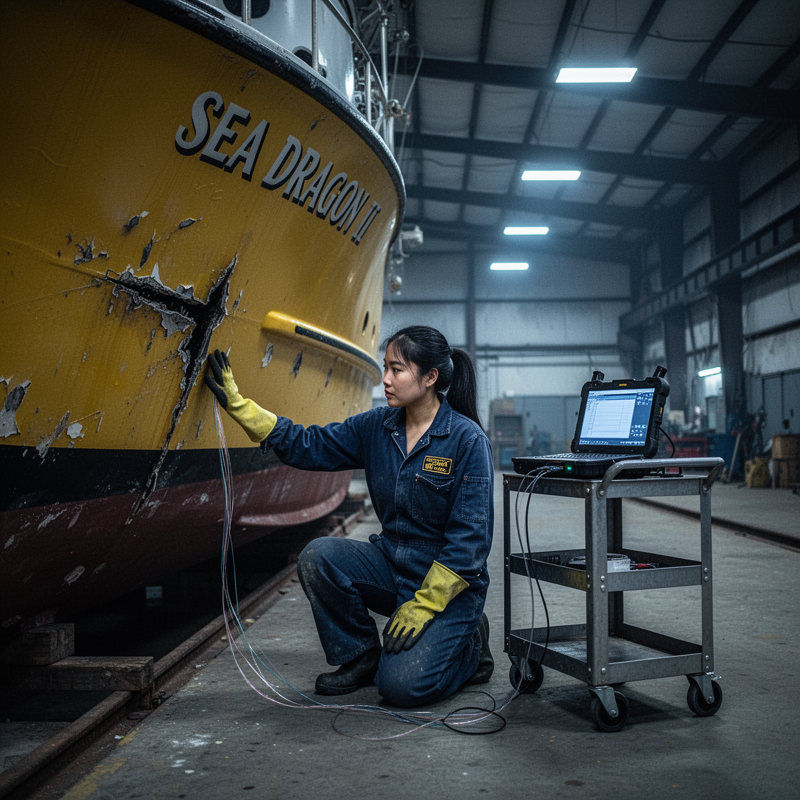
Mina Tran knelt beside the hull of the *Sea Dragon II*, a commercial fishing trawler that usually brought in shrimp and crab from the Gulf. Now, it was just a silent, hulking shadow in the vast bay, a monument to a terrible loss.
She ran her gloved hand along the scarred yellow fiberglass, feeling for any subtle inconsistencies. Her cousin, Leo, Victor Duong’s youngest son, had been on this boat.
Two days. Two days since the Coast Guard had called off the search.
The *Sea Dragon II* looked mostly intact to the untrained eye, but Mina knew better. As the shipyard’s head hull-stress technician, she understood the language of composite materials and the silent stories they told.
She connected her diagnostic laptop to the boat’s primary console, the fiber-optic cables snaking across the deck like neon yellow veins. The screen flickered to life, displaying a cascade of raw data.
Her fingers danced over the keyboard, calling up the hull sensor logs from the afternoon Leo vanished. Every vibration, every micro-fracture, every impact point was recorded, timestamped, and stored. It was her job to translate that silent language.
The early logs showed typical operational stress – engine vibrations, wave impacts, the gentle sway of the Gulf tide. Mundane, predictable.
She scrolled through, past the 1:00 PM and 2:00 PM entries, towards the time Leo’s friends said they last saw him.
A knot tightened in her stomach. Chloe Bennett, Leo’s girlfriend, had been insistent: Leo was on shore at Horn Island at 3:00 PM, alone. He’d gone for a swim, she’d told the sheriff, and simply never returned.
Mina’s gaze fixed on the screen. The log continued, a steady, rhythmic pulse of data.
Then, at precisely 3:15:03 PM, the rhythm shattered.
A sudden, sharp spike flared across the graph—a violent, undeniable anomaly. The hull sensors along the *Sea Dragon II*’s port side, just above the waterline, registered a blunt force impact. The data points flared bright red, screaming warnings.
It wasn’t a wave. It wasn’t a bump against a dock. The pattern was too specific, too concentrated. It was a collision. A strike.
Her breath hitched. Chloe’s voice, relayed by the police, echoed in her mind: “He was on the beach at 3:00 PM.”
But the boat, according to its own irrefutable digital fingerprint, had suffered a significant impact a full fifteen minutes *later*. And if the boat was struck, it meant it was still on the water, still in motion.
It meant Leo wasn’t alone on shore. Or, at the very least, he wasn’t gone.
Her fingers hovered over the “Download Raw Data” button. This was proof. Hard, scientific proof that contradicted the entire official narrative.
This wasn’t just a drowning. This was something else.
A heavy shadow fell over her shoulder. The scent of expensive cologne, sharp and familiar, preceded him.
Mina didn’t need to look up. The air in the bay had changed, growing heavier, colder.
Victor Duong, her uncle and boss, stood over her. His custom-made work boots, polished to a mirror shine, were planted firmly on the concrete. His face, usually ruddy from sun and command, was pale, his eyes sharp and unyielding.
He didn’t need to read the screen. He knew.
“Mina,” he said, his voice low, a soft rumble that still carried absolute authority, “wipe the memory buffer.”
Part 2
Victor’s shadow loomed, heavy and cold. He leaned closer, his voice barely a whisper, yet it felt like a shout in the silent bay. “That impact, Mina, it was just a floating log. Driftwood. Happens all the time.”
My gaze remained on the screen, the red spike mocking his words. Driftwood didn’t leave a clean, focused blunt-force signature like that. It was too precise.
“The police are already asking too many questions,” he continued, his tone hardening. “If you start digging, if you bring that kind of suspicion to my docks, you’ll ruin everything. Our export contracts, our name. Do you understand what that means for this family?”
He didn’t wait for my answer. He straightened up, his eyes sweeping across the bay, then back to me, a silent command in their depths. “Wipe it. Now.”
Then he turned and walked away, his polished boots echoing on the concrete. The air felt lighter, but the knot in my stomach tightened. I watched him go, past the stacked crab traps, past the repair benches, until he disappeared through the main office door.
He expected me to erase it. To make it all disappear. But I couldn’t. Not after seeing that data. Not after thinking about Leo, so full of life, so desperate to get away from… something.
My fingers hesitated over the “Delete” button. No. I had to at least get a backup. There had to be a primary log somewhere, a raw file that didn’t get deleted from the buffer. A failsafe.
I clicked out of the hull sensor menu and navigated to the main system diagnostics. Every boat had one, a secondary brain that mirrored critical operational data. If the main buffer was wiped, the memory card for the depth-sounder often held a more robust, less accessible record. It was my best shot.
I found the option: “Extract Primary Depth Log Memory Card.” My heart hammered against my ribs as the system whirred, attempting to access the data.
A moment passed. Then another.
Instead of a download progress bar, an error message flashed across the screen: “Memory Card Read Failure. Physical Damage Detected.”
My blood ran cold. I quickly located the physical slot for the memory card on the console, a small, shielded compartment usually sealed tight. It was slightly ajar.
I pulled it open. Inside, the tiny depth-sounder memory card lay mangled. Someone had jammed a thin, sharp wire pick into its delicate circuitry, not just erasing the data, but physically destroying the chip itself.
And then I saw the timestamp on the system’s last access log for that card. *5:00 PM, August 14th.*
CHAPTER 2: Broken Statements
The rain had cleared over Ocean Springs by noon, leaving the air heavy with damp heat and the smell of fried mullet.
I sat across from Chloe Bennett in the corner booth of a diner on Government Street. Her fingers trembled as she held a plastic spoon over an untouched bowl of gumbo.
“You told the sheriff you last saw Leo on the sand at 3:00 PM,” I said, laying a printout of the hull telemetry on the laminate table between us. “The boat’s fiber-optic sensors registered a heavy impact at 3:15 PM out in deep water.”
Chloe stared at the red signal spike on the paper. Her lower lip began to quiver.
“I didn’t have a choice, Mina,” she whispered, her voice barely carrying over the hum of the diner’s overhead fan.
“Choice about what?” I asked. “Leo is dead, Chloe. The tide brought him into the marsh with his shoulder crushed.”
Chloe wiped her cheek with the back of her hand, leaving a smear of damp mascara.
“Your uncle came to my apartment two hours after the Coast Guard was called,” she said.
She pulled her phone from her purse and opened her bank application, sliding the screen toward me. A pending wire transfer showed twenty-four thousand dollars, credited directly from a commercial account held by Duong Seafood.
“My college tuition balance for the fall,” Chloe whispered. “He paid it in full. He told me if I said anything other than 3:00 PM on the beach, he would cancel the transfer and make sure no distributor on the coast hired my father.”
My stomach tightened. “What actually happened on the beach?”
“Leo wasn’t alone when he set sail,” Chloe said, looking around the diner to ensure no one was listening. “At 2:45 PM, a second boat pulled up to the shallow shore on the north side of Horn Island.”
“What kind of boat?”
“A small, gray utility craft with no call numbers,” she said. “A man stepped off onto the sand. Leo screamed at him. They were fighting over a yellow plastic case before Leo jumped into his boat and shoved off into the fog.”
“Who was in the second boat?” I asked.
Chloe shook her head rapidly, pulling her phone back into her purse.
“I didn’t see his face under his rain slicker,” she said. “I swear I didn’t. But he didn’t come from the mainland. He came from the bayou.”
CHAPTER 3: Personal Leverage
By six o’clock that evening, I sat in my parked truck outside the Jackson County Harbor Patrol office in Pascagoula.
I had a manila folder resting on my lap containing printed acoustic sensor logs, the fiber-optic strain reports, and a timeline of the erased depth-sounder memory card.
Before I could open my truck door, a dark gray Lexus pulled into the space directly beside me.
Victor Duong stepped out, wearing a dry, pressed navy polo with the Duong Seafood logo embroidered over the breast. He did not look like a man grieving his eighteen-year-old son. He looked like an executive heading into an audit.
He opened my passenger door and slid onto the seat, bringing the sharp scent of mint and diesel fuel into the cab.
“Your grandmother’s knees are worse today, Mina,” Victor said smoothly, looking straight out the windshield. “The damp weather in the bayou isn’t good for her.”
“I’m filing this report with the duty officer, Uncle Victor,” I said, my fingers tightening on the steering wheel.
Victor pulled a folded sheet of yellowed paper from his inner jacket pocket and laid it across my glove compartment.
“That is the ground lease for the three acres on Graveline Bayou,” he said. “The house your grandmother has lived in since 1984. My company holds the commercial title to the parcel.”
I looked at the document. The signature at the bottom was dated twenty years ago, assigning land usage rights directly to Duong Seafood & Shipyard.
“You wouldn’t,” I said.
“If you hand that folder to the deputy behind that glass, I will sign an administrative eviction notice by eight o’clock tomorrow morning,” Victor said. His voice was completely devoid of anger. It was flat, mechanical, and absolute. “Your grandmother will have forty-eight hours to clear her belongings from the property.”
“Leo was your son,” I said, my voice breaking.
“And this family built an empire that feeds forty people across three counties,” Victor replied, turning his eyes to me for the first time. “I will not let an ambiguous sensor glitch destroy thirty years of commercial operations because my youngest boy was reckless in a fog.”
He reached over, picked up my manila folder from my lap, and tapped it against his palm.
“Go home, Mina,” he said softly. “Make sure your grandmother takes her medicine.”
CHAPTER 4: The Harbor Master’s Marker
I did not go home.
Instead, I waited until Victor’s Lexus left the lot, then walked straight through the heavy glass doors of the harbor patrol building.
Officer Mark Callahan sat behind the high counter, a half-empty foam cup of black coffee resting near his elbow. He looked up, his face flushing red when he recognized me.
“Mina,” Callahan said, clearing his throat. “We’re wrapping up shift operations. If this is about Leo’s accident, the official preliminary report is already logged.”
“The report is wrong,” I said, setting duplicate copies of the raw telemetry data onto the counter. “The boat did not hit floating timber. It hit a solid vessel hull at 3:15 PM. The depth-sounder card was manually destroyed with a tool at 5:00 PM.”
Callahan did not touch the paper. He pushed his chair back slightly, looking over my shoulder toward the empty hallway.
“We don’t deal with technical equipment disputes here, Mina,” he said nervously. “The Coast Guard reviewed the surface water data. The incident is classified as an accidental drowning.”
“Look at the impact readings, Mark,” I demanded, stepping closer to the counter. “You’ve known our family since I was ten years old.”
As Callahan leaned forward to pull the papers away from the open counter, his elbow brushed against an unsealed legal envelope resting beside his logbook.
The envelope tipped over. Inside were three stacks of hundred-dollar bills bound with white paper bands, stamped with the red emblem of Duong Seafood & Shipyard.
Callahan froze, his face draining of color. He quickly snatched the envelope and stuffed it beneath a stack of printed marine charts.
“You need to leave, Mina,” Callahan said, his voice dropping to a harsh whisper.
“How much do you owe him?” I asked, looking directly into his eyes.
Callahan slammed his hand onto the counter.
“Thirty-five thousand dollars,” Callahan hissed, his jaw clenched tight. “Two years of private backroom poker games at the dock house. Your uncle holds every single marker I signed. If I file an official investigation into his fleet, he turns those markers over to the state internal review board by midnight.”
He leaned across the counter, his breathing shallow.
“I have three years until my state pension kicks in, Mina,” he whispered. “I’m not destroying my life for a dead boy who should have stayed on the dock.”
CHAPTER 5: The Silent Witness
The rain returned by nine that night, hammering against the rusted metal roof of a single-wide trailer tucked deep in the marsh near the Pascagoula River.
I knocked three times on the screen door before a porch light flickered on.
Hank “Grizz” Jenkins opened the door, wearing an oversized flannel shirt and clutching a half-empty bottle of cheap whiskey. He had worked as Victor’s head deckhand for twenty years before disappearing from the docks four years ago.
“I don’t sell bait here, kid,” Hank grunted, starting to close the door.
“Uncle Victor wiped the telemetry off Leo’s boat today,” I said loudly through the screen. “Just like he wiped the engine maintenance logs on the *Southern Pearl* in 2020.”
Hank paused, his hand gripping the aluminum frame. He stared at me through the mesh for five long seconds before unhooking the latch.
“Get inside,” he growled.
The trailer smelled of stale tobacco and boiled shrimp. Hank sat down in a sagging vinyl recliner and took a long swig from his bottle.
“You shouldn’t be digging into this, Mina,” Hank said, looking at the floor. “Your uncle owns every plank of wood from here to Biloxi.”
“He told the harbor patrol Leo drowned after falling overboard,” I said, sitting on the edge of a wooden stool. “He’s threatening to evict my grandmother if I talk to the sheriff.”
Hank let out a harsh, dry laugh.
“Four years ago, I was on the *Southern Pearl* when the hydraulic steering cable snapped,” Hank said, his eyes narrowing. “Victor knew the lines were rusted through. He refused to buy replacement parts to save eleven hundred dollars on the quarterly balance sheet.”
Hank pointed a thick, calloused finger at me.
“The rudder jammed in the channel, and we clipped a crab barge,” Hank continued. “A nineteen-year-old greenhorn deckhand lost two fingers in the winch line. Victor told the insurance adjuster the kid was drunk on duty. He paid me five thousand dollars to keep my mouth shut and sign an affidavit blaming the boy.”
“Did you sign it?” I asked.
“I signed it,” Hank spat, looking away with shame. “And I took his money and bought this trailer. But I kept my private paper dock logs from that year, Mina. I kept every maintenance requisition form Victor rejected.”
Hank leaned forward, pulling a grease-stained notebook from a drawer beneath his coffee table.
“Victor doesn’t just run commercial seafood,” Hank said softly. “He keeps a secondary fiberglass tender hidden down at the old abandoned processing dock in Graveline Bayou. Unregistered. No call numbers. He uses it to run un-inspected catch and off-the-books cash transfers.”
“A secondary tender,” I said, remembering Chloe’s description of the gray boat on the beach.
“If Leo was hit by a boat out at Horn Island,” Hank said, “it wasn’t a stranger. It was the only vessel Victor keeps off the state registry.”
CHAPTER 6: The Secondary Tender
At midnight, I pulled my truck down a dirt access track choked with wild overgrown cane grass near the mouth of Graveline Bayou.
The abandoned seafood processing plant stood on rotting cypress pilings, its tin roof half-collapsed into the dark water.
I carried a waterproof flashlight and a small digital camera wrapped in plastic.
Navigating the rusted catwalks over the black bayou water, I smelled oil and decaying marsh grass. Tucked beneath the shadow of a collapsed roof overhang sat the vessel Hank had described—a twenty-foot, reinforced fiberglass tender painted industrial gray.
I lowered myself onto the narrow wooden slip beside the boat.
The vessel had an oversized outboard motor, but what caught my eye was the bow.
I aimed my flashlight at the starboard gunwale. Fresh, heavy scratches scarred the dark gray fiberglass, stripping away the outer protective coat.
Deep within the gouges were thin, bright yellow flakes of gel-coat paint—the exact shade of bright yellow paint used exclusively on the hull of Leo’s custom recreational skiff.
I reached into my pocket, pulled out a small stainless steel scraper, and carefully collected the loose yellow paint chips into a clear plastic specimen bag.
I took five high-resolution photographs of the bow damage, holding a pocket ruler beside the indentations to record the exact width and angle of the impact.
The height of the scrape line matched the precise elevation of the impact fractures I had measured on Leo’s boat in the repair bay.
This wasn’t a random collision with floating debris in the open Gulf.
This unregistered boat had struck Leo’s skiff broadside at high speed, striking directly where my cousin sat at the helm.
CHAPTER 7: The Matriarch Speaks
By seven o’clock the following morning, I returned to my grandmother’s house on the bayou.
Victor’s gray Lexus was already parked in the driveway, its engine idling.
I walked into the kitchen and found Victor standing near the stove, sipping tea from a small porcelain cup. Grandmother Thuy sat across from him at the wooden kitchen table, her hands resting quietly on top of a faded blue silk tablecloth.
“Mina,” Victor said, setting his cup down with a light clink. “I told you yesterday to leave this alone. My men went to the repair bay last night. Your diagnostic station has been cleared out. Your employment at the shipyard is suspended indefinitely.”
“I know about the secondary tender in Graveline Bayou, Uncle,” I said, stepping into the kitchen and laying the plastic bag of yellow paint chips on the table between them. “I took samples from the bow three hours ago.”
Victor’s face hardened, his eyes narrowing into cold slits.
“You are destroying your future for nothing,” Victor said quietly. “As of eight this morning, I signed the land clearing order for this lot. The marsh machinery will be here by Monday.”
Grandmother Thuy had remained completely silent until now.
She slowly reached into her lap and pulled out a heavy, dark wooden box bound with tarnished brass straps—a box she had kept locked inside her bedroom closet for as long as I could remember.
“Sit down, Victor,” Thuy said. Her voice was quiet, but it possessed a weight that instantly stopped my uncle in his tracks.
“Mother, this is business,” Victor said, taking a step toward the door. “Mina has outstepped her place.”
“Sit down,” Thuy repeated, her dark eyes fixing on him with an authority that allowed no argument.
Victor paused, then slowly pulled out a wooden chair and sat across from her.
Thuy used a small brass key resting around her neck to unlock the box. She lifted the lid and pulled out a thick stack of yellowed, hand-drawn paper documents bound with black string.
“In 1982, when we came to this coast from the refugee camp,” Thuy said softly, her fingers gently tracing the edge of the paper, “your father and I bought the original dock parcel from the city.”
She slid the top document across the table toward Victor.
“You were twelve years old,” she continued. “You think you built Duong Seafood with your commercial loans and your corporate contracts. But the original 1982 purchase deed was signed under my legal name.”
Victor picked up the paper, his eyes scanning the Vietnamese and English land filings.
“This is forty years old,” Victor muttered, though his fingers began to twitch. “The corporate restructuring in 2005 consolidated all land holdings under the shipyard entity.”
“Look at page three,” Thuy said calmly. “The 2005 restructuring required a full title transfer signature from the original owner. I never signed it. The corporate filing you submitted to the county was a copy signed only by you.”
She leaned forward, resting her frail elbows on the table.
“I legally own fifty-one percent of the land beneath the main shipyard, Victor,” Thuy said. “Not the corporation. Me. If you move one piece of machinery onto this marsh parcel, I will file a partition suit in federal court tomorrow morning. It will freeze every dock asset, every boat lease, and every bank account you operate.”
Victor sat frozen, his jaw tight as he stared at his mother.
“You would destroy the entire fleet for her?” Victor whispered, his voice trembling with anger.
“I am preserving what is left of our family,” Thuy said softly. “You will meet us at the old Horn Island dock house today at three o’clock. Alone. No lawyers. No harbor officers.”
CHAPTER 8: Pre-Climax Assembly
The sky over Horn Island turned a deep, bruised purple by two o’clock that afternoon.
A sudden autumn squall rolled in from the Gulf, driving dark rain across the shallow marsh grass and kicking up three-foot whitecap swells inside the sound.
I stood inside the abandoned wooden fish house at the end of the dilapidated Horn Island dock. The building was little more than a rusted tin shell built on weathered cypress posts, its floorboards creaking under the force of the wind.
Water leaked through the corrugated roof, dripping into rusting aluminum wash tubs left behind decades ago.
I pulled my yellow slicker tightly around my shoulders and checked my waterproof bag. Inside were the printed acoustic sensor charts, the high-resolution photo prints of the gray tender’s bow, the plastic bag of matching gel-coat paint chips, and Hank Jenkins’ signed handwritten log notebook from four years ago.
Through the salt-smeared window, I saw the dark shape of a boat cutting through the choppy gray water of the channel.
It was Victor’s personal vessel, pitching heavily as it pushed through the whitecaps toward the rotting slip.
He tied the boat to an old iron cleat and stepped onto the wooden dock, wearing his dark oilskin coat. He carried no umbrella, his gray hair plastered to his forehead by the driving rain.
He walked into the fish house, pushing the heavy wooden door shut against the howling wind.
He looked around the empty, decaying room, his eyes finally landing on me standing near the edge of the open fish chute where the tide churned below.
“Where is my mother?” Victor asked, his voice competing with the roar of the rain hitting the tin roof.
“She’s on her way with Sam on the larger shrimp boat,” I said, holding my waterproof folder tightly against my chest. “She wanted me to show you this first.”
CHAPTER 9: The Shadow on the Dock
Victor took two slow steps across the warped floorboards, stopping five feet from me.
“You have technical charts and paint samples, Mina,” Victor said, his voice cold and dry despite the damp air. “You think you have a crime story.”
“I have the physical evidence that your secondary tender hit Leo’s boat at 3:15 PM,” I said, stepping closer to him. “Who was driving it, Uncle Victor? Which one of your partners did you send to silence him?”
Victor closed his eyes for a brief moment. When he opened them, the cold authority in his face had cracked, revealing a deep, hollow exhaustion.
“Nobody was driving it except me,” Victor said quietly.
The wind rattled the rusted tin walls, but inside the fish house, everything felt suddenly motionless.
“You?” I whispered.
“Leo didn’t come out here to go swimming, Mina,” Victor said, taking a raspy breath. “He took the master key from my office safe at midnight the night before. He took the backup encrypted hard drive containing our secondary cash ledgers—the off-the-books seafood sales, the illegal dock payments, everything.”
Victor pointed a trembling finger toward the open water outside the window.
“He was meeting a federal auditor at the Ocean Springs public marina at four o’clock,” Victor continued, his voice shaking. “He wanted to blow up the entire business. He wanted to watch me lose everything because I refused to let him move to Atlanta for college.”
“So you hunted your own son down on the water?” I asked, horror settling heavy in my chest.
“I took the tender out to intercept him before he reached the main channel,” Victor said, stepping toward the open fish chute. “I matched his speed side-by-side in the fog. I screamed at him to hand over the yellow drive case. He refused. He swung his skiff hard to port to cut around me, and the gunwales clipped.”
He stared down through the opening in the floorboards, where the black salt water surged against the pilings.
“The impact knocked him off the helm,” Victor whispered. “He fell backward, struck his shoulder against the gunwale, and went into the water. The current pulled him straight under the hull.”
“You could have pulled him out,” I said, tears burning my eyes. “You were right there!”
“I threw him a ring buoy!” Victor shouted, his voice cracking into a raw, painful scream. “I threw it right to him! But he was unconscious, Mina! He drifted into the deep marsh grass within ninety seconds!”
“And then you called the Coast Guard?” I asked.
Victor looked away, his jaw trembling as he stared into the dark corner of the fish house.
“No,” Victor whispered. “The encrypted hard drive was still inside his yellow water-tight case, floating in his skiff.”
He swallowed hard, his hands clenching into tight fists inside his coat pockets.
“If I called the Coast Guard immediately, the authorities would have recovered his skiff and found the hard drive before I could secure it,” Victor said, his voice dropping to a hollow rasp. “I stayed on his boat for two hours. I spent two hours searching for that drive, manually erasing the depth-sounder memory card with a pick, and steering his boat out toward the open gulf to make it look like an offshore navigational error.”
I stared at him, unable to speak.
“By the time I called the Coast Guard from the mainland at five o’clock,” Victor said, tears finally spilling down his weathered cheeks, “I knew the tide had turned. I knew he was gone. I sacrificed my own boy’s rescue window to make sure that hard drive sank in thirty feet of salt water.”
CHAPTER 10: Family Reckoning
The heavy wooden door of the fish house creaked open.
Grandmother Thuy stood in the doorway, wrapped in a black wool coat, supported on one side by Sam Nguyen. Her face was completely pale, her dark eyes fixed on her son.
She had heard everything.
Victor turned slowly, his face drained of all color as he saw his mother standing in the doorway. He took a hesitant step toward her, his hands open in surrender.
“Mother…” Victor began, his voice breaking.
Thuy raised one frail hand, stopping him instantly. She did not yell. She did not weep.
“The physical drive is at the bottom of the channel, Victor,” Thuy said, her voice clear and bone-dry against the sound of the rain. “The salt water has dissolved the tape. The sheriff will never have enough clean evidence to convince a county jury of murder.”
Victor let out a long, ragged breath, his shoulders slumping.
“You keep your freedom from the state,” Thuy continued, her eyes unblinking. “But you step down from Duong Seafood tonight.”
Victor jerked his head up. “Mother, the fleet cannot run without—”
“Sam will take over daily fleet coordination,” Thuy said, looking at the young deckhand beside her. “Mina will manage the technical logs and hull inspections. Your name will be removed from the commercial charter filings by Monday morning.”
“You are stripping me of my life’s work,” Victor whispered, his voice trembling with desperation. “I built that dock!”
“You built it on my land, with your father’s sweat, and you paid for it with my grandson’s life,” Thuy said coldly. “You will receive a minimal monthly dividend from the land trust to pay your basic living expenses. You will live in the small cottage at the far edge of the property.”
She stepped closer to him, her cane tapping firmly against the wet wooden floorboards.
“You will never set foot in my house again,” she said. “You will never sit at our family table. You will walk the empty docks alone until the day you die.”
Victor looked at me, then back at his mother. Neither of us moved. Neither of us offered him a hand.
He slowly turned and walked out of the fish house into the pouring rain, his head bowed low against the gale-force wind.
CHAPTER 11: Salt on the Wind
A month later, the November wind off the Gulf turned cold and sharp, sweeping across the marshlands of Ocean Springs.
I stood on the narrow sand spit at the tip of Horn Island, right where the tide had washed Leo’s body ashore weeks ago.
The gray marsh grass swayed in the wind, and the water was clean, calm, and pale green under the cool morning sun.
There were no official court records detailing what happened at 3:15 PM on that fateful afternoon.
Officer Callahan had retired early from the harbor patrol, taking a reduced pension while his unpaid markers were quietly quietly liquidated by the shipyard’s new oversight committee.
Chloe Bennett had transferred to an out-of-state university, her tuition paid for not by Victor, but through an independent educational trust set up by Grandmother Thuy.
I walked back to my truck, driving down the coastal highway toward the Duong Seafood shipyard.
The morning fleet was preparing to depart. Six commercial boats sat idle in their slips, their diesel engines rumbling softly in the morning mist as deckhands secured fuel lines and iced down the storage holds.
Sam Nguyen stood on the main pier, clipboard in hand, directing the dock crews with quiet, steady efficiency.
At the far end of the property, near the abandoned secondary slip, a solitary figure in a worn canvas jacket was sweeping salt and pine needles from the gravel path.
It was Victor. He worked in complete silence, surrounded by the giant commercial empire he had built, while the dock crews walked past him without a word, without a glance, without a greeting.
He had his freedom, his money, and his life. But he was a ghost on his own docks, completely erased from the family that surrounded him.
I sat down at my technical station inside the bay, opening the new acoustic telemetry logs for the morning fleet.
The quiet routine of the fishing town resumed, thick with the unyielding weight of our shared, unspoken truth.
The gulf tide washes away footprints on the sand, but it never empties the salt from the water we are forced to drink.
Leave a Reply