CHAPTER 1: The Price of Honor
Part 1
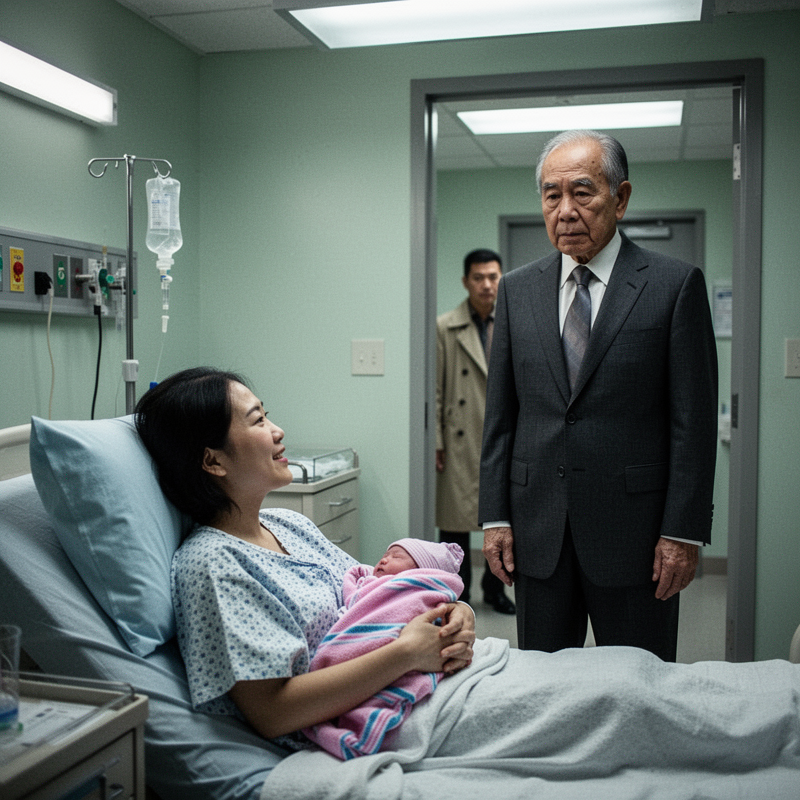
“You are no longer recognized as a beneficiary of this family estate,” my father said, standing over my hospital bed while I held my six-hour-old daughter.
He did not look at his newborn granddaughter once.
Instead, he signaled a process server to hand me an official petition removing me from my late mother’s $450,000 trust.
After two years of rebuilding my life from a $320,000 personal bankruptcy, my own father had chosen the morning of my child’s birth to legally erase me.
I vowed that day to uncover what he was trying so desperately to hide.
The fluorescent lights of the Garden Grove hospital room cast a sterile glow on the pale walls, a stark contrast to the swirling, overwhelming joy that had filled me just hours before. My body ached with a deep, primal exhaustion, the kind only a difficult delivery could inflict, but the pain was a distant hum beneath the pure, intoxicating scent of my daughter.
Maya, tiny and perfect, slumbered in my arms, her infinitesimal fingers curled around my thumb. Six hours old, and already she was my entire world. I gazed at her soft, dark fuzz of hair, her impossibly delicate eyelids fluttering, and a wave of fierce, protective love washed over me. This was the fresh start I desperately needed, the reason I’d fought so hard to climb out of the financial wreckage of my divorce and $320,000 bankruptcy.
A soft knock interrupted the quiet sanctity of the moment. I looked up, a weary smile already forming on my lips, expecting a nurse or David, Maya’s father, who had stepped out for coffee.
Instead, my father, Tuan Nguyen, stood in the doorway.
He was dressed in a dark, impeccably tailored suit, a crisp white shirt, and a silk tie—the same formal attire he wore to community events at the Vietnamese Cultural Center in Westminster, even on a Tuesday morning. It felt strangely out of place in a hospital room, especially a maternity ward.
Behind him, a tall, nondescript man in a beige trench coat held a slim leather briefcase. The man’s face was unreadable, his stance stiffly professional.
My smile faltered. My father’s gaze, usually so intense, was flat, devoid of the warmth I had secretly hoped for. He didn’t look at Maya, not even a flicker of curiosity or tenderness towards his newest grandchild. His eyes met mine, cold and assessing.
“Ba,” I whispered, using the Vietnamese word for father, my voice thick with sleep and emotion. “You came.”
A silence stretched, heavy and uncomfortable. The only sounds were Maya’s soft, rhythmic breathing and the distant hum of hospital machinery. My father remained still, his hands clasped behind his back.
He turned his head slightly, giving a curt nod to the man behind him.
The man stepped forward, his shoes making a soft scuff on the linoleum floor. He didn’t speak, simply reached into his briefcase and produced a thick, legal-sized envelope. He approached my bedside table, his movements precise and deliberate.
I watched him, confused, my heart beginning to quicken. Why was this man here? Why was my father so silent, so… cold?
“Linh Nguyen?” the man asked, his voice low and formal, without a trace of inflection.
“Yes,” I replied, my brow furrowing. I shifted Maya slightly, a protective instinct tightening my grip.
He placed the envelope on the small, movable table that held my water pitcher and a half-eaten cup of jelly. The paper felt heavy, substantial, and the stark black lettering on the front seemed to leap out.
*Superior Court of California, County of Orange.*
A petition. My mind raced, trying to grasp what this could possibly be. My stomach clenched.
My father spoke then, his voice cutting through the quiet like a blade.
“It is a petition,” he stated, his eyes still fixed on mine. “To remove you as a beneficiary of your mother’s trust.”
The words hung in the air, distorting the peaceful scene around me. The joyous afterglow of childbirth shattered instantly. Remove me? From Mama’s trust? The $450,000 trust she’d set up for Mai and me before she passed, meant to secure our futures?
My mouth fell open, but no sound came out. My throat felt suddenly dry, constricted.
He continued, his tone unwavering, as if reciting a pre-written statement. “Your recent financial difficulties… your bankruptcy. They are an embarrassment. A liability to our family’s honor.”
A liability. An embarrassment. The words hit me like physical blows, each one echoing the humiliation I’d fought so hard to overcome. My bankruptcy, a public record, had been a crushing weight, and I’d rebuilt my life, dollar by painful dollar, for two years. Now, in this sacred, vulnerable moment, it was being thrown back at me.
I looked down at Maya, then back at my father, begging him silently with my eyes for an explanation, for a shred of compassion. He knew what I had been through. He knew how hard I had fought.
The man in the trench coat gave a slight, almost imperceptible bow, then turned and walked silently out of the room.
My father took a single step back. His expression was still unyielding.
He looked at the envelope on the table, then once more at me. Still, not a single glance towards the bundled infant in my arms, his own granddaughter.
“You understand,” he said, the words a pronouncement, not a question. “This is for the family.”
Then, without another word, he turned on his heel. The door swung shut behind him with a soft click, leaving me utterly alone in the chilling silence of the room. My hand trembled as I reached for the thick envelope. The weight of it felt like a stone, sinking into my chest.
Part 2
The envelope felt like a brick in my hands. I stared at the formal lettering, the words blurring through a fresh wave of tears. How could he do this? To me, to Mama’s memory, especially today? My first instinct was to call David, but then a stronger thought pushed through. Mai. My younger sister, a junior associate at a law firm downtown. She would know what to do.
I dialed her number, my voice trembling as I explained everything that had just happened. Mai listened, quiet and methodical, a sharp contrast to my own spiraling panic. “Don’t worry, Linh,” she said, her voice firm. “I’ll look at it. Just focus on Maya.”
She called me back that afternoon, her tone already shifting from reassurance to concern. “Linh, there’s something off about these filing dates,” she explained. “The petition was drafted weeks ago, but the notary stamp is recent. And there’s a reference to a corporate entity I don’t recognize.”
A few days later, after I was discharged and settled back into my apartment, Mai drove out to Westminster. She told me she wanted to check in on our father at the family’s herb shop, but I knew she was really investigating. It was the heart of Little Saigon, a place teeming with familiar faces, where gossip spread faster than lemongrass chicken at Tet.
When she arrived, the shop was bustling, but not with customers. Instead, a small crowd of community elders was gathered in the back office. My father stood at the head of the table, his posture as imposing as ever. Beside him was a young man, much younger than me, with an unfamiliar, nervous smile.
Mai recognized him from photos my father had shown us – Bao, a distant cousin from Vietnam. She watched, hidden from view, as my father addressed the group. He announced that Bao would be taking over the management of “certain family properties.” He spoke about “restoring balance” and “protecting the family’s assets from… liabilities.”
Then came the blow. My father stated, in Vietnamese, that because of my “recent financial incapacitation” and my “troubles with modern law,” I was no longer fit to oversee our mother’s legacy. Bao, he declared, would assume full stewardship.
Mai, ever the quick thinker, saw a stack of papers on Tuan’s desk. While everyone was distracted by the announcements, she used her phone to snap quick photos of the corporate filings. She sent them to me, still reeling from my father’s public humiliation. Her next call was urgent. “Linh,” she said, her voice tight. “These documents… they’re a plan to liquidate all of Mama’s real estate. Within sixty days.”
CHAPTER 2: The Paper Trail
My sister Mai sat across from me at her kitchen table in Irvine, surrounded by legal pads and highlighters. The soft, rhythm of baby Maya sleeping in her bassinet in the corner was the only quiet sound in the room.
Mai slid a printed bank statement across the dark wood.
“Look at the entry from seven months ago,” Mai said, her pen hovering over a highlighted line.
I leaned in, holding my breath. It was an official accounting log from my late mother’s $450,000 trust account.
Dated March 14th, a single wire transfer of $185,000 had been pulled directly from the core funds. The recipient was an entity named Golden Orchid LLC, registered in Nevada.
“That transfer happened exactly twelve days before Dad filed the petition to disinherit you,” Mai whispered. “He drained more than forty percent of the trust in a single afternoon.”
My hands shook as I stared at the numbers. My father had claimed I was too financially unstable to touch my mother’s estate because of my $320,000 bankruptcy. Yet here was proof that he was secretly moving hundreds of thousands of dollars out of state.
I pulled out my phone and dialed my father’s cell phone immediately.
He picked up on the fourth ring. I could hear the bell above the door of his traditional herb shop in Little Saigon chiming in the background.
“Father, I’m looking at the bank statements for Mom’s trust,” I said, keeping my voice as steady as possible. “Where did the $185,000 go? Who owns Golden Orchid LLC?”
There was a long silence on the line. I could hear his heavy, measured breathing.
“You have no right to question how family business is conducted,” my father replied in Vietnamese, his tone icy and controlled. “You are an ungrateful daughter who understands nothing about duty.”
“It’s my mother’s legacy,” I said. “And it belongs to her children.”
“You ruined your own legacy when you filed for bankruptcy,” he said coldly. “Do not call this line again.”
The call went dead before I could answer.
CHAPTER 3: Eviction Order
Two weeks after coming home from the hospital with Maya, I walked down the carpeted hallway of my apartment building carrying a bag of fresh baby formula.
A bright yellow paper was taped directly over the deadbolt of my front door.
I set the bag down and pulled the document off the wood. It was an official 30-day notice to vacate the premises, signed by a process server.
The landlord listed on the eviction notice was not a third-party management company. It was Nguyen Family Holdings Inc.—the umbrella corporation managed entirely by my father.
My jaw tightened. My father technically owned the twelve-unit apartment building I had lived in for three years. I had paid my $1,600 monthly rent on time every single month, directly out of my modest post-bankruptcy savings.
My phone rang in my pocket. It was Mai.
“Did you get it?” Mai asked, her voice tight with anger. “He just served a copy to my office email.”
“He’s kicking a newborn out onto the street,” I said, leaning my forehead against the cool surface of my door. “Mai, I have nowhere else to move on short notice with my credit score.”
“I’m filing an emergency stay with the Orange County Superior Court right now,” Mai said. “It’s illegal retaliation against a trust beneficiary.”
An hour later, my phone chimed with a direct text message from my father.
*If you challenge this notice in court, I will personally file an affidavit regarding your $320,000 bankruptcy with David’s family lawyer,* the text read. *Let us see if the family judge believes an insolvent mother should keep full custody of a infant.*
I stared at the screen, my pulse pounding in my ears. He wasn’t just trying to disinherit me anymore. He was threatening to take my baby daughter away.
CHAPTER 4: The Former Partner
The heavy knock on my apartment door came at eight o’clock on a Tuesday evening.
I checked the peephole expecting another process server. Instead, I saw an older woman standing under the hallway light, wearing a high-necked wool coat and clutching a worn leather tote bag.
It was Madame Huong Le.
She was fifty-eight years old and had been my father’s primary business partner in an overseas import business back in 2008. She had abruptly vanished from our community fifteen years ago after a bitter fallout with my father that no one ever discussed.
I opened the door, keeping the security chain attached. “Madame Huong?”
“Let me in, Linh,” she said softly, her voice carrying a thick accent. “Before your father’s people see me in this building.”
I unlatched the chain and let her step into the small entryway. She smelled faintly of dried lotus tea and cold air. Without speaking, she walked to my kitchen table and unzipped her bag.
“I heard in the community that Tuan is using your bankruptcy to strip your mother’s estate,” Madame Huong said, laying three thick blue folders on the table. “He did the exact same thing to me when our partnership ended.”
I sat down across from her. “What do you mean?”
“Your father believes that law is secondary to authority,” she said, opening the first folder. “In 2018, he opened off-the-books entities in Nevada to transfer funds outside the oversight of company officers.”
She pointed to a stamped corporate registry document dated five years prior.
At the top of the state document was the entity name: Golden Orchid LLC.
Listed at the bottom, printed in clear black ink as the 100 percent sole managing member, was my father’s full legal name: Tuan Van Nguyen.
“He didn’t just wire that $185,000 to a stranger,” Madame Huong said, looking me in the eye. “He wired your mother’s trust money directly to himself.”
CHAPTER 5: Emergency Injunction
The next morning, Mai stood before a probate judge in the Orange County Probate Court in Santa Ana.
She placed Madame Huong’s certified corporate documents and the $185,000 bank wire record directly onto the clerk’s desk.
“Your Honor,” Mai argued, her voice echoing clearly in the high-ceilinged courtroom. “The trustee, Tuan Nguyen, has committed a clear breach of fiduciary duty by transferring $185,000 of estate assets into an entity under his personal control.”
The judge reviewed the documents for five long minutes while my father’s high-priced corporate defense attorney sat silently at the opposite table.
“Emergency motion granted,” the judge ruled, slamming his gavel down. “All financial accounts associated with the Nguyen Family Trust are frozen immediately pending a full accounting.”
Exiting the courthouse, I felt a sudden surge of relief. For the first time in months, we had stopped my father’s momentum.
But as we crossed the marble lobby toward the glass exit doors, a man in a gray suit stepped out from behind a pillar and blocked my path.
He handed me a thick stack of legal papers.
“Linh Nguyen,” the man said flatly. “You’ve been served.”
I opened the top page. It was a formal counter-lawsuit filed by my father’s legal team.
The filing accused me of grand theft of private business records, trade secret theft, and intentional forgery of bank records. It demanded an immediate $50,000 in emergency civil damages.
If a judge ordered me to pay $50,000, my recent bankruptcy discharge would be placed in severe jeopardy, threatening to throw me right back into total financial destruction.
CHAPTER 6: Unmasking the Relative
Two days later, I drove down Bolsa Avenue in Little Saigon and parked across from my father’s herb shop.
I watched through the glass window as Bao—the young man from Vietnam my father had brought into the business—loaded wooden crates onto a hand truck near the back entrance.
When Bao walked out into the alley to stack the empty crates, I stepped out of my car and approached him.
He jumped, dropping a wooden crate onto the pavement when he saw me. “Miss Linh… I am not supposed to speak to you. Your father said—”
“Bao, listen to me,” I interrupted, showing him a copy of the court injunction on my phone. “The judge froze all the trust accounts today. Anyone involved in transferring those funds is facing serious legal liability.”
Bao’s face turned pale. He pulled off his canvas work gloves, his hands trembling.
“I am not his nephew,” Bao stammered, looking nervously down the alley toward the street. “I am not family at all.”
“Then who are you?” I asked. “Why is my father giving you authority over our family holdings?”
“My father is a private lender in San Jose,” Bao confessed in a rushed whisper. “Five years ago, your late mother took a private, off-the-books loan from him for $200,000.”
I froze. “My mother took an unrecorded loan?”
“Yes,” Bao said, nodding frantically. “There was an unrecorded lien against her personal assets. Your father brought me here to ensure the money from the business was paid back to my family in cash settlements so no one would ever file a public lawsuit against her estate.”
CHAPTER 7: The Federal Audit
Mai acted immediately on Bao’s confession. She submitted the full record of Golden Orchid LLC’s transactions and the unrecorded $200,000 lien claim to the court-appointed probate referee.
The referee flagged the cross-border nature of the $185,000 wire transfer as a high-risk transaction, automatically triggering a mandatory audit notice to federal tax authorities.
On Friday afternoon, a courier delivered a sealed envelope to my apartment. It was a formal settlement proposal signed directly by my father.
The document offered to drop the $50,000 counter-lawsuit and give me a cash payout of $20,000 from his personal savings.
In exchange, I had to sign a complete release of all claims against the trust and withdraw our petition with the court referee immediately.
Attached to the offer was a handwritten note from my father in Vietnamese.
*Take the money and care for your daughter,* he had written. *If you let the government look deeper into these accounts, you will destroy this entire family forever.*
I sat at my kitchen table, holding my sleeping daughter against my chest. Twenty thousand dollars would easily pay off my immediate bills and give me security for months.
“If you accept this, he wins,” Mai said, standing by the window. “And he keeps total control over everything Mom left behind.”
I folded the paper in half, placed it back into the envelope, and slid it across the table to Mai.
“Tell his lawyer we will see him in court on Monday,” I said.
CHAPTER 8: Interrupted Testimony
On Monday morning, the probate courtroom in Santa Ana was cold and completely silent.
I took the witness stand first. For forty minutes, I answered Mai’s questions clearly, detailing the timeline of my mother’s passing, my father’s attempt to disinherit me while I was in the maternity ward, and the missing $185,000.
My father sat at the defense table, wearing a crisp dark suit, his face completely expressionless as he stared straight ahead.
When Mai finished, my father’s defense attorney called him to the stand to testify.
My father walked slowly to the witness box, swore the oath, and sat down comfortably. He adjusted his silver tie clip and looked directly at the judge.
“Mr. Nguyen,” his attorney began. “Can you explain to the court the business purpose of transferring $185,000 to Golden Orchid LLC?”
“Every dollar I have ever moved was done to protect my family’s honor,” my father said, his voice deep and calm. “My late wife made decisions that threatened our family name. As the head of the household, it was my sole responsibility to fix it—”
The heavy oak doors at the back of the courtroom suddenly swung open with a loud thud.
Two tall men in dark suits carrying federal badges walked down the central aisle. The entire courtroom went dead quiet.
“Tuan Van Nguyen?” the lead federal marshal called out loudly.
My father stopped speaking. His hands tightened on the edge of the wooden witness box.
“We have a federal warrant for your arrest,” the officer stated, walking straight up to the judge’s bench and handing over a paper. “Charged with two counts of federal wire fraud and tax evasion.”
The marshals stepped inside the witness well. Before my father could offer a single word of explanation to the judge or to me, they pulled his arms behind his back and clicked heavy steel handcuffs over his wrists.
My father didn’t struggle. As they turned him around to lead him down the aisle, his eyes met mine for a split second, filled with an unreadable, distant expression, before he was marched out of the room.
CHAPTER 9: The Unsealed Truth
Three days after my father’s arrest, Mai and I sat in a private conference room at the federal prosecutor’s office, staring at a thick stack of unsealed grand jury documents.
The federal investigator slid a financial forensics binder toward us.
“Your father wasn’t stealing that money for himself,” the prosecutor said plainly.
I blinked, confused. “What do you mean?”
“Your late mother ran up an illegal $400,000 gambling debt with a predatory underground loan ring in Northern California prior to her death,” the investigator explained, tapping a page of bank records.
My breath hitched in my throat.
“When you filed your personal $320,000 bankruptcy two years ago,” the prosecutor continued, “you listed your mother as a joint holder on two of your local bank accounts. If these underground lenders had sued her estate publicly, those predatory debts would have been legally tied to your joint accounts.”
Mai leaned forward, reading the highlighted lines rapidly. “It would have invalidated Linh’s bankruptcy discharge.”
“Exactly,” the prosecutor said. “It would have made Linh legally liable for her mother’s $400,000 debt, destroying her financially for the rest of her life and likely triggering fraud charges against her bankruptcy filing.”
The room felt entirely devoid of air.
“Your father discovered the debt right after your mother passed away,” the prosecutor added quietly. “He created Golden Orchid LLC and wired the $185,000 to pay off the loan sharks in secret. He intentionally served you with disinheritance papers at the hospital to create a clear, public legal barrier between you and the estate, so federal authorities and creditors could never link the illegal debt to you or your newborn child.”
He took the blame, broke federal tax laws, and made himself look like a cold, heartless monster—all to ensure that the debt died with him, leaving my clean slate intact.
CHAPTER 10: The Hollow Victory
A month later, the afternoon sun streamed through the windows of a quiet Pho restaurant in Little Saigon, just three blocks from the federal detention center where my father was awaiting his four-year prison sentence.
The probate court had officially closed the matter. A check for $225,000—my full fifty percent share of my late mother’s trust—lay inside my purse on the vinyl booth seat beside me.
My financial future was completely secure. My daughter Maya slept peacefully in her carrier beside me, safe and fully provided for.
Mai sat across from me, quietly stirring her tea.
“Community elders are still refusing to speak to us,” Mai said softly, looking out the window. “They say we put our own father in prison for money.”
My father had refused all prison visitors. He had returned every letter I sent to his cell unopened. He had chosen to carry his sacrifice in total silence, maintaining his rigid pride even behind bars.
I pulled the official bank deposit slip out of my purse and stared at the numbers printed in neat black ink.
I had fought for fairness, for respect, and for what I believed was my mother’s stolen legacy. I had pushed through every legal barrier until I brought the absolute truth into the light.
I won every dollar my mother left behind, but sitting in the silence of that restaurant, I realized some victories cost far more than bankruptcy ever could.
Leave a Reply