CHAPTER 1: The Slush on the Glass
Part 1
When a viral photo of me standing over my ailing husband at Pinecrest Care Center racked up 4.2 million views overnight, the internet called me a monster trying to end his life for insurance money.
My ex-fiancé, Julian Kincaid, had leaked the cropped image to destroy my legal guardianship and force control over our family’s assets.
By noon the next morning, news vans blocked the care center entrance in upstate New York, while facility management demanded $18,500 in overdue fees or they would discharge my husband into the street.
I stood in the freezing slush outside the glass doors, holding my eight-year-old son’s hand, knowing my personal bank accounts had just been frozen to zero.
I had been quiet my whole life, but surviving Julian meant I had to play a far colder leverage game than anyone thought I was capable of.
The biting wind of upstate New York bit at my ears, even through my thin scarf, as I steered my old sedan through the still-dark, pre-dawn streets. It was 7:25 AM, the sky a bruised purple, promising snow it hadn’t yet delivered.
The roads were slick with freezing slush from yesterday’s melt, reflecting the dim glow of my headlights. Leo, my eight-year-old son, sat strapped into his booster seat, his small hand still clutching mine from the drive. He was usually chatty, but this morning, a quiet tension had settled over him.
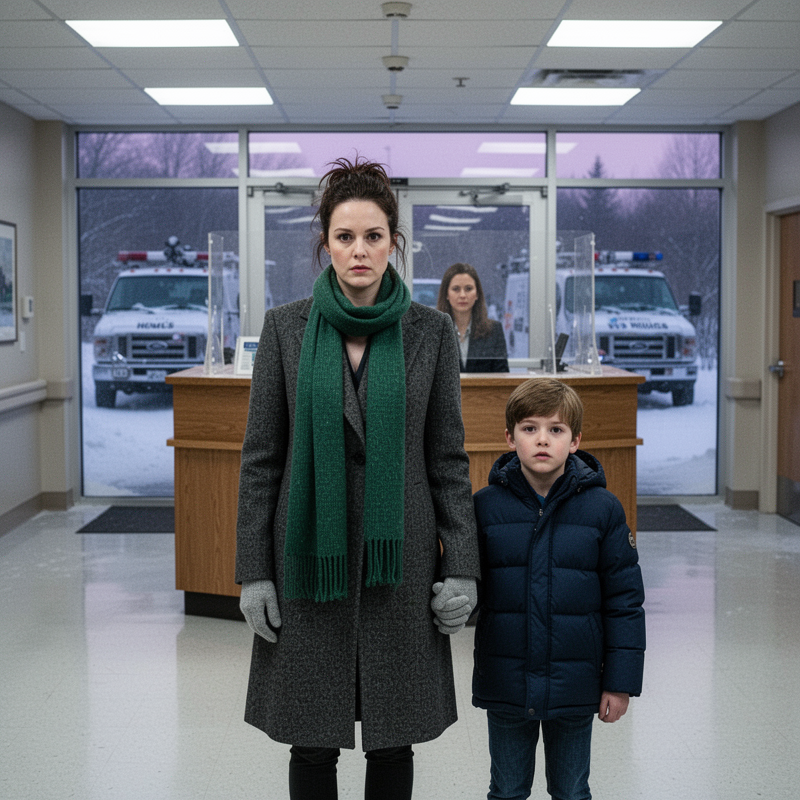
As Pinecrest Care Center came into view, the familiar, comforting silhouette of the building was obliterated by an alien, hostile presence. Three large white television news vans were parked haphazardly across the main entrance, their satellite dishes pointing skyward like metallic vultures.
Their engines idled, exhaling plumes of white vapor into the frigid air. The slush around them was already churned into a muddy brown, littered with disposable coffee cups and discarded cigarette butts.
A reporter with too much hairspray was practicing her lines in front of a cameraman, her breath fogging in the cold. The sight made my stomach clench.
I found a spot at the far end of the parking lot, as far from the chaos as possible. The short walk across the freezing asphalt to the entrance felt like an endless journey through an invisible gauntlet. Each step crunched on ice.
My grip tightened on Leo’s hand. He stumbled once, splashing slush onto his worn winter boots. He didn’t complain, just looked up at me with wide, worried eyes.
The automatic glass doors of the care center slid open with a whoosh, revealing a lobby that was usually quiet and calm, but today felt charged with an unnatural stillness. The bright fluorescent lights hummed, glinting off the polished linoleum floor.
A young security guard, his face pale and stressed, nodded curtly as we passed. He didn’t meet my gaze.
Clara Vane, the facility administrator, was already waiting at the front desk, behind a thick pane of plexiglass. Her usually composed face was drawn tight, her lips a thin, unsmiling line. She held a stack of papers, her knuckles white where she gripped them.
“Ms. Barrett,” Clara said, her voice flat, devoid of any warmth. Her gaze flickered briefly to Leo, then back to me, an unreadable mix of disdain and pity in her eyes.
“Thank you for coming in so quickly. We need to discuss Mr. Barrett’s situation.”
She slid a tablet across the counter, its screen already open to a social media page. It was a photo of me, leaning over David’s bed. My face was blurred, but the pill bottle in my hand, generic and unlabeled, was sickeningly clear. David’s emaciated face was visible on the pillow.
The view counter beneath the image read: 4.2M.
“This image has gone viral, Ms. Barrett,” Clara continued, her voice gaining a sharp, professional edge. “Over four point two million views in less than twelve hours. We’ve been inundated with calls, emails, even physical threats against the facility.”
Her finger tapped the screen, indicating a string of vitriolic comments scrolling below the image. “The perception, Ms. Barrett, is that you are actively trying to harm your husband. That you are… attempting to hasten his end.”
A cold dread seeped into my bones. The internet’s judgment was a tangible force, pressing down on me, suffocating me.
“We cannot operate under these conditions,” Clara stated, her voice hardening further. “Pinecrest Care Center cannot afford to be associated with such public scandal. Not when there are vulnerable residents here.”
She pushed a stack of printed invoices under the plexiglass, their edges sharp and official.
“As per our records, Mr. Barrett’s account is currently $18,500 overdue. We require immediate payment in full, Ms. Barrett.”
My breath hitched. My hands felt cold, clammy.
“Immediate payment, or we will be forced to initiate a transfer to a municipal state facility by the end of the day.”
The words hung in the air, a threat heavier than the freezing slush outside. A state facility. That meant a significant downgrade in care, a less specialized environment for David’s advanced ALS. It would be a death sentence, slow and inhumane.
“I can pay a portion today,” I managed, my voice thin, almost a whisper. I reached into my purse, fumbling for my debit card. My hands trembled slightly.
Clara watched me, her expression unyielding. She pushed the card reader across the counter.
I inserted the card, my fingers stiff. The small screen lit up, demanding my PIN. I entered the four digits, my heart pounding a frantic rhythm against my ribs.
The machine whirred for a moment, then beeped twice, an insistent, dismissive sound. The screen flashed a stark, red message.
‘ACCOUNT FROZEN.’
Part 2
The red text on the screen burned into my eyes. My stomach dropped, a cold, sickening lurch. I pulled my debit card from the slot, my fingers numb. Clara Vane’s expression remained unmoving, a silent judgment in her eyes.
“Ms. Barrett, do you have any other means of payment?” she asked, her voice laced with an impatience that felt like a slap.
I shook my head, unable to form words. My mind was reeling. Frozen. All my accounts, zeroed out. How?
I gripped Leo’s hand and stumbled back through the lobby, ignoring the curious glances of the few staff members. The security guard watched us with a new intensity. I needed to call the bank, right now.
Stepping back into the freezing parking lot, the wind cut through my coat. News vans still idled, their engines a low growl. I steered Leo toward my car, a battered, rusting sedan that suddenly felt like the only safe haven in the world.
Inside, the air was still frigid. Leo climbed into the backseat, quietly clutching his backpack to his chest. He didn’t ask questions, just watched me with wide, anxious eyes.
My hands trembled as I pulled out my phone. I dialed the bank’s customer service line, the automated voice a cruel drone against the frantic beating of my heart. After what felt like an eternity, a compliance representative picked up.
“I need to know why my accounts are frozen,” I demanded, my voice tight with fear.
The representative, a woman named Sharon, spoke with a practiced, detached calm. “An emergency asset hold was placed by a Mr. Julian Kincaid,” she explained. “He provided documentation citing an unrevoked prenuptial indemnity clause from 2016. It grants him temporary financial authority in the event of… significant marital distress.”
Julian. Of course. The name hit me like a physical blow. He’d been planning this. That old, unsigned prenup, buried in a drawer, now weaponized against me.
As Sharon spoke, the blinding flash of a paparazzi camera exploded through my windshield, followed by another, and another. My car was a fishbowl.
My phone vibrated again in my hand. It was Julian. His name flashed on the screen, cold and accusatory. I hesitated for a split second, then answered.
“Elena,” his voice was smooth, devoid of any emotion, yet it chilled me to the bone. “A simple phone call could have saved you all this trouble.”
“What do you want?” I whispered, my gaze flicking to Leo in the rearview mirror. He was still and quiet, watching me.
“Simple. I want what’s rightfully mine,” Julian continued, ignoring my question. “Sign over full power of attorney for David’s estate. By 5:00 PM today. Do that, and your accounts will be unfrozen. Your husband’s care will be covered. Your name will be cleared. Resist, and you lose everything. And I mean *everything*.”
He waited for no response. There was a click, and the line went dead.
CHAPTER 2: The Offer at Pinecrest
My boots tracked brown meltwater across the worn linoleum tile of the care center lobby.
Clara Vane sat behind a thick sheet of bulletproof plexiglass, her eyes fixed on her computer monitor. She didn’t look up when the heavy glass door hissed shut behind me.
A fresh sheet of paper slid through the metal pass-through tray at the bottom of the partition.
“Notice of Involuntary Transfer,” the dark heading read in bold letters.
“What is this, Clara?” I asked, resting my fingers against the cold glass.
“Mr. Kincaid’s legal representatives paid a visit two hours ago,” Clara said, her voice flat and completely devoid of warmth. “They made a formal motion with our administrative board.”
“Julian has no legal standing over David,” I said. “None.”
“They offered to clear Mr. Barrett’s entire $18,500 overdue balance instantly,” Clara replied. She finally turned her head, her expression rigid. “On the condition that facility management accepts his private foundation as David’s temporary legal conservator.”
“You can’t sell guardianship over a patient,” I said.
“We aren’t selling anything, Mrs. Barrett,” Clara said, tapping her desk calendar. “We are managing an unpaid debt and severe public disruption. If that fee isn’t paid or transferred by 5:00 PM tomorrow, state transport picks David up.”
“He won’t survive a transfer to a municipal ward,” I said.
“Then you have twenty-eight hours to clear your bank hold,” Clara said, pulling her microphone closer to her collar. “Or let someone else pay the bill.”
“Julian framed me,” I said, my voice dropping to a whisper. “You know he did.”
“I know what the board requires,” Clara said, turning back to her screen. “And right now, you are a liability to this facility.”
I pulled my hand back from the glass. The brown slush under my boots had pooled into a dark puddle on the floor.
Julian hadn’t just frozen my bank accounts to starve me out. He was using the arrears to buy physical control of my husband before the end of the week.
***
CHAPTER 3: The Engraved Brass Watch
I slipped past the unattended security desk in the East Wing corridor, my rubber-soled boots making no sound against the rubber floor mats.
Inside Room 114, the air was thick with the chemical smell of antiseptic and warmed humidified air.
David lay motionless under a thin blue hospital blanket. The plastic cannula rested beneath his nose, his chest rising in quick, shallow hitches against the mechanical hum of the bedside ventilator.
“David,” I whispered, reaching down to press my thumb against his wrist.
His eyelids fluttered, but he didn’t open his eyes. He couldn’t speak, couldn’t turn his head, couldn’t move his arms.
I knelt beside his small wooden bedside locker. The bottom drawer was jammed with spare tracheostomy ties, saline wipes, and old paper receipts.
I reached deep into the back corner until my knuckles struck a heavy, cold metallic object wrapped in a wool sock.
I pulled it out and unwrapped the fabric.
It was David’s heavy brass pocket watch—an antique heirloom with a thin hairline crack across the glass casing.
I wedged my thumbnail into the seam along the rim, popping the back cover open with a dull metallic click.
Taped neatly inside the brass inner lining sat a black micro-SD card no larger than a fingernail. Beneath it lay a tightly folded piece of paper.
I unfolded the paper under the bed light. It was a stamped receipt from a local pawn shop four miles down the highway, dated three weeks ago at 3:14 AM, detailing a $5,000 cash transaction.
“What did you hide, David?” I murmured.
The mechanical monitor beside his head beeped once, a rhythmic beat marking his fragile pulse.
I slid the tiny memory card into my coat pocket and closed the watch.
***
CHAPTER 4: Freezing Locks and Paper Trails
The Saratoga County Public Library smelled of wet wool carpet and printer toner.
I sat at a corner computer terminal tucked behind the local history archives, far from the main entrance windows.
Marcus Carver sat in the wooden chair next to me. He wore a faded canvas jacket stained with blue ink along the cuffs, his face shadowed by dark circles under his eyes.
“Plug it in,” Marcus said, sliding a USB card reader across the laminate desk.
I inserted the micro-SD card into the slot. The file directory opened instantly, showing three raw video files.
“Look at the timestamp,” Marcus whispered, pointing his thumb at the screen.
The video feed flickered to life in raw infrared night vision. The timer in the top corner read 3:14 AM on the date the viral photo was supposedly taken.
A tall man wearing a dark tactical jacket opened the door to Room 114. He reached into his pocket, placed an unlabelled prescription bottle on David’s bedside table, and leaned down over David’s pillow with a digital camera.
“That’s not you,” Marcus said, leaning closer to the monitor. “That’s a hired operative.”
“Julian paid someone to slip into his room in the middle of the night,” I said, my heart pounding against my ribs.
“He staged the shot to make it look like an overdose attempt,” Marcus said. “He knew a single frame would tear you apart online before anyone asked for video proof.”
Before I could drag the file into a backup drive, my phone buzzed on the wooden desk.
It was an automated alert from a local news site.
“NEW AUDIO LEAK,” the notification headline read. “Wife of Comatose Engineer Heard Threatening Medical Staff at Pinecrest.”
I pressed play on the audio clip with a trembling finger.
A distorted, grainy version of my own voice filled my ear: “If you don’t let me handle his care, I’ll make sure he doesn’t last another week.”
“That’s spliced,” Marcus said immediately, his voice cold. “They took your legal intake statement from three months ago and cut the words together.”
“It doesn’t matter if it’s spliced,” I said, watching the share count on the article jump by thousands in real time. “They’re building a wall around me.”
***
CHAPTER 5: The Mob at the Gate
By 2:15 PM, the slush outside Pinecrest Care Center was churned into dark mud by the boots of over forty protesters.
They stood along the chain-link perimeter fence, holding corrugated plastic signs printed with enlarged, grainy cutouts of my face.
“Murderer!” a woman in a red coat screamed as I slowed my sedan near the main entrance gates.
“She’s trying to collect the policy!” another voice shouted, slamming a fist against my passenger side window.
In the backseat, eight-year-old Leo pulled his knees up to his chest, pressing his hands flat over his ears.
“Keep your head down, Leo,” I said, keeping my hands glued to the steering wheel at ten and two.
A county sheriff cruiser was parked diagonally across the driveway, its red and blue lights flashing against the overcast sky.
Deputy Sarah Holbrook stepped out from the driver’s side, raising one hand to stop my car while holding her duty belt with the other.
I rolled down my window three inches. The cold air rushed inside, carrying the roar of the crowd behind us.
“You need to turn around, Mrs. Barrett,” Deputy Holbrook said, leaning down toward the frame.
“My husband is inside that wing,” I said. “I have legal visitation rights.”
“Facility management placed the East Wing under emergency lockdown ten minutes ago,” Holbrook replied. Her face was completely expressionless. “The crowd is unsafe. No visitors, including immediate family, are permitted past this line.”
“They’re missing his respiratory clearing sessions,” I said, my voice rising. “His lungs fill with fluid if he doesn’t get cleared every eight hours!”
“That is an internal medical matter for Pinecrest staff,” Holbrook said, tapping the top of my door. “My job is public order. Turn the vehicle around before this crowd breaks your glass.”
I looked at the glass doors of the facility sixty yards away. Through the double doors, I could see two orderlies pushing a heavy transport cart across the lobby floor.
I shifted the car into reverse and backed slowly into the street.
***
CHAPTER 6: Shadows of the $2.4 Million Debt
Marcus Carver’s garage smelled of oil, old paper, and stale coffee.
He pulled a thick stack of printed corporate disclosures from a cardboard file box and spread them across a workbench under a bare hanging light bulb.
“Here’s the structural link,” Marcus said, pointing his pencil at a set of line items from five years ago.
“What am I looking at?” I asked, standing close to the workbench with my arms crossed over my chest.
“When Julian’s restructuring firm bought out David’s civil engineering group during the liquidation phase, they assumed all physical assets,” Marcus explained. “But David retained sole signatory authority over an offshore escrow liability account worth $2.4 million.”
“I didn’t know about any escrow account,” I said.
“David didn’t tell you because he was trying to keep you out of the legal crosshairs,” Marcus said. “Julian ran up massive debt obligations during the buyout. He can’t access that $2.4 million without David’s signature—or without David dying while under a conservatorship controlled by Julian’s foundation.”
“If David dies while I am his legal guardian…” I began.
“The trust automatically freezes for independent probate review,” Marcus said, slamming his pencil onto the wood. “Auditors would look at the original buyout books. Julian’s entire domestic network would face federal fraud charges.”
“He doesn’t want the money to pay for David’s care,” I whispered.
“He needs David silenced or under his control before the end of the quarter,” Marcus said. “If he controls the conservatorship, he signs off on the release of funds, clears his personal liability, and buries the records forever.”
“And if I refuse to sign?” I asked.
“He’ll strip everything you own until you have no choice left,” Marcus said.
***
CHAPTER 7: Cold Radiators and Social Services
I opened the front door of our small suburban house at 6:00 PM.
The air inside was so cold my breath formed thick white clouds in the hallway.
I walked straight to the thermostat on the dining room wall and clicked the plastic dial up to seventy degrees. Nothing happened. The metallic click echoed in the silent, freezing house.
I walked out to the side porch. A bright yellow tag was wire-tied to the oil line intake valve.
“ACCOUNT SUSPENDED — INSUFFICIENT FUNDS,” the red stamp across the card read.
Before I could step back inside, heavy car tires crunched over the icy driveway behind me.
A grey county midsize sedan pulled up behind my car, followed closely by Deputy Sarah Holbrook’s patrol cruiser.
A woman in a heavy charcoal overcoat stepped out of the grey car carrying a manila folder under her arm.
“Elena Barrett?” she asked, walking up the front porch steps.
“Yes,” I said, blocking the door frame with my body.
“I’m Brenda Vance from County Child Welfare Services,” the woman said, holding up a laminated ID badge. “We received an urgent tip regarding an unsafe living environment and minor neglect at this address.”
“My home is clean and safe,” I said through gritted teeth.
“We have a report stating your utility services have been terminated due to financial insolvency,” Vance said, looking past my shoulder into the dark, unlit hallway. “And that you are currently under active police investigation for medical endangerment.”
“My son is inside wearing a sweater,” I said. “This account freeze was engineered by an outside party.”
“If there is no heat in this structure by 9:00 AM tomorrow,” Vance said, her voice dropping into a clipped, mechanical rhythm, “we will be forced to place Leo in temporary state custody until a safety hearing can be scheduled.”
Deputy Holbrook stood at the bottom of the steps, her hand resting on her belt, watching me in silence.
***
CHAPTER 8: The Parking Garage Trap
The concrete parking structure in downtown Albany was dark and drafty, the wind howling through the open ramp walls.
I stood beside my car on the third level at 9:30 PM, my fingers numb inside my coat pockets.
A black SUV pulled up the concrete ramp, its headlights cutting through the dim yellow light overhead. It stopped ten feet away, the engine idling with a low rumble.
Arthur Vance, Julian’s chief legal counsel, did not step out.
Instead, the rear passenger door opened, and Julian Kincaid stepped onto the oil-stained concrete. He wore a tailored dark cashmere topcoat, his leather gloves polished and unblemished.
Two large private security men stepped out from the front doors, positioning themselves behind my driver’s side door, blocking my exit path.
“You brought a camera card to bargain with, Elena,” Julian said, his voice quiet and even. “You always were predictable.”
“I have the raw video from 3:14 AM,” I said, backing up until my spine touched the cold driver’s side glass. “I have the timestamp showing your security operative in David’s room.”
“You have nothing,” Julian said, stepping closer. “Because nobody is listening to an accused wife.”
Before I could move, one of the security men stepped forward and seized my arm, pinning my shoulder against the car door.
I gasped as my wrist twisted. He unzipped my handbag with his free hand, pulled out the heavy brass pocket watch, and handed it directly to Julian.
Julian took the watch, turned it over in his gloved hands, and dropped it into his coat pocket.
“You don’t have the leverage for this game, Elena,” Julian said softly. He pulled a folded sheet of paper from his jacket and tossed it onto the hood of my car. “Sign the temporary conservatorship transfer before morning, or C.P.S. takes your boy at sunrise.”
He turned and stepped back into the SUV. The heavy doors slammed shut, and the vehicle accelerated down the exit ramp into the night.
***
CHAPTER 9: What Was Left in the Pencil Box
I sat at the formica kitchen table at 10:45 PM, an ice pack pressed against my swollen right wrist.
The house was so cold the water in the sink dog bowl had formed a thin skin of ice around the edges.
I stared at the blank power-of-attorney form lying open on the table beside my car keys.
The brass watch was gone. The raw video file was lost.
Footsteps sounded softly on the wooden stairs behind me.
Leo walked into the kitchen wearing his thick blue winter coat and a knit cap pulled low over his ears. He was carrying his yellow plastic school pencil box in both hands.
“Leo, you should be under the blankets,” I said, trying to smooth my hair down with my good hand. “It’s too cold down here.”
Leo didn’t answer. He walked over to the table, set the yellow box on the laminate surface, and popped the blue plastic latch open.
He reached inside, past two broken crayons and a rubber eraser, and pulled out a tiny black square of plastic.
He set it gently on top of the legal paper.
It was the micro-SD card.
I stared at the tiny piece of plastic, then looked up into my son’s face.
“I saw you hide the watch in your purse before we left for the garage,” Leo said, his voice small and steady in the dark kitchen. “I took the little card out and put it in my pencil box while you were loading the car.”
My throat tightened so fast I couldn’t breathe.
“You kept it?” I whispered.
“You told me dad gave you that watch to keep us safe,” Leo said, looking at the floor. “I didn’t want the man in the suit to take it.”
***
CHAPTER 10: The Midnight Upload
At 11:45 PM, I sat on the edge of Leo’s bed upstairs while he opened his school-issued tablet on his knees.
“We don’t send it to the news,” I said, leaning over his shoulder. “They’ll edit it again.”
“Where do we put it?” Leo asked, his fingers hovering over the glowing touchscreen.
“Right on the original thread,” I said. “Where the photo was first posted.”
Leo inserted the card into the tablet’s side slot using a small adapter Marcus had given me.
He opened the primary social media platform where the viral image had reached 4.2 million views. The comment section was still filling with thousands of angry messages every minute.
Leo selected the raw 3:14 AM video file. He added a second attachment—a high-resolution photo of the physical $5,000 pawn shop receipt stamped with the operative’s signature.
“Do you want me to write something?” Leo asked, looking up at me with wide eyes.
“Keep it simple,” I said. “Just the truth.”
Leo tapped the screen with his index finger, typing slowly:
“This is my dad. The man in the suit paid to frame my mom.”
He hit the blue send button.
The loading circle spun once, twice, and then vanished.
We sat in the dark room, watching the screen in silence.
Within four minutes, the post had twenty retweets. Within twelve minutes, it had twelve hundred.
By 12:30 AM, national media accounts were retagging the clip with the original unedited timestamps highlighted in red. The narrative was cracking wide open in real time.
***
CHAPTER 11: The Tide Turns in Silence
By 6:00 AM the following morning, the sun rose over a completely altered landscape.
I sat downstairs wrapped in a wool blanket, watching the screen of my phone.
The front page of three major national news sites featured side-by-side screenshots: the cropped photo on the left, and the raw 3:14 AM infrared frame on the right showing Julian’s hired operative holding the pill bottle.
A prominent morning news anchor was speaking live from a studio in Manhattan:
“New digital evidence uploaded late last night conclusively proves that the viral image targeting Elena Barrett was staged during an unauthorized 3:00 AM entry at Pinecrest Care Center. Federal tax authorities have reportedly opened an inquiry into shell entities connected to Kincaid Restructuring.”
My phone chimed with an incoming email notification.
It was an automated statement from the regional bank branch:
“NOTICE: The administrative freeze on checking account ending in 4102 has been lifted per legal instruction. Available balance: $2,140.50.”
Outside my front window, the news vans were still parked along the curb, but the protesters were completely gone.
Two reporters stood near my front gate, holding microphones down at their sides, waiting quietly in the snow without shouting.
There was no victory cheer in the kitchen. The radiators were still ice-cold. The house was still freezing.
My phone rang again. It was the main desk at Pinecrest Care Center.
“Mrs. Barrett?” a nurse’s voice spoke hurriedly over the line. “You need to get to the Intensive Care Unit immediately.”
***
CHAPTER 12: The Quiet Retreat
I arrived at Pinecrest at 8:15 AM.
The front entrance was quiet. The crowds, signs, and sheriff cruisers had vanished as if they had never existed.
In the lobby, Clara Vane did not look up from her desk as I walked past the partition.
I checked my email on my phone while waiting for the elevator. A short message from Arthur Vance’s law firm sat at the top of my inbox:
“Be advised that all motions for temporary conservatorship regarding David Barrett have been formally withdrawn with prejudice. All liens are released.”
My phone buzzed again—a text from Marcus Carver:
“Julian cleared his executive suite at 3:00 AM. Boarded a private charter out of Teterboro to St. Maarten. He moved his remaining offshore holdings before the domestic freeze hit.”
I stared at the small screen.
Julian hadn’t been arrested. He hadn’t stood in a courtroom. He hadn’t apologized.
He had calculated his legal exposure, cut his domestic losses, and walked away into a country beyond federal extradition, leaving his empty shell companies to take the blame.
The elevator doors opened on the third floor ICU.
The air smelled strongly of rubbed alcohol and oxygen.
The head ICU physician, Dr. Aris, was waiting for me outside Room 302, holding a silver clipboard against his chest.
“Mrs. Barrett,” he said softly, his hands trembling slightly as he adjusted his glasses. “We need to talk about what happened during the lockdown.”
***
CHAPTER 13: The Monitor’s Flat Line
“During the forty-eight hours the East Wing was sealed by security,” Dr. Aris said, walking me into the muted room, “the specialized respiratory team was unable to access David’s mechanical clearance system.”
I stood at the foot of the bed.
David looked smaller than he had two days ago. His skin was gray, dry, and tight across his cheekbones.
“Without those specialized airway clearing cycles,” Dr. Aris continued, his voice quiet, “fluid accumulated deep within his lower pulmonary lobes. Severe bacterial pneumonia has set in.”
“Can’t you drain it now?” I asked. My voice sounded thin, like dry paper tearing. “The hold is lifted. The money is clear. I can pay the bill.”
“The damage occurred while the treatment was delayed, Mrs. Barrett,” Dr. Aris said, looking down at his shoes. “His system is in septic shock. His organs are failing. Medication is no longer holding his blood pressure.”
I walked to the side of the bed and took David’s right hand in both of mine.
His fingers were cold as ice. His skin felt like old parchment.
The heart monitor beside his bed ticked erratically: fifty-four beats a minute, then forty-eight, then forty-two.
“David,” I whispered, pressing his knuckles against my cheek. “David, can you hear me?”
His chest gave a heavy, ragged shudder against the blue blanket. He didn’t open his eyes. He didn’t move his fingers.
The mechanical ventilator clicked and hissed, pumping air into lungs that could no longer process it.
“I’m so sorry,” Dr. Aris whispered from the doorway, pulling the curtain half-closed behind him. “We are keeping him as comfortable as possible.”
I sat in the plastic armchair beside his bed, holding his hand through the dark.
***
CHAPTER 14: The Silent Room at 4:12 AM
The room was totally quiet except for the steady, slowing tone of the bedside monitor.
At 4:10 AM, the digital readout dropped to twenty-two beats per minute.
I stood over David, holding his hand tightly in my own, watching his chest rise and fall one last time.
At 4:12 AM, the line on the screen went completely flat. A long, continuous tone filled the small room.
David was dead.
He had passed away without opening his eyes, without hearing his name cleared, without saying a final word to me or his son.
I stood there in the harsh blue light of the heart monitor.
The public narrative had been corrected. The viral video had been exposed as a fraud. Julian’s reputation in corporate circles was destroyed.
And none of it mattered.
The forty-eight-hour delay had killed David just as surely as a bullet. The leverage game had been won, but the physical toll was absolute and irreversible.
My phone screen chimed on the small bedside table.
A news push alert flashed across the glass:
“FEDERAL OFFICIALS CONFIRM KINCAID ASSETS BEYOND U.S. JURISDICTION; NO EXTRADITION EXPECTED.”
Julian was sitting in a sunlit villa five thousand miles away with his wealth intact, completely untouched by the criminal justice system.
I leaned down and kissed David’s cold forehead, resting my cheek against his still chest while the monitor continued its flat, endless tone in the dark.
***
CHAPTER 15: Empty Corridors and Flashing Lights
By 6:30 AM, two orderlies stepped into Room 302 with a metal transport gurney.
They pulled the thin blue blanket over David’s face, pulled the straps tight across his frame, and rolled him slowly down the rear service corridor toward the loading bay.
I walked three paces behind them, holding eight-year-old Leo’s hand tightly in mine.
Deputy Sarah Holbrook was standing near the double metal doors at the exit bay, her hands clasped behind her back.
As the gurney rolled past her, she slowly pulled off her dark felt uniform hat and held it over her chest, stepping back to let us pass.
She didn’t say a word. She didn’t look me in the eye.
We stepped out into the freezing morning slush of the rear parking area.
A single remaining television news van was parked near the dumpster. A reporter stepped out from the passenger door holding a foam-covered microphone, stepping toward us across the gray slush.
“Mrs. Barrett!” the reporter called out, his voice loud in the quiet morning air. “Do you feel vindicated now that the full truth about the video is out?”
I didn’t stop walking. I didn’t turn my head. I didn’t look at his camera.
I guided Leo past the bumper of the van, unlocked the passenger door of my rusting sedan, and helped him slide into his seat.
I got behind the wheel, pulled the door shut, and turned the key in the ignition.
The engine sputtered twice before turning over, its exhaust rising in white plumes against the freezing gray morning sky.
***
CHAPTER 16: Twenty-Two Winters Later
Twenty-two years later, the slush along Highway 9 in upstate New York was the exact same color of dirty brown rust.
I sat in a high-backed vinyl booth inside a dimly lit roadside diner two miles from the cemetery where David was buried.
Outside the cracked window, freezing rain slapped against the red neon sign above the parking lot.
Across the formica table sat Leo. He was thirty years old now, wearing a dark canvas work coat with ink-stained cuffs, his hands rough and weathered around a white ceramic coffee mug.
We hadn’t spoken more than ten sentences to each other in three years.
The silence between us was heavy, awkward, and thick with the unhealed distance of a childhood broken by headlines and police cruisers.
Leo reached into his coat pocket, pulled out an old metallic object, and set it on the table between our coffee cups.
It was David’s brass pocket watch—its glass face still bearing the thin hairline crack from 2002.
“I found this in the hall closet while clearing out the old house,” Leo said. His voice was low, flat, and quiet.
I reached out with a trembling hand and touched the cold brass casing.
“He never came back from overseas, did he?” Leo asked, looking out the rain-streaked window at the passing semi-trucks on the highway.
“No,” I said. “He lived in Sint Maarten until he died four years ago. Peaceful. Rich.”
Leo picked up his coffee cup, took a slow sip, and set it back down on the saucer with a soft click.
We sat together in the drafty booth while the freezing rain turned to slush against the glass outside.
We won the battle for the public mind, but survival in the dark always demands a tax that no victory can ever pay back.
Leave a Reply