CHAPTER 1: Locked Out at the Gates
Part 1
Three days after I gave birth to my son in Austin, Texas, my mother Eleanor changed the security codes to my $1.4 million home while I was at the pharmacy buying baby formula.
She stood behind the glass door holding my newborn’s birth certificate and told me I was unfit to live in my own house.
She claimed that because she paid $5,000 toward my college tuition twelve years ago, the house legally belonged to her family trust now.
I was left sitting in my car in the driveway with a three-day-old infant and $42 in my checking account.
She thought I would break down and beg for her forgiveness like I had done my entire life.
She had no idea what I had already put in motion.
The late afternoon sun in Austin was still warm, even in early October, casting long shadows across my meticulously manicured lawn. I pulled my car into the driveway, the familiar crunch of gravel under the tires a small comfort.
In the back seat, my son, Leo, let out a soft whimper. Three days old, and already he had me wrapped around his tiny finger.
I’d just made a quick, desperate run to the pharmacy for more specialized formula. My own milk hadn’t come in properly, and the guilt was a heavy blanket on top of my exhaustion.
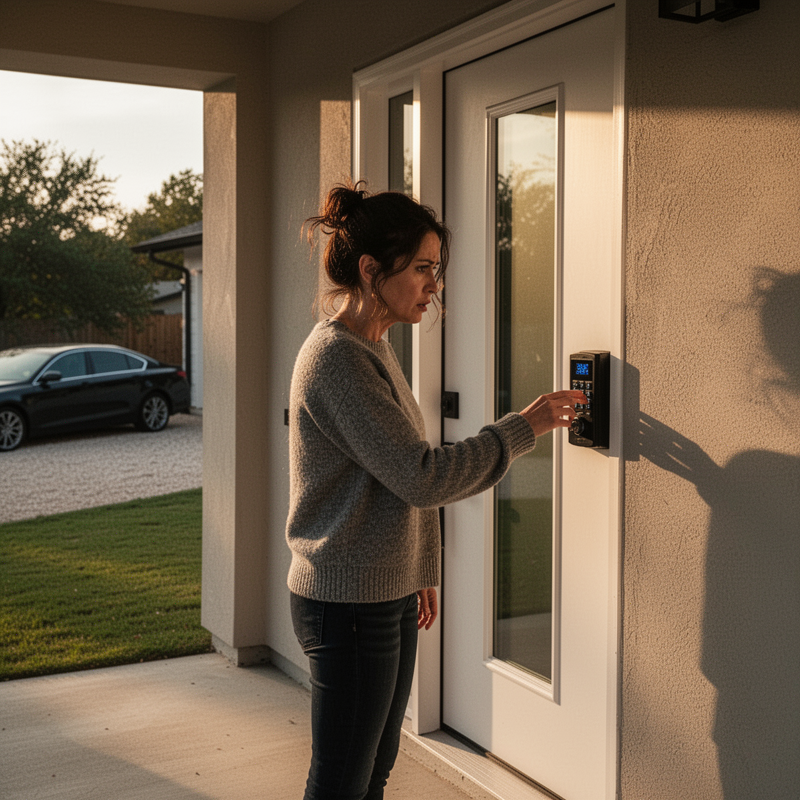
The front door, a modern design with a tall, narrow glass panel running down one side, looked welcoming. I fumbled for my keys, then remembered the electronic keypad.
My fingers hovered over the familiar numbers, but something felt off. The usual soft glow wasn’t there.
I pressed my usual code, “2-5-0-8.” Nothing. Not a beep, not a click, not even the faint hum of the mechanism engaging.
I tried it again, slowly, deliberately. Still nothing. The keypad was dead, inert, a blank black rectangle against the white door.
A knot tightened in my stomach. I leaned closer, peering through the glass. The light inside was dim, but I could make out a shape.
A figure moved in the foyer.
Then, my mother, Eleanor, emerged from the shadows. She stood directly behind the glass panel, framed by the entryway.
Her expression was entirely devoid of warmth. There was no welcoming smile for her daughter, no joy for her newborn grandson’s return.
In her hands, she clutched a familiar blue folder—Leo’s baby folder. My personal papers, including his birth certificate.
My heart pounded. This wasn’t right.
I tried the handle. It didn’t budge. The deadbolt was thrown.
Eleanor’s lips parted, and her voice, muffled by the thick glass, carried an icy edge I knew all too well.
“Clara,” she said, her voice completely devoid of emotion, “I’ve changed the codes.”
I stared at her, utterly bewildered. “Mom, what are you talking about? Let me in. Leo needs to be inside.”
She simply shook her head, her gaze fixed and unwavering. She wasn’t looking at me, it felt like she was looking through me.
“You’re not fit to live here, Clara,” she stated, as if discussing the weather. “Not anymore.”
Then, with a deliberate, slow motion, she reached down and slid open the mail slot at the bottom of the door.
A folded piece of paper appeared, pushed through the narrow opening. It fluttered to the ground at my feet on the porch.
I bent down, my knees aching from childbirth, and picked it up. My eyes scanned the official-looking header.
It was a draft petition. For emergency guardianship.
Under “Reasons for Guardianship,” Eleanor had meticulously typed “mentally unfit and incapable of providing adequate care for a minor child.”
My breath caught in my throat. Mentally unfit? This was insane.
Eleanor watched me read it, her face a mask of calm, superior detachment.
“I am taking control of this house,” she announced, her voice resonating with chilling finality, “to safeguard family interests. Our family’s interests.”
She gestured vaguely around the $1.4 million home, the house I had worked tirelessly for years to make my own.
Her words hung in the air, heavy and suffocating. I held the absurd document, my three-day-old son whimpering softly in the back seat of the idling car.
The sun beat down, warming the paper in my hand. It was real.
I was locked out of my own house, with my newborn baby, on the basis of a fraudulent claim that could rip him away from me.
Part 2
My hands shook so badly I almost dropped the document. Leo’s cries intensified in the back seat, a raw, piercing sound that mirrored the panic rising in my chest. I couldn’t stay there. Not in the driveway, not with Eleanor watching from behind her barricade. I started the car and pulled out, driving aimlessly for a few blocks before the neon sign of a 24-hour diner caught my eye.
The diner was mostly empty, just a few truckers and an older man nursing a coffee at the counter. I found a booth in the corner, trying to soothe Leo, but he was inconsolable. His tiny face was red, his mouth a perfect ‘O’ of distress. I laid the guardianship petition on the table, along with other manipulative notes Eleanor had sent me over the past few weeks, hoping to make some sense of it all. My vision blurred. I couldn’t focus on the legalese, only the stark words “mentally unfit.” A tear slipped down my cheek.
After a few minutes, the older man at the counter, who I hadn’t really noticed before, slid off his stool and walked over. He was lean, with kind, tired eyes and a neatly trimmed gray beard. “Rough night, sweetheart?” he asked gently, his voice low. I just nodded, wiping my eyes. “Mind if I take a look at that?” he gestured to the papers. “I used to be a title auditor. Seen a lot of tricky situations.”
I pushed the petition across the table, along with the other papers. His eyes, sharp and quick, scanned Eleanor’s messy signature on the bottom. A flicker of recognition crossed his face. “Eleanor Montgomery,” he murmured, almost to himself. He looked up, his expression suddenly serious. “I recognize this. And her handwriting. She pulled this exact same move on her sister-in-law fourteen years ago.”
CHAPTER 2: The Stranger at the Counter
Julian Brody tilted his mug toward the overhead fluorescent light and adjusted his reading glasses.
He spread the folded document across the formica counter, smoothing out the crease with the side of his hand.
“Look at the bottom left corner,” Julian said, tapping a pale finger against the light gray ink. “Right under the signature line.”
A tiny string of text ran along the lower margin in eight-point font: *Form-108-TX-Free-Legal-Templates-Dot-Com*.
“This isn’t an legal filing,” Julian said. “There is no court seal, no county clerk stamp, and no docket number. Your mother downloaded a free emergency custody form, filled in the blanks, and signed it herself.”
Leo shifted in the infant car seat resting on the adjacent stool, letting out a soft sigh in his sleep.
“She called it an emergency petition,” I said, my voice barely carrying over the hum of the diner’s milkshake machine.
“It’s a piece of paper designed to make a scared person surrender,” Julian replied. He slid the sheet back across the formica. “In real estate, we call this an unlawful self-help eviction. She has zero legal right to keep you out of that building.”
He took another slow sip of his black coffee, watching my face.
“Fourteen years ago, I audited title records for Travis County,” Julian said. “A woman named Eleanor Montgomery tried to file a fraudulent wild deed against her late sister-in-law’s property in West Lake Hills. Exact same signature style. Exact same internet-form tactics.”
I sat up straight in the vinyl booth. “You knew my mother?”
“I knew her paperwork,” Julian said. “And paperwork never lies about who a person really is.”
He leaned closer, resting his forearms on the counter.
“She is counting on you panicking,” Julian said softly. “She thinks you see a piece of paper with legal words on it and crawl away. Stop acting like a frightened daughter, and start looking at what she actually holds in her hands.”
“Nothing,” I said.
“Exactly,” Julian said. “Not a single damn thing.”
CHAPTER 3: Unraveling the Betrayal
I stepped outside the diner into the cool damp air of the parking lot and dialed Mark’s cell phone.
It rang six times before going to voicemail. I called back immediately.
On the third ring of the second attempt, the line picked up. Background noise hummed through the speaker—heavy highway traffic and the sound of a turn signal clicking.
“Clara?” Mark’s voice was thin, vibrating with a high-pitched edge. “Are you okay? Where are you?”
“I’m in the parking lot of the 24-hour diner on South Congress,” I said. “Where are you, Mark?”
“I’m… I’m driving around,” he stammered. “I went to get groceries, like I said, but then your mom called me and—”
“Mark,” I interrupted, keeping my voice dead flat. “The door lock master code was changed from the mobile app this morning. Only two people have administrator access to that system. Me, and you.”
Silence stretched across the cellular connection for five full seconds.
“She said she was going to fix things,” Mark whispered. His breath caught in his throat. “She found out about the poker account, Clara. I don’t know how, but she found the offshore statements from last year.”
“How much?” I asked.
“Sixty-five thousand,” Mark blurted out, the words tumbling over each other in a rush of panicked relief. “The collectors were calling the house while you were in labor at the hospital. Eleanor stepped in. She paid them off directly from her liquid account.”
“And what did she buy with sixty-five thousand dollars?” I asked.
“She just wanted the master override code for the keypad,” Mark whimpered. “She said she was coming over to help us organize the baby’s estate documents. She told me if I gave her the code, she’d destroy the debt promissory note I signed with her.”
A heavy truck rattled past the diner on the access road, its headlights sweeping across my windshield.
“You traded the front door of our home to cover your gambling debt,” I said.
“Clara, please, she’s your mother,” Mark pleaded. “We can just talk to her. We can go to a counselor. She just wants to make sure the family money is safe—”
“Do not come to the apartment I’m renting tomorrow,” I said. “Do not come near Leo.”
I hung up before he could answer and blocked his number.
CHAPTER 4: The Deed in the Shadows
At eight o’clock the following morning, I walked into the downtown office of Ross & Associates Commercial Real Estate.
David Ross was already standing by his desk, two glass bottles of cold-pressed juice resting on the walnut surface beside a thick black binder.
“You look like you haven’t slept in three days,” David said, pulling out an armchair for me.
“I haven’t,” I said, placing Leo’s portable carrier on the floor beside my feet. “My mother is sitting in the living room on Barton Creek Trail right now. She thinks she owns the house because she contributed five thousand dollars toward my college expenses twelve years ago.”
David picked up his tablet and tapped the screen twice.
“I pulled the Travis County property tax register ten minutes ago,” David said. He turned the screen toward me. “She’s been searching the public record database from her home computer since six this morning.”
“What is she looking for?” I asked.
“She’s looking for your name,” David said, a faint smile touching his mouth. “And she can’t find it.”
He swiped to the official land title abstract.
Under *Primary Property Owner*, the entry did not say Clara Montgomery or Mark Montgomery.
It listed the *Leo Montgomery Irrevocable Family Asset Protection Trust*, filed quietly with the state of Texas ninety days before my delivery date.
“When you transferred the deed into the trust in November, you relinquished personal individual title,” David explained, tapping the legal seal on the document. “You are the primary trustee, but the property itself belongs entirely to the trust entity.”
“And Mark?” I asked.
“Mark signed a quitclaim deed waiving all marital homestead rights as part of the trust creation agreement three months ago,” David said. “He signed it in front of a notary right here in this room when he wanted you to co-sign his vehicle loan.”
I leaned back against the leather chair, closing my eyes for a single brief moment.
“She thinks she’s occupying my personal asset,” I said.
“She’s squatting on property owned by a corporate trust structure,” David replied. “And she doesn’t even know it yet.”
CHAPTER 5: An Asset Under Siege
By mid-afternoon, Eleanor had already called an independent antique dealer from West Lake to evaluate the interior furnishings.
I stood in the shadow of the oak tree across the street from my house, watching through a pair of high-powered binoculars from the front seat of my parked SUV.
A black Mercedes van pulled into the driveway. A man wearing a gray blazer stepped out carrying a digital tablet and a clipboard.
Eleanor opened the front door, wearing her cream silk cardigan, gesturing expansive hand movements toward the interior grand foyer.
She was showing him the custom Italian marble entry console and the original oil paintings hanging in the main hallway—pieces worth an estimated $180,000 combined.
Ten minutes later, the dealer walked back out to his vehicle alone, holding his tablet.
He pulled up a digital public record on his screen, typed for a moment, and then turned back toward Eleanor with his hands raised in a sharp gesture of refusal.
Two weeks prior to going into labor, I had registered a formal UCC-1 personal property security lien against every serialized piece of art, custom furniture, and architectural fixture inside the home.
The items were legally encumbered as collateral for a business line of credit under my interior architecture firm.
The dealer climbed back into his Mercedes van, closed the door sharply, and backed out of the driveway into the street.
Through the glass panel of the front entrance, Eleanor’s face flushed dark red.
She slammed the heavy oak door so hard the glass pane rattled in its frame.
Her phone came up to her ear immediately, but my phone stayed silent on the seat beside me, set to decline all incoming calls from unlisted numbers.
CHAPTER 6: The Caretaker’s Trap
I sat at the small dining table in the corporate rental unit, pouring hot water into Leo’s formula bottle.
For thirty years, my mother had operated on a simple mathematical formula: whenever she created a crisis, I absorbed the cost.
When she defaulted on her credit cards in 2018, I paid the twenty-four thousand dollar balance to protect her credit score.
When her apartment lease in Dallas was canceled for unpaid fees, I signed the lease on her luxury high-rise unit under my own name.
She believed my lifelong caretaking habit was a permanent vulnerability.
She had no idea it was the exact training that allowed me to set this snare.
I hadn’t left the lock admin code accessible to Mark by accident six months ago.
I knew his gambling habits, and I knew Eleanor watched his financial troubles like a hawk waiting for an opening.
I had deliberately left that system vulnerability open because I needed her to make an unauthorized physical entry onto the property before the end of the quarter.
Under clause 14-B of my late father’s testamentary estate distribution agreement, Eleanor was entitled to a monthly caretaking allowance of $3,500, paid directly from his remaining liquidation fund.
However, the clause contained a strict behavioral stipulation: any deliberate legal trespass, property conversion, or bad-faith financial assertion against his direct heirs would result in immediate, permanent forfeiture of the monthly distribution.
She had taken the bait, hook and line.
By changing the lock code and taking physical possession of the house, she had personally triggered the self-executing forfeiture clause.
The $3,500 monthly transfer that paid for her lifestyle was gone forever as of four o’clock that afternoon.
CHAPTER 7: Sisterly Reckoning
My twenty-four-year-old sister Sarah walked up the stone walkway of the Barton Creek home at five in the evening.
She carried a brown paper shopping bag containing Eleanor’s daily blood pressure medication and a bottle of wine.
“Where is Clara?” Sarah asked the second she stepped into the entry hall, looking around at the quiet house. “Her car isn’t in the garage, and her phone is going straight to voicemail.”
Eleanor stood near the kitchen island, pouring herself a glass of water.
“Clara is taking some time away to address her mental health,” Eleanor said smoothly, not looking up. “She wasn’t handling the stress of the newborn properly. I stepped in to secure the household assets until she gets herself sorted out.”
Sarah narrowed her eyes. “Her baby is four days old, Mom. She wouldn’t just leave.”
“She didn’t leave, Sarah. I relieved her of her duties,” Eleanor said, taking a measured sip of water. “Go up to my study and fetch my reader glasses off the desk. They’re next to the green leather folder.”
Sarah walked up the stairs to the home office.
The desk was littered with printouts of property records, hand-annotated tax statements, and bank envelopes.
Beside the desk lamp sat an accordion file labeled *Family Trust Distributions*.
Sarah pulled open the flap, looking for the reading glasses, but her eyes landed on a blue cardstock folder marked *Sarah Montgomery – Educational Custodial Account*.
She pulled out the statement page.
The balance at the top of the 2019 report read $120,000—the money our grandmother had left specifically for Sarah’s graduate studies.
Below it were six wire transfers executed over a nine-month period, all routed directly into Eleanor’s personal checking account at Chase Bank.
The current remaining balance on the account statement was $14.12.
Sarah’s hands trembled as she pulled out her smartphone, snapping clean, focused photographs of every transaction record in the folder.
She tucked her phone into her back pocket, left the reading glasses on the desk, and walked downstairs without saying a single word.
She walked straight out the front door, got into her car, and drove directly to my corporate apartment.
CHAPTER 8: The Paperwork War
On Friday morning, a heavy commercial truck from Austin Premier Renovations pulled into the driveway of the house.
Eleanor had called a high-end contractor to begin an unapproved demolition of the master bedroom suite.
She intended to convert the space into a permanent private residence unit for herself, calculating that physical alteration of the structure would solidify her claim of long-term tenancy.
“We have a work order for a custom master bath and walk-in closet buildout,” the site supervisor said, holding a clipboard as he stood near the front porch. “Total estimated cost is one hundred and ten thousand dollars.”
“Sign the authorization under my name,” Eleanor instructed him, sweeping her pen across the contract line with a grand flourish. “The property balance will cover the draws upon completion.”
The contractor, seeing an affluent woman standing inside a $1.4 million home, accepted the signature without checking the county land registry.
At two o’clock that same afternoon, a courier pulled up to the front security gate.
He stepped out, walked to the iron fence, and attached a laminated legal document directly over the electronic keypad using heavy zip-ties.
Eleanor walked down the driveway in her silk slippers to pull the document down.
It was a formal *Notice to Cease Unlawful Occupancy and Order to Vacate*, issued by an independent trust management firm representing the Leo Montgomery Family Trust.
The document gave the current occupant exactly seventy-two hours to clear the premises before formal physical eviction proceedings commenced.
It was signed by the trust’s court-appointed independent administrator.
At the bottom of the page, highlighted in bright yellow ink, was a formal notice that any unauthorized construction or physical alteration performed on the property would be treated as criminal destruction of trust assets, with all costs assigned personally to the signatory.
Eleanor tore the paper off the gate, crumpling it into a tight ball in her fist.
CHAPTER 9: Cornered Ambition
By Saturday afternoon, the cracks in Eleanor’s strategy were turning into giant chasms.
Her bank account manager called her mobile phone to inform her that her monthly $3,500 estate distribution check had been rejected due to a trust violation filing.
With her income streams cut off and the renovation contractor demanding an upfront twenty-percent cash deposit of $22,000, panic set in.
She sat at my dining room desk and drafted a handwritten document on heavy linen stationery.
It was a homemade *Promissory Note and Demand for Caretaker Compensation*.
In it, she claimed that I owed her $400,000 for “uncompensated personal support, financial management, and domestic caretaking services” rendered between 2012 and 2024.
She attached a copy of the $5,000 college tuition check from twelve years ago, adding a handwritten compound interest calculation that miraculously brought the balance up to six figures.
She scanned the document and emailed it directly to the senior partners at my interior architecture firm, copying every client on my current project roster.
The accompanying text read: *Notice of Impending Judicial Lien on Clara Montgomery’s Professional Earnings*.
Thirty minutes later, my Managing Partner called me on my private mobile line.
“Clara,” he said smoothly. “Your mother just sent a bizarre, fraudulent lien notice to our entire corporate inbox.”
“I know,” I said calmly. “I’m looking at the copy she forwarded to my personal account right now.”
“Do you need us to handle this legally?” he asked.
“No,” I replied, printing out the email and placing it inside a thick black binder labeled *Extortion Evidence*. “She is filing fraudulent claims against a protected trust asset. Let her keep building her own case file.”
I clicked the binder rings shut with a sharp metallic snap.
CHAPTER 10: The Final Stand
On Sunday evening, the renovation contractor returned to the Barton Creek house, accompanied by two large men in work boots.
He held a printed invoice for $110,000—the full contract price for the materials already ordered and delivered to his warehouse.
“Mrs. Montgomery,” the contractor said, his voice cold and stripped of any professional pleasantry. “We ran a title check on this parcel before committing our crew. You don’t own this house. Your name isn’t on the deed, and your signature on our work order is invalid.”
“My daughter owns this property!” Eleanor snapped, backing away toward the foyer staircase. “The funds will be released as soon as our settlement is signed!”
“Your daughter’s trust owns this house,” the man said, leaning toward her. “And if I don’t receive a certified bank cashier’s check for twenty-two thousand dollars for the restocking fee by tomorrow morning, I am filing an immediate personal mechanic’s lien against your private assets and taking you to county court for fraud.”
After the contractors left, the house fell into absolute, suffocating silence.
Eleanor’s hands shook violently as she picked up her phone and typed a text message to me.
*Come to the house alone tomorrow morning at nine o’clock,* she wrote. *Sign the fifty-percent equity release agreement, or I will file the parental support lawsuit in public court and destroy your professional reputation in this city forever. No lawyers. No police. Just us.*
I sat in the nursery of my rental apartment, cradling Leo against my shoulder as he drank his evening bottle.
I looked down at the illuminated phone screen on the table.
I typed back four words: *I will be there.*
CHAPTER 11: The Living Room Settlement
At exactly nine o’clock on Monday morning, I unlocked the heavy oak front door of my Barton Creek home using the original mechanical key override.
The grand living room was completely empty of its usual warmth.
Eleanor sat behind the glass-topped dining table like a judge presiding over a court, surrounded by thick stacks of printed emails, internet legal forms, and her handwritten $400,000 promissory note.
She wore a dark suit jacket, her hair pulled back into a tight, severe bun.
“You brought yourself here at last,” Eleanor sneered, tapping her manicured fingernail on the glass table. “Sit down, Clara. Let’s finish this.”
I remained standing in the center of the rug, my arms folded across my chest.
“You have no leverage left, Mom,” I said softly.
“I have everything I need!” Eleanor raised her voice, her eyes wide with cold rage. “I have twelve years of proof that I supported you! I have claims of squatter rights! I will tie this property up in county litigation for the next five years until you are bankrupt from legal fees!”
At that exact second, Eleanor’s phone chimed with a loud, piercing notification.
An automated broadcast text message from Sarah’s phone number flashed onto Eleanor’s screen, containing an attached audio file labeled *Mom_Confession_Pecos_Debt.mp3*.
The phone’s automatic playback feature kicked in, filling the quiet living room with Eleanor’s voice, crystal clear and unmistakable:
*”Mark, listen to me carefully. I don’t care about your poker debt. I’m paying off the sixty-five thousand dollars so I can get that master code. Once I’m inside Clara’s house, she’ll have to give me at least three hundred thousand dollars from her estate trust to get me out. She’s weak. She’s always taken care of me, and she’ll do it again.”*
Eleanor froze, her hand hovering over the phone screen as if she had been burned.
“Sarah recorded you two weeks ago,” I said, my voice dropping to a low, steady tone. “And that audio file was just delivered to the Travis County District Attorney’s office, along with Sarah’s statement regarding the hundred and twenty thousand dollars you stole from her college trust.”
Eleanor’s face drained of all color, leaving her skin a dull, chalky gray.
I pulled a single blue cardstock document from my coat pocket and placed it on the glass table directly in front of her.
“What… what is this?” Eleanor whispered, her voice cracking.
“That is the final deed transfer notice,” I said. “The trust sold the house yesterday to a private institutional entity called Barton Asset Holdings LLC. I am the sole managing member of that entity.”
I leaned over the table, looking directly into her eyes.
“You aren’t squatting on my property anymore, Eleanor,” I said. “You are trespassing on corporate commercial real estate. And the renovation contractor you hired just filed his personal fraud claim against your Social Security number for the hundred and ten thousand dollars in unapproved work orders.”
Eleanor stared at the document, her mouth open, unable to utter a single word.
CHAPTER 12: The Eviction
Forty-eight hours later, two Travis County Sheriff deputies stood on the front porch of the Barton Creek home.
The senior officer held an official court execution order for physical removal.
Eleanor stood in the driveway, holding two plastic grocery bags filled with her personal clothes.
Her high-end leather suitcases remained inside the locked foyer—retained under a lawful landlord lien until her outstanding residential property damages were settled.
A moving truck pulled up to the curb, but it wasn’t there for her.
David Ross stood near the gate, directing workers as they loaded my remaining personal belongings into a secured transport van.
A gray sedan pulled up to the curb behind the police cruiser. Mark stepped out, wearing a rumpled work shirt, his head bowed.
He walked toward me, holding an envelope in his hand.
“Clara,” Mark stammered, looking at the ground. “I paid off twenty thousand of the debt. I borrowed it from my brother. Can we please just sit down and talk about Leo?”
I pulled a white folder from my bag and handed it to him.
Inside were completed divorce papers, accompanied by a legally binding agreement assigning his entire $65,000 poker debt strictly to his personal name, completely releasing me and the trust from any joint marital liability.
“Sign the third page,” I said. “Or my corporate attorney files for full non-custodial parental termination based on financial endangerment by noon.”
Mark looked at the paper, then at the sheriff deputies standing ten feet away, and signed his name with a trembling hand on the hood of his car.
Eleanor was escorted off the pavement by the junior deputy, forced to walk down the street to where her old sedan was parked on the public road.
She moved into a 400-square-foot studio apartment on the far northern edge of Austin, her monthly income restricted strictly to her fixed social security check, with forty percent of it garnished monthly to pay down the $110,000 contractor judgment.
CHAPTER 13: A Long Time Later
A long time later, late afternoon sunlight poured across the green grass of my new backyard in the Austin hills.
Two-year-old Leo laughed as he chased a yellow plastic ball across the lawn, his small sneakers squeaking against the stone patio steps.
I sat in a wooden lounge chair, drinking a glass of iced tea while watching him play.
My phone chimed on the small cedar table beside me.
It was a text message from Sarah: *Just got the final court notice. Mom’s Chapter 7 bankruptcy discharge was approved. She has zero assets left and no legal standing to file anything ever again. She tried to ask for your address through the clerk, but the privacy block held.*
I looked down at the glowing text screen for three seconds.
I didn’t feel anger. I didn’t feel triumph.
I felt only the deep, quiet stillness of a person who had finally cleared the smoke from their life.
I swiped the notification away, turned the phone face down on the table, and walked out onto the grass to play with my son.
For thirty years I built walls to keep my mother safe from her own mistakes; in the end, I only needed four walls to keep myself safe from her.
Leave a Reply