CHAPTER 1: The Unexpected Heir
Part 1
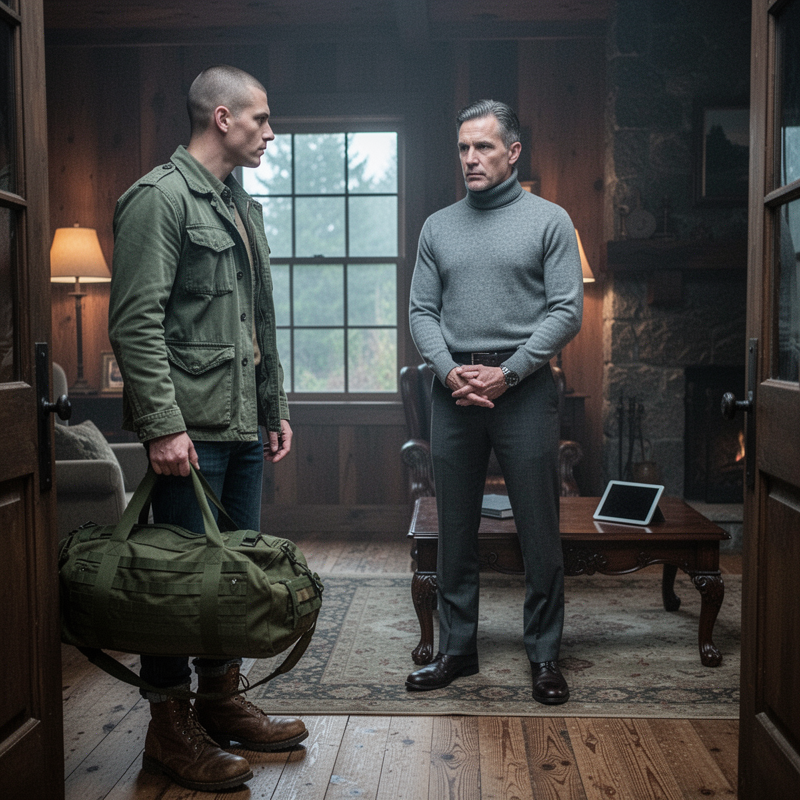
When I returned home to our 85-acre timber ranch in rural Oregon after finishing my military service, I expected my father to meet me at the gate.
Instead, I found an unexpected stranger named Julian Ross living in our family house.
He calmly informed me that my father had died three months ago from a sudden heart attack and that the property now belonged to his firm.
When I demanded to see my seventy-eight-year-old grandmother Evelyn, Julian claimed she had been placed in a specialized care facility due to severe dementia.
The smell of pine and damp earth that usually greeted me was overshadowed by something else, a faint, almost sterile scent that hung in the air of the entryway. My duffel bag, heavy with three years of military life, thudded against the worn wooden floor.
Julian Ross stood in the living room, his hands clasped loosely in front of him. He wasn’t overtly hostile, but his composure felt like a wall. His gaze, an unsettling shade of grey, seemed to analyze rather than see me.
“This is not a care facility,” I said, my voice tight, the words feeling foreign in my own home. “My grandmother would never leave this ranch voluntarily.”
He sighed, a measured release of air that conveyed patience bordering on annoyance.
“Evelyn Danforth’s health deteriorated rapidly,” Julian replied, his voice even. “The doctors recommended a specialized program.”
He gestured vaguely toward the kitchen, where a half-empty mug sat on the counter, next to a stack of papers I didn’t recognize. The kitchen was always bustling with my father, but now it felt empty, lifeless.
I took a step further into the house, my boots echoing on the floorboards I’d walked a thousand times. Every detail felt wrong. The framed photos of my family were still on the mantelpiece, but a sleek, unfamiliar tablet rested on the old mahogany coffee table beneath them.
“My father wouldn’t have just… died,” I continued, pushing past the shock to find a foothold. “He would have contacted me. Someone would have.”
Julian’s eyes didn’t waver. He simply walked to the coffee table and picked up a thick manila envelope.
“Your father, Arthur Danforth, passed away peacefully in his sleep three months ago. It was sudden, a massive coronary,” he stated, as if reading from a script.
He pulled out a sheaf of documents, handing them to me. My fingers brushed against his, and I felt a jolt of cold. The papers felt substantial, official.
“I regret you weren’t notified sooner,” he added, a flicker of something unreadable in his gaze. “But we acted in accordance with the legal documentation we possessed.”
I looked down at the top page. It was a deed transfer. My father’s name, Arthur Danforth, printed clearly, followed by the description of the 85-acre property. My eyes darted to the date.
October 12th.
My father died on October 26th.
A deed signed just fourteen days before his death. The world tilted on its axis. My grip tightened on the documents, the edges digging into my palms.
“This is a forgery,” I whispered, the words catching in my throat. “My father would never sell this land. Never.”
Julian simply retrieved another document from the envelope – a certified death certificate. It was dated. Official.
“Your father’s signature was authenticated. The property was transferred as part of a settlement for outstanding debts,” he explained, his voice losing its last hint of manufactured empathy. “Ross Holdings now legally owns the timber ranch.”
He paused, letting the words hang in the air, heavy and absolute. The sterile scent seemed to grow stronger, suffocating.
“I understand this is difficult,” Julian continued, “but you cannot remain here. We have already initiated estate proceedings. You have until tomorrow morning, twenty-four hours, to gather any personal belongings.”
He glanced at his wrist, though he wore no watch. It was a gesture of dismissal.
“After that,” he finished, “I will have to consider you a trespasser.”
I looked at the forged document in my hand, then at the man standing in my father’s living room, claiming ownership of my family’s legacy. The hyper-vigilance honed by years in the military flared, overriding the grief. This wasn’t just a stranger; this was a threat.
“I’m not going anywhere,” I said, my voice low and firm.
I dropped the papers onto the coffee table, letting them fall with a soft rustle. I wasn’t just going to stand here and argue with him. I needed to see for myself. Every inch of this land, every building, every memory held a piece of the truth.
My father was not the kind of man to leave his family, or his land, so vulnerable. Evelyn was not the kind of woman to succumb to dementia without a fight.
I turned and walked past him, my eyes scanning the hallway, past the old coat rack where my father always hung his favorite canvas army jacket, toward the back door. There were other buildings, a barn, a guest cottage, sheds. If there were secrets here, they weren’t confined to this main house.
“Where are you going?” Julian asked, his voice sharper now, stripped of its calm veneer.
I didn’t answer. I pulled open the back door and stepped out onto the porch, the cool Oregon air a stark contrast to the stifling tension inside. The familiar expanse of the timberland stretched before me, foggy and silent, holding its breath.
I had to find Evelyn. And I had to find out what Julian Ross was truly doing here.
Part 2
The cool air bit at my exposed skin as I marched toward the rear of the property. The main house felt wrong, but the familiar landscape offered a strange comfort, a canvas for truth. My boots crunched on the gravel path leading past the old apple orchard and toward the barn.
Beyond the barn, nestled amongst a cluster of towering firs, was the small, converted guest cottage. It was usually a welcoming place, always ready for visitors. But as I approached, a knot of dread tightened in my stomach.
A heavy, shiny new padlock secured the door. It looked entirely out of place on the weathered wood. My father would never lock this cottage.
I tried the handle anyway, just to confirm. It was solid, unyielding.
Then, I heard it. A faint, irregular tapping sound from inside. My heart hammered against my ribs.
It was rhythmic, almost like a code. Desperate.
“Grandma?” I whispered, pressing my ear to the door. The tapping stopped for a moment, then resumed, a little louder.
My military training kicked in. There was no time to search for tools. I examined the heavy steel padlock, new and glinting. With a surge of adrenaline, I braced myself and kicked it, once, twice. The old wood around the hasp splintered, and the lock clattered to the ground.
The door groaned open, revealing a dim interior. The air inside was stale, heavy.
And there, sitting in a worn armchair, looking frail and startled but unmistakably herself, was Evelyn. My seventy-eight-year-old grandmother.
She was thinner than I remembered, her silver hair pulled back in a loose braid, but her eyes, though wide with shock, held a spark of recognition.
“Maya?” she croaked, her voice a thin whisper. She tried to stand, her hands fumbling at a stack of papers on the small table beside her – official-looking documents with bold legal headings.
I rushed to her, kneeling beside the chair, tears blurring my vision. “Grandma! What are you doing here? He said you were in a facility!”
“He said I needed constant supervision,” Evelyn replied, her voice gaining a little strength, but laced with fear. She gestured weakly at the papers. “These… these papers. He had them drawn up.”
I glanced at the documents. They were guardianship papers, restricting her movements, outlining her need for “non-medical care and isolation for her own safety.”
“Julian has something, Maya,” Evelyn urged, grabbing my hand, her grip surprisingly firm. “Something important. A key. It’s hidden. In your father’s study.”
CHAPTER 2: The Brass Key in the Lining
The gravel dust from Julian’s black Ford F-150 had barely settled at the end of the long driveway before I moved.
Gran sat on the edge of the cot in the guest cottage, her knuckles white against her dark green woolen shawl. The air inside the small room still smelled of pine shavings and damp cedar.
“Arthur didn’t sell this place, Maya,” Gran said, her voice dry and rasping like dead leaves. “He wouldn’t.”
“The papers he showed me have Dad’s signature,” I said, leaning over her chair. “They were signed two weeks before he died.”
“Because he was desperate, not stupid,” Gran spat, her chin trembling slightly. “Julian Ross didn’t break in here with a bulldozer. Arthur brought him in.”
She pulled a worn handkerchief from her sleeve and pressed it to her lips.
“A three hundred and forty thousand dollar private loan,” Gran continued, looking directly into my eyes. “Your father needed capital to keep the north timber stand from tax foreclosure. Julian’s firm held the paper.”
The number hit me like a physical weight in the pit of my stomach. Three hundred and forty thousand dollars.
“Why didn’t Dad call me?” I asked.
“You were in Germany dealing with army lawyers,” Gran said quietly. “He didn’t want your discharge ruined. But Arthur wasn’t reckless. He kept his own proof.”
“Where?”
“In the main house,” Gran said. “The hallway closet where he kept his heavy winter coats. Look for his old canvas field jacket.”
I checked the front porch window once more to ensure the driveway was clear, then slipped through the back kitchen door of the main lodge.
The house was eerily silent, smelling of stale coffee, old cedar, and Julian’s faint leather aftershave.
I walked down the central hallway toward the coat closet near the gun rack.
My hand shook slightly as I pulled open the heavy oak door. Inside hung three rain slickers, two work vests, and at the far back, Dad’s stiff canvas army jacket.
I reached into the dark interior of the closet, sliding my fingers across the heavy material.
I ran my hands down the lower hem of the canvas coat, feeling for anything unusual along the stiff seams.
Near the left waist pocket, the inner lining felt thick and rigid.
“Come on,” I whispered to myself.
My thumbs found a rough alteration in the original stitching near the heavy brass zipper.
I slid two fingers into the hidden slit between the canvas shell and the thermal lining.
My fingertips struck cold, heavy metal.
I pulled out a thick brass key, dark with age and stamped with three sharp numbers across its spine: 412.
The metal felt icy against my palm, holding a weight that had nothing to do with its size.
CHAPTER 3: Behind the Mahogany Bookshelf
The study smelled of old leather books and cold ash from the fieldstone fireplace.
I stood in front of the floor-to-ceiling mahogany shelves that my grandfather had built by hand in 1984.
Gran had told me to look behind the historical texts on the third row down.
I pulled out three heavy volumes of Oregon forestry records, setting them down softly on the broad oak desk.
Behind where the books had rested, the wood paneling looked completely solid, smooth and polished under the lamplight.
I held up the brass key marked 412, tracing its edges against the seam of the mahogany trim.
Near the lower edge of the third shelf, a tiny brass keyhole was recessed deep into the dark wood, almost invisible against the grain.
I slid the key into the lock.
It turned with a stiff, heavy click that echoed through the empty room.
A eight-inch section of the wooden panel popped forward half an inch.
I pulled the panel open, revealing a shallow steel wall safe built directly into the timber framing behind the wall.
Inside lay a thick leather-bound ledger and a stack of bank deposit slips held together by a thick rubber band.
I pulled the ledger out and opened it across the desk under the desk lamp.
The handwriting was unmistakably my father’s—slanted, tight, and written in blue ballpoint ink.
Every entry logged a monthly payment of exactly $2,500 made directly to Ross Holdings.
The final entry was dated seven days before Dad’s heart attack, stamped with a bank teller’s official mark from the county branch in town.
I pulled my cell phone from my pocket and began taking rapid, high-resolution photographs of every single page.
The front door heavy latch clicked downstairs.
Heavy boots sounded on the hardwood entryway floor.
Julian was back.
I quickly pushed the steel panel shut, turned the brass key, and slipped the three heavy forestry books back onto the shelf just as footsteps reached the top of the stairs.
CHAPTER 4: Digital Footprints in the Forum
The blue neon sign of the Black Bear Diner flickered in the misty Oregon drizzle outside.
I sat in a corner booth near the back emergency exit, a mug of black coffee steaming against the Formica tabletop.
My laptop was open, connected to the diner’s weak Wi-Fi signal.
I navigated through archived threads of the Pacific Northwest Forestry Alliance forum, filtering search terms for the year 2011.
I typed in “Danforth” and “Ross” alongside the township grid numbers for our 85-acre parcel.
A dozen threads popped up, mostly routine discussions on timber yield, Douglas fir pricing, and seasonal beetle control.
Then I found an old thread titled *Joint Timber Rights – Clackamas / Lane Line*.
The user handle was *Ross_Timber_88*, registered to Julian’s late father, Thomas Ross.
I scrolled down to a post dated October 14, 2011.
*“Arthur D. and I finalized our informal joint land covenant today,”* the post read. *“Neither family holds individual right of sale without secondary sign-off. Protects the ridge from outside corporate clear-cutters.”*
I stared at the glowing screen as my coffee went cold.
Julian had claimed in my kitchen that his firm owned the entire deed outright through a simple mortgage default.
Yet his own father had publicly recorded the existence of an informal joint land covenant over a decade ago.
Julian knew the title transfer his lawyers were pushing was legally flawed from the moment he stepped foot on our porch.
He wasn’t just managing a debt; he was enforcing a transfer he knew was encumbered by an unrecorded family agreement.
“More coffee, honey?” the waitress asked, stopping beside my booth with a glass pot.
“No, thank you,” I said, closing the laptop screen. “I have what I need.”
I packed my laptop into my canvas duffel, my heart pounding against my ribs with renewed military precision.
This wasn’t just a estate dispute; it was a fraud.
I swung my duffel over my shoulder and walked out into the cool rain, heading back to Timber Creek to face Julian Ross face-to-face.
CHAPTER 5: The Weight of Intimidating Paperwork
When I pulled my truck into the gravel turn-around at the ranch, a sleek gray Lincoln sedan was parked next to Julian’s Ford.
A tall man in a tailored charcoal suit stood on the gravel near the front steps, holding a thick manila folder.
Julian stood on the porch above him, his arms crossed over his chest, his face unreadable in the gray afternoon light.
I stepped out of the truck, slamming the door hard enough to ring across the clearing.
“Maya Danforth?” the man in the suit asked, stepping forward with a practiced, neutral smile.
“Who are you?” I demanded, stopping three feet from him.
“My name is Howard Finch. I represent Ross Holdings and Mr. Julian Ross,” he said, extending a hand I didn’t take.
He withdrew a stapled legal packet from his folder and handed it directly to me.
“You are being formally served with a temporary restraining order and a notice of emergency trespass,” Finch said smoothly.
I looked down at the document. The top header bore the seal of the Clackamas County Circuit Court.
“On what grounds?” I asked, my voice tight.
“Unauthorized entry, interference with commercial operations, and destruction of property regarding the rear outbuildings,” Finch replied.
“This is my family’s land!” I shouted, looking past Finch straight up at Julian.
Julian didn’t blink. He stayed motionless on the porch, his dark eyes locked on mine.
“Furthermore,” Finch continued, pulling a second sheet from his file, “an asset freeze has been issued against the estate’s primary accounts, including your secondary $12,000 credit line linked to Arthur Danforth’s agricultural trust.”
My chest seized. Twelve thousand dollars—my entire operational reserve to hire a local land attorney—wiped out with a single filing.
“You’re cutting me off before I can even get a court date,” I said, taking a step toward the steps.
Finch stepped neatly into my path, holding up a finger.
“I advise you not to cross that threshold, Miss Danforth,” Finch said calmly. “The sheriff will be called immediately.”
I looked up at Julian again. He remained silent, standing like a wall against the dark timber of the house.
CHAPTER 6: Uncovering the Real Threat
I waited in my truck until Howard Finch’s Lincoln kicked up gravel and disappeared down the state highway.
The moment his taillights faded, I stepped out of the cab and walked straight past the front porch into the kitchen.
Julian was standing at the sink, pouring hot water into a heavy ceramic mug.
“Get out of my way, Julian,” I said, slamming my hands onto the butcher-block counter.
He didn’t jump. He set the kettle down slowly and turned around, leaning back against the edge of the counter.
“Finch is an aggressive attorney,” Julian said softly. “I told him to give you three days.”
“You froze my credit line,” I said, my voice shaking with rage. “You served me an eviction notice on my own front lawn. And you locked my grandmother in a cottage behind the barn like a prisoner!”
Julian set his mug down on the wood with a quiet thud.
“If your grandmother was listed on the primary deed as a resident, my investment partners would have filed for an immediate public bankruptcy receivership,” he said, his voice dropping an octave.
I blinked, caught off guard by the stillness in his voice.
“What are you talking about?”
“My board members—the people funding the debt buyout—wanted her moved to a state-run long-term facility in Salem three weeks ago,” Julian said, stepping closer. “They wanted the house empty so they could list the 85 acres for an immediate timber liquidation auction.”
He pointed a finger toward the window facing the rear outbuildings.
“I signed a personal indemnity bond to keep her on this property under private care,” Julian said. “I put her in the guest house so their field assessors wouldn’t document her presence and force a court-ordered conservatorship.”
I stared at him, trying to find the lie in his eyes. My military training told me to look for hesitation, for shifted glances, but he held my look without flinching.
“You could have told me,” I whispered.
“You showed up at my gate looking for a fight, Maya,” Julian said quietly. “And my partners have eyes on this property every hour of the day.”
The kitchen fell dead silent, saved only by the rhythmic ticking of the wall clock above the stove.
CHAPTER 7: Late Night Records and Unspoken Shifts
By eleven o’clock that night, the kitchen table was covered in bank statements, forestry tax receipts, and handwritten ledgers.
A single brass lamp illuminated the center of the table, casting long shadows across the timber walls.
Julian sat across from me, his sleeves rolled up to his elbows, a pencil tucked behind his ear.
“Look at this entry from June 2022,” I said, pointing to a copy of Dad’s ledger with my pen. “He paid twenty-five hundred. But your firm logged it as fifteen hundred.”
Julian pulled the ledger copy closer, his forearm brushing against mine. A sharp spark of tension ran through my skin at the contact.
“That’s a thousand-dollar discrepancy per month,” Julian muttered, checking the entry against his laptop spreadsheet. “Over two years… that’s twenty-four thousand dollars in uncredited principal.”
“Your board inflated the default total,” I said, looking up at him. “They manufactured the foreclosure threshold.”
Julian ran a hand over his face, his jaw tight.
“My father trusted Arthur,” Julian said softly, his eyes meeting mine in the dim yellow light. “And I let my board turn this into a corporate ledger item.”
He was inches away from me now. The air between us felt suddenly thick, stripped of the legal battle and the anger that had driven us all week.
I could see the faint silver scars along his knuckles, the tired lines around his eyes, the real weight he had been carrying alone.
“Why didn’t you leave when Finch told you to?” I asked, my voice barely a whisper.
“Because this land isn’t just a file to me, Maya,” Julian said. “And neither are you.”
He reached out slowly, his fingers touching the side of my face, his thumb tracing the line of my jaw.
I didn’t pull back. My hyper-vigilance, honed over years in the military and courtroom battles, collapsed into the quiet warmth of the room.
Julian leaned in and kissed me—a slow, deep, quiet kiss that smelled of rain and dark coffee.
When he pulled back, his dark eyes held mine in the stillness of the midnight house.
Neither of us said a word about the injunction hearing forty-eight hours away.
CHAPTER 8: Build-up: The Injunction Hearing Nears
Two days later, rain hammered relentlessly against the roof of the main lodge.
I sat on the edge of the living room sofa, my military duffel bag half-packed beside me while legal notes covered the coffee table.
Julian stood by the window, his phone pressed to his ear, his face white as chalk.
“I understand the board’s position, Howard,” Julian said into the phone, his voice tight and clipped. “I am telling you the default figures are inaccurate.”
I could hear Finch’s shrill voice leaking through the speaker from the other end.
“The board doesn’t care about internal accounting errors, Julian!” Finch shouted over the line. “If you do not sign the final eviction order and execute the timber rights transfer by eight o’clock tomorrow morning, the board is pulling your personal liability shield.”
Julian stayed silent, staring out at the sheet of gray rain falling on the fir trees.
“Did you hear me?” Finch pressed. “You will be personally liable for the full three hundred and forty thousand dollars. They will file for your personal bankruptcy by noon.”
“I heard you, Howard,” Julian said softly.
He hung up the phone without another word and set it gently on the windowsill.
“You can’t let them ruin you, Julian,” I said, standing up from the couch. “We have the 2011 forum threads. We have Dad’s ledger copies showing the missing payments.”
“A county judge won’t resolve a complex accounting fraud in an emergency injunction hearing, Maya,” Julian said, turning around to face me. “Finch will push for immediate vacant possession. Once you’re off the land, the board clear-cuts the north 40 acres within forty-eight hours.”
He walked over to where I stood, reaching down to gently touch my hand.
“They’ll destroy the ranch before a full trial ever happens,” he said quietly.
“Then what are you going to do?” I asked, my heart hammering against my ribs.
Julian didn’t answer. He just looked at me, his eyes dark and resolute in the fading storm light.
“Get some sleep,” he said, turning toward the hallway. “The court opens at nine.”
CHAPTER 9: Climax: The Shift in Silence
The Clackamas County Courthouse smelled of wet wool, old floor wax, and brass polish.
I sat at the defense table in Courtroom 3B, my hands folded tightly over my manila folder containing the forum printouts and ledger photos.
Howard Finch sat three feet away at the plaintiff’s table, meticulously arranging his formal motion papers into neat stacks.
Julian sat beside Finch, staring straight ahead at the empty judicial bench. He wore a dark navy suit, his posture rigid and calm.
The court bailiff stepped up to the door.
“All rise for the Honorable Judge Patricia Vance,” the bailiff called out.
We stood as the judge took her seat at the bench, pulling her reading glasses down over her nose.
“Case number 24-CV-8812,” Judge Vance read from her docket. “Ross Holdings versus Maya Danforth. Application for emergency preliminary injunction and order to vacate.”
Judge Vance looked down over her glasses at Finch.
“Counsel, brief statements before I rule on the temporary stay?”
Finch stood up instantly, buttoning his suit jacket.
“Your Honor, the primary debtor is deceased, the debt remains in uncured default standing at three hundred and forty thousand dollars, and the occupant is currently trespassing—”
Julian reached out and placed his hand firmly over Finch’s arm.
Finch stopped mid-sentence, looking down at Julian in total confusion.
“Julian, what are you doing?” Finch whispered loudly.
Julian did not answer him. He stood up slowly from the table, facing the judge directly.
“Your Honor,” Julian said, his voice flat, clear, and unhurried. “Plaintiff wishes to withdraw all pending motions for emergency eviction and asset freezes against Miss Danforth today.”
The courtroom fell into absolute silence. Finch’s mouth opened, his face turning bright red.
“Julian! Are you insane?” Finch hissed, grabbing Julian’s coat sleeve. “The board will destroy you!”
Julian ignored him completely. He pulled a signed document from his inner pocket and placed it flat on the clerk’s desk.
“We are entering a motion for an administrative stay pending a formal probate audit,” Julian said to the judge.
Judge Vance blinked, looking from Julian to Finch, then down at the paper.
“Mr. Ross, if you withdraw these emergency filings, this court will suspend all immediate enforcement actions indefinitely,” Judge Vance warned.
“Understood, Your Honor,” Julian said.
He turned away from the bench without making another statement, without glancing at Finch, and walked down the central aisle toward the exit doors.
As he passed my table, he didn’t say a word. He simply set his set of brass house keys on the edge of my desk, pushed open the double doors, and walked out into the hallway alone.
CHAPTER 10: Immediate Aftermath: The Empty House
By four o’clock that afternoon, the rain had stopped, leaving the ranch shrouded in a dense, quiet fog.
I helped Gran walk back through the kitchen doors of the main lodge, holding her arm as she stepped onto the polished hardwood.
She looked around the high-ceilinged living room, her eyes wet with tears as she touched the edge of the stone fireplace.
“It feels like Arthur’s house again,” she whispered, leaning heavily on her cane.
“It is, Gran,” I said softly. “It’s yours.”
I helped her settle into her old bedroom on the main floor, tucking her green wool shawl around her knees before closing her door quietly.
I walked into the kitchen.
The large oak table was completely bare, stripped of all the spreadsheets and legal folders we had spent the last week analyzing.
Julian’s truck was gone from the driveway.
I walked upstairs to the guest room where he had been staying.
The bed was neatly made, the sheets pulled tight over the mattress.
The closet was completely empty; his leather duffel and clothes were gone.
On the small bedside table lay a single brown folder and a white index card.
I stepped into the room and picked up the index card.
Written across the middle in sharp, dark ink was a local telephone number and a short message:
*Unpaid county property taxes paid through November. Call if the board sends independent adjusters. – J.*
Inside the brown folder were receipts showing a personal payment of $4,200 made to the county tax collector that very morning.
He had stripped himself of his corporate backing, taken on three hundred and forty thousand dollars in personal debt liability from his firm, and moved into a rented room above the local hardware store in town—just to buy me time.
The title to the 85 acres remained frozen in open probate litigation, entirely unresolved, trapped between two legal worlds.
CHAPTER 11: Resolution/Epilogue: The Following Month
A month later, the cold November fog hung low over the Douglas firs at the edge of the timberline.
I sat on the top step of the front porch, wearing my father’s canvas army jacket against the morning chill.
My heavy military duffel bag sat on the wooden deck beside my boots, just as it had on the afternoon I arrived back from my tour of duty.
Nothing on the ranch was fixed.
The corporate board was still pursuing civil claims against Julian in federal court.
The county land registry still held our 85 acres in an indefinite administrative hold while state auditors reviewed ten years of altered bank records.
The property was trapped in a legal no-man’s-land, and my future here was as precarious as the day I returned.
My phone buzzed in my jacket pocket.
I pulled it out and looked at the screen.
A text message from Julian:
*Probate judge extended the stay. Court hearing set for November. Stay warm.*
I stared at the short message, feeling the quiet, steady pulse of connection that had bound us together through the wreckage of his firm and my family’s past.
He wasn’t coming back to the main house today, and I wasn’t leaving it.
I tapped the screen and typed a single word in reply:
*Waiting.*
I slid the phone back into my pocket, resting my chin on my knees as the fog drifted slowly through the dark green trees along the ridge.
The land was still contested, the lawsuit was still active, and the battle was far from over.
Some battles aren’t won by surviving the fire, but by learning to live alongside the smoke that never fully clears.
Leave a Reply