CHAPTER 1: The Memory You Lost
Part 1
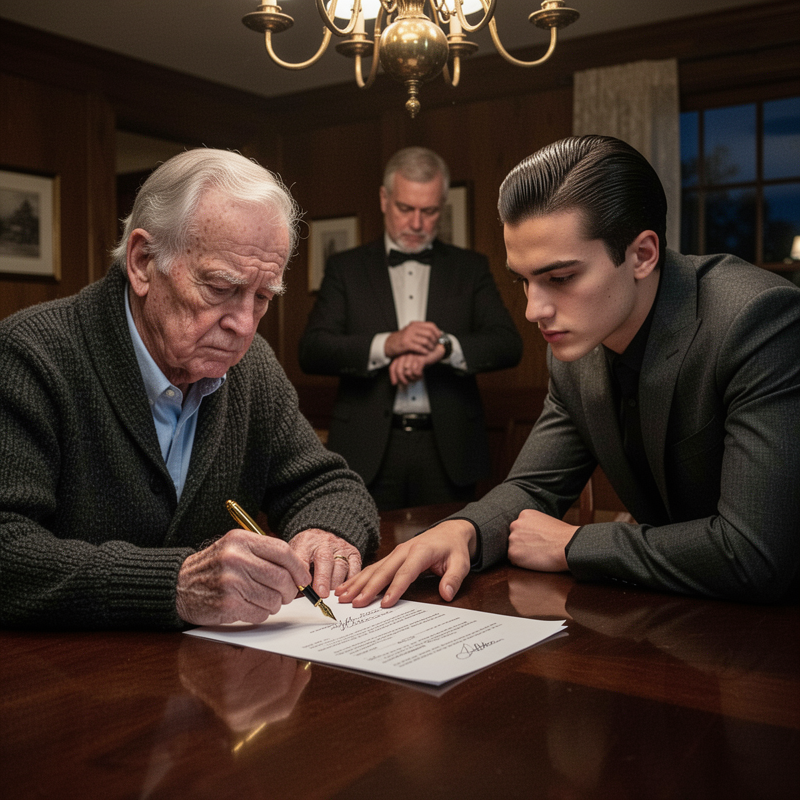
My twenty-six-year-old son Julian put a heavy gold fountain pen in my hand and told me my mind was slipping.
He claimed I had already agreed to sign over our $1.8 million family real estate property to his new investment firm.
When I hesitated, he gently reminded me that I had forgotten my own house keys twice that week—unaware that he had secretly taken them from my coat pocket.
He pressed the contract against the table and told me to sign before the notary left.
What Julian didn’t know was that my four-year-old daughter Lily was crawling under the desk, pulling a bright blue folder out of his unzipped leather briefcase.
The gold fountain pen felt impossibly heavy in my grasp, cool and smooth against my clammy palm. It seemed to amplify the silence in the dining room, a silence thick with Julian’s unspoken expectation.
He leaned forward, his tailored suit jacket straining slightly across his shoulders. His eyes, usually so quick to charm, held a hard, unyielding glint I hadn’t seen before.
Across the gleaming mahogany table, Lyle Boudreaux, the notary, cleared his throat. He checked his watch with an exaggerated gesture, his discomfort radiating across the room.
Lyle usually looked rumpled and cheerful, but today his collar was tight, and his face was unusually pale. He avoided my gaze.
“Dad, we really can’t keep Mr. Boudreaux waiting,” Julian said, his voice a low, insistent hum. “He has other appointments.”
He tapped a manicured finger on the glossy, legal-sized papers spread before me. The scent of fresh ink and expensive paper filled the air.
My vision blurred for a moment, not from tears, but from the overwhelming sensation that the room was spinning. I gripped the pen tighter, my knuckles white.
“It’s just the transfer, Dad,” Julian added, his tone softening just enough to sound reasonable. “We discussed this last month. For the new investment firm.”
He pushed a glass of water closer to me. The ice tinkled against the rim, a jarring sound in the quiet.
“It’s all above board, perfectly legal,” Julian continued. “Just like we talked about. Remember? Your memory isn’t what it used to be.”
My mind raced, trying to catch up. Had we truly discussed this? A $1.8 million property, our family home, signed over to his “new investment firm” without my clear recollection?
Julian had a way of twisting memories, of planting seeds of doubt that would grow into full-blown confusion. Lately, those seeds had been sprouting everywhere.
“The keys, Dad,” he pressed, his gaze piercing. “Twice this week. You left them on the counter the first time, then couldn’t find them in your coat pocket on Wednesday.”
He shook his head, a feigned look of concern creasing his brow.
“I found them eventually, in your study. Under a pile of old newspapers,” he explained, almost too quickly.
I remembered the frantic search, the gnawing anxiety that had seized me each time. The relief when they mysteriously reappeared, making me question my own mind.
Had I really been that careless? My late wife, Elizabeth, had always said my memory was like a steel trap. But that was before. Before the long nights alone, before the constant worry about Lily, before the endless responsibilities.
Julian pushed the contract again, the corner catching my elbow. His eyes flickered to Lyle, who fidgeted in his seat.
“And the bank statements,” Julian added, almost as an afterthought. “You were looking for those last week. Said you thought you’d paid the taxes, but the receipt was nowhere.”
He sighed, a long, suffering sound. “I found them neatly tucked inside your old tax folder. Right where you always put them, Dad. You just forgot.”
A faint ache throbbed behind my eyes. I felt a cold knot tightening in my stomach. The evidence mounted against me, presented by my own son.
Perhaps he was right. Perhaps I *was* slipping.
A soft scraping sound broke through my troubled thoughts. It was barely audible, drowned out by the blood rushing in my ears.
From under the massive mahogany table, a small hand emerged. It was Lily’s.
She was just four, a tiny sprite with a mop of bright red hair, inherited from her mother. She had been playing quietly, coloring in a book on the rug beside my chair.
I hadn’t even registered her movements beneath the table. She was a master of quiet exploration, a silent observer of the adult world.
Her small fingers, usually sticky with jam or crayons, now clutched something. It was a file folder.
My eyes widened, a sudden rush of adrenaline cutting through the haze of self-doubt. Julian was still talking, his voice a low drone about “fiscal responsibility” and “diversifying assets.”
He didn’t notice Lily. His eyes were fixed on the pen in my hand, on the signature line that would seal my fate.
Lily’s head, framed by her bright red curls, poked out from under the table. Her wide, innocent blue eyes met mine.
She gave a small, triumphant grin, oblivious to the tension that hummed in the air above her.
She held the folder aloft, a beacon of bright, unmistakable blue against the dark wood of the table and Julian’s polished shoes.
Her tiny arm stretched, extending the folder towards me.
Julian paused mid-sentence, his gaze finally dropping. His eyes landed on the folder, on Lily’s beaming face.
His jaw tightened. The blood drained from his face, leaving it a sickly gray.
Lily giggled, a pure, innocent sound.
“Daddy, look what I found!” she declared, her voice clear and bright. “It was in Julian’s bag!”
Part 2
Lily’s small hand extended the bright blue folder towards me. Julian stared at it, a deer caught in headlights. His face, already gray, now looked ashen.
I gently took the folder from Lily’s grasp. Her innocent smile widened, proud of her discovery. I gave her a quick, reassuring squeeze of my hand.
My eyes dropped to the folder. It was thick, heavier than it looked. The top sheet, a formal legal document, was titled “Deed of Conveyance – 1214 Maple Street Property.”
My breath hitched. This wasn’t the document Julian had just presented. This was something else entirely.
Julian sprang to his feet, knocking his chair backward with a loud scrape against the polished floor. He reached for the blue folder, his hand outstretched, a desperate glint in his eyes.
“Dad, that’s nothing,” he stammered, his voice losing its smooth assurance, replaced by a ragged edge. “Just some old papers. Not important.”
But I pulled it away from his reach, my grip firm. My fingers trembled as I flipped through the pages. The language was dense, full of legal jargon I barely understood, but the critical details were horrifyingly clear.
This contract wasn’t transferring the property to Julian’s new investment firm. It was pledging it, in its entirety, to an entity called “Oceanic Holdings Ltd.” – an offshore shell company based in the Cayman Islands.
My mind reeled. Two contracts. One for his firm, one for… this? The betrayal was deeper than I could have imagined.
Julian was no longer trying to snatch the papers. He stood frozen, watching my face as the realization dawned on me. Lyle Boudreaux, the notary, was staring at his shoes, refusing to look up. The air crackled with unspoken truths.
Suddenly, a sharp *buzz* echoed across the dining room table. Julian’s phone, which he had placed face down, vibrated violently. It skittered slightly on the polished wood.
Julian flinched, his eyes darting to the phone. He reached for it instinctively, but hesitated, his hand hovering.
Before he could grab it, another *buzz* came, and the screen flashed bright with an incoming message preview. My eyes, still wide from the shock of the second contract, caught the words.
It was a text from “Ray Torrance.” And the message read: “WHERE’S MY $600K BY MIDNIGHT?”
CHAPTER 2: The Staged Lapse
I set my teacup down on the wooden tray and stood up from the dining table.
“My reading glasses are upstairs,” I said, keeping my voice steady. “Give me two minutes.”
Julian barely looked up from his tablet. His thumb flicked across the screen with restless speed.
“Hurry up, Dad,” Julian said. “The notary has another appointment at six.”
I walked quietly down the hallway toward the coat rack near the front door.
Julian’s heavy wool overcoat hung over the wooden bench. Beside it sat his leather briefcase, unzipped just enough to see the inner brass key ring sticking out of a side flap.
I reached into his coat pocket first.
My fingers brushed against metal. I pulled out my primary brass house ring—the exact set of keys Julian insisted I had misplaced at the grocery store three days ago.
Tucked behind the ring were two pristine white index cards from the Fairview Memory and Cognitive Center.
Both cards were printed with my name, dated for next Tuesday, and marked under urgent neurological assessment.
I had never made those appointments. I had never spoken to that clinic.
My hand closed tight around the brass keys as the cold truth settled into my chest.
Every forgotten item, every misplaced bill over the last four months had not been my failing mind at all.
Julian had been quietly cleaning out my pockets while I slept.
CHAPTER 3: The Accountant’s Stamp
I walked into the kitchen and opened the side porch door.
Lyle Boudreaux was leaning against the railing outside, holding a steaming paper cup and checking his watch.
“Lyle,” I said, stepping back to hold the door open. “Come inside for a moment. Let’s get you a fresh cup of coffee.”
The accountant wiped his shoes on the mat and stepped into the kitchen. He smoothed his graying tie and offered a nervous smile.
“We really need to get these documents finalized, Arthur,” Lyle said, adjusting his spectacles. “Julian wants everything recorded before the county clerk office closes.”
I picked up the blue folder Lily had pulled from the briefcase and set it flat on the granite counter.
“This secondary agreement has your official notary stamp on the final acknowledgment page,” I said, pointing to the red ink seal. “Dated three weeks ago.”
Lyle took a step back, his heel knocking against the baseboard.
“Arthur, that was just a preliminary authorization,” he stammered.
I pressed the record button on the small digital dictaphone sitting beside the knife block.
“You stamped a power-of-attorney transfer without me present,” I said clearly. “How much did my son promise you?”
Lyle swallowed hard, his eyes darting toward the hallway where Julian was still waiting.
“Forty-five thousand,” Lyle whispered, his voice cracking. “Julian swore you were non-responsive and that the property was being liquidated to cover medical trusts.”
“Forty-five thousand dollars to help steal a one-point-eight million dollar family estate,” I said.
Lyle reached for his coat, his hand trembling as he tucked his leather binder under his arm.
CHAPTER 4: The Quiet Refusal
I walked back into the dining room, holding the blue folder in my left hand.
Julian stood up immediately, holding out the heavy gold fountain pen.
“Lyle said everything is set,” Julian said, his voice rising in pitch. “Just put your signature on line four of the main deed. We can handle the rest tomorrow.”
I did not take the pen.
I walked past him to the corner of the room, unlocked the heavy floor safe behind the sideboard, and slid the blue folder deep inside.
I pulled the steel door shut and turned the combination dial until the lock clicked hard.
Julian dropped his arm, his forehead glistening under the chandelier lights.
“What are you doing?” Julian asked. “Dad, sign the paper. The notarization window closes in twenty minutes.”
I sat down in my armchair, crossed my hands over my lap, and looked directly into his eyes.
I did not offer an explanation. I did not raise my voice. I did not mention the keys in my pocket or the medical cards.
Julian took a step forward, his knuckles turning white around the gold pen.
“Say something!” Julian yelled. “Why are you looking at me like that?”
I remained entirely motionless, keeping my eyes fixed on his face in absolute silence.
Julian took two fast steps backward, pulled his phone from his pocket, and rushed out the front door into the rain.
CHAPTER 5: The Missing Equity
By six o’clock the next morning, I was sitting in the home office with thirty-six months of bank statements spread across the desk.
I opened the online portal for our primary home equity line of credit.
Six weeks prior, an unauthorized withdrawal of eighty-five thousand dollars had been executed electronically.
The application bore my scanned signature, submitted from an IP address registered to Julian’s downtown apartment.
My thumb pressed hard against the oak desk as I dialed the bank’s fraud prevention department directly.
“First National Fraud Risk department,” a woman answered. “State your account number.”
“My name is Arthur Callahan,” I said. “Account ending in four-zero-two. I am reporting an unauthorized equity draw.”
“We see an active authorization for Julian Callahan on file,” she noted.
“Revoke it immediately,” I said. “Freeze all line transfers, cancel all linked debit cards, and lock the estate credit profile.”
“We will require a formal affidavit, Mr. Callahan.”
“Send the forms to my personal email now,” I replied. “Nothing leaves this estate without my physical thumbprint.”
I ended the call and placed the phone back on its cradle.
Julian’s access to every dollar of the Callahan family legacy was officially severed.
CHAPTER 6: The Toy Box Shield
At precisely twelve-thirty that afternoon, the front door burst open.
Julian strode into the hallway, his hair disheveled and his suit coat unbuttoned.
“The bank just blocked my corporate transfer,” Julian shouted, walking straight toward the kitchen. “They said you flagged the account!”
He slammed his leather briefcase onto the island counter and unzipped the front pouch.
He reached frantically inside for his gold signature pen.
His hand came out empty.
He reached in again, dumping the contents of his briefcase across the granite counter—folders, loose paperclips, receipts, and highlighters spilled everywhere.
The gold pen was gone.
In the corner of the living room, four-year-old Lily sat quietly on the rug, stacking red and green plastic building blocks.
Beside her, tucked safely inside a hollow yellow toy brick deep at the bottom of her plastic storage chest, sat the gold fountain pen.
She had picked it up off the dining table while Julian was pacing the night before.
Julian dropped his hands onto the counter, staring at the empty leather pouch.
“I need that pen,” Julian muttered, his breath coming in shallow gasps. “The filing deadline with the county registrar is at one o’clock.”
He checked his watch. It was twelve-fifty-two.
He had lost his window.
CHAPTER 7: The Bookie’s Trail
While Julian searched his car in the driveway, I swept the dropped receipts from the kitchen counter into a small pile.
Among the crumpled gas receipts was a carbon slip stamped with a corporate logo: *Torrance Holdings LLC*.
Below the logo was a handwritten ledger line showing three separate wire transfers totaling one hundred and twenty thousand dollars, marked *Default Penalty – Tier 3*.
I picked up my desk phone and called Marcus Vance, a retired civil investigator who had worked with my late wife’s family business thirty years ago.
“Arthur,” Marcus answered. “It’s been a while. How can I help?”
“What can you tell me about Torrance Holdings?” I asked.
The line went silent for three long seconds.
“Where did you see that name, Arthur?” Marcus asked quietly.
“On my son’s receipts.”
“Torrance Holdings is Ray Torrance,” Marcus said. “He runs high-stakes illegal sports books out of South Chicago. If Julian’s name is on his books, he isn’t investing in software.”
“How deep is he?” I asked.
“Ray doesn’t write down penalty slips for small fish,” Marcus replied. “Julian is likely six hundred thousand dollars in the hole, minimum. And Ray doesn’t use collection agencies.”
I stared at the crumpled paper in my hand as the final piece of the puzzle locked into place.
Julian was not trying to start a business. He was running for his life from a loan shark.
CHAPTER 8: The Crayons on the Deed
Julian slammed the kitchen door open, holding a fresh black ballpoint pen he had grabbed from his car dashboard.
“I don’t need the gold pen,” he said, his voice hoarse. “I have the backup copy of the land transfer deed right here.”
He pulled a thick sheaf of legal bond paper from his secondary portfolio folder and threw it onto the table.
He froze.
Every single page of the transfer deed was covered in thick, dark wax strokes.
Bright blue and scarlet crayon scribbles crisscrossed the signature lines, rendering the text completely unreadable and legally void.
Lily had spent two hours that morning sitting on the living room rug, carefully coloring inside the margins of the blue-backed documents she had found on the low shelf.
Julian picked up the top page, his hands shaking so violently the paper rattled.
“She ruined it,” Julian whispered, his face turning pale. “It’s completely ruined.”
“Those were your only official backup pages, weren’t they?” I asked from the doorway.
Julian looked up at me, his eyes wide with genuine panic.
He had no signed agreement, no notarized seal, and zero collateral to present to Ray Torrance that evening.
CHAPTER 9: The Ghost of the House
By four o’clock that afternoon, a commercial locksmith was finished replacing every deadbolt and keypad entry lock on the property.
I sat at the kitchen table with the technician’s digital tablet, deleting Julian’s finger-scan access and revoking his smart-home credentials.
I opened the family safety portal and removed his name from our emergency contact routing list, replacing it with my sister Nora.
At six-fifteen, as dusk settled over the front lawn, headlights cut through the fog in the driveway.
Julian walked up the front brick steps and pressed his thumb against the new electronic deadbolt scanner.
A harsh red light flashed twice. The lock beeped three times in rejection.
He pulled his mechanical key from his pocket and tried to slide it into the keyway. The key struck solid brass; the keyways had been re-pinned.
Julian slammed his fist against the heavy mahogany door panel.
“Dad!” he shouted, his voice muffled through the thick glass. “Open the door! My clothes are inside! My laptop is inside!”
I stood six feet inside the foyer, holding Lily’s small hand in mine.
I did not move toward the door. I did not speak a word.
Julian pounded on the glass three more times, his silhouette framed against the darkening lawn, before turning around and running down the steps toward his car.
CHAPTER 10: The Cold Separation
Over the next forty-eight hours, my phone vibrated constantly against the granite counter.
Julian sent thirty-two separate text messages.
The first six were frantic apologies, promising he would repay the eighty-five thousand dollar credit draw within thirty days.
By midnight, the tone shifted to aggressive legal threats, claiming he would file an emergency petition for adult guardianship based on my alleged cognitive decline.
By the second morning, the messages degraded into desperation, asking for just twenty thousand dollars to keep his creditors from visiting his apartment building.
I read every single message once. I did not type a single character in response.
Instead, I focused entirely on the small world inside my home.
I cooked breakfast for Lily, sat beside her as she built block towers on the rug, and walked her to the neighborhood park under the crisp autumn trees.
For twenty-six years, I had poured every resource, every dollar, and every allowance into protecting my adult son from his own reckless choices.
I turned the notification sound on my phone to silent and set it face down on the shelf.
The curtain was down.
CHAPTER 11: The Black Sedan
On Friday evening at eight o’clock, two unmarked black sedans pulled up to the curb outside Julian’s downtown apartment complex.
Across town, Lyle Boudreaux had already spent the morning scrambling to save his own license.
Panicked by the voice recording I held, Lyle had called Ray Torrance’s principal office to clarify that he would not be notarizing any real estate transfers for the Callahan estate.
Lyle had given Torrance’s associates Julian’s exact residential address, his vehicle make, and his current financial isolation.
Inside the lobby of Julian’s building, two broad-shouldered men in dark raincoats walked past the security desk without stopping.
The night manager looked up, saw the expressions on their faces, and immediately looked back down at his desk monitor without saying a word.
The men rode the elevator directly to the fourth floor.
Julian opened his door expecting a takeout delivery driver.
Instead, he found himself face-to-face with Ray Torrance’s primary field enforcers.
Julian attempted to step back into his entryway, but a heavy leather boot slammed against the frame, holding the door wide open.
CHAPTER 12: The Late Night Ring
At precisely 2:14 AM, the brass landline phone on my bedside table began to ring.
I opened my eyes, reached over in the dark, and picked up the heavy receiver.
“Dad?” Julian’s voice came through the speaker, thin, gasping, and stripped of all arrogance.
He was calling from an unlisted payphone line.
“Dad, please,” he sobbed into the receiver. “You have to wire two hundred thousand dollars to the offshore clearing account. Right now. Please, Dad.”
In the background, the dull roar of highway traffic swept past the phone booth.
“They’re sitting in the car right across the street,” Julian whispered, his voice trembling so violently he could barely articulate the words. “They told me I have until sunrise before they take my car and my business registration.”
I sat on the edge of my bed, listening to the ragged sound of my son’s breathing over the crackling telephone line.
I thought of the forged land deeds, the staged medical cards, and the four-year-old girl who had almost lost her home.
I kept the receiver to my ear for five full seconds in absolute silence.
I did not scold him. I did not argue.
I slowly brought the telephone back to its cradle and set it down until it clicked into place.
Then, I reached down, pulled the phone line cord directly from the wall jack, and laid it quietly on the floor.
CHAPTER 13: The Unspoken Departure
Twenty minutes later, I stood at the second-story bay window holding Lily asleep against my shoulder.
Down at the corner of our street, illuminated by the amber glow of the municipal streetlamp, the black sedan sat idling in the dark.
The rear door of the vehicle opened.
Julian stepped out onto the damp pavement, flanked on both sides by two tall men wearing long dark coats.
He did not fight. He did not yell. He walked between them with his head bowed, his hands shoved deep into his coat pockets.
No police sirens sounded in the night. No emergency lights flashed against the oak trees. No harsh words were shouted across the damp grass.
Just before he reached the open rear door of the vehicle, Julian paused and turned his head toward our lit living room window.
He looked directly up at the glass where I stood holding his little sister.
I met his gaze without flinching.
The tall man behind him placed a single hand on Julian’s shoulder and guided him into the back seat.
The heavy door clicked shut, the dark sedan shifted into gear, and its taillights faded into the midnight rain.
CHAPTER 14: The Empty Apartment
The following afternoon, I drove to Julian’s apartment building accompanied by a private security guard I had hired for the day.
We walked up the carpeted hallway to unit 4B.
The apartment door stood unlocked, hanging open by two inches.
Inside, the living room was entirely stripped. His clothing, his expensive leather chairs, his laptop, and his television were completely gone.
On the kitchen counter sat a single smashed smartphone, its screen shattered into a web of spiderweb fractures.
Beside the phone lay an unpaid electric bill for ninety-four dollars and an empty glass of water.
There were no signs of a physical struggle, no blood, and no note written on the counter.
Julian had simply vanished from the lease, from his accounts, and from the city of Chicago.
I picked up the unpaid utility bill, folded it cleanly into four squares, and placed it inside my pocket.
I walked out of the apartment, pulled the heavy door shut behind me, and turned the latch for the final time.
CHAPTER 15: One Generation Later
Twenty-two years later, the autumn sun beat down softly over the bustling intersection of Michigan Avenue.
Lily, now a twenty-six-year-old associate corporate attorney, stood beside me at the pedestrian crosswalk holding a steaming paper cup of coffee.
I was seventy-six years old, walking with a dark wooden cane, my coat buttoned against the chilly wind.
“Dad, the court hearing starts at two,” Lily said, checking her wrist watch. “We should cross now.”
Before we stepped off the curb, Lily’s phone buzzed sharply in her palm.
She pulled up the screen. It was a multimedia message sent from an untraceable, pre-paid burner phone number.
There was no text attached to the message.
The screen displayed only a single, grainy photograph digitized from an old print paper photo.
It showed me sitting on the front porch thirty years ago, holding a four-year-old Julian on my lap while he held a plastic toy steering wheel.
Lily held the screen out toward me, her brow furrowed in quiet confusion.
“Dad?” she asked softly. “Who sent this?”
I looked at the small photo on the illuminated screen for three long seconds.
I smiled gently, patted her arm, and looked down the long avenue of bright autumn leaves.
I did not offer an explanation. I did not utter his name.
“It’s just an old shadow, sweetheart,” I said softly, stepping off the curb with her into the bright afternoon light.
I spent half my life holding up walls for people who were trying to pull the roof down over my head, until a child taught me to just step outside.
Leave a Reply