CHAPTER 1: The Blanket in the Frame
Part 1
Seventy-two-year-old Eleanor Harrington hired twenty-three-year-old Maya Brooks as a live-in housekeeper at her estate in Bar Harbor, Maine.
Inside Maya’s pocket was a faded photograph of an infant wrapped in a unique hand-stitched heirloom blanket—the exact blanket Eleanor placed on her biological child twenty-three years ago before being told the baby died at birth.
When Eleanor secretly paid $1,200 for a private laboratory DNA comparison, the report confirmed a 99.9% maternal match with Maya.
Before Eleanor could process the truth, her wealthy next-door neighbor, sixty-eight-year-old Patricia Kingsley, personally hand-delivered a legal cease-and-desist letter accusing Maya of felony theft and demanding her immediate removal from the property.
Eleanor suddenly realized that her lifelong neighbor had been guarding a dark secret about the night Eleanor’s baby allegedly died.
The salty air of Bar Harbor, Maine, carried the scent of pine and ocean spray through Eleanor Harrington’s sprawling estate. It was a familiar comfort, a constant in a life that had otherwise known its share of quiet sorrows.
Seventy-two years old, Eleanor found herself in need of assistance, not just for the house, but for the company. She placed an advertisement for a live-in housekeeper.
Among the applicants, a young woman named Maya Brooks stood out. Twenty-three years old, with kind, observant eyes and a gentle demeanor, Maya radiated a quiet strength.
Eleanor remembered the interview clearly. Maya spoke softly, describing her experience with meticulous care, her hands often smoothing the fabric of her simple dress.
“I’m very organized, Mrs. Harrington,” Maya had said, her voice a melodic hum. “And I appreciate quiet.”
Eleanor, who cherished her solitude but felt its increasing weight, found herself drawn to Maya’s respectful presence. There was an unspoken understanding in the young woman’s gaze.
She offered Maya the position on the spot.
Maya moved into the small, cozy apartment above the detached garage two weeks later. The main house, with its grand rooms and antique furniture, quickly began to hum with a new, subtle rhythm.
Eleanor watched Maya work. The young woman moved through the house with an almost ethereal grace, dusting the heirloom portraits, polishing the cherrywood tables, and sweeping away the dust that seemed to accumulate faster than Eleanor could imagine.
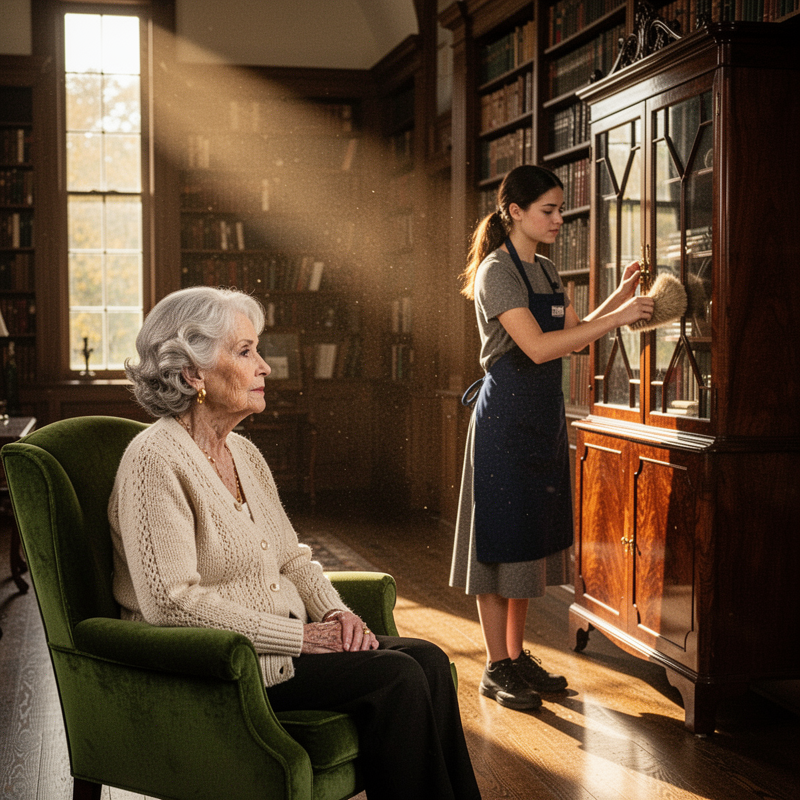
One particularly sunny afternoon, Maya was in the library, Eleanor’s favorite room. Dust motes danced in the shafts of light that pierced through the tall windows, illuminating the spines of countless leather-bound books.
Eleanor sat in her favorite armchair, pretending to read, but truly just observing Maya’s diligent movements. It was a peaceful scene, the kind of quiet domesticity Eleanor had always longed for.
Maya was carefully wiping down the top shelf of an antique display cabinet, where a collection of delicate porcelain figurines resided. Her arm stretched high, her fingers nimble.
Suddenly, a small, worn object slipped from the pocket of her work apron. It wasn’t a porcelain piece, but something personal.
It hit the polished hardwood floor with a soft, papery thud.
Maya gasped, her hand flying to her chest. She knelt quickly, her movements precise as she retrieved the fallen item.
It was a photograph.
Eleanor, despite herself, leaned forward slightly. She saw Maya’s gaze linger on the photo for a moment, a tender, almost longing expression on her face, before the young woman quickly tucked it back into her pocket.
It was a fleeting moment, easily missed, but something about the intensity of Maya’s brief glance caught Eleanor’s attention. A tiny seed of curiosity was planted.
Later that evening, after Maya had finished her duties and retired to her apartment, Eleanor found herself drawn back to the library. The sun had set, and the room was bathed in the dim glow of a single lamp.
She walked over to the antique cabinet. She ran her fingers over the smooth wood, over the exact spot where Maya had been cleaning.
A memory stirred, faint at first, then sharp, clear, and painful. The way the photograph had fluttered to the ground. The brief glimpse Eleanor had caught.
She could see it in her mind’s eye: a faded, sepia-toned image. And in it, an infant.
But it wasn’t just any infant. It was the blanket.
Eleanor felt a cold dread creep through her veins. The blanket wrapped around the baby in that quick, snatched view… it looked impossibly familiar.
It couldn’t be. Not after all these years.
She moved with a sudden urgency, her steps quickening as she ascended the grand staircase. Her heart hammered against her ribs, a frantic drumbeat against the silence of the house.
She went directly to her bedroom, a room filled with elegant furniture and a lifetime of carefully curated memories. She bypassed the ornate dresser, the antique vanity, and moved straight to a small, unassuming cedar chest tucked away in the corner of her closet.
The chest was heavy, its wood worn smooth from years of quiet storage. She knelt, her knees protesting slightly, and fumbled with the old brass latch.
It clicked open.
Inside, nestled among layers of tissue paper and dried lavender, was a small, hand-stitched blanket.
It was an heirloom, lovingly crafted by Eleanor’s own mother, specifically for her firstborn child. Each stitch was a prayer, each thread woven with hope and expectation.
The blanket was unique, a delicate tapestry of muted greens and soft blues, with a tiny, embroidered robin perched on a branch in the center. A distinctive pattern, a symbol of new life and spring.
Eleanor’s fingers trembled as she lifted it, the soft wool cool against her skin. She carried it back to the library, to the soft light of the lamp.
She sat back in her armchair, holding the blanket. She tried to recall Maya’s photograph with absolute clarity, every detail etched into her memory. The shape of the baby’s head, the tiny, folded hands.
And then, the blanket in the photograph.
The same robin. The same delicate pattern of greens and blues. The same distinctive, hand-stitched border.
An icy grip seized Eleanor’s chest, stealing her breath. It was undeniably the same blanket. The very blanket she had wrapped around her newborn daughter in the hospital twenty-three years ago.
The child she had been told died shortly after birth, a tragic complication, a brief, devastating moment. The hospital had been apologetic, efficient, and final. Eleanor had been too sedated, too heartbroken, to question.
She had kept this blanket, tucked away, a silent monument to a life that never was.
But if that was the same blanket… then Maya…
The thought was too monumental, too impossible to fully grasp. Her mind reeled, trying to reconcile the image of a dead infant with the vibrant, living young woman who cleaned her home every day.
Eleanor knew, with a certainty that both terrified and thrilled her, that she needed answers. And she needed them in absolute secrecy.
She spent the next few days in a fog, observing Maya with new, scrutinizing eyes, yet careful not to betray her suspicions. Maya continued her duties with her usual quiet diligence, oblivious to the storm brewing in Eleanor’s heart.
Eleanor remembered an article she had read, about private DNA testing services. She found one online, discreet and promising confidentiality.
The process was simple enough: a small sample, mailed in a secure kit. The cost, $1,200, was a mere trifle compared to the truth it might uncover.
She ordered the kit using an old, rarely used credit card, sent it to a post office box she had set up years ago for a brief period of online anonymity, and waited for it to arrive.
The kit arrived a week later. She collected her sample, her hands shaking, and then, with a heavy heart and a mind alight with a desperate hope, she found a way to discreetly obtain a sample of Maya’s. A discarded hairbrush, a water glass left in the sink. Anything that might yield the DNA she needed.
She packaged the samples carefully, labeled them precisely as instructed, and drove to a small, isolated post office twenty miles away, making sure no one saw her.
The package was sealed, stamped, and dropped into the slot.
And then, Eleanor began the agonizing wait.
Part 2
The agonizing wait stretched into weeks. Each day felt longer than the last, filled with a torturous blend of hope and dread. Eleanor found herself watching Maya with a new intensity, searching for any sign, any resemblance, any clue. Maya remained her quiet, efficient self, completely unaware of the scientific truth about to upend their lives.
Then, one crisp autumn morning, a discreet brown envelope arrived in her private post office box. Eleanor retrieved it, her heart thumping against her ribs.
Her hands trembled as she tore open the seal. Inside was a single sheet of paper, folded precisely. She unfolded it, her eyes scanning for the crucial line.
There it was. A 99.9% maternal match. Maya Brooks was her daughter. Her baby, the one she’d been told died twenty-three years ago, was alive.
A gasp escaped her lips, a sound caught somewhere between a sob and a laugh. A torrent of emotions flooded her—disbelief, overwhelming joy, a crushing wave of grief for lost years, and a fierce, protective love she hadn’t known she still possessed.
Her baby was not dead. She was here, in her home, bringing light and order to her life.
Eleanor sat down heavily, the paper rustling in her shaking hand. She needed to tell Maya. She needed to embrace her, to explain, to make up for every lost moment.
But before Eleanor could even rise from her chair, before she could process the monumental truth that had just rewritten her entire past, a shadow fell across her study.
A brisk knock echoed from the front door.
Eleanor rose, still dazed, and walked to the entrance. Her wealthy next-door neighbor, sixty-eight-year-old Patricia Kingsley, stood on the stoop, her face rigid, a thick, official-looking envelope clutched in her gloved hand.
Patricia rarely visited unannounced, and her expression was unusually severe.
“Eleanor,” Patricia began, her voice tight, devoid of her usual easy pleasantries. “This concerns your new housekeeper. I’m afraid there’s been a serious issue.”
She pushed the envelope into Eleanor’s hand. It was a formal cease-and-desist letter, accusing Maya Brooks of felony theft and demanding her immediate removal from the property.
“She’s an unregistered trespasser, Eleanor,” Patricia stated, her eyes narrowed. “A liability risk for our shared $4.2 million private estate drive. She must be fired immediately.”
Eleanor felt a cold dread settle over her, momentarily eclipsing the euphoria of the DNA results. She noticed Patricia’s usually steady hands were shaking violently, a subtle tremor Eleanor wouldn’t have caught if she hadn’t been watching so closely.
Eleanor forced herself to nod, feigning compliance. “I understand, Patricia. I’ll see to it.”
Inside, her mind raced, a storm of protective maternal instinct overriding everything else. She couldn’t let Maya leave, not now. Not when she had just found her.
As soon as Patricia turned and walked stiffly back across the lawn toward her own estate, Eleanor reached for the phone, her mind already forming a desperate plan to move Maya into the secluded guest cottage on the far side of the property.
Chapter 2: The Paper Injunction
Patricia stood on the porch, her fingers pressing so hard against the manila envelope that the cardstock creaked under her grip.
“She has to leave the grounds tonight, Eleanor,” Patricia said, her voice thin and sharp against the ocean breeze. “I’ve drawn up a formal civil notice. She is an unregistered employee using our shared private drive.”
Eleanor took the document. Her eyes scanned the bold lettering at the top of the crisp white page: *Notice of Civil Liability and Intent to Enjoin*.
The paperwork formally threatened a $500,000 damages claim against Maya for unauthorized access across the $4.2 million private estate driveway that connected their two properties.
“She’s just a twenty-three-year-old girl, Patty,” Eleanor said quietly. “She cleans my house three days a week.”
“She’s a trespasser,” Patricia snapped, stepping closer to the porch railing.
Eleanor looked down at Patricia’s hands. Despite the cold certainty in her neighbor’s tone, Patricia’s right wrist was shaking so violently that her gold charm bracelet clicked rhythmically against her watch face.
“I won’t have liability risk on this road,” Patricia added, pulling her scarf tighter around her chin. “If she is on the driveway by eight o’clock tomorrow morning, my attorney files the petition.”
Eleanor carefully folded the legal paper in half.
“I understand your position, Patty,” Eleanor said smoothly, keeping her voice completely level. “I’ll make sure she isn’t on the driveway.”
When Patricia turned and walked back across the manicured lawn toward her house, Eleanor stepped back inside and closed the front door.
She did not fire Maya. Instead, Eleanor packed a small suitcase for the girl and carried it down the narrow garden path behind the garage, far out of sight from Patricia’s front windows.
She unlocked the doors to the small detached guest cottage nestled deep in the pine trees at the edge of her lot.
“You’ll stay here for now, Maya,” Eleanor said, handing her the key. “No one uses this back trail except me.”
Maya held the silver key in her palm, looking at Eleanor with wide, quiet eyes. “Mrs. Harrington, why is your neighbor so angry that I’m here?”
Eleanor reached out, her fingers gently touching the faded collar of Maya’s jacket.
“I’m going to find out,” Eleanor said.
Chapter 3: The Forgotten Ledger
The next morning, Eleanor sat at the heavy oak desk in her study, surrounding herself with old real estate folders, boundary maps, and property tax records from the last thirty years.
If Patricia was going to use legal access agreements as a weapon, Eleanor intended to read every word of the original 1998 road easement.
She reached for the top shelf of the built-in bookcase, reaching past the leather-bound law books toward an old landscape art volume.
The heavy book was a gift Patricia had given her back in 2005 after a summer trip to Boston.
As Eleanor pulled the heavy art book down, her elbow caught the thick back lining of the cloth cover.
A folded piece of aged yellow paper slipped out from behind the rear sleeve and fluttered down onto her lap.
Eleanor picked it up. It was not a art print or a bookmark.
It was a standard private hospital intake transfer record dated October 14, 2001—the exact date Eleanor was told her newborn daughter had died in the local private clinic.
The document listed an anonymous infant release form, noting that a healthy female child wrapped in a hand-knit blanket had been transported off site late that evening.
In the bottom right corner of the transfer sheet was a clear, heavy ink impression from a personal notary stamp.
Eleanor stared at the crest on the ink impression. The central initials inside the floral border read *P. K.*
Chapter 4: The Stranger at the Diner
Eleanor drove three miles down the coastal highway to a small diner overlooking the marina.
She chose a booth in the corner away from the windows, spreading the yellowed 2001 document on the Formica tabletop.
Her hands remained motionless over the paper as she stared at the notary seal.
“Mind if I ask what year that stamp is from?” a quiet voice asked.
Eleanor looked up. A tall man in a navy wool coat was standing in the aisle, holding a white ceramic coffee mug. He had short gray hair and wire-rimmed glasses resting on his nose.
“I didn’t mean to pry,” the man said, offering a small, polite smile. “I spent thirty-four years as a state document examiner before I retired down here to Bar Harbor. You get an eye for old seal dies.”
Eleanor hesitated for a moment, then gestured to the vinyl seat across from her.
“Please,” she said. “Sit down.”
The man set his mug down and introduced himself as Arthur Lawson.
He pulled a small pocket magnifying glass from his coat and leaned over the table, angling the diner’s overhead lamp toward the paper.
“This ink is iron gall standard, typical for estate papers around twenty years ago,” Arthur said, adjusting the lens. “Look at the edge of the seal press here.”
“What about it?” Eleanor asked.
“The brass die had a tiny notch on the upper left rim,” Arthur pointed out, pointing with the tip of a pen. “This isn’t a institutional public seal. This was a private estate notary stamp registered to a single individual in Hancock County.”
He leaned back and looked directly into Eleanor’s eyes.
“The registration code inside the border belongs to Patricia K. Kingsley,” Arthur said softly. “She notarized this release form herself.”
Chapter 5: The First Legal Strike
By two o’clock that afternoon, a county sheriff’s deputy pulled up the main driveway and delivered a sealed white envelope to Eleanor’s front porch.
Patricia had not waited for morning.
Her attorney had filed an emergency ex parte petition with the district court, requesting a temporary restraining order to restrict access along the joint driveway.
The paperwork specifically named Maya Brooks, barring her from stepping within fifty feet of the shared pavement.
Eleanor stood on her porch, holding the legal summons while the deputy walked back to his cruiser.
Across the lawn, behind the high lace curtains of her second-floor living room, Patricia was standing completely still, watching the driveway through the glass.
Eleanor did not wave. She did not raise her voice.
She walked down the side steps and found Maya sitting on the edge of the cottage porch, polishing a pair of brass brass fixtures from the kitchen.
“Is everything alright, Mrs. Harrington?” Maya asked, setting her cloth down.
“Everything is moving forward,” Eleanor said quietly, sitting beside her on the wooden step. “Maya, I need to ask you something about your early childhood.”
Maya looked down at her hands. “I don’t remember much before the foster house in Bangor when I was five.”
“Did anyone ever tell you where the hand-stitched blanket came from?” Eleanor asked.
“The social worker said it was in the cradle box with me,” Maya said softly. “The night I was left at the county drop center.”
Chapter 6: Chloe’s Confession
That evening, Eleanor’s raised daughter, thirty-year-old Chloe, arrived at the main house after driving up from Portland.
Chloe walked into the kitchen, dropping her handbag on the counter and pulling Eleanor into a tight embrace.
“Mom, I saw Patricia’s legal filing on the court database this afternoon,” Chloe said, her face pale. “Why is she suing to block access to our own driveway? What is going on with her?”
Eleanor set two cups of tea on the kitchen table and sat down across from Chloe.
“Chloe,” Eleanor said gently, “Patricia is trying to force Maya off the property because she is afraid of what Maya represents.”
Chloe frowned, setting her tea cup back into its saucer. “What does a housekeeper have to do with Patricia?”
Eleanor pulled the private DNA lab report and the 2001 clinic paper from her cardigan pocket, laying them side by side on the table between them.
Chloe read the lab report first. Her eyes widened, her chest heaving as she processed the 99.9% biological match.
“She’s… your daughter?” Chloe whispered, her voice cracking. “The baby from the clinic?”
“Yes,” Eleanor said softly.
Chloe sank back into her chair, her face turning completely white. She looked at the second paper, seeing Patricia’s notary stamp at the bottom of the intake transfer.
Suddenly, Chloe covered her face with both hands, her shoulders beginning to shake.
“Chloe?” Eleanor asked, leaning forward.
“Mom… I have to tell you something,” Chloe sobbed, pulling her hands away from her face. “When I went to college ten years ago… my grant fell through at the last minute. I was going to have to drop out.”
Eleanor watched her closely. “I remember. You found an private academic grant.”
“It wasn’t a grant,” Chloe choked out, tears running down her cheeks. “Patricia called me into her house. She wrote an emergency check for $85,000 directly to the registrar’s office. She made me promise never to tell you.”
Chloe looked up at Eleanor, her eyes filled with confusion and grief. “She told me it was a gift because she loved our family. But it wasn’t a gift, was it? It was penance.”
Chapter 7: The Boundary Lawsuit Draft
The following morning, a formal courier arrived at Eleanor’s front gate, handing over a thick binder of legal documents directly from Patricia’s high-priced legal team in Portland.
It was a draft copy of a full land dispute lawsuit.
The filing claimed that the east property boundary between the two estates had been incorrectly marked in 1994, and that Eleanor’s guest cottage actually sat six feet inside Patricia’s legal acreage.
The cover letter from Patricia’s lawyer was stark: if Maya Brooks was not permanently removed from the property within twenty-four hours, the boundary suit would be officially filed with the county court, triggering a full survey injunction that would freeze all property usage on Eleanor’s land.
Eleanor held the legal binder in her hands, sitting quietly on her porch swing.
The threat was clear. Patricia was willing to tie up Eleanor’s entire estate in costly, exhausting civil litigation just to get Maya off the land.
Eleanor stood up, walked inside to her desk, and pulled out a clean sheet of stationary.
She did not write to Patricia’s lawyer. She did not call her own property attorneys.
Instead, she began reviewing the notes she had gathered from her meeting with Arthur Lawson and the nurse she had tracked down in town earlier that morning.
The truth was finally taking a clear, devastating shape.
Chapter 8: Uncovering the Tragedy
Two hours earlier, Eleanor had sat in the small living room of a retired clinic nurse named Evelyn, who had worked the night shift in October 2001.
Evelyn had held a warm mug of tea, her hands steady as she spoke about that night twenty-three years ago.
“Patricia Kingsley came into the private ward at three in the morning,” Evelyn had told her softly. “She had delivered a stillborn baby girl in the local clinic room just six hours earlier. She was in deep shock, out of her mind with grief.”
Eleanor had listened in silence, her heart pounding against her ribs.
“You were under heavy sedation after your own difficult delivery,” Evelyn continued. “The staff was short-handed. Patricia walked into the nursery room in the dark. She saw your baby wrapped in that unique knitted blanket. She took the child.”
“She took her?” Eleanor whispered.
“She took her home in a panic,” Evelyn said quietly. “But by dawn, the realization of what she had done broke through her grief. She couldn’t keep the baby without everyone knowing. She was terrified of going to prison, terrified of facing you.”
Evelyn reached across the table and touched Eleanor’s arm.
“So she drove sixty miles down the coast to the safe haven cradle box at the county fire station in Bangor,” Evelyn said. “She left the baby safely inside, wrapped in your blanket, and drove home in silence.”
Eleanor sat perfectly still in Evelyn’s small room, the final piece of the twenty-three-year-old puzzle clicking into place.
Patricia hadn’t acted out of greed or malice. She had acted out of temporary postpartum trauma, followed by twenty-three years of paralyzing, suffocating shame.
Chapter 9: The Final Paper Ultimatum
By four o’clock that afternoon, Patricia’s attorney delivered a final legal packet to Eleanor’s front step.
It was an emergency ultimatum paper demanding a formal binding settlement meeting to force the immediate sale of the shared access drive.
The document gave Eleanor exactly forty-eight hours to sign the agreement or face a public, permanent civil lawsuit over property rights, boundary lines, and estate liabilities.
The legal jargon was dense, but the underlying message was undeniable: Patricia was prepared to tear both of their lives apart in public court rather than let Maya stay across the fence.
Eleanor walked through her house, looking at the family photos hanging along the hallway wall.
She saw photos of Chloe’s graduation, photos of summer dinners on the porch, and old black-and-white snapshots of her and Patricia standing side by side on the lawn as young women forty years ago.
Maya came in through the back door, carrying a basket of fresh linen from the cottage.
“Mrs. Harrington,” Maya said softly, noticing the papers stacked on the dining table. “If my being here is going to destroy your home… I can leave. I don’t want to cause trouble for you.”
Eleanor turned to look at the young woman—the daughter she had grieved for over two decades, standing right in front of her.
“You are not leaving, Maya,” Eleanor said, her voice firm and filled with quiet warmth. “You belong right here.”
Chapter 10: Walking Across the Lawn
At nine o’clock that evening, the ocean fog rolled in thick across the bay, wrapping the coastal trees in damp, heavy air.
Eleanor sat alone in her dark living room, staring out the window toward Patricia’s property.
Across the lawn, a soft yellow light was glowing inside Patricia’s large glass greenhouse at the edge of the garden.
Eleanor stood up. She did not dial her lawyer’s number. She did not prepare a legal response.
She put on her heavy wool coat, took the yellowed 2001 intake paper from her desk, and slipped it inside her pocket.
She stepped out onto the porch and walked slowly down the front steps, her boots sinking softly into the damp lawn.
The night air was cold against her face as she crossed the invisible property line between the two estates.
She reached the iron structure of Patricia’s greenhouse. Through the condensation-covered glass panes, she could see Patricia standing by the long wooden potting workbench, her back turned to the door.
Eleanor pulled open the heavy iron door.
The hinges creaked softly in the quiet night, and Eleanor stepped inside, closing the heavy glass door firmly behind her.
Patricia turned around instantly, her face turning pale in the warm yellow light of the hanging heat lamps.
“Eleanor,” Patricia said, her voice trembling slightly as she wiped her soil-stained hands on her apron. “What are you doing here? My attorney told you that all communications must go through his office.”
“We aren’t talking to attorneys tonight, Patty,” Eleanor said quietly. “It’s just you and me.”
Chapter 11: The Glass House Confrontation
Eleanor walked slowly toward the center of the greenhouse.
She reached into her coat pocket, pulled out the yellowed 2001 private clinic transfer paper, and placed it flat on the wooden worktable between them, right next to a tray of small terracotta pots.
Patricia looked down at the paper. Her eyes locked onto her own embossed notary seal at the bottom of the page.
Her breath hitched sharply in her chest. She stumbled back a step, catching the edge of the workbench with her hand to steady herself.
“Where… where did you get that?” Patricia whispered, her voice barely audible over the hum of the greenhouse heaters.
“Inside the art book you gave me in 2005,” Eleanor said gently. “You forgot it was tucked inside the back cover.”
Patricia looked up at Eleanor, her face completely pale, tears welling instantly in her eyes.
“Eleanor… I… I didn’t know what to do,” Patricia choked out, her shoulders collapsing inward as twenty-three years of terrifying secrecy shattered in an instant. “I lost my baby that night. The room was so dark… and I was out of my mind with grief.”
Patricia sank down onto a wooden stool beside the workbench, burying her face in her soil-stained hands.
“I took her,” Patricia sobbed, her entire body shaking. “I took your baby, Eleanor. I brought her to my house, but by morning… I realized what a monster I had been. I was so terrified you would find out. I was so terrified of going to prison.”
She looked up, tears streaming down her wrinkled cheeks.
“I drove her to the safe haven box in Bangor,” Patricia wept. “I thought… I thought if she went to a good family through the state, no one would ever know what I did. I’ve lived every single day for twenty-three years trapped in that night.”
Eleanor stood motionless across the table, watching her lifelong neighbor weep on the stool.
The anger that had been building inside her for days slowly melted away, replaced by a profound, quiet sorrow for the decades of pain they had both carried on opposite sides of the fence.
Eleanor walked around the worktable and stood directly in front of Patricia.
She reached down and gently placed her hands over Patricia’s trembling knuckles.
“Patty,” Eleanor said softly, her voice steady and clear. “The baby survived. She grew up safe and good. Her name is Maya. She is standing in my guest house right now.”
Patricia looked up, her eyes wide with shock. “You… you aren’t calling the police?”
“No,” Eleanor said softly, wiping a tear from Patricia’s cheek with her thumb. “I am not going to ruin what is left of your life, Patty. I forgive you.”
Patricia stared at her in utter disbelief, fresh tears pouring down her face as she gripped Eleanor’s hands tightly, weeping in quiet relief against Eleanor’s coat.
Chapter 12: The Morning Withdrawal
At eight o’clock the following morning, a sleek black sedan pulled up the main driveway and parked near the edge of the lawn.
Patricia’s personal attorney stepped out, holding a thick leather briefcase.
He walked up Eleanor’s porch steps, where Eleanor was sitting with a cup of warm coffee.
“Mrs. Harrington,” the attorney said politely, opening his briefcase. “Ms. Kingsley instructed me to deliver these to you personally.”
He handed her a stack of signed court documents.
Eleanor looked through the pages. They were official court notices formally withdrawing every legal filing—the driveway injunction, the $500,000 civil liability claim, and the property boundary lawsuit.
All claims were permanently dismissed with prejudice.
Along with the court papers was a sealed cream-colored envelope addressed to Eleanor and Maya in Patricia’s neat, traditional cursive handwriting.
Eleanor opened the envelope and read the letter inside:
*Dear Eleanor and Maya,*
*I am leaving this morning for my family’s quiet cottage down the coast in Stonington. I have enrolled in a private residential program there to finally confront the grief and mental health struggles I should have faced twenty-three years ago.*
*Eleanor, thank you for showing me a mercy I did not deserve. Maya, I am so deeply sorry for the pain my fear caused you.*
*The driveway and the land between our homes are entirely yours to enjoy in peace.*
*With deep remorse, Patricia.*
Eleanor looked across the lawn.
Patricia’s car was already gone from the driveway. The high lace curtains in the upstairs windows were still, and the morning sun was reflecting brightly off the glass roof of the greenhouse.
Chapter 13: Two Years in the Sun
Two years later, the morning sun rose bright and clear over the Bar Harbor coast, painting the tranquil ocean in shades of deep gold and amber.
Seventy-four-year-old Eleanor Harrington sat alone on her wide oceanfront porch, a light wool blanket wrapped comfortably around her shoulders as she held a warm mug of tea.
The air was quiet, filled only with the soft, steady rhythm of waves lapping against the granite rocks below the lawn.
Inside the house, she could hear the soft sounds of morning movement in the kitchen.
Maya and Chloe were preparing breakfast together, laughing softly as they traded recipes and set the table for three.
Over the last two years, the two young women had built a deep, inseparable sisterly bond, sharing weekends between Portland and the coast.
Eleanor reached onto the small side table beside her porch chair and picked up a postcard that had arrived in the mail the day before.
It was from Stonington, showing a peaceful view of small wooden boats resting in a calm harbor.
On the back, Patricia had written a short, gentle update: she was doing well, working quietly in a local community garden, and living in steady, quiet peace.
Eleanor set the postcard back down and leaned her head back against the porch chair, watching the morning light spread across the vast ocean horizon.
There were no legal papers on her desk, no boundary disputes along the driveway, and no heavy secrets hiding behind closed curtains.
She smiled softly in the peaceful morning quiet, taking a sip of her warm tea as the quiet ocean breeze brushed against her face.
Forgiveness does not change the painful history behind us, but it opens the quiet space where peace can finally sit.
Leave a Reply