CHAPTER 1: The Shadow on the Patio
Part 1
My 24-year-old brother, Julian, collapsed and died during our landlord’s annual 4th of July neighborhood barbecue in Oak Haven, Ohio.
The local coroner initially ruled his death a sudden cardiac event caused by an undiagnosed congenital defect.
Two days after the funeral, police released public security photos of a mysterious woman in a yellow dress seen arguing with Julian minutes before he fell.
When I opened the local news report, I realized the woman in the photos was my brother’s quiet girlfriend, who had lived in the unit directly across from us for six months.
She had completely vanished from her apartment overnight, leaving behind a locked safe and an empty frame.
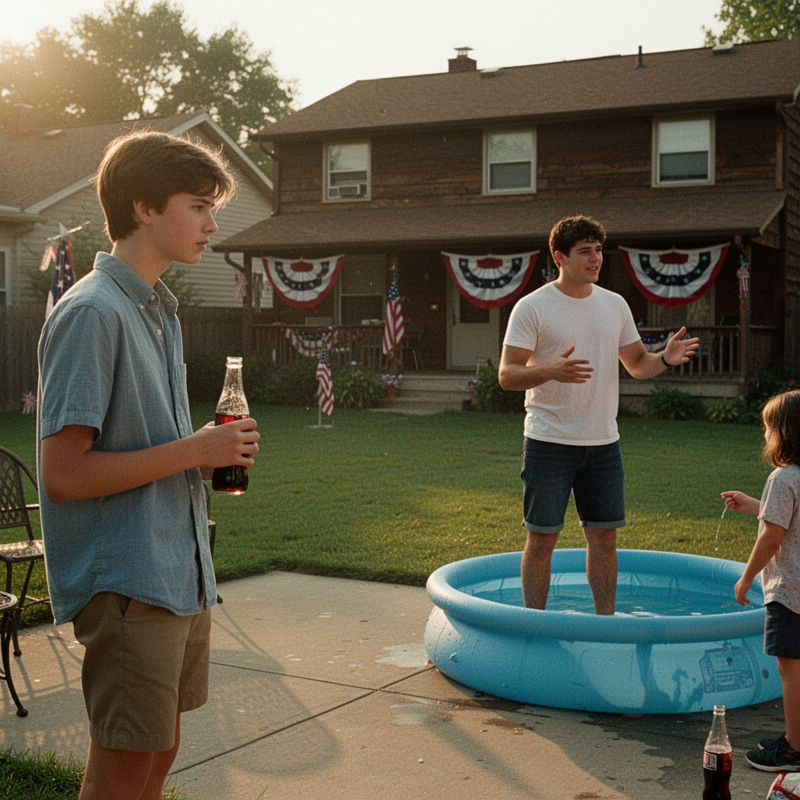
The aroma of charcoal smoke and sizzling burgers hung heavy in the humid Ohio air, mixing with the sweet scent of honeysuckle from Mrs. Henderson’s trellis. It was a perfect 4th of July afternoon, the kind you remember from childhood.
Richard Garber, our landlord, beamed from behind his oversized barbecue, flipping ribs with practiced showmanship. He loved these parties.
Laughter and conversation swelled around the courtyard, punctuated by the occasional pop of a distant firecracker, early birds testing the night’s main event.
I watched Julian from the edge of the crowd, a warm bottle of soda clutched in my hand. He was talking animatedly with someone near the overflowing kiddie pool, his broad shoulders easily visible above the other guests.
Julian was always the life of the party, always drawing people in. At 24, he was my protector, my mentor, everything. I, Leo Finch, at 19, often felt like a shadow trailing behind his brightness.
Our landlord’s assistant, Chloe Danforth, in a sparkly red-white-and-blue bandana, called out over a portable speaker.
“Alright, folks! Raffle for the grand prize is next, don’t wander too far!”
Julian turned then, his eyes scanning the crowd for me. He caught my gaze, gave me a quick, reassuring nod, and headed my way.
He still had that playful grin on his face, but as he moved, a subtle hitch in his step caught my eye. He paused for a moment, pressing a hand to his chest, a flicker of discomfort crossing his features before it vanished.
“Hey, Leo,” he said, his voice a little lower than usual. “Find anything good to eat yet?”
Before I could answer, a loud, sharp crackle burst from the nearby fire pit, showering sparks into the air. Someone shrieked playfully.
Julian flinched, his hand flying back to his chest. This time, the grimace on his face was undeniable. He swayed.
My heart seized.
“Julian?” I started, stepping forward.
He didn’t respond. His eyes, usually so vibrant, rolled back into his head. His body went rigid for a terrifying second, then crumpled. He hit the patio flagstones with a sickening thud, a sound that cut through the festive noise like a shard of ice.
A collective gasp swept across the yard. The music seemed to stop, the laughter died. Time itself warped.
Someone dropped a glass. It shattered violently.
The coroner’s report, delivered days later, was succinct: “Sudden cardiac event. Undiagnosed congenital defect.” It felt too clean, too simple for such a brutal, sudden absence.
The funeral was a blur of hushed condolences and damp handshakes. I moved through it like a ghost, Julian’s empty apartment across the hall a constant, aching presence.
He had lived in the downstairs unit of our duplex, I in the upstairs, a shared wall between us always a comfort. Now, it was just a wall.
Then came the news report. Two days after we laid Julian to rest, an online article flashed across my phone screen: “Oak Haven Police Seek Witness in 4th of July Tragedy.”
A blurry security camera photo was attached. It showed Julian near the barbecue, just minutes before he fell. And standing opposite him, her back slightly turned, was a woman in a bright yellow sundress. Her arm was raised, as if gesturing emphatically.
The caption identified her as “Nadia,” a tenant from Julian’s building. Police were seeking her for questioning, describing her as a “person of interest.”
My blood ran cold. It *was* Nadia. Nadia, the quiet, reclusive woman who lived directly across from Julian’s apartment, in unit 1B. The woman Julian had casually mentioned as his new girlfriend a few months prior.
Her face, while partially obscured in the photo, was unmistakable. The distinct yellow dress, the way her dark hair was pulled back.
But the article also stated that she had vanished, leaving her apartment locked and vacant.
A knot of dread tightened in my stomach. Julian never introduced me to her. He always said she was “shy” and “busy.” Now, she was gone.
Why hadn’t she come forward? Why disappear?
A chilling thought crept into my mind: Had she done something to him? Was the argument, visible even in the grainy photo, more than just a lovers’ quarrel?
Fueled by a cocktail of grief and mounting suspicion, I grabbed my spare key for Nadia’s apartment. Julian, being the unofficial handyman of the building, kept a spare for every unit, “just in case.” I’d found the small tag with “1B” scrawled on it among his tools.
The hallway was quiet, the air stale. Unit 1B’s door was an imposing, silent barrier. I slid the key into the lock. It clicked open with a soft, final sound.
The apartment was eerily silent, devoid of any personal touches. No pictures on the walls, no scattered mail. It was as if no one had ever truly lived there. Just bare walls, a few pieces of generic rental furniture, and the faint scent of something metallic, almost like old coins.
I walked into the living room, my footsteps echoing on the polished concrete floor. It was cleaner than Julian’s apartment, much cleaner than mine. Too clean.
On a small side table, a framed photo lay face down. I picked it up, hope warring with trepidation. Was this a photo of her and Julian? A clue to their relationship?
The frame was empty. A stark white rectangle, perfectly clean, no dust, no adhesive residue. As if a picture had been purposefully removed, erased.
I checked the small closet in the entry. Empty coat hangers, a single shoebox. Inside the shoebox, nestled among crumpled newspaper, was a small, heavy safe. It was the kind you might find in a hotel room, bolted to the floor. It was locked tight.
It looked out of place, a solid block of mystery in an otherwise vacant room. My fingers brushed against its cold metal surface. What secrets was she hiding in there?
Then, in the bathroom, tucked behind a loose tile in the shower, I found it. A small, water-resistant pouch. Inside, a laminated ID card.
It wasn’t a driver’s license, but a professional ID badge. The name on the card wasn’t Nadia. It read: Clara Winslow. Property Research Analyst. Underneath, a logo for “Oak Haven Environmental Watchdog Group.”
My hands started to tremble. Clara Winslow. Not Nadia. And not Julian’s girlfriend. She was an investigator.
What was she investigating? And why was she living across the hall from my brother under a fake name?
Part 2
My mind raced. Clara Winslow. Not Nadia. Not Julian’s girlfriend. She was a professional. An environmental watchdog. What could she possibly be investigating in *our* building?
I moved out of the bathroom, my gaze now sweeping the apartment with new eyes. Every sparse detail, every too-clean surface, screamed “cover story.” This wasn’t a home; it was a stakeout.
The metallic scent, which I’d dismissed earlier as old coins, now seemed sharper, more acrid. It pricked at the back of my throat. I followed my nose toward the small, empty bedroom.
There, almost perfectly camouflaged against the off-white wall, I saw it. Tucked just inside a barely open air vent, was a small, sleek device. Wires snaked from it, disappearing deeper into the ductwork. It was atmospheric testing equipment.
A cold dread spread through me, far worse than my initial suspicion about Nadia. This wasn’t about a lovers’ quarrel. This was about something systemic.
Julian’s sudden collapse. The way he clutched his chest. The doctor’s easy explanation of a “cardiac event.” It all started to unravel.
Clara wasn’t poisoning Julian. She was studying what was *already* poisoning him.
This equipment. The smell. It wasn’t just old coins. It was a faint, yet distinct, chemical tang. Industrial sewer fumes. Leaking into the basement floor, into Julian’s unit.
My brother, my protector, had been breathing this in. This was it. This was why he died. Not a congenital defect, but something insidious, something hidden in the very air he breathed.
I felt a surge of adrenaline, a desperate need to act. I had to call someone. The police, the health department, anyone who would listen.
My hand was already reaching for my phone when a shadow fell across the doorway. I looked up, my heart leaping into my throat.
Richard Garber stood there, framed by the dim hallway light, a set of new locks and a toolbox clutched in his hand. His face was tight, his smile gone.
“Leo,” he said, his voice dangerously low. “What are you doing in here?” His eyes flicked to the testing equipment, then back to me, an unreadable intensity in them. “This unit is off-limits. You have 24 hours to clear out your brother’s apartment and be off my property.
CHAPTER 2: The Paper Valuation
The wood-paneled office smelled of expensive tobacco and damp paper.
Arthur Delancey sat behind a mahogany desk, his gold pen hovering over a stack of commercial real estate files. His brass nameplate read *Licensed Property Appraiser & Public Notary*.
“I don’t have time for local drama, kid,” Delancey said, without looking up. “I certify structural health based on official filings.”
I dropped the laminated safety certificate onto his blotter. It bore his official seal and a date from three weeks ago, declaring the basement units of Oak Haven completely compliant with city health codes.
“My brother died in that basement,” I said. “The air down there burns your throat. You never walked those halls.”
Delancey’s hand froze. He lowered the pen, his eyes shifting nervously toward the frosted glass door of his reception area.
“You need to leave,” he whispered, leaning across the desk. “You don’t understand how these municipal deals work.”
“Explain it to me then,” I said, leaning closer. “Because my brother is in a cold morgue drawer while you stamp papers.”
Delancey slid open his desk drawer and shoved a yellowing file out of sight. His knuckles were white against the wood.
“Richard Garber pays me five thousand dollars per report,” Delancey said, his voice dropping to a harsh whisper. “He hands me the specs, I sign off on structural safety, and he gets his paper values. I’ve never set foot in your basement, and neither has anyone else.”
He stood up, shoving his hands into his trousers.
“If you think taking this to city hall will fix anything, you’re delusional,” Delancey added, staring at the floor. “Garber owns the people who review those forms. You’re just a nineteen-year-old kid pushing against a brick wall.”
CHAPTER 3: Fumes in the Foundation
The midnight air in the Oak Haven courtyard was heavy with humidity.
I ducked under the yellow police tape fluttering against the basement doorframe and slipped into the subterranean hallway. The odor hit me instantly—a sharp, chemical stench of rotten eggs and raw sewage that made my eyes water.
Julian’s key felt cold in my palm. I unlocked our old unit, stepping over scattered junk mail and the lingering chill of the concrete floor.
I dropped to my knees near the laundry closet. Julian had always been meticulous about his work tools, keeping a hidden compartment beneath the loose floorboards where the main line met the foundation wall.
I pried the warped oak board loose with a screwdriver.
Inside lay Julian’s black spiral notebook. I flicked on my phone flashlight and opened to the final entries, dated just hours before the 4th of July party.
Page after page was filled with neatly drawn diagrams of the plumbing stacks. Beside the sketches were numerical logs of air quality readings—methane levels spiking four times above legal limits, paired with elevated sulfur dioxide metrics dating back three full months.
Underneath the numbers, Julian had written a single, bold line in black ink: *Illegal runoff bypass installed directly beneath the main laundry slab. Garber redirected the municipal vent to dodge environmental fines. Reporting to EPA on Monday.*
Julian wasn’t killed by an unknown genetic defect. He was breathing trapped industrial fumes every night while he slept.
CHAPTER 4: The Inspector’s Price
The grease-stained menu at the Oak Haven Diner rattled in my hands as I sat down across from Chief Building Inspector Sam Kowalski.
Kowalski wiped egg yolk from his mustache with a paper napkin, his heavy eyes darting to the black notebook sitting between us on the Formica table.
“This is amateur hysteria,” Kowalski said, shoving the notebook back toward me with a thick finger. “Your brother wasn’t a certified technician, Leo. He was a twenty-four-year-old mechanic.”
“The numbers match the chemical smell in the basement,” I said. “He logged those gas spikes for three months. You stamped off on the building’s clearance last month.”
Kowalski leaned back, the booth vinyl groaning under his weight.
“I’ve been the chief inspector in this county for twenty-two years,” he said, his voice dropping into a raspy threat. “If you keep floating slander about structural hazards, I’ll have the police arrest you for illegal entry and filing false municipal reports. Garber’s property is fully compliant.”
He slid two twenty-dollar bills onto the table to cover his breakfast and stood up without another word.
I watched through the diner’s foggy window as Kowalski walked across the rain-slicked asphalt lot.
He didn’t get into a city vehicle. He climbed into the passenger side of a late-model black sedan registered to Garber’s commercial property management company.
As the car pulled away, I caught a glimpse of the driver sliding a thick white envelope across the console toward Kowalski. Garber had paid fifteen thousand dollars in cash to clear the building for his pending refinance loan.
CHAPTER 5: Signal in the Smoke
Back in the apartment, the silence felt suffocating.
I stood in the narrow hallway, staring up at the white plastic smoke detector mounted near the ceiling. I remembered Clara—the girl who called herself Nadia—standing in this exact spot three days ago, staring up at the casing with an intense, quiet focus before she vanished.
I dragged a folding chair over, stepped up, and twisted the detector housing counterclockwise.
The plastic casing popped loose in my hands. Taped neatly behind the nine-volt battery was a slim micro-SD card wrapped in clear plastic.
I dropped down, opened my laptop on the kitchen counter, and inserted the card.
Dozens of spreadsheets filled the screen. Clara hadn’t been Julian’s secret girlfriend—she was a private researcher compiling evidence against Garber’s corporate network.
The digital files contained complete double-entry accounting ledgers for the entire Oak Haven complex.
One set of books was prepared for the commercial lenders, showing pristine operational maintenance. The second set recorded the truth: intentional utility bypasses, altered ventilation stacks, and emergency repair budgets slashed by seventy percent over two years.
Garber was faking the building’s financial health to secure a three-point-two-million-dollar refinance package from the regional bank.
CHAPTER 6: The Blue Folder
The heat in the courtyard was thick as I sat on the concrete steps, staring at the complex financial spreadsheets on my laptop screen.
Eight-year-old Toby Albright bounced a worn tennis ball against the brick wall nearby. The ball missed the ledge and rolled against my sneaker.
“Sorry, Leo,” Toby muttered, picking up the ball. He looked at my screen, then at the empty parking space where Julian’s car used to sit. “Are you looking for Julian’s dog tags?”
“No, Toby,” I said softly. “Just trying to figure some things out.”
Toby wiped his forehead with his dusty sleeve.
“Mr. Garber was angry on the Fourth of July,” Toby said casually, looking down the driveway. “Before the fireworks started, he had a big blue folder with red bright stickers on it. He was yelling at a lady.”
I pulled my attention away from the laptop. “What blue folder?”
“The heavy one,” Toby said, tracing a square in the air with his hands. “He locked it under the back seat of his white pickup truck right before everyone started eating burgers. He told her nobody was allowed to touch it.”
My heart hammered against my ribs.
Garber’s white utility truck was still parked in the rear maintenance bay behind the leasing office.
CHAPTER 7: What the Deck Covered
Rain began to drizzle over the asphalt as I slipped around the back of the maintenance shed.
Garber’s white pickup was parked under the rusted overhang. Using a spare master maintenance key Julian had kept on his desk ring, I unlocked the rear cab door.
The interior smelled of old coffee and wet leather.
I reached beneath the folded rear bench seat, my fingers brushing against thick vinyl. I pulled out a heavy blue accordion folder sealed with red inspection tags.
I opened it under the dim dome light.
Inside were original, unedited engineering surveys conducted fourteen months ago by a state structural firm.
The top document was stamped in red ink: *CRITICAL HAZARD — BASEMENT VENTILATION SYSTEM FAILED. HUMAN OCCUPANCY NOT RECOMMENDED.*
Garber had received the official warning over a year ago. Instead of spending forty thousand dollars to replace the central ventilation stacks, he had intentionally capped the exhaust flues with plywood to save four thousand dollars a month in commercial utility bills.
He knew the basement was trapping toxic fumes. He had chosen to keep collecting rent anyway.
CHAPTER 8: Breaking Loyalty
“Put that down, you little thief!”
The heavy garage door slammed open. Richard Garber stepped into the bay, his face red and slick with sweat. His large frame blocked the narrow exit toward the alley.
“You’re trespassing on private commercial property,” Garber growled, stepping closer, his boots heavy on the wet concrete. “I have officers on speed dial. Hand me that folder, or you’ll spend your nineteenth birthday in a county jail cell.”
I clutched the blue folder against my chest, backing up until my spine hit the side of the pickup.
“You killed my brother,” I said, my voice shaking. “You capped the vents to save money.”
“Your brother was an incompetent amateur who meddled in things he didn’t understand!” Garber shouted, raising his hand toward me.
“That’s enough, Richard.”
Chloe Danforth, Garber’s twenty-three-year-old assistant property manager, walked out from the office doorway. She held a black plastic flash drive in her hand, her knuckles trembling.
“Get back inside, Chloe,” Garber snapped without turning his head. “This doesn’t concern you.”
“It does concern me,” Chloe said, her voice clear despite her trembling hands. “I’m not going to prison for you. I’m not taking the fall when the bank audits these records.”
She walked past Garber and handed the flash drive directly to me.
“Those are recorded phone calls between Garber and Delancey,” Chloe said softly. “He threatened to fire me and revoke my lease if I didn’t hide the structural inspection failures.”
CHAPTER 9: The Forged Signature
Garber lunged forward, but Chloe stepped directly into his path, blocking him with her small frame.
“Show him the insurance file, Chloe,” Garber spat, his eyes wild. “Show him what his precious brother actually did!”
Chloe turned to her shoulder bag and pulled out a stapled paper document, handing it to me. It was an incident claim Garber had filed with his commercial insurer early that morning.
Attached to the back was a forged maintenance sign-off sheet dated two days before Julian died.
At the bottom of the page was Julian’s signature—coarsely copied in blue ink, claiming Julian had personally altered the basement ventilation pipes without authorization.
“He’s trying to claim Julian caused the gas buildup himself,” Chloe said, looking at me with pure disgust for her boss. “He submitted this to dodge liability and collect a clean payout on the structural insurance policy.”
I looked up at Garber. The man was smiling—a thin, cruel line across his heavy face.
“A dead man can’t testify in court, kid,” Garber whispered. “His signature is on the paper. As far as the law is concerned, your brother killed himself.”
CHAPTER 10: The Gathering Storm
By six o’clock that evening, the sky over Oak Haven had turned a bruised, dark purple.
Word had spread through the complex. All twenty-eight tenant families gathered in the center courtyard, standing in the light rain around the concrete picnic tables.
I stood on top of a wooden bench holding Clara’s laptop, Julian’s notebook, and the blue folder.
“Garber forged signatures,” I told the crowd, my voice echoing off the brick walls. “He shut down our air filtration to cut his utility bill by four thousand dollars a month. He paid off inspectors while our families breathed poison.”
Murmurs rippled through the neighbors. Toby’s mother clutched her son’s hand, her face pale with anger.
“We aren’t paying another dollar,” an older tenant from the second floor yelled out. “Not one cent!”
Chloe stepped forward, holding a clipboard loaded with rent-withholding notices. One by one, the heads of all twenty-eight households signed their names to a collective rent strike document.
As the last signature was collected, two black luxury sedans pulled slowly into the complex driveway.
Three corporate executives in gray suits stepped out, holding paper briefing files. They were the lead underwriting auditors from the regional bank, arriving early to inspect the site for Garber’s three-point-two-million-dollar loan finalization.
CHAPTER 11: Systemic Collapse
The courtyard erupted as Garber rushed out of his leasing office, shouting at the tenants to clear the pavement.
“Ignore these people!” Garber yelled to the lead bank officer, his voice cracking with desperation. “It’s a disgruntled group of non-paying tenants trying to avoid standard rent increases!”
Chloe stepped directly between Garber and the lead auditor.
“Here are the double-entry accounting ledgers, sir,” Chloe said clearly, handing a thick manila envelope and a flash drive directly to the officer. “And here are the fraudulent safety valuations stamped by Arthur Delancey.”
A local news crew, tipped off by Chloe an hour earlier, rolled up to the curb, their heavy camera lights illuminating the rain.
The lead bank officer opened the envelope, scanned the internal engineering warning, and looked up at Garber with cold disgust.
“Your refinance loan package is immediately canceled, Mr. Garber,” the banker said. “We are issuing an immediate call on your one-point-eight-million-dollar existing default notes. Your corporate accounts are frozen as of five minutes ago.”
Garber stumbled back against his car door, his face completely drained of color as the news camera zoomed in on his face. His multi-million-dollar real estate empire had collapsed in front of the entire neighborhood.
A county police cruiser pulled up behind the news van. Detective Vance stepped out and motioned for me to walk over to the curb, away from the screaming crowd.
“Leo,” Vance said quietly, looking down at his notepad. “We got the official report back from the state forensic lab twenty minutes ago.”
My breath caught in my chest. “Is Garber being arrested for murder?”
Vance shook his head slowly, his expression grim.
“Julian’s primary tissue samples were contaminated during transport to the state facility,” Vance said. “The chemical markers were ruined by heat exposure in the lab transit van. Legally, we cannot establish direct homicide causation in a criminal court. Garber is ruined financially, but murder charges are off the table.”
CHAPTER 12: The Empty Office
By the following afternoon, Oak Haven was a ghost town surrounded by yellow plastic tape.
Bright orange municipal notices were slapped across every front door, declaring the entire twenty-eight-unit complex condemned and unsafe for human habitation. The city forced all families to evacuate within forty-eight hours.
I walked past the open door of the leasing office.
The room was completely stripped. File drawers hung open, papers littered the floor, and the desk was bare. Garber’s personal vehicles had been repossessed by the bank before noon, and his name was splashed across the state news as a ruined, fraudulent developer facing millions in civil debt.
Detective Vance was standing by the curb as emergency moving vans packed up the last tenant belongings.
“Where is Garber?” I asked, stepping up to the cruiser.
“He posted a minor fifty-thousand-dollar interim bond on municipal code charges early this morning,” Vance said, staring out at the rain. “Before the bank could freeze his personal savings accounts, he walked into a branch and withdrew four hundred thousand dollars in cash.”
“And then?” I asked, my heart sinking.
“He missed his afternoon court appearance,” Vance replied softly. “He crossed state lines four hours ago. He’s gone, Leo.”
CHAPTER 13: Nine Days Later
Nine days after the collapse of Oak Haven, the complex sat dead and dark against the gray autumn sky.
I sat alone on the damp concrete steps out front, wrapped in Julian’s old canvas jacket. Stacked cardboard boxes and sealed plastic tubs surrounded my feet on the rain-slicked pavement. The last moving van was idling at the curb, waiting to take my remaining belongings to a small room I had rented across town.
A figure stepped out from the fog across the street.
Clara Winslow stood on the sidewalk, dressed in a dark coat, holding a small travel bag. Her real name had finally come out in the news reports—she had spent two years hunting Garber to avenge her father’s bankruptcy.
She looked across the empty street at me. She didn’t cross over, and she didn’t smile.
We exchanged a long, quiet glance through the falling rain—a shared acknowledgment of the war we had fought and the heavy cost we had both paid. She turned her collar up against the wind and walked away toward the bus station without saying a word.
I picked up my last box and walked toward the idling truck.
Garber was financially destroyed, his real estate holdings were foreclosed, and his name was ruined. But he was somewhere across the country with a suitcase full of cash, hiding from a legal system that had failed to protect my brother when it mattered most.
I looked back at the cold, silent brick facade of the building where Julian had lived and died.
Buildings can be condemned in an afternoon, but the spaces left behind inside us take a lifetime to rebuild.
Leave a Reply