CHAPTER 1: The Guardianship Papers at Dawn
Part 1
When I was diagnosed with terminal stage-4 cancer, my mother-in-law Beatrice Kensington immediately drew up papers to seize full custody of my six-year-old son, Leo.
Instead of fighting her in her own corrupt high-society courts, I secretly signed over legal guardianship to our middle-class neighbors, Marcus and Hannah Croft.
Beatrice responded by hitting the Crofts with a $320,000 emergency lawsuit and four separate restraining orders within twenty-four hours.
She thought she was protecting our family’s old-money legacy, but she didn’t know I had just uncovered the real reason I was dying.
The sterile smell of disinfectant clung to everything, even the white rose Julian had brought. It was a cruel irony, the faint floral scent battling the metallic tang of the hospital air. Dr. Evans spoke in hushed, practiced tones.
“I’m so sorry, Mrs. Kensington,” he had said, his voice flat. “It’s angiosarcoma. Stage four. Aggressive.”
The words floated in the air like dust motes, catching the weak afternoon light. I didn’t cry. There was no space for tears, only a cold, hard knot of fear coiling in my stomach. Leo. Six years old.
Later that afternoon, the first blow landed, not from the disease, but from the family that had always felt more like an institution than a home. Richard Sallow, the Kensington family’s lead corporate attorney, called.
His voice was smooth, devoid of warmth.
“Lauren,” he began, “Beatrice is deeply concerned about Leo’s welfare given your recent diagnosis.”
I clutched the phone, my knuckles white. Leo.
“She believes,” Sallow continued, “that the most stable environment for him would be within the Kensington family, under her direct guardianship.”
My heart hammered against my ribs. Beatrice. My son would become another asset, another perfectly groomed accessory in the Kensington dynasty, far away from any real love or warmth. I would die, and Leo would be swallowed whole.
I hung up without another word. My decision was made, clear and unwavering. Beatrice Kensington would never get her hands on my son. Not while I still drew breath.
That evening, a cool breeze rustled through the maple trees outside the modest home of Marcus and Hannah Croft. Their house, a cozy two-story, stood in stark contrast to the Kensington estate a few miles away in Newport. No towering columns, no sprawling lawns, just a tidy garden and a swing set in the backyard. Leo loved playing with their kids.
I watched Marcus, a carpenter by trade, rough-housing with his son, while Hannah, a high school teacher, read aloud from a picture book on their porch swing. They were ordinary, loving, and real. Everything the Kensingtons weren’t.
I rehearsed my words a hundred times, but they still felt inadequate. When they invited me in, their faces were etched with concern. They knew about my diagnosis. The news, like all things in Newport, traveled fast.
We sat at their kitchen table, bathed in the soft glow of a hanging lamp. The smell of freshly baked bread filled the air.
“I have a request,” I began, my voice wavering despite my efforts. “A favor, really. The biggest favor I could ever ask.”
Hannah reached across the table, her hand warm on mine. “Anything, Lauren.”
I took a deep breath, picturing Leo’s bright, curious eyes.
“I need you to take Leo,” I said, the words a raw whisper. “When I’m gone. I need you to raise him.”
Silence descended, heavy and thick. Marcus stopped fiddling with a loose thread on his jeans. Hannah’s grip tightened on my hand. Their expressions shifted from sympathy to stunned disbelief.
“Lauren,” Marcus finally said, his brow furrowed, “we… we love Leo like our own, but…”
“Beatrice is already moving to get custody,” I interrupted, my voice gaining strength. “She sees him as an heir, a possession. Not a child.”
I looked from Marcus to Hannah, pleading with my eyes. “She’ll give him everything money can buy, but nothing of what he truly needs. I want him to have a normal life, a happy one. With you.”
They exchanged a long, silent glance. I saw the worry in Hannah’s eyes, the practical concern in Marcus’s. The weight of what I was asking was immense. They were middle-class, working hard to support their own family. Taking on Leo would be a monumental sacrifice.
“We need a lawyer,” Hannah said, her voice quiet but firm. “To make it legal. So there are no questions.”
Two days later, a local probate attorney, a no-nonsense woman with kind eyes, sat at that same kitchen table. The guardianship papers lay spread out between us, stark and official. Every clause, every signature, an irreversible promise. Marcus and Hannah looked solemn but resolute as they signed their names. I signed mine, sealing Leo’s future, freeing him from a life I knew would suffocate his spirit.
The call came at precisely 6:15 AM. The phone blared, shattering the pre-dawn quiet. It was Julian, my husband. His voice was a panicked hiss.
“She knows, Lauren! Mother knows!”
I already knew who “she” was. Beatrice. She had found out. Perhaps Sallow had connections in the probate court, or maybe Julian, weak-willed as always, had let slip some detail.
An hour later, I saw the black Bentley pull up to the Kensingtons’ sprawling estate from my bedroom window. Richard Sallow emerged, his face grim. Beatrice, a formidable silhouette against the rising sun, stood waiting for him on the grand portico. Even from a distance, I could feel her fury. I knew she would unleash hell.
The Crofts, caught completely off guard, called me later that morning, their voices filled with a mixture of shock and terror. Beatrice had indeed summoned Sallow, and the first legal threats, veiled but menacing, had already begun.
I drove over to their house immediately. Hannah met me at the door, her face pale.
“Lauren, what have we done?” she whispered, her eyes wide with fear. “They’re threatening everything. Our home, Marcus’s business…”
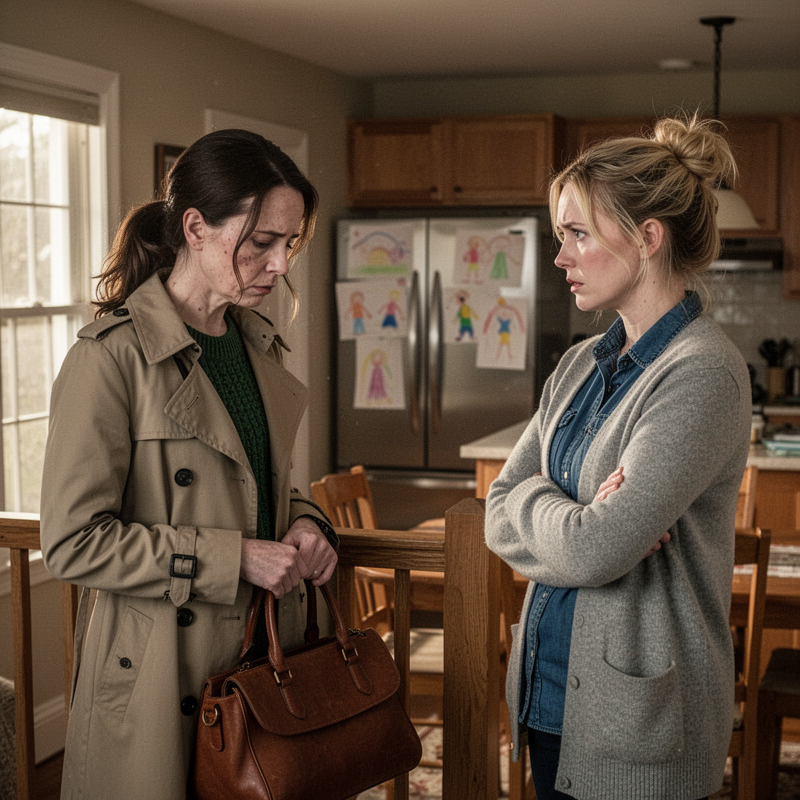
I led her to the living room, a space filled with mismatched furniture and children’s drawings taped to the fridge – a real home. I looked into her scared eyes, and I knew I couldn’t keep the truth from her any longer. She deserved to know the full price of the sacrifice they were making.
“Hannah,” I said, my voice low and urgent, “there’s something I need to tell you. Something Beatrice doesn’t want anyone to know.”
I pulled a faded, crumpled document from my handbag – a lab report I’d retrieved just days before my diagnosis. Its contents had shattered my world even more than the doctor’s words.
“My cancer,” I explained, pointing to the chemical names listed in the report, “it wasn’t random. It was caused by something. Something Beatrice Kensington knew about and covered up.”
Hannah’s eyes narrowed, trying to make sense of the foreign words on the page.
“Eighteen years ago,” I continued, “the Kensington enterprise’s chemical manufacturing plant in Newport. They were secretly dumping industrial toxins. Directly into the ground. On the land that became part of the Newport estate.”
I watched as the realization dawned on her face, slowly at first, then with a horrifying clarity.
“The ground where I used to play as a child,” I said, my voice barely a whisper. “The place where I grew up.”
I met her gaze, unflinching. “That’s why I chose you, Hannah. Because I found proof that Beatrice Kensington literally poisoned me to save her company. And I will not let her poison my son’s life too. Not now, not ever.”
Part 2
Hannah stared at me, her eyes reflecting a profound mix of horror and understanding. The truth, ugly and raw, hung between us, solidifying the choice we had made. This wasn’t just about custody; it was about justice.
Less than twenty-four hours later, the first official blow landed. A grim-faced process server arrived, not just at the Crofts’ door, but at mine too. He handed me a thick, intimidating stack of papers – a 42-page emergency court injunction. Beatrice’s legal team, led by Richard Sallow, wasted no time.
The injunction alleged I was mentally unfit, citing my terminal diagnosis and the “presumed cognitive impairments” from my medication. They claimed my decision to appoint the Crofts as guardians was irrational, a deluded act of a dying woman, making the guardianship void. They wanted Leo immediately.
Marcus, his jaw tight, refused to budge. He wouldn’t surrender Leo. Sallow’s response was swift and brutal. Within hours, another lawsuit was filed against Marcus and Hannah, demanding $320,000 and accusing them of conspiracy, undue influence, and child endangerment. The financial terror campaign had begun.
I knew I had to face Julian. He had to know what his mother was doing, what she had done. I found him in his study, nursing a glass of scotch, his face pale and drawn. I showed him the lab reports, the proof of the Newport plant’s toxic dumping.
His facade crumbled. He broke down, confessing that he’d known about the toxic groundwater contamination for three years. He’d found old internal reports, buried deep in Kensington Enterprises archives, but had kept silent.
He sobbed, “Mother said it would destroy everything! My inheritance, Lauren! The $14.5 million trust! Our whole life would be ruined!” His tears were for himself, for his lost comfort, not for the wife he knew was dying because of his family’s greed.
In that moment, I saw him clearly. Not a husband, but another victim of Beatrice’s control, too weak and compromised to ever protect Leo. My son deserved more than a legacy bought with poison and silence.
I didn’t argue. I didn’t cry. I simply walked out. That afternoon, I began packing. Not for another grand Kensington trip, but for a final, desperate strategic move. I emptied my closets, took only essentials, and left behind every symbol of my Kensington life. I voluntarily checked into a modest public hospice ward, relinquishing all marital privileges to strip Beatrice of domestic venue control.
CHAPTER 2: The $320,000 Lawsuit
The legal summons sat on the Crofts’ kitchen table next to a half-empty mug of coffee and a box of cold toast.
Marcus Croft picked up the thick blue folder, his calloused fingers trembling against the smooth cream paper.
“They’re demanding immediate temporary surrender of Leo,” Marcus said. His voice was flat, devoid of its usual warmth. “Or they hit us with criminal contempt. Six months in jail.”
Hannah sat across from him, her hands wrapped around her elbows. “And the financial part?”
“Three hundred and twenty thousand dollars,” Marcus read from page four. “For alleged child endangerment, conspiracy, and tortious interference with family relations.”
The landline phone on the counter began to ring. Hannah snatched the receiver on the second chime.
“Hannah, it’s Lauren,” my weak voice came through the speaker. I was sitting on the thin mattress of room 214 in the public hospice ward, clutching the plastic cord. “Did Sallow deliver the paperwork?”
“It arrived twenty minutes ago,” Hannah whispered, looking toward the hallway where six-year-old Leo was playing quietly with wooden blocks. “Lauren, three hundred and twenty thousand dollars. We don’t have three thousand in savings.”
“Do not break,” I told her, pressing my hand against the dull ache in my side. “Beatrice thinks everyone has a price or a breaking point. She expects you to panic and run.”
“What about Julian?” Hannah asked. “Is he really standing behind his mother on this?”
I squeezed my eyes shut, remembering my husband’s pale face from late last night when he visited my hospital room before I transferred here.
“Julian knew,” I said softly into the receiver. “He admitted it to me before I left the mansion. He found out about the chemical contamination three years ago.”
“He knew the ground was poisoned?” Hannah breathed.
“He stayed silent because Beatrice threatened to slice his fourteen-point-five million dollar trust fund in half,” I said. “He chose his inheritance over my life and his son’s safety.”
Across town, inside the gilded mahogany dining room of the Beacon Hill Club, Beatrice Kensington sliced into a poached egg with surgical precision.
Attorney Richard Sallow sat opposite her, adjusting his gold cufflinks.
“The papers were served at seven-fifteen AM,” Sallow reported, taking a sip of black tea. “The working-class couple is undoubtedly panicking.”
“Good,” Beatrice said, not looking up from her plate. “Working-class people like the Crofts don’t fight lawsuits. They see six-figure demands and they collapse.”
“And if they attempt to retain legal counsel?” Sallow asked.
“They can’t afford a retainer,” Beatrice replied coldness in her eyes. “They are holding my grandson hostage because they think they can squeeze a settlement out of us. Give them forty-eight hours to realize they are outmatched, then offer them a way out.”
CHAPTER 3: The Sealed Escritoire
The public hospice ward smelled of industrial floor sanitizer and boiled cabbage.
I sat in a wheelchair beside three cardboard boxes containing the few personal belongings I had managed to take from the Kensington estate before relinquishing my marital status.
“Help me open this cabinet,” I said to the nurse’s aide, pointing to a small mahogany escritoire desk sitting in the corner.
I had bought the antique two years ago at a private auction of estate items belonging to Arthur Pendelton, Beatrice’s long-banished ex-husband.
The aide nodded, setting down a tray of paper cups containing my afternoon pain medication.
“The top drawers are jammed, Mrs. Kensington,” the aide said, tugging gently on the brass ring pulls.
“Use the metal letter opener on the side,” I instructed. “There is a hidden release latch along the interior moulding.”
The aide slid the thin piece of steel along the inner groove until a quiet mechanical click echoed through the small room.
A false back panel in the upper cabinet popped forward a fraction of an inch.
I reached out with trembling fingers and pulled the dark wood panel free.
Inside lay a single sheet of yellowed letterhead paper, heavy and crisp despite the years.
The date stamped at the top read October 14, 2006.
The handwritten penmanship was sharp and panicked, bearing the distinct signature of Arthur Pendelton.
“To Beatrice,” the letter began. “The preliminary soil tests from the lower four acres of the Newport estate came back from the independent laboratory this morning.”
I swallowed hard, my breath catching in my throat as my eyes scanned the next line.
“Benzene levels in the groundwater surrounding the southern spring are four hundred times above the legal state safety limit,” Arthur had written. “The industrial runoff from the plant’s 1998 chemical spill was never contained. We must notify the town board and clear the property immediately before someone gets hurt.”
Across the bottom of the page, written in faded black ink, was a brief reply in Beatrice’s unmistakable elegant script: “If this leak reaches the press, the enterprise goes under. The test files are destroyed as of today. Keep your mouth shut, Arthur.”
My hand shook so violently the paper rattled.
This was not an tragic, unexpected illness.
Beatrice had known for eighteen years that the estate where I walked every morning was saturated with lethal carcinogens.
CHAPTER 4: The 12-Hour Ultimatum
The circular saw hummed to a stop inside Marcus Croft’s woodworking shop on the outskirts of the city.
Sawdust settled over the stacks of raw oak and pine as the heavy side door creaked open.
Attorney Richard Sallow stepped over the threshold, his polished leather shoes leaving shiny tracks in the fine wooden dust.
Two uniformed court enforcement officers followed closely behind him, their hands resting on their utility belts.
“Marcus Croft,” Sallow said, holding up a folded legal document with a red state seal stamped on the front page.
Marcus wiped his hands on his canvas apron and stepped out from behind his workbench, holding a heavy steel ruler.
“You’re trespassing on private commercial property,” Marcus said.
“I am serving an ex parte emergency enforcement order signed by Judge Vance two hours ago,” Sallow replied smoothly. “You have twelve hours to produce Leo Croft and hand him over to child protective services for transition to Mrs. Kensington.”
“Leo isn’t here,” Marcus said, stepping forward until he was six inches from the attorney’s face.
“We know he isn’t at your home address either,” Sallow said, unbuttoning his suit jacket. “Where is the boy, Mr. Croft?”
“Somewhere you can’t touch him,” Marcus said.
He had driven Leo north at three in the morning, leaving the boy at a secluded lake cabin owned by his brother, far outside the county’s jurisdiction.
“Hiding a child from a court order is a felony,” Sallow said, his voice dropping to a low hiss. “If that boy is not delivered to the family court steps by eight o’clock tomorrow morning, you will be in handcuffs before nightfall.”
“Then bring the handcuffs,” Marcus said, pointing the steel ruler toward the open door. “Get off my shop floor.”
Sallow smiled thinly, turning back toward the sunlight outside.
“Twelve hours, Mr. Croft,” Sallow called over his shoulder. “Your little woodworking business won’t survive a criminal indictment.”
CHAPTER 5: The Hospice Garden Meeting
The wind blew yellow autumn leaves across the gravel path in the quiet courtyard behind the hospice facility.
I sat bundled in a thick wool blanket, my wheelchair parked beneath the shade of an old oak tree.
A tall, stooped man in a faded trench coat approached down the walkway, his footsteps slow and hesitant.
Arthur Pendelton looked thirty years older than his sixty-six years, his gray hair unkempt and his face lined with deep grooves of regret.
“Lauren,” Arthur said softly, stopping three feet away. “I barely recognized you.”
“Cancer moves fast, Arthur,” I said, pulling the yellowed 2006 letter from beneath my blanket. “Especially when it comes from benzene exposure.”
Arthur stared at the piece of paper in my hand, his hands trembling as he reached out to take it.
Tears welled in his pale blue eyes as he recognized his own handwriting.
“Where did you find this?” Arthur whispered, his voice cracking.
“Inside the hidden compartment of your old escritoire desk,” I said. “The one sold at auction two years ago.”
Arthur buried his face in his weathered hands, a raspy sob escaping his chest.
“I was a coward,” Arthur stammered, pulling a crumpled handkerchief from his pocket. “When I found those test results in 2006, Beatrice threatened to destroy me. She threatened to frame me for financial embezzlement and take everything.”
“She poisoned the ground, Arthur,” I said coldness in my voice. “And now I am dying. My son is six years old, and she is trying to take him too.”
Arthur looked up, wiping his eyes.
“I didn’t destroy all the records like she told me to,” Arthur confessed, his voice dropping to an urgent whisper.
I leaned forward in my wheelchair. “What do you mean?”
“The original lab audits from 2006,” Arthur said. “The complete four-hundred-page chemical analysis report from the environmental testing firm. I locked duplicate copies in a safety deposit box at Boston National Bank under my maiden name.”
“Will you give them to me?” I asked.
Arthur looked down at his shoes, the fear of eighteen years battling against the small spark of conscience remaining in his chest.
“If I open that box, Beatrice will unleash her attorneys on me,” Arthur muttered.
“Look at me, Arthur,” I commanded.
He raised his head to meet my eyes.
“I have less than two months to live,” I said. “You kept quiet for eighteen years to protect your comfort. If you don’t help me save my son now, that guilt will follow you to your own grave.”
Arthur closed his eyes for a long moment, the wind howling through the dry branches above us.
“The bank opens at nine AM,” Arthur whispered.
CHAPTER 6: The Bribe in the Diner
The fluorescent lights of the roadside diner hummed loudly above a corner booth forty miles outside Boston.
Beatrice Kensington sat on the vinyl seat, holding a porcelain cup of black coffee without touching it to her lips.
Hannah Croft sat opposite her, wearing a faded denim jacket over her schoolteacher clothes.
“You are out of your depth, Hannah,” Beatrice began, her tone calm and patronizing. “You are a high school English teacher. Your husband makes tables out of pine. You cannot fight my legal firm.”
“We aren’t fighting for money, Mrs. Kensington,” Hannah said, her hands resting on the laminate table. “We are keeping a promise to Lauren.”
Beatrice reached into her leather handbag and pulled out a long white envelope.
She slid it across the red tabletop until it rested against Hannah’s glass of water.
Inside was an official cashier’s check made out to Marcus and Hannah Croft for exactly $1,000,000.
“One million dollars,” Beatrice said smoothly. “Tax-free. The moment you sign the guardianship revocation documents, the check is yours. We will drop the three hundred and twenty thousand dollar lawsuit immediately.”
Hannah looked down at the seven-figure sum printed on the blue paper.
“And if I refuse?” Hannah asked.
“Then my legal team will dismantle your lives,” Beatrice replied, her eyes narrowing. “Marcus will lose his shop to legal fees. The state will investigate your home environment. You will be ruined, and I will take Leo anyway.”
Hannah reached down to adjust the lapel pin on her denim jacket.
Hidden inside the brass button of the pin was a microscopic microphone, transmitting every word directly to a recording van parked fifty feet away in the diner’s parking lot.
Inside the van, investigative broadcast journalist Rebecca Albright sat with heavy headphones clamped over her ears, monitoring the digital audio levels on a laptop screen.
“That’s gold,” Rebecca whispered into her microphone, watching the green sound waves spike. “Total extortion.”
Back in the diner booth, Hannah picked up the cashier’s check between two fingers.
Without a word, she slid it back across the table, pressing it against Beatrice’s coffee saucer.
“Leo isn’t an asset on your corporate balance sheet, Beatrice,” Hannah said softly. “You can’t buy him, and you can’t buy us.”
Hannah stood up from the booth and walked out into the chilly autumn air, leaving the matriarch sitting alone with her money.
CHAPTER 7: The Federal Injunction
The newsroom at Channel 4 News was buzzing with energy at four o’clock in the afternoon.
Rebecca Albright stood in front of an editing console, watching the finalized video package play across three digital monitors.
The screen showed clear footage of the 2006 lab reports alongside Hannah’s crystal-clear audio recording of Beatrice offering the million-dollar bribe.
“We air this as the lead story on the six o’clock broadcast,” Rebecca told her chief news director. “It’s tight, fully verified, and the public impact will be massive.”
Before the director could answer, the glass door to the newsroom burst open.
Attorney Richard Sallow stepped into the room, followed by a federal court marshal carrying a manila envelope sealed with red tape.
“Rebecca Albright?” the marshal called out.
“I’m Rebecca,” she said, stepping forward.
The marshal handed her a folded three-page document.
“You have been served with a temporary emergency federal injunction issued by the District Court of Massachusetts,” Sallow announced loudly, his voice echoing over the quieted newsroom.
Rebecca scanned the first paragraph, her face turning pale.
“On what grounds?” she demanded.
“Violation of corporate trade secret laws and illegal distribution of proprietary internal documents,” Sallow said with a cold smile. “That 2006 environmental audit is the private property of Kensington Enterprises. If you air one frame of that document or play one second of that illegal audio recording, this station will face immediate federal seizure and criminal prosecution.”
“This is news reporting on a public health hazard!” Rebecca shouted, slamming the paper onto the desk.
“It is stolen property,” Sallow replied smoothly. “The injunction goes into effect immediately. Have a pleasant evening, Miss Albright.”
Ten minutes later, the telephone beside my hospice bed rang.
I picked up the heavy plastic receiver.
“Lauren, it’s Beatrice,” my mother-in-law’s voice came through the line, cold and triumphant. “I hope you are listening closely.”
“I hear you, Beatrice,” I said, breathing heavily into the mouthpiece.
“Your little journalist friend just had her broadcast killed by a federal judge,” Beatrice sneered. “No television station, newspaper, or radio outlet in New England will ever publish a single word against my family. You have nothing left.”
“I still have the truth,” I whispered.
“The truth is whatever I pay my attorneys to establish,” Beatrice said, and clicked the line dead.
CHAPTER 8: The Irrevocable Trust Waiver
The afternoon light was fading quickly, casting long shadows across my small hospice room.
Sitting on a folding chair beside my bed was Thomas Vance, an independent probate attorney who specialized in trust structures and high-net-worth estate law.
On the bed table lay a four-page legal document heavy with formal notary stamps.
“Are you absolute certain about this, Lauren?” Thomas asked, adjusting his reading glasses. “Once you execute this waiver, there is no turning back. You are permanently stripping your son of any claim to the Kensington trust.”
“Explain the trust mechanics to me again, Thomas,” I said, holding a blue ballpoint pen in my weak fingers. “Just so I am completely sure.”
“The Kensington Family Master Trust dictates that fourteenth-generation assets—valued at approximately fourteen point five million dollars—can only be disbursed to a living direct male heir who maintains active legal standing within the family bloodline,” Thomas explained. “Beatrice’s entire push for total legal custody of Leo is driven by that clause. If she controls Leo, she controls the distribution of that fourteen point five million dollars.”
“And if Leo is no longer a legal beneficiary?” I asked.
“Then the trust clause collapses,” Thomas said. “The fourteen point five million dollars defaults to a charitable foundation, and Leo becomes legally and financially worthless to the Kensington corporate structure.”
“Give me the paper,” I said.
My hand was shaking violently from the physical toll of the stage-four angiosarcoma, but I pressed the pen firmly against the signature line at the bottom of page four.
I signed my name clearly: *Lauren Elizabeth Kensington*.
The notary public standing beside the door stamped the page with a heavy metallic seal.
“It is done,” Thomas said, taking the papers and placing them inside his briefcase. “You have just willingly surrendered a fortune on behalf of your six-year-old child.”
I leaned back against the thin hospice pillows, letting out a long, shuddering breath.
“I didn’t surrender a fortune,” I whispered, looking out the window at the gray sky. “I stripped the target off my son’s back.”
CHAPTER 9: Smeared in the Press
The morning edition of the *Boston Daily Chronicle* hit newsstands at six o’clock sharp.
On page three, inside the high-society gossip column, was a prominent feature article accompanied by an old photograph of me from a charity gala three years ago.
The headline read: *Tragic Decline: Kensington Heir’s Wife Suffers Brain Metastases Amid Bitter Family Dispute.*
“Look at this,” Marcus Croft said, throwing the newspaper onto his kitchen table where Hannah was packing Leo’s school lunch.
Hannah picked up the paper and read the highlighted lines written by Beatrice’s preferred society publicist:
*”Sources close to the prominent Kensington family confirm that thirty-two-year-old Lauren Kensington has experienced severe cognitive decline due to terminal cancer metastasizing to her brain. Family members express deep concern that local opportunistic acquaintances are taking advantage of her erratic mental state to disrupt the family legacy.”*
“They’re calling us opportunists,” Hannah said, her hands trembling as she folded the newspaper. “They’re telling the entire city that Lauren has lost her mind.”
Outside the Croft home, two unmarked news vans and a pair of freelance photographers were parked along the curb.
When Marcus opened the front door to head to his workshop, camera flashes erupted from across the street.
“Mr. Croft! Are you manipulating a dying woman for money?” a reporter shouted from the sidewalk.
“Are you holding the Kensington child for a ransom payout?” another called out, raising a microphone over the fence.
Marcus stood on the porch step, his chest heaving with anger as he looked at the crowd of reporters feeding on Beatrice’s lies.
He didn’t answer them. He stepped back inside, locked the front door, and pulled the window blinds closed.
Inside room 214 of the hospice ward, I watched the morning television news ticker scroll past the same false headline.
My physical body was failing, the pain escalating with every passing hour, but my mind remained crystal clear.
Beatrice thought she was crushing my reputation.
She didn’t realize she was setting the stage for her own destruction.
CHAPTER 10: The Gala Plan
The clock on the wall of room 214 read eight-fifteen PM.
Gathered around my bed were Arthur Pendelton, journalist Rebecca Albright, and Marcus Croft.
“The federal injunction blocks Rebecca’s television network from airing the story,” I said, my voice barely above a whisper through the oxygen cannula in my nose. “And the courts are slow-walking our emergency motions.”
“Sallow has every traditional legal door locked,” Marcus added, his knuckles white against the wooden bed frame. “And the state troopers have an enforcement writ ready for tomorrow morning.”
Rebecca pulled a laminated gold invitation card from her purse.
“Tomorrow night at seven o’clock is the annual Kensington Foundation Gala at the Beacon Hill Hotel,” Rebecca said. “It’s the biggest high-society charity event of the year. Five hundred wealthy donors, state politicians, and three local television networks covering the opening speech live on regional public broadcasting.”
“The television networks aren’t allowed to air leaked documents,” Arthur Pendelton pointed out.
“They aren’t allowed to air *investigative packages* produced by journalists,” Rebecca corrected, her eyes sparkling with determination. “But if an official event speaker goes off-script during a live broadcast, the network camera feeds are mandated to run continuously until the stage director cuts the transmission.”
Arthur looked down at the gold invitation card in Rebecca’s hand.
“I still hold a lifetime honorary board seat on the Kensington Foundation,” Arthur said softly. “They haven’t removed my name from the master donor list because Beatrice didn’t want the public asking why her ex-husband disappeared.”
“You can walk onto that stage, Arthur,” I said, reaching out to take his hand. “You can carry the 2006 lab reports and your original warning letter right up to the microphone.”
Arthur looked at his frail hands, then looked at me—dying in a public ward, stripped of everything, yet fighting for her son.
“I stayed silent eighteen years ago because I was afraid of losing my social standing,” Arthur said, his voice growing firm for the first time in two decades. “I won’t stay silent tomorrow night.”
“What about the police writ at my house?” Marcus asked. “Sallow said he would show up with troopers at seven PM tomorrow to enforce the custody order.”
“You hold the doorway, Marcus,” I told him, looking him in the eye. “Hold that doorway until Arthur finishes speaking on live television.”
CHAPTER 11: The Standoff at the Door
At seven o’clock the following evening, the street outside the Croft residence was lined with parked cars.
Neighbors stood on their front lawns, holding their mobile phones up to film the scene unfolding on the Crofts’ front porch.
Attorney Richard Sallow stood on the top wooden step, holding an official emergency custody enforcement writ in his hand.
Behind him stood four state troopers in dark blue uniforms, their leather duty belts creaking in the cool night air.
Marcus Croft stood directly in the center of his doorway, his tall frame completely blocking the entrance to his home.
“Stand aside, Mr. Croft,” Sallow said, his voice loud enough for the gathering crowd to hear. “This is a court-ordered enforcement. You are interfering with state officers in the execution of their legal duties.”
“You are not coming inside this house, Sallow,” Marcus said, his arms crossed tightly over his chest.
Inside the living room behind him, Hannah sat on the floor with Leo, holding a pair of noise-canceling headphones over the boy’s ears as he colored in a drawing book.
Sallow turned to the lead trooper, a stern-faced officer named Sergeant Miller.
“Arrest him for obstruction of justice,” Sallow ordered, pointing at Marcus. “And breach that front door.”
Sergeant Miller stepped forward, pulling a pair of steel handcuffs from his utility belt.
“Mr. Croft, turn around and place your hands behind your back,” Sergeant Miller commanded, reaching out to grab Marcus’s left wrist.
Marcus did not move. He braced his shoulders against the wooden door frame, holding his ground as the cameras recorded every movement from the street.
“You’re making a massive mistake, officer,” Marcus said clearly, eye to eye with the trooper. “Look at who is paying for this legal order.”
“Five seconds, Croft,” Sallow snapped, looking at his gold wristwatch. “Put him in cuffs now!”
CHAPTER 12: The Live Feed Hijack
Inside the grand ballroom of the Beacon Hill Hotel, crystal chandeliers cast brilliant light over five hundred guests dressed in tuxedos and evening gowns.
Beatrice Kensington stood at the center podium on the elevated main stage, smoothing the front of her dark blue silk gown.
Behind her, a massive projection screen displayed the logo of the Kensington Foundation, alongside regional public television network logos covering the live broadcast.
“Good evening, ladies and gentlemen,” Beatrice began, her voice echoing smoothly through the ballroom speakers. “Welcome to the forty-second annual Kensington Gala, where honor, legacy, and philanthropy meet.”
Suddenly, the heavy velvet curtain at the side of the stage was pushed open.
Arthur Pendelton stepped onto the platform, holding a black wireless microphone in his right hand and a thick blue binder under his left arm.
A murmur ran through the crowd of high-society guests as elder members recognized the former co-founder.
Beatrice froze, her smile instantly hardening into a mask of rage as Arthur walked calmly toward the central microphone stand.
“Arthur, what are you doing?” Beatrice whispered under her breath, pulling away from her podium microphone. “Get off this stage immediately.”
Security guards in black suits began moving down the side aisles toward the stage.
Arthur stepped directly in front of the main television camera lens, pressing his wireless microphone to his lips.
“My name is Arthur Pendelton,” he announced, his voice filling the ballroom and broadcasting live to thousands of homes across the state. “And eighteen years ago, I helped cover up a lethal chemical hazard on the Kensington estate.”
The ballroom went dead silent.
On the live television feed, the camera director panicked, but the regional broadcast rules kept the camera locked on the stage speaker.
Arthur opened the blue binder, pulling out the original yellowed 2006 letter.
“On October 14, 2006,” Arthur read loudly, his voice echoing over the silent audience, “laboratory tests revealed benzene contamination in the groundwater at levels four hundred times above legal limits. Beatrice Kensington ordered those records destroyed to protect the company stock.”
Beatrice lunged forward to grab Arthur’s arm, but he pulled back, holding the paper directly up to the main camera lens.
“This chemical runoff killed my daughter-in-law, Lauren Kensington, who lies dying in a public hospice ward tonight!” Arthur shouted into the microphone. “And Beatrice Kensington is using corrupt custody lawsuits to steal Lauren’s son to maintain control of a fourteen point five million dollar trust fund!”
The ballroom erupted into chaos as guests gasped and stood up from their tables.
CHAPTER 13: The Public Explosion
Outside the Croft residence, the tension on the front porch was shattered by the sharp ringing of Sergeant Miller’s department mobile phone.
The trooper held Marcus’s wrist with one hand while using his free hand to retrieve the phone from his jacket.
“Miller,” the sergeant answered.
“Release the suspect immediately!” the loud voice of the state police precinct commander roared through the phone speaker, loud enough for Marcus to hear every word. “Stand down! Pull all officers out of that residence right now!”
Sergeant Miller frowned in confusion. “Commander, we have a signed court enforcement writ from Attorney Sallow—”
“I don’t care about Sallow!” the commander shouted back. “Turn on any news channel! The Kensington family is under active federal environmental investigation! The Governor’s office just issued a statement! Get your men out of there before you put this department on national news!”
Sergeant Miller slowly released his grip on Marcus’s wrist.
He stepped back and looked at Attorney Sallow, who was staring down at his own glowing smartphone screen in total shock.
News notification banners were cascading across Sallow’s phone display:
*KENSINGTON GALA DISRUPTED: LIVE CONFESSION OF 2006 CHEMICAL COVER-UP.*
*MASS-DEP LAUNCHES EMERGENCY ENVIRONMENTAL SEIZURE OF KENSINGTON ENTERPRISES.*
*KENSINGTON STOCK PLUNGES 45% IN AFTER-HOURS TRADING.*
Sallow’s face drained of all color as he looked around at the crowd of neighbors on the sidewalk, all staring at him with open disgust while holding up their phone screens showing the viral broadcast clip.
“This enforcement action is suspended,” Sergeant Miller announced, turning to his three troopers. “Back to the vehicles. Now.”
“Wait! You can’t leave!” Sallow demanded, his voice cracking with desperation. “I have a court order!”
Sergeant Miller walked past Sallow without a word, climbing into his patrol car and slamming the door shut.
Marcus Croft stood on his porch, watching Attorney Sallow turn and hurry down the driveway, stumbling over his own dress shoes as he scrambled into the back seat of his black sedan.
Marcus took a deep breath of the cool night air, stepped back inside his home, and closed the door safely behind him.
CHAPTER 14: The Husband’s Surrender
The clock on the hospice wall read eleven-forty-five PM.
The door to room 214 opened slowly, and Julian Kensington stepped inside.
His tuxedo jacket was rumpled, his silk tie undone, and his eyes red and swollen from crying.
He looked broken, stripped of the polished high-society posture his mother had spent thirty-four years instilling in him.
I lay in the dim light of the room, my breathing shallow, monitoring the soft beep of the heart machine beside my bed.
“Lauren,” Julian choked out, stopping at the foot of my bed. “It’s all over.”
“I know,” I said quietly.
“The federal agents locked down the corporate headquarters an hour ago,” Julian stammered, pulling a folded legal document from his inner pocket. “My mother is surrounded by criminal defense attorneys at the estate. The stock fell to zero. The family name is gone.”
He walked over to the small bedside table and set the legal paper down beside my medicine tray.
“What is that, Julian?” I asked.
“It’s a full, voluntary surrender of all parental rights,” Julian said, tears streaming down his face. “And an official legal consent agreeing to Marcus and Hannah Croft’s permanent guardianship of Leo.”
I looked at the document, seeing his signature already written on the bottom line, notarized by a late-night legal courier.
“Why now, Julian?” I asked, my voice barely a whisper. “Because you’re afraid of going to prison for concealing those test records three years ago?”
Julian dropped to his knees beside my bed, burying his face in the thin cotton blanket, weeping uncontrollably.
“I was a coward, Lauren,” he sobbed. “I was so afraid of my mother. I was so afraid of losing the money.”
I looked down at my husband’s shaking shoulders.
I felt no anger toward him anymore, only a cold, tragic pity for a man who had sold his soul to a dynasty that destroyed itself in a single night.
“Sign the second page as a witness, Lauren,” Julian whimpered, holding out a pen. “Please. Let me give him this one thing.”
I took the pen and wrote my witness signature beside his.
Leo was safe.
Not because of millions of dollars, but because the truth had finally burned away the lies.
“Leave now, Julian,” I said softly, turning my face toward the window. “I need to rest.”
Julian stood up slowly, wiped his tears with his sleeve, and walked out of the room, leaving me alone in the quiet dark.
CHAPTER 15: The Epilogue at Dawn
The morning sun broke over the horizon, casting warm golden light across the white walls of room 214.
Outside the hospice hospital gates half a mile away, satellite news trucks were parked end-to-end as reporters broadcast live updates on the federal asset seizure of Kensington Enterprises and the impending criminal indictments against Beatrice Kensington.
Inside the quiet hospice room, the air was still and peaceful.
On the wooden nightstand beside my bed, my cell phone screen lit up with a silent text notification.
It was a picture message from Hannah Croft.
In the photo, six-year-old Leo sat at the Crofts’ sunlit kitchen table, wearing a bright yellow sweater.
He was laughing, his face smeared with maple syrup as Marcus served him a plate of fresh pancakes before school.
In the corner of the photo, a wooden toy boat Marcus had carved sat beside his school backpack.
There were no marble floors, no silver trays, no grand trust funds, and no dynastic expectations.
There was only warmth, safety, and an honest family sitting down to breakfast together.
I looked at my son’s smile on the lit screen, my chest rising and falling in slow, peaceful rhythms.
I had forfeit my fourteen point five million dollar inheritance trust.
I had given up my marital status, my high-society standing, my reputation in the press, and my physical comfort, spending my final days in a modest public ward while the world gossiped about my name.
Beatrice Kensington was left isolated in her cold Beacon Hill mansion, surrounded by federal subpoenas and empty wealth that could no longer buy her grandson’s legacy.
I closed my eyes in the quiet warmth of the morning sun, letting out one final, soft breath.
I traded my name, my fortune, and my remaining dignity so my son could grow up with a clean heart in an honest home.
Leave a Reply