CHAPTER 1: The Banishment Protocol
Part 1
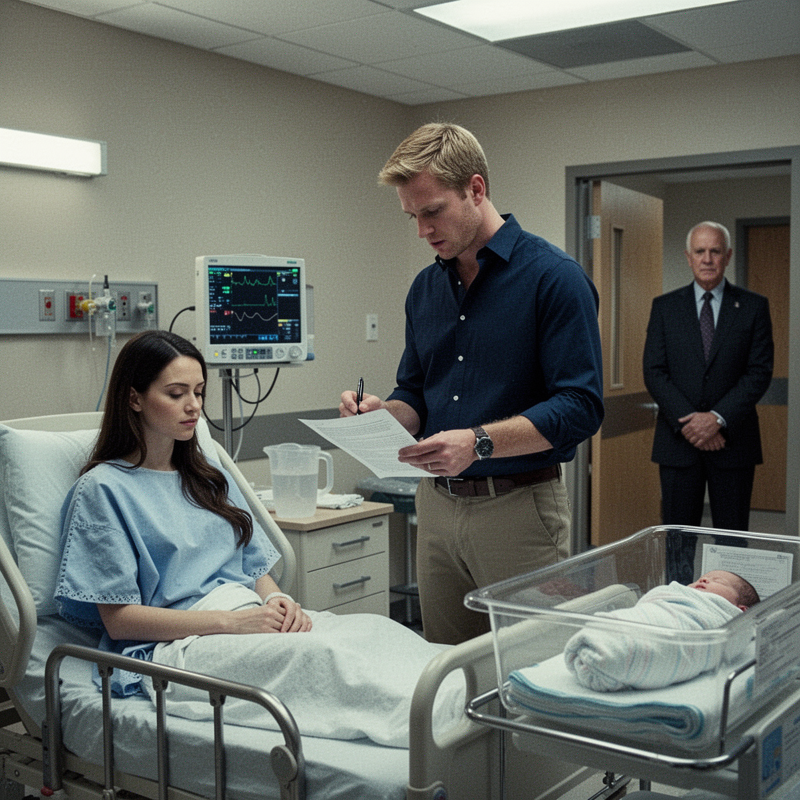
My husband walked into my hospital room two hours after I gave birth to our baby daughter and handed me a pen.
He told me his uncle had already drawn up the divorce papers because the Driscoll estate required a male heir, and his new girlfriend was already three months pregnant with his son.
His uncle Harlan stood in the doorway and warned me that if I didn’t take my baby and leave their mountain property by midnight, they would cut off my medical coverage and freeze my accounts.
I didn’t scream or fight; I simply signed the single document confirming I received the petition.
What neither of them knew was that before I became a mother, I spent six years as a military signal intelligence technician.
***
The ink on the document felt cold beneath my fingertips. My signature, small and neat, appeared shockingly normal next to the official script.
Greg Driscoll, my husband of three years, avoided my gaze. He fidgeted with the cuff of his shirt, a fresh wrinkle already forming between his brows.
He looked like a child caught stealing cookies. A child who had just shattered my life into a million pieces.
Uncle Harlan Driscoll, however, did not fidget. He stood by the door, a solid, unyielding block of granite in his tailored suit. His eyes, the color of flint, swept over the pristine hospital room, dismissing it with a glance.
They landed on the bassinet beside my bed. Our daughter, less than a day old, was sleeping soundly, a tiny fist tucked under her chin.
Harlan’s lips thinned.
“The papers are clear, Nora,” he said, his voice a low growl that carried no warmth. “You acknowledge receipt. That’s all that’s required.”
He didn’t wait for a reply. He never did.
“A car will be here by eight,” Harlan continued. “Your brother, Mark, will meet you at his cabin.”
He paused, letting his words hang heavy in the air. The fluorescent lights of the hospital room hummed overhead, a sterile contrast to the raw emotions simmering beneath the surface.
“By midnight, you and the child must be off all Driscoll land. Any delay, any attempt to contact Greg, or any… complications, and your medical coverage vanishes. Your accounts will be frozen.”
A nurse, a kind woman named Brenda who had helped me through labor, entered the room, pushing a cart with a fresh water pitcher. Her cheerful demeanor faltered the moment she saw Harlan. Her eyes darted to Greg, then to me, a flicker of concern shadowing her face.
“Everything alright in here?” she asked, her voice a little too bright.
Harlan offered her a chillingly polite smile. “Perfectly, thank you, nurse. Just some family matters being settled.”
Brenda hesitated, then simply nodded, placing the pitcher on the nightstand before quietly excusing herself. She avoided my eyes as she left.
Greg finally spoke, his voice thin. “Nora, you understand, it’s for the best. The estate… the trust…”
I looked at him then, truly looked at him. The man I had loved, the man who had promised me a future. He was a hollow shell, filled only with his uncle’s fear.
“I understand, Greg,” I said, my voice barely a whisper. I focused on the tiny rise and fall of my daughter’s chest in the bassinet.
“Good,” Harlan said, stepping back from the doorway. “Consider this your final notice.”
He turned and left, his footsteps echoing down the sterile corridor. Greg lingered for a moment, a pathetic tableau of indecision. He opened his mouth, then closed it. His gaze landed on our daughter again, a fleeting flicker of something that might have been regret, before he, too, turned and scurried out, avoiding eye contact completely.
I was alone, a fresh mother, clutching a divorce petition in one hand, my infant daughter sleeping beside me.
The discharge process was disturbingly efficient. It felt less like being released from a hospital and more like being ejected. The nurses moved with a quiet urgency, wrapping my daughter, swaddling her tightly. They avoided any personal conversation, their professional distance palpable.
Within an hour, a dark SUV was waiting outside the hospital entrance. Mark, my older brother, was leaning against the passenger door, his arms crossed, a grim expression on his face. He nodded tersely at the driver, a burly man I didn’t recognize, but whose watchful eyes told me he was likely one of Harlan’s enforcers.
“You okay, kid?” Mark asked, taking my small overnight bag and sliding his arm around my shoulder as I was helped into the back seat, my daughter nestled securely in her car seat beside me.
I just nodded, pressing my cheek against hers. She smelled of milk and newness.
The drive to Mark’s cabin was long, winding through the darkening timberlands that made up the vast Driscoll estate. Each pine tree, each patch of darkened earth, now felt like a prison wall rather than a familiar landscape. The forest pressed in, vast and silent, as the last rays of twilight faded.
Mark’s cabin was deep in the woods, remote and unyielding. It was a rustic structure, more suited for hunting season than for a new mother and her infant. The air inside was cold, carrying the faint scent of pine and stale woodsmoke.
He immediately built a fire in the stone hearth, the crackling flames throwing dancing shadows across the rough-hewn walls. He knew I needed to get our daughter settled and warm.
“I’ll boil some water for the bottles,” Mark said, his voice gruff with concern. He kept glancing at me, his brow furrowed. “Don’t worry about anything else. Just focus on her.”
I placed my daughter in the portable bassinet Mark had hastily borrowed, watching her sleep. She was so small, so innocent. This wasn’t the life I had planned for her. This wasn’t the welcoming, safe home she deserved.
My fingers brushed against the fabric of her tiny blanket, a gift from my mother before she passed. A warmth spread through me, firming my resolve.
Harlan Driscoll had made a catastrophic error in assuming I was just a housewife, easily cowed. He didn’t know the six years I spent in military intelligence had taught me how to operate in the shadows, how to find the cracks in any system.
Once my daughter was sound asleep and the fire was roaring, I walked over to the old military-issue footlocker that Mark had hauled out of his shed for me. It was scarred and dented, a relic from my past.
I flipped open the heavy latches. Inside, nestled amongst my old field gear, was my real arsenal: a collection of custom-built radio tuners, digital forensics hardware, and a hardened laptop loaded with proprietary signal analysis software.
My fingers, though still a little stiff from the delivery, moved with practiced ease. I connected the laptop to a small, directional antenna I’d modified years ago, then plugged in a USB-enabled frequency scanner.
The small screen flickered to life, displaying a complex web of radio waves, digital packets, and network traffic. The forest around Mark’s cabin might have felt isolated, but it was still crisscrossed by invisible highways of data.
I started by mapping the local cellular towers, honing in on the frequencies Greg’s phone would use. It wasn’t about intercepting live calls; that was too risky and often encrypted. It was about finding the ghost in the machine: the digital footprint he left behind.
I targeted the cloud backup services Greg used. He was sloppy with his security, always had been. A few keystrokes, a familiar brute-force algorithm I’d written myself years ago, and the system began to probe his account.
Minutes stretched into an hour. The only sounds in the cabin were the crackling fire, my daughter’s soft breaths, and the low hum of my equipment.
Then, a ping. A connection.
I bypassed the two-factor authentication, diving deep into his archived data. Scrolling through years of photos, emails, and forgotten documents, my eyes scanned for anything out of place. Anything Harlan Driscoll wouldn’t want me to see.
It took another half-hour. My eyes were burning, but I pressed on. Then, nestled within a folder cryptically labeled “Timber Projections_2024,” I found it.
An encrypted file. Greg was too lazy to encrypt anything himself. Harlan must have sent it to him.
I ran my decryption tool, the processor whirring, lights blinking on the external hard drive. The progress bar crawled. It felt like an eternity.
Finally, the file unlocked. My breath hitched.
It wasn’t a timber projection. It was a series of deleted text messages. A thread between Greg and Harlan. My eyes raced through the cold, stark language. The messages laid bare a meticulously orchestrated plan, detailing how Harlan had forced Greg to initiate the divorce.
Not for an heir.
But because Harlan held undeniable leverage over Greg. He had fabricated and filed a series of forged gambling debt liens against Greg’s assets, threatening to bankrupt him entirely and cut him out of the Driscoll trust forever if he didn’t comply.
Part 2
My stomach clenched. So that was it. Not an heir, but a weapon. Harlan didn’t want a grandson; he wanted control. He wanted to break Greg and remold him into his image.
But something about it still felt incomplete. Harlan was too thorough for just one layer of manipulation. The urgency, the demand for an heir—it didn’t quite line up with mere financial leverage.
I kept digging, pushing deeper into Greg’s archived data. My fingers flew across the keyboard, bypassing hidden folders, unearthing fragmented files. If there was one secret, there were likely others.
I cross-referenced common contacts, searching for unusual patterns. A name kept appearing in deleted call logs and email fragments: Silas Finch.
Silas Finch. The insurance adjuster who had handled Greg’s minor workplace injury claim about a year ago. Why would Greg be in such frequent, yet entirely deleted, contact with him now? And why would Harlan have any interest in their communication?
It took another stretch of intense focus, but my system finally pulled another thread from the digital ether. A new series of text messages, explicitly marked “deleted” by Greg, began to reconstruct on the screen.
They were dated roughly fourteen months ago, stretching over a week. The conversation was between Greg and Silas Finch.
My eyes narrowed as I scanned the content. It wasn’t about a workplace injury. It was about *after* the injury. Finch was discussing “recovery protocols” and “medical clearances.”
Then I saw it. Attached to one of Finch’s messages was a scanned hospital release form. It detailed a surgical procedure.
A vasectomy. Permanent. Dated exactly fourteen months ago.
My mind reeled, trying to process the information. Tessa was three months pregnant with Greg’s “son.”
But according to these records, it was impossible. The baby couldn’t possibly be Greg’s.
CHAPTER 2: The Adjuster’s Shadow
Mark pulled his laptop closer to the oil lamp on the kitchen table. The glow reflected off his tired eyes as he stared at the extracted message thread.
“Look at this notary stamp on the hospital release form,” Mark said, pointing a thick finger at the screen. “It isn’t a state medical clerk’s mark.”
I leaned over his shoulder, holding my two-day-old baby girl tight against my chest. Her gentle breathing was the only quiet sound in the cold room.
“That serial number matches Silas Finch,” I said. “He’s the independent land and insurance adjuster Harlan keeps on his payroll.”
“Finch stamped a clinical vasectomy record himself?” Mark asked, turning to look at me. “Why would an insurance adjuster forge medical filing stamps for your husband?”
“To keep the procedure off the state database,” I replied. “If the state doesn’t record the vasectomy, the trust auditors don’t flag Greg as sterile.”
I walked over to my signal rig on the workbench. I plugged in the shortwave scanner, dialing the low-frequency band used by local private security channels in the valley.
Static hummed through the small speaker before a voice broke through clear and sharp.
“Unit Four, Finch just pulled out of the apartment complex on Elm,” a voice crackled through the speaker. “He was inside for two hours again.”
Mark froze. “Elm Street? That’s where Greg rented the apartment for Tessa.”
I checked the time stamp on the radio log. It was 11:42 PM.
“Silas Finch isn’t just covering up Greg’s procedure,” I said, setting the receiver down on the raw wood. “He’s been visiting Tessa late at night every week for the last four months.”
Mark looked at the text logs on his screen, then back at me. “The unborn child isn’t Greg’s.”
“No,” I said. “It’s Silas Finch’s baby.”
“Greg is taking the fall for another man’s child just to help Harlan trigger the heir clause,” Mark muttered, slamming his hand on the wooden table.
“They think I’m sitting in this cabin crying over a broken marriage,” I said softly, adjusting the blanket around my daughter. “They don’t realize they left their entire digital paper trail wide open.”
CHAPTER 3: Darkness in the Pines
At 2:15 AM, the soft hum of the cabin’s refrigerator suddenly died.
The overhead battery light flickered once and went dark. Outside, the whine of a chainsaw echoed through the frozen pines, followed by a heavy crash against the snow-covered ground.
Mark grabbed his flashlight and stepped to the window. “They took down the utility pole at the main road. The line is completely dead.”
I walked to the sink and turned the brass handle. A dry hiss came out of the faucet.
“They severed the well-pump line too,” I said.
The temperature inside the cabin was already dropping. I wrapped my baby in two heavy wool blankets and secured her in the chest carrier against my body heat.
My phone screen lit up on the counter. An unknown number flashed across the glass.
I pressed speaker.
“You look cold out there, Nora,” Uncle Harlan’s gravelly voice came through the speaker.
“The power line didn’t fall on its own, Harlan,” I said flatly.
“It’s a rough winter on the ridge,” Harlan replied, his tone slow and mocking. “A newborn baby can’t survive long in a cabin without heat or water. It would be a shame if someone tipped off Child Protective Services about unfit living conditions before sunrise.”
Mark stepped toward the phone, his knuckles white, but I held up a hand to stop him.
“You have until six in the morning to hand over the baby,” Harlan continued. “Surrender custody to Greg, and we’ll let you sign a full release for the mountain property.”
“I have two solar battery banks hooked directly to my signal array,” I said into the microphone. “And I’m recording this call.”
“Record whatever you want,” Harlan sneered. “In this county, my word is the law. You’re a hysterical mother freezing in the dark.”
He hung up. The line went dead.
I didn’t panic. I walked to the corner of the room, flipped the toggle switch on my auxiliary battery array, and watched the digital green numbers light up the dark.
“Get the backup propane heater,” I told Mark. “We’re not leaving.”
CHAPTER 4: The Unlikely Signal
By 4:00 AM, the wind was howling through the pine trees outside.
I sat at the shortwave radio, tuning through the emergency frequencies to check local weather reports. As I swept past 146.520 MHz, a sharp voice cut through the static.
“Unidentified station on the ridge, do you copy? This is Karen Ruiz.”
I grabbed the hand mic and pressed the button. “This is Nora. Who is this?”
“I’m a reporter with the County Sentinel,” the voice replied, fighting through heavy interference. “I’ve been monitoring Harlan Driscoll’s private security channels. I heard him cut your utility grid.”
“Why are you monitoring Harlan?” I asked, my voice cautious.
“Because I’ve been investigating his timber company for eight months,” Karen said. “Harlan’s holding company, Driscoll Timber Limited, is $4 million in debt to an offshore creditor. The loan defaults in thirty days.”
I leaned closer to the microphone. “He needs the trust payout.”
“Exactly,” Karen confirmed. “The $10 million family trust is his only way out. But the trust rules state that if Greg doesn’t have a verified male heir by his thirtieth birthday, the funds revert to a federal conservatorship.”
“That’s why he pushed Greg to divorce me the moment I gave birth to a daughter,” I said.
“Yes,” Karen replied. “He needs Tessa’s pregnancy verified and Greg named as the legal father before bank auditors arrive on Friday.”
“The baby isn’t Greg’s,” I told her. “I have proof that Greg had a vasectomy fourteen months ago, and the real father is his insurance adjuster, Silas Finch.”
There was a long pause on the radio line.
“If you have proof of that,” Karen said, her voice dropping an octave, “you don’t just have a divorce dispute. You have a massive commercial fraud case.”
“I have the raw data,” I said. “Where are you?”
“I’m at my desk in town,” Karen said. “Keep your receiver on this frequency. Harlan doesn’t know I’m listening.”
CHAPTER 5: The Encrypted Signature
Mark set two cups of steaming instant coffee on the table beside my paper files.
“We have the text logs,” Mark said. “But Harlan’s lawyers already filed the divorce petition with the county clerk first thing yesterday morning.”
“They think they filed a valid document,” I said, reaching into my canvas bag for the paper receipt I had signed in the hospital room.
I laid the white slip of paper under the desktop magnifying lamp.
“Look closely at the signature line,” I said, pointing to the fine black ink where my name was written.
Mark leaned down, squinting at the paper. “It looks like your normal signature.”
“Look at the tail end of the ‘a’ in Nora,” I said. “I didn’t draw a smooth line. I used micro-steganography. It’s a technique we used in signal tech to embed data into visual physical marks.”
“What did you write?” Mark asked.
“It’s a series of alternating dot-dash micro-strokes,” I explained. “It spells out a seven-digit military status code indicating the document was signed under active physical duress.”
“Does a county judge even know what that means?” Mark asked, tilting his head.
“The county judge doesn’t,” I said. “But the Federal Land and Title Registry does. Any document flagged with a verified military duress code automatically suspends land transfer title updates for ninety days under federal property laws.”
Mark stared at the tiny marks on the paper, a slow smile spreading across his face.
“Harlan thinks he owns this cabin and the land under it right now,” Mark said.
“He filed the paper to seize the property,” I said, standing up from the chair. “But the moment his lawyer uploads that scanned receipt to the state portal, the federal system will freeze the land transfer automatically.”
“He trapped himself,” Mark said.
“He thinks he’s playing local politics,” I replied. “He doesn’t know he’s dealing with federal signal protocols.”
CHAPTER 6: The Gaslight Strategy
At 1:15 AM the following night, bright red and blue lights flashed across the cabin walls.
A heavy knock rattled the front door frame. Mark opened it slowly, keeping his hand near his belt.
Sheriff Bob Lawson stood on the porch, flanked by two armed deputies. He didn’t take off his hat or wipe the snow from his boots as he stepped straight into the living room.
“Got a distress call from your uncle, Nora,” Lawson said, looking around the dark room with a smirk. “He’s worried about your mental state.”
“I’m perfectly fine, Sheriff,” I said, staying seated beside my baby’s crib.
Lawson walked over to the kitchen counter, casually tapping his fingers on my notebook.
“Harlan says you’ve been hallucinating phone calls,” Lawson said. “Says you’re suffering from severe postpartum psychosis and refusing to feed the baby.”
He reached into his jacket pocket and dropped a heavy amber prescription bottle onto the counter. The printed label bore my name and listed a high-dose anti-psychotic medication.
“I’ve never taken that medication in my life,” I said, my voice steady.
“Well, it’s sitting right here on your kitchen counter, signed by a doctor,” Lawson said, tapping the bottle with his thumb. “Looks to me like you’re not in a stable mind to care for an infant.”
“You planted that,” Mark stepped forward, his voice low and dangerous.
Lawson put a hand on his holster. “Watch your tone, son. I’m filing an emergency psychiatric affidavit with the county clerk in the morning.”
“You do that,” I said, looking Lawson dead in the eye. “And I’ll release the audio recording of you walking in here without a search warrant and setting that bottle on my counter.”
Lawson froze, his eyes darting to the small black microphone clipped to the underside of my shelf.
“You’re playing a dangerous game, girl,” Lawson growled, backing toward the doorway.
“Get off my property, Sheriff,” I said.
Lawson stared at me for three long seconds before turning on his heel and walking out into the freezing night.
CHAPTER 7: Deep Archives
By morning, the sun rose over a thick blanket of ice.
I sat at the computer terminal, running a deep file-carving algorithm across Greg’s secondary cloud backup folder. The recovery bar slowly ticked up to ninety-eight percent.
A new folder popped open on the screen, labeled with a simple job number from six months ago.
“Mark, come look at this,” I called out.
Mark walked over, holding a bowl of warm soup. “What did you pull up?”
“It’s a direct message log between Greg and Tessa from three months before she got pregnant,” I said, opening the text thread.
I clicked on the first image file. It was a picture of a hand-written agreement signed by Greg and Tessa.
“Read paragraph two,” I said, pointing to the screen.
“I, Greg Driscoll, acknowledge that I am physically incapable of biological fatherhood,” Mark read aloud. “I agree to acknowledge Tessa Albright’s child as my legal heir in exchange for $500,000 cash upon trust distribution.”
Mark took a sharp breath. “Greg knew he was sterile the entire time.”
“He wasn’t just being tricked by Tessa,” I said. “He was an active accomplice in the fraud. He needed the $500,000 to clear his own secret gambling debts in Nevada.”
“And Harlan?” Mark asked.
I scrolled down to the next text message from Greg to Tessa.
*Harlan set up the deal with Finch,* the text message read. *Just go along with the medical visits. Once the trust pays out $10M, we all get paid.*
“It’s a full conspiracy,” Mark whispered. “Harlan, Greg, Silas Finch, and Tessa.”
“They didn’t just break civil trust laws,” I said, backing up the entire thread to an encrypted flash drive. “This is felony wire fraud and commercial conspiracy.”
“We have them,” Mark said.
“Not yet,” I replied. “We need to make sure Silas Finch breaks before Harlan realizes we have these logs.”
CHAPTER 8: Blackout on the Wire
At noon, a loud honk echoed from the snow-covered driveway.
A beat-up blue sedan spun its wheels in the snow before coming to a stop near the porch. Karen Ruiz stepped out, wearing a heavy winter coat and carrying two oversized black hard drive cases.
“Harlan just bought my newspaper,” Karen said, stepping inside and kicking the snow off her boots.
“He bought the Sentinel?” Mark asked, closing the door behind her.
“His holding company bought controlling shares at nine o’clock this morning,” Karen said, setting the hard drive cases on the table. “By nine-thirty, the publisher spiked my fraud article and handed me a termination notice.”
“He’s closing every hole he can find,” I said.
“He thinks he killed the story,” Karen said, pulling a laptop from her bag. “He doesn’t know I pulled all the raw research off the newspaper server before they revoked my login access.”
She flipped open her laptop and pulled up a land map of the county forest reserves.
“Look at this plot,” Karen said, pointing to a highlighted red zone bordering the Driscoll land. “Harlan claims this 5,000-acre section is prime timber. But my environmental reports show the soil is heavily contaminated with industrial runoff.”
“He’s overvaluing the land to inflate the trust assets,” I observed.
“Worse,” Karen said. “He’s planning to sell the contaminated land to an offshore mining group the moment he gets full control of the trust. If that sale goes through, the local water table will be ruined within two years.”
“He’s desperate for that $10 million,” I said.
“He’s so desperate he’s throwing money at everything that moves,” Karen said, looking at my baby sleeping peacefully in her basket. “He thinks shutting down the newspaper stops me. I drove straight here to work with you directly.”
“Good,” I said, pulling an extra network cable from my tool kit. “Let’s hook your drives into my secure server.”
CHAPTER 9: The Satellite Clone
By 8:00 PM, the wind picked up again, rattling the iron chimney pipe.
I stood on a wooden chair, positioning a high-gain directional antenna toward the mountain peak where Harlan’s private estate sat three miles away.
“Are you getting a signal lock?” Mark asked, watching the signal-strength bar on my monitor.
“I have his satellite link,” I said, tapping the keyboard. “Harlan uses an encrypted satellite phone system because the local cell towers are unreliable up here.”
The screen flashed red, then green as my decryption script bypassed his weak network handshake.
Audio crackled through my headphones, filling the quiet cabin.
“…the buyers are coming from London on Friday,” Harlan’s voice echoed clearly from the speakers. “They’re bringing the final land purchase contracts for $12 million.”
“What about the bank auditors?” a second voice asked—Harlan’s corporate attorney.
“The auditors will clear the trust release the moment Greg presents the certified heir documents at the gala reception,” Harlan replied. “Silas Finch registered the paternity form this morning.”
“Is Silas clean?” the attorney asked.
“Finch is an idiot,” Harlan sneered over the line. “He thinks he’s getting a cut of the payout. The moment the land deal closes and the money hits my offshore account, we’re dumping all the tax liability and insurance fraud onto Finch’s desk. Let the feds arrest him.”
I hit the record button, saving the uncompressed audio file to my primary server.
Mark looked at me, his eyes wide. “Harlan is setting up Silas Finch to take the fall for the whole operation.”
“Finch doesn’t know it yet,” I said, pulling up my untraceable burn phone service on the screen. “In ten minutes, he will.”
CHAPTER 10: Flipping the Adjuster
Twenty minutes later, Silas Finch sat in his parked SUV near the county courthouse, tapping his fingers nervously on the steering wheel.
His phone chimed with an incoming text notification from an unknown, encrypted number.
Attached was a ten-second audio file.
Finch pressed play. Harlan’s voice rang through his car speakers: *”We’re dumping all the tax liability and insurance fraud onto Finch’s desk. Let the feds arrest him.”*
A second later, I called the number directly. Finch answered on the first ring, his breathing fast and ragged.
“Who is this?” Finch demanded, his voice shaking.
“It doesn’t matter who I am, Silas,” I said, using a digital voice modulator. “What matters is that Uncle Harlan is selling the Driscoll timberland on Friday and setting you up as the sole architect of the insurance fraud.”
“That’s a lie,” Finch stammered. “Harlan promised me twenty percent of the trust distribution!”
“You’re not getting twenty percent,” I said calmly. “You’re getting twenty years in federal prison for forging notary stamps on medical records and falsifying paternity claims.”
“Who gave you this audio?” Finch yelled into the phone.
“I have the audio, I have Greg’s vasectomy records, and I have the text logs between you and Tessa,” I said. “When federal auditors arrive at the Driscoll estate on Friday, every piece of this evidence goes to them.”
Silence stretched over the line for five long seconds.
“What do you want?” Finch whispered.
“I want a full, written, signed confession detailing every illegal order Harlan gave you,” I told him. “And I want it notarized by an independent state official, not yourself.”
“If I sign that, I go to prison too!” Finch panicked.
“You sign it, and I withhold your offshore banking details from federal prosecutors,” I said. “You take a plea deal for fraud instead of serving a life sentence for racketeering. You have twelve hours to decide.”
I ended the call before he could reply.
CHAPTER 11: Emergency Warrants
At 7:00 AM on Thursday morning, Mark was looking through the front window scanner.
“Nora, we have three county patrol vehicles coming up the lower ridge trail,” Mark said, racking the slide on his hunting rifle. “Lawson is leading them.”
I walked to the desk monitor. Lawson’s squad car was navigating the deep snow, accompanied by two unmarked SUVs.
“He obtained an ex-parte emergency child welfare warrant,” Karen said, looking at her laptop screen. “Harlan’s judge signed it thirty minutes ago without a hearing.”
“They’re coming to take my daughter,” I said, my voice dropping into a cold, focused calm.
“We can’t fight three armed deputies with guns,” Mark said, staying behind the heavy wooden door frame. “Lawson is looking for an excuse to open fire.”
“We’re not shooting at deputies,” I said, plugging a high-frequency transmitter unit into my signal rig. “We’re going to shut down his command structure.”
I tuned the transmitter frequency to 155.370 MHz—the primary dispatch channel for the entire county sheriff’s department.
“Karen, hand me the voice notes we pulled from Lawson’s phone last night,” I said.
I patched the digital audio cable directly into the transmitter’s mic input.
“What are you doing?” Karen asked, her eyes bright with realization.
“Lawson relies on the county repeater system to communicate with state police,” I said, flipping the power amplifier switch to maximum output. “I’m about to broadcast his private corruption files across every emergency channel in the district.”
I hit the red broadcast switch.
CHAPTER 12: Frequency Hijack
Outside, Sheriff Lawson pulled his squad car to a stop fifty yards from the cabin door. He stepped out, raising a bullhorn to his mouth.
“Nora Driscoll! Step outside with your hands visible!” Lawson shouted across the snow. “We have a court order to take custody of the child!”
Before he could finish his sentence, his radio unit burst into high-volume static.
Then, a clear, unedited audio recording of Lawson’s voice blasted out from his squad car speaker, echoing across the valley.
*”…Harlan offered fifty grand to make sure Nora loses custody before the audit,”* Lawson’s recorded voice echoed clearly through the cold air. *”…I’ll file the fake psychiatric paper tomorrow morning.”*
The two deputies standing beside Lawson froze, staring at their sheriff in shock.
“Turn that off!” Lawson screamed, grabbing at his radio belt. “Turn it off!”
The broadcast didn’t stop. I routed the signal through the state police emergency repeater network. Down in the valley, state troopers on highway patrol were listening to the exact same audio feed over their dispatch radios.
“Unit 4 to Dispatch, do you copy?” a state trooper’s voice suddenly cut in over the open frequency. “We are monitoring a corruption broadcast involving Sheriff Lawson. All units hold your position.”
Lawson’s face turned white as snow. He looked up at the cabin roof, spotting my high-power transmission antenna humming in the cold air.
“She’s broadcasting to the state police,” one deputy muttered, stepping back toward his vehicle. “I’m not getting involved in this.”
“Get back here!” Lawson yelled, but the deputy shook his head, got back into his cruiser, and put it in reverse.
Lawson stared at the cabin door for one long moment, his hands shaking, before slamming his truck door shut and speeding back down the mountain trail.
CHAPTER 13: The Written Confession
At 3:00 PM, Karen met Silas Finch at an abandoned logging staging area two miles down the valley.
Snow was falling heavily as Finch stepped out of his car, holding a thick manila envelope against his chest. He looked around nervously, his eyes darting toward the dense pine trees.
“Is Nora here?” Finch asked, his voice trembling.
“She’s at the cabin,” Karen said, standing by the trunk of her car. “I’m taking the document.”
Finch unsealed the envelope and handed a four-page handwritten document to Karen.
“Everything is in there,” Finch said, wiping cold sweat from his forehead. “I detailed how Harlan forced me to forge the notary marks on Greg’s vasectomy papers. I included dates, financial transaction logs, and the offshore account numbers Harlan used to pay me.”
Karen flipped through the pages under the interior car light. Each page was signed in blue ink and bore an official state notary seal from an independent bank officer in the next county over.
“And Tessa’s baby?” Karen asked, looking up.
“It’s mine,” Finch admitted, looking down at the snow. “Greg was never involved with her biologically. Harlan paid Tessa $100,000 upfront to pretend Greg was the father so they could present a male heir to the bank auditors.”
“You’re testifying to all of this if the federal prosecutor calls you?” Karen pressed.
“I don’t have a choice,” Finch said bitterly. “Harlan was going to leave me penniless in a federal prison. Just make sure Nora keeps my name off the initial public news leak.”
“Nora keeps her promises,” Karen said, closing the car door. “As long as you don’t step foot near that estate before the audit.”
“I’m leaving the county tonight,” Finch said, turning back to his vehicle.
Karen drove back up the ridge, holding the four signed pages tightly in her hand.
CHAPTER 14: The Gala Infiltration
By 7:00 PM, the grand ballroom of the Driscoll Mountain Estate was lit with glittering crystal chandeliers.
Over one hundred guests—local politicians, timber executives, and legal representatives—filled the hall. At the main head table sat Harlan Driscoll, wearing a tailored black suit, flanked by Greg and a heavily pregnant Tessa.
Across from them sat three senior bank auditors from the state capital, holding leather-bound trust verification binders.
Outside in the dark tree line, three hundred yards from the estate gates, I sat in the back of Mark’s van, surrounded by glowing monitor screens.
“Karen is inside,” Mark whispered, watching a miniature camera feed hidden on Karen’s collar.
On screen, Karen was dressed in the black vest and white shirt of the estate’s hired catering staff. She carried a silver serving tray, moving smoothly through the crowd toward the head table.
“Harlan just called the lead auditor to the podium,” I said into my headset microphone. “They’re getting ready to sign the trust release forms.”
“I’m in position,” Karen’s low voice came through my earpiece.
“Wait until Harlan finishes his opening speech,” I instructed her. “When he hands the auditor the official trust binder, swap the inner document package.”
On my monitor, Harlan stepped up to the microphone, smiling warmly at the cheering crowd.
“Tonight, we secure the future of the Driscoll legacy,” Harlan announced into the microphone, his voice reverberating through the hall. “With my nephew Greg and his expectant wife providing a verified male heir, the $10 million Driscoll Family Trust will finally be released to oversee our mountain lands.”
The audience applauded. Harlan turned with a wide smile and picked up the heavy leather trust binder from the presentation table.
“Now,” I told Karen. “Do it now.”
CHAPTER 15: The Confession Delivered
Karen stepped smoothly beside the lead bank auditor, setting down a fresh glass of water.
As the auditor reached for his pen, Karen slipped Silas Finch’s notarized confession letter and the extracted text logs directly into the central sleeve of the trust binder, pulling out Harlan’s forged documents in one clean motion.
Harlan handed the binder to the lead auditor with a triumphant smile. “Sign on page three, sir, and the land transfer is official.”
The lead auditor opened the binder. He didn’t find the standard corporate forms.
He found four pages of signed handwritten confessions on state-notarized paper, accompanied by high-resolution printouts of Greg’s vasectomy records and text messages.
The auditor stopped. His smile vanished. He adjusted his reading glasses and read the first paragraph out loud.
“Statement of Silas Finch… I hereby certify that Greg Driscoll underwent a complete surgical vasectomy fourteen months ago, and the child carried by Tessa Albright is my biological offspring…”
A gasp ran through the front table.
Greg turned ghost white, grabbing the edge of the table. Tessa froze, dropping her glass onto the floor, where it shattered into dozens of pieces.
“What is the meaning of this?” the auditor demanded, looking up at Harlan with cold, sharp eyes.
Harlan’s smile turned into a snarling grimace. “That’s a fake! Some disgruntled ex-wife forged those papers!”
“Look at layer two,” I whispered into my mic.
The auditor turned to the second page of the attachment. It was an internal audit record from Harlan’s own accounting firm, showing Harlan had authorized a $100,000 wire transfer to Silas Finch six months prior under the header *Heir Verification Fee*.
“You knew he was sterile,” the auditor said, his voice ringing across the silent room. “You attempted to fraudulently trigger a $10 million trust release using a fabricated heir.”
“This gala is over!” Harlan yelled, reaching to grab the binder, but the auditor pulled it back out of his reach.
The auditor flipped to the final attached page—a certified copy of the original 1984 land registry deed.
“And layer three…” the auditor read, his eyes widening. “The original land title of the entire 5,000-acre Driscoll estate was never owned by Harlan Driscoll. The sole title holder was Nora Driscoll’s late father, transferred directly to his legal bloodline upon his passing.”
Harlan backed away from the podium, his face red with rage.
“Harlan Driscoll,” the auditor said firmly, closing the binder. “This trust is frozen, your land claims are void, and federal examiners are being notified immediately.”
CHAPTER 16: Fractured Lines
Within ten minutes, red and blue lights illuminated the long driveway of the Driscoll estate.
Four federal vehicles pulled up to the main entrance. Federal bank examiners and state investigators poured into the ballroom, holding asset freeze notices and federal search warrants.
Greg collapsed into a chair, crying openly, as two state troopers placed him in handcuffs.
“It was Harlan!” Greg screamed, pointing a shaking finger at his uncle. “He forced me to do it! He paid my gambling debts! I didn’t want any of this!”
“Shut up, you coward!” Harlan roared, backing toward the service door behind the stage.
Three private armed security guards dressed in tactical black gear stepped between Harlan and the approaching federal agents.
“Hold them right there,” one guard commanded, drawing his sidearm.
Gasps echoed through the ballroom as guests ducked beneath tables.
Harlan didn’t wait. He slipped through the heavy wooden service door and disappeared into the dark service hallway leading out to the rear forest trail.
“Nora!” Karen’s voice crackled through my headset. “Harlan escaped through the back with three armed guards! They took two snowmobiles and headed up the mountain toward your ridge!”
My heart hammered against my ribs. “He knows I have the original signal servers.”
“He’s coming to destroy the digital backups,” Mark said, reaching for his shotgun in the front seat. “We need to get back to the cabin now.”
“Federal agents are locking down the estate perimeter,” Karen reported. “But Harlan knows these woods better than anyone. He’s coming for you.”
“Let him come,” I said, sliding the van’s side door shut. “We’re going home.”
CHAPTER 17: The Unending Night
It was 11:45 PM on the exact same freezing evening.
The cabin was pitch black and bone-chilling cold. The power was still out, and the wind screamed through the surrounding pine trees like a dying animal.
I sat in the squeaking wooden rocking chair near the cold cast-iron stove, cradling my baby daughter inside my heavy wool coat.
Mark stood beside the frosted window, his shotgun resting on his shoulder, his shadow long and dark under the pale moonlight.
On the table beside me, my shortwave radio crackled with low static.
“Unit One, we have eyes on the cabin,” a harsh voice whispered through the radio speaker—one of Harlan’s private guards. “The van is parked in the drive. They’re inside.”
“Take out the server array first,” Harlan’s voice came back over the line, cold and unhinged. “Then burn the cabin to the ground. Leave no records behind.”
I didn’t tremble. I didn’t cry.
I slowly reached down with one hand, picked up my military-issue bolt-action rifle resting against the rocking chair, and pulled the bolt back.
A sharp, metallic *clack-clack* echoed through the dark, quiet room as a heavy brass round slid cleanly into the chamber.
The legal win at the gala had frozen his bank accounts and shattered his trust scheme, but legal victories didn’t stop armed men in the middle of a winter night three miles from the nearest paved road.
Out in the driveway, distant tires crunched softly against the packed snow and dry pine needles. A flashlight beam swept across the frosted glass of the front window.
I adjusted my baby’s blanket with my left arm, keeping her warm against my chest, while my right hand held the cold steel frame of the rifle steady against my shoulder.
The court papers meant nothing out here in the dark. Down in the valley, the lawyers would argue over asset transfers and land deeds tomorrow morning, but survival on this mountain was decided line by line, second by second.
They thought kicking me out into the dark would destroy me, but they forgot that the dark is where signal tech operators do their best work.
Leave a Reply